I. Introduction
In the series of experiments on the pathogenic features of the early-onset periodontitis(EOP), we have initially shown our attempts to revise the classi- cal forms of the EOP into the more homogeneous subsets1). The subsequent immunological studies in the EOP patients have clearly demonstrated the diversity of immunoglobulin(Ig)G subclass respons- es against Porphyromonas gingivalis(Pg) among the patients, the IgG2 and the IgG4 being most fre- quently found to be elevated2). The phenomenon together with the pronounced individual difference within the same EOP subform strongly necessitated the further studies for identifying the immunogenet- ic factors responsible for the different patterns of the IgG subclass responsiveness. It has been known that the IgG subclass levels in health and disease are under the genetic control, which again are antigen- specific and highly race-dependent3-16). For exam- ple, the IgG2 subclass levels, usually responding to the bacterial carbohydrate antigens, may be closely related to the Ig heavy-chain allotype markers(Gm)
or the light-chain allotype markers(Km)7,8), present in the patient serum. Several authors postulated the genetic predisposition of the patients with the allo- type markers to the certain kinds of systemic dis- eases17,18). Forms of the EOP have been thought to have familial tendencies and genetic predispositions14,15,19,20). Therefore, one might rea- son that the elevated IgG subclass levels against the bacterial antigen(s) in each EOP subform should be carefully reinterpreted in terms of the their function- al roles, the immunodominant antigen(s), and the immunogenetic aspects to comprehensively under- stand the immunopathogenic features of the EOP more. As there have not been enough informations on the EOP in these regards, we have screened the Gm markers of the EOP patients in association with the various IgG subclass responsiveness against Porphyromonas gingivalisreported in the previous studies2).
II. Materials and Methods
1. Selection of Study PatientsImmunogenetic Study on the IgG Subclass Responses in the Phenotypic Subsets of the Early-Onset Periodontitis
Jeom-Il Choi, Jun-Hong Kim, Mi-Hye Ha, Sung-Jo Kim
Research Center for Periodontal Disease, Department of Periodontology School of Dentistry, Pusan National University, Pusan, Korea
대한치주과학회지 : Vol. 29, No. 3, 1999
*The study has been supported in part by a grant from Korea Science Foundation (951-0705-094-2).
The patients who originally have been selected for measuring the antibody levels against Porphyromonas gingivalisin the previous study have been examined of their immunoglobulin allo- type markers21). The patients were consisted of 69 patients(61 patients from the four EOP subforms and 8 patients from the age-matched adults peri- odontitis) and 50 race and age-matched control sub- jects, respectively. The 69 EOP patients consisted of 3 from the subform I(distinctive localized juvenile periodontitis(LJP) pattern), 19 from the subform II(post-LJP pattern), 15 from the subform III(local- ized but rapidly progressing pattern), and 24 from the subform IV(distinctive rapidly progressing peri- odontitis(RPP) pattern), respectively.
2. Determination of the Immunoglobulin Allotype Markers(Gm Types)
The following allotype markers have been identi- fied by the hemagglutination inhibition assay according to the method described by van Loghem et al.7), and others16,18); G1m(a), G1m(x), G1m(f), G2m(n), G3m(g), G3m(b) including b0b1b3b5, G3m(s), G3m(t). Gm system consisted of anti-Gm
agglutinators and red blood cells coated with Gm(+) anti-Rho antibodies. Anti-Rho antibodies were used as the coating antigens of red blood cells, except for G2m(n) where erythrocytes were coated with myeloma proteins. Nine phenotypes observed among the Koreans fell into the four Gm haplo- types. Frequency distributions of the observed four halpotypes among the four EOP subforms were evaluated. Based upon the data from the measure- ment of the IgG subclass levels of each patient in the previous study2), we also made an attempt to correlate these patterns of the elevated IgG subclass antibodies with the Gm phenotypes.
3. Statistical Management of the Data
A Chi-square test has been performed to seek the differences in the observed frequencies of each hap- lotype between the EOP subforms or adult peri- odontitis and the control group.
III. Results
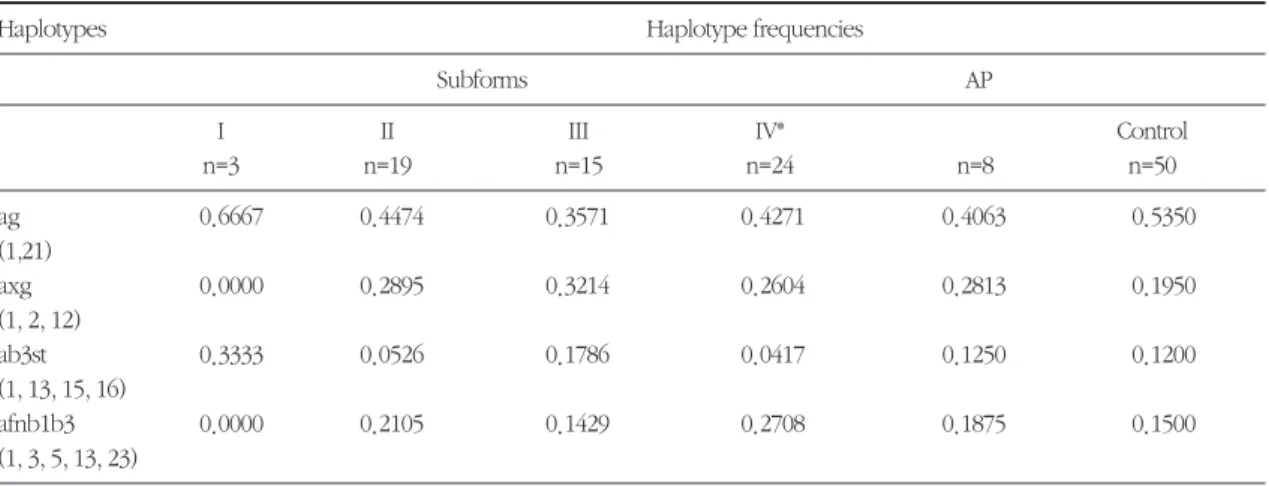
Table 1 summaries the Gm haplotype frequencies observed in the patients with the four EOP sub- Table 1. The haplotype frequencies of the various immunoglobulin allotypes observed in the patients with four subforms of
EOP, age-matched adult periodontitis(AP) and the age-matched control subjects
Haplotypes Haplotype frequencies
Subforms AP
I II III IV* Control
n=3 n=19 n=15 n=24 n=8 n=50
ag 0.6667 0.4474 0.3571 0.4271 0.4063 0.5350
(1,21)
axg 0.0000 0.2895 0.3214 0.2604 0.2813 0.1950
(1, 2, 12)
ab3st 0.3333 0.0526 0.1786 0.0417 0.1250 0.1200
(1, 13, 15, 16)
afnb1b3 0.0000 0.2105 0.1429 0.2708 0.1875 0.1500
(1, 3, 5, 13, 23)
* significantly different from the control group in the four Gm haplotypes by Chi-square analysis (df=3, 2=9.589, p<0.05)
Table 2. Serum IgG subclass titers to Pg in G2m(n)-positive and G2m(n)-negative patients(means±s.d.)
G2m(n+) G2m(n-)
IgG subclass n=21 n=39
IgG1 413.1±502.0* 141.6±284.0
IgG2 614.4±626.5* 241.3±247.0
IgG3 67.0±164.2 82.9±142.7
IgG4 865.6±1563.5** 331.0±324.9
* significantly higher(p<0.01)
** significantly higher(p<0.05)
Table 3. Association of the Gm phenotypes and the patterns of the elevated lgG subclasses to Porphyromonas gingivalis in the four EOP subforms
EOP Subforms
Subclasses I II III IV Total
1 only 0 2 2 0 4
(axg,agfnb) (axg,axgb3st)
1+2 0 0 0 2 2
(all agfnb)
1+3 0 0 0 0 0
1+4 0 0 1 0 1
(agb3st)
1+2+3 0 1 0 0 1
(agb3st)
1+2+4 0 3 3 6 12
(2agfnb, 1axgfnb) (all agfnb) (5agfnb, 1axgfnb)
1+3+4 0 0 0 0 0
1+2+3+4 0 2 1 1 4
(agfnb, axg) (agfnb) (agfnb)
2 only 0 1 1 5 7
(axg) (axgb3st) (2agfnb, ag, axg, agb3st)
2+3 0 0 0 0 0
2+4 0 1 3 2 6
(ag) (2agb3st, ag) (agfnb, axg)
2+3+4 2 1 3 0 6
(all agb3st) (ag) (2axg, axgb3st)
3 only 0 0 0 0 0
3+4 0 0 0 0 0
4 only 1 5 0 4 10
(agb3st) (axgfnb, ag, axg, agfnb, agb3st) (3ag, 1axgfnb)
No elevations 0 3 1 4 8
Total 3 19 15 24 61
forms, the adult periodontitis and the race- and the age-matched control. The four Gm haplotype were significantly different in subform IV from the control groups(p< 0.05, chi-square test) in observed fre- quencies. In the subform I, the haplotype agb3st demonstrated the high observed frequency. As the haplotype G2m(n) is always associated with G1m(f) and G3m(b) in the mongolian populations8), (per- sonal communication with Dr. Hideo Matsumoto, Osaka Medical University, Japan), the haplotype Gm(f,n,b) has usually been designated as G2m(n) or G2m(23). The G2m(n)-positive patients were sig- nificantly elevated in this group compared with the control subjects.
The mean IgG2 levels in the G2m(n) positive patients as a whole were significantly higher than in the patients without G2m(n)(p< 0.01, Table 2).
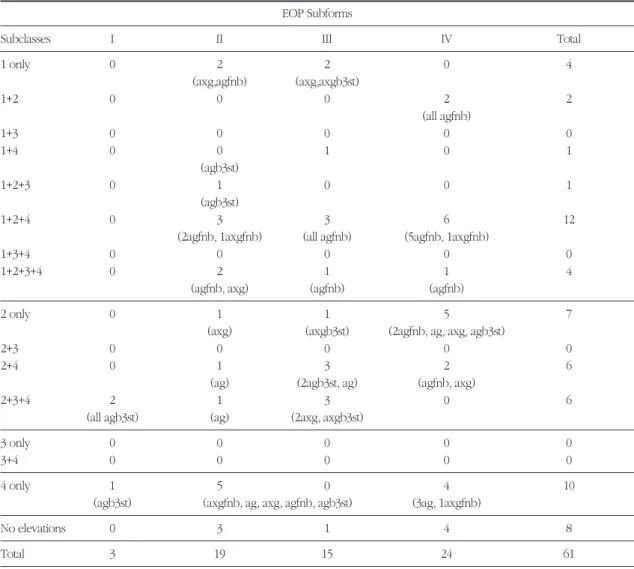
Moreover, both the mean IgG4 and IgG1 levels also were significantly higher in the G2m(n) positive group(p< 0.05, Table 2). When the various patterns of elevated IgG subclasses were correlated with the Gm phenotypes, the patients demonstrating the pat- terns of combined IgG1+2+4 or combined IgG1+2 consistently had had either the Gm phenotypes agfnb or axgfnb both of which were expressed posi- tively for the haptotype G2m(n)(Table 3).
IV. Discussion
This probably would be the fast report on the genetic predisposition of the EOP subform IV(dis- tinctive rapidly progressing periodontitis pattern) based on the observed frequencies of the Gm hap- lotypes. We were unable to find the similar results in the other subforms and the adult periodontitis. In the subform I, the haplotype ab3st demonstrated the high observed frequency. However due to the very small sample size, we were unable to make any conclusion and hence we are currently under the
study using the large numbers of the serum sam- ples. The association of Gm types with the systemic diseases have extensively been studied17,18).
We could clearly demonstrate the elevated IgG2 levels in the patients who were positive for the genetic marker, G2m(n). This indicated that the IgG subclass response to the bacterial antigen(s) are under the immunogenetic control, which might explain for the diverse patterns in the IgG subclass responsiveness among the patients within the same disease phenotypes. This may further explain the different result among races in these regards report- ed by the authors22,23). The IgG4 as well as the IgG1 levels were also concomitantly higher in patients positive for the G2m(n) which was similar with the result shown by others24). This result confirmed the possible cross reaction of the antibody IgG4 with the IgG2b molecules in the patients4,25,26). However, the exact features might have to be understood more clearly by the analysis on the immunodomi- nant antigens according to the patterns of the elevat- ed IgG subclass antibodies.
With these in mind, a caution may have to be exercised when interpreting the mean values of the elevated IgG subclass levels. For an example, the mean IgG3 in LJP were significantly higher in the subform I compared with the subform IV in our pre- vious experiment1). When we carefully looked into the IgG3 levels in each individual, no one in the subform I demonstrated the elevated level of the single IgG3 subclass(Table 3). The elevated IgG3 levels were consistently accompanied by the elevat- ed IgG2 or IgG4 antibodies, This phenomenon was understood better by the variety in the distributions of observed Gm phenotypes in those patients.
There were hardly any patients who demonstrat- ed the elevated levels in the single IgG subclass among the total EOP patients, except for the IgG2 and the IgG4, which were frequently found to be
elevated mostly in the subforms III or IV. This led us to reason that the elevated responses in the IgG2 and the IgG4 subclass against Pgmight be important in the most, if not all, of the severe forms of the EOP. This folding again has been shown to be closely related the genetic predisposition of the sub- form IV patients who had a significantly higher G2m(n) haplotypes. As this probably the first reports on the immunogenetic predisposition of RPP, it is tempting to postulate a genetic mechanism underlying in this form of the EOP based on our research findings. This also may be true for the RPP patients in Caucasians. It is very important to con- sider that Gm and Km types are race-dependent7,8,13) (van Loghem, 1984, 1986, Matsumoto, 1989). LJP patients are more frequently found in the black, while these are usually lacks G2m(n) in contrast with the most of the Asian peoples. To look into a possible genetic predisposition of the LJP in the blacks, it may be wise to consider their Km frequen- cies in the populations.
It is also interesting to find that the elevated IgG1+2 or IgG1+2+4 antibodies are always associat- ed with the Gm phenotypes agfnb or axgfnb, while Gm haplotype afnb-positive(i.e. G2m(n+)) patients demonstrated the higher IgG1, IgG2 and IgG4 levels compared with the G2m(n-) patients(Tables 2 and 3). Therefore we may reason that the G2m(n+) patients, most of whom are subform IV(distinctive RPP pattern) patients, had the elevated primarily IgG2 levels accompanied by the IgG4 or the IgG1 levels. This strongly suggests the complex protein- carbohydrate antigenic challenges in the pathogene- sis of the RPP(and possibly severe forms of the EOP). Realizing the importance of these antibody subclasses in the EOP, we are currently under the experiments aimed at identifying the immunodomi- nant antigens of Pgin these groups of patients.
Genetic epidemiology is another field of study to
confirm the genetic aspects of the EOP. If we con- sider that haplotype G2m(n) frequencies are extremely higher in the souther Chinese populations13), there would be a much higher preva- lences than any other part of the world. This possi- bility has been proved in part by our fast reports on the prevalence of the EOP in Korean populations visiting the periodontal clinic, which comprised greater than 10%, even excluding the patients whose accurate diagnosis could not be made due to insufficient data(1). The mean haplotype G2m(n) frequencies in Korean population are about 0.15, while that of southern Chinese is about 0.813). We are under the collaboratory works with the Chinese researchers to verify this concept. As we were also interested in the immunodominant antigens recog- nized the predominant IgG subclasses which were under the immunogenetic control as well. We are currently under the experiments to identify the Pg antigen(s) responsible for the pathogenesis of the each EOP.
Based on the findings from our series studies, it has become more evident that the different patterns of elevated IgG subclasses among the patients even within the same disease entities and the genetic con- trol over the elevated antibody responses.
Moreover, the immunodominant bacterial antigen(s) may have to identified in accordance with the vari- ous pattern of elevated IgG subclasses. The concept based on the IgG subclasses-immunodominant anti- gen(s)-immunogenetic markers-axis must be exer- cised in the design of the animal immunization experiments with immunodominant antigen prepa- rations for the more consistent and conclusive out- comes. Through these systematic efforts, we may hopefully fold clues to establish the specific pathogen-free human in the near future27). Consequently, our have initiated the experiments aimed at the identifying various immunodominant
antigen(s) of Pgin the EOP patients showing the different pattern of elevated IgG subclasses.
V. References
1. Choi, J.I. Choi, K.S., Kim, S.J. Revision of early- onset periodontitis into homogeneous pheno- typic subsets. J. Korean Acad.
Periodontol.26:725-734, 1996a.
2. Choi, J.I. IgG subclass responses in the pheno- type subsets of the early-onset periodontitis. J.
Korean Acad. Periodontol. 29 (in press), 1999.
3. Morell, A., Skvaril, F., Steinberg, A.G., van Loghem, E., Terry, W.D. Correlations between the concentrations of the four subclasses of IgG and Gm allotypes in normal human sera. J.
Immunol. 108:195-205, 1972.
4. Steinberg, A.G., Morrell, A., Skvaril, F., van Loghem, E. The effect of Gm(23) on the concen- tration of IgG2 and IgG4 in normal human serum. J. Immunol. 110:1642-1646, 1973.
5. Van der Giessen, M., Freyee, W., Rossouw, E., van Loghem, E. Qualitative and quantitative studies on IgG2 globulins in individual human sera with an antiserum capable of differentiating between Gm(n+) and Gm(n-) proteins. Clin.
Exp. Immunol. 14:127-139, 1973.
6. Van der Giessen, M., Rossouw, E., Algra-van Veen, T., van Loghem, E. Quantitification of IgG subclass in sera of normal adults and healthy children between 4 and 12 years of age. Clin.
Exp. Immunol. 21:501-509, 1975.
7. Van Loghem, E. The immunoglobulin genes:
Genetics, biological and clinical significance.
Clinics in Immunology and Allergy. 4:607-622, 1984.
8. Van Loghem, E. Allotypic Markers. IgG Subclasses in Bacterial Infections. In: Shakib F.
eds. Basic and Clinical Aspects of IgG Subclass.
Monographs in Allergy vol.19, Basel: Karger, 41- 50, 1986.
9. Hammarstrom, L., Smith, C.I.E. IgG Subclasses in Bacterial Infections. In: Shakib F. eds. Basic and Clinical Aspects of IgG Subclass. Monographs in Allergy vol.19, pp 122-133, Basel: Karger, 1986.
10. Yount, E.J., Dormer, M.M., Kunkel, H.G., Kabat, B.A. Studies on human antibodies. VI.
Selective variations in subgroup composition and genetic markers. J. Exp. Med. 127:633-646, 1986.
11. Slack, J.H. Strain-dependent IgG subclass response patterns. J. Immunol. 139:3734-3738, 1987.
12. Granoff, D.M., Saurez, B.K., Pandey, J.P., Shackelford, P.G. Genes associated with the G2m(23) immunoglobulin allotype regulate the IgG subclass responses to Haemophilus influen- zaetype b polysaccharide vaccine. J. Infect. Dis.
157:1142-1149, 1988.
13. Matsumoto, H. Characteristics of mongoloid populations and immunogenetics of various dis- eases based on the genetic markers of human immunoglobulins. Expl. Clin. Immunogenet.
6:68-87, 1989.
14. Hart, T.C. Genetic considerations of risk in human periodontal disease. Cur. Opin.
Periodontol. 1:3-11, 1994.
15. Michalowicz, B.C. Genetic and heritable risk fac- tors in periodontal disease. J. Periodontol.
65:479-488, 1994.
16. Ambrosino, D.M., Schiffman, G., Gotschlich, E.C., Schur, P.H., Rosenberg, G.A., DeLange, G.G., van Loghem, E., Siber, G.R.
Correlationship between G2m(n) immunoglobu- lin allotype and human antibody response and susceptibility to polysaccharide encapsulated bacteria. J. Clin. Invest. 75:1935-1942, 1995.
17. Nakao, Y., Matsumoto, H., Miyazaki, T., Nishitani, H., Ota, K., Fujita, T. Gm allotypes in myasthenia gravis. Lancet. 1:677-680, 1980.
18. Nakao, Y., Matsumoto, H., Miyazaki, T., Mizuno, N., Arima, N., Wakisaka, A., Okimoto, K., Akazawa, Y., Tsuji, K., Fujita, T. IgG heavy chain (Gm) allotypes and immune response to insulin-requiring diabetes mellitus. New. Eng. J.
Med. 304:407-409, 1981.
19. Schenkein, H.A., van Dyke, T. Early-onset peri- odontitis: systemic aspects of etiology and pathogenesis. Periodontology 2000 6:7-25, 1994.
20. Sofaer, J.A. Genetic approaches in the study of periodontal diseases. J. Clin. Periodontol.
17:401-408, 1994.
21. Choi, J.I., Kim, J.H., Ha, M.H., Kim, S.J.
Immunoglobulin allotypes and immunlglobulin G subclass responses to in early-onset periodon- titis. Infect. Immun. 64:4226-4230, 1996b.
22. Gunsolley, J.C., Tew, J.G., Gooss, C.M., Burmeister, J.A., Schenkein, H.A. Effect of race and periodontal status on antibody reactive with Actinobacillus actinomycetemcomitansstrain Y4.
J. Periodont. Res. 23:303-307, 1988.
23. Lu, H., Wang, M., Gunsolley, J.C., Schenkein, H.A., Tew, J.G. Serum immunoglobulin G sub- class concentrations in periodontally healthy and diseased individuals. Infect. Immun. 62:1677-
1682, 1994.
24. Shakib, F., Brown, H.M., Phelps, A., Redhead, R., McDonald, D. Relationship between serum levels of total and milk- and egg-specific IgG4 and the expression of G2m(n) in atopic exzema patients. Expl. Clin. Immunogenet. 1:185-188, 1984.
25. Jefferis, R., Reimer, C.B., Skvaril, F., De Lange, G., Ling, N.R., Lowe, J., Walker, M.R., Philips, D.J., Aloisio, C.H., Wells, T.W., Vaerman, J.P., Magnussion, C.G., Kubagawa, H., Cooper, M., Vartdal, F., Vandvik, B., Haaijman, J.J., Makela, O., Sarnesto, A., Kando, Z., Gergely, J., Rajnavolgyi, E., Laszlo, G., Radl, J., Molinaro, G.A. Evaluation of monoclonal antibodies hav- ing specificity for human IgG subclass: Results of an IUIS/WHO collaborative study. Immunol.
Lett. 10:223-252, 1985.
26. Walker, M.R., Bird, P., Ulaeto, D.O., Vartdal, F., Goodall, D.M., Jefferis, R. Immunogenic and antigenic epitopes of immunoglobulins. XIV.
Antigenic variants of IgG4 proteins revealed with monoclonal antibodies. J. Immunol. 57:25-28, 1986.
27. Taubman, M.A., Genco, R.J., Hillman, J.D. The specific pathogen-free human: A new frontier in oral infectious discase research. Adv. Dent. Res.
3:58-68, 1989.
국문초록
조기발병형 치주염환자의 표현형에 따른 IgG subclass에 따른 면역 유전학적 연구
최점일, 김준홍, 하미혜, 김성조 부산대학교 치과대학 치주과학교실
본 논문은 조기발병형 치주염에 이환된 환자의 immunoglobulin allotype markers(Gm)에 대한 연구를 한 것 이다. 원래 이전의 논문에서 Porphyromonas gingivalis(Pg)에 대한 항체역가를 측정하기위해 선택되었던 환자 로 이는 subform Ⅰ(distinctive localized juvenile periodontitis(LIP) pattern)으로부터 3명, subtype Ⅱ(post-LJP pattern)으로부터 19명, subform Ⅲ(localized but rapidly progressing pattern)으로부터 15명 그리고 subform Ⅳ (distinctive rapidly pregressing periodontitis(RPP)으로부터 24명을 추출하여 구성하였고, 각각 인종과 나이에 맞게 50명의 대조군을 구성했다. Gm type은 hemagglutination inhibition assay; b0b1b3b5, G3m(s), G3m(t)를 포함한 G1m(a), G1m(x), G1m(f), G2m(n), G3m(g), G3m(b)로 확인했었다. 관찰되어진 Gm haplotypes의 도수 는 각각의 EOP subform에 따라 계산되었고 Gm phenotypes은 각 환자에서 발견된 증가된 IgG subclass responses의 다양성에 따라 구분했다.
환자들 중에서 관찰된 9개의 Gm phenotype은 4개의 Gm haplotype으로 나타났다. subform Ⅳ에서 관찰되 어진 모든 4개의 Gm haplotype의 도수는 대조군과 유의성있는 차이가 났다. 특히 haplotype afnb(Gm(n))의 그 것이 유의성있게 높았다. 더욱이 G2m(n)은 IgG4와 IgG1의 level뿐만 아니라 IgG2 level의 증가와 밀접한 관련 이 있었다. Gm phenotype을 검사할 때 IgG1+2와 IgG1+2+4모두에서 antibody level이 증가한 모든 환자가 일 관되게 Gm phenotype agfnb나 axfnb를 가졌다.
결론적으로, IgG subclass response는 개인의 immunogenetic marker에 의해 조절되었고 genetic predisposi- tion의 가능성은 EOP subform Ⅳ환자에서 관찰할 수 있었다. 더욱이G2m(n)과 Gm phenotype agfnb나 axfnb 모두 IgG1+2 나 IgG1+2+4 antibody의 증가와 밀접한 관련이 있었다.
Key words: Immunoglobulin allotypes, IgG subclass, Early-onset periodontitis Porphyromonas gingivalis