Received:January 3, 2018, Revised:January 26, 2018, Accepted:March 15, 2018 Corresponding to:Young Ho Lee http://orcid.org/0000-0003-4213-1909
Department of Rheumatology, Korea University Anam Hospital, Korea University College of Medicine 73, Inchon-ro, Seongbuk-gu, Seoul 02841, Korea. E-mail:[email protected]
Copyright ⓒ 2018 by The Korean College of Rheumatology. All rights reserved.
This is a Open Access article, which permits unrestricted non-commerical use, distribution, and reproduction in any medium, provided the original work is properly cited.
Association between Circulating Adiponectin Levels and Osteoarthritis: A Meta-analysis
Young Ho Lee, Gwan Gyu Song
Department of Rheumatology, Korea University Medical Center, Korea University College of Medicine, Seoul, Korea
Objective. The aim of this study was to analyze the relationship between the circulating adiponectin levels and osteoarthritis (OA). Methods. Meta-analysis was conducted on the serum/plasma adiponectin levels in patients with OA and controls, and subgroup analysis was performed based on ethnicity, sex, OA site, and adjustment for age, sex, and/or body mass index (BMI).
Results. Seven studies with eleven comparisons including 538 patients with OA and 366 controls were selected, which showed that the adiponectin levels were significantly higher in the OA group than in controls (standardized mean difference [SMD]=0.745, 95% confidence interval [CI]=0.316∼1.174, p=0.001). Stratification according to ethnicity showed sig- nificantly elevated adiponectin levels in Caucasian individuals with OA (SMD=0.769, 95% CI=0.218∼1.319, p=0.006).
Stratification according to sex revealed significantly higher adiponectin levels in women with OA, but not in men (SMD=0.861, 95% CI=0.099∼1.623, p=0.027; SMD=1.177, 95% CI=−0.911∼3.316, p=0.281). Stratification by an ad- justment for age, sex, or BMI showed significantly higher adiponectin levels in the OA group (SMD=0.837, 95% CI=0.326∼
1.349, p=0.001). Stratification according to the OA site showed significantly higher adiponectin levels in patients with knee OA (SMD=0.938, 95% CI=0.456∼1.419, p<0.001). Conclusion. The significantly higher levels of circulating adiponectin in patients with OA than in healthy controls indicates that adiponectin likely plays a role in the pathogenesis of OA. (J Rheum Dis 2018;25:231-238)
Key Words. Osteoarthritis, Adiponectin
INTRODUCTION
Osteoarthritis (OA) is the most common form of arthri- tis, and it primarily affects the knees, hips, hands, and spine [1]. OA is characterized by progressive degener- ation of articular cartilage, along with joint pain, de- formity, and disability. Although the etiology of OA re- mains unknown, it has been established that OA is a mul- tifactorial process, and that environmental factors such as obesity, sex, age, mechanical stress, and joint trauma con- tribute to its pathogenesis [1].
It has been known that there is a correlation between OA and inflammatory mediators, and inflammation plays a key role in the pathogenesis of OA [2]. Adipose tissues form an endocrine organ that helps regulate immune
processes and inflammation by secreting bioactive medi- ators called adipokines [3]. Adipokines including adipo- nectin are synthesized in the adipose tissue and have been reported to play important roles in the pathogenesis of in- flammatory or metabolic diseases [3]. Adiponectin, the most abundant adipokine, is a 30-kDa plasma protein that is produced mainly by adipocytes/macrophages, and functions as an inflammatory and anti-inflammatory agent [4]. Adiponectin has catabolic and anabolic effects, as well as proinflammatory effects on various cells of the immune system [5]. It can increase the production of in- terleukin (IL)-6 and metalloproteinases (MMPs) from endothelial cells, monocytic cells, and synovial fibro- blasts [6]. On one hand, adiponectin may disrupt carti- lage homeostasis through inducing joint structural degra-
dation or controlling inflammatory processes. On the other hand, it is also involved in the modulation of in- flammatory responses [7].
Although adiponectin exerts inflammatory and anti-in- flammatory functions, its role in the pathogenesis of OA still remains unclear. Studies on the status of circulating adiponectin in patients with OA compared to that in healthy controls have shown mixed results [8-14]. These disparities are probably caused by small sample sizes, low statistical power, and/or clinical heterogeneity; therefore, to overcome the limitations of individual studies and re- solve inconsistencies, we conducted a meta-analysis. The present study aimed to determine serum/plasma adipo- nectin levels in patients with OA compared to those in healthy controls by using a meta-analytic approach.
MATERIALS AND METHODS
Identification of eligible studies and data extraction
We performed a literature search for studies that exam- ined adiponectin levels in patients with OA, and controls.MEDLINE, Embase, and Cochrane library databases were searched to identify all available past articles (up to August 2017). The following keywords and subject terms were used in the search: “adiponectin” and “osteoarthritis.”
All references cited were also reviewed to identify addi- tional studies that were not covered by the above- mentioned electronic databases. Studies were considered eligible if they (1) were case-control, cross-sectional, or cohort studies and (2) provided data on serum/plasma adiponectin levels in OA and control groups. No language or race restrictions were applied. Studies were excluded if they (1) contained overlapping or insufficient data or (2) were reviews or case reports. The following information was extracted from each study: primary author, year of publication, country, ethnicity, number of participants, OA site, sample type, and the mean and standard devia- tion (SD) of adiponectin levels. Data on methods and re- sults were extracted from original studies by two in- dependent reviewers. Any discrepancies between re- viewers were resolved by consensus, and the meta-analy- sis was conducted in accordance with Preferred Reporting Items for Systematic Systematic reviews and Meta- Analyses (PRISMA) guidelines [15]. When the data given were medians, interquartile ranges, or ranges, the mean and SD values were computed [16]. The quality of each study included in the meta-analysis was scored according to the Newcastle–Ottawa Scale [17]. Scores ranging from
6 to 9, with 9 being the highest score possible, indicated high methodological quality.
Evaluation of statistical associations
We performed a meta-analysis examining the relation- ship between adiponectin levels and OA. For continuity of data, results were presented as standardized mean dif- ferences (SMDs) and 95% confidence intervals (CIs).
SMDs were calculated by dividing the mean difference be- tween two groups by the pooled SD, and were used when different scales were integrated to measure the same concept. This measure compares case and control arms in terms of standardized scores. The magnitude of SMD was considered as follows: 0.2∼0.5, small effect; 0.5∼0.8, medium effect; and ≥0.8, large effect [18]. Within-study and between-study variations and heterogeneities were assessed using Cochran’s Q-statistics [19]. The hetero- geneity test was used to assess the null hypothesis that all studies were evaluating the same effect. When the sig- nificant Q-statistic (p<0.10) indicated heterogeneity across studies, the random effects model was used for the meta-analysis [20]. In case of no heterogeneity, the fixed effects model was used, which assumed that all studies estimated the same underlying effect and considered within-study variation only [19]. We quantified the effect of heterogeneity using I2=100%×(Q-df)/Q [21], where I2 measured the degree of inconsistency between studies and determined whether the percentage total variation across studies was due to heterogeneity rather than chance. I2 ranged between 0% and 100%; I2 values of 25%, 50%, and 75% were referred to as low, moderate, and high estimates, respectively [21]. Statistical manipulations were undertaken using the Comprehensive Meta-Analysis computer program (Biostat Inc., Englewood, NJ, USA).
Evaluation of heterogeneity, sensitivity test, and publication bias
To examine the potential sources of heterogeneity ob- served in the meta-analysis, subgroup analyses were per- formed using the following variables: ethnicity, matched variables, sample size, and sample type. A sensitivity test was performed to assess the influence of each study on the pooled odds ratio by individually omitting each study.
Although funnel plots are often used to detect publication bias, they require diverse study types of varying sample sizes, and their interpretation involves subjective judgment. Therefore, publication bias was evaluated us- ing Egger’s linear regression test [22], which measured
Table 1. Characteristics of individual studies included in the meta-analysis AuthorCountryEthnicityPatientAge (yr)Sex (female/male)BMI OA siteMatchedQuality scoreOAControlOAControlOAControlOAControl Toussirot-1, 2017 [8]FranceEuropean2322 64.5±0.2* 59.7±0.1* 23/022/0 29.9±0.9* 24.9±0.7*KneeSex7 Toussirot-2, 2017 [8]FranceEuropean2728 64.5±0.2* 59.7±0.1* 0/27 0/28 29.9±0.9* 24.9±0.7*KneeSex7 Tootsi, 2016 [9]EstoniaEuropean7070 62.0±7.0 60.0±7.0 35/3534/36 28.0±3.0 26.0±3.0Knee, hipAge, sex7 Cuzdan-1, 2015 [11]TurkeyTurkish302567.03±12.7143.08±14.60 27/313/1223.39±1.7727.45±5.55KneeNA6 Cuzdan-2, 2015 [11]TurkeyTurkish302564.56±10.6043.08±14.60 30/098/3433.11±3.4227.45±5.55KneeNA6 de Boer, 2012 [14]NetherlandsEuropean172132 67.4±8.4 56.5±4.5119/5319/5 29.5±5.3 28.1±3.8KneeSex7 Honsawek, 2010 [10]ThailandAsian7624 69.8±1.1* 71.2±1.5* 62/1426/0 26.1±0.6* 25.5±0.6*Knee, hipAge, sex, BMI8 Laurberg-1, 2009 [12]DenmarkEuropean2226 63.0±10.3 46.0±14.4 22/0 0/19 29.9±5.2NAKneeSex7 Laurberg-2, 2009 [12]DenmarkEuropean1319 65.0±7.8 54.0±7.4 0/1320/0 27.1±4.0NAKneeSex7 Filkova-1, 2009 [13]CzechEuropean2720NANA 27/020/0NANAKnee, hipSex6 Filkova-2, 2009 [13]CzechEuropean4820NANA 48/020/0NANAKnee, hipSex6 Values are presented as number only or mean±standard deviation. OA: osteoarthritis, BMI: body mass index, NA: not available. *Standard error.
funnel plot asymmetry using a natural logarithm scale of SMDs. When asymmetry was indicated, the “trim and fill” method was used to adjust summary estimates for the observed bias [23].
RESULTS
Studies included in the meta-analysis
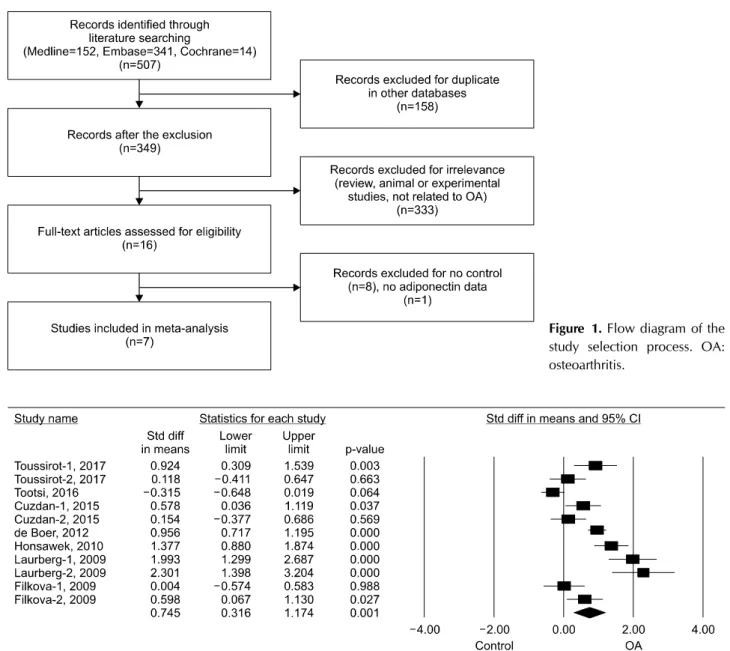
A total of 507 studies were identified using electronic and manual search methods, 16 of which were selected for full-text review based on the title and abstract, and 9 were excluded because they had no data on adiponectin or on control group. Thus, seven articles met the inclusion criteria [8-14] (Figure 1). Four reports contained data on two different groups; these studies were independently analyzed. Therefore, in total, 11 separate studies were considered in the meta-analysis, consisting of 538 pa- tients with OA and 366 controls (Table 1). The quality as- sessment score of each study ranged between 6 and 8, and all of studies having a high or moderate quality score >6.
Selected characteristics of these studies related to the as- sociation between the adiponectin and OA are summarized in Table 1.
Meta-analysis of adiponectin levels in patients with OA compared to those in controls
Adiponectin level was significantly higher in the OA group than in the control group (SMD=0.745, 95%
CI=0.316∼1.174, p=0.001) (Table 2, Figure 2). In addi- tion, stratification by ethnicity showed a significantly ele- vated adiponectin level in the OA group among Caucasian individuals (SMD=0.769, 95% CI=0.218∼1.319, p=0.006) (Table 2). And the single Asian study showed a sig- nificantly increased adiponectin level in the OA group (SMD=1.377, 95% CI=0.880∼1.874, p<0.001) (Table 2).
Meta-analysis of adiponectin levels in patients with OA compared to those in controls in each subgroup
Stratification by sex revealed that the adiponectin level was significantly higher among women in the OA group, but not in men (SMD=0.861, 95% CI=0.099∼1.623, p=0.027; SMD=1.177, 95% CI=−0.911∼3.316, p=
0.281) (Table 2). Stratification by adjustment for age, sex, and body mass index (BMI) indicated that the adipo- nectin level was significantly higher in the OA group by adjustment, but not by non-adjustment (SMD=0.837,
95% CI=0.326∼1.349, p=0.001; SMD=0.362, 95% CI= Table 2.
Meta-analysis of adiponectin levels in patients with OA compared to that in controls GroupPopulationStudy (n)NumberTest of associationTest of heterogeneity OAControlSMD*95% CIp-valueModelp-valueI2 AllOverall115383660.7450.316∼1.1740.001R<0.00188.4 EthnicityEuropean84023370.7690.218∼1.3190.006R<0.00190.6 Turkish260250.362−0.017∼0.7410061F0.27416.2 Asian176241.3770.880∼1.874<0.001NANANA SexFemale420680.8610.099∼1.6230.027R<0.00184.4 Male240471.177−0.911∼3.3160.281R<0.00194.0 Age-, sex-, or BMI-matchedMatched94783410.8370.326∼1.3490.001R<0.00190.3 Not-matched260250.362−0.017∼0.7410.061F0.27416.2 OA siteKnee73172520.9380.456∼1.419<0.001R<0.00183.3 Knee, hip42211140.409−0.377∼1.1940.308R< 0.00190.9 OA: osteoarthritis, SMD: standard mean difference, CI: confidence interval, BMI: body mass index, F: fixed effects model, R: random effects model, NA: not available. *Magnitude of Cohen’s d effect size (SMD): 0.2∼0.5, small effect; 0.5∼0.8, medium effect; ≥0.8, large effect.
Figure 1. Flow diagram of the study selection process. OA:
osteoarthritis.
Figure 2. Meta-analysis of the relationship between adiponectin levels and osteoarthritis (OA). Std diff: standard difference, CI:
confidence interval.
−0.017∼0.741, p=0.061) (Table 2). Stratification by OA site showed that the adiponectin level was significantly higher in the knee OA group (SMD=0.938, 95%
CI=0.456∼1.419, p<0.001) (Table 2). A similar trend was observed in the knee and hip OA group, although it did not reach statistical significance (SMD=0.409, 95%
CI=−0.377∼1.194, p=0.308) (Table 2).
Heterogeneity, sensitivity test, and publication bias
Between-study heterogeneity was identified during the meta-analyses of adiponectin levels in patients with OA (Table 2). Subgroup analysis showed decreased hetero- geneity in women and in patients with knee OA (Table 2).The main cause of heterogeneity was the difference in the magnitude of effect size. Meta-analytic SMDs remained significant after using a half number of controls to avoid duplicate data in two studies (SMD=0.730, 95%
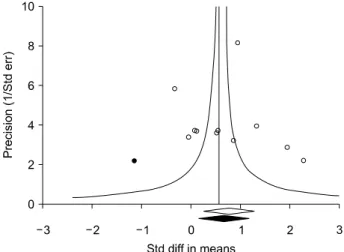
CI=0.328∼1.212, p=0.001) [11,13]. Sensitivity analysis showed that excluding individual study or two studies us- ing a half number of controls did not significantly affect the pooled SMDs, indicating that the results of this meta-analysis were robust. Although Egger’s regression test showed no evidence of publication bias (Egger’s re- gression test p-value=0.559), the funnel plot showed asymmetry suggesting publication bias, Therefore, the
“trim and fill” method was used to adjust for publication
Figure 3. Funnel plot of studies that examined the association between adiponectin levels and osteoarthritis (Egger’s re- gression p-value=0.559). The filled circles represent studies that showed publication bias. The diamonds at the bottom of the figure show summary effect estimates before (open) and af- ter (filled) publication bias adjustment. Std diff: standard differ- ence, Std err: standard error.
bias (Figure 3). However, SMD that had been significant before this adjustment remained significant after the ad- justment (SMD=0.621, 95% CI=0.184∼1.058), indicat- ing publication bas did not significantly affect this meta-analysis results.
DISCUSSION
In this meta-analysis, we combined the evidence of cir- culating adiponectin status in OA. This meta-analysis showed that circulating adiponectin levels were sig- nificantly higher in the OA group than in the control group. High adiponectin levels associated with OA were found after adjustment for age, sex, and/or BMI. The meta-analysis data suggested that circulating adiponectin plays a role in the pathogenesis of OA. It suggests the no- tion that adiponectin plays a role in the proinflammatory state in OA.
Adipose tissue may play an important role in the devel- opment of OA, and the pro- or anti-inflammatory effects of adipokines may contribute to the pathogenesis of OA [4]. Adiponectin may disturb cartilage homeostasis through directly inducing joint structural degradation.
Adiponectin enhances the proliferation and mineraliza- tion of human osteoblasts, and destroys chondrocytes and synovial fibroblasts by increasing the production of the inflammatory mediators including IL-6, IL-8, and monocyte chemo-attractant protein-1, MMP-3, and
MMP-9 [6]. A positive correlation has been shown be- tween serum levels of cartilage oligomeric matrix protein MMP-3 and adiponectin. Increased production of intra- cellular adhesion molecule-1 by adiponectin results in ad- hesion of monocytes in the synovial fluid in OA. It also has been reported that circulating adiponectin levels were higher in patients with advanced OA compared to those in patients with less severe disease [24].
In contrast, adiponectin may play a role in modulating the inflammatory response by inhibiting the expression of adhesion molecules, and suppressing macrophage and nuclear factor-kappaB signaling [4]. Adiponectin may have a protective role on cartilage by increasing the level of tissue inhibitor of metalloproteinases-2 and down- regulating IL-1β-induced MMP-13 production [25]. It can stimulate the release of anti-inflammatory molecules such as IL-10 and IL-1 receptor antagonist, suggesting its protective role against cartilage damage [26]. This dis- crepancy may be explained partially by the fact that the proinflammatory activities are related only to high-mo- lecular-weight adiponectin, whereas low-molec- ular-weight adiponectin has anti-inflammatory effects [27]. Analysis of specific adiponectin isoforms in further studies may help further clarify whether adiponectin has pro- or anti-inflammatory effects in the pathogenesis of OA. Our results are in line with the notion that adipo- nectin exerts pro-inflammatory activity. However, our re- sults could also rule out the possibility of a beneficial counter-regulatory function of adiponectin through coun- teracting the pro-inflammatory effects of inflammatory cytokines.
This meta-analysis has some shortcomings that should be considered. First, most of the studies had a small sam- ple size, and only a small number of studies were included in subgroup analysis. Thus, the meta-analysis may be underpowered. Second, the studies included in the meta-analysis were heterogeneous in demographic char- acteristics and clinical features. The heterogeneity and confounding factors such as disease severity and limited clinical information provided by the study population may have affected the results. This limited data did not al- low further analysis. Third, it is known that serum adipo- nectin is correlated with OA severity [8]. Thus, the whole study results could have been confounded by OA severity.
For example, if OA severity had been more severe in fe- males than males, the significant result on the association in only females would have been due to severity differ- ence rather than gender difference. However, we could
not check if OA severity was more severe in females than males due to limited data in the studies.
Nevertheless, this meta-analysis also has its strengths.
To the best of our knowledge, our meta-analysis is the first study that provides combined evidence for adipo- nectin status in patients with OA. Previous individual studies included a population size ranging from 13 to 172 only; however, our pooled analysis consisted of 538 patients. Compared to individual studies, our study was able to provide more accurate data on the relationship be- tween adiponectin level and OA by increasing the stat- istical power and resolution through pooling of the re- sults of independent analyses. Meta-analysis determines the magnitude of adiponectin levels in OA compared to controls and summarizes the overall results. Thus, meta-analysis is significant in this case, although adipo- nectin level was high in OA patients in six articles and low in only one article.
CONCLUSION
In conclusion, our meta-analysis demonstrated that cir- culating adiponectin levels were significantly higher in patients with OA than in controls. The levels were espe- cially elevated in European patients with OA, women, and in patients with knee OA, and after adjustment for age, sex, and/or BMI. This analysis indicates that adipo- nectin likely plays an important role in the pathogenesis of OA. Further studies are warranted to determine wheth- er increased adiponectin levels are correlated with the se- verity of OA and whether adiponectin directly contributes to the pathogenesis of OA.
CONFLICT OF INTEREST
No potential conflict of interest relevant to this article was reported.
REFERENCES
1. Gelber AC, Hochberg MC, Mead LA, Wang NY, Wigley FM, Klag MJ. Body mass index in young men and the risk of sub- sequent knee and hip osteoarthritis. Am J Med 1999;107:
542-8.
2. Berenbaum F. Osteoarthritis as an inflammatory disease (osteoarthritis is not osteoarthrosis!). Osteoarthritis Cartilage 2013;21:16-21.
3. Coelho M, Oliveira T, Fernandes R. Biochemistry of adipose tissue: an endocrine organ. Arch Med Sci 2013;9:191-200.
4. Shehzad A, Iqbal W, Shehzad O, Lee YS. Adiponectin: regu-
lation of its production and its role in human diseases.
Hormones (Athens) 2012;11:8-20.
5. Cheng X, Folco EJ, Shimizu K, Libby P. Adiponectin induces pro-inflammatory programs in human macrophages and CD4+ T cells. J Biol Chem 2012;287:36896-904.
6. Lee YA, Ji HI, Lee SH, Hong SJ, Yang HI, Chul Yoo M, et al.
The role of adiponectin in the production of IL-6, IL-8, VEGF and MMPs in human endothelial cells and osteo- blasts: implications for arthritic joints. Exp Mol Med 2014;46:e72.
7. Xu A, Wang Y, Keshaw H, Xu LY, Lam KS, Cooper GJ. The fat-derived hormone adiponectin alleviates alcoholic and nonalcoholic fatty liver diseases in mice. J Clin Invest 2003;112:91-100.
8. Toussirot E, Michel F, Béreau M, Dehecq B, Gaugler B, Wendling D, et al. Serum adipokines, adipose tissue meas- urements and metabolic parameters in patients with ad- vanced radiographic knee osteoarthritis. Clin Rheumatol 2017;36:2531-9.
9. Tootsi K, Kals J, Zilmer M, Paapstel K, Märtson A. Severity of osteoarthritis is associated with increased arterial stiffness. Int J Rheumatol 2016;2016:6402963.
10. Honsawek S, Chayanupatkul M. Correlation of plasma and synovial fluid adiponectin with knee osteoarthritis severity.
Arch Med Res 2010;41:593-8.
11. Cuzdan Coskun N, Ay S, Evcik FD, Oztuna D. Adiponectin:
is it a biomarker for assessing the disease severity in knee osteoarthritis patients? Int J Rheum Dis 2017;20:1942-9.
12. Laurberg TB, Frystyk J, Ellingsen T, Hansen IT, Jørgensen A, Tarp U, et al. Plasma adiponectin in patients with active, early, and chronic rheumatoid arthritis who are steroid- and disease-modifying antirheumatic drug-naive compared with patients with osteoarthritis and controls. J Rheumatol 2009;36:1885-91.
13. Filková M, Lisková M, Hulejová H, Haluzík M, Gatterová J, Pavelková A, et al. Increased serum adiponectin levels in fe- male patients with erosive compared with non-erosive osteoarthritis. Ann Rheum Dis 2009;68:295-6.
14. de Boer TN, van Spil WE, Huisman AM, Polak AA, Bijlsma JW, Lafeber FP, et al. Serum adipokines in osteoarthritis;
comparison with controls and relationship with local pa- rameters of synovial inflammation and cartilage damage.
Osteoarthritis Cartilage 2012;20:846-53.
15. Moher D, Liberati A, Tetzlaff J, Altman DG; PRISMA Group.
Preferred reporting items for systematic reviews and meta-analyses: the PRISMA statement. PLoS Med 2009;
6:e1000097.
16. Hozo SP, Djulbegovic B, Hozo I. Estimating the mean and variance from the median, range, and the size of a sample.
BMC Med Res Methodol 2005;5:13.
17. Wells GA, Shea B, O’connell D, Peterson J, Welch V, Losos M, et al. The Newcastle-Ottawa Scale (NOS) for assessing the quality of nonrandomised studies in meta-analyses [Internet]. Ottawa (ON): The Ottawa Hospital Research Institute, 2000. Available from: http:// www.ohri.ca/pro- grams/clinical_epidemiology/oxford.asp.
18. Cohen J. Statistical power analysis for the behavioral sciences. 2nd ed. New York, Psychology Press, 2009.
19. Egger M, Smith GD, Phillips AN. Meta-analysis: principles and procedures. BMJ 1997;315:1533-7.
20. DerSimonian R, Laird N. Meta-analysis in clinical trials.
Control Clin Trials 1986;7:177-88.
21. Higgins JP, Thompson SG. Quantifying heterogeneity in a meta-analysis. Stat Med 2002;21:1539-58.
22. Egger M, Davey Smith G, Schneider M, Minder C. Bias in meta-analysis detected by a simple, graphical test. BMJ 1997;315:629-34.
23. Duval S, Tweedie R. Trim and fill: A simple fun- nel-plot-based method of testing and adjusting for pub- lication bias in meta-analysis. Biometrics 2000;56:455-63.
24. Koskinen A, Juslin S, Nieminen R, Moilanen T, Vuolteenaho K, Moilanen E. Adiponectin associates with markers of car- tilage degradation in osteoarthritis and induces production of proinflammatory and catabolic factors through mi-
togen-activated protein kinase pathways. Arthritis Res Ther 2011;13:R184.
25. Chen TH, Chen L, Hsieh MS, Chang CP, Chou DT, Tsai SH.
Evidence for a protective role for adiponectin in osteoarthritis.
Biochim Biophys Acta 2006;1762:711-8.
26. Wolf AM, Wolf D, Rumpold H, Enrich B, Tilg H.
Adiponectin induces the anti-inflammatory cytokines IL-10 and IL-1RA in human leukocytes. Biochem Biophys Res Commun 2004;323:630-5.
27. Haugen F, Drevon CA. Activation of nuclear factor-kappaB by high molecular weight and globular adiponectin.
Endocrinology 2007;148:5478-86.
![Table 1. Characteristics of individual studies included in the meta-analysis AuthorCountryEthnicityPatientAge (yr)Sex (female/male)BMIOA siteMatchedQuality score OAControlOAControlOAControlOAControl Toussirot-1, 2017 [8]FranceEuropean2322 64.5±0.2* 59.7](https://thumb-ap.123doks.com/thumbv2/123dokinfo/5319329.166888/3.892.214.673.124.1152/characteristics-individual-included-authorcountryethnicitypatientage-sitematchedquality-oacontroloacontroloacontroloacontrol-toussirot-franceeuropean.webp)