PGHN
Case Report
Oral Vancomycin Therapy in a Child with Primary Sclerosing Cholangitis and Severe Ulcerative Colitis
Cynthia Buness, Keith D. Lindor*
,†, and Tamir Miloh
‡National Patient Advocate Foundation, Paradise Valley, *College of Health Solutions, Arizona State University,
†Department of Gastroenterology and Hepatology, Mayo Clinic, Phoenix, AZ, ‡Department of Gastroenterology, Hepatology and Nutrition, Texas Children's Hospital, Houston, TX, USA
Primary sclerosing cholangitis (PSC), a rare progressive liver disease characterized by cholestasis and bile duct fibrosis, has no accepted, effective therapy known to delay or arrest its progression. We report a 15 year old female patient diagnosed with PSC and moderate chronic active ulcerative colitis (UC) who achieved normalization of her liver enzymes and bile ducts, and resolution of her UC symptoms with colonic mucosal healing, after treatment with a single drug therapy of the antibiotic oral vancomycin. We postulate that the oral vancomycin may be acting both as an antibiotic by altering the intestinal microbiome and as an immunomodulator. Oral vancomycin may be a promis- ing treatment for PSC that needs to be further studied in randomized trials.
Key Words: Primary sclerosing cholangitis, Ulcerative colitis, Vancomycin, Liver diseases
Received:November 5, 2015, Revised:January 21, 2016, Accepted:February 5, 2016
Corresponding author: Keith D. Lindor, College of Health Solutions, Arizona State University, 550 North 3rd Street, Phoenix, AZ 85004, USA. Tel:
+1-602-496-0789, Fax: +1-602-496-0544, E-mail: [email protected] Copyright ⓒ 2016 by The Korean Society of Pediatric Gastroenterology, Hepatology and Nutrition
This is an openaccess article distributed under the terms of the Creative Commons Attribution NonCommercial License (http://creativecommons.org/licenses/by-nc/4.0/) which permits unrestricted noncommercial use, distribution, and reproduction in any medium, provided the original work is properly cited.
INTRODUCTION
Primary sclerosing cholangitis (PSC) is a rare pro- gressive disease of the liver characterized by choles- tasis and bile duct fibrosis, leading to decreased qual- ity of life, cirrhosis, and the need for liver trans- plantation within an average of 12 years [1]. The dis- ease occurs in children and adults, and is closely linked with inflammatory bowel disease (IBD), most often colitis, especially ulcerative colitis (UC) [1].
Small-duct PSC has an overall better long-term prog- nosis than large-duct PSC [2]. While the patho-
genesis of PSC remains obscure, a leading theory is that an abnormal gut microbiome activates innate immunity within the liver, resulting in bile duct-tar- geted inflammation and biliary fibrosis [1]. Presently, there are no effective therapies known to delay the progression of PSC. In this case, a single antibiotic, oral vancomycin, led to normalization of the pa- tient’s liver enzymes.
CASE REPORT
The patient first presented at age 13 with bloody
www.pghn.org 211
Cynthia Buness, et al:Oral Vancomycin Therapy in a Child with PSC and Severe UC
Fig. 1. Case study data. ALT: alanine aminotransferase, ALP: alkaline phosphatase, AST: aspartate aminotransferase, GGT: gamma glutamyltranspeptidase.
diarrhea after taking doxycycline daily for acne treatment 4 months prior to initiation of symptoms.
She was diagnosed with blastocystis hominis and treated with ciprofloxacin and metronidazole (for 10 days), and later with nitazoxanide (for 4 days). Her symptoms improved while on the ciprofloxacin/
metronidazole, but returned when the treatment was completed. She was admitted to the hospital 3 months later with erythema nodosum which re- solved without treatment. She discontinued the dox- ycycline treatment just prior to her hospitalization.
Her labs showed slight elevations in alanine amino- transferase (ALT), alkaline phosphatase (ALP), and perinuclear anti-neutrophil cytoplasmic antibodies were positive at 113.9 EU/mL. The patient was diag- nosed by colonoscopy with moderate chronic active ulcerative pancolitis and was started on mesalamine, which she did not tolerate and had worsening bloody diarrhea and abdominal pain. She was transitioned to 9 mg of budesonide and later also to 6,750 mg/day balsalazide, the latter which also caused worsening diarrhea. The patient elected to stop all medication and started herbal remedies for 6 months: VSL#3 probiotic, curcumin, and Nopalea (cactus juice;
Trivita in Scottsdale, AZ, USA). The patient con- tinued to experience diarrhea up to 4-5 times a day and azathioprine was initiated. Screening blood tests
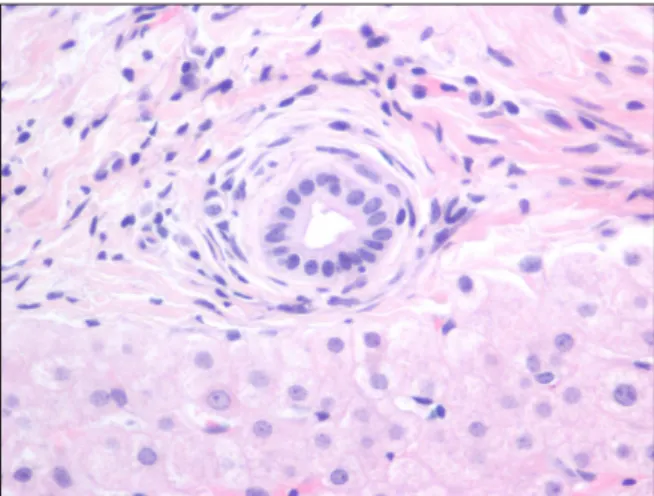
for azathioprine therapy in August 2012 revealed in- creased liver enzymes (Fig. 1). Quantitative im- munoglobulin G (IgG) was normal and screening for hepatic autoimmune antibodies (anti-nuclear anti- bodies, anti- smooth muscle antibodies, and anti-liv- er/kidney microsomal antibodies) was negative. The IgG subclasses panel showed normal IgG4. A mag- netic resonance cholangiopancreatography (MRCP) showed localized common hepatic duct prominence measuring 7 mm proximally at the porta hepatis of uncertain significance with no changes of PSC. A liv- er biopsy showed mild portal lymphocytic infiltrates with focal infiltration of bile duct epithelium. Several small and medium-size bile ducts were surrounded by concentric fibrosis with mild bile ductular proli- feration. There was no significant fibrosis. Findings were consistent with small-duct PSC (Fig. 2).
With the diagnosis of PSC, the patient was started on ursodeoxycholic acid (UDCA) 300 mg 2× per day.
The liver enzymes improved but did not normalize (Fig. 1). She developed intolerance to azathioprine:
nausea, vomiting, and epigastric pain, which re- solved with discontinuation of the medicine. Over the next two months, she continued to have diarrhea and malaise. She was started on 500 mg oral vanco- mycin 3× per day (35 mg/kg) for the management of PSC as the patient was reluctant to start infliximab.
Fig. 2. Bile duct is surrounded by concentric layers of fibrosis (H&E, ×400).
The diarrhea resolved within three days, and after several weeks stools became solid. UDCA was dis- continued after starting oral vancomycin.
The patient gained weight, fatigue significantly improved and within 2 months, the patient began menarche. After 9 months of therapy, transaminases had not normalized, and the dose of vancomycin was increased to 750 mg 3× per day (40 mg/kg) leading to normalization of liver enzymes with only mild gamma-glutamyltransferase (GGT) elevation (Fig.
1). Patient’s surveillance MRCPs in 2 and 3 years fol- lowing the diagnosis showed a normal liver with res- olution of the localized hepatic duct prominence and normal bile ducts. Surveillance colonoscopies in each subsequent year showed nearly normal, with only quiescent to mild chronic colitis on biopsy. Vanco- mycin dose was reduced to 1,000 mg 2× per day (35 mg/kg) and her liver function tests (LFTs) remained fully normalized. The patient has continued on this dose to date and it is well tolerated. She has had no infections. She has continued to have normal bowel movements and normal LFTs, other than transient elevations in the LFTs when she contracted acute in- fectious mononucleosis (Fig. 1).
DISCUSSION
PSC, a rare progressive liver disease characterized by cholestasis and bile duct fibrosis, has no accepted,
effective therapy known to delay or arrest its pro- gression. UC is an IBD of unclear etiology charac- terized by diffuse mucosal inflammation of the rec- tum and the colon. At diagnosis, pediatric UC asso- ciated with PSC is often more severe and extensive and many patients are affected with pancolitis.
Pediatric UC can be very aggressive with a high fre- quency of acute severe exacerbations. Patients with UC are known to develop PSC in 4-5% of cases [3], therefore, patients with IBD should be screened for abnormal liver enzymes. Other causes of abnormal LFTs in patients with IBD may be autoimmune hep- atitis, drug hepatotoxicity, disease flare, and malnu- trition.
UDCA has been extensively utilized as a ther- apeutic option for the treatment of pediatric PSC.
One uncontrolled pilot study showed that UDCA im- proved liver biochemistries, however there is no evi- dence that UDCA alters the progression of disease [4,5]. A multicenter study of adults with PSC using high-dose UDCA (28-30 mg/kg/day) over 5 years showed improvement in liver biochemistries, how- ever the study had to be terminated because of an in- creased risk of death and liver transplantation in the UDCA group [6].
Vancomycin is a glycopeptide antibiotic with bac- tericidal activity against many gram-positive bacteria.
Patients with UC and PSC who are treated with oral vancomycin have been shown to improve both UC symptoms and liver biochemistries [7-9], suggesting that oral vancomycin could be of therapeutic benefit in patients with PSC-UC. A study with 14 pediatric patients with PSC and concurrent active IBD treated with oral vancomycin showed significant improve- ment in GGT, ALT, and erythrocyte sedimentation rate values within 3 months of therapy [8]. These pa- tients also measured higher levels of transforming growth factor-β, an anti-inflammatory protein, and regulatory T cells (inhibits autoimmunity) indicat- ing a potential immunoregulatory mechanism of ac- tion of vancomycin [7]. Oral vancomycin treatment was also effective in the treatment of a pediatric pa- tient with recurrent PSC after an orthotopic liver transplantation, suggesting a disease mechanism
www.pghn.org 213
Cynthia Buness, et al:Oral Vancomycin Therapy in a Child with PSC and Severe UC
with some causes external to the liver—potentially from the gut bacteria [10].
In children and adolescents, ALP may be elevated due to accelerated growth and bone metabolism, therefore GGT is a followed as a marker of biliary disease. The patient had a diagnosis of small duct PSC and had no fibrosis at diagnosis, which gen- erally has a more benign course [2]. An additional benefit associated with the oral vancomycin treat- ment was the resolution of the patient’s UC symp- toms and colonic mucosal healing. The oral vanco- mycin may be acting both as an antibiotic by altering the intestinal microbiome and as an immunomodu- lator. The microbiome has been shown to affect a spectrum of liver diseases as intestinal blood flows through the portal tract. Modulating the micro- biome through oral vancomycin, which mostly af- fects gram positive bacteria, may have resulted in de- creased PSC activity and normalization of GGT.
Another mechanism is a direct immunomodulatory effect of oral vancomycin. Oral vancomycin is given orally with minimal systemic absorption, therefore the effect is likely via the intestines. Based upon this single case report and a case series, oral vancomycin may be a promising treatment for PSC that needs to be further studied in randomized trials.
ACKNOWLEDGEMENTS
The authors thank Steve Taylor, P.A., for assis- tance with photography (Fig. 2).
SUPPLEMENTARY DATA
Supplementary data can be found with this article online at http://www.pghn.org and at http://dx.do- i.org/10.5223/pghn.2016.19.3.210.
REFERENCES
1. Tabibian JH, O'Hara SP, Lindor KD. Primary scleros- ing cholangitis and the microbiota: current knowledge and perspectives on etiopathogenesis and emerging therapies. Scand J Gastroenterol 2014;49:901-8.
2. Björnsson E, Olsson R, Bergquist A, Lindgren S, Braden B, Chapman RW, et al. The natural history of small-duct primary sclerosing cholangitis. Gastroen- terology 2008;134:975-80.
3. Lindor KD, Kowdley KV, Harrison ME; American College of Gastroenterology. ACG clinical guideline:
primary sclerosing cholangitis. Am J Gastroenterol 2015;110:646-59.
4. Miloh T, Arnon R, Shneider B, Suchy F, Kerkar N. A ret- rospective single-center review of primary sclerosing cholangitis in children. Clin Gastroenterol Hepatol 2009;7:239-45.
5. Feldstein AE, Perrault J, El-Youssif M, Lindor KD, Freese DK, Angulo P. Primary sclerosing cholangitis in children: a long-term follow-up study. Hepatology 2003;38:210-7.
6. Lindor KD, Kowdley KV, Luketic VA, Harrison ME, McCashland T, Befeler AS, et al. High-dose ursodeox- ycholic acid for the treatment of primary sclerosing cholangitis. Hepatology 2009;50:808-14.
7. Abarbanel DN, Seki SM, Davies Y, Marlen N, Benavides JA, Cox K, et al. Immunomodulatory effect of vancomycin on Treg in pediatric inflammatory bowel disease and primary sclerosing cholangitis. J Clin Immunol 2013;33:397-406.
8. Davies YK, Cox KM, Abdullah BA, Safta A, Terry AB, Cox KL. Long-term treatment of primary sclerosing cholangitis in children with oral vancomycin: an im- munomodulating antibiotic. J Pediatr Gastroenterol Nutr 2008;47:61-7.
9. Tabibian JH, Weeding E, Jorgensen RA, Petz JL, Keach JC, Talwalkar JA, et al. Randomised clinical trial: van- comycin or metronidazole in patients with primary scle- rosing cholangitis-a pilot study. Aliment Pharmacol Ther 2013;37:604-12.
10. Davies YK, Tsay CJ, Caccamo DV, Cox KM, Castillo RO, Cox KL. Successful treatment of recurrent primary sclerosing cholangitis after orthotopic liver trans- plantation with oral vancomycin. Case Rep Transplant 2013;2013:314292.
Supplementary Fig. 1. Concentric fibrosis is highlighted on trichrome stain (Masson trichrome, ×400). Acknowledgment:
The authors thank Steve Taylor, P.A., for assistance with photography.
www.pghn.org