서 론
악성고열증(malignant hyperthermia)은 이에 대한 감수성 (malignant hyperthermia susceptibility, MHS)을 가진 사 람에서 마취를 위한 흡입마취제 및 탈분극성 근육이완제 등에
노출되었을 때 급격하고 지속적인 체온의 상승, 골격근의 강직, 심한 호흡성 및 대사성 산증, 빈맥, 심장 및 신장의 손상, 근육 의 파괴 등의 임상 증상을 나타내는 치명적 과대사반응의 약물 유전성 질환이다[1]. 그 발생기전으로는 골격근 세포 내 근형질 세망(sarcoplasmic reticulum)의 막에 위치하는 칼슘분비통로 (calcium-release channel)인 ryanodine 수용체(ryanodine receptor, RYR1)의 기능장애에 의한 칼슘분비조절 이상으로 유발물질에 노출되었을 때 골격근세포 내의 칼슘농도를 지속적 으로 급격하게 증가시켜 초래하는 것으로 알려져 있다[2].
악성고열증에 대한 감수성을 가진 사람일지라도 일반적으로 는 임상증상 없이 건강한 생활을 유지하기 때문에 마취 등에 노 출되기 전에는 MHS의 유무를 판단하기 어렵고, 수술 전 이를 쉽게 인지할 수 있는 일반적 선별 검사방법도 없으므로 현재 악 성고열증의 예방과 발생 시 신속한 대처 및 치료에 많은 한계점
702 702 702 702 Received :March 12, 2010 Manuscript No :KJLM10-047 Revision received :August 30, 2010
Accepted :September 29, 2010 Corresponding author :Dal Sik Kim, M.D.
Department of Laboratory Medicine, Chonbuk National University Medical School, 638-18 Geumam-dong 1-ga, Deokjin-gu, Jeonju 561-712, Korea
Tel : +82-63-250-1793, Fax : +82-63-250-1200 E-mail : [email protected]
*The work described in this paper was supported by the Korea Research Foundation (KRF-2005-003-E00002) using the fund provided by the Min- istry of Education, Science, and Technology (2005).
ISSN 1598-6535 The Korean Society for Laboratory Medicine
Background : Malignant hyperthermia (MH) is genetically heterogeneous, with mutations in the gene encoding the skeletal muscle ryanodine receptor (RYR1) at 19q13.1 accounting for up to 80%
of the cases. However, the search for known and novel mutations in the RYR1 gene is hampered by the fact that the gene contains 106 exons. We aimed to analyze mutations from the entire RYR1 coding region in Korean MH families.
Methods : We investigated seven affected MH individuals and their family members. The entire RYR1 coding region from the genomic DNA was sequenced, and RYR1 haplotyping and mutation- al analysis were carried out.
Results : We identified nine different RYR1 mutations or variations from seven Korean MH families.
Among these, five previously reported mutations (p.Gly248Arg, p.Arg2435His, p.Arg2458His, p.Arg- 2676Trp, and p.Leu4838Val) and four novel variations of unknown significance (p.Arg2508Cys, p.Met- 4022Val, p.Glu2669Lys, and p.Ala4295Val) were identified. In two families, two variations (R2676W &
M4022V, R2435H & A4295V, respectively) were identified simultaneously. Four of the observed nine mutations or variations were located outside the hotspot region of RYR1 mutations.
Conclusions : These data indicate that RYR1 is a main candidate gene in Korean MH families, and that comprehensive screening of the entire coding sequence of the RYR1 gene is necessary for molecular genetic investigations in MH-susceptible individuals, owing to the presence of RYR1 mutations or variations outside of the hotspot region. (Korean J Lab Med 2010;30:702-10)
Key Words : Malignant hyperthermia, Ryanodine receptor type 1, Mutational screening
Molecular Genetic Analysis of the Ryanodine Receptor Gene (RYR1) in Korean Malignant Hyperthermia Families
Ho Lee, M.D.
1,4, Dong Chan Kim, M.D.
2,4, Jae Hyeon Lee, M.D.
3, Yong Gon Cho, M.D.
3,4, Hye Soo Lee, M.D.
3,4, Sam Im Choi, M.D.
3,4, and Dal Sik Kim, M.D.
3,4Departments of Forensic Medicine1, Anesthesiology and Pain Medicine2, Laboratory Medicine3, and Research Institute of Clinical Medicine4, Chonbuk National University Medical School, Jeonju, Korea
이 있다. MHS의 유무를 진단하는 검사방법으로는 생검한 골격 근 섬유의 caffeine 및 halothane에 대한 수축의 민감도를 측 정하는 in vitro contracture test (IVCT)와 caffeine halothane contracture test (CHCT)가 표준검사방법으로 받아들여지고 있다. 하지만 수술로 골격근육을 생검해야 하는 침습적인 방법 이기 때문에 검사의 어려움, 비용 및 표준화 등의 한계가 있어 북미 및 유럽의 몇몇 나라에서 제한적으로 시행되고 있다[3, 4].
1990년대 초에 염색체 19q13.1에 위치하는RYR1유전자의 변이와 악성고열증 및 central core disease (CCD)와의 연관성 이 보고된 이후[5, 6], 점차 많은 악성고열증의 가계에서RYR1 유전자의 변이가 증명되었다[7-9]. 연관분석(linkage analy- sis) 등의 연구에서 MH는 상당한 유전적 이질성(genetic het- erogeneity)을 보여주고 있지만[10-15], RYR1유전자가 MHS (OMIM #145600) 및 CCD (OMIM #117000)의 주요 원인유전 자로 알려지고 있다[16-18].
RYR1유전자는 106개의 exon을 갖는 160 kb gDNA와 15 kb cDNA의 매우 크고 복잡한 유전자이며[19, 20], 악성고열증 및 CCD와 연관된 유전자의 변이는 주로 세 곳의 호발영역(exon 2- 17, exon 39-46 및 exon 90-104)에서 보고되고 있다[21]. 따라 서 대부분의RYR1유전자 변이의 탐색에 대한 연구도 주로 세 곳 의 호발영역에 집중되어 왔다. 그러나 최근 연구에서는 호발영역 이외에서도 유전자변이의 검출이 증가되고 있어RYR1유전자의 전체 coding sequence를 대상으로 한 유전자변이 탐색의 필요 성이 대두되고 있다[22, 23]. 아울러 최근에는 European Malig- nant Hyperthermia Group (EMHG) 및 North American Malignant Hyperthermia Group (NAMHG)에서 MHS에 대한 분자유전학적 진단을 위한 가이드라인도 제시하고 있다[24, 25].
우리나라의 악성고열증에 대한 연구는 1973년 이후 30여 증 례가 보고되었으나 대부분 대형병원에서 마취 중 사망한 임상 증례를 보고한 경우였으며, 2003년 한 악성고열증의 가계에서 분자유전학적 연구 및 광범위한 가계도 조사를 시행하여 규명 한 Arg2435His의 변이가 국내의 첫 보고이다[26].
본 연구는 국내에서 발생한 악성고열증의 사례를 수집하여 가계도 조사와RYR1유전자의 전체 coding sequence를 대상 으로 유전자의 변이탐색을 시행하여 분석하고자 하였다.
대상 및 방법
1. 발단자 및 가계도 조사마취통증의학교실, 법의학교실 및 국립과학수사연구소 등에
설문지 등을 발송하여 악성고열증의 사례와 정보를 수집하여 얻은 20여 증례 중 악성고열증 발단자 및 가계도 조사 등이 가 능했던 7예를 대상으로 하였다. 가계도 조사는 발단자 및 가계 구성원들로부터 동의를 얻은 후 직접 방문하거나 내원하여 이 루어졌다. 가계 1의 발단자(III-1)는 25세 남자로 안면 성형수술 을 위해 halothane 등을 이용한 전신마취 중 42℃ 이상의 체온 상승 등을 동반한 악성고열증이 초래되었으나 dantrolene의 치료로 합병증 없이 회복되었다. 가계 2의 발단자(II-2)는 56세 여자로 파이프의 절단공정 중 절단된 손가락의 봉합수술을 위 한 전신마취 중 악성고열증이 발병되었으며 dantrolene 치료는 받지 못하였고 사망하였다. 가계 3의 발단자(II-1)는 4세 여아 로 충치치료를 위한 전신마취 중 41℃ 이상의 체온상승을 동반 한 악성고열증으로 사망한 경우이며 dantrolene의 치료는 받 지 못하였다. 가계 4의 발단자(II-1)는 50세 남자로 교통사고에 의한 안면골절 등의 수술을 위해 halothane 등을 이용한 전신 마취 중 42℃ 이상의 고열을 동반한 악성고열증이 발병하였으 나 dantrolene 등의 치료로 합병증 없이 회복되었다. 가계 5 (III-9)의 발단자는 9세 여아로 충수돌기염의 수술을 받기 위한 전신마취 중 42℃ 이상의 고열을 동반한 악성고열증이 있었으 나 dantrolene의 투여 후 회복되었으며, 그 가계 내의 다른 구 성원들(II-1, III-4, III-7)에서도 악성고열증의 병력이 있었다 (Fig. 1). 가계 6의 발단자는 63세 남자로 충수돌기염의 수술을 위한 전신마취 중 악성고열증이 발생하였으며 dantrolene 치 료 후 회복된 경우이고, 가계 7의 발단자는 쇠파이프에 다친 손 가락의 피부이식수술을 위한 전신마취 중 43℃ 이상의 체온상 승을 동반한 악성고열증의 발병으로 사망하였으며 가계도 조사 는 시행하지 못하였다.
2. Genomic DNA추출
발단자 혹은 가계 구성원의 대상자에서 말초혈액 혹은 파라핀 포매 근육조직으로부터 DNA 추출 시약(GENErALL Nucleic Acid Purification kit, General Biosystem, Seoul, Korea)을 이용하여, 제조사의 사용설명서에 따라 DNA를 추출하였다. 추 출된 DNA는 검사 전까지 -70℃에 냉동 보관하였다.
3.
RYR1
유전자의 변이분석발단자에서 유전자 변이를 확인하기 위해 RYR1 유전자의 106개 전체 exon을 대상으로 Ibarra 등[22]의 방법에서와 같이 중합효소연쇄반응 및 직접염기서열분석법을 이용하였다. 증폭
I-1 I-1
II-3 II-5
Family 1 Family 2
E- 1 5II-1 2 8 - - 9 83 3 1 4
E- 5 5I-2 6 4 - - 8 22 2 3 5
II-4 E- 1 5 2 4 - - 8 8 3 25 3
II-6 E- 1 5 2 4 - - 8 2 3 25 5 E- 3 1II-1
5 6 - - 8 83 3 7 3
III-1 E- 5 3 6 5 - - 8 8 2 33 7
III-2 E- 1 3 6 5 - - 8 8 2 33 7
III-3 E+ 1 3 6 5+ - 2 8 2 3 4 7
III-4 E- 5 3 6 5 - - 8 8 2 33 7
III-5 E- 1 5 2 8 - - 8 2 3 15 3
III-6 E- 5 5 4 3 - - 8 2 2 13 3
III-8 E- 5 4 4 7 - - 2 1 2 25 6 III-7 E+ 1 5II-2
6 6 + - 2 82 2 4 3
III-4 E- 3 5 7 8 - - 4 9 2 33 6
III-5 E- 3 5 7 8 - - 4 9 2 33 6 III-2
E- 5 3 8 8 - - 8 4 3 34 6 E+ 3 10II-2 8 9 - + 4 23 3 6 5
E+10 2II-6 9 5 + - 2 63 9 5 5
R2458H R2458H
II-3 II-4
? NT NT
II-5 I-2
III-6 E+10 3
9 2 + - 2 2 3 25 7 R2458H III-1
E+ 1 10 2 9 - + 9 2 3 31 5
R2458H P
P
III-3 E+ 4 10
2 9 - + 2 2 2 33 5
R2458H
Family 3
?
R2508C
R2508C
NT NT
NT
I-1 E+ 4 5
12 7+ - 1 8 3 3 5 3 M4022V
II-2
? II-1 E+ 4 10
12 3 + + 1 9 3 25 1 M4022V
R2435H A4295V
R2676W I-2 E+ 4 10
4 3- + 13 9 2 2 3 1
R2676W
P
Family 4
Family 5
NT
I-1
I-1
III-1 III-4
II-4
P
I-2 I-3
II-3 II-5 II-7
I-2
E2669K E2569K
NT NT
E- 6 5II-2 5 2 - - 2 23 2 6 1
E- 4 3II-4 5 7 - - 9 23 3 1 1 E+ 3 4II-1
5 5 + - 1 92 3 5 1
III-1 E- 4 5 5 2- - 9 2 3 2 1 1
E- 4 13II-2 9 7 - - 7 10- - 1 2 3 3
III-3 E- 3 4 6 9- - - - 8 7 2 15 3
III-5 E- 3 4 6 9- - - - 8 7 2 15 3 E+ 4 3II-1
6 6 + - + -8 8 3 2 7 5
III-2 E- 4 5 5 2- - 9 2 3 2 1 1
E- 4 3II-6 5 7 - - 9 23 3 1 1
E+3 4II-8 5 5 + - 1 92 3 5 1 P
? ?
? ? ?
NT
R2435H A4295V
II-3 E+ 4 5 6 3 + -+ - 8 2 3 3 7 5
R2435H A4295V
IV-1 E+ 4 10
6 7 + -+ - 8 10 3 1 7 5
R2435H A4295V
III-2 E+ 4 4 + -6 9 + - 8 7 3 17 3
R2435H A4295V
III-6 E+ 4 13
6 7+ - + - 8 10 3 27 3
R2435H A4295V
III-7 E+ 4 13
6 7+ - + - 8 10 3 27 3
R2435H A4295V
III-8 E+ 4 3 6 7+ - + - 8 10 3 27 3
R2435H A4295V
III-9 E+ 4 1 6 8+ - + - 8 1 3 27 5
R2435H A4295V
IV-2 E+ 4 4 6 9 + -+ - 8 6 3 1 7 3
Fig. 1. Haplotype analysis and segregation of the RYR1 mutations and variations p.Arg2458His (in family 1), p.Arg2508Cys (in family 2), p.Met4022Val and p.Arg2676Trp (in family 3), p.Glu2669Lys (in family 4), and p.Arg2435His and p.Ala4295Val (in family 5). The arrow denotes the proband who ex- perienced malignant hyperthermia crises. Black shapes indicate individuals with a past history of malignant hyperthermia attack, and white shapes with a question mark denote individuals for whom disease status is unknown. Segregation of the res- pective mutations and variations is also indicated:
a plus sign (+) indicates that an individual is het- erozygous for the mutant allele, and a minus sign (-) indicates that an individual is homozygous for the normal allele. The results of marker typing and muta- tion identification are shown in order: D19S191- D19S220-RYR1 mutations or variations-D19S422- D19S190-D19S223.
된 중합효소연쇄반응의 산물은 QIAquick PCR purification kit (QIAGEN Inc., Valencia, CA, USA)로 정제한 후 BigDye Terminator chemistry (Applied biosystems, Foster City, CA, USA)를 이용하여 ABI PRISM 자동염기서열분석기(Appl- ied biosystems)로 염기서열분석을 시행하였으며, 염기서열 및 유전자변이의 분석은 Sequencher (Gene Codes Corpora- tion, Ann Arbor, MI, USA) 프로그램을 이용하였다. 발단자 에서 확인된 유전자 변이에 대해 가계 구성원에서의 선별검사 는 확인된 유전자 변이를 갖는 exon만을 중합효소연쇄반응한 다음 직접염기서열분석을 이용하였다.
4. 일배체형 분석
발단자의 가계구성원의 말초혈액으로부터 genomic DNA를 추출하여 일배체형분석을 시행하였다. 사용된 microsatellite marker는 19번 염색체상의RYR1유전자와 인접하는 D19S191, D19S422, D19S220, D19S190, D19S223을 이용하였으며, ABI 3100 Genetic Analyzer (Applied biosystems) 및 GENES- CAN/GENOTYPER software (Applied biosystems)를 사용 하여 분석하였다.
결 과
분석된 7가계의 악성고열증 발단자 모두에서RYR1유전자의 변이가 확인되었다. 관찰된 유전자 변이는 exon 9 (c.742G>A;
p.Gly248Arg), exon 45 (c.7304G>A; p.Arg2435His), exon 46 (c.7373G>A; p.Arg2458His), exon 47 (c.7522C>T; p.Arg- 2508Cys), exon 50 (c.8005G>A; p.Glu2669Lys, c.8026C>T;
p.Arg2676Trp), exon 88 (c.12064A>G; p.Met4022Val), exon 91 (c.12884C>T; p.Ala4295Val) 및 exon 101 (c.14512C>G;
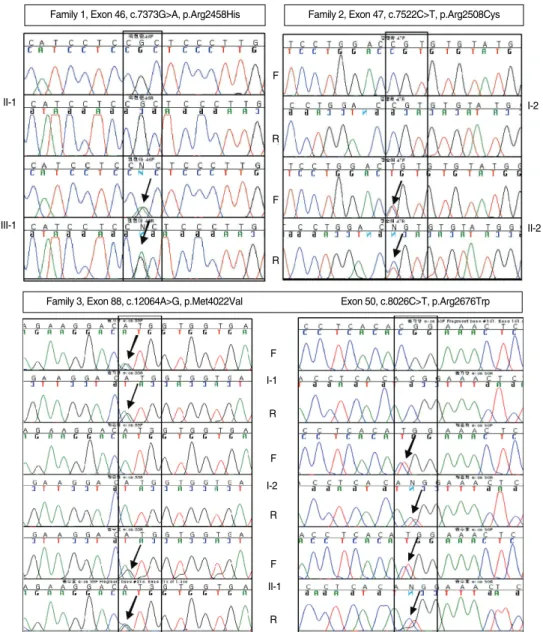
p.Leu4838Val) 등이었다(Fig. 1, 2). 이 중 5개의 돌연변이(p.
Gly248Arg, p.Arg2435His, p.Arg2458His, p.Arg2676Trp, p.Leu4838Val)는 이전에 보고되었고, 4개(p.Arg2508Cys, p.Met4022Val, p.Glu2669Lys, p.Ala4295Val)는 새롭게 확 인된 변이(variation)였다. 모든 변이는 이형접합체의 과오변이 였으며(Fig. 2), 가계도 조사 및 microsatellite marker (D19- S191, D19S422, D19S220, D19S190, D19S223)를 이용하여 일배체형 분석이 가능했던 다섯 가계 중 세 가계(가계 1, 가계 3, 가계 5)의 발단자는 부모로부터 물려받은 돌연변이를 가지고 있었으나, 가계 2와 가계 4의 발단자는 부모로부터 물려받았는 지 확인할 수 없는 새로운 변이를 가지고 있었다(Fig. 1). 다섯
가계의 각 발단자에서는 1개의RYR1유전자변이가 관찰되었 고, 두 가계(가계 3, 5)의 각 발단자에서는 2개의RYR1유전자 변이가 확인되었다(Fig. 1, 2). 가계 3의 발단자는 exon 50과 88에서 각각 p.Arg2676Trp 및 p.Met4022Val의 2개의 유전 자 변이를 보였으며, 일배체형 분석 결과 아버지의 일배체형 (4-12-1-3-5)의 p.Met4022Val 변이와 어머니의 일배체형 (10-3-9-2-1)의 p.Arg2676Trp 변이를 받은 것으로 확인되었 다. 가계 5의 발단자는 exon 45와 91에서 각각 p.Arg2435His 및 p.Ala4295Val의 2개의 유전자변이를 보였으며, 이는 일배 체형(4-6-8-3-7) 위에 2개의 변이가 동시에 존재하였다(Fig.
1). 본 연구에서 확인된 9개의 유전자 변이는 170명의 정상 대 조군에서 관찰되지 않았다.
고 찰
본 연구는 한국인의 악성고열증 가계에서 MHS의 주요 원인 유전자인RYR1유전자의 전체 coding sequence를 대상으로 변이탐색을 시행한 분자유전학적 분석의 첫 보고이다. 다섯 개 의 알려진 돌연변이와 p.Arg2508Cys, p.Met4022Val, p.Glu- 2669Lys 및 p.Ala4295Val 등 4개의 새로운 유전자 변이(vari- ation of unknown significance)를 확인하였으며, 특히 두 가 계에서 동시에 2개의 유전자 변이(p.Arg2676Trp & p.Met- 4022Val, p.Arg2435His & p.Ala4295Val)가 관찰된 것은 매 우 드문 보고이며 흥미로운 점이다.
RYR1유전자의 변이가 MHS의 주요 원인으로 간주되고 있 지만 여러 연구에서는 MH 가계의 약 50% 정도에서RYR1유 전자와의 연관성을 보였으며, 표현형 검사(IVCT 및 CHCT)에 서 양성인 사람의 22-25% 정도에서만RYR1유전자변이를 나 타내고 있다[27]. 이러한RYR1유전자 변이의 낮은 검출률은 크고 복잡한RYR1유전자의 특성으로 인해 검사의 어려움과 소요비용에 따른 호발영역에 집중된 변이검사 등에 기인된 면 이 있다. 그러나 최근 연구에서는RYR1유전자의 전체 coding sequence 및RYR1cDNA의 염기서열분석 등을 통하여RYR1 유전자변이의 검출률을 70%까지 증가시키고 있다[28, 29]. 본 연구에서도 분석한 7 가계 모두에서RYR1유전자의 변이가 확 인되었고, 호발영역 이외의 exon (47, 50 및 88)에서도 변이가 관찰되었으며, 한 가계 내에서 동시에 2개의 유전자 변이를 보 인 점 등의 소견은RYR1유전자의 전체 coding sequence를 대상으로 변이검색이 이루어져야 함을 뒷받침한다.
악성고열증 및 CCD와 관련되어 보고된RYR1유전자 변이는 대부분 소수의 가계에서 하나의 과오돌연변이를 보이는 pri-
vate mutation으로 알려져 있다[30]. 본 연구의 악성고열증 가 계 3과 5에서와 같이 한 가계 내에서 p.Arg2676Trp/p.Met- 4022Val 및 p.Arg2435His/p.Ala4295Val의 2개 변이가 조합 된 보고는 처음이다. 가계 3의 발단자에서 관찰된 p.Arg2676Trp 과 p.Met4022Val의 두 변이는 일배체형 분석에서 발단자 어머 니의 10-3-9-2-1과 아버지의 4-12-1-3-5의 일배체형 위에 각각 위치하고 있다(Fig. 1). 그러나 흥미롭게도 가계 5에서 관
찰된 두 변이는 4-6-8-3-7의 일배체형 위에 같이 위치하고 있는데(Fig. 1, 2), 이와 같이 2개의 변이가 같은 일배체형 위에 존재하는 경우는 1예만이 보고되고 있을 뿐이다[31].
마취 전 MHS에 대한 진단을 위해서는 EMHG와 NAMHG가 제시하고 있는 IVCT 혹은 CHCT가 현재 표준검사법으로 이용 되고 있지만, 침습적이고 비용이 많이 들며 표준화가 어려워 유 전자검사와 같은 간단하고 비침습적인 검사의 필요성이 대두되
Family 1, Exon 46, c.7373G>A, p.Arg2458His
II-1
F
R
R F III-1
I-2
II-2 Family 2, Exon 47, c.7522C>T, p.Arg2508Cys
Family 3, Exon 88, c.12064A>G, p.Met4022Val Exon 50, c.8026C>T, p.Arg2676Trp
F
F
F R I-1
I-2
II-1 R
R
Fig. 2. DNA sequencing of the entire coding region of the RYR1 gene, in which c.7373CGC>CAC* in exon 46 (from family 1); c.7522CGT>
TGT in exon 47 (from family 2); c.12064ATG>GTG and c.8026CGG>TGG in exon 88 and 50, respectively (from family 3); c.8005GAG>
AAG in exon 50 (from family 4); c.7304CGC>CAC and c.12884GCG>GTG in exon 45 and 91, respectively (from family 5); c.742GGG>
AGG in exon 9 (from family 6); and c.14512CTG>GTG in exon 101 (from family 7) were detected. Individuals without a mutation or varia- tion showed a single peak, whereas individuals with mutations or variations showed two superimposed peaks (arrows), indicating a het- erozygous missense mutation or variation. *Residue numbering within the human RYR1 cDNA (accession number: NM_000540).
Abbreviations: F, forward sequencing; R, reverse sequencing. (Continued to the next page)
고 있다. EMHG 및 NAMHG 등은 MHS의 분자유전학적 진단 을 위한 가이드라인을 마련하여 근육생검에 의한 IVCT를 시행 하지 않고 MHS로 진단할 수 있는 15개의RYR1유전자 돌연변 이를 제시한 바 있으며[24] 최근에는 30개로 증가하였다(http://
www.emhg.org/genetics/mutations-in-ryr1/). 본 연구에 서 확인된 p.Gly248Arg [8], p.Arg2435His [9], p.Arg2458- His [32] 및 p.Leu4838Val [33]은 악성고열증 및 CCD와 연관
되어 이미 보고된 돌연변이이다. 이들의 변이형RYR1수용체 는 야생형보다 caffeine과 halothane에 대해 더 민감한 세포 내 칼슘유리효과를 나타냄이 증명되어 IVCT를 시행하지 않고 MHS로 판정할 수 있는 유전자 변이로 제시되고 있다[25, 34].
따라서 MH 가계의 구성원에 대한 MHS의 진단은 해당하는 유전 자 변이형에 대한 스크리닝 검사로 비교적 쉽게 시행할 수 있다.
본 연구의 악성고열증 발단자에서 새롭게 확인된 4개의 유전
Family 5, Exon 45, c.7304G>A, p.Arg2435His Exon 91, c.12884C>T, p.Ala4295Val
F
F R III-7
III-3
R Family 4, Exon 50, c.8005G>A, p.Glu2669Lys
III-1
II-8
F
R
F
R
Family 6, Exon 9, c.742G>A, p.Gly248Arg
Family 7, Exon 101, c.14512C>G, p.Leu4838Val
Fig. 2. (Continued from the previous page) DNA sequencing of the entire coding region of the RYR1 gene, in which c.7373CGC>CAC* in exon 46 (from family 1); c.7522CGT> TGT in exon 47 (from family 2); c.12064ATG>GTG and c.8026CGG>TGG in exon 88 and 50, respec- tively (from family 3); c.8005GAG> AAG in exon 50 (from family 4); c.7304CGC>CAC and c.12884GCG>GTG in exon 45 and 91, respec- tively (from family 5); c.742GGG> AGG in exon 9 (from family 6); and c.14512CTG>GTG in exon 101 (from family 7) were detected. Indi- viduals without a mutation or variation showed a single peak, whereas individuals with mutations or variations showed two superimposed peaks (arrows), indicating a heterozygous missense mutation or variation. *Residue numbering within the human RYR1 cDNA (accession number: NM_000540).
Abbreviations: F, forward sequencing; R, reverse sequencing.
자 변이(p.Arg2508Cys, p.Met4022Val, p.Glu2669Lys, p.Ala- 4295Val)는 아직RYR1수용체의 기능적 특성에 대한 연구가 이루어져 있지 않아서 유전자형의 검사만으로는 MHS라고 진 단하기에 한계가 있다. 그러나 이들 변이형이RYR1유전자의 전체 coding sequence에서 확인되었고, 척추동물에서는 비교 적 잘 보존된 아미노산의 영역에 위치해 있으며, 대부분의RYR1 변이와 같이 CpG dinucleotides에서 나타나고 있다. 그리고 여 전히 rare polymorphism의 가능성도 배제할 수는 없지만, 1%
의 빈도를 보이는 유전자 다형성(polymorphism)을 95%의 유 의수준과 90%의 power로 확인하기 위해 170명의 정상 대조군 의 분석 결과 관찰되지 않았기 때문에 MHS를 유발하는 변이로 생각할 수도 있다[35]. 따라서 이러한 변이형RYR1수용체의 기능적 특성을 파악하기 위해서는 좀 더 광범위한 가계도 조사, 근육의 조직학적 소견, 그리고 세포 내 칼슘유리의 민감도를 평 가할 수 있는 in vitro cellular Ca2+ photometry assay 등의 추가연구가 필요할 것으로 사료된다[34].
요 약
배경 : 악성고열증은 상당한 유전적 이질성을 보이나, 골격근 의 ryanodine receptor (RYR1)의 유전자 변이가 증례의 80%
이상을 차지하고 있다. 그러나RYR1유전자의 크기와 복잡성 때문에 유전자 변이의 검색은 쉽지 않다. 저자들은 한국인 악성 고열증 환자 및 그 가계에서 전체RYR1coding region을 대상 으로 유전자 변이를 탐색하였다.
방법 : 수술 중 악성고열증이 발생하였던 7명의 발단자와 그 가계에 대해 광범위한 가계도 조사를 하였다. RYR1유전자에 대한 변이분석을 위해 중합효소연쇄반응, 직접염기서열분석법 및 일배체형 분석을 시행하였다.
결과 : 분석한 악성고열증 가계의 7명 발단자 모두에서RYR1 유전자의 변이가 관찰되었다. 그중 4개의 새로운 유전자 변이 (p.Arg2508Cys, p.Met4022Val, p.Glu2669Lys, p.Ala4295- Val)와 5개의 보고된 돌연변이(p.Gly248Arg, p.Arg2435His, p.Arg2458His, p.Arg2676Trp, p.Leu4838Val)가 관찰되었 다. 두 가계에서는 동시에 2개의 유전자 변이가 확인되었고, 관 찰된 9개의 변이 중 4개는 지금까지 흔히 보고되었던 호발부위 이외의 영역에서 관찰되었다.
결론 : 한국인의 악성고열증에서도RYR1유전자는 가장 중 요한 후보유전자이며, 본 연구에서와 같이RYR1유전자의 변 이가 기존의 호발부위 이외에서도 관찰되기 때문에 유전자 변 이의 탐색은RYR1유전자의 전체 coding sequence를 대상으
로 이루어져야 할 것으로 사료된다.
참고문헌
1. Jurkat-Rott K, McCarthy T, Lehmann-Horn F. Genetics and patho- genesis of malignant hyperthermia. Muscle Nerve 2000;23:4-17.
2. López JR, Allen PD, Alamo L, Jones D, Sreter FA. Myoplasmic free [Ca2+] during a malignant hyperthermia episode in swine. Muscle Nerve 1988;11:82-8.
3. Allen GC, Larach MG, Kunselman AR. The sensitivity and speci- ficity of the caffeine-halothane contracture test: a report from the North American Malignant Hyperthermia Registry. The North Amer- ican Malignant Hyperthermia Registry of MHAUS. Anesthesiolo- gy 1998;88:579-88.
4. Ording H, Brancadoro V, Cozzolino S, Ellis FR, Glauber V, Gonano EF, et al. In vitro contracture test for diagnosis of malignant hyper- thermia following the protocol of the European MH Group: results of testing patients surviving fulminant MH and unrelated low-risk subjects. The European Malignant Hyperthermia Group. Acta Ana- esthesiol Scand 1997;41:955-66.
5. MacLennan DH, Duff C, Zorzato F, Fujii J, Phillips M, Korneluk RG, et al. Ryanodine receptor gene is a candidate for predisposi- tion to malignant hyperthermia. Nature 1990;343:559-61.
6. Schwemmle S, Wolff K, Palmucci LM, Grimm T, Lehmann-Horn F, Hubner C, et al. Multipoint mapping of the central core disease locus.
Genomics 1993;17:205-7.
7. Quane KA, Healy JM, Keating KE, Manning BM, Couch FJ, Palmuc- ci LM, et al. Mutations in the ryanodine receptor gene in central core disease and malignant hyperthermia. Nat Genet 1993;5:51-5.
8. Gillard EF, Otsu K, Fujii J, Duff C, de Leon S, Khanna VK, et al. Poly- morphisms and deduced amino acid substitutions in the coding sequence of the ryanodine receptor (RYR1) gene in individuals with malignant hyperthermia. Genomics 1992;13:1247-54.
9. Zhang Y, Chen HS, Khanna VK, De Leon S, Phillips MS, Schappert K, et al. A mutation in the human ryanodine receptor gene associ- ated with central core disease. Nat Genet 1993;5:46-50.
10. Levitt RC, Olckers A, Meyers S, Fletcher JE, Rosenberg H, Isaacs H, et al. Evidence for the localization of a malignant hyperthermia sus- ceptibility locus (MHS2) to human chromosome 17q. Genomics 1992;14:562-6.
11. Iles DE, Lehmann-Horn F, Scherer SW, Tsui LC, Olde Weghuis D,
Suijkerbuijk RF, et al. Localization of the gene encoding the alpha 2/delta-subunits of the L-type voltage-dependent calcium channel to chromosome 7q and analysis of the segregation of flanking mark- ers in malignant hyperthermia susceptible families. Hum Mol Genet 1994;3:969-75.
12. Sudbrak R, Procaccio V, Klausnitzer M, Curran JL, Monsieurs K, van Broeckhoven C, et al. Mapping of a further malignant hyper- thermia susceptibility locus to chromosome 3q13.1. Am J Hum Genet 1995;56:684-91.
13. Gregg RG, Couch F, Hogan K, Powers PA. Assignment of the human gene for the alpha 1 subunit of the skeletal muscle DHP-sensitive Ca2+ channel (CACNL1A3) to chromosome 1q31-q32. Genomics 1993;15:107-12.
14. Robinson RL, Curran JL, Ellis FR, Halsall PJ, Hall WJ, Hopkins PM, et al. Multiple interacting gene products may influence susceptibil- ity to malignant hyperthermia. Ann Hum Genet 2000;64:307-20.
15. Robinson RL, Monnier N, Wolz W, Jung M, Reis A, Nuernberg G, et al. A genome wide search for susceptibility loci in three European malignant hyperthermia pedigrees. Hum Mol Genet 1997;6:953-61.
16. Brini M. Ryanodine receptor defects in muscle genetic diseases. Bio- chem Biophys Res Commun 2004;322:1245-55.
17. Benkusky NA, Farrell EF, Valdivia HH. Ryanodine receptor chan- nelopathies. Biochem Biophys Res Commun 2004;322:1280-5.
18. Hamilton SL. Ryanodine receptors. Cell Calcium 2005;38:253-60.
19. Ogawa Y, Kurebayashi N, Murayama T. Ryanodine receptor iso- forms in excitation-contraction coupling. Adv Biophys 1999;36:27- 64.
20. Phillips MS, Fujii J, Khanna VK, DeLeon S, Yokobata K, de Jong PJ, et al. The structural organization of the human skeletal muscle ryan- odine receptor (RYR1) gene. Genomics 1996;34:24-41.
21. McCarthy TV, Quane KA, Lynch PJ. Ryanodine receptor mutations in malignant hyperthermia and central core disease. Hum Mutat 2000;15:410-7.
22. Ibarra M CA, Wu S, Murayama K, Minami N, Ichihara Y, Kikuchi H, et al. Malignant hyperthermia in Japan: mutation screening of the entire ryanodine receptor type 1 gene coding region by direct sequencing. Anesthesiology 2006;104:1146-54.
23. Brandom BW. Genetics of malignant hyperthermia. Scientific World Journal 2006;6:1722-30.
24. Urwyler A, Deufel T, McCarthy T, West S. Guidelines for molecu- lar genetic detection of susceptibility to malignant hyperthermia.
Br J Anaesth 2001;86:283-7.
25. Sei Y, Sambuughin N, Muldoon S. Malignant hyperthermia genetic testing in North America Working Group Meeting. Bethesda, Mary- land. September 4-5, 2002. Anesthesiology 2004;100:464-5.
26. Kim DC and Kim DS. Identification of G7304A mutation in the ryan- odine receptor type 1 gene in a patient with malignant hyperther- mia and an extended pedigree study in a Korean malignant hyper- thermia family. Korean J Anesthesiol 2003;44:56-64. (김동찬 및 김달 식. 한국인 악성고열증 환자에서 발견된 Ryanodine 수용체(RYR1) G- 7304A (Arg2435His) 유전자변이와가계구성원의유전자변이추적조 사. 대한마취과학회지 2003;44: 56-64.)
27. Sambuughin N, Sei Y, Gallagher KL, Wyre HW, Madsen D, Nel- son TE, et al. North American malignant hyperthermia population:
screening of the ryanodine receptor gene and identification of novel mutations. Anesthesiology 2001;95:594-9.
28. Sambuughin N, Holley H, Muldoon S, Brandom BW, de Bantel AM, Tobin JR, et al. Screening of the entire ryanodine receptor type 1 cod- ing region for sequence variants associated with malignant hyper- thermia susceptibility in the north american population. Anesthesi- ology 2005;102:515-21.
29. Kraev N, Loke JC, Kraev A, MacLennan DH. Protocol for the sequen- ce analysis of ryanodine receptor subtype 1 gene transcripts from human leukocytes. Anesthesiology 2003;99:289-96.
30. Treves S, Anderson AA, Ducreux S, Divet A, Bleunven C, Grasso C, et al. Ryanodine receptor 1 mutations, dysregulation of calcium homeostasis and neuromuscular disorders. Neuromuscul Disord 2005;15:577-87.
31. Guis S, Figarella-Branger D, Monnier N, Bendahan D, Kozak-Ribbens G, Mattei JP, et al. Multiminicore disease in a family susceptible to malignant hyperthermia: histology, in vitro contracture tests, and genetic characterization. Arch Neurol 2004;61:106-13.
32. Manning BM, Quane KA, Ording H, Urwyler A, Tegazzin V, Le- hane M, et al. Identification of novel mutations in the ryanodine- receptor gene (RYR1) in malignant hyperthermia: genotype-phe- notype correlation. Am J Hum Genet 1998;62:599-609.
33. Oyamada H, Oguchi K, Saitoh N, Yamazawa T, Hirose K, Kawana Y, et al. Novel mutations in C-terminal channel region of the ryan- odine receptor in malignant hyperthermia patients. Jpn J Pharma- col 2002;88:159-66.
34. Tong J, Oyamada H, Demaurex N, Grinstein S, McCarthy TV, Mac- Lennan DH. Caffeine and halothane sensitivity of intracellular Ca2+
release is altered by 15 calcium release channel (ryanodine recep- tor) mutations associated with malignant hyperthermia and/or central core disease. J Biol Chem 1997;272:26332-9.
35. Collins JS and Schwartz CE. Detecting polymorphisms and muta- tions in candidate genes. Am J Hum Genet 2002;71:1251-2.