†Corresponding Author: Division of Marine Engineering, Korea Maritime and Ocean University, Busan, 606-791, Korea, E-mail: [email protected], Tel: 051-410-4253
1 Joining and Welding Research Institute, Osaka University, JAPAN, E-mail: [email protected], Tel: +81-6-6879-8682 2 Joining and Welding Research Institute, Osaka University, JAPAN, E-mail: [email protected], Tel:
+81-6-6879-8682
Microstructural behavior on weld fusion zone of Al-Ti and Ti-Al dissimilar lap welding using single-mode fiber laser
Su-Jin Lee
1․ Seiji Katayama2 ․ Jong-Do Kim†
(Received November 6, 2013; Revised November 11, 2013;Accepted November 13, 2013)
Abstract: Titanium (Ti) metal and its alloys are desirable materials for ship hulls and other ocean structures because of their high strength, corrosion-resistance and light weight properties. And light weight and corro- sion-resistant aluminum (Al) is the ideal metal for shipbuilding. The joining of Ti and Al dissimilar metals is one of the effective methode to reduce weight of the structures. Ti and Al have great differences in materials properties, and intermetallic compounds such as Ti
3Al, TiAl, TiAl
3are easily formed at the contacting surface between Ti and Al. Thus, dissimilar welding and joining of Ti and Al are considered to be very difficult.
However, it was clarified that ultra-high speed welding could suppress the formation of intermetallic com- pounds in the previous study. Results of tensile shear strength increases with an increase in the welding speed, and therefore extremely high welding speed (50 m/min) is good to dissimilar weldability for Ti and Al. In this study, therefore, full penetration dissimilar lap welding of Ti (upper) - Al (lower) and Al (upper) - Ti (lower) with single-mode fiber laser was tried at ultra-high welding speed, and the microstructure of the interface zones in the dissimilar Al and Ti weld beads was investigated.
Keywords: Ti, Al, Dissimilar welding, Laser, Intermetallic compound
1. Introduction
Dissimilar welding has been received great attention because of good advantages such as reducing weight, improving material properties, supplementing each ma- terial and saving rare metals. Ti metal and its alloys are one of desirable materials for ocean structures be- cause of their good properties such as a high strength, corrosion-resistance and light weight. And light weight and corrosion-resistant Al is the ideal metal for shipbuilding. If constructed in Ti and Al, ships would have lighter weight for the same size with good an anti-corrosive property. But Ti has been avoided by the shipbuilding industry, because Ti costs up to nine
times more than steel. And Al and Ti are technically
difficult to manufacture into marine vessels. As an
implication there is need for a measure to utilize the
superior properties of dissimilar materials such as low
weight and low cost of Al and anti-corrosive and high
strength of Ti discussed before. Several approaches
about Ti and Al dissimilar welding have been made in
the past [1]-[5]. In the previous researches, the filler
metals, and FSW welding and typical welding ar-
rangement butt joint were performed to reduce gen-
eration of intermetallic compounds [1]-[5]. Also, butt
joint was usually used to weld the Ti and Al dissim-
ilar metals because control material percentage was
easier than lap welidng due to weld location [1]-[5], but there were few reports and lack of data of lap welding of Ti and Al dissimilar metals. Therefore, a study of the lap welding process and compound struc- tural behavior of Ti and Al is important as basic data of Ti and Al dissimilar welding for various fields.
Especially, a difference of microstructural behavior in combination of Ti (upper) - Al (lower) or Al (upper) - Ti (lower) lap sheets was investigated as an im- portant viewpoint in dissimilar welding in this study.
2. Materials and Experimental Procedures
2.1 Materials Used
The materials used in experiments were pure titanium and commercially available virtually pure aluminum A1050 sheets. These specimences size is 0.3 mm thick- ness, 30 mm width and 60 mm length. The Ti used this study has over 99.9% Ti and Al050 has about 99.57%
Al. Physical properties of materials used show Table 1.
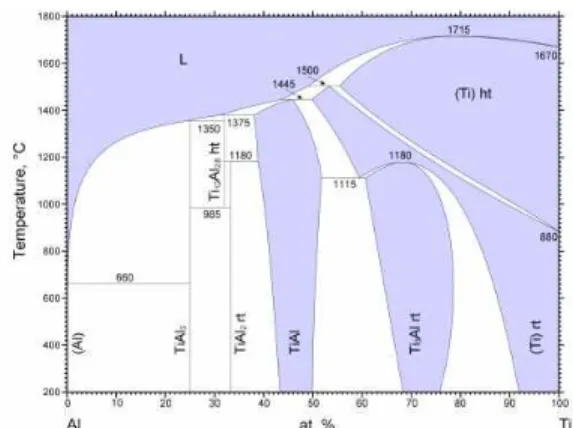
The mechanical properties of Tiand Al have great dif- ferences in melting point, boiling point, thermal con- ductivity, thermal expansion, etc. And also lattice struc- ture was different. During the welding process, Al is easily lost at the temperature below the melting point of Ti because of melting point and low density of Al. In addition, the brittle Ti and Al intermetallic compounds such as Ti3Al, TiAl, TiAl3, etc., are easily formed as shown Figure 1. As a result, it is difficult to sound dis- similar welds of Ti and Al materials.
Table 1: Physical properties of materials used
Al Ti
Melting point (℃) 660 1668
Boiling point (℃) 2519 3287
Density (g/cm
3) 2.70 4.51
Thermal conductivity
(W/m∙K) 237 22
Thermal expansion
(µm·m
−1·K
−1) (25 °C) 23.1 8.6
Vapor pressure (°C)(1kPa) 2054 2692