This paper is extended and updated from the short version that appeared in the Proceedings of the International
†Corresponding Author: Division of Marine Engineering, Korea Maritime and Ocean University, Busan, 606-791, Korea, E-mail: [email protected], Tel: 051-410-4253
1Joining and Welding Research Institute, Osaka University, JAPAN, E-mail: [email protected], Tel: +81-6-6879-8682 2 Joining and Welding Research Institute, Osaka University, JAPAN, E-mail: [email protected], Tel:
+81-6-6879-8682
Microstructural behavior on weld fusion zone of Al-Ti and Ti-Al dissimilar lap welding using single-mode fiber laser
Su-Jin Lee1
․
Seiji Katayama2․
Jong-Do Kim†(Received January 3, 2014 ; Revised February 26, 2014; Accepted February 26, 2014)
Abstract: Titanium (Ti) metal and its alloys are desirable materials for ship hulls and other ocean structures because of their high strength, corrosion-resistance and light weight properties. And light weight and corro- sion-resistant aluminum (Al) is the ideal metal for shipbuilding. The joining of Ti and Al dissimilar metals is one of the effective methode to reduce weight of the structures. Ti and Al have great differences in materials properties, and intermetallic compounds such as Ti3Al, TiAl, TiAl3 are easily formed at the contacting surface between Ti and Al. Thus, dissimilar welding and joining of Ti and Al are considered to be very difficult.
However, it was clarified that ultra-high speed welding could suppress the formation of intermetallic com- pounds in the previous study. Results of tensile shear strength increases with an increase in the welding speed, and therefore extremely high welding speed (50 m/min) is good to dissimilar weldability for Ti and Al. In this study, therefore, full penetration dissimilar lap welding of Ti (upper) - Al (lower) and Al (upper) - Ti (lower) with single-mode fiber laser was tried at ultra-high welding speed, and the microstructure of the interface zones in the dissimilar Al and Ti weld beads was investigated.
Keywords: Ti, Al, Dissimilar welding, Laser, Intermetallic compound
1. Introduction
Dissimilar welding has been received great attention because of good advantages such as reducing weight, improving material properties, supplementing each ma- terial and saving rare metals. Ti metal and its alloys are one of desirable materials for ocean structures be- cause of their good properties such as a high strength, corrosion-resistance and light weight. And light weight and corrosion-resistant Al is the ideal metal for shipbuilding. If constructed in Ti and Al, ships would have lighter weight for the same size with good an anti-corrosive property. But Ti has been avoided by the shipbuilding industry, because Ti costs up to nine
times more than steel. And Al and Ti are technically difficult to manufacture into marine vessels. As an implication there is need for a measure to utilize the superior properties of dissimilar materials such as low weight and low cost of Al and anti-corrosive and high strength of Ti discussed before. Several approaches about Ti and Al dissimilar welding have been made in the past [1]-[5]. In the previous researches, the filler metals, and FSW welding and typical welding ar- rangement butt joint were performed to reduce gen- eration of intermetallic compounds [1]-[5]. Also, butt joint was usually used to weld the Ti and Al dissim- ilar metals because control material percentage was
easier than lap welidng due to weld location [1]-[5], but there were few reports and lack of data of lap welding of Ti and Al dissimilar metals. Therefore, a study of the lap welding process and compound struc- tural behavior of Ti and Al is important as basic data of Ti and Al dissimilar welding for various fields.
Especially, a difference of microstructural behavior in combination of Ti (upper) - Al (lower) or Al (upper) - Ti (lower) lap sheets was investigated as an im- portant viewpoint in dissimilar welding in this study.
2. Materials and Experimental Procedures
2.1 Materials Used
The materials used in experiments were pure titanium and commercially available virtually pure aluminum A1050 sheets. These specimences size is 0.3 mm thick- ness, 30 mm width and 60 mm length. The Ti used this study has over 99.9% Ti and Al050 has about 99.57%
Al. Physical properties of materials used show Table 1.
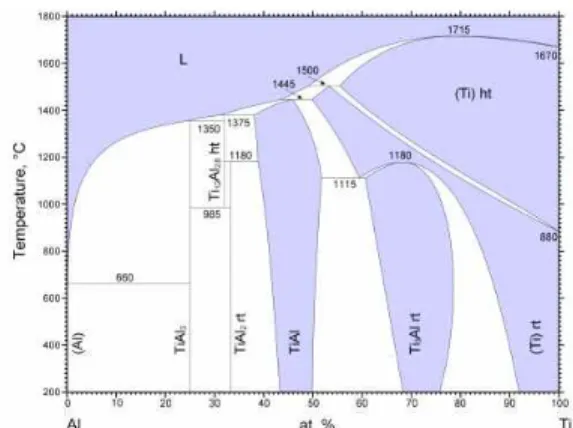
The mechanical properties of Tiand Al have great dif- ferences in melting point, boiling point, thermal con- ductivity, thermal expansion, etc. And also lattice struc- ture was different. During the welding process, Al is easily lost at the temperature below the melting point of Ti because of melting point and low density of Al. In addition, the brittle Ti and Al intermetallic compounds such as Ti3Al, TiAl, TiAl3, etc., are easily formed as shown Figure 1. As a result, it is difficult to sound dis- similar welds of Ti and Al materials.
Table 1: Physical properties of materials used
Al Ti
Melting point (℃) 660 1668
Boiling point (℃) 2519 3287
Density (g/cm3) 2.70 4.51
Thermal conductivity
(W/m∙K) 237 22
Thermal expansion
(µm·m−1·K−1) (25 °C) 23.1 8.6 Vapor pressure (°C)
(1kPa) 2054 2692
Vickers hardness (Mpa) 167 970
Poisson ratio 0.35 0.32
Figure 1: Phase diagram of Al and Ti system.
2.2 Experimental Procedures
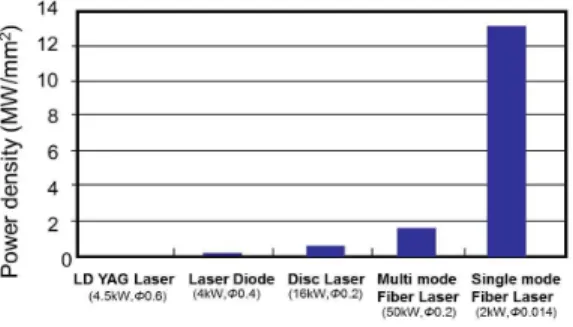
A single-mode fiber laser which used in this study has many merits in comparison with the others heat sources of welding. It has high quality and high effi- ciency comparison with others heat sources. Moreover, a single-mode fiber laser can be easily focused to an extremely small spot size. Therefore, an extremely high power density can be achieved. Figure 2 shows comparison of a power density (MW/mm2) among typical lasers. Furthermore, a single-mode fiber laser has compact size and a long life comparison to other lasers. The laser with a higher power density can pro- duce a deeper penetration weld and achieve a higher welding speed than other lasers with the lower power density (Figure 2) at the same laser powers [6].
Therefore, a laser lap welding of Ti and Al dissimilar metals was performed using a single-mode fiber laser at an extremely high welding speed, in this study.
And microstructural behavior and phases formed of the weld fusion zones were investigated in detail.
Figure 3 shows the experimental device set-up for dissimilar laser lap welding of Ti and Al. Ti and Al specimences were laped and fixed to a jig on ul- tra-high speed stage. The single-mode fiber laser in- stalled in this study has the 2 kW maximum power and the 1070 nm wavelength, and a laser beam pa- rameter product (BPP) was 1.05 mm∙mrad. The high power density laser beam was delivered by an optical
Figure 2: Difference of energy density (kW/mm2) graph according to laser equipment.
fiber and it focused on the workpiece surface by laser head. The spot size of a laser beam was about 20 ㎛ at the just focal point. The laser beam was directly ir- radiated on 0.3 mm thick material sheets overlapped.
Welding conditions used in this experiment for Ti and Al dissimilar laser lap welding were a 1 kW laser power and the welding speed of 5, 10, 20, 30, 40 and 50 m/min. The laser focal condition was a 0 mm de- focused distance. An Ar shielding gas of 35 L/min was used to suppress oxidation of the molten surface of upper parts during laser lap welding.
Disk laser was used to compare the weldability with single-mode laser. The disk laser has the maximum power of 16 kW and the 1030 nm wavelength. The spot size of a laser beam was about 300 ㎛ at the just focal point. The laser beam was directly irradiated on 0.3 mm thick material sheets overlapped.
The mechanical properties of the Ti and Al dissim- ilar welds zone under the all welding conditions were evaluated by the tensile shear test at a 0.1 mm/s travel-
Figure 3: Schematic experimental set-up for 2 kW single-mode fiber laser welding of Al and Ti dissim- ilar metals.
ing speed. Microstructure of the cross sections of the weld parts was observed using a microscope, an energy dispersive X-ray spectroscopy (EDX) and a transmission electron microscopy (TEM) to investigate the weld fu- sion zones to understand the production of a strong weld resulting from the high speed welding process.
3. Results and Discussion
3.1 Ti and Al dissimilar welds produced with 16 kW disk laser at various high welding speeds
It is generally recognized until now that dissimilar welding of Ti and Al metals is too difficult to pro- duce sound welds due to their formation of brittle in- termetallic compounds. In this study, full penetration lap welding of Ti and Al sheets was performed using disk laser under various conditions. And several con- ditions were selected which had relatively good weld condition in this paper. Figure 4 shows the welds bead of Al (upper) – Ti (lower) and Ti (upper) – Al (lower) dissimilar welds made with disk laser. A laser power 1.25 kW and 9 m/min welding speed had best weldability of Al–Ti and 1kW laser power and 10m/min welding speed was good condition for Ti (upper) –Al (lower) in this study. But welds beads had cracks due to brittle intermetallic compounds un- der all conditions. Crack was generated easily in Al- Ti welds zone compare with Ti-Al conditions.
The mechanical properties of the welds were eval- uated by the tensile shear test. The obtained loads of the tensile shear test for Al-Ti and Ti-Al were 565 N and 587N respectively. It was difficult to make sound welds because a spot size of laser beam was large comparison with a thickness of workpiece, and a thickness of specimens was too thin and Al has very low viscosity to hold melt parts sufficiently.
3.2 Ti and Al dissimilar welds produced with
single-mode fiber laser at various high welding
speeds
Figure 4: Photographs of top and bottom surface ap- pearances and fractural parts photos of Ti and Al dis- similar welds made with disk laser at different welding conditions.
A dissimialr lap welding of Ti and Al metals was performed at various welding speeds by a sin- gle-mode fiber laser. To produce sound welds, high welidng speed welding was tried because may the in- termetallic compounds formation can be suppress. It was clarified that ultra-high speed welding could sup- press the formation of intermetallic compounds in the previous study [7].
Figure 5 shows top and bottom surface appear- ances of weld beads of Ti and Al dissimilar welds made with a 1kW laser power and various welding speeds from 10 to 50 m/min under the just focal conditions. Full penetration welds were obtained un- der all the conditions as shown Figure 5. A crack was generated in the bottom surface of weld bead (Ti side) made at 10 m/min welding speed for the Al-Ti combination, but relatively good welds were formed in the all the weld beads except a having cracks con- dition in Figure 5. The top and bottom welds bead widths were getting narrower with an increase in welding speed. The mechanical properties of the dis- similar welds under the all welding conditions were evaluated using the tensile shear test
Figure 6 indicates the results of tensile shear test with fracture parts photos for Ti and Al similar and dissimilar welds with single-mode fiber laser under various welding speed conditions. The longitudinal
axes show the obtained loads of the tensile shear test.
The tensile shear loads of Ti-Ti similar welds were the highest, while Al-Al similar welds had the small- est loads among tensile shear loads tested in Figure 6. The tensile shear loads of the Ti and Al dissimilar welds were higher than Al-Al welds one under the all conditions. The tensile shear loads of Ti and Al welds were about 700 N (620~720 N) except Ti-Al welds produced at welding speed of 40 and 50 m/min. It had higher tensile strength than results of disk laser welds (587 N) which discussed in chapter 3.1. Even though, welded area of disk laser welding was lager than single-mode laser one due to the spot size. In the case of similar welds of Ti and Al, the fracture occurred in the weld beads nearby Ti and Al interface zone, and the tensile shear loads decreased with increasing welding speed due to the decreased welding area. In the most cases of dissimilar welds of Al-Ti and Ti-Al, the fracture occurred in the base Al metal, as shown in the polished cross sectional im- ages of Figure 6 and thus the loads were almost equal and this the load were similar with value of 0.3 mm Al tensile shear load. The tensile shear strength increased with welding speed increasing accompany- ing with a decrease in the welds zone, and therefore higher welding speed is better condition for dissimilar weldability for Al and Ti. Al (upper) - Ti (lower) specimence location has better weldability than that of the opposite Ti-Al combination, averagely.
Especilly, Al-Ti dissimilar welds at 50 m/min weld- ing speed were fractured at Al base metal nearby weld fusion zones, although the weld beads were very narrow. The reason may be the formation of brittle intermetallic compounds was reduced and this phenomenon was leading to a strong dissimilar welds of Al and Ti. While, Ti (upper) - Al (lower) dissim- ilar welds at 50 m/min welding speed fractured in the welds area nearby interface of two metals. The differ- ence may be according to the distribution of inter- metallic compounds and Ti-rich zone of lapped inter-
(a) Al (upper) and Ti (lower)
(b) Ti (upper) and Al (lower)
Figure 5: Photographs of top and bottom surface ap- pearances of Ti and Al dissimilar welds made with single-mode laser at different welding conditions.
face by specimence set-up.
The results of tensile shear test in this study has a different tendency comparison with the previous re- search results [1]-[4] which is easy fracture in Ti and Al welds zones near the interface of two sheets beca- seu of brittle intermetallic compounds produced. To understand and confirm the effects of welding speed and workpieces set-up on weldability, the micro- structural behavior and the formation of phases should be elucidated by TEM in detail.
3.3 Microstructural behavior and phases formation of weld fusion zone
It was confirmed that ultra-high speed welding could suppress the amount of intermetallic compounds formed during dissimilar welding in the previous study [7]. These are summaries of it as follows.
During the dissimilar welding, Ti was locally dis- tributed into Al metal sheets, while very small amount of Al was distributed into Ti metal sheets because small amounts of Al are easily included in Ti as Ti
Figure 6: Results of tensile shear test for Ti and Al similar and dissimilar welds with single-mode laser.
solid solution. And intermetallic compounds existence zone was changed by welding speed. The weld zone was reduced by welding speed increased. It is more- over confirmed from the SEM photo that a larger area of Ti enriched zone was flowed into the melted Al fu- sion zone.To know the reason for the tendency of ten- sile shear test results, microstructure of welds zone and the characteristics were analyzed. The difference in welds characteristics by various welding speed and material set-up were investigated. The formation ten- dency of microstructural phases and intermetallic com- pounds in weld fusion zones were subjected to XRD analysis in the previous study [7]. At the slower speed of 10 m/min, Al3Ti intermetallic compounds were de- tected with Al and Ti basemetals. On the other hand, no peaks from intermetallic compounds were found and peaks from Al and Ti phases were only identified at speed of 50 m/min. It means 50 m/min welidng speed conditions has no intermetallic compounds ac- cording to previous study data [7].
From the above results, it is supposed that inter- metallic compounds were formed at the welding speed of 10 m/min, resulting in the formation of cracks. On the other hand, the formation tendency of brittle intermetallic compounds should be reduced or not generated at the extremely high welidng speed.
Accordingly, the above result leads to high pro- duction possibility of sound and strong dissimilar
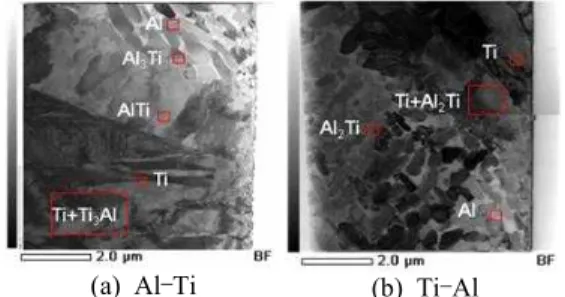
(a) Al–Ti (b) Ti–Al Figure 7: TEM photos and TEM results of laser weld fusion zones near lap joint interfaces of dis- similar Al (upper) – Ti (lower) and Ti (upper) – Al (lower) sheets produced at 50 m/min.
welds in Al and Ti sheets using a single-mode fiber laser at ultra-high welding speed.
To confirm the exact microstructure and existence of intermetallic compounds of high speed laser welds (50 m/min in this study), microstructure phases were observed and analyzed with TEM with EDX analysis.
Figure 7 (a) and (b) show TEM images of the boun- dary layer near the Al and Ti mixed zone of dissim- ilar Al-Ti and Ti-Al lap sheets subjected to laser welding at the speed of 50 m/min. The small red box areas were analyzed with EDX, and the data were summarized using atomic percentages of Al and Ti and phase diagram system in Figure 7. Figure 7 red box areas exhibited formation phases of Al, Al3Ti, AlTi, Ti, Ti+Al3Ti, Ti+Al2Ti, Al2Ti, and Al, respectively. Al-Ti has Al3Ti intermetallic compounds and Ti-Al has Al2Ti. It was found out that the kind of formation intermetallic compounds was changed by the specimence set-up.
The weld fusion zone was solidified at extremely high solidification rates, and therefore the growth of intermetallic compound phases was suppressed at high welding speeds. And different types of intermetallic compounds were generated depends on specimen location. Especially, Ti area of Al-Ti looks lamellar microstructure and needle-shaped martensite.
Needle-shaped martensitic Ti phase was generated on Ti rich side of a weld fusion zone, and dendritic phases of intermetallic compounds were formed from
Ti phase in Figure 7 (a).On the other hands, marten- sitic Ti phase was not generated on Ti rich side of a weld fusion zone, and small size dendritic phases and island type phases of intermetallic compounds were formed from Ti phase in Figure 7 (b).
In this study, very small sized grains and nee- dle-shaped martensitic Ti phases were generated by extremely high melting and solidification rate during welding with a high power density laser beam. The amount of needle-shaped martensitic Ti phase gen- erated under Al–Ti specimen set-up conditions at 50 m/min welding speed. This is in good agreement of the general interpretation of rapid solidification.
4. Conclusions
In order to find out the possibility of Ti and Al dissimilar lap welding, dissimilar laser lap welding of Ti and Al metals was carried out under the Al-Ti and Ti-Al specimen combinations at various welding speeds using single-mode fiber laser having very high power density. The results of the tensile shear test in- dicated that Al-Ti dissimilar weld joints had higher tensile shear load than Ti-Al and averagely higher welding speed has stronger tensile shear loads.
However, single-mode laser welding process makes higher tensile shear load than disk laser dissimilar welding. According to microstructural observation, in the case of the dissimilar welding at the welding speed of 50 m/min and 1 kW laser power, formation of intermetallic compounds was sufficiently reduced.
On the other hand, intermetallic compounds were formed more easily at 10 m/min welding speed than higher speed. But amount of brittle intermetallic com- pounds at 10 m/min was reduced to enough to sup- press fracture in weld zone using high power density laser which had a very small spot size.
It was confirmed that the ultra-high welding speed of 50 m/min could reduce the formation area of brittle intermetallic compounds such as Al3Ti and Al2Ti.
Especially, Al3Ti intermetallic compounds were gen-
erated in Al-Ti and Al2Ti was generated in Ti-Al. It was confirmed that the kind of formation intermetallic compounds was changed by the Al and Ti locations.
And a needle-shaped martensitic Ti phase was gen- erated under Al-Ti condition at 50 m/min welding speed. On the other hands, martensitic Ti phase was not generated on Ti rich side of a weld fusion zone, and small size dendritic phases and island type phases of intermetallic compounds were formed from Ti phase under Ti-Al condition at 50 m/min welding speed.
Consequently, dissimilar lap welding of Al and Ti sheets using a single-mode fiber laser at extremely high welding speeds suggests the possibility of sound and strong dissimilar welds by reducing formation of brittle intermetallic compounds. And Al and Ti speci- men location is one of important factor of welding conditions for dissimilar lap welding of Al and Ti sheets due to difference of intermetallic compounds formations and microstructural behavior such as area of Ti rich zone and mixed zone, and phases shape.
Acknowledgement
This research was supported by the MSIP (Ministry of Science, ICT &Future Planning), Korea, under the ITRC(Information Technology Research Center) support program supervised by the NIPA(National IT Industry Promotion Agency (NIPA-2013-H0301-13-2009), and this work was the outcome of a Manpower Development Program for Marine Energy by the Ministry of Oceans and Fisheries.
References
[1] C. Leyens and M. Peters, Titanium and Titanium Alloys; Fundamentals and Applications, Weinheim, WILEY-VCH GmbH & Co. KGaA, 2003.
[2] S. Chen, L. Li, Y. Chen, and J. Huang,
“Joining mechanism of Ti/Al dissimilar alloys during laser welding-brazing process”, Journal of Alloys and Compounds, vol. 509, no. 3, pp.
891-898, 2011.
[3] Y. C. Chen and K. Nakata, “Microstructural characterization and mechanical properties in friction stir welding of aluminum and titanium dissimilar alloys”, Materials and Design, vol.
30, no. 3, pp. 469-474, 2009.
[4] Katayama Seiji, “Laser welding”, Journal of the Japan welding society, vol. 78, no. 2, pp.
124-138, 2009 (in Japanese).
[5] Katayama Seiji, “Laser welding for manu- facturing innovation”, Journal of the Japan welding society, vol. 78, no. 8, pp. 682-692, 2009 (in Japanese).
[6] Hideyasu Shamoto and Kazuhisa Mikame,
“The feature of high power single mode fiber laser processing”, Proceedings of the 72nd Laser Materials Processing Conference, pp.
31-34, 2009.
[7] S. J. Lee, H. Nakamura, Y. Kawahito, and S.
Katayama, “Weldability of Ti and Al dissim- ilar metals using single-mode fiber laser”, Journal of Laser Micro/Nano engineering, vol.
8, no. 2, pp. 149-154, 2013.