• 검색 결과가 없습니다.

Synthesis of Nanoporous Metal Oxide Films Using Anodic Oxidation and Their Gas Sensing Properties

N/A
N/A
Protected

Academic year: 2021

Share "Synthesis of Nanoporous Metal Oxide Films Using Anodic Oxidation and Their Gas Sensing Properties"

Copied!
8
0
0

로드 중.... (전체 텍스트 보기)

전체 글

(1)

http://dx.doi.org/10.5369/JSST.2018.27.1.13 pISSN 1225-5475/eISSN 2093-7563

Synthesis of Nanoporous Metal Oxide Films Using Anodic Oxidation and Their Gas Sensing Properties

Jun Min Suh

1

, Do Hong Kim

2

, and Ho Won Jang

1,+

Abstract

Gas sensors based on metal oxide semiconductors are used in numerous applications including monitoring indoor air quality and detecting harmful substances like volatile organic compounds. Nanostructures, for example, nanoparticles, nanotubes, nanodomes, and nanofibers have been widely utilized to improve gas sensing properties of metal oxide semiconductors, and this increases the effective surface area, resulting in participation of more target gas molecules in the surface reaction. In the recent times, 1-dimensional (1D) metal oxide nanostructures fabricated using anodic oxidation have attracted great attention due to their high surface-to-volume ratio with large- area uniformity, reproducibility, and capability of synthesis under ambient air and pressure, leading to cost-effectiveness. Here, we pro- vide a brief overview of 1D metal oxide nanostructures fabricated by anodic oxidation and their gas sensing properties. In addition, recent progress on thin film-based anodic oxidation for application in gas sensors is introduced.

Keywords: Gas sensor, Metal oxides, Anodic oxidation, Nanoporous, Nanotube

1. INTRODUCTION

The development of building structures and interior design for efficient and effective utilization of indoor space, has significantly increased the number of human beings spending their lives indoors. A recent survey on average Americans has revealed that they spend 93% of their lives indoors [1]. Therefore, the concept of indoor air quality has attracted a great deal of interest with regard to human health. Indoor air consists of ambient air and various minor gaseous substances emitted by various sources like building materials, printers, paints, glues, or even due to human activity. Those with a low vapor pressure, consequently existing in gaseous phase at room temperature, are classified as volatile organic compounds (VOCs). The VOCs, even in very small concentrations, are known for their potential harmful effects on the human body. For example, form aldehyde (HCHO) from

building materials induces sick building syndrome, while benzene (C

6

H

6

) from car garages or tobacco smoke is notorious carcinogen [2,3]. In order to sensitively and selectively detect the VOCs and to prevent damages to human body, a lot of effort has been put into developing gas sensors with various materials. The gas sensors based on metal oxide semiconductors especially show very selective detection of VOCs, but their plain films show relatively low gas response. Since their low gas response can result in poor overall selectivity of various VOCs, a number of strategies including catalyst decoration [4-6], heterojunctions [7], and nanostructures [8-10] have been suggested to overcome the shortages. Metal oxide nanostructures in 1-dimension (1D), including nanorods, nanocolumns, nanotubes, or nanobamboos [11-16] have very high surface-to-volume ratio thus providing enlarged surface area to interact with the target gas molecules. The enlarged surface area contributes to an enhancement in the gas response, or sensitivity for the effective detection of the VOCs.

The 1D metal oxide nanostructures can be synthesized using various methods, such as dc sputter, e-beam evaporation, hydrothermal method, solvothermal method, etc. However, their synthesis conditions of high temperature and high pressure require complex and advanced equipment and long reaction times. As an alternative, anodic oxidation method, which is feasible at ambient air, temperature, and pressure with a high uniformity of the synthesized nanostructures, can be used.

Herein, we have summarized 1D metal oxide nanostructures

1

Department of Materials Science and Engineering, Research Institute of Advanced Materials, Seoul National Unversity

Gwanank-ro 1, Gwanak-gu, Seoul 08826, Republic of Korea

2

Department of Materials Science and Engineering, Korea University Inchon-ro 22 gil 6-3, Seongbuk-gu, Seoul 02841, Republic of Korea

+

Corresponding author: [email protected]

(Received: Jan. 2, 2018, Revised: Jan. 22, 2018, Accepted: Jan. 29, 2018)

This is an Open Access article distributed under the terms of the Creative Commons Attribution Non-Commercial License(http://creativecommons.org/

licenses/bync/3.0) which permits unrestricted non-commercial use, distribution,

and reproduction in any medium, provided the original work is properly cited.

(2)

anodic oxidation directly on the electrodes to show capability of practical gas sensor applications.

2. STRATEGIES TO ENHANCE GAS SENSING PROPERTIES BY ANODIC

OXIDATION

2.1 Anodic oxidation

Anodic oxidation has been widely conducted in various fields, especially in industrial fields for surface treatment of metal.

Through anodic oxidation, a thin oxide layer can be formed on the surface of metal, resulting in significantly enhanced corrosion- resistivity and mechanical properties. The research of previous decades reported that acidic electrolytes can control the morphology of the oxide films form nanoporous structures, and its application has been broadening to Al, Ti, Ta, Fe, and various other metals [17-20]. The Schmuki group summarized various anodic morphologies obtained using the method of anodic oxidation (Figure 1) [21]. The diameter, shape, and length of nanoporous structures can be controlled through appropriate selection of the electrolyte, concentration, applied voltage, and reaction time. With all conditions optimized, highly ordered nanotubes, as shown in Figure 1b and c, can be synthesized.

Paulose et al. synthesized TiO

2

nanotubes using the anodic oxidation of Ti foil under various conditions, such as different applied voltages, electrolytes, and reaction times [23]. As shown in Figure 2, electrolytes and other conditions result in different morphologies of the synthesized TiO

2

nanotubes. Among various electrolytes, the use of a fluoride-based electrolyte for the anodic oxidation of Ti foil has been the most effective strategy in synthesizing nanotubes, and was first reported by Grimes group in 2001 [24]. The composition of the electrolyte is a critical factor in determining the porosity of the nanostructures and the chemical

composition of the nanotubes. When the voltage is applied, the oxygen and hydroxyl ions interact with the Ti foil and a thin oxide layer is formed. Oxygen and hydroxyl ions then penetrate the oxide layer and move into the interface between the metal and metal oxide in order to react with Ti continuously. Meanwhile, Ti

4+

ions move to the interface and react with oxygen and hydroxyl ions to form TiO

2

. The fluoride ions and applied voltage induce field-enhanced oxide dissolution at the interface of the oxide and electrolyte. Continuous applied voltage results in the formation of a dipole in Ti-O bond. Dissolution of metal cations into the electrolyte is reduced, and chemical dissolution, rather than electric field-induced dissolution dominates to form vertical pores at the interface between the oxides and electrolyte.

Therefore, the use of fluoride ions facilitates efficient and effective formation of porous metal oxide nanostructures, and can be applied to various materials. Among various applications of synthesized porous metal oxide nanostructures, we will focus on their gas sensing properties.

Fig. 1. The electrochemical anodization process and possible anodic morphologies: (a) I) metal electro-polishing, II) formation of compact anodic oxides, III) self-ordered oxides (nanotubes or nanopores), IV) rapid (disorganized) oxide nanotube forma- tion, V) ordered nano-porous layers. Examples of morphol- ogies of obtained structures: (b) Classical highly organized nanoporous alumina (taken with permission from Ref.[22], (c) highly ordered TiO

2

nanotubes (in top and side view) with dimpled structure (right) on metal surface when tubes are removed, (d) disordered TiO

2

nanotubes growing in bundles.

RBA = rapid-breakdown anodization. Reprinted with per-

mission from [21]. Copyright © 2011 John Wiley & Sons,

Inc.

(3)

2.2 Bulk material based gas sensors

The anodic oxidation is usually conducted on a metal foil or metal plate held at a working electrode with another metal plate, like Pt, as a counter electrode. When the metal foil and plate are anodized, only a single surface gets oxidized, and the metal part remains after anodic oxidation. Therefore, in order to measure the gas sensing properties of the anodized metal oxides, various studies have reported electrical contacts made in either top-bottom contact, or lateral contact on top of the metal oxide nanostructures [25-28]. Varghese et al. reported TiO

2

nanotubes synthesized by the anodic oxidation of Ti foil for the gas sensing application [29].

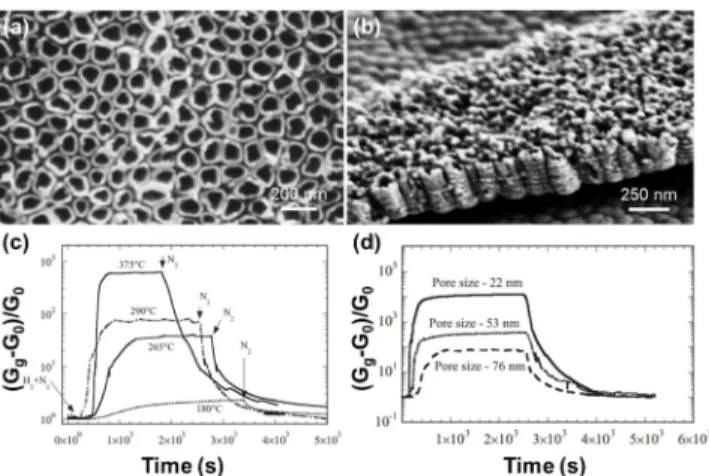
They made electrical contact by depositing two platinum pads (10 mm × 2 mm spaced 2 mm apart) on top of the nanotube array. The morphologies of the nanotubes are shown in Figures 3a and b, and their gas sensing properties with respect to 1000 ppm hydrogen at 290 °C are shown in Figures 3c and d. Among the various diameters of nanotubes (22, 53 and 76 nm), 22 nm exhibited 200 times higher gas response than 76 nm diameter. As the diameter of the nanotube decreases, the total surface area increases for more gas molecules become accessible, leading to better gas sensing properties. Owing to their porous nanostructure, TiO

2

nanotubes exhibit sensitive behavior to hydrogen. However, two platinum pads on top of the nanotube array blocks the access of gas molecules and the gap of 2 mm between two electrical contacts

can increase electrical noise owing to electron scattering, while detecting the target gas at low concentration.

Joo et al. reported gas sensors based on TiO

2

nanotubes using anodic oxidation of Ti thin films deposited by ion-beam sputter deposition (IBSD) on a glass substrate (Figure 4a) and Figure 4b show their cross-sectional TEM images [30]. Using holed acrylic plates with four screw bolts, they could successfully anodize a selective area on the metal thin film. This strategy minimized the interference of the top electrodes on nanostructures. However, the distance between two electrodes was 5 mm and could not guarantee stable sensing behavior under low gas concentration.

The authors decorated TiO

2

nanotubes with Pt and Pd to obtain further enhanced gas sensing properties owing to catalytic effects.

Figures 4c-e show gas sensing properties of pure TiO

2

nanotubes, Pt-added TiO

2

nanotube, and Pd-added TiO

2

nanotube to 0.1–10 vol% hydrogen. With catalyst decoration, the TiO

2

nanotubes exhibited dramatically enhanced gas responses to hydrogen. Still, the resistance level was relatively high, which can be attributed to the depletion layer formed by the catalyst decoration, but a smaller distance between the two electrodes can lower the resistance level, leading to more stable sensing behavior.

In addition to above studies, there have been numerous reports on gas sensing properties of metal oxide nanotubes including SnO

2

[31], Nb

2

O

5

[32], and WO

3

[33] synthesized by anodic Fig. 2. TiO

2

nanotubes on Ti foil using anodic oxidization under con-

dition of (a) 60 V in 0.25wt% NH

4

F in ethylene glycol for 17 h, (b) 40 V in DMSO containing 2% HF for 69 h, (c) 60 V in DMSO containing 2% HF for 70 h, and (d) 35 V in form- aldehyde-based electrolyte for 48 h. Reprinted with permis- sion from [23]. Copyright © 2006 American Chemical Society.

Fig. 3. (a, b) Field emission scanning electron microscopy images of

a TiO

2

nanotube array sample prepared using a 20 V anod-

ization voltage, then subsequently annealed at 500 °C for 6 h

in an oxygen ambient: (a) top view (b) vertical cross-sectional

view. Normalized change in electrical conductance of (c) 76

nm diameter TiO

2

nanotube array at different temperatures

and (d) TiO

2

nanotube arrays of 76 nm, 53 nm, and 22 nm

diameter at 290 °C to 1000 ppm hydrogen. G

g

is the con-

ductance in the presence of the test gas and G

0

the base resis-

tance associated with a nitrogen atmosphere. Reprinted with

permission from [29]. Copyright © 2003 John Wiley & Sons,

Inc.

(4)

oxidation. However, they could not escape from the conventional structure of top-bottom or top electrical contacts. This limited structure has originated from incomplete anodic oxidation of metal foil and remaining metal parts on the other side of the metal foil and plate, leading to complex electrical contact. Therefore, further studies were required for development of a novel structure appropriate for practical application, and the thin film-based anodic oxidation method has been suggested to meet the above demands.

2.3 Thin film based gas sensors

Thin film-based anodic oxidation is suitable for the synthesis of metal oxide nanotubes appropriate for practical gas sensors.

Compared to a metal foil or plate, a metal thin film is deposited directly on the electrodes using a dc sputter or an e-beam evaporator. Then complete anodic oxidation of the thin film is undertaken. The mechanism for the anodic oxidation of the metal thin film is the same as that for the bulk metal foil or plate.

However, when anodic oxidation is undertaken on the metal thin film, porous nanostructures may not form and even exfoliation of the thin film can happen, which were not an issue in the bulk material-based anodic oxidation.

D. H. Kim et al. [34] revealed that the problem was the crystallinity of the deposited metal (Ti) thin film. The crystallinity of Ti thin film is inferior to that of Ti foil. In order to improve the

crystallinity, the deposition temperature should have been over 500 °C and a high deposition temperature reduces the chance of exfoliation owing to improved adhesion of the Ti thin film.

Figures 5a-c show the experimental procedure for the synthesis while Figures 5d and e show the fabricated sample before and after the anodic oxidation. As shown in Figures 5f and g, in case of deposition at room temperature, grain size of Ti thin film is very small and very coarse. In other words, the interfaces between Ti crystal grains interfere with the growth of porous nanostructures, leading to the failure of forming porous nanostructures. On the other hands, deposition at 600 °C shows relatively smooth grain interfaces which is beneficial for the growth of porous nanostructures (Figures 5h and i).

In addition, adhesion is another problem in anodic oxidation of the metal thin film. Since the adhesion between the substrate and Ti thin film deposited at room temperature is poor, when they are dipped in the acidic electrolyte, they are easily exfoliated.

However, when a Ti thin film is deposited at 600 °C, it not only

has almost similar crystallinity as that of a Ti foil or plate, but the

adhesion also becomes relatively good, and the film is densely

deposited so as to not be easily exfoliated from the substrate. The

thickness of Ti thin film is another factor that contributes to the

final nanostructures. If deposited thin film is too thin, etching at

the interfaces between electrolyte, metal film, and the substrate

occurs at a very early stage, leading to exfoliation of the thin film

regardless of the condition for the anodic oxidation. Therefore, the

Fig. 4. (a) Schematic of the process for fabricating TiO

2

nanotube sensors (b) TEM cross-sectional micrograph of a Pt-added TiO

2

nanotube

film used for EDS analysis. Circles show the areas where EDS analysis was performed. (c-e) Typical response of TiO

2

nanotube sensors

prepared from thin films of (c) pure Ti, (d) Ti-2% Pt, and (e) Ti-2% Pd upon exposure to H

2

with concentrations of 0.1, 1.0, and 10

vol% at 290 °C. IBSD = Ion-beam-sputter deposition. Reprinted with permission from [30]. Copyright © 2010 ECS - The Elec-

trochemical Society.

(5)

optimum thickness of Ti thin film for the synthesis of porous TiO

2

nanostructures was found to be more than 500 nm. Moreover, synthesis condition of porous TiO

2

depends significantly on the applied voltage. When the applied voltage increases, surface of the thin film tends to become coarser, and etching by fluoride ions forms larger holes resulting in porous nanotubes (Figure 5j).

Previously reported Ti foil based anodic oxidation exhibited varying thicknesses for the synthesized porous TiO

2

nanostructures, but 500 nm thin film-based anodic oxidation exhibited uniformly distributed 1 μm long nanotubes.

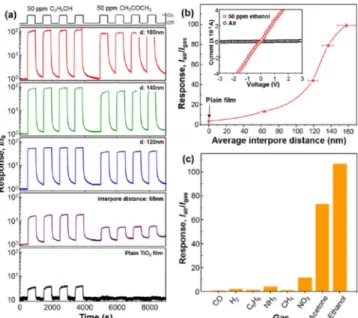
Figure 6 shows their gas sensing properties to 50 ppm C

2

H

5

OH and CH

3

COCH

3

. The TiO

2

nanotubes exhibited their highest gas response when pore diameter was 160 nm, and it was 30 times higher than that of a plain TiO

2

thin film. When exposed to various gases, the selectivity toward C

2

H

5

OH was established.

The sensitive behavior can be attributed to the nanoporous structures with optimized pore diameter and length. Since the electrodes had a 5 μm gap between them and were placed at the

bottom of the nanostructures, the electron scattering through the nanostructures as well as the interference of electrodes on the nanostructures were minimized.

The same group [35] applied the same method to Fe thin film.

Fe is also reported to be capable of anodic oxidation into Fe

2

O

3

by a fluoride-based electrolyte, similar to TiO

2

(Figure 7a). A Fe thin film with 500 nm thickness was deposited on Pt-interdigitated electrodes (IDEs)-patterned SiO

2

/Si substrate using e-beam evaporator at 400 °C. Figures 7b and c show optical micrographs of the Fe thin film before and after the anodic oxidation with distinct difference in color. Figure 7d and e show the SEM images of the synthesized Fe

2

O

3

nanotubes. The deposition of the Fe thin film at a high temperature enhanced the crystallinity and adhesion, resulting in little exfoliation under an applied voltage of 200 V.

The synthesized Fe

2

O

3

nanotubes were exposed to 50 ppm CH

3

COCH

3

. Compared to the plain Fe

2

O

3

thin film, Fe

2

O

3

nanotubes exhibited 10 times higher gas response owing to increase in the surface area originating from the porous nanostructures (Figure 7f). While TiO

2

nanotubes exhibited selective behavior towards C

2

H

5

OH, Fe

2

O

3

nanotubes exhibited selective detection of CH

3

COCH

3

(Figure 7g and h).

Fig. 6. (a) Response curve of the reference dense-planar TiO

2

film and TiO

2

nanotube film prepared with different inter-pore dis- tance to 50 ppm C

2

H

5

OH and CH

3

COCH

3

at 400 °C. The response for C

2

H

5

OH and CH

3

COCH

3

gases is presented as the normalized current l/l

0

. (b) Response change of dense-pla- nar TiO

2

film and TiO

2

nanotube film to 50 ppm C

2

H

5

OH gas at 400 °C. The inset shows the I−V characteristics of the TiO

2

nanotube sensor in 50 ppm C

2

H

5

OH gas at 400 °C. (c) Response of the TiO

2

nanotube sensor to various gases (all 50 ppm except 5 ppm NO

2

). Reprinted with permission from [34]. Copyright © 2013 American Chemical Society.

Fig. 5. (a−c) Sketch illustrating synthesis-in-place method to form TiO

2

nanotube films on Pt-IDE-patterned SiO

2

/Si substrate.

The key idea of the method is clamping the Pt IDEs as the current spreader during anodization. (d) Photograph of Ti film on Pt-IDE-patterned SiO

2

/Si substrate before anodiza- tion. Inset: optical microphotograph of the 500-nm-thick Ti films on Pt-IDE-patterned SiO

2

/Si substrate. (e) Photograph of TiO

2

nanotube film on Pt IDEs after anodization. Inset:

optical microphotograph of TiO

2

nanotube sensors. Cross-

sectional SEM images of Ti films deposited onto a SiO

2

/Si

substrate at room temperature (f) before and (g) after anod-

ization. The insets are plane-view SEM images. (h) Cross-

sectional SEM images of the Ti films deposited at 600 °C. (i)

Cross-sectional SEM images of the TiO

2

nanotubes formed

by anodization of Ti film deposited at 600 °C. (j) Change in

the diameter of TiO

2

nanotube films with various bias volt-

ages from 30 to 200 V. (k) Cross-sectional SEM micrographs

of the formation of TiO

2

nanotubes at 200 V for 30 s, and (l)

90 s. Reprinted with permission from [34]. Copyright ©

2013 American Chemical Society.

(6)

For enhancing the gas sensing properties of TiO

2

nanotubes, D.

H. Kim et al. decorated Au nanoparticles on them using electrodeposition of HAuCl

4

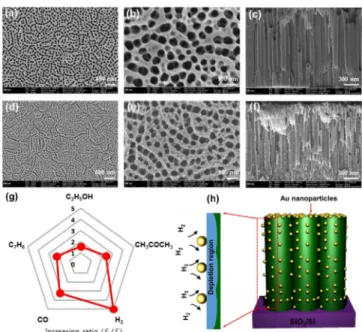
precursor solution for the electronic sensitization [36]. Figures 8a-c and Figures 8d-f show SEM images of bare TiO

2

nanotubes and Au-decorated TiO

2

nanotubes, respectively. Bright region stands for Au nanoparticles, and the average size of Au nanoparticles is approximately 10 nm with uniform distribution. While bare TiO

2

nanotubes exhibited selective detection of C

2

H

5

OH, Au-decorated TiO

2

nanotubes selectively detected H

2

(Figure 8g). This can be attributed to the electronic sensitization and catalytic effect of the Au nanoparticles (Figure 8h).

3. CONCLUSIONS AND PERSPECTIVES

3.1 (Times New Roman, 10, Line Height 1)

Compared to other previously reported synthesis methods for 1D metal oxide nanostructures, anodic oxidation has advantages like its operation at ambient air, temperature, and pressure, leading to its cost-effectiveness, with less complex equipment, as well as

its capability of uniform large-area synthesis. In this article, 1D metal oxide nanostructures fabricated by anodic oxidation and their gas sensing properties were reviewed.

Incomplete anodic oxidation of the metal foil and plate restrict the sensor structures, making them inappropriate for practical sensors. On the other hand, thin film-based anodic oxidation suggested a novel structure of gas sensors based on 1D metal oxide nanostructures for their practical application to gas sensors.

The gas sensors based on 1D metal oxide nanostructures synthesized by thin film-based anodic oxidation were found to show impressive gas sensing behavior, as well as potential for further enhancement of gas sensing properties using catalyst decoration.

ACKNOWLEDGMENT

This work was financially supported by the Nano-Material Technology Development Program (2016M3A7B4910) through Fig. 7. (a) Sketch illustrating our anodization method to form Fe

2

O

3

nanotube array on Pt-IDEs-patterned SiO

2

/Si substrate. The Key idea of our method is clamping the Pt electrodes as the current spreader during anodization. (b, c) Photographs of a Fe film on Pt-patterned SiO

2

/Si substrate (b) before anod- ization and (c) after anodization. (d) Plane-view SEM images of Fe

2

O

3

nanotube array on Pt-IDEs-patterned SiO

2

/Si sub- strate. (e) High magnification cross-sectional SEM images of the Fe

2

O

3

nanotube array. (f) Dynamic sensing transients of the dense-planar hematite films and hematite nanotube array to 50 ppm CH

3

COCH

3

at 350 °C. (g) Sensing transients of the hematite nanotube array to various gases. (h) Response of dense-planar hematite films and the hematite nanotube array to various gases. Reprinted with permission from [35]. Copy- right © 2014 American Chemical Society.

Fig. 8. A SEM micrograph of surface of (a) TiO

2

nanotubes and (d) Au-decorated TiO

2

nanotubes. High magnification SEM micrograph of surface and cross-section of (b, c) TiO

2

nano- tubes and (e, f) Au-decorated TiO

2

nanotubes, respectively.

(g) Polar plot of response ratio (S

a

/S

b

) between bare TiO

2

nanotubes and Au-decorated TiO

2

nanotubes to 50 ppm

C

2

H

5

OH, CH

3

COCH

3

, C

7

H

8

, H

2

, and CO at 350 °C, respec-

tively. (h) Schematic illustration for H

2

adsorption Au-dec-

orated TiO

2

nanotubes. Note that the width of the surface

depletion region is drastically increased by Au decoration via

electronic and chemical sensitizations. Reprinted with per-

mission from [36]. Copyright © 2014 The Korean Sensors

Society.

(7)

the National Research Foundation of Korea. Jun Min Suh acknowledges the Global Ph.D. Fellowship Program through the National Research Foundation of Korea funded by the Ministry of Education (2015H1A2A1033701).

REFERENCES

[1] A. Anderson, A. Cheung, and M. Lei, “Evaluation of Hong Kong’s indoor air quality management programme: certi- fication scheme, objectives, and technology,” Bachelor of Sci. Proj. Rep., Polytechnic Institute, Worchester, MA 2014.

[2] T. Tang, R. Gminski, M. Ko?nczo?l, C. Modest, B. Arm- bruster, and V. Mersch-Sundermann, “Investigations on cytotoxic and genotoxic effects of laser printer emissions in human epithelial A549 lung cells using an air/liquid expo- sure system,” Environ. Mol. Mutagen. Vol. 53, pp. 125-135, 2012.

[3] J. J. Zhang and K. R. Smith, “Indoor air pollution: a global health concern,” Br. Med. Bull. Vol. 68(1), pp. 209-225, 2003.

[4] J.-M Jeon, T. L. Kim, Y.-S. Shim, Y. R. Choi, S. Lee, K. C.

Kwon, S.-H. Hong, Y.-W. Kim, S. Y. Kim, M. Kim, and H.

W. Jang, “Microscopic Evidence for Strong Interaction between Pd and Graphene Oxide that Results in Metal-Dec- oration induced Reduction of Graphene Oxide,” Adv.

Mater., Vol. 29(15), pp. 1605929, 2017.

[5] Y.-S. Shim, H. G. Moon, D. H. Kim, L. Zhang, S.-J. Yoon, Y. S. Yoon, C.-Y. Kang, and H. W. Jang, “Au-decorated WO

3

cross-linked nanodomes for ultrahigh sensitive and selective sensing of NO

2

and C

2

H

5

OH,” RSC Adv., Vol. 3, No. 26, pp. 10452-10459, 2013.

[6] Y.-S. Shim, D. H. Kim, H. Y. Jeong, Y. H. Kim, S. H.

Nahm, C.-Y. Kang, J.-S. Kim, W. Lee, and H. W. Jang,

“Utilization of both-side metal decoration in close-packed SnO

2

nanodome arrays for ultrasensitive gas sensing,” Sens.

Actuator B-Chem., Vol. 213, pp. 314-321, 2015.

[7] J. M. Suh, Y.-S. Shim, D. H. Kim, W. Sohn, Y. Jung, S. Y.

Lee, S. Choi, Y. H. Kim, J.-M. Jeon, K. Hong, K. C. Kwon, S. Y. Park, C. Kim, J.-H. Lee, C.-Y. Kang, and H. W. Jang,

“Synergetically Selective Toluene Sensing in Hematite Dec- orated Nickel Oxide Nanocorals,” Adv. Mater. Technol., Vol.

2(3), pp. 1600259, 2017.

[8] H. G. Moon, Y.-S. Shim, D. Su, H.-H. Park, S.-J. Yoon, and H. W. Jang, “Embossed TiO

2

Thin Films with Tailored Links between Hollow Hemispheres: Synthesis and Gas Sensing Properties,” J. Phys. Chem. C, Vol. 115(20), pp.

9993-9999, 2011.

[9] Y.-S. Shim and H. W. Jang, “Design of Metal Oxide Hollow Structures Using Soft-templating Method for High-Perfor- mance Gas Sensors,” J. Sens. Sci. Tech., Vol. 25(3), pp.178- 183, 2016.

[10] Y.-S. Shim, L. Zhang, D. H. Kim, Y. H. Kim, Y. R. Choi, S.

H. Nahm, C.-Y. Kang, W. Lee, and H. W. Jang, “Highly sensitive and selective H

2

and NO

2

gas sensors based on surface-decorated WO

3

nanoigloos,” Sens. Actuator B-

Chem, Vol. 198, pp. 294-301, 2014

[9] H. G. Moon, Y.-S. Shim, D. H. Kim, H. W. Jang, S. H. Han, H.-H. Park, and S.-J. Yoon, “Highly Ordered Large-Area Colloid Templates for Nanostructured TiO

2

Thin Film Gas Sensors,” J. Nanosci. Nanotechnol., Vol. 12(4), pp. 3496- 3500, 2012.

[10] K. Lee, Y.-S. Shim, Y. G. Song, S. D. Han, Y.-S. Lee, and C.-Y. Kang, “Highly sensitive sensors based on metal-oxide nanocolumns for fire detection,” Sensors, Vol. 17(2), pp.

303, 2017.

[11] S. D. Han, M.-S. Noh, S. Kim, Y.-S. Shim, Y. G. Song, K.

Lee, H. R. Lee, S. Nahm, S.-J. Yoon, and J.-S. Kim, “Ver- satile approaches to tune a nanocolumnar structure for opti- mized electrical properties of In

2

O

3

based gas sensor,” Sens.

Actuator B-chem., Vol. 248, pp. 894-901, 2017.

[12] S. D. Han, H. G. Moon, M.-S. Noh, J. J. Pyeon, Y.-S. Shim, S. Nahm, J.-S. Kim, K. S. Yoo, and C.-Y. Kang, “Self doped nanocolumnar vanadium oxides thin films for highly selec- tive NO

2

gas sensing at low temperature,” Sens. Actuator B- Chem., Vol. 241, pp. 40-47, 2017.

[13] H. G. Moon, Y. R. Choi, Y.-S. Shim, K.-I. Choi, J.-H. Lee, J.-S. Kim, S.-J. Yoon, H.-H. Park, C.-Y. Kang, and H. W.

Jang, “Extremely sensitive and selective NO probe based on villi-like WO

3

nanostructures for application to exhaled breath analyzers,” ACS Appl. Mater. Interfaces, Vol. 5(21), pp. 10591-10596, 2013.

[14] H. G. Moon, Y.-S. Shim, H. Y. Jeong, M. H. Jeong, J. Y.

Jung, S. M. Han, J. K. Kim, J.-S. Kim, H.-H. Park, J.-H.

Lee, H. L. Tuller, S.-J. Yoon, and H. W. Jang, “Self-acti- vated ultrahigh chemosensitivity of oxide thin film nano- structures for transparent sensors,” Sci. Rep., Vol. 2, p. 588, 2012.

[15] J.-M. Jeon, Y.-S. Shim, S. D. Han, D. H. Kim, Y. H. Kim, C.-Y. Kang, J.-S. Kim, M. Kim, and H. W. Jang, “Vertically ordered SnO

2

nanobamboos for substantially improved detection of volatile reducing gases,” J. Mater. Chem. A, Vol. 3(35), pp. 17939-17945, 2015.

[16] D. H. Kim, D. M. Andoshe, Y.-S. Shim, C.-W. Moon, W.

Sohn, S. Choi, T. L. Kim, M. Lee, H. Park, K. Hong, K. C.

Kwon, J. M. Suh, J.-S. Kim, J.-H. Lee, and H. W. Jang,

“Toward High-Performance Hematite Nanotube Photoan- odes: Charge-Transfer Engineering at Heterointerfaces”, ACS App. Mater. Interfaces, Vol 8(36), pp. 23793-23800, 2016.

[17] H. Masuda, and K. Fukuda, “Ordered metal nanohole arrays made by a two-step replication of honeycomb structures of anodic alumina,” Science, Vol. 268, pp. 1466-1468, 1995.

[18] T. Kasuga, M. Hiramatsu, A. Hoson, T. Sekino, K. Niihara,

“Formation of Titanium Oxide Nanotube,” Langmuir, Vol.

14, pp. 3160-3163, 1998.

[19] W. Wei, J. M. Macak, P. Schmuki, “High aspect ratio ordered nanoporous Ta

2

O

5

films by anodization of Ta,”

Electrochem. Commun., Vol. 10, pp. 428-432, 2008.

[20] T. J. LaTempa, X. J. Feng, M. Paulose, and C. A. Grimes,

“Temperature-Dependent Growth of Self-Assembled Hematite (α-Fe

2

O

3

) Nanotube Arrays: Rapid Electrochem- ical Synthesis and Photoelectrochemical Properties,” J.

Phys. Chem. C, Vol. 113, pp. 16293-16298, 2009.

(8)

arrays prepared by anodic oxidation,” J. Mater. Res., Vol.

16(12), pp. 3331-3334, 2001.

[25] Y. Kwon, H. Kim, S. Lee, I. J. Chin, T. Y. Seong, W. I. Lee, and C. Lee, “Enhanced ethanol sensing properties of TiO

2

nanotube sensors,” Sens. Actuator B-chem., Vol. 173, pp.

441-446, 2012.

[26] H. F. Lu, F. Li, G. Liu, Z. G. Chen, D. W. Wang, H. T. Fang, G. Q. Lu, Z. H. Jiang, and H. M. Cheng, “Amorphous TiO

2

nanotube arrays for low-temperature oxygen sensors,” Nan- otechnology, Vol.19(40), pp. 405504, 2008.

[27] E. Şennik, Z. Çolak, N. Kılınç, and Z. Z. Öztürk, “Synthesis of highly-ordered TiO

2

nanotubes for a hydrogen sensor,”

Int. J. Hydrogen Energy, Vol. 35(9), pp. 4420-4427, 2010.

[28] O. K. Varghese, D. Gong, M. Paulose, K. G. Ong, and C. A.

Grimes, “Hydrogen sensing using titania nanotubes,” Sens.

Actuator B-Chem., Vol. 93(1), pp. 338-344, 2003.

[29] O. K. Varghese, D. Gong, M. Paulose, K. G. Ong, E. C.

Dickey, and C. A. Grimes, “Extreme changes in the elec-

Szabó, A. Schchukarev, J. P. Mikkola, H. Jantunen, and K.

Kordás, “Gas sensors based on anodic tungsten oxide,”

Sens. Actuator B-Chem, Vol. 153(2), pp. 293-300, 2011.

[34] D. H. Kim, Y.-S. Shim, H. G. Moon, H. J. Chang, D. Su, S.Y.

Kim, J.-S. Kim, B. K. Ju, S.-J. Yoon, and H. W. Jang,

“Highly Ordered TiO

2

Nanotubes on Patterned Substrates:

Synthesis in-Place for Ultrasensitive Chemiresistors,” J.

Phys. Chem. C, Vol. 117(34), pp. 17824-17831, 2013.

[35] D. H. Kim, Y.-S. Shim, J.-M. Jeon, H. Y. Jeong, S. S. Park, Y.-W. Kim, J.-S. Kim, J.-H. Lee, and H. W. Jang, “Ver- tically Ordered Hematite Nanotube Array as an Ultrasen- sitive and Rapid Response Acetone Sensor,” ACS Appl.

Mater. Interfaces, Vol. 6(17), pp. 14779-14784, 2014.

[36] D. H. Kim, Y.-S. Shim, and H. W. Jang, “Synthesis of Au- Decorated TiO

2

Nanotubes on Patterned Substrates for Selective Gas Sensor,” J. Sens. Sci. Tech., Vol. 23(5), pp.

305-309, 2014.

수치

Fig. 1. The electrochemical anodization process and possible anodic morphologies: (a) I) metal electro-polishing, II) formation of compact anodic oxides, III) self-ordered oxides (nanotubes or nanopores), IV) rapid (disorganized) oxide nanotube  forma-tion
Fig. 3. (a, b) Field emission scanning electron microscopy images of a TiO 2  nanotube array sample prepared using a 20 V  anod-ization voltage, then subsequently annealed at 500 °C for 6 h in an oxygen ambient: (a) top view (b) vertical cross-sectional vi
Figure 6 shows their gas sensing properties to 50 ppm C 2 H 5 OH and CH 3 COCH 3 . The TiO 2  nanotubes exhibited their highest gas response when pore diameter was 160 nm, and it was 30 times higher than that of a plain TiO 2  thin film
Fig. 8. A SEM micrograph of surface of (a) TiO 2  nanotubes and (d) Au-decorated TiO 2  nanotubes

참조

관련 문서

12) S. Park, “A Review on Monitoring Mt. Baekdu Volcano Using Space-based Remote Sensing Observations”, Special Issue on Earthquake and Volcano Research using Remote Sensing

ƒ Reduction (환원) : reduction of metal oxides using gases such as.. ƒ Reduction (환원) : reduction of metal oxides using gases such as hydrogen

Lee, “Effective Ag Doping by He-Ne Laser Exposure to Improve the Electrical and the Optical Properties of CdTe Thin Films for Heterostructured Thin Film

Charging plate Liquid metal Shaft & disk Vibration transmitter Inert gas supply..

So gas dispersion characteristic such as superficial gas velocity (J g ), bubble size (d b ), gas holdup (  ) and bubble surface area flux (S b ) have

Improvement of the Performance and Stability of Oxide Semiconductor Thin-Film Transistors Using Double-Stacked Active Layers.. Metal oxide semiconductor

Among the various methods, plasma electrolytic oxidation (PEO) is a method for surface processing in which a biocompatible oxide film is formed using a number of ions..

In this study, we demonstrated a transparent oxide-metal-oxide (OMO) structure using aluminum-doped zinc oxide and oxidized silver (AgO x ) and applied it as