http://dx.doi.org/10.46670/JSST.2020.29.5.283 pISSN 1225-5475/eISSN 2093-7563
Bluetooth Low-Energy Current Sensor Compensated Using Piecewise Linear Model
Jung-Won Shin
1+Abstract
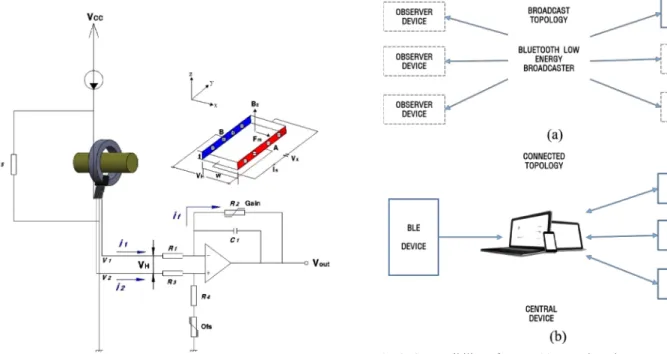
Current sensors that use a Hall element and Hall IC to measure the magnetic fields generated in steel silicon core gaps do not dis- tinguish between direct and alternating currents. Thus, they are primarily used to measure direct current (DC) in industrial equipment.
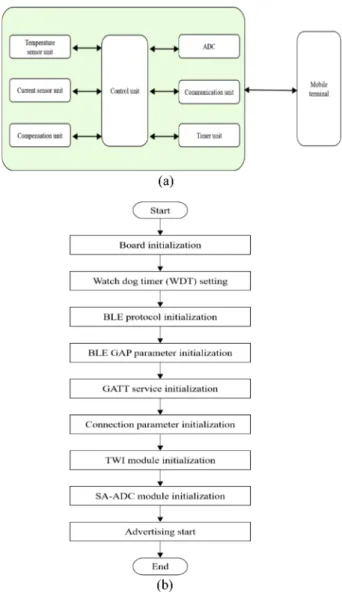
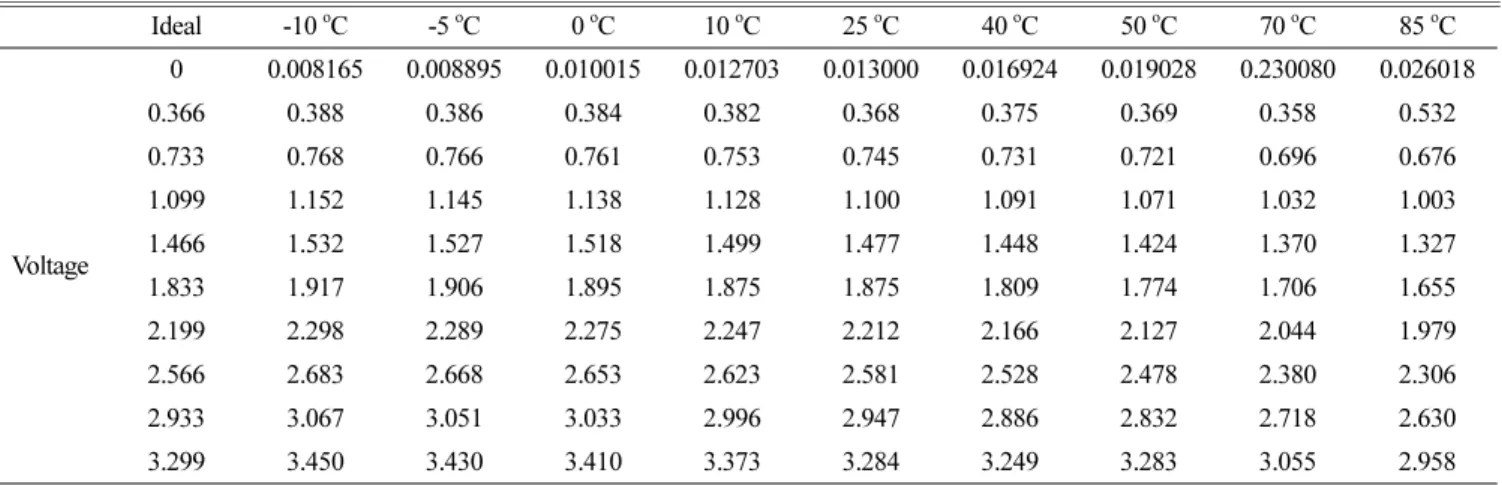
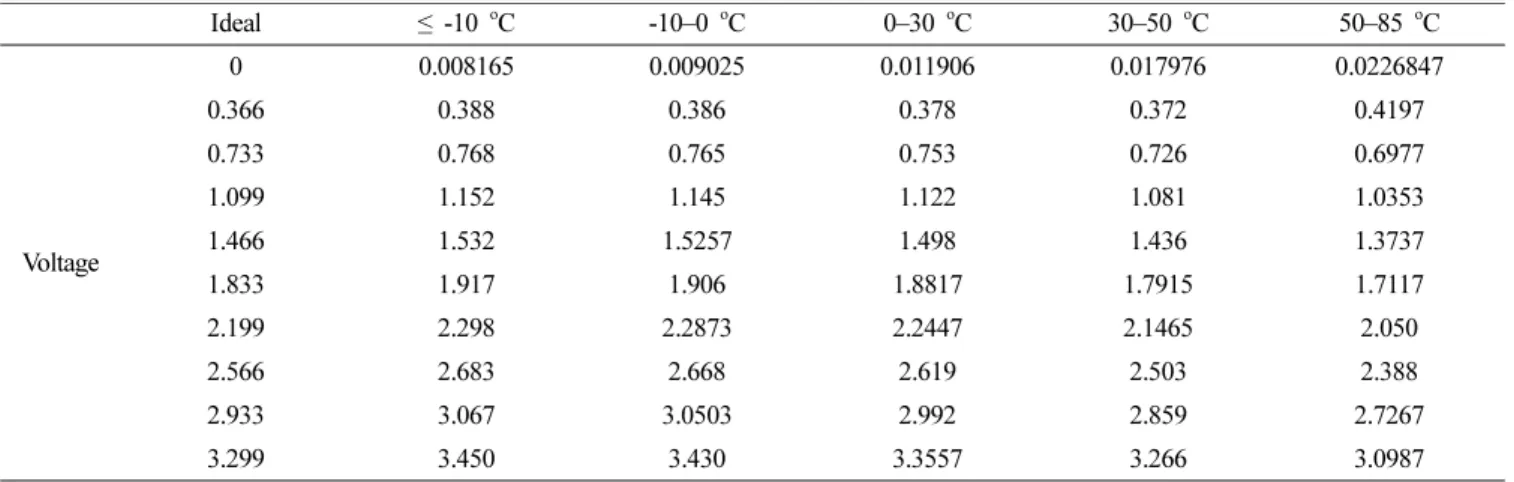
Although such sensors can measure the DC when installed in expensive equipment, ascertaining problems becomes difficult if the equip- ment is set up in an unexposed space. The control box is only opened during scheduled maintenance or when anomalies occur. There- fore, in this paper, a method is proposed for facilitating the safety management and maintenance of equipment when necessary, instead of waiting for anomalies or scheduled maintenance. A Bluetooth 4.0 low-energy current-sensor system based on near-field com- munication is used, which compensates for the nonlinearity of the current-sensor output signal using a piecewise linear model. The sen- sor is controlled using its generic attribute profile. Sensor nodes and cell phones used to check the signals obtained from the sensor at 50-A input currents showed an accuracy of ±1%, exhibiting linearity in all communications within the range of 0 to 50 A, with a stable output voltage for each communication segment.
Keywords: Shunt current, Hall-effect sensor, Hall IC, Hall current sensor, Magneto-electric effect, Armature coil, DC voltage transducers, Bluetooth, Bluetooth-low-energy, Piecewise linear model
1. INTRODUCTION
For the past few decades, current sensors have served as parts for the over-current control of DC industrial equipment. In the future, the third industrial revolution, involving computer- and Internet-based knowledge and information, will pave the way for the fourth industrial revolution, which is centered on intelligent information technology, with keywords such as “smart” and
“platform.” The transition between the third and fourth industrial revolutions has resulted in the development of smart factories. In addition to expanding and standardizing the distribution, the overall paradigm shift in industries and research and development projects related to smart factories could produce drastic changes in the future [1]. Factory-wide energy management related to production, consumption, generation, transmission, and power distribution power is required to efficiently manage, maintain, and repair various energy sources. Energy-intensive buildings and
factories are currently adopting building and factory energy- management systems, respectively. In addition, home energy management systems have also been developed [2]. The structure of such smart management systems can be divided into the application program, platform, and device network, all exhibiting interoperability and security [3]. Research into smart factories is currently focused on determining the peak demand with an understanding of modeling power related to machine equipment.
Simulators are also needed in areas where mechanical management and intelligent building control solutions are designed. Thus, the study can be classified into software and hardware research. However, a simulator that aids understand energy consumption modeling, determines the peak demand, and designs intelligent building control solutions using wireless sensor and actuator networks (WSAN) is required. Furthermore, in the future, current sensors will serve as software convergence devices, rather than just for blocking or controlling when an over-current over-voltage is applied. Moreover, intelligent building control solutions have been proposed for automating home applications, which minimize or control energy use by collecting and analyzing data on energy consumption, among others. These systems include intruder alarms, environment monitoring, and asset tracking setups [4-6]. Although these intelligent management systems are convenient and safe, they require expensive equipment, in addition to the installation and maintenance costs.
1
School of Electronics Engineering, Kyungpook National Unversity IT3, Kyungpook National University, 80 Daehakro, Bukgu, Daegu 41566, Korea
+
![Table 3 lists the magnetic materials used in current sensors [15].](https://thumb-ap.123doks.com/thumbv2/123dokinfo/4791681.277140/3.892.68.829.160.408/table-lists-magnetic-materials-used-current-sensors.webp)