INTRODUCTION
The predictors of successful smoking cessation have been investigated in many studies (1-5). Successful smoking ces- sation was found to be associated with older age, male gen- der, a lower consumption of cigarettes per day, owning a home, high social status, and baseline motivation to stop smoking (6, 7).
Cepeda-Benito et al. reported that nicotine replacement therapy (NRT) was efficacious for women only at short-term (≤3 months) follow-up; however, for men, it was found to be efficacious at all the follow up periods (≤3 months, 6 months, and ≥12 months) (8). However, to our knowledge, there have been few studies on sociodemographic and smok-
ing behavioral predictors of smoking cessation according to short-term (3 months), midterm (6 months), and long-term (12 months) follow-up periods.
In this randomized clinical trial of transdermal nicotine patches, we examined the sociodemographic and smoking behavioral predictors of smoking cessation according to short- term, midterm, and long-term follow-up periods.
MATERIALS AND METHODS Study design
This was a randomized, double-blind, placebo-controlled Seung Kwon Myung*,�, Hong Gwan Seo*, Sohee Park�, Yeol Kim�,�, Dong Jin Kim‖, Do-Hoon Lee¶, Moon-Woo Seong¶, Myung-Hyun Nam¶, Seung Won Oh�, Ji Ae Kim�, Mi Young Kim*
Smoking Cessation Clinic*, and Center for Cancer Prevention and Detection, National Cancer Center, Goyang; Department of Preventive Medicine�, Seoul National University College of Medicine, Seoul; Cancer Biostatistics Branch�, Research Institute for National Cancer Control and Evaluation, National Cancer Center, Goyang; Department of Family Medicine�, Seoul National University Hospital, Seoul; Health Care Center‖, Kyobo Life Insurance Co., Seoul; Department of Laboratory Medicine¶, National Cancer Center, Goyang, Korea
Address for correspondence Hong Gwan Seo, M.D.
Smoking Cessation Clinic, and Center for Cancer Prevention and Detection, National Cancer Center, 809 Madu 1-dong, Ilsandong-gu, Goyang 410-769, Korea
Tel : +82.31-920-1707, Fax : +82.31-920-1520 E-mail : [email protected]
*This study was supported in part by patches from a pharmaceutical company; the company does not want to disclose its name because there were no significant positive findings regarding the effectiveness of nicotine patch therapy in this trial. We declare that this condition has no relation to our study results.
1065 DOI: 10.3346/jkms.2007.22.6.1065
Sociodemographic and Smoking Behavioral Predictors Associated with Smoking Cessation According to Follow-up Periods: A Randomized, Double-blind, Placebo-controlled Trial of Transdermal Nicotine Patches
This study investigated sociodemographic and smoking behavioral factors associ- ated with smoking cessation according to follow-up periods. In this randomized, double-blind, placebo-controlled trial of transdermal nicotine patches, subjects were a total of 118 adult male smokers, who were followed up for 12 months. Univariable logistic regression analysis and stepwise multiple logistic regression analyses were performed to identify the predictors of smoking cessation. The overall self-reported point prevalence rates of abstinence were 20% (24/118) at 12 months follow-up, and there was no significant difference in abstinence rates between placebo and nicotine patch groups. In the univariable logistic regression analysis, predictors of successful smoking cessation were the low consumption of cigarettes per day and the low Fagerstrom Test for Nicotine Dependence (FTND) scores (p<0.05) at 3, 6, and 12 months follow-up. In the stepwise multiple logistic regression analyses, pre- dictors of successful smoking cessation, which were different according to the fol- low-up periods, were found to be the low consumption of cigarettes per day at the short-term and midterm follow-up (≤≤6 months), older age, and the low consump- tion of cigarettes per day at the long-term follow-up (12 months).
Key Words : Smoking Cessation; Demography; Socioeconomic Factors; Randomized Controlled Trials; Fol- low-up Studies
Received : 2 February 2007 Accepted : 2 May 2007
form were approved by the institutional review board at the National Cancer Center.
Setting and recruitment
The subjects were all adult male office workers recruited from the company, Kyobo Life insurance Co. We visited the company at baseline and at all the follow-up checkups, owing to the geographical distance between the company and the National Cancer Center. After providing a week’s public no- tice by means of bulletin board announcements at the com- pany and via e-mail, we visited the company, and recruited and enrolled the subjects only for a day on 29 July 2004. All the subjects signed written informed consent form volun- tarily.
Sample size estimation
A sample size of 162 was estimated on the basis of the results of a previous study in which the smoking abstinence rates were approximately 40% in the nicotine patch group and 20% in the placebo group, with a power of 80% and an alpha level of 0.05 (9).
Inclusion and exclusion criteria for subjects
To be eligible for this study, subjects had to be between 20 and 55 yr, in good health without any major physical or psychiatric illness, and motivated to quit smoking regard- less of their daily cigarette consumption. Subjects were ex- cluded from the study if they 1) had experienced NRT within 6 months before enrollment in the study; 2) were alcohol or narcotic drug abusers; or 3) had allergic skin diseases or heart problems including ischemic heart disease, myocar- dial infarction, or any type of arrhythmia or cerebrovascular disease.
Randomization
All the eligible subjects were randomly assigned to receive either nicotine patches or placebo patches according to one of two schedules provided by the computerized randomized plan generator. We stratified the subjects by the severity of nicotine dependence. This was done by generating two ran- domization schedules: one for the subjects scoring 7 or more on the Fagerstrom Test for Nicotine Dependence (FTND) questionnaire; the other, for the subjects scoring below 7 on the questionnaire. A score of 7 or higher was considered to be indicative of high nicotine dependence. This entire ran- dom allocation sequence was conducted by a third person and remained unknown until the interventions were blindly assigned to the two groups by the third person.
The total treatment period was 6 weeks. During the first 2 weeks, the subjects in the nicotine patch group wore 30 cm2 transdermal nicotine patches; during the middle 2 weeks, they wore 20 cm2transdermal nicotine patches; and during the last 2 weeks, they wore 10 cm2 transdermal nicotine patches. The subjects in the placebo patch group wore iden- tical-appearing patches that did not contain nicotine.
Interventions
On the first day of recruitment, all the subjects were given either seven 30 cm2transdermal nicotine patches with 57 mg of nicotine in each patch, delivering 21 mg/day or seven place- bo patches. They were instructed to apply one patch daily and to quit smoking from the very next day after recruitment.
The nicotine patch group was given seven additional 30 cm2 nicotine patches on the 1st-week visit day; fourteen 20 cm2 transdermal nicotine patches with 38 mg of nicotine in each patch, delivering 14 mg/day, on the 2nd-week visit day; and fourteen 10 cm2 transdermal nicotine patches with 19 mg of nicotine in each patch, delivering 7 mg/day, on the 4th- week visit day. The placebo patch group was given identi- cal-appearing patches using the same method as that used for the nicotine patch group.
Behavioral counseling and follow-up period
We visited the company at short term (1, 2, 4, and 7 weeks and 3 months); midterm (6 months); and long-term (12 mon- ths) periods of follow-up after the start of the study. The sub- jects were given one-on-one behavioral counseling for about 10 min by three doctors trained in smoking cessation thera- py. The subjects who were absent on the appointed counsel- ing day received telephone calls from the doctors, who pro- vided support for smoking cessation and identified whether or not they stopped smoking.
Baseline assessments
At enrollment, the subjects answered a self-administered questionnaire containing questions pertaining to sociode- mographic characteristics and smoking behavioral factors, and were also administered the FTND. Sociodemographic characteristics and smoking behavioral predictors included age, smoking initiation age, smoking duration, average daily cigarette consumption, types of tobacco, second-hand smoke, marriage, current diseases, alcohol drinking, exercise, educa- tion, monthly income, and previous attempts to quit smok- ing within the past year. The FTND questionnaire, which consists of 6 questions and was validated in Korea, was used to evaluate the severity of nicotine dependence (score range was from 0 [least dependence]to 10 [highest dependence]).
Blood pressure and urine cotinine concentrations were mea- sured at baseline.
Outcome measures
The primary outcome measure was the self-reported point prevalence rate of abstinence at 3, 6, and 12 months follow- up. Subjects were considered to be abstinent if at the time of the visit, they reported not having smoked during the pre- vious week. The subjects lost to follow-up, who were both absent at each follow-up and not able to be kept in touch with by telephone, were considered to be smokers. The out- come measure analysis was conducted using the intention- to-treat analysis.
Statistical analysis
Pearson’s chi-square test for categorical variables and a two- sample t-test for continuous variables were used to test the baseline differences between the treatment and control groups with regard to the sociodemographic characteristics and smok- ing behaviors. To study the sociodemographic and smoking behavioral factors and their association with smoking cessa- tion, we first performed univariable logistic regression anal- yses at the follow-up periods of 3, 6, and 12 months. We then conducted a stepwise multiple logistic regression anal- ysis to determine the predictors of abstinence at the respec- tive follow-up periods. All the statistical tests were two-sided, and p values of 0.05 or less were considered to be statistically significant. Data analyses were performed using SPSS 12.0 K for Windows.
RESULTS Baseline characteristics
A total of 118 subjects entered the study from July 2004 to August 2005. The baseline characteristics of the study population in the nicotine and placebo patch groups are described in Table 1. At baseline, there was no significant difference between the nicotine and placebo patch groups with regard to the sociodemographic and lifestyle variables (p>0.05).
Adverse events and dropouts
Adverse events were minimal in both nicotine and place- bo patch groups. Some examples of these events were skin reactions at the application site, headaches, insomnia, and dream abnormalities. No serious adverse events were report- ed in either group. No subject was dropped out; all the sub- jects who were not present at the time of the scheduled visit were interviewed by telephone.
Univariable logistic regression analysis
Using univariable logistic regression analysis, we identified several sociodemographic and smoking behavioral factors related to the status of abstinence, as a result of the smoking cessation intervention, at different follow-up periods (Table 2). Throughout all the follow-up periods, the cigarette con- sumption per day and the FTND scores, which revealed the severity of nicotine dependence, showed a significant differ- ence in the self-reported abstinence rates (p<0.05).
The overall self-reported point prevalence rates of absti- nence were 20.3% (24/118) at 3 months follow-up, 24.6%
(29/118) at 6 months follow-up, and 20.3% (24/118) at 12 months follow-up; furthermore, the abstinence rates between the placebo and nicotine patch groups were not significantly different across the follow-up periods. At 12 months follow- up, successful abstinence was significantly associated with increasing age (OR=1.09; 95% CI, 1.01-1.18) and marginal- ly significantly associated with increasing years of smoking cigarettes (OR=1.08; 95% CI, 1.00-1.16).
At 3 months and 12 months follow-up, the baseline uri-
*, Plus-minus values are means±SD. The unit of the values in round brackets is percentage. Percentages do not sum up to 100 due to roun- ding. �, p values obtained from Pearson’s chi-square test for the cate- gorical variables and the two-sample t-test for continuous variables.
FTND, Fagerstrom Test for Nicotine Dependence; BMI, body mass index.
Baseline characteristics
Placebo patch group (n=59)
Nicotine patch group (n=59) p�
Age (yr) 36.7±6.2 36.6±5.6 0.96
Age at start of smoking (yr) 20.2±2.6 19.6±2.0 0.16 Years of cigarette smoking 16.5±5.8 17.1±5.7 0.60 No. of cigarettes per day 15.3±5.1 15.0±5.8 0.80
Degree of puff 0.93
Deep 18 (30.5) 18 (30.5)
Mid 37 (62.7) 38 (64.4)
Shallow 4 (6.8) 3 (5.1)
No. of attempts to quit smoking 0.93±1.20 1.11±1.70 0.52 in the previous year
FTND scores 3.0±2.1 2.8±2.3 0.63
Marital status 0.37
Not married 11 15
Married 48 44
Monthly income ($1=1,150 won) 0.47
<$1,739 (2 million won) 11 (18.6) 11 (19.0)
$1,739-$2,608 (2-3 million won) 33 (55.9) 28 (48.3)
>$2,608 (3 million won) 15 (25.4) 19 (32.8)
Education 0.36
High school graduate 2 (3.4) 0 (0)
College graduate 50 (84.7) 51 (86.4)
Postgraduate 7 (11.9) 8 (13.6)
BMI 24.1±2.6 23.9±2.7 0.67
Frequency of alcohol drinking 2.0±1.0 2.0±1.1 0.81 per week
Frequency of exercise per week 1.5±1.7 1.5±1.4 0.95 Table 1.Baseline characteristics of the study population (n=
118)*
Variable
Abstinence (%) 3 months
follow-up
6 months follow-up
12 months follow-up No. of
subjects
Univariable OR (95% CI) 3 months
follow-up
6 months follow-up
12 months follow-up Patch
Placebo 59 10 (16.9) 12 (20.3) 11 (18.6) 1 1 1
Nicotine 59 14 (23.7) 17 (28.8) 13 (22.0) 1.52 (0.62-3.78) 1.59 (0.68-3.70) 1.23 (0.50-3.03)
Age (continuous)* 1.05 (0.98-1.14) 1.04 (0.97-1.12) 1.09 (1.01-1.18)
Age at the start of smoking (yr)
≤18 29 4 (13.8) 5 (17.2) 5 (17.2) 1 1 1
≥19 89 20 (22.5) 24 (27.0) 19 (21.3) 1.81 (0.56-5.82) 1.77 (0.61-5.17) 1.30 (0.44-3.87)
Years of cigarette smoking 1.05 (0.97-1.13) 1.04 (0.96-1.11) 1.08 (1.00-1.16)
(continuous)� Cigarettes per day*
≤10 37 14 (37.8) 16 (43.2) 14 (37.8) 1 1 1
11-15 32 5 (15.6) 6 (18.8) 4 (12.5) 0.30 (0.10-0.97) 0.30 (0.10-0.91) 0.24 (0.07-0.81)
≥16 49 5 (10.2) 7 (14.3) 6 (12.2) 0.19 (0.06-0.58) 0.22 (0.08-0.61) 0.23 (0.08-0.68)
Degree of puff
Deep 36 7 (19.4) 6 (16.7) 6 (16.7) 1 1 1
Mid 75 15 (20.0) 21 (28.0) 15 (20.0) 1.04 (0.38-2.82) 1.94 (0.71-5.35) 1.25 (0.44-3.55)
Shallow 7 2 (28.6) 2 (28.6) 3 (42.9) 1.66 (0.26-10.39) 2.00 (0.31-12.84) 3.75 (0.66-21.25)
Frequency of attempts to quit smoking in the previous year
0 56 11 (19.6) 13 (23.2) 12 (21.4) 1 1 1
1-2 46 10 (21.7) 14 (30.4) 9 (19.6) 1.14 (0.43-2.97) 1.45 (0.60-3.50) 0.89 (0.34-2.35)
>3 16 3 (18.8) 2 (12.5) 3 (18.8) 0.94 (0.23-3.90) 0.47 (0.10-2.36) 0.85 (0.21-3.46)
FTND score (continuous)* 0.74 (0.58-0.95) 0.68 (0.54-0.87) 0.74 (0.58-0.95)
Marital status
Not married 26 5 (19.2) 6 (23.1) 3 (11.5) 1 1 1
Married 92 19 (20.7) 23 (25.0) 21 (22.8) 1.09 (0.37-3.28) 1.11 (0.40-3.10) 2.27 (0.62-8.30) Monthly income ($1=1,150 won)
< $1,739 (2 million won) 22 2 (9.1) 5 (22.7) 3 (13.6) 1 1 1
$1,739-$2,608 (2-3 million won) 61 12 (19.7) 14 (23.0) 11 (18.0) 2.45 (0.50-11.95) 1.01 (0.32-3.24) 1.39 (0.39-5.54)
>$2,608 (3 million won) 34 9 (26.5) 9 (26.5) 9 (26.5) 3.60 (0.70-18.58) 1.22 (0.35-4.29) 2.28 (0.54-9.58) Education
High school graduate 2 1 (50.0) 1 (50.0) 1 (50.0) 1 1 1
College graduate 101 21 (20.8) 26 (25.7) 22 (21.8) 0.26 (0.02-4.37) 0.35 (0.02-5.74) 0.28 (0.02-4.63) Postgraduate 15 2 (13.3) 2 (13.3) 1 (6.7) 0.15 (0.01-3.58) 0.15 (0.01-3.58) 0.07 (0.002-2.22) BMI
<23 38 6 (15.8) 8 (21.1) 6 (15.8) 1 1 1
≥23 79 18 (22.8) 21 (26.6) 18 (22.8) 1.57 (0.57-4.36) 1.36 (0.54-3.43) 1.57 (0.57-4.36)
Frequency of alcohol drinking per week
<1 14 5 (35.7) 5 (35.7) 5 (35.7) 1 1 1
1-2 60 9 (15.0) 13 (21.7) 8 (13.3) 0.32 (0.09-1.17) 0.50 (0.14-0.75) 0.28 (0.07-1.04)
>2 44 10 (20.3) 11 (25.0) 11 (25.0) 0.53 (0.14-1.94) 0.60 (0.17-2.18) 0.60 (0.17-2.18)
Frequency of exercise per week
Never 27 4 (14.8) 4 (14.8) 6 (22.2) 1 1 1
≤1 48 9 (18.8) 13 (27.1) 9 (18.8) 1.33 (0.37-4.80) 2.14 (0.62-7.37) 0.81 (0.25-2.58)
>1 37 11 (29.7) 11 (29.7) 9 (24.3) 2.43 (0.68-8.70) 2.43 (0.68-8.70) 1.13 (0.35-3.65)
Urinary cotinine (ng/mL)*
≤500 33 13 (39.4) 13 (39.4) 13 (39.4) 1 1 1
501-1,000 29 4 (13.8) 6 (20.7) 4 (13.8) 0.25 (0.07-0.87) 0.40 (0.13-1.25) 0.25 (0.07-0.87)
1,001-1,500 25 4 (16.0) 4 (16.0) 4 (16.0) 0.29 (0.08-1.05) 0.29 (0.08-1.05) 0.29 (0.08-1.05)
≥1,501 20 2 (10.0) 3 (15.0) 2 (10.0) 0.17 (0.03-0.86) 0.27 (0.07-1.11) 0.17 (0.03-0.86)
*, Significant (p<0.05) at 12 months follow-up. �, Marginally significant at 12 months follow-up.
The unit of the values in the round brackets is percentage. Percentages do not add up to 100 due to rounding.
OR, odds ratio; CI, confidence interval; FTND, Fagerstrom Test for Nicotine Dependence; BMI, body mass index.
nary cotinine concentration was also inversely associated with the abstinence rate.
However, age at the start of smoking, degree of puff, fre- quency of attempts to quit smoking in the previous year, marital status, monthly income, education, body mass index (BMI), frequency of alcohol drinking per week, and frequen- cy of exercise per week were not shown to be significantly associated with the smoking abstinence rate.
Stepwise multiple logistic regression analysis
To identify the adjusted predictors of abstinence according to the follow-up periods, we conducted a multiple logistic regression analysis with forward stepwise selection and with an entry criteria of 0.10 and an elimination criteria of 0.10.
Age was included in the final model and ‘years of smoking cigarettes’ was excluded because of its collinearity with age.
Moreover, considering the multicollinearity among number of cigarettes per day, FTND score, and baseline urinary coti- nine concentration, only the variable of number of cigarettes per day, which showed the strongest association with absti- nence rate, was included in the final model.
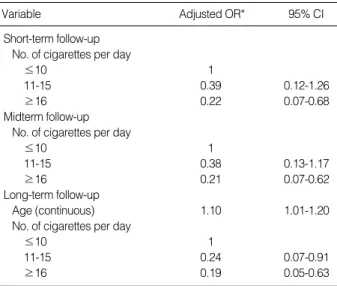
The final multivariable model showed that only the vari- able of number of cigarettes per day was the predictor of smoking cessation at short-term and midterm follow-up;
however, the variables of age and cigarettes per day were the predictors of smoking cessation at long-term follow-up. The main outcomes of the final model at long-term follow-up were as follows: a higher success rate in the older subjects
(adjusted OR=1.10; 95% CI, 1.01-1.20) as well as a lower consumption of cigarettes per day (adjusted OR of 11-15 cigarettes per day compared with ≤10 cigarettes per day=
0.24; 95% CI, 0.07-0.91 and for ≥16, adjusted OR=0.19;
95% CI, 0.06-0.63) (Table 3).
DISCUSSION
Several studies have shown that the main predictors of smoking cessation are age, gender, the daily consumption of tobacco, housing conditions, social status, baseline motiva- tion to stop smoking, and so on (1, 6, 7).
In the present study, we found that only the number of ciga- rettes per day was a significant predictor for smoking cessa- tion at short-term (3 months) and midterm (6 months) fol- low-up; however, at long-term (12 months) follow-up, age and number of cigarettes per day were the predictors of suc- cessful smoking cessation.
We do not have a clear answer to why age was found to be a predictor of long-term smoking cessation. However, we can infer that although younger smokers succeeded in quit- ting smoking at the short-term and midterm follow-up pe- riod after the onset of the therapy, compared to older smok- ers, they were relatively more prone to failing to maintain their smoking cessation; this could be due to less motivation or the thought of other opportunities for smoking cessation in the future. In addition, generally, older subjects tended to maintain smoking cessation better than the younger ones (2-4); this is thought to be associated with the fact that older subjects are more likely to be confronted with health deterio- ration and accompanying medical advice to quit smoking (1, 2). Among those who did recognize the dangers, there was greater motivation to quit smoking and a greater suc- cess rate; for example, among the older subjects, the former smokers believed that smoking definitely increases the chance of developing heart disease to a greater extent than the cur- rent smokers (10, 11).
It has been well known that smokers who smoke few ciga- rettes per day are more likely to quit and maintain the ab- stinence than smokers who smoke a large number of cigarettes per day (6, 7, 12). A high consumption of cigarettes per day is associated with high nicotine dependence and a low smok- ing cessation rate (12-14). In the univariable analysis of our study, the consumption of cigarettes per day, the FTND score, and urinary cotinine concentration were found to be signifi- cant predictors of smoking cessation. The correlation coeffi- cients between the consumption of cigarettes per day and the FTND score, between the consumption of cigarettes per day and urinary cotinine concentration, and between the FTND score and urinary cotinine concentration were 0.65, 0.61, and 0.57, respectively, and were all statistically signif- icant. These results were compatible with those of the pre- vious study (15). In the final model, we included only the
*Odds ratio adjusted for age, age at start of smoking, No. of cigarettes per day, degree of puff, No. of attempts to quit smoking in the previous year, marital status, monthly income, education, body mass index, fre- quency of alcohol drinking per week, and frequency of exercise per week.
Variable Adjusted OR* 95% CI
Short-term follow-up No. of cigarettes per day
≤10 1
11-15 0.39 0.12-1.26
≥16 0.22 0.07-0.68
Midterm follow-up No. of cigarettes per day
≤10 1
11-15 0.38 0.13-1.17
≥16 0.21 0.07-0.62
Long-term follow-up
Age (continuous) 1.10 1.01-1.20
No. of cigarettes per day
≤10 1
11-15 0.24 0.07-0.91
≥16 0.19 0.05-0.63
Table 3.Significant predictors of successful smoking cessation in multiple logistic regression models with forward stepwise selec- tion at short-term (3 months), midterm (6 months), and long- term (12 months) follow-up
sation in order to avoid the multicollinearity among the vari- ables.
One interesting finding in the present study was that the point prevalence rate of abstinence was the highest at 6 mon- ths follow-up, although generally, the abstinence rate tends to decrease with the passage of time. However, our finding was thought to be associated with the subjects’ New Year’s resolutions to quit smoking. The 6-month follow-up fell on a day in February 2005, when many smokers in Korea were motivated to try to quit smoking; therefore, the abstinence rate at 6 months follow-up was believed to have increased conversely as compared with the abstinence rate at 3 months follow-up. Contrary to the point prevalence abstinence rates, the continuous abstinence rates decreased linearly as follows:
20.3% at 3 months follow-up, 17.8% at 6 months follow- up, and 15.3% at 12 months follow up (data not shown).
The main limitations of our study were as follows: 1) we could not present the continuous abstinence rate validated with an expired CO concentration or urinary cotinine con- centration, owing to the non-compliance of the subjects at the follow-up periods; only 9 among 24 subjects, who re- ported abstinence at 12 months follow up, took the urinary cotinine examination; 2) the inclusion of only males in a localized workplace reduced the generalizability of these find- ings; and 3) we could not confirm that the difference between the direct visit counseling and the telephone interview would influence the abstinence rate.
In conclusion, this study was the first randomized, double- blind, placebo-controlled trial of nicotine patch to show that sociodemographic and smoking behavior factors associated with successful smoking cessation were different according to the follow-up periods. The results of this study can aid physicians to clinically help smokers to quit smoking in smok- ing cessation units. In the future, further studies on larger populations including women will be needed to investigate more predictors for successful smoking cessation.
ACKNOWLEDGEMENTS
We are grateful to all residents from the Department of Family Medicine, Seoul National University Hospital for their contributions to this study.
1. Grotvedt L, Stavem K. Association between age, gender and reasons for smoking cessation. Scand J Public Health 2005; 33: 72-6.
2. Gourlay SG, Forbes A, Marriner T, Pethica D, McNeil JJ. Prospec- tive study of factors predicting outcome of transdermal nicotine treat- ment in smoking cessation. BMJ 1994; 309: 842-6.
3. Levy DT, Romano E, Mumford E. The relationship of smoking ces- sation to sociodemographic characteristics, smoking intensity, and tobacco control policies. Nicotine Tob Res 2005; 7: 387-96.
4. Raherison C, Marjary A, Valpromy B, Prevot S, Fossoux H, Taytard A. Evaluation of smoking cessation success in adults. Respir Med 2005; 99: 1303-10.
5. Van Der Rijt GA, Westerik H. Social and cognitive factors contribut- ing to the intention to undergo a smoking cessation treatment. Addict Behav 2004; 29: 191-8.
6. Osler M, Prescott E. Psychosocial, behavioural, and health determi- nants of successful smoking cessation: a longitudinal study of Dan- ish adults. Tob Control 1998; 7: 262-7.
7. Monso E, Campbell J, Tonnesen P, Gustavsson G, Morera J. Socio- demographic predictors of success in smoking intervention. Tob Con- trol 2001; 10: 165-9.
8. Cepeda-Benito A, Reynoso JT, Erath S. Meta-analysis of the efficacy of nicotine replacement therapy for smoking cessation: differences between men and women. J Consult Clin Psychol 2004; 72: 712-22.
9. Fiore MC, Kenford SL, Jorenby DE, Wetter DW, Smith SS, Baker TB. Two studies of the clinical effectiveness of the nicotine patch with different counseling treatments. Chest 1994; 105: 524-33.
10. Connolly MJ. Smoking cessation in old age: closing the stable door?
Age Ageing 2000; 29: 193-5.
11. Ruchlin HS. An analysis of smoking patterns among older adults.
Med Care 1999; 37: 615-9.
12. Farkas AJ, Pierce JP, Zhu SH, Rosbrook B, Gilpin EA, Berry C, Kaplan RM. Addiction versus stages of change models in predicting smoking cessation. Addiction 1996; 91: 1271-80.
13. Vink JM, Willemsen G, Beem AL, Boomsma DI. The Fagerstrom Test for Nicotine Dependence in a Dutch sample of daily smokers and ex-smokers. Addict Behav 2005; 30: 575-9.
14. Quist-Paulsen P, Bakke PS, Gallefoss F. Predictors of smoking ces- sation in patients admitted for acute coronary heart disease. Eur J Cardiovasc Prev Rehabil 2005; 12: 472-7.
15. Park SM, Son KY, Lee YJ, Lee HC, Kang JH, Lee YJ, Chang YJ, Yun YH. A preliminary investigation of early smoking initiation and nicotine dependence in Korean adults. Drug Alcohol Depend 2004;
74: 197-203.