ABSTRACT
Background: Histologically, nonalcoholic steatohepatitis (NASH) is categorized into adult-type (type 1) and pediatric-type (type 2). The origination of the histological difference between the two types and how they differ clinically remain uncertain. We aimed to understand the incidence and clinical characteristics of the two types of NASH in Korean children, and to investigate the association between their pathological type and clinical characteristics, using anthropometric and laboratory data.
Methods: In 38 children with confirmed NASH, we investigated hepatic pathological findings, and correlating factors between pathological type and laboratory and
anthropometric data (weight percentile, body mass index (BMI) z-score, and blood pressure percentile). Adult-type NASH was noted in 21 patients and pediatric-type in 17 patients.
Results: Age, sex, BMI, transaminase levels, and insulin resistance were not significantly different between the two groups. Triglyceride (TG) levels were higher in adult-type NASH (P = 0.033). Hematocrit and albumin levels were lower in adult-type NASH (P = 0.016 and 0.013, respectively). Hepatic fibrosis was more common in pediatric-type. The fibrosis scores in patients with adult-type were mostly 0 and 1, whereas the score was 3 in patients with pediatric-type (P = 0.024, 0.004, and < 0.010, respectively). Anthropometric data, liver function, and insulin resistance scores did not differ between the two pathological NASH types. TG, hematocrit, and albumin may be potential factors to predict pathological types.
Fibrosis was observed more frequently in pediatric-type NASH.
Conclusion: Monitoring children with pediatric-type NASH for progression to fibrosis or cirrhosis is recommended.
Keywords: Non-alcoholic Steatohepatitis; Children; Liver; Pathology
INTRODUCTION
Obesity has become a significant health issue globally. The prevalence rate of obesity in children and adolescents from 7 to 18 years old in Korea was 14.3% in 2016 and 8.4% in 2008.1 The prevalence rate in preschool kids was 2.8% in 2016, and 1.4% in 2008. The rate had rapidly increased and reached double within one decade. Nonalcoholic fatty liver disease
Original Article
Received: Sep 12, 2017 Accepted: Nov 6, 2017 Address for Correspondence:
Yong Joo Kim, MD
Department of Pediatrics, Hanyang University College of Medicine, 222-1 Wangsimni-ro, Seongdong-gu, Seoul 04763, Korea.
E-mail: [email protected]
© 2018 The Korean Academy of Medical Sciences.
This is an Open Access article distributed under the terms of the Creative Commons Attribution Non-Commercial License (https://
creativecommons.org/licenses/by-nc/4.0/) which permits unrestricted non-commercial use, distribution, and reproduction in any medium, provided the original work is properly cited.
ORCID iDs Jungmin Yoon
https://orcid.org/0000-0003-1427-4750 Byung Han Park
https://orcid.org/0000-0002-3909-5794 Ja Hye Kim
https://orcid.org/0000-0002-2477-5199 Jin-Hwa Moon
https://orcid.org/0000-0003-0235-5318 Young Ho Lee
https://orcid.org/0000-0003-1498-2773 Se Min Jang
https://orcid.org/0000-0002-5442-3303 Yong Joo Kim
https://orcid.org/0000-0002-2654-5397 Disclosure
The authors have no potential conflicts of interest to disclose.
Jungmin Yoon ,1 Byung Han Park ,1 Ja Hye Kim ,1 Jin-Hwa Moon ,1 Young Ho Lee ,1 Se Min Jang ,2 and Yong Joo Kim 1
1Department of Pediatrics, Hanyang University College of Medicine, Seoul, Korea
2Department of Pathology, Konyang University College of Medicine, Daejeon, Korea
Investigation of Clinical and
Pathological Relationships between Adult- and Pediatric-type NASH in Korean Children
Pediatrics
Author Contributions
Data curation: Yoon J, Park BH. Formal analysis: Yoon J, Jang SM. Investigation: Kim JH, Jang SM, Kim YJ. Writing - original draft:
Yoon J. Writing - review & editing: Kim YJ.
(NAFLD) is a common chronic liver disease in children.2-4 With gradually increasing rates of childhood obesity, the incidence of NAFLD increases as a result of early and long-term exposure to obesity and related inflammation.5 NAFLD is defined as liver fat infiltration of 5% or more hepatocytes evaluated by liver biopsy, when there is no evidence of alcohol consumption, drug-induced, viral, or autoimmune liver disease. NAFLD can range from intrahepatic fat accumulation alone (steatosis) to the triad (fatty infiltration, inflammation, and fibrosis), termed nonalcoholic steatohepatitis (NASH).6
Most patients are asymptomatic. The known risk factors in pediatric NASH cohorts include obesity, male sex, hypertriglyceridemia, and insulin resistance.7,8 The elevation of serum aminotransferase levels are not specific or sensitive markers for NASH. No biomarkers are currently a reliable alternative to biopsy. Although ultrasonography detects NAFLD, recent imaging modalities cannot distinguish between steatosis and NASH. A liver biopsy is requested for a delimiting diagnosis. The long-term prognosis of NASH that develops in childhood is unknown. Approximately 25% of patients with NASH can develop progressive fibrosis and consequential cirrhosis.9 Childhood NASH is associated with severe metabolic disorders such as insulin resistance, abdominal obesity, and hypertension, as in adults.9 Schwimmer et al.10 categorized NASH into two established patterns in children; type 1 (adult-type) and type 2 (pediatric-type). The characteristics of the two types are as follows:
In adult-type NASH, the distribution of steatosis is more common in zone 3, and is associated with ballooning, lobular inflammation, and perisinusoidal fibrosis. This type is usually observed in adult-onset NASH, but sometimes noted in pediatric patients. In pediatric-type, steatosis is not confined to a specific area but is more extensively distributed;
the main site of inflammation and fibrosis is in the portal area, and ballooning is not noted.
Pediatric-type is noted usually in children rather than in adults; however, it is still uncertain whether these differences originate through specific mechanisms in the development of these two types.
We performed this study to know the incidence of these two types of NASH (adult- and pediatric-type) in Korean children, the clinical characteristics of each type, and to determine the association between pathological type and clinical characteristics via anthropometric and laboratory data.
METHODS
Subjects
Among the children who visited the Pediatric Clinic for NAFLD at Hanyang University Hospital from January 2006 to November 2015, we performed liver biopsies in 44 patients with suspected NASH. NASH was diagnosed in 38 patients (28 boys, 10 girls).
Patients were identified and data was gathered via retrospective chart review. We selected patients who were 18 years old or younger and overweight with abnormal liver function test (LFT) results. We educated these children to modify their lifestyle by reducing their calorie intake and exercising more intensely. Medicine was not prescribed or introduced for the purpose of passive improvement of the liver dysfunction. We checked their LFT results every 2 months to assess improvement or lack thereof. We suspected hepatic pathologic lesions in the children who did not show any improvement in anthropometric data and LFT results
more than 6 months after baseline assessment despite their efforts; then, we performed a liver biopsy. This observation period with lifestyle modification is recommended in the clinical guideline for pediatric NAFLD by US Preventive Service Task Force in 2010.11 These children were free of viral hepatitis, alcohol history, history of parenteral nutrition, drug toxicity, and genetic metabolic hepatic disease at the time of liver biopsy.
Anthropometric data
Abdominal imaging (ultrasonography or computed tomography) was performed in all patients to confirm the presence of fatty liver change.
Body mass index (BMI) was calculated for all patients. The BMI calculated as follows:
BMI = weight (kg)/height (m2)
Weight percentile, height, BMI, and blood pressure (systolic and diastolic) were determined by age and sex, based on the 2007 Korean Pediatric Society and Korea Centers for Disease Control and Prevention child growth standard data. Z-scores for weight, height, and BMI were also calculated using standard weight, height, and BMI. The z-score for measurement y at age t was computed as:
Obesity was defined when the BMI for age and sex was greater than 95th percentile. Children who were older than 2 years with a BMI greater than or equal to 85th and less than 95th percentiles belong to the overweight category. Hypertension was defined as a blood pressure (systolic or diastolic) exceeding the 95th percentile for age, height, and sex.
Laboratory evaluation
Laboratory evaluation included LFT (serum alanine aminotransferase [ALT], aspartate aminotransferase [AST], gamma-glutamyl transpeptidase [GGT], total bilirubin, and albumin levels), fasting lipid profiles (total cholesterol, triglyceride [TG], high-density lipoprotein [HDL] cholesterol, low-density lipoprotein [LDL] cholesterol, free fatty acid [FFA]), fasting blood glucose, and complete blood count [CBC] such as white blood cell [WBC], hemoglobin, hematocrit, and platelet.
Insulin sensitivity index and insulin resistance were also calculated as follows12: Homeostasis model assessment of insulin resistance (HOMA-IR) = fasting insulin (μIU/mL) × fasting glucose (mg/dL) / 405
Insulin sensitivity index-free fatty acid (ISI-FFA) = 2/(insulin × FFA + 1) Normal subject's ISI-FFA is reported as 1 in adults.13,14
Quantitative insulin sensitivity check index (QUICKI) = 1/[log fasting insulin (μIU/mL) + log fasting glucose (mg/dL)]
Impaired QUICKI is defined as QUICKI between 0.43 to 0.91 in children.15,16
𝑍𝑍𝑖𝑖𝑖𝑖𝑖𝑖= [ 𝑦𝑦𝑀𝑀(𝑡𝑡)]
𝐿𝐿(𝑡𝑡)
− 1
𝑆𝑆(𝑡𝑡)𝐿𝐿(𝑡𝑡) = 𝑦𝑦 − 𝑀𝑀(𝑡𝑡) 𝑆𝑆𝑡𝑡𝑆𝑆𝑆𝑆𝑆𝑆(𝑡𝑡)
Plasma lipid levels were measured after at least a 12-hour overnight fast. Abnormalities were defined as TG greater than 150 mg/dL, and HDL less than 40 mg/dL, according to International Diabetes Federation (IDF) guidelines.17
Liver biopsy and pathologic investigation
Percutaneous needle liver biopsies were performed in all patients. Samples were taken from the right intercostal space, to avoid the pleura and blood vessels, with an 18-gauge needle automatic gun (Autovan; BARD GmbH/Angiomed, Karlsruhe, Germany). The skin to be biopsied was disinfected with povidone-iodine and local anesthesia was administered. All biopsies were at least 1.5 cm. Each specimen was fixed in formalin and paraffin-embedded sections were stained with hematoxylin-eosin and Masson trichrome. One hepato- pathologist, blinded to clinical and laboratory data, evaluated the liver biopsy samples.
The histological features including the amount of steatosis, inflammation (portal and lobular), and hepatocyte ballooning were evaluated. Fibrosis stage was assigned.
These features were graded according to the nonalcoholic fatty liver disease activity score (NAS) system.18 The steatosis was scored as 0 (less than 5%), 1 (5% or more, less than 33%), 2 (33% or more, less than 66%), or 3 (66% or more). Lobular inflammation was scored as 0 (no foci), 1 (less than 2 foci/200 × field), 2 (2–4 foci/200 × field), 3 (> 4 foci/200 × field).
Ballooning was scored as 0 (none), 1 (few ballooning cells), 2 (many cells/prominent ballooning). Then, the NAS were determined by adding scores of steatosis, lobular inflammation, and ballooning. The NAS system is used to evaluate overall histological change and cannot replace the pathological diagnosis of NASH. However, generally, a NAS score of 5 or higher is considered diagnostic of NASH. Three or 4 scores are regarded as borderline, so this group can be divided between 3 diagnostic categories (“NASH”,
“possible NASH”, or “not NASH”). So, patients with ballooning and lobular inflammation, in addition to lower NAS scores, can be diagnosed as NASH.18,19 Fibrosis was scored as 0 (none), 1 (zone 3 perisinusoidal fibrosis), 2 (portal/periportal fibrosis), 3 (bridging fibrosis), and 4 (cirrhosis).
The liver biopsy specimens were classified into two types. Samples with characteristic features of zone 3 steatosis, ballooning and zone 3 perisinusoidal fibrosis were classified as type 1 or adult-type NASH, and more extensive steatosis, portal inflammation and fibrosis without ballooning and zone 3 perisinusoidal fibrosis were classified as type 2 or pediatric- type NASH.11
Statistical analysis
We used Student's t-test or Wilcoxon rank sum test or continuous factors (CBC, ALT, AST, TG, total cholesterol, HDL cholesterol, LDL cholesterol, total protein, albumin, total bilirubin) and Pearson's χ2 test or Fisher's exact test for categorical variables (hypertension, dyslipidemia) to determine which factors were significantly different between the two groups. P < 0.05 was considered statistically significant. SPSS version 21.0 (IBM Co., Armonk, NY, USA) was used for all analyses.
Ethics statement
The present study protocol was reviewed and approved by the Hanyang University Hospital Institutional Review Board (2016-04-040). Informed consent was submitted by all subjects when they were enrolled.
RESULTS
Clinical characteristics of the study subjects
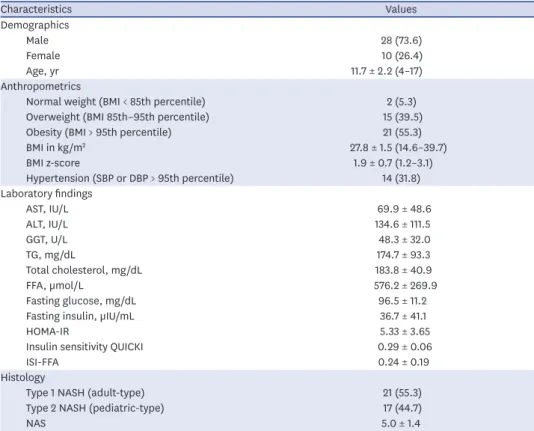
The characteristics of the study group are summarized in Table 1. The mean age of the patients was 11.7 ± 2.21 years (range, 4–17 years). The number of male patients was thrice the number of female patients (male:female = 74%:26%). Most patients (95%) had ≥ 85th percentile for BMI. Among them, obesity was present in 55.26% of patients. Hypertension was observed in 31.8% of patients. No patient had diabetes mellitus.
In most children, AST, ALT, and GGT levels were elevated to 69.9 ± 48.6 IU/L, 134.6 ± 111.5 IU/L, and 48.3 ± 32.0 U/L, respectively. TG levels were also elevated, 174.7 ± 93.3 mg/dL. FFA level was 576.2 ± 269.9 μmol/L; fasting glucose and insulin levels were 96.5 ± 11.2 mg/dL and 36.7 ± 41.1 μIU/mL, respectively. Mean HOMA-IR, QUICKI, and ISI-FFA were 5.33 ± 3.65, 0.29
± 0.06, and 0.24 ± 0.19, respectively.
Histologically, 21 patients (55.3%) showed adult-type NASH and 17 patients (44.7%) showed pediatric-type NASH. The mean value of NAS was 5.0 ± 1.4.
Table 1. Characteristics of children enrolled in the study (n=38)
Characteristics Values
Demographics
Male 28 (73.6)
Female 10 (26.4)
Age, yr 11.7 ± 2.2 (4–17)
Anthropometrics
Normal weight (BMI < 85th percentile) 2 (5.3)
Overweight (BMI 85th–95th percentile) 15 (39.5)
Obesity (BMI > 95th percentile) 21 (55.3)
BMI in kg/m2 27.8 ± 1.5 (14.6–39.7)
BMI z-score 1.9 ± 0.7 (1.2–3.1)
Hypertension (SBP or DBP > 95th percentile) 14 (31.8) Laboratory findings
AST, IU/L 69.9 ± 48.6
ALT, IU/L 134.6 ± 111.5
GGT, U/L 48.3 ± 32.0
TG, mg/dL 174.7 ± 93.3
Total cholesterol, mg/dL 183.8 ± 40.9
FFA, µmol/L 576.2 ± 269.9
Fasting glucose, mg/dL 96.5 ± 11.2
Fasting insulin, µIU/mL 36.7 ± 41.1
HOMA-IR 5.33 ± 3.65
Insulin sensitivity QUICKI 0.29 ± 0.06
ISI-FFA 0.24 ± 0.19
Histology
Type 1 NASH (adult-type) 21 (55.3)
Type 2 NASH (pediatric-type) 17 (44.7)
NAS 5.0 ± 1.4
Values are presented as number (%) of children, mean ± standard deviation (range), or mean ± standard deviation.
BMI = body mass index, SBP = systolic blood pressure, DBP = diastolic blood pressure, AST = aspartate
aminotransferase, ALT = alanine aminotransferase, GGT = gamma-glutamyl transpeptidase, TG = triglyceride, FFA
= free fatty acid, HOMA-IR = homeostasis model assessment of insulin resistance, QUICKI = quantitative insulin sensitivity check index, ISI-FFA = insulin sensitivity index-free fatty acid, NASH = nonalcoholic steatohepatitis, NAS = nonalcoholic fatty liver disease activity score.
Pathologic characteristics
The histological features of the patients are summarized in Table 2. In this study, 38 patients were classified into two groups (type 1 or type 2), according to their histological features, and then, each subgroup was divided into two groups according to NAS. There were 10 patients in the low score group (NAS from 0 to 4) and 28 patients in the high score group (NAS from 5 to 8). Mean NAS was higher in pediatric-type NASH (5.0 ± 0.86 for adult-type NASH, 5.3 ± 1.79 for pediatric-type NASH), but groups were not significantly different (P = 0.793). In the high score group; however, the adult-type NASH group had a significantly higher NAS value than the pediatric-type NASH group (P = 0.039)
Some degree of fibrosis was present in 84.2% of patients (n = 32). In the adult-type NASH group, 52.4% showed stage 1 (zone 3 perisinusoidal) fibrosis (n = 11) and 19% showed stage 2 (portal/periportal) fibrosis (n = 4). In the pediatric-type NASH group, stage 1 fibrosis was 5.9% (n = 1), stage 2 was 29.4% (n = 5), and stage 3 was 64.7% (n = 11) (Table 3). No patient had cirrhosis.
Fibrosis was found in 71.4% (n = 15) of patients with adult-type NASH and 100% (n = 17) in pediatric-type patients. Therefore, hepatic fibrosis was more common in patients with pediatric-type NASH.
Comparing subtypes according to fibrosis score, a significantly greater number of patients with adult-type NASH had low scores (score 0 and 1), whereas a greater number of patients with pediatric-type NASH had high scores (score 3) (P values = 0.024, 0.004, and < 0.001, respectively).
Table 2. Classification according to NAS
NAS Type 1 NASH (adult-type) Type 2 NASH (pediatric-type) P value
< 5 4 6 1.000
0 0 0
1 0 0
2 0 0
3 1 2
4 3 4
≥ 5 17 11 0.039a
5 12 4
6 4 3
7 1 2
8 0 2
Mean ± SD 5.0 ± 0.9 5.3 ± 1.6 0.793
NAS = nonalcoholic fatty liver disease activity score, NASH = nonalcoholic steatohepatitis, SD = standard deviation.
aP ≤ 0.05.
Table 3. Classification according to fibrosis score
Fibrosis Type 1 NASH (adult-type) Type 2 NASH (pediatric-type) P value
None (score = 0) 6 (28.6) 0 (0) 0.024a
Zone 3 perisinusoidal (score = 1) 11 (52.4) 1 (5.9) 0.004a
Portal/periportal (score = 2) 4 (19.0) 5 (29.4) 0.703
Bridging (score = 3) 0 (0) 11 (64.7) 0.000a
Cirrhosis (score = 4) 0 (0) 0 (0) -
Total 21 (100.0) 17 (100.0)
Values are presented as number (%).
NASH = nonalcoholic steatohepatitis.
aP ≤ 0.05.
Differences in laboratory results between type 1 NASH and type 2 NASH groups The main laboratory characteristics of our patient sample are summarized in Table 4. There was no statistically significant difference in age and sex distributions in both two types nor in the severity of obesity. Type 1 NASH group had significantly lower albumin level and higher TG than type 2 NASH group. Hematocrit was also significantly lower in the type 1 NASH group. LFT (AST, ALT, and GGT) results, other dyslipidemia-related blood test results (HDL, LDL, FFA, and total cholesterol), and insulin resistance (HOMA-IR and QUICKI) were not statistically significant between groups. Insulin sensitivity (ISI-FFA) was lower in type 1 NASH group with marginal statistical significance (P value = 0.056). WBC, hemoglobin, and platelet were also not significantly different between groups.
DISCUSSION
In recent years, NASH in adults has been extensively studied, yet little is known about NASH in children due to the difficulty performing liver biopsies in children. For this reason, we studied histologically verified NASH in children and focused on the subtypes (adult- and pediatric-type) in relation to their histologic characteristics and the anthropometric and laboratory differences between these subtypes.
The classical criteria of steatohepatitis are hepatic pathological findings of steatosis with ballooning, lobular inflammation, Mallory hyaline, or fibrosis. Based on these criteria, 86.4%
of the biopsies in our study were diagnosed as NASH. The presence of fibrosis in 84.2%
of these children in the current study also supports the opinion that childhood fatty liver disease can be severe. Schwimmer et al.10 classified two types of NASH in children. The first is the “adult-type” that shows the zone 3 distribution of steatosis, lobular inflammation, ballooning, and perisinusoidal fibrosis. The second is the “pediatric-type” that appears as Table 4. Anthropometric and laboratory data of the studied population
Parameters Type 1 NASH (adult-type) Type 2 NASH (pediatric-type) P value
Age, yr 11.02 ± 2.33 11.49 ± 2.10 0.674
Sex ratio (M:F) 15:6 13:4 0.726
BMI z-score 1.9 ± 0.8 1.9 ± 0.6 0.931
Fasting glucose, mg/dL 92.4 ± 21.3 95.0 ± 13.0 0.636
AST, IU/L 59.8 ± 48.4 74.9 ± 52.1 0.361
ALT, IU/L 120.1 ± 110.3 141.2 ± 121.3 0.580
GGT, U/L 53.6 ± 37.3 42.3 ± 21.6 0.472
Albumin, g/dL 4.5 ± 0.4 4.8 ± 0.4 0.016a
Total cholesterol, mg/dL 188.5 ± 27.8 185.6 ± 45.0 0.808
TG, mg/dL 203.5 ± 100.7 139.2 ± 71.1 0.033a
FFA, µmol/L 611.4 ± 317.9 588.8 ± 216.2 0.056
HDL cholesterol, mg/dL 45.6 ± 11.3 41.0 ± 8.4 0.163
LDL cholesterol, mg/dL 121.3 ± 23.2 115.3 ± 38.0 0.554
WBC, /mm3 7,759.2 ± 1,924.0 8,323.5 ± 1,618.0 0.373
Hemoglobin, g/dL 13.5 ± 1.2 14.1 ± 0.8 0.074
Hematocrit, % 40.1 ± 3.2 42.6 ± 2.4 0.013a
Platelet, /mm3 311 ± 65 K 305 ± 75 K 0.802
HOMA-IR 5.85 ± 3.54 4.21 ± 2.88 0.124
Insulin resistance QUICKI 0.29 ± 0.01 0.31 ± 0.02 0.181
ISI-FFA 0.16 ± 0.14 0.28 ± 0.23 0.056
Values are presented as mean ± 2 standard deviations.
NASH = nonalcoholic steatohepatitis, BMI = body mass index, AST = aspartate aminotransferase, ALT = alanine aminotransferase, GGT = gamma-glutamyl transpeptidase, TG = triglyceride, FFA = free fatty acid, HDL = high-density lipoprotein, LDL = low-density lipoprotein, WBC = white blood cell, HOMA-IR = homeostasis model assessment of insulin resistance, QUICKI = quantitative insulin sensitivity check index, ISI-FFA = insulin sensitivity index-free fatty acid.
aP ≤ 0.05.
steatosis with inflammation and fibrosis in the portal area without ballooning. Previous studies have revealed that pediatric-type NASH predominates in children.10,20,21 However, in our study, there was a similar occurrence between the pediatric- and the adult-type, which was slightly different from earlier studies. Why the histological pattern of adult- and pediatric-types differ is not clear.22 One hypothesis that explains the difference in the histologic patterns of pediatric-type NASH is that the pathologic changes begin in zone 1, and then progress gradually to adult pattern. Another hypothesis is that pediatric-type pathology differs from adult-type NASH.23 Hepatic fibrosis in NASH occurs as a result of inflammation- related immune responses. In our case, fibrosis was more general and its score was higher in pediatric-type NASH than in adult-type. The staging system of fibrosis was defined by Brunt et al.,24 who reported the incidence of fibrosis was exceptionally high in many children.
Our findings correspond to Brunt's fibrosis staging, and indicate the possibility of the latter hypothesis that the pediatric pattern is distinct from the adult pattern.
A “two-hit hypothesis” involving TG accumulation (first hit) and liver damage (second hit) was suggested by Day and James.25 A typical characteristic of the “first hit” is peripheral insulin resistance, which increases hepatocellular fat accumulation and lipid peroxidation.
Under physiologic conditions, fatty acids are derived from various organs, and fatty acids are either β-oxidized in mitochondria or stored as TG. The excessive hepatic TG accumulation induces hepatic insulin resistance as well as impaired insulin responsiveness of the whole organism. Hyperinsulinemia and insulin resistance, lead to hepatic steatosis, and these increase FFA uptake into the liver. Consequently, these phenomena explain why high TG levels in NASH patients are correlated with high NAS. In our study, the age of the two groups was similar, but the TG levels were considerably higher in the adult-type group.
Although hypertriglyceridemia is a risk factor for NASH, there are very few reports about the direct relationship between histological patterns of NASH and TG levels. Our study also demonstrated that TG levels were significantly higher in the adult-type group, while fibrosis was higher in the pediatric-type group, indicating no association between TG and fibrosis. Some studies also have shown a significant correlation between TG levels and portal inflammation than fibrosis.21 As shown in our outcomes, both two types demonstrated insulin resistance and weakened insulin sensitivity with borderline statistical significance in ISI-FFA. Even though the current study did not confirm insulin resistance as a determining factor in the types of NASH, additional studies with a larger sample may be required.
A typical feature of the “second hit” is oxidative stress induced by reactive oxygen species, which plays a major role in the progression to liver fibrosis.
Few studies on the relationship between severity of fibrosis and hematocrit have been conducted. Li et al.26 reported the greater the severity of fibrosis, the more hematocrit increased. The mechanism of increased hematocrit levels in NASH is not unclear. Li et al.26 attempted to explain it through the association of hypoxia and dyslipidemia, and obstructive sleep apnea.24 Hypoxia stimulates erythropoiesis and increases hematocrit levels.27
Additionally, hypoxia regulates the expression of genes involved in the production and metabolism of lipids and, as a result, promotes the progression of NASH by reducing insulin sensitivity.28 Besides hypoxia, serum TG levels may also be relevant to increased hematocrit levels in NASH. As TG circulates with other lipoproteins, higher TG levels increase large volume lipoproteins, such as very LDL or chylomicrons. These large lipoproteins increase the fluid resistance of blood flow, which increases blood viscosity and hematocrit.26 In our study, hematocrit was distributed to the normal range or upper normal limit, but the type 2
NASH group that presented a higher grade of fibrosis had a significantly higher hematocrit compared to the type 1 NASH group (Table 4).
As noted in our study, NASH incidence in male children was much higher. A related NASH animal study reported more severe and extensive damage in male sex.29 Sex hormones have been implicated as important factors in the development and prevention of steatohepatitis.
Some studies have shown that estrogens may protect liver from NASH, while androgens may aggravate NASH.30,31 Clark et al.32 reported that NAFLD is more common in postmenopausal than premenopausal women, and hormone therapy decreases the risk of NAFLD. In women with polycystic ovarian syndrome, hyperandrogenism was significantly associated with fatty liver disease, without any correlation with insulin sensitivity and BMI.33 Men with aromatase deficiency, induced by a CYP19 gene mutation, have congenital estrogen deficiency and eventual metabolic syndrome which are presented with progressive insulin resistance, and type 2 diabetes mellitus, acanthosis nigricans, cardiovascular complications, NASH after testosterone treatment for more than 2 years. All the problems developed in these men improved after 1-year of estrogen treatment.34 Hepatic steatosis has also been observed in aromatase knockout (ArKO) male mice. Therefore, the ratio of estrogen: testosterone may be a potential mediator in the development of insulin resistance and fatty liver changes.
However, there was no statistically significant difference in sexual distribution between the two types in this study.
A few study limitations should be acknowledged. First, the study sample was acquired from a single center. Second, liver biopsy examinations were performed while the patients chronically showed liver dysfunction for over 6 months. Therefore, little is known about the hepatic pathology of NAFLD in children with normal ALT levels. Finally, because it is a retrospective study, we could not consider the Tanner stage of the children. The Tanner stage may affect insulin sensitivity and resistance; therefore, further studies are needed.
We conclude that type 1 (adult-type) and type 2 (pediatric-type) NASH are subtypes of pediatric NASH and have an almost similar distribution in children. Hematocrit, albumin, and TG levels are the key differences between these subtypes. TG level was higher in adult- type NASH, and albumin level and hematocrit were higher in pediatric-type NASH. What determines the pathological characteristics of the two NASH types should be investigated in a larger study.
REFERENCES
1. Kang KS. Nutritional counseling for obese children with obesity-related metabolic abnormalities in Korea. Pediatr Gastroenterol Hepatol Nutr 2017;20(2):71-8.
PUBMED | CROSSREF
2. Day CP. Non-alcoholic fatty liver disease: a massive problem. Clin Med (Lond) 2011;11(2):176-8.
PUBMED | CROSSREF
3. Matthiessen J, Velsing Groth M, Fagt S, Biltoft-Jensen A, Stockmarr A, Andersen JS, et al. Prevalence and trends in overweight and obesity among children and adolescents in Denmark. Scand J Public Health 2008;36(2):153-60.
PUBMED | CROSSREF
4. Ji CY; Cooperative Study on Childhood Obesity: Working Group on Obesity in China (WGOC). The prevalence of childhood overweight/obesity and the epidemic changes in 1985–2000 for Chinese school- age children and adolescents. Obes Rev 2008;9 Suppl 1:78-81.
PUBMED | CROSSREF
5. Charlton M. Nonalcoholic fatty liver disease: a review of current understanding and future impact. Clin Gastroenterol Hepatol 2004;2(12):1048-58.
PUBMED | CROSSREF
6. Brunt EM. Pathology of nonalcoholic fatty liver disease. Nat Rev Gastroenterol Hepatol 2010;7(4):195-203.
PUBMED | CROSSREF
7. Barshop NJ, Francis CS, Schwimmer JB, Lavine JE. Nonalcoholic fatty liver disease as a comorbidity of childhood obesity. Ped Health 2009;3(3):271-81.
PUBMED | CROSSREF
8. Sundaram SS, Zeitler P, Nadeau K. The metabolic syndrome and nonalcoholic fatty liver disease in children. Curr Opin Pediatr 2009;21(4):529-35.
PUBMED | CROSSREF
9. Schwimmer JB, Pardee PE, Lavine JE, Blumkin AK, Cook S. Cardiovascular risk factors and the metabolic syndrome in pediatric nonalcoholic fatty liver disease. Circulation 2008;118(3):277-83.
PUBMED | CROSSREF
10. Schwimmer JB, Behling C, Newbury R, Deutsch R, Nievergelt C, Schork NJ, et al. Histopathology of pediatric nonalcoholic fatty liver disease. Hepatology 2005;42(3):641-9.
PUBMED | CROSSREF
11. US Preventive Services Task Force, Barton M. Screening for obesity in children and adolescents: US Preventive Services Task Force recommendation statement. Pediatrics 2010;125(2):361-7.
PUBMED | CROSSREF
12. Matthews DR, Hosker JP, Rudenski AS, Naylor BA, Treacher DF, Turner RC. Homeostasis model assessment: insulin resistance and β-cell function from fasting plasma glucose and insulin concentrations in man. Diabetologia 1985;28(7):412-9.
PUBMED | CROSSREF
13. Valerio G, Licenziati MR, Iannuzzi A, Franzese A, Siani P, Riccardi G, et al. Insulin resistance and impaired glucose tolerance in obese children and adolescents from Southern Italy. Nutr Metab Cardiovasc Dis 2006;16(4):279-84.
PUBMED | CROSSREF
14. Reinehr T, Kiess W, Andler W. Insulin sensitivity indices of glucose and free fatty acid metabolism in obese children and adolescents in relation to serum lipids. Metabolism 2005;54(3):397-402.
PUBMED | CROSSREF
15. Brown RJ, Yanovski JA. Estimation of insulin sensitivity in children: methods, measures and controversies. Pediatr Diabetes 2014;15(3):151-61.
PUBMED | CROSSREF
16. Hrebícek J, Janout V, Malincíková J, Horáková D, Cízek L. Detection of insulin resistance by simple quantitative insulin sensitivity check index QUICKI for epidemiological assessment and prevention. J Clin Endocrinol Metab 2002;87(1):144-7.
PUBMED | CROSSREF
17. IDF consensus worldwide definition of the metabolic syndrome. http://www.idf.org/e-library/consensus- statements/60-idfconsensus-worldwide-definitionof-the-metabolic-syndrome. Updated 2006. Accessed September 2, 2017.
18. Kleiner DE, Brunt EM, Van Natta M, Behling C, Contos MJ, Cummings OW, et al. Design and validation of a histological scoring system for nonalcoholic fatty liver disease. Hepatology 2005;41(6):1313-21.
PUBMED | CROSSREF
19. Dyson JK, Anstee QM, McPherson S. Non-alcoholic fatty liver disease: a practical approach to diagnosis and staging. Frontline Gastroenterol 2014;5(3):211-8.
PUBMED | CROSSREF
20. Manton ND, Lipsett J, Moore DJ, Davidson GP, Bourne AJ, Couper RT. Non-alcoholic steatohepatitis in children and adolescents. Med J Aust 2000;173(9):476-9.
PUBMED
21. Schwimmer JB, Deutsch R, Rauch JB, Behling C, Newbury R, Lavine JE. Obesity, insulin resistance, and other clinicopathological correlates of pediatric nonalcoholic fatty liver disease. J Pediatr 2003;143(4):500-5.
PUBMED | CROSSREF
22. Hübscher SG. Histological assessment of non-alcoholic fatty liver disease. Histopathology 2006;49(5):450-65.
PUBMED | CROSSREF
23. Giorgio V, Prono F, Graziano F, Nobili V. Pediatric non alcoholic fatty liver disease: old and new concepts on development, progression, metabolic insight and potential treatment targets. BMC Pediatr 2013;13(1):40.
PUBMED | CROSSREF
24. Brunt EM, Janney CG, Di Bisceglie AM, Neuschwander-Tetri BA, Bacon BR. Nonalcoholic steatohepatitis:
a proposal for grading and staging the histological lesions. Am J Gastroenterol 1999;94(9):2467-74.
PUBMED | CROSSREF
25. Day CP, James OF. Steatohepatitis: a tale of two “hits”? Gastroenterology 1998;114(4):842-5.
PUBMED | CROSSREF
26. Li Y, Liu L, Wang B, Wang J, Chen D. Hematocrit is associated with fibrosis in patients with nonalcoholic steatohepatitis. Eur J Gastroenterol Hepatol 2014;26(3):332-8.
PUBMED | CROSSREF
27. Richardson MX, de Bruijn R, Schagatay E. Hypoxia augments apnea-induced increase in hemoglobin concentration and hematocrit. Eur J Appl Physiol 2009;105(1):63-8.
PUBMED | CROSSREF
28. Piguet AC, Stroka D, Zimmermann A, Dufour JF. Hypoxia aggravates non-alcoholic steatohepatitis in mice lacking hepatocellular PTEN. Clin Sci (Lond) 2009;118(6):401-10.
PUBMED | CROSSREF
29. Kirsch R, Clarkson V, Shephard EG, Marais DA, Jaffer MA, Woodburne VE, et al. Rodent nutritional model of non-alcoholic steatohepatitis: species, strain and sex difference studies. J Gastroenterol Hepatol 2003;18(11):1272-82.
PUBMED | CROSSREF
30. Lobanova YS, Scherbakov AM, Shatskaya VA, Evteev VA, Krasil'nikov MA. NF-kappaB suppression provokes the sensitization of hormone-resistant breast cancer cells to estrogen apoptosis. Mol Cell Biochem 2009;324(1-2):65-71.
PUBMED | CROSSREF
31. Xu JW, Gong J, Chang XM, Luo JY, Dong L, Jia A, et al. Effects of estradiol on liver estrogen receptor-alpha and its mRNA expression in hepatic fibrosis in rats. World J Gastroenterol 2004;10(2):250-4.
PUBMED | CROSSREF
32. Clark JM, Brancati FL, Diehl AM. Nonalcoholic fatty liver disease. Gastroenterology 2002;122(6):1649-57.
PUBMED | CROSSREF
33. Schwimmer JB, Khorram O, Chiu V, Schwimmer WB. Abnormal aminotransferase activity in women with polycystic ovary syndrome. Fertil Steril 2005;83(2):494-7.
PUBMED | CROSSREF
34. Maffei L, Murata Y, Rochira V, Tubert G, Aranda C, Vazquez M, et al. Dysmetabolic syndrome in a man with a novel mutation of the aromatase gene: effects of testosterone, alendronate, and estradiol treatment. J Clin Endocrinol Metab 2004;89(1):61-70.
PUBMED | CROSSREF