ABSTRACT
Background: Apolipoprotein E (APOE) gene polymorphism is associated with
neurodegenerative and cardiovascular diseases. Although the effects of the gene differ by ethnic group, few studies have examined Asians. Therefore, the association between APOE polymorphism and mortality in Koreans was evaluated in this study.
Methods: This study population included participants from the Dong-gu and Namwon Studies. APOE genotypes were categorized as E2 (E2/E2 and E2/E3), E3 (E3/E3), and E4 (E3/
E4 and E4/E4). Multivariate Cox proportional hazard models were constructed using the E3 allele as a reference.
Results: In the model adjusting for study site, age, gender, and lifestyle, the hazard ratio (HR) of mortality for those with the E4 allele was 1.08 (95% confidence interval [CI], 0.97–
1.20), while that for those with the E2 allele was 0.84 (95% CI, 0.74–0.96). After adjusting for blood lipids to evaluate their mediating effects, the HRs of mortality for those with E4 and E2 alleles were 1.08 (95% CI, 0.97–1.20) and 0.80 (95% CI, 0.70–0.92), respectively. These associations were more evident in younger groups, with HRs of 0.70 (95% CI, 0.52–0.92) for the E2 allele and 1.25 (95% CI, 1.03–1.53) for the E4 allele.
Conclusion: In two large population-based cohort studies, the E2 allele was associated with a lower risk of mortality compared with the E3 allele, whereas the E4 genotype was not associated with mortality in Koreans.
Keywords: Apolipoprotein E Cohort Studies; All-cause Mortality; Polymorphism
INTRODUCTION
The lipoprotein apolipoprotein E (APOE) is mainly produced in the liver and is involved in cholesterol metabolism. APOE has three isoforms (E2, E3, and Ε4), distinguished by its lipid-
Original Article
Received: Jul 11, 2019 Accepted: Sep 3, 2019 Address for Correspondence:
Min-Ho Shin, MD, PhD
Department of Preventive Medicine, Chonnam National University Medical School, 264 Seoyang-ro, Hwasun 58128, Republic of Korea.
E-mail: [email protected]
© 2019 The Korean Academy of Medical Sciences.
This is an Open Access article distributed under the terms of the Creative Commons Attribution Non-Commercial License (https://
creativecommons.org/licenses/by-nc/4.0/) which permits unrestricted non-commercial use, distribution, and reproduction in any medium, provided the original work is properly cited.
ORCID iDs Chang Kyun Choi
https://orcid.org/0000-0002-8257-3114 Sun-Seog Kweon
https://orcid.org/0000-0003-2378-8550 Young-Hoon Lee
https://orcid.org/0000-0003-1367-025X Hae-Sung Nam
https://orcid.org/0000-0003-0911-4576 Kyeong-Soo Park
https://orcid.org/0000-0001-8838-4894 So-Yeon Ryu
https://orcid.org/0000-0001-5006-1192 Seong-Woo Choi
https://orcid.org/0000-0002-6150-3934 Hye-Yeon Kim
https://orcid.org/0000-0003-2446-9308 Min-Ho Shin
https://orcid.org/0000-0002-2217-5624
Chang Kyun Choi ,1 Sun-Seog Kweon ,1 Young-Hoon Lee ,2 Hae-Sung Nam ,3 Kyeong-Soo Park ,4 So-Yeon Ryu ,5 Seong-Woo Choi ,5 Hye-Yeon Kim ,6 and Min-Ho Shin 1
1Department of Preventive Medicine, Chonnam National University Medical School, Hwasun, Korea
2 Department of Preventive Medicine, Institute of Wonkwang Medical Science, Wonkwang University College of Medicine, Iksan, Korea
3Department of Preventive Medicine, Chungnam National University College of Medicine, Daejeon, Korea
4Cardiocerebrovascular Center, Mokpo Jung-Ang Hospital, Mokpo, Korea
5Department of Preventive Medicine, Chosun University College of Medicine, Gwangju, Korea
6 Gwangju-Jeonnam Regional Cardiocerebrovascular Center, Chonnam National University Hospital, Gwangju, Korea
The Association between the
Apolipoprotein E Gene Polymorphism and All-cause Mortality in the Korean Population
Medicine General & Policy
Funding
This study was supported by a Grant (CRI18094-3) from Chonnam National University Hospital Biomedical Research Institute.
Disclosure
The authors have no potential conflicts of interest to disclose.
Author Contributions
Conceptualization: Shin MH. Formal analysis:
Choi CK, Shin MH. Investigation: Kweon SS, Lee YH, Nam HS, Park KS, Ryu SY, Choi SW, Kim HY, Shin MH. Methodology: Shin MH.
Supervision: Shin MH. Writing - original draft:
Choi CK, Shin MH. Writing - review & editing:
Choi CK, Kweon SS, Lee YH, Nam HS, Park KS, Ryu SY, Choi SW, Kim HY, Shin MH.
binding activity.1 The most common isoform, E3, is considered the normal form. Compared with E3, E2 is defective in receptor-binding activity and is associated with lower low-density lipoprotein (LDL) cholesterol, whereas Ε4 has high binding activity with very-low-density lipoprotein (VLDL) and low binding activity with high-density lipoprotein (HDL). These differences in the function of APOE are determined by two single nucleotide polymorphisms (SNPs) within the APOE genes: rs429358 and rs7412.
APOE polymorphism due to the two SNPs results in three major alleles (E2, E3, and E4) and six genotypes (E2/E2, E2/E3, E2/E4, E3/E3, E3/E4, and E4/E4). Compared with E3 allele carriers, E4 allele carriers have higher risks of dementia2 and cardiovascular disease,3 while the E2 allele may induce hyperlipidemia in conditions such as diabetes and hypothyroidism and are associated with low risks of neurodegenerative disease.2,4 Furthermore, APOE polymorphism is associated with longevity. In cross-sectional studies,5 the E4 allele frequency decreased with age, while the Ε3 allele frequency increased; centenarian studies demonstrated similar results.6
However, the association between APOE polymorphism and mortality is inconsistent. In many studies, the E4 allele was associated with high mortality,7-12 whereas the E2 allele was associated with low mortality.7,9,11 In other studies,13-16 these associations were not significant. Although several cross-sectional studies have reported associations between APOE polymorphism and longevity,17-19 few large-scale cohort studies of Asians have been conducted. Therefore, in this study, the effect of APOE polymorphism on mortality was investigated in two, large population-based cohort studies of Asians.
METHODS
Study population
This study was based on the Dong-gu and Namwon Studies, i.e., prospective cohort studies of risk factors for chronic diseases in Korean adults.20 The Dong-gu Study involved 9,260 participants aged 50 years or over. Among them, participants with missing values and 120 participants with E2/E4 genotypes were excluded; therefore, 9,045 participants were included in our analysis. The Namwon Study involved 10,667 participants aged 45 years or over. Among them, participants with missing values and 111 participants with E2/E4 genotypes were excluded; therefore, 10,350 participants were included in our analysis.
APOE genotyping
The APOE genotyping method has been reported.21 Briefly, genomic DNA was extracted from peripheral blood with the AccuPrep Genomic DNA Extraction Kit (Bioneer, Seoul, Korea) or QIAamp DNA Mini Kit (QIAGEN, Chatsworth, CA, USA), according to the manufacturers' protocols. APOE genotypes were determined as described by Hixson and Vernier, with slight modifications.22 The APOE genotypes were categorized as E2 (E2/E2 and E2/E3), E3 (E3/E3), and E4 (E3/E4 and E4/E4). Because the E2 and E4 alleles have counteracting effects, the E2/E4 genotypes were excluded from the analysis.
Ascertainment of deaths
Causes and dates of death were obtained through linkage with data from the National Statistical Office. The date of death was ascertained until December 31, 2017. Events were coded according to the International Statistical Classification of Diseases and Related Health
Problems, 10th revision (ICD-10).23 Causes of death were categorized as cardiovascular disease (I20–25 and I60–69), cancer (C00–C96), and others.
Covariates
Information regarding smoking history, alcohol intake, and comorbidities was collected through interviews. Smoking history was coded as never, ex-smoker, or current smoker.
Alcohol consumption was coded as nondrinker or drinker. Body mass index (BMI) was calculated as weight in kilograms divided by height in meters squared based on the weight and height measured in a standing position without shoes. Venous blood samples were collected from the participants following an overnight fast. Serum was separated on-site and stored at –70°C until analysis. Total cholesterol, HDL cholesterol, and triglyceride concentrations were determined using an automatic analyzer (Hitachi-7600; Hitachi, Tokyo, Japan).
Statistical analysis
The baseline characteristics of the participants are expressed as the mean ± standard deviation or number (%). To examine differences in covariates across the APOE genotypes, a trend test was performed. The triglyceride levels were log-transformed because they did not follow normal distributions. The log-rank test was used to compare differences in Kaplan–
Meier survival curves.
Multivariate Cox proportional hazard regression was used to evaluate the association between APOE genotype and mortality. Model 1 was adjusted for study site. Model 2 was additionally adjusted for age, gender, BMI, smoking history, and alcohol consumption.
Model 3 was additionally adjusted for comorbidities, serum total and HDL cholesterol levels, and log-transformed serum triglyceride levels. In subgroup analyses, a Wald test was used to evaluate the interaction.
Ethics statement
These two studies were approved by the Institutional Review Board (IRB) of Chonnam National University Hospital (Dong-gu Study, IRB No. I-2008-05-056; Namwon Study, IRB No. I-2007-07-062), and informed consent was obtained from each subject.
RESULTS
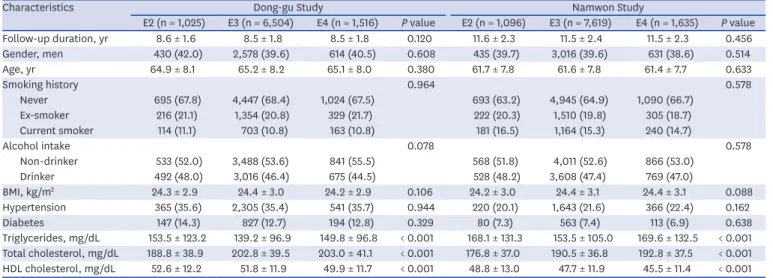
Table 1 presents the participants' baseline characteristics. The 9,045 participants in the Dong- gu Study were followed for 8.5 ± 1.8 years; among them, 1,070 (11.8%) died during this period.
The 10,350 participants in the Namwon Study were followed for 11.5 ± 2.3 years, and 1,399 (13.5%) died during this period. In both studies, the serum triglyceride levels were lowest in participants with the E3 allele, and the serum total cholesterol levels were lowest in participants with the E2 allele. The serum HDL cholesterol level was lowest in participants with the E4 allele.
The baseline characteristics of the study population according to the APOE genotypes (E2/E2, E2/E3, E2/E4, E3/E3, E3/E4, and E4/E4) are shown in Supplementary Tables 1 and 2.
Fig. 1 shows the Kaplan–Meier survival curve for the APOE alleles. Compared with the E3 allele, the E2 allele was associated with low mortality, and the E4 allele was non-significantly associated with high mortality.
Table 2 shows the hazard ratios (HRs) and 95% confidence intervals (CIs) according to APOE genotype, with the E3 allele used as the reference. In Model 1, the HR for the E2 allele was 0.86 (95% CI, 0.75–0.99) and that for the E4 allele was 1.05 (95% CI, 0.94–1.16); the respective values were 0.84 (95% CI, 0.74–0.96) and 1.08 (95% CI, 0.97–1.20) in Model 2. To evaluate the mediating effect of lipid profiles, we further adjusted for lipid profiles in Model 3. Consequently, the HR for the E2 allele decreased slightly to 0.80 (95% CI, 0.70–0.92), while that for the E4 allele remained unchanged (HR, 1.08; 95% CI, 0.97–1.20). Compared with the E3/E3 genotype, the HRs of E2/E2, E2/E3, E2/E4, E3/E4, and E4/E4 were 1.00 (95%
CI, 0.50–2.01), 0.80 (95% CI, 0.69–0.92), 1.05 (95% CI, 0.74–1.51), 1.09 (95% CI, 0.97–1.21), and 1.01 (95% CI, 0.66–1.55) in Model 3, respectively (Supplementary Table 3).
Table 1. Baseline characteristics of the study population according to apolipoprotein E genotypes
Characteristics Dong-gu Study Namwon Study
E2 (n = 1,025) E3 (n = 6,504) E4 (n = 1,516) P value E2 (n = 1,096) E3 (n = 7,619) E4 (n = 1,635) P value
Follow-up duration, yr 8.6 ± 1.6 8.5 ± 1.8 8.5 ± 1.8 0.120 11.6 ± 2.3 11.5 ± 2.4 11.5 ± 2.3 0.456
Gender, men 430 (42.0) 2,578 (39.6) 614 (40.5) 0.608 435 (39.7) 3,016 (39.6) 631 (38.6) 0.514
Age, yr 64.9 ± 8.1 65.2 ± 8.2 65.1 ± 8.0 0.380 61.7 ± 7.8 61.6 ± 7.8 61.4 ± 7.7 0.633
Smoking history 0.964 0.578
Never 695 (67.8) 4,447 (68.4) 1,024 (67.5) 693 (63.2) 4,945 (64.9) 1,090 (66.7)
Ex-smoker 216 (21.1) 1,354 (20.8) 329 (21.7) 222 (20.3) 1,510 (19.8) 305 (18.7)
Current smoker 114 (11.1) 703 (10.8) 163 (10.8) 181 (16.5) 1,164 (15.3) 240 (14.7)
Alcohol intake 0.078 0.578
Non-drinker 533 (52.0) 3,488 (53.6) 841 (55.5) 568 (51.8) 4,011 (52.6) 866 (53.0)
Drinker 492 (48.0) 3,016 (46.4) 675 (44.5) 528 (48.2) 3,608 (47.4) 769 (47.0)
BMI, kg/m2 24.3 ± 2.9 24.4 ± 3.0 24.2 ± 2.9 0.106 24.2 ± 3.0 24.4 ± 3.1 24.4 ± 3.1 0.088
Hypertension 365 (35.6) 2,305 (35.4) 541 (35.7) 0.944 220 (20.1) 1,643 (21.6) 366 (22.4) 0.162
Diabetes 147 (14.3) 827 (12.7) 194 (12.8) 0.329 80 (7.3) 563 (7.4) 113 (6.9) 0.638
Triglycerides, mg/dL 153.5 ± 123.2 139.2 ± 96.9 149.8 ± 96.8 < 0.001 168.1 ± 131.3 153.5 ± 105.0 169.6 ± 132.5 < 0.001 Total cholesterol, mg/dL 188.8 ± 38.9 202.8 ± 39.5 203.0 ± 41.1 < 0.001 176.8 ± 37.0 190.5 ± 36.8 192.8 ± 37.5 < 0.001 HDL cholesterol, mg/dL 52.6 ± 12.2 51.8 ± 11.9 49.9 ± 11.7 < 0.001 48.8 ± 13.0 47.7 ± 11.9 45.5 ± 11.4 < 0.001 All values are given as number (%) or mean ± standard deviation.
BMI = body mass index, HDL = high-density lipoprotein.
0.75 0.80 0.85 0.95 1.00
Survival probability
Follow−up period, yr 0.90
0 2 4 6 8 10 12 14
E2 E3 E4
Comparison E2 vs. E3 E4 vs. E3
P value 0.034 0.396
2,121 2,093 2,061 2,015 1,712 1,172 456
14,123 13,902 13,627 13,312 11,319 7,870 3,025
3,151 3,115 3,043 2,953 2,511 1,708 648
E2 No. at risk E3 E4
Fig. 1. Kaplan-Meier survival curves for APOE genotypes.
APOE = apolipoprotein E.
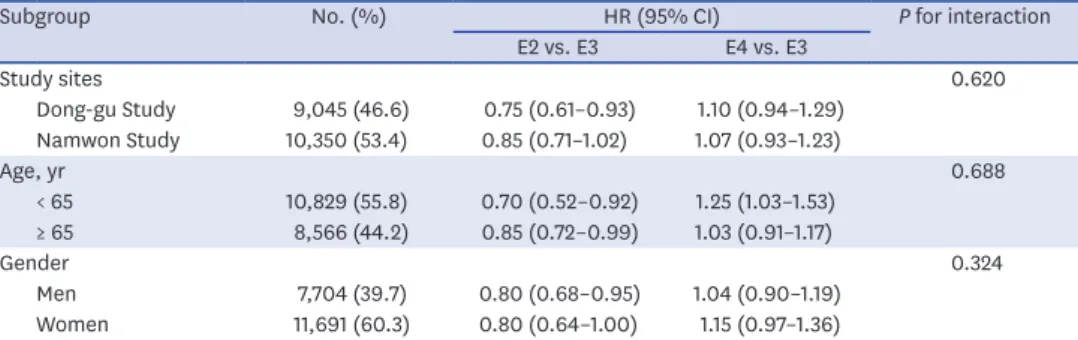
Table 3 shows the HR and 95% CI according to the subgroups. No significant difference was found among the subgroups in the association between APOE allele and mortality. The difference in HR among the APOE genotypes tended to be greater in the Dong-gu Study than in the Namwon Study. The HRs of the E2 allele were 0.75 (95% CI, 0.61–0.93) and 0.85 (95%
CI, 0.71–1.02) in the Dong-gu and Namwon Studies, respectively, while those of the E4 allele were 1.10 (95% CI, 0.94–1.29) and 1.07 (95% CI, 0.93–1.23), respectively. The risk difference according to the APOE alleles tended to be greater in women than in men, and greater in participants younger than 65 years than in older participants. In participants younger than 65 years, the HR of the E2 allele was 0.70 (95% CI, 0.52–0.92) and that of the E4 allele was 1.25 (95% CI, 1.03–1.53), whereas in the older participants, the HRs were 0.85 (95% CI, 0.72–0.99) and 1.03 (95% CI, 0.91–1.17) in the E2 and E4 alleles, respectively. The HRs of the E2 allele were 0.80 (95% CI, 0.68–0.95) and 0.80 (95% CI, 0.64–1.00) in men and women, respectively, and those of the E4 allele were 1.04 (95% CI, 0.90–1.19) and 1.15 (95% CI, 0.97–1.36), respectively.
DISCUSSION
In our study, the E2 allele was negatively associated with mortality, while the Ε4 allele was positively, but non-significantly, associated with mortality. There was no mediating effect of serum lipids on this association; unexpectedly, the effect of E2 allele increased slightly.
In previous studies, the association between APOE polymorphism and mortality was varied according to the size and age of the study population. The association between the E4 allele and mortality was not significant in small studies or studies with insufficient follow-ups.13-16 In large studies and studies with sufficient follow-ups,7,8,10,11 the E4 allele was associated with high mortality. Studies with participants with the E4 allele, aged 90 years or older, indicated Table 2. HR and 95% CI among apolipoprotein E genotypes
APOE Death/person-year Mortality rate
(per 1,000 person-year) Model 1a Model 2b Model 3c
E2 236/21,546.42 10.95 0.86 (0.75–0.99) 0.84 (0.74–0.96) 0.80 (0.70–0.92)
E3 1,813/142,929.72 12.68 1 (reference) 1 (reference) 1 (reference)
E4 420/31,696.00 13.25 1.05 (0.94–1.16) 1.08 (0.97–1.20) 1.08 (0.97–1.20)
HR = hazard ratio, CI = confidence interval.
aStudy sites were adjusted; bage, gender, body mass index, smoking history, and alcohol consumption were additionally adjusted; chistory of hypertension and diabetes, total and high-density lipoprotein cholesterol, and log-transformed triglycerides was additionally adjusted.
Table 3. Stratified analyses of the association between apolipoprotein E genotype and mortality
Subgroup No. (%) HR (95% CI) P for interaction
E2 vs. E3 E4 vs. E3
Study sites 0.620
Dong-gu Study 9,045 (46.6) 0.75 (0.61–0.93) 1.10 (0.94–1.29) Namwon Study 10,350 (53.4) 0.85 (0.71–1.02) 1.07 (0.93–1.23)
Age, yr 0.688
< 65 10,829 (55.8) 0.70 (0.52–0.92) 1.25 (1.03–1.53)
≥ 65 8,566 (44.2) 0.85 (0.72–0.99) 1.03 (0.91–1.17)
Gender 0.324
Men 7,704 (39.7) 0.80 (0.68–0.95) 1.04 (0.90–1.19)
Women 11,691 (60.3) 0.80 (0.64–1.00) 1.15 (0.97–1.36)
All models were adjusted for study site, age, gender, body mass index, smoking history, alcohol consumption, history of hypertension and diabetes, total and high-density lipoprotein cholesterol, and log-transformed triglycerides. E3 genotype group was used as a reference.
HR = hazard ratio, CI = confidence interval.
a significantly higher risk of mortality.9,10,12 However, despite the large sample size in our study, the E4 allele did not confer a significantly higher mortality risk than the E3 allele.
Previous studies have consistently shown that the E2 allele is associated with a lower risk of death than the E3 allele.7,10,11 Rajan et al.11 and Rosvall et al.7 reported that this association was significant. In a meta-analysis of centenarians,10 the probability of surviving more than 105 years, or the oldest 0.1 percentile, was significantly higher in those with the E2 genotype compared with those with the E3 genotype. However, in the Danish 1905 Cohort Survey of participants older than 92 years,12 the E2 allele did not indicate a significantly lower mortality rate than the other alleles. The protective effect of the E2 allele is primarily explained by its association with low LDL cholesterol levels.1 However, in our study, contrary to our expectations, the HR strengthened from 0.84 to 0.80, when we adjusted for the lipid profile.
In contrast to a previous study using the same dataset as that used in the present study, we reported an association between carotid atherosclerosis and APOE polymorphism,24 in which adjusting for the lipid profile attenuated this association.
These discrepancies in the association between APOE alleles and mortality in previous studies can be attributed to three factors. First, the genetic influence may depend on age.
As mentioned above, the older the study population, the smaller is the effect of E2 and the greater is the effect of E4. Jacobsen et al.9 evaluated changes in the association between the E4 allele and mortality with a follow-up period and reported that the longer the follow-up period, the greater was the HR of the E4 allele. By contrast, in our study, the HR of the E4 allele was higher in the younger groups. Next, the association between APOE polymorphism and mortality can vary depending on the APOE genotype classification method. The APOE genotype can be divided into either E2, E3, and E4 according to the allele type or into E4 carrier and E4 non-carrier according to the E4 carrier type. Previous studies comparing risk differences between E4 carriers and non-carriers8,9,14 overestimated the risk of the E4 allele because the E4 non-carriers included not only E3 carriers but also E2 carriers, who exhibited a lower mortality risk than the E3 carriers. Finally, the frequency of the E4 allele varies by population and is affected by environmental variables such as latitude and temperature.25 The E4 allele frequency of 14.5%–27.9% has been reported, which is higher than 8.6% in our study.7,9,11,12,14,15 The statistical power of our study was insufficient to detect an HR of 1.08, which was slightly lower than the HR (1.10 to 1.22) reported in other studies,7,10-12 because of the low frequency of the E4 allele. Studies based on Asian populations reported a low E4 allele frequency similar to our study, and the association between the E4 allele and mortality was non-significant.13,16
This is the largest individual study evaluating the association between APOE genotypes and mortality, which allows us to assess this association according to APOE allele types (E2, E3, or E4). Nevertheless, our study presents several limitations. First, additional genetic information that could affect APOE was not included. Although the rs429358 and rs7412 considered in our study affect the function of APOE, other DNA positions in the APOE may also affect its function.26 Next, because the follow-up period was relatively short in this study, the association between APOE and mortality by cause of death could not be determined.
Additionally, interactions with variables such as age and gender could not be obtained.
In conclusion, the death risk differed according to the APOE polymorphism in Korean adults.
The E2 allele was associated with a lower risk of mortality than the E3 allele, whereas the E4 genotype was not associated with mortality in Koreans.
SUPPLEMENTARY MATERIALS
Supplementary Table 1
Baseline characteristics of study population according to apolipoprotein E genotypes in the Dong-gu Study
Click here to view
Supplementary Table 2
Baseline characteristics of study population according to apolipoprotein E genotypes in the Namwon Study
Click here to view
Supplementary Table 3
Stratified analyses of the association between apolipoprotein E genotypes and mortality Click here to view
REFERENCES
1. Davignon J. Apolipoprotein E and atherosclerosis: beyond lipid effect. Arterioscler Thromb Vasc Biol 2005;25(2):267-9.
PUBMED | CROSSREF
2. Kamboh MI, Minster RL, Kenney M, Ozturk A, Desai PP, Kammerer CM, et al. Alpha-1-antichymotrypsin (ACT or SERPINA3) polymorphism may affect age-at-onset and disease duration of Alzheimer's disease.
Neurobiol Aging 2006;27(10):1435-9.
PUBMED | CROSSREF
3. Eichner JE, Dunn ST, Perveen G, Thompson DM, Stewart KE, Stroehla BC. Apolipoprotein E polymorphism and cardiovascular disease: a HuGE review. Am J Epidemiol 2002;155(6):487-95.
PUBMED | CROSSREF
4. Benjamin R, Leake A, McArthur FK, Ince PG, Candy JM, Edwardson JA, et al. Protective effect of ApoE epsilon 2 in Alzheimer's disease. Lancet 1994;344(8920):473-4.
PUBMED | CROSSREF
5. McKay GJ, Silvestri G, Chakravarthy U, Dasari S, Fritsche LG, Weber BH, et al. Variations in
apolipoprotein E frequency with age in a pooled analysis of a large group of older people. Am J Epidemiol 2011;173(12):1357-64.
PUBMED | CROSSREF
6. Garatachea N, Marín PJ, Santos-Lozano A, Sanchis-Gomar F, Emanuele E, Lucia A. The ApoE gene is related with exceptional longevity: a systematic review and meta-analysis. Rejuvenation Res 2015;18(1):3-13.
PUBMED | CROSSREF
7. Rosvall L, Rizzuto D, Wang HX, Winblad B, Graff C, Fratiglioni L. APOE-related mortality: effect of dementia, cardiovascular disease and gender. Neurobiol Aging 2009;30(10):1545-51.
PUBMED | CROSSREF
8. Joshi PK, Fischer K, Schraut KE, Campbell H, Esko T, Wilson JF. Variants near CHRNA3/5 and APOE have age- and sex-related effects on human lifespan. Nat Commun 2016;7(1):11174.
PUBMED | CROSSREF
9. Jacobsen R, Martinussen T, Christiansen L, Jeune B, Andersen-Ranberg K, Vaupel JW, et al. Increased effect of the ApoE gene on survival at advanced age in healthy and long-lived Danes: two nationwide cohort studies. Aging Cell 2010;9(6):1004-9.
PUBMED | CROSSREF
10. Sebastiani P, Gurinovich A, Nygaard M, Sasaki T, Sweigart B, Bae H, et al. APOE alleles and extreme human longevity. J Gerontol A Biol Sci Med Sci 2019;74(1):44-51.
PUBMED | CROSSREF
11. Rajan KB, Barnes LL, Wilson RS, McAninch EA, Weuve J, Sighoko D, et al. Racial differences in the association between apolipoprotein E risk alleles and overall and total cardiovascular mortality over 18 years. J Am Geriatr Soc 2017;65(11):2425-30.
PUBMED | CROSSREF
12. Lindahl-Jacobsen R, Tan Q, Mengel-From J, Christensen K, Nebel A, Christiansen L. Effects of the APOE ε2 allele on mortality and cognitive function in the oldest old. J Gerontol A Biol Sci Med Sci 2013;68(4):389-94.
PUBMED | CROSSREF
13. Vasunilashorn S, Glei DA, Lan CY, Brookmeyer R, Weinstein M, Goldman N. Apolipoprotein E is associated with blood lipids and inflammation in Taiwanese older adults. Atherosclerosis 2011;219(1):349-54.
PUBMED | CROSSREF
14. Rockwood K, Nassar B, Mitnitski A. Apolipoprotein E-polymorphism, frailty and mortality in older adults. J Cell Mol Med 2008;12(6B):2754-61.
PUBMED | CROSSREF
15. van Exel E, Koopman JJ, Bodegom DV, Meij JJ, Knijff P, Ziem JB, et al. Effect of APOE ε4 allele on survival and fertility in an adverse environment. PLoS One 2017;12(7):e0179497.
PUBMED | CROSSREF
16. Gao S, Jin Y, Unverzagt FW, Cheng Y, Su L, Wang C, et al. Cognitive function, body mass index and mortality in a rural elderly Chinese cohort. Arch Public Health 2014;72(1):9.
PUBMED | CROSSREF
17. Jian-Gang Z, Yong-Xing M, Chuan-Fu W, Pei-Fang L, Song-Bai Z, Nui-Fan G, et al. Apolipoprotein E and longevity among Han Chinese population. Mech Ageing Dev 1998;104(2):159-67.
PUBMED | CROSSREF
18. Ewbank DC. Differences in the association between apolipoprotein E genotype and mortality across populations. J Gerontol A Biol Sci Med Sci 2007;62(8):899-907.
PUBMED | CROSSREF
19. Kardaun JW, White L, Resnick HE, Petrovitch H, Marcovina SM, Saunders AM, et al. Genotypes and phenotypes for apolipoprotein E and Alzheimer disease in the Honolulu-Asia aging study. Clin Chem 2000;46(10):1548-54.
PUBMED
20. Kweon SS, Shin MH, Jeong SK, Nam HS, Lee YH, Park KS, et al. Cohort profile: the Namwon study and the Dong-gu Study. Int J Epidemiol 2014;43(2):558-67.
PUBMED | CROSSREF
21. Shin MH, Kim HN, Cui LH, Kweon SS, Park KS, Heo H, et al. The effect of apolipoprotein E polymorphism on lipid levels in Korean adults. J Korean Med Sci 2005;20(3):361-6.
PUBMED | CROSSREF
22. Hixson JE, Vernier DT. Restriction isotyping of human apolipoprotein E by gene amplification and cleavage with HhaI. J Lipid Res 1990;31(3):545-8.
PUBMED
23. World Health Organization. ICD-10: International Statistical Classification of Diseases and Health-related Problems.
Geneva: World Health Organization; 1992.
24. Shin MH, Choi JS, Rhee JA, Lee YH, Nam HS, Jeong SK, et al. APOE polymorphism and carotid atherosclerosis in Korean population: the Dong-gu Study and the Namwon Study. Atherosclerosis 2014;232(1):180-5.
PUBMED | CROSSREF
25. Eisenberg DT, Kuzawa CW, Hayes MG. Worldwide allele frequencies of the human apolipoprotein E gene:
climate, local adaptations, and evolutionary history. Am J Phys Anthropol 2010;143(1):100-11.
PUBMED | CROSSREF
26. Xu Q, Brecht WJ, Weisgraber KH, Mahley RW, Huang Y. Apolipoprotein E4 domain interaction occurs in living neuronal cells as determined by fluorescence resonance energy transfer. J Biol Chem 2004;279(24):25511-6.
PUBMED | CROSSREF