A Study on the Introduction of Urban Agriculture to Permanently Rental Apartment Complexes
Eun-Joo Yoon1 and Young-Ho Yoon2
(Received March 5, 2011 / Revised April 5, 2011 / Accepted April 20, 2011)
ABSTRACT
Urban agriculture is drawing people’s attention along with environmental problems and recent changes in population and society such as the expansion of the aged, and various related discussions are going on for expanding the base. The purpose of this study was to suggest the application of urban agriculture in the permanently rental apartment complex to build a social welfare. Aiming at the introduction of urban agriculture in permanently rental apartment complexes, this study presented the roles and necessities of urban agriculture in response to environmental changes at home and overseas, explained the current state of permanently leased apartment complexes, estimated the land area usable for urban agriculture in existing complexes, and proposed strategies for the introduction of urban agriculture.
Key words: Urban Agriculture, Permanently Rental Apartment Complex, Vegetable Garden, Elderly Population's Increase, Local food, Food justice
http://lhi.lh.or.kr
This study was the part of the LHI strategies report (2010) 「A Study on the Introduction of Urban Agriculture to Permanently Leased Apartment Complexes」
1) Associate Research Fellow, Land & Housing Institute (Main author: [email protected]) 2) Exective Research Fellow, Land & Housing Institute (Corresponding author: [email protected])
1. Introduction
1.1 Background and objective
Urban agriculture, which is called by various names, is drawing people’s attention along with environmental problems and recent changes in population and society such as the expansion of the aged population, and various related discussions are going on for expanding the base.
First of all, urban agriculture was defined by UNDP (1996) as activities of intensive production, processing and distribution of various crops and livestock grown in soil and water in urban or suburban areas using natural resources or waste resources generated from urban areas. The Ministry for Food, Agriculture, Forestry and Fisheries (2010) also defined it as a series of agricultural activities for restoring urban communities. In this way, urban agriculture has environmental and social functions in addition to its basic production function, and thus, can play various roles depending on the subject of application (Kim, 2010).
Particularly if it is applied to the low-income class, it may produce various benefits including leisure activities, the formation of community, and the support of balanced nutrition intake. Thus, this study purposed to examine the introduction of urban agri-
culture to permanently rental apartment complexes on the dimension of social welfare. Permanently rental apartment complexes have the unique characteristics distinguished from detached houses or ordinary apartment complexes. Thus, we attempted to propose urban agriculture introduction strategies suitable for the type of complexes.
1.2 Scope and methods
This study aimed to propose strategies for the introduction of urban agriculture into permanently rental apartment complexes, and its subjects were 126 rental housing complexes under the management of Korea Land and Housing Corporation. We limited spaces, to which urban agriculture is applicable, to green zones in the lots and building rooftops, and estimated the possible area and production of urban agriculture through analyzing basic data on the 126 complexes. In addition, we proposed strategies for urban agriculture introduction suitable for the conditions of the subject areas and the residents’ characteristics through interviews with specialists and literature review.
1.3 Review of related cases
Related previous studies investigated the planning, effects and
Ireland Japan Netherlands France American Canada Korea Fig. 1. The urbanization rate (%)
Fig. 2. The area of farm lands in Korea(1990~2008) operation methods of urban agriculture, and we reviewed such
studies focusing on the characteristics and needs of residents at permanently rental apartment complexes in order to get basic information for the application of urban agriculture to such complexes.
First, with regard to research trends on the planning of urban agriculture, Lim et al.(2009) analyzed how to introduce urban agriculture in urban green zones, and Lim(2009) mentioned considerations in planning and designing an agricultural park as a type of urban park using the case of Dongtan New Town. Kim (2009) and Jang(2006) analyzed the utilization of urban agri- culture as parts, green zones, recreation spaces, etc. and analyzed its effects. With regard to the operation of urban agriculture, So (2008) defined the operators of urban agriculture, and proposed an urban agriculture operation method through interaction among the operators and the establishment of governance.
With regard to permanently rental apartment complexes, Choi et al.(2008) and Choi(2005) reported that the residents of permanently rental apartment complexes tend to have a low sense of community due to surrounding neighbors’ discriminative eyes, and to cause problems in complex operation such as deliberate destruction of facilities, and pointed out such residents’ high need of outdoor spaces and the necessity to activate community. Lim et al.(2010) also mentioned problems in the operation of permanently rental apartment complexes and analyzed the characteristics of residents in such complexes, and maintained that social and physical revival may have a positive effect on the residents’ sociability.
According to the results of reviewing previous studies, most of them were at the early stage, discussing the possibility for introducing urban agriculture, making simple proposals for the operation of urban agriculture, or describing design techniques, and there were few studies that applied urban agriculture to specific subjects or dealt with introduction strategies. In the results of studies with permanently rental apartment complexes were analyzed, many of residents at such complexes were the old and the weak who were in need of activities. Thus, it is necessary to consider the introduction of urban agriculture as a solution to need their need.
2. Dynamics and necessity of urban agriculture in response to environmental changes at home and overseas
The following lists why urban agriculture is necessary to cope with major environmental changes at home and overseas.
2.1 Global energy problem
The worsening environmental problems mainly caused by climate change have so immense impacts on entire global society that they are regarded as megatrends not only in the environ- mental aspect but also in the economic aspect. Among the OECD
members, Korea is the 9th largest country in terms of greenhouse gas emission (based on carbon dioxide discharge in the energy sector as of 2007, IEA). The Korean government is intensifying regulations to reduce carbon dioxide emission including the enactment of related laws including the ‘Framework Act on Low Carbon and Green Growth’and the ‘Greenhouse Gas Emission Trading Act’ (Committee on Green Growth, 2009).
2.2 Food security
According to the Food and Agriculture Organization (2009), Korea is 26th in food self-sufficiency rate among 30 OECD countries. While the rate is as high as 329% in France, the front runner, and over 100% in other countries such as the U.S., the U.K., Sweden and Germany, it is only 26.2% in Korea. In this sense, urgent measures are required in the aspect of food security (www.fao.org). According to statistics on this issue, 59.1% of the respondents expressed their concern over food security, and the government also took food security as one of tasks for green growth (www.kostat.go.kr).
2.3 Urbanization and the shrinkage of arable lands The urbanization rate (%), which is the proportion of people living in cities among the whole population and indicates the concentration of population in urban areas, is 90.5% currently as
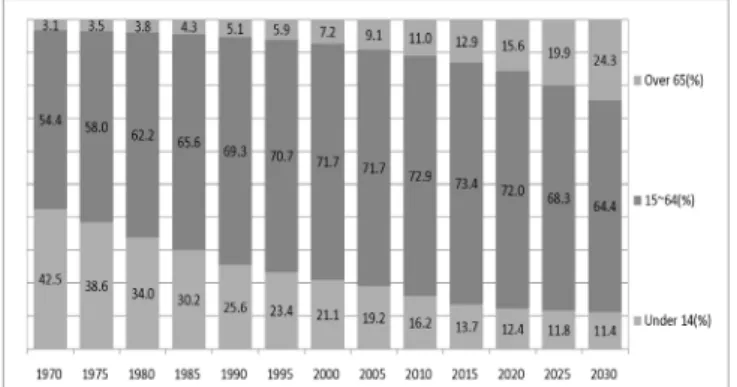
Fig. 3. Estimated population by age(1970~2030)
Fig 4. National mean of Engel’s coefficient(2005~2010) of 2007 in Korea, quite high compared to 59.9% in Ireland, 65.3% in Japan, 65.8% in the Netherlands, 76.3% in France, 80.1% in the U.S., and 80.4% in Canada.
Despite the concentration of population in cities, the size of arable lands in rural areas is decreasing. According to a survey on arable lands by the National Statistical Office (2009), the area of farm lands has decreased by 0.9% annually on the average for 19 years from 1990 to 2008, that is, by a total of 350ha (16.6%) from 2,108ha in 1990 to 1,758ha in 2008. This suggests that Korea should take immediate actions for its food security.
2.4 Expansion of the aged population and the retirement of the baby boom generation
According to estimated population by age published by the National Statistical Office (2007), the aged population over 65 is expected to increase from 3.1% in 1970 up to 24.3% in 2030.
Among them, the proportion of baby boomers (born between 1955-1963) is 15.2% (7,140,000) of the total population in the 2005 Census, and 83.4% of them are living in urban areas. In particular, the number of waged workers who will retire, excluding the self-employed who do not need to retire, is estimated to be 3,110,000 (Seo, 2010; the National Statistical Office, 2005). In the field of housing and urban studies, it is necessary to develop programs to cope with the expanding aged population and the retirement of the baby boom generation. Because
most of people in this generation have direct and indirect experiences in farming, we need to consider the introduction of urban agriculture as a means of leisure and livelihood after retirement.
2.5 Food justice
According to data from the National Statistical Office, currently as of the 3rd quarter of 2010, the national mean of Engel’s coefficient is 14.86%, and the coefficient is 12.36% for the top 20% income earners and 21.74% for the bottom 20%, showing a large gap according to income level. In addition, low-income people are heavily dependent on instant food for their food intake due to the high cost of healthy food such as vegetable(www.kostat.go.kr).
Urban agriculture is suggested as a solution of food justice, a concept to cope with low-income classes’ unbalanced nutrition intake by guaranteeing the right to have the minimum amount of good food. In Korea, the 2007 statistics of National Health Insurance reported that the amount of expenses for treating adult diseases involving unbalanced food intake reached 1.8 trillion won. Different from the past when insufficient intake of quality meat was the problem, now the shortage of vegetable intake is arising as a new problem due to the rise of vegetable price. The average vegetable consumption by each Korean person is around 187kg or 4,500,000 won in amount, which is quite a large sum of money for low-income earners (Korea Rural Economic Institute, 2002).
2.6 Food mileage and local food
Food mileage means the distance between the place of food production and that of food consumption. Since the concept appeared first in ‘The Food Miles Report' published by the U.K.
SAFE Alliance (NGO promoting safe food and local organic farming) in 1999, it has been spread worldwide to the U.S., France, Germany, Japan, etc. As an ideological base of local farming and local food promotion movements, this concept is gaining its persuasiveness in the aspect of energy saving from food distribution for impeding global warming. Food mileage is quite high in Korea, which imports a large part of its food demand. For imported food, food mileage per person in Korea is 5,121t․km/person (as of 2007), and this is 5.9 times higher than 869t․km/person in France. If this mileage is converted to carbon dioxide discharge, carbon dioxide discharge per person resulting from the transportation of imported food is 114kgCO2/person in Korea, which is 1.2 times higher than that in France (Gyeonggi Research Institute, 2009).
Local food is related not only to the reduction of carbon dioxide but also to food safety. Some foreign countries are providing governmental support to urban agriculture and industrializing it as a solution for local food and food mileage (Ministry for Food, Agriculture, Forestry and Fisheries, 2010).
Fig. 5. Fallen leaves from roadside trees
Fig. 6. Lot area to family garden in Dongil High Ville
Global energy problem Food security Urbanization and the shrinkage of arable lands
Expansion of the aged population &
the retirement of the baby boom generation
Food justice Food mileage & local food
Resource recycling
… Absorption of CO2 through the expansion of biotope area … Increase in arable land and
agricultural labor … Provision of arable land
… Provision of leisure or work programs
… Cost saving of vegetable … Short-range production &
consumption systems / safe food … Recycling of food waste & fallen
leaves
Environment Role of Urban Agri.
Changes in lifestyle … Well-being needs & creation of community spaces
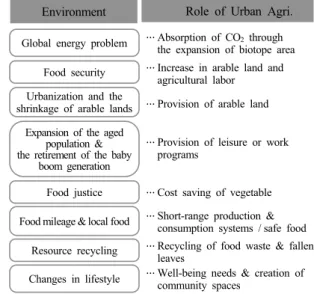
Fig. 7. Changes in surrounding environment and the roles of urban agriculture
2.7 Resource recycling
Korea generates food waste of over 5,300,000 ton/year, occupying 29% of general waste, and the cost of food waste disposal is 80,000 won/ton. Along with its large volume and disposal cost, food waste causes various environmental problems through salt, water, leachate, bad odor, harmful gas, etc.
contained in it. Fallen leaves from roadside trees in autumn are recyclable as compost or other uses, but they are collected and burned. The cost of fallen leaf incineration is as high as 190,000-200,000 won/ton. In case of the Gangdong District, 1,800 ton of fallen leaves is generated annually, and the disposal cost is around 350,000,000 won a year. Because of the large volume and disposal cost, it is necessary to consider the recycling of food waste and fallen leaves within rural areas.
2.8 Changes in lifestyle
With the introduction of the five-day-work-week system and the expansion of the aged population, there is an increasing demand for various types of leisure activities. To cope with socio-demographic changes, housing complexes are executing many plans and consumers also prefer houses reflecting well-being and environment-friendly values. In response to these demands, some apartment complexes divert a part of the lot area to family garden. In case of Dongil High Ville, an apartment complex at Yongin Dongbaek completed in 2006, 5% of the lot area is used as family garden so that the residents can grow vegetable. The family garden has been operated successfully for over 4 years since the completion.
2.9 Changes in surrounding environment and the roles of urban agriculture
In response to abovementioned political and socio-cultural needs such as energy saving, food security, the shrinkage of arable land resulting from urbanization, aging and retirement of the baby boom generation, and demand for local food and resource recycling, urban agriculture can play various roles including the absorption of carbon dioxide through the expansion of biotope area, absorption of carbon dioxide, increase in arable
land and agricultural labor, provision of leisure or work programs, self-production and resultant cost saving of vegetable, short-range production and consumption systems and consequent availability of safe food, recycling of food waste and fallen leaves as compost, satisfaction of well-being needs, creation of community spaces, etc. This is summarized as in Figure 7.
3. Current state of the subject area
3.1 Distribution of permanently rental apartment complexes A total of 190,000 units of permanently rental housing have been constructed for the housing security of socially protected classes such as basic livelihood security recipients, people of distinguished national services, the victims of Japanese army comfort women. Of them, around 140,000 units were built by Korea Land and Housing Corporation, and 50,000 by local self-governing bodies.
Currently as of the end of 2008, Korea Land and Housing Corporation is managing 126 complexes, 140,078 unites, and
Fig 8. The distribution of permanently rental apartment complexes Fig 9. Familly garden and box garden in Suseo Jugong
most of them were constructed between 1989-1992, so are 17-20 years old and in need of repair.
3.2 Current state of residents
Most of the residents of permanently rental apartments are the social weak such as welfare beneficiaries, the disabled, and living-alone elders. Recently, the proportion of aged residents is high due to the aging of society. Because the beneficiaries and the disabled live on the government’s subsidies, they do not have to work. Furthermore, if they have any earned income their benefits may be cut down, and for this reason, many of residents pass their time in wandering around the complex. Even some misuse benefits and become alcoholics (Korea Housing Management Seoul Suseo Office, 2009).
Taking the Suseo Jugong Apartment Complex as an example, 1,088 households (42.4%) are welfare beneficiaries, of which 10% are living-alone elders and 14.2% are disabled (Korea Housing Management Seoul Suseo Office, 2009). Demand for family gardenis high among women’s association members and aged residents, and some people actually grow vegetable using vacant lots in the complex.
4. Estimating the land area for urban agriculture
In order to measure the size of usable land if urban agriculture is introduced to established complexes, we analyzed data on 126 permanently rental apartment complexes under the management of Korea Land and Housing Corporation, and estimated the land area for introducing urban agriculture into permanently rental apartment complexes.Land types usable for urban agriculture are landscape areas covered with lawn, plants or flower on the ground, and building
rooftops that may be usable for rooftop greening. As to landscape area, 15% of the lot area is used for landscape in complexes with small-size units like permanently rental apartment complexes.
We assumed that 10% of the landscape area would be usable for urban agriculture. As to rooftop, we excluded the rooftops of residential buildings in consideration of user safety, and assumed that urban agriculture would be applied only to the rooftops of relatively low-rise subsidiary welfare facilities. Taking into account rooftop equipment such as air conditioners and load, we calculated on the assumption that around 40% of the rooftop area would be usable for urban agriculture.
When these criteria were applied to the 126 subject complexes, the urban agriculture area on the ground was around 550,000m2, and that on the rooftops was around 550,000m2, so a total of 110,000m2. When this area was divided into the number of households in the complexes, 0.74m2 of land was allocated to each household. If the land of 110,000m2 is converted to lettuce production, it can produce around 450 ton.
5. Urban agriculture introduction strategies at rental housing complexes
As this study purposed to suggest the introduction of urban agriculture as a solution for various problems in permanently rental apartment complexes, we need different approaches and introduction strategies from those for private apartment complexes.
Most of all, we should consider the peculiarity of permanently rental apartment complexes in introducing urban agriculture, and differentiate strategies through the stages of introduction such as early stage and settlement stage.
In detail, we can employ a total of 6 strategies for the introduction
of urban agriculture as follows.
First, with regard to how to approach, we should approach the project as a part of welfare policies at the beginning. Because most of the residents are old, weak or disabled, the practical purposes of urban agriculture such as production and environ- mental control should be applied only after the settlement of urban agriculture.
Second, with regard to the nature of project, urban agriculture should be promoted as a demonstrative project for campaign at the beginning. We should emphasize the positive effects of urban agriculture through the campaign, and the development of business models as found in foreign countries like Japan and Cuba should be postponed until techniques for urban agriculture are acquired.
Third, with regard to the purposes of introduction, urban agriculture should be approached lightly as a hobby, leisure, or therapy. For the residents of rental housing complexes whose will to work is low, it is desirable to create atmosphere for working by stimulating their interest in urban agriculture as a hobby and then to provide them with vocational training and develop practical work models. In order to stimulate the participants’ interest, it will be effective to execute gardening such as horticulture and herb cultivation in addition to farming.
Fourth, with regard to production and sales, urban agriculture should aim to produce a small amount of crops for sharing or self-support at the beginning. Then, at the sage of settlement, we may establish sales networks in connection with stores inside the complex or local markets, and develop revenue models.
Fifth, with regard to support, indirect financial support for facilities and organizations is necessary at the early stage. Because direct financial support may discourage the residents’ will of self-support, indirect financial support programs should be developed. After the settlement of urban agriculture, support should be focused more on operation and organization than on finance.
Lastly, with regard to the subjects of application, it may be desirable to start cultivation from the top of sewage purification systems and part of landscape areas, and then, in consideration of safety, expand gradually to the rooftops of 3-story or lower subsidiary buildings, the rooftops of low-rise apartment buildings, and the rooftops of high-rise apartment buildings.
6. Conclusions
Aiming at the introduction of urban agriculture in permanently rental apartment complexes, this study presented the roles and necessities of urban agriculture in response to environmental changes at home and overseas, explained the current state of permanently rental apartment complexes, estimated the land area usable for urban agriculture in existing complexes, and proposed strategies for the introduction of urban agriculture.
The application method of urban agriculture varies according
to the subject or purpose of introduction. Based on the results of surveying the characteristics of residents at permanently rental apartment complexes, this study divided the application of urban agriculture into the introduction stage and the settlement stage, and proposed strategies according to the stage.
As it focused on the proposal of strategies for the introduction of urban agriculture, however, this study has the limitation that it did not cover details on organizational support and financial support for residents’ voluntary participation, management, and education. Thus, further research should be made on these issues for the activation of urban agriculture.
References
1. Choi, J. M. (2005), “Dissatisfaction and Recognition Evaluation on the Permanent Rental Apartment Housing”, Journal of Archi- tectural Institute of Korea (Planning div.), 21(12): 235~247.
2. Choi, P. G., Lee, J. W., Ha, J. M. (2008), “A Study on Improvement of Settlement Environment based on the Rental Housing Resident's Lifestyle”, Journal of Architectural Institute of Korea (Planning div.), 24(6): 69~77.
3. Gyeonggi Research Institute (2009), Local Strategies for Building a Low Carbon Society(II), Suwon: Gyeonggi Research Institute.
4. Jang, D. H. (2006), Study on Ecology-oriented Urban Agriculture- centered on Jeonju City, Ph.D. Dissertation. Jeonju : Chonbuk National Unversity.
5. Kim, J. H. (2010), “A Study on the Implementation of Urban Agri- culture Utlizing the Idle Land”, Proceeding of Architectural Institute of Korea, 1: 98~104.
6. Kim, O. J. (2009), A Study on the Characteristics and Application of the Urban Farmland, Master Thesis, Sunchon : Sunchon Nationa University.
7. Korea Housing Management Seoul Suseo Office (2009), The result and problem of Suseo Jugong apartment complex
8. Land & Housing Institute (2010), LHI Strategies Report : A Study on the Introduction of Urban Agriculture to Permanently rental Apartment Complexes, Seoul : Land & Housing Institute 9. Lim, E. S., Lee, Y. S., Kim, J. S. (2010), “The Effect of
Socio-Physical Regeneration on Social Network of Elderly Residents”, Journal of the Korea Institute of Ecological Archi- tecture and Environment, 10(5): 31~41.
10. Lim, H. S., Zoh, W. B., Hong, K. P. (2009), “A study on the Urban agriculture for the Green space expansion”, Autumn proceedings of the Korean Institute of Landscape Architecture Conference, 128~130.
11. Lim, J. E. (2009), The Design for Urban Agricultural Park in Dong-tan New City, Master Thesis. Seoul : Seoul National University.
12. Ministry for Food, Agriculture, Forestry and Fisheries(2010), Press kit for the activation of Urban agriculture Network in Korea.
13. National Housing Corporation (2009), Public fifth years․ the current state of the permanently rental apartment complexes I,II,III,
Seoul: National Housing Corporation.
14. National Statistical Office(2007), 2005 Population and Housing Census.
15. Park, D.G. (2010), “Rice’s stabilize supply and raise the food self-sufficiency rate”, International Food and Agriculture, Spring 2010, 16~21.
16. Presidential Committee on Green Growth(2009), Five-year Action plan on Green Growth(2009~2013), Seoul : Presidential Committee on Green Growth.
17. Seo, S. B. (2010), “Retirement Migration Factors of Baby Boom Generation and Implication of Housing policy”, Journal of Korea Planners Association, 45(5): 93~104.
18. So, H. J. (2008), Analysis of the Network governance for the activation of Urban agriculture, Master Thesis. Seoul : Seoul National University.
19. www.fao.org 20. www.kostat.go.kr