• 검색 결과가 없습니다.

Synthesis of Antioxidant and Evaluation of Its Oxidation Stability for Biodiesel

N/A
N/A
Protected

Academic year: 2021

Share "Synthesis of Antioxidant and Evaluation of Its Oxidation Stability for Biodiesel"

Copied!
5
0
0

로드 중.... (전체 텍스트 보기)

전체 글

(1)

DOI http://dx.doi.org/10.9725/kstle.2013.29.6.392

Synthesis of Antioxidant and Evaluation of Its Oxidation Stability for Biodiesel

Soo-Youl Park

, Seung-Rim Shin, Joung-II Shin, Kyoung-Lyong An and Kun Jun Interface Chemistry and Engineering Research Team,

Green Chemistry Engineering Division, Korea Research Institute of Chemical Technology (Received September 1, 2013 ; Revised October 10, 2013 ; Accepted October 16, 2013)

Abstract − Biodiesel fuels contain unsaturated fatty acid ester, which can easily oxidize, especially when exposed to ultraviolet light. The products formed by this oxidation give rise to sediment or gum formation. As a result, the fuel can contribute to the corrosion and plugging of the filter pump. Antioxidants have been used in an effort to stabilize biodiesels, but there is still a need for a biodiesel composition with improved oxidation stability. In general, good fuel compositions should provide synergistic combinations of a biodiesel and anti- oxidants. Our work involved the synthesis of antioxidants to improve the oxidative stability of biodiesel fuel.

Keywords - antioxidant, biodiesel, oxidative stability

1. Introduction

Biodiesel is a natural substitute for petroleum diesel that may be produced from renewable resources such as vegetable oils, animal fats and used cooking oil [1-4].

Chemically, the biodiesel as alkyl-esters from fatty acids derived from naturally occurring lipids, which may be produced, along with glycerin, through the reaction of tri-acylglycerides with ethanol or methanol, in the presence of an acid or base catalyst [5].

Biodiesel has great potential as an alternative fuel for compression ignition engines, and one of its great advantages is that it is similar to diesel fuel. Homoge- neous and oxygen content structure gives good com- bustion properties and oxygen gives it excellent properties for environment and fuel lubricity. Also, biodiesel is easy to handle because its boiling point is higher than that of diesel and it is an environment-friendly fuel with low smoke emissions because it contains 10%

oxygen. In addition, biodiesel has a higher specific gravity and higher kinematic viscosity than diesel; the higher cetane number of biodiesel can shorten the igni- tion delay, reducing the NOx emissions during the ini- tial combustion process. Biodiesel also emits lower levels of hydrocarbons (HC), CO, polycyclic aromatic hydrocarbons (PHA), SO

2

, and smoke than diesel.

The oxidation stability of biodiesel must be a con- cern for both producers and future consumers of this product. This is because oxidative processes promote increased viscosity through the occurrence of conden- sation reactions involving double bonds. These reac- tions can be lead to the formation of insoluble materials, such as gums and sediments that plug fuel filters and injection systems [6-7]. Given that factors such as the presence of be lead to the formation of insoluble mate- rials, such as gums and sediments that plug fuel filters and injection systems [6-7]. Given that factors such as the presence of air, heat, light and pro-oxidants such as hydroperoxides and metals are known to be responsible for the onset of oxidation reactions. In this content, the use of effective antioxidants that increase the stability of biodiesel, is of fundamental importance to maintain-

Corresponding author : [email protected] Tel: +82-(0)42-860-7666

Fax: +82-(0)42-860-7669

(2)

ing a program, aimed at its production and use. When exposed to air during storage, autoxidation of biodiesel can cause degradation of fuel quality. One approach for increasing resistance of fatty derivatives against is to treat them with oxidation inhibitors, i.e. antioxidants.

Alkylphenols are valuable industrial chemicals, among which t-butylated phenols are of particular importance [8-10]. This study examines the effectiveness of such antioxidants, t-butylhydroquinone (TBHQ), butylated

hydroanisole (BHA), n-propyl gallate (PrG), pyro- gallol (PyG) in biodiesel.

This study investigates the oxidation stability of biodiesels made from used edible frying oils using the Rancimat test, as recommended in European Nor- malization(EN) 14214. The effects of antioxidants in biodiesels on engine performance, combustion charac- teristics, and exhaust emissions are also studied.

2. Experiments

2-1. Materials and analytical methods

All solvents, reagents and starting materials were purchased and used without further purification. All chemical agents were purchased from Aldrict.

1

H NMR spectra was recorded on a Bruker Advance DRX 400 spectrometer at 300 and 500 MHz, respec- tively. Samples were run in CDCl

3

or DMSO-d and referenced to TMS. Melting points were recorded on a Buchi Melting Point B-544. GC analyses were carried out using a Hewlett Packard Series 5890 equipped with a DB-1 fused silica coloumn (25 m × 0.32 mm id, 0.5 µm film thickness). The injector and detector tem- peratures were 250 and 290

o

C, respectively. The oven temperature was programmed as follow: initially 80

o

C, increasing to 290

o

C at 10

o

C min and holding for 10 min.

2-2. Experiments methods

2-2-1. The synthesis of 2-t-butylhydroquinone A typical experiment procedure for alkylation of hydroquinone is as follows. 66 g of hydroquinone (0.6 mole) and 240 ml of phosphoric acid were dissolved in toluene. A solution 60 ml of tert-butanol (0.6 mole) was placed in a dropping funnel and was added to the reaction mixture dropwise maintaining the reaction temperature about 110

o

C over a period of 1 to 2 hours.

The reaction mixture was stirred further about 110

o

C for one hour. The reaction is monitored by thin layer chromatography. After separated phosphoric acid layer off, the reaction mixture is cooled to room tem- perature and the solvent was removed from organic phase under reduced pressure. The solid separated was Fig. 1. The chemical structure of bio diesel.

Scheme 1. The antioxidation mechanism for biodiesel.

(3)

purified by a mixture of toluene and dioxane. Mass spectrum (EI); found M=166, required for M=166, Anal. Calcd for C

10

H

14

O

2

: C, 72.26; H, 8.49. Found: C, 71.83; H, 8.43.

1

HNMR (300 MHz, CDCl

3

): δ (ppm) 1.36(s, 9H), 6.52(d, 2H, J=1.65 Hz), 6.75(t, H, J=1.80 Hz), 10.10(s, H), 11.20(s, H).

2-2-2. The synthesis of 2-t-butylhydroanisole

166 g of 2-t-butylhydroquinone were dissolved in 996 ml hexane and was added 159.3 g of dimethyl sul- phate with stirring for 20 minutes. A solution of 55.6 g sodium hydroxide in 111 ml water was placed in a dropping funnel and was added to the reaction mixture drop-wise maintaining the reaction temperature below 45-50

o

C over a period of 1 to 3 hours. The reaction is monitored by thin layer chromatography. After the addition is over, reaction mixture is cooled to room temperature and adjusted to pH of 3 to 4 with 50% sul- phuric acid. Aqueous layer was separated and dis- carded. The hexane layer was washed with 250ml water and further it was optionally washed with sodium hydroxide solution. The total hexane layer was removed from organic phase under reduced pressure and the solid filtered was filtered and washed with hexane. The solid filtered was sucked dry and the product obtained was colorless solid form. Mass spec- trum (EI); found M=180, required for M=180, Anal.

Calcd for C

11

H

16

O

2

: C, 73.30; H, 8.95. Found: C, 73.39;

H, 8.89.

1

HNMR (300MHz, CDCl

3

): δ (ppm) 1.41 (d, 9H, J=9.30Hz), 3.72(s, 3H), 6.60(d, 2H, J=1.50Hz), 6.86 (t, H, J=2.80Hz), 10.32(s, H).

2-2-3. The synthesis of propyl gallate

37.6 g of gallic acid (0.2 mole), 4ml of sulfuric acid and were dissolved in toluene. A 96 ml of n-propyl alcohol (1.3 mole) was placed in a dropping funnel and was added to the reaction mixture dropwise. The reaction mixture was stirred further about 100 for 16 hours. The reaction is monitored by thin layer chroma- tography. After the reaction mixture is cooled to room temperature and the solvent was removed from organic phase under reduced pressure. The solid sepa- rated was purified by a mixture of ethanol and water.

The solid filtered was sucked dry and the product obtained was colorless solid form. Mass spectrum(EI);

found M=212, required for M=212, Anal. Calcd for C

10

H

12

O

5

: C, 56.60; H, 5.70. Found: C, 56.40; H, 5.67.

1
H NMR (300 MHz, DMSO-d

6

) 0.93(t, 3H, J=7.50Hz), 1.67(quart, 2H, J=7.20Hz), 4.10(t, 2H, J=6.60Hz), 6.93(s, 2H), 8.90(s, H), 9.23(s, 2H)

2-2-4. The synthesis of pyrogallol

26 g of gallic acid (0.15 mole) and 50ml of distil- lated water was placed in Autoclave chamber. The reaction mixture was stirred further about 190 for 4 hours. The reaction is monitored by thin layer chroma- tography. After the reaction mixture is cooled to room temperature and the solid precipitated was separated from 50ml of ethyl formate organic phase. After the organic ethyl formate layer was removed under reduced pressure, the solid filtered was filtered and washed with distillated water. The solid filtered was sucked dry and the product obtained was colorless solid form. Mass spectrum(EI); found M=126, required for M=126, Anal. Calcd for C

6

H

6

O

3

: C, 57.14; H, 4.80.

Found: C, 57.40; H, 5.03.

1

H NMR (300 MHz, DMSO- d

6

) 6.22(d, 2H, J=8.10Hz), 6.39(dd, H, J=7.50Hz), 7.99(s, H) 8.71(s, 2H)

3. Results and Discussion

The general reaction scheme is given in Scheme 1.

The t-butylation of hydroquinone with t-butanol or isobutylene is an electrophilic substitution reaction on the aromatic ring. In the presence of acid catalyst, H

3

PO

4

is used for the production of t-butylhydro- quinone while for the synthesizing 2,5-di-t-butylhyd- roquinone the reaction occurs in the presence acid condition.

The general reaction scheme is given in Scheme 2.

The tert-butylation of hydroquinone with tert-butanol is an electrophilic substitution reaction on the aromatic ring commonly via a carbenium ion mechanism. In the presence of acid catalyst at high temperatures, tert- butanol gets dehydrated into isobutylene and water.

Isobutylene is subsequently protonated by the acid cat-

(4)

alysts to form tert-butyl carbenium[11], which further reacts with hydroquinone to generate 2-tert-butyl hyd- roquinone (2-TBHQ) and 2,5-di-tert-butyl hydroquinone (2,5-DTBHQ). No O-alkylation products were found and Badamali et al. [12] considered that only weak acid sites can favor formation of O-alkylation product, and Yadav et al. [13] thought that the ratio of different products depends on the nature of catalysts and reac- tion conditions used for alkylation.

A Model 743 Rancimat (Metrohm, Herisau, Swit- zerland) was used to measure the thermal oxidation stability. Over time, oxygen breaks down fats and vol- atile acids formed, affecting the consistency and taste of a product. The 743 Rancimat accelerates this pro- cess by exposing the sample to elevated temperatures while pumping air into it. The induction time, calcu- lated automatically, is usually a few hours instead of weeks or months, and the time correlates to the years of life of a product. The Rancimat oxidative stability

method allows us to test the effectiveness of antioxi- dants, determine a produce effectiveness of antioxi- dants, determine a product’s shelf life, and test the stability of new ingredients.

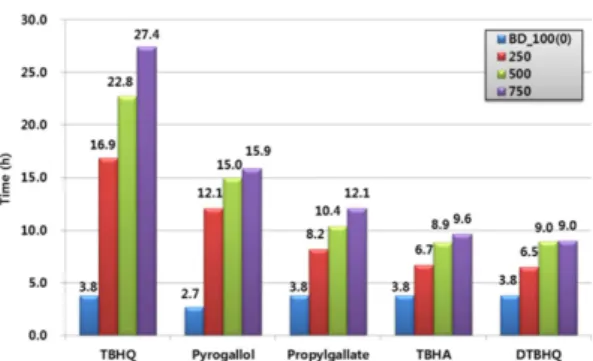
We evaluated the effect of antioxidants on the oxi- dation stability of biodiesels. The quantity of antioxi- dant added was 0, 250. 500, 750 ppm by weight. After determining that the antioxidants were soluble in biodiesel, the test fuels were sampled to examine their oxidation stability. The oxidation stability of the biodiesels was evaluated with a Rancimat 743(Metrohm Herisau, Switzerland) applying the accelerated oxida- tion test specified in EN 14214 [14]. The Rancimat (EN 14214) method specifies that samples are to be ana- lyzed at 110(block temperature) with an air flow rate of 10 L/h through the sample.

Fig. 3 shows the effect of antioxidants on the oxida- Scheme 2. Reaction mechanism of tert-butylation of

hydroquinone.

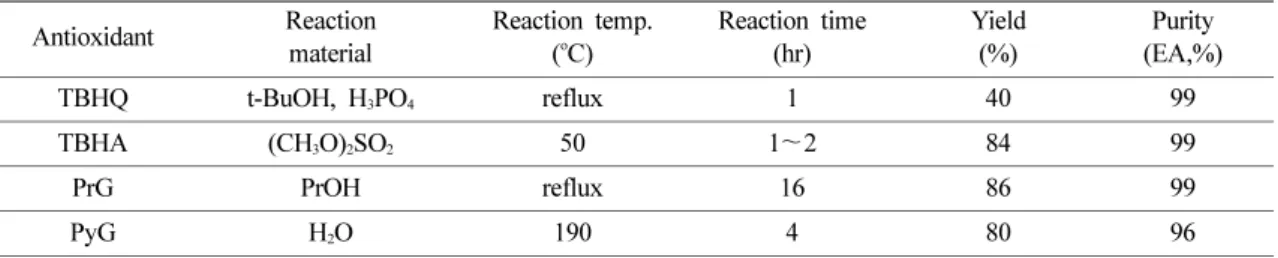
Table 1. Physical characterization data of antioxidant compounds Antioxidant Reaction

material

Reaction temp.

(

o

C)

Reaction time (hr)

Yield (%)

Purity (EA,%)

TBHQ t-BuOH, H

3

PO

4

reflux 1 40 99

TBHA (CH

3

O)

2

SO

2

50 1 ∼2 84 99

PrG PrOH reflux 16 86 99

PyG H

2

O 190 4 80 96

Fig. 2. The oxidation instrument for the Rancimat 743.

Table 2. The oxidation stability of hydroquinone typed and galate typed antioxidants

Compounds BD100 250 ppm/hr 500 ppm/hr 750 ppm/hr

TBHQ 3.8 16.9 22.8 27.4

PyG 2.7 12.1 15.0 15.9

PrG 3.8 8.2 10.4 12.1

TBHA 3.8 6.7 8.9 9.6

(5)

tion stability of biodiesel fuels.The efficiency of the antioxidants on the oxidation stability in this works was in the order TBHQ > PyG > PrG > TBHA in weight of 500 ppm.

4. Conclusion

The antioxidants of hydroquinone typed were pro- duced by electrophilic substitution reaction in acid cat- alyst. The other antioxidants of gallic acid typed were obtained by reacting of absolute alcohol or high tem- perature and autoclave was introduced preferably by CO

2

emission.

Among the synthetic antioxidants evaluated for the increased stability of biodiesels. TBHQ offered the best oxidation stability for all the biodiesel in concen- trations ranging from 250 to 700 ppm. The synthetic antioxidants, especially, TBHQ and PrG were more effective than the other antioxidants such as BHA and BHT. The efficiency of the antioxidants investigated

in this study was in the order TBHQ > PyG > PrG >

TBHA > DTBHQ. Finally, our research studies have been aimed at the use of these antioxidants materials for automotive or energy-related purposes.

References

[1] Ferrari, L. P., Oliveira, V. S. and Scabio, A., Quim.

Nova, Vol. 28, pp. 19, 2005.

[2] Pinto, A. C., Guarieiro, L. L., Rezande, M. J. C., Ribeiro, N. M., Torres, E. A., Lopes, W. A., Pereira, P. A. P., de Andrade, J. B., J. Braz, Chem. Soc., Vol. 16, 1313, 2005.

[3] Schuchardt, U., Sercheli, R., Vargas, R. M., J. Braz.

Chem. Soc., Vol. 9, pp. 199, 1998.

[4] Zagonel, G. F., Ramos, L. P., Rev, Quim. Ind., Vol.

717, pp. 17, 2001.

[5] Gunstone, F. D., The Chemistry of Oil and Fats, Blackwell Publishing; Boca Raton, 2004.

[6] Monyem, A., Van Gerpen, J. Biomass and Bioen- ergy, Vol. 20, pp. 317, 2001.

[7] Tao, Y, Operation of Cummins N-14 Diesel on Biodiesel; Performance Enissions and Durability, Final Report to the National Biodiesel Board, Ortech Report No. 95-E11-B004524, 1995.

[8] M. D. Shahid, US Patent. 6,525,146.

[9] M. Blum and M. Roitberg, US patent. 5,958,479.

[10] B. Nager, WO 90/00015.

[11] Selvarai M, Jean SH, Han J, Sinha PK, Lee TG, Appl Catal A Gen, Vol. 286, pp. 44, 2005.

[12] Badamali S.K., Sakthivel A, Selvam P, Catal. Lett., Vol. 65, pp. 153, 2000.

[13] Yadav G.D. Kirthivasan N, Appl Catal A, Vol. 154, pp. 29, 2000, Yadav G.D. Kirthivasan N, Appl Catal A, Gen., Vol. 286, pp. 61, 2005.

[14] Fat and oil derivatives, Fatty acid methyl esters (FAME)-Dertermimation of oxidation stability, EN 14214, 2003.

Fig. 3. The oxidation stable effects of antioxidants in

biodiesel.

수치

Table 2. The oxidation stability of hydroquinone typed and galate typed antioxidants
Fig. 3. The oxidation stable effects of antioxidants in biodiesel.

참조

관련 문서

2) polymer reactions using a polymer as a carrier or support for some component of a reaction system (polymeric brominating and Wittig reagents, the Merrifield

Third, there was no significant difference in the frequency of second hospital evacuation after moving to the medical room due to experience and

The purpose and necessity of this study was to investigate the effects of lactic acid fatigue and body oxidation through myofascial relaxation exercise using small tools

Fresh samples were immediately tested for antioxidant activity, and antioxidant activity was compared according to gestational age and measured the difference

- The magnetic pressure and plasma pressure each produce positive (outward forces) near the outside of the plasma...

The study consisted of applying the taping measures to 10 professional golfers and observe its effects, before and after such measure. The taping was applied

An efficient combinatorial solid-phase synthesis of asymmetric cyanine dyes was developed by Isacsson and Westman [17] using a Rink amide polystyrene resin.. The

The crude extract and its solvent-partitioned fractions were evaluated for their antioxidant and antiproliferative effects.. In the DPPH radical assay system,