• 검색 결과가 없습니다.

Tin Sulphide Thin Films Formed by Sulphidising D.C. Magnetron Sputtered Layers of Tin Using $H_2S$

N/A
N/A
Protected

Academic year: 2021

Share "Tin Sulphide Thin Films Formed by Sulphidising D.C. Magnetron Sputtered Layers of Tin Using $H_2S$"

Copied!
5
0
0

로드 중.... (전체 텍스트 보기)

전체 글

(1)

Tin Sulphide Thin Films Formed by Sulphidising D.C.

Magnetron Sputtered Layers of Tin Using H

2

S

M. Leach

, D. Y. Jang

and R. Miles * Seoul National University of Science and Technology

* Northumbria University, Newcastle upon Tyne, UK

H

2

S 가스를 이용한 황화주석 박막 증착에 관한 연구

마크리치·장동영·로저 마일즈

*

서울과학기술대학교 국제융합학부 기계시스템디자인 (MSDE) 프로그램

*영국 노섬브리아대학교 전자 컴퓨터공학부

(Received September 30, 2010; Revised November 2, 2010; Accepted November 4, 2010)

논문초록 − 황화주석 박막을 만들기 위해 마그네트론 스퍼터 박막증착 공정을 통해 몰리브텐 유리 판위에 주석박막을 만들고 , 95% 알곤 +5% 황화수소 가스 혼합물을 사용하여 아닐링 공정을 통해 황화주석 박막을 형성하위에 증착하는것이 좋은 결과를 보여주고있다 . 박막면의 화학적 물리적

성을 전자현미경 , X 선 분석 , X 선회절을 통해 실험하였으며 , 아닐링 조건에 따른황화주석 박막의 파장대 반사율의 관계를 측정하였다 .

Abstract − Thin films of tin sulphide (SnS) have been formed by a novel 2-stage process where-in D.C. mag- netron sputtering was used to deposit to thin films of tin (Sn) and the layers then sulphidised using 5% hydrogen sulphide (H

2

S) gas in Argon. Although it was not found possible to deposit high quality thin films of tin directly onto glass substrates, excellent layers of tin were produced by using molybdenum (Mo) coated glass as the sub- strate material. The chemical and physical properties of the SnS layers formed were determined using scanning electron microscopy, energy dispersive x-ray analysis, x-ray diffraction studies and using reflectance versus wavelength measurements and these related to the conditions of synthesis. The data shows that it should be pos- sible to produce conventional “substrate structure” devices based on the use of this technology.

Keywords − 황화주석박막필름( tin sulphide thin films), 스퍼터링 (sputtering), 황화수소아닐링 (h

2

s annealing), 물리적 특성 (physical properties)

1. Introduction

Thin film solar cells based on the use of cadmium tel- luride (CdTe) and copper gallium indium diselenide (CIGS) have been developed to lower the cost of manu- facture of photovoltaic cells and modules and these tech- nologies are now taking an increasing market share from

conventional silicon –based technologies[1]. However some problems remain. In the long term the lack of abundance of indium and gallium may limit the wide- spread use of CIGS technologies to generate power on a large scale. It is also desirable to make devices cadmium free, to satisfy environmental concerns. There are how- ever many other inorganic materials, which do not have these problems. In most cases their potential for use as PV materials has not been thoroughly assessed[2].

One such compound is SnS. Some of the important

주저자

: [email protected]

책임저자

: [email protected]

(2)

properties of SnS are in fact similar to those of CdTe and CIGS; these are that it has (i) a near optimum, direct energy bandgap of 1.35 eV and (ii) it is ampho- teric (i.e. it can be doped both n-type and p-type) giv- ing flexibility to device design and to the likelihood of grain boundary passivation by counter-doping the grain boundaries[3]. The main benefits of SnS with respect to CdTe and CIGS are (i) that it consists of abundant, non-toxic elements and (ii) the processes for mass manufacture of thin films of tin and for the sul- phidisation of metals are well known in industry.

Some limited works on producing SnS have been reported in the literature with the thin films being pro- duced mainly by thermal evaporation, spray pyrolysis, chemical bath deposition or electrochemical deposition of the compound[4-8]. Some limited work has also been done to form SnS by first of all producing thin films of Sn and then converting the Sn into tin SnS by heating in the presence of elemental sulphur (S)[8].

The latter conversions have only been used to produce very thin films of SnS, typically <0.2 micron thick, which is much too thin to be used in a solar cell device.

In this work we have investigated the formation of SnS by annealing pre-deposited layers of Sn using dilute (5%) H

2

S in Argon, rather using elemental sulphur (S).

Although in our initial studies we have used thin layers of Sn, it is possible that not only can the material quality of the layers be substantially improved, but also that it may be possible to sulphidise much thicker layers of Sn using the H

2

S/Argon anneal rather than just an S anneal.

This improvement in material quality and ability to sul- phardise thicker layers has been observed in other works using H

2

S in Argon as the S source[9].

2. Experimental Details

The substrates used in this work were standard soda lime glass slides and soda lime glass slides coated with 1 µ m thick Molybdenum (Mo) (deposited using R.F.

magnetron sputtering).

The layers of Sn were deposited using a D.C mag- netron sputtering system (SORONA SRN-110) at a base pressure of 8 × 10

-6

Torr. The Sn target used in

this work was 99.99% pure and approximately 18 cm in diameter. The sputtering gas used was argon. The sputtering of the Sn took place using an argon pressure of 5mTorr and a D.C. power of 1500 W. After sputter- ing each slide was cut into three sections approxi- mately 25 × 25 mm in size.

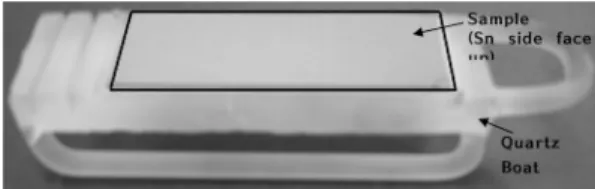
In order to synthesise the SnS, the Sn sputtered slides were positioned lying with the sputtered side face up on a quartz boat as shown in Fig. 1 and then placed in a customised vacuum tube furnace as shown in Fig. 2 (Sun Han Vaccum Tech Ltd.). The furnace was then evacuated to 0.5 Torr. Sulphidisation was carried out for temperatures in the range 300~450

o

C for time periods in the range 1~2 hours.

The furnace was heated to the desired temperature and allowed to stabilise before being flooded with a 5% H

2

S in Ar gas mixture. At the end of the anneal time the gas mixture was evacuated and the tube flushed with pure Ar gas. Finally the furnace was allowed to cool to room temperature in a state of vac- uum, prior to the sample being removed.

The topology and topography of the samples were observed using a JEOL Ltd. JSM-6700F field emission Fig. 1. Quartz boat and sample.

Fig. 2. H

2

S Annealing plant.

(3)

scanning electron microscope, energy dispersive x-ray analysis facility, the x-ray diffraction data taken with a Rigaku Denki Co. Ltd. D/max-IIIC x-ray diffractometer and the reflectance measurements made using a Perki- nElmer Lambda 35, UV-Vis spectrophotometer.

3. Results and Analysis

When depositing the layers of Sn directly onto the soda lime glass slides, the slides were initially pre- pared by cleaning, first in acetone followed by an ultrasonic bath, then in isopropyl alcohol and distilled water followed by a second ultrasonic bath. Finally they were rinsed with isopropyl alcohol followed by distilled water and blown dry with an N

2

gun. It was however found that although the Sn layers deposited adhered well to the substrates they were not uniformly thick. Closer inspection using an SEM revealed that the Sn layers did not completely cover the glass slides as there were pinholes penetrating the layers across the entire area deposited. It was initially suspected that the cleaning process was at fault; however cleaning the substrates using other methods including just distilled water made little difference to the results.

With the fabrication of solar cells absorber layers used are usually not deposited directly onto glass sub- strates. In the case of CdTe technology, “the super- strate configuration devices” are formed in the sequence: glass, transparent conductive oxide (TCO), buffer layer, CdTe absorber layer, back contact i.e. the absorber layer is formed on a buffer layer material usually cadmium sulphide (CdS). With CIGS solar cells, “substrate configuration” devices are formed in the sequence: glass, Mo, CIGS absorber layer, buffer layer, TCO and then a top contact grid.

In this work it was decided to try to deposit the tin layers onto Mo-coated glass substrates. Depositing the Sn layers directly onto Mo-coated glass, using similar conditions as those used for the plain glass substrates, resulted in all cases with layers that were both confor- mal and adherent to the substrate.

It was possible with such layers to anneal them in the 5% H

2

S in argon mixture for temperatures in the

range 300~450

o

C for times of up to 2 hours, to convert the Sn layers to SnS without the layers peeling from the substrate. Before the anneal the Sn layers were a shinny grey colour; after annealing the layers became a darker shade of grey with a blueish tinge.

Fig. 3(a) is a scanning electron micrograph of the

sulphidised layer. It can be seen that crystalline struc-

tures of SnS are being formed approximately 200 nm

in diameter. It was found that the best layers exhibiting

the lowest density of pinholes (shown as the dark sec-

tions) were formed at 400 °C, although the process

requires optimization to eliminate them. Fig. 3(b) is an

Fig. 3(a). Scanning Electron Micrograph of Crystalline

grains formed by annealing at 400

o

C, (b). Scanning

Electron Micrograph of Crystalline grains formed by

annealing at 450

o

C.

(4)

SEM showing that at an annealing temperature of 450°C little of the material is still present having evap- orated and only the Mo layer remains.

The formation of SnS was confirmed by the XRD data shown in Fig. 4. The traces for anneal tempera- tures of 350°C and 400°C clearly show the prominent reflections expected for the (111), (131) and (151) phases of SnS at 31.9 degrees 39.2 degrees and 51.28 degrees respectively, although the latter are some- what is obscured by the large reflection at 40 degrees due to the Mo pre-cursor layer. Some other reflections also observed to be present in the x-ray diffractograms indicate that other phases are present in the layers; these are most likely due to the SnS

2

and Sn

2

S

3

phases com- monly observed by other workers to be present in the SnS layers formed using other methods[3-8]. It is nota- ble that at 300°C the SnS peak is just beginning to appear and that at 450°C it has completely disappeared.

This suggests that a temperature >300°C is needed to form the SnS; for temperatures > 450°C the SnS has been re-evaporated from the substrate surface which agrees with the micrograph as discussed previously.

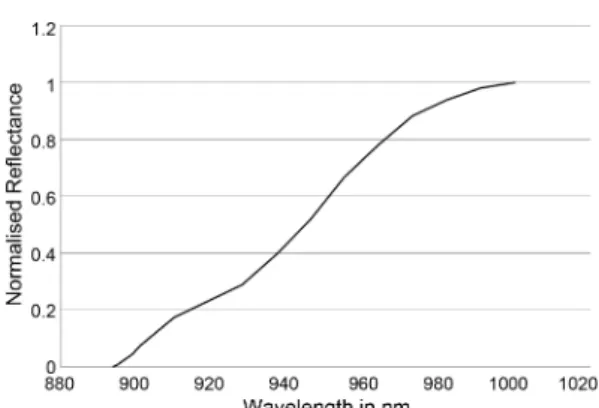
Reflectance versus wavelength data was also obtained for the tin sulphide layers formed on the Mo- coated glass using the spectrophotometer to measure the percentage of photon reflection over the wave- length range from 850 nm to 1000 nm. These mea- surements were normalised by, setting the minimum value to zero and dividing by the range of the mea- surements, Fig. 5 shows the normalised reflectance

data plotted against wavelength for an anneal temper- ature of 400

o

C. It is clear from this figure that the reflectance starts to increase at a wavelength of 890 nm, corresponding to an energy bandgap 1.38 eV.

This is in the range commonly observed for the energy bandgap reported for SnS, 1.35~1.7 eV.

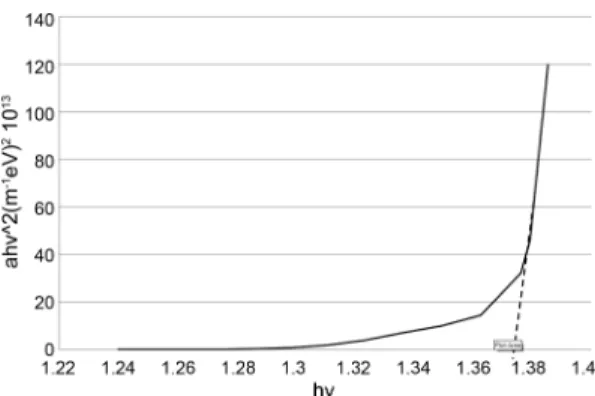
The reflectance results can be interpreted in this way because photons with energies less than the energy band- gap of the SnS will be transmitted through the tin sul- phide layer to the Mo layer where they are reflected back out of the structure. On the other hand photons with ener- gies greater than the energy bandgap will be absorbed by the SnS and therefore not transmitted or reflected. The reflection data can also be used to calculate how the opti- cal absorption coefficient of the layer varies with photon energy. For a direct energy bandgap material it is expected the intercept on the hí (where hv is found as 1.24/wavelength(in nm)) axis of a plot of ( α h ν )

2

versus hí equal to the energy bandgap, where á is given by (1)

(1) where R

norm

(%) is the normalised reflectance from Fig. 5 and d is the thickness of the layer. Such a plot is given in Fig. 6, indicating an energy bandgap of approximately 1.37 eV.

4. Conclusions

Although it was not found possible to deposit good

α = – ( 1 d ⁄ ) ln ( R

norm

( ) % )

Fig. 4. XRD Patterns for SnS layers grown at

different annealing temperatures. Fig. 5. Reflectance versus Wavelength plot for a SnS

layer grown at an annealing temperature of 400

o

C

for 1 hour.

(5)

quality layers of tin directly onto soda lime glass sub- strates using D.C. magnetron sputtering good quality layers were formed on Mo-coated glass substrates using this method. Therefore Mo is able to act as a suitable layer to which Sn will bond. Annealing the tin layers in 5% H

2

S in argon resulted in the formation of SnS layers with promising properties. These layers were both conformal and adherent to the substrates.

With further optimisation, layers which are pinhole free will be obtained and used to produce substrate configuration devices to assess their viability for pho- tovoltaic applications. The ability to improve the depth to which layers of Sn can be converted to SnS via the H

2

S anneal process will also be investigated.

감사의 글

본 연구를 위해 실험장치 설치 및 실험에 도움을 준 서울과학기술대학교 서울테크노폴리스센터 김종준 실 장 , 전병인 팀장 및 서울테크노파크 강성근 연구원에게 감사드립니다 .

References

1. R.W. Miles, G.Zoppi, K.T.Ramakrishna Reddy and I.

Forbes, “Thin Film Solar Cells Based on the use of Polycrystalline Thin Film Materials”, Chapter 1, Organic Nanostructured Thin Film Devices and Coat- ings for Clean Energy, CRC, June 2010, pp. 1-56.

2. R.W.Miles, G.Zoppi and I.Forbes, “Inorganic Solar Cells”, Materials Today, Vol. 10 No. 11, pp. 20-27, Nov. 2007.

3. K.T. Ramakrishna Reddy, P. Prathap2and R.W. Miles,

“Thin Films of Tin Sulphide for Application in Pho- tovoltaic Solar Cells”, Chapter 2, published in “Pho- tovoltaics, Applications and Impact”, pp. 1-27, Ed.

Hidecki Tanaka and Kiyoshi Yamashita, Nova Sci- ence Publishers, Inc.

4. Robert W. Miles, Ogah E. Ogah, Guillaume Zoppi, and Ian Forbes, “Thermally Evaporated Thin Films of SnS for Application in Solar Cell Devices”, Thin Solid Films, Vol. 517, pp. 4702-4705, 2009.

5. K.T. Ramakrishna Reddy, N. Koteswara Reddy and R.W. Miles, “Photovoltaic Properties of SnS Based Solar Cells”, Solar Energy Materials and Solar Cells, Vol. 90, Iss. 18-19, pp. 3041-3046, Nov.2006.

6. A.Tanuseski, “Optical and Photoelectric Properties of SnS Thin Films Prepared by Chemical Bath Deposi- tion”, Semiconductor Science and Technology, Vol.

18, Iss. 6, pp. 501, 2003.

7. M.Ichimura and K.Takeuchi and Y. Ono et al, “Elec- trochemical Deposition of SnS Thin Films”, Thin Solid Films, Vol. 361-362, pp. 98-101, Feb. 2000.

8. K.T. Ramakrishna Reddy, P.P. uranhra Reddy, P.K.

Datta and R.W. Miles, “Formation of Polycrystalline SnS Layers by a Two-Step Process Using Graphite Box”, Thin Solid Films, Vol. 403-404, pp. 116-119, Feb 2002.

9. J.J. Scragg, P.J. Dale and L.M. Peter, “Synthesis and Characterisation of Cu

4

ZnSnS

4

Absorber Layers by an Electrodeposition-Annealing Route”, Thin Solid Films, Vol. 517, pp. 2481-2484, 2009.

Fig. 6. ( α h ν )

2

versus hí plot for a SnS layer grown at

an annealing temperature of 400

o

C for 1 hour.

수치

Fig. 2. H 2 S Annealing plant.
Fig. 4. XRD Patterns for SnS layers grown at
Fig. 6. ( α h ν ) 2  versus hí plot for a SnS layer grown at an annealing temperature of 400 o C for 1 hour.

참조

관련 문서