• 검색 결과가 없습니다.

Effects of High-temperature UNSM Treatment on Wear Resistance of Ti-6Al-4V Alloy Prepared by Selective Laser Melting

N/A
N/A
Protected

Academic year: 2021

Share "Effects of High-temperature UNSM Treatment on Wear Resistance of Ti-6Al-4V Alloy Prepared by Selective Laser Melting"

Copied!
8
0
0

로드 중.... (전체 텍스트 보기)

전체 글

(1)

DOI https://doi.org/10.9725/kts.2020.36.1.47

Selective Laser Melting 방식으로 적층가공된 Ti-6Al-4V 합금의 내마모성 특성에 미치는 고온 UNSM 처리 영향에 대한 연구

산성충호1ㆍ노준석1ㆍ편영식2ㆍ아마노프 아웨즈한3†

1

선문대학교 대학원 융합과학기술학과 석사과정생

2

선문대학교 융합과학기술학과 명예교수

3

선문대학교 기계공학과 부교수

Effects of High-temperature UNSM Treatment on Wear Resistance of Ti-6Al-4V Alloy Prepared by Selective Laser Melting

Choongho Sanseong

1

, Jun-Suek Ro

1

, Young-Sik Pyoun

2

and Auezhan Amanov

3†

1

Master’s Student, Graduate School, Dept. of Fusion Science and Technology, Sun Moon University

2

Emeritus Professor, Dept. of Fusion Science and Technology, Sun Moon University

3

Associate Professor, Dept. of Mechanical Engineering, Sun Moon University (Received January 28, 2020; Revised February 15, 2020; Accepted February 16, 2020)

Abstract − In this study, the effects of ultrasonic nanocrystal surface modification (UNSM) treatment at room and high temperatures (RT and HT of 400

o

C) on friction and wear behavior of Ti-6Al-4V alloy prepared by selective laser melt- ing (SLM) were investigated. The objective of this study is to improve the mechanical properties and frictional behav- ior of Ti-6Al-4V alloy by UNSM treatment. Dry friction and wear tests were conducted using a ball-on-disk method at RT with a bearing steel as the counter ball. Due to the high HT and UNSM treatment, the surface hardness tended to increase and surface roughness tended to reduce. X-ray diffraction (XRD) analysis showed that nanocrystallization structure and compressive residual stress were formed at the surface layer after UNSM treatment at both RT and HT.

After UNSM treatment, it was observed that the wear rate was reduced by about 6% for the specimen treated at RT and a 28% reduction for the specimen treated at HT in comparison with the untreated one. Based on scanning electron microscope (SEM) images showed that the damage caused by fatigue wear occurred in the wear track of the heat- treated specimen, and it is believed to be the cause of the highest wear rate. Mechanical properties and wear resistance of Ti-6Al-4V alloy were improved and prospect of industrial application was confirmed. Further research is still required to improve the characteristics of SLM Ti-6Al-4V alloy to the level of wrought Ti-6Al-4V alloy.

Keywords − additive manufacturing(적층가공), Ti-6Al-4V alloy(Ti-6Al-4V 합금), surface roughness(표면거칠 기), wear resistance(내마모성), ultrasonic nanocrystal surface modification(초음파 나노표면개질)

ⓒ Korean Tribology Society 2020. This is an open access article distributed under the terms of the Creative Commons Attribution License(CC BY, https://creativecommons.org/

licenses/by/4.0/), which permits unrestricted use, distribution, and reproduction of the work in any medium, provided the original authors and source are properly cited.

1. 서 론

Ti-6Al-4V 합금은 낮은 밀도, 높은 강도, 우수한 내부 식성, 생체적합성과 같은 특성을 갖는다. 그리고 항공우 주산업, 생체의료 등의 분야에서 사용되며 그 수요가 확

Corresponding author: Auezhan Amanov Tel: +82-41-530-2892, Fax: +82-41-530-8018 E-mail: [email protected]

http://orcid.org/0000-0002-8695-7430

(2)

대되어 가고 있다[1,2].

산업에서 티타늄 합금은 전통적인 제조 공정에서 발 생하는 재료 낭비와 높은 비용문제가 있어, 재료를 층별 로 적층하는 적층가공기술(additive manufacturing, AM) 이 제안되어왔다. 하지만 AM 소재는 기공(pore), 균열 (crack), 미용해 입자(unmolten powder) 등의 조직 결함 과 인장잔류응력(residual stress), 높은 표면거칠기(high surface roughness) 같은 한계 때문에 전통적 가공 소재 에 비해 기계적, 물리적 특성이 떨어져 열화되기 쉽다 [3,4].

AM 된 Ti-6Al-4V 합금의 열화된 기계적 특성을 완화 시키기 위해 쇼트피닝(shot peening, SP)[5], 레이저충격 피닝(laser shock peening, LSP)[6], 초음파표면압연공정 (ultrasonic surface rolling process, USRP)[7] 같은 다 양한 표면개질기술들을 적용한 연구들이 있다. 표면의 밀 도, 경도, 압축잔류응력, 표면거칠기 등의 특성들을 수정 하여 피로나 마모 특성을 향상시키고자 하였다. 이전 연 구에서 초음파나노표면개질(ultrasonic nanocrystal surface modification, UNSM) 기술 또한 AM 된 Ti-6Al-4V 합 금의 피로강도를 증가시켰고[8], AM 된 STS 316L 합금 의 마찰계수 감소 및 마모율을 향상시켰다[9]. UNSM 기 술과 타 기술을 비교하면, SP는 무작위로 표면을 타격하 는 공정으로 표면거칠기를 낮추는데 제한이 있으나 UNSM 처리는 초음파 진동으로 타격하는 공구와 가공 물이 접촉을 유지하면서 진행되므로 표면거칠기를 낮출 수 있는 이점이 있다[10]. LSP는 충격파로 인해 압축잔 류응력과 경도의 유효깊이가 UNSM 보다 더 깊지만 UNSM 기술은 잦은 타격으로 가공경화(work hardening) 가 일어나 표면에서 더 큰 값이 나타난다[11]. USRP기 술은 UNSM 기술과 다르게 공구가 가공물과 미끄럼 운 동을 하지 않고 굴림 운동을 하기 때문에 소성변형이 덜 일어나 유효깊이가 상대적으로 얕다. 이는 UNSM 기술 이 USRP 기술 보다 표면을 변화시키는 정도가 더 크다 는 것을 의미한다[12]. 이러한 낮은 거칠기와 표면의 높 은 경도 및 큰 압축잔류응력은 소재의 마모 특성에 긍정 적인 영향을 미칠 것이다.

본 논문의 목적은 AM 기술 중 하나인 선택적레이져 용융(selective laser melting, SLM) 방식으로 적층가공 된 Ti-6Al-4V 합금에 UNSM 기술을 상온 및 400

o

C의 고온상태에서 적용하여 기계적 특성과 내마모성을 향상 시키는 것이다. 가스터빈 압축기에 해당 소재가 사용되 며 blade root 부분의 낮은 내마모성이 고장이 원인이 되 므로 사용 소재에 대한 높은 내마모성이 요구되기 때문 이다[13]. UNSM 처리로 개선된 마모 특성은 AM 소재

가 전통적 가공 소재를 대체할 가능성을 보여준다.

2. 연구방법 및 내용

2-1. 시편 준비

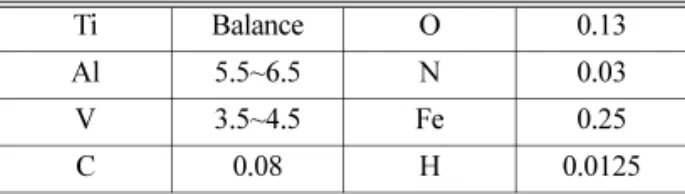
시험에 사용된 시료는 Ti-6Al-4V 시료로 길이 (150 mm), 너비 (150 mm) 및 두께 (50 mm)가 되도록 SLM 방식 으로 제작하였다. Table 1에 출력조건을 나타내었다.

Build Part 밀도는 99.5% 이상이다. 사용되는 분말은 구 형이며 크기는 50(20~63) μm, 밀도는 4.43 g/cm

3

, 열전 도율은 7.1 W/mK(at 20

o

C) 이다. 화학적 조성 및 기계적 특성은 각각 Table 2, 3에 나타나 있다.

2-2. 초음파나노표면개질 기술

UNSM 기술은 초음파 진동에너지를 응용하여 아주 큰 정적 및 동적 하중이 부가된 반구 형상의 공구로 1초에 20,000 번 이상의 큰 타격(1,000~100,000회/mm

2

정도)을 금속 표면에 주어 S

2

PD(severe surface plastic defor- mation) 를 발생시켜 이로 인해 표층부 조직을 나노결정 구조로 개질함과 동시에 아주 크고 깊은 압축잔류응력 등을 부가하는 대표적 초음파 나노표면개질 기술이다.

[14].

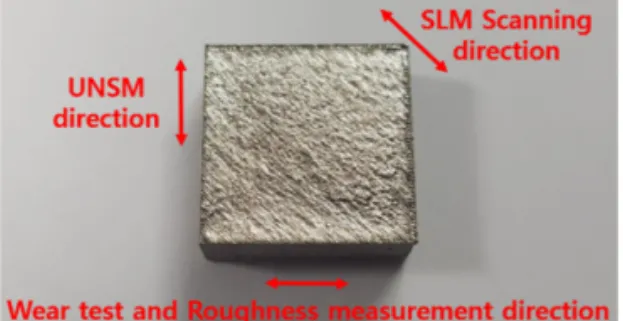
UNSM 처리는 상온, 고온 모두 출력된 시편의 약 절 반만큼 하였고 처리 방향은 Fig. 1의 UNSM direction과 Table 1. SLM process conditions

Layer thickness, µm 50

Laser power, W 270

Scan speed, mm/s 110

Hatching spacing, mm 0.12

Table 2. Chemical composition of Ti-6Al-4V in wt%

Ti Balance O 0.13

Al 5.5~6.5 N 0.03

V 3.5~4.5 Fe 0.25

C 0.08 H 0.0125

Table 3. Mechanical properties of SLM Ti-6Al-4V alloy Tensile strength (MPa) 1251 ± 61

Yield strength (MPa) 1120 ± 44

Elongation break (%) 3 ± 1

Contraction at fracture (%) 5 ± 2

Young’s modulus 110 ± 7

Hardness by vickers (HV10) 380 ± 8

(3)

같이 SLM scanning direction의 45

o

방향이다. Fig. 1에 는 이후 기술될 마찰-마모 시험의 방향과 표면거칠기 측 정 방향도 나타내었다. Table 4는 UNSM 처리 조건이다.

고온 UNSM 처리는 할로겐 램프를 활용하여 상온에서 400

o

C까지 가열하면서 수행하였으며 보다 자세한 처리 조건은 참고문헌[15]에 나타나 있다.

2-3. 마찰-마모 시험 조건

마찰-마모 시험은 마찰 시험기(Friction tester, S&G, Korea) 로 진행하였으며 Fig. 2에 장치 사진과 시험의 개

략도가 나타나 있다. 시험 조건은 Table 5와 같다. 마모 시험의 방향은 미처리 및 UNSM 처리 시편 모두 SLM scanning direction 의 45

o

방향이며 UNSM 처리 방향의 90

o

방향이기도 하다. UNSM 처리 방향은 표면거칠기에 영향을 미치며 일반적으로 처리 방향의 90

o

방향에서 표 면거칠기가 가장 높기 때문에 해당 방향으로 마모 시험 을 진행하였다. 시편과 상대제로 사용된 볼의 마모흔 촬 영을 위해 3D 측정 현미경(VK-X100, Keyence, Japan) 을 사용하였다.

2-4. 측정 및 분석 방법

경도는 마이크로 비커스 경도계(MVK-E3, Mitutoyo, Japan) 로 300 gf의 하중을 10초 동안 압입하여 측정하였 다. 표면거칠기는 표면 조도 측정기(SJ-210, Mitutoyo, Japan) 로 측정하였고 ISO 1997 Standard, GAUSS Filter, λs: 2.5 μm, Cut-off: 0.8 mm 의 조건으로 진행하였다. 측 정 방향은 미처리 시편의 경우 SLM scanning direction의 45

o

이며 UNSM 처리 시편의 경우 처리 방향의 90

o

이다. 표 면 분석을 위해 SEM (scanning electron microscope, Apreo S HiVac, FEI Company, USA) 및 EDS (energy dispersive X-ray spectroscopy, XFlash 6I100, BRUKER, USA) 를 사용하였다. 표면 결정 구조 분석을 위해 XRD (X-ray diffraction: EMPYREAN, Panalytical B.V, The Netherlands) 를 CuKα 선으로 하였다.

3. 결과 및 고찰

3-1. 표면 변화

UNSM 처리 전후의 표면을 관찰하기 위해 SEM 촬영 을 하였고 Fig. 3에 나타나 있다. 상온 미처리 시편 (a)은 표면에 기공과 미용해 입자들이 관찰되며 상온 UNSM 처 리 시편 (b)에서 해당 결함들이 감소하였음을 확인할 수 있다. 고온 미처리 시편 (c) 또한, 표면에 기공과 미용해 입자들이 관찰되며 고온 UNSM 처리 시편 (d)에서 미용 해 입자들은 줄어들었지만 상온 처리 시편과 달리 기공 감소는 유의미한 수준으로 일어나지 않았다.

Fig. 1. A photography of Ti-6Al-4V specimen manufactured by SLM.

Fig. 2. A photography of friction tester and schematic of contact configuration.

Table 4. UNSM treatment parameters

Frequency, kHz 20

Amplitude, μm 20

Load, N 40

Feed-rate, mm/min 2000

Interval, mm 0.01

Ball diameter, mm 2.38

Ball material WC

Temperature 25, 400

o

C

Table 5. Tribo test conditions

Normal load, N 10

Cycle 5000

Frequency, Hz 1

Stroke, mm 5

Ball diameter, mm 7.13

Ball material SUJ2

(4)

3-2. 표면경도

UNSM 처리 전후의 표면경도를 측정하여 비교한 결 과가 Fig. 4에 있다. 상온 처리 시편은 395.88 HV에서 437.65 HV 로 약 10% 증가하였고 고온 처리 시편은 452.88 HV 에서 508.87 HV로 약 12% 증가하였다. Ti- 6Al-4V 합금은 quenching 에 의해 경도가 높은 α' 마르 텐사이트 상이 형성되거나 온도가 증가함에 따라 β상이 경화하여 경도가 증가한다[16]. 또한, Hall-Patch 이론에 따르면 결정의 크기가 작을수록 경도가 증가한다.

UNSM 기술은 표면층을 나노결정구조로 개질하기 때문

에 결정립 미세화로 경도가 증가하였다고 사료된다. 고 온 처리에 의한 경화와 UNSM 기술의 표면개질로 인해 고온 UNSM 처리 시편에서 가장 높은 경도가 나타났다.

3-3. 표면거칠기

UNSM 처리 전후 표면거칠기를 측정하여 비교한 결 과가 Fig. 5에 있다. 상온 처리 시편 (a)은 R

a

4.566 μm 에서 R

a

2.099μm 로 약 54% 감소하였고 고온 처리 시 편 (b)은 R

a

3.113μm 에서 R

a

1.237 μm 로 약 60% 감 소하였다. 고온 처리로 표면에 용융이 일어나 표면거칠 기가 감소하였고, UNSM 처리에 의해서는 UNSM 장 치의 볼이 시편에 접촉한 상태에서 이동하는 공정 메커 니즘에 의해 시편 표면에 burnishing 이 일어나 표면거 칠기가 감소하였다고 사료된다. 고온 상태 및 UNSM 기 술의 burnishing 효과로 인해 고온 UNSM 처리 시편에 서 가장 낮은 표면거칠기가 나타났다.

Fig. 3. SEM images of the before (a and c) and after (b and d) UNSM treatment at room and high temperatures of Ti-6Al-4V alloy manufactured by SLM, respectively.

Fig. 4. Comparison in surface hardness before and after UNSM treatment at room and high temperatures of Ti-6Al-4V alloy manufactured by SLM, respectively.

Fig. 5. Comparison in surface roughness of the RT

untreated and RT UNSM treated specimens (a), the

HT400 untreated and HT400 UNSM treated (b)

specimens.

(5)

3-4. 결정화 분석

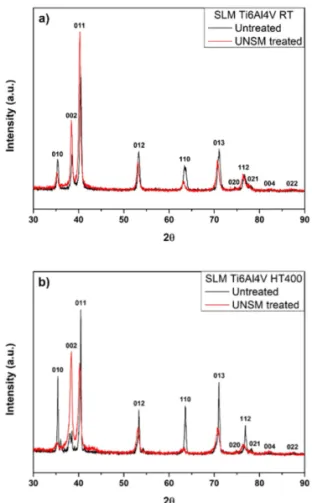
XRD 분석 결과는 Fig. 6의 상온 처리(a)와 고온 처리 (b) 로 각각 나타나 있다. 상온 UNSM 처리 후에 primary 피크(011) intensity가 증가하였고, 전체 secondary 피크 (010, 110) 의 intensity가 감소하였다. 고온 UNSM 처리 후에 primary 및 secondary 피크의 intensity모두 감소하 였다. 또한, primary 피크의 FWHM(full width at half maximum) 값이 상온 및 고온 UNSM 처리 후 증가하였 다. 피크 intensity의 감소와 FWHM 값의 증가는 표면층 의 나노결정구조에 의한 결과이다. 그리고 곡선이 왼쪽 으로 이동하는 것으로 보아 압축잔류응력이 생성되었음 을 알 수 있다. 이러한 UNSM 처리에 의한 현상은 이전 연구에서도 보고되었다[10,17].

3-5. 마찰-마모 시험 결과 3-5-1. 마찰계수

마찰-마모 시험 후 마찰계수를 비교한 결과가 Fig. 7

에 있다. 상온 처리 시편의 마찰계수 거동은 서로 큰 차 이를 보이지 않았다. 고온 처리 시편은 running-in 구간 에서 UNSM 처리된 쪽이 더 높았고 약 3000 cycles 이 후 steady-state 구간에서 약간 감소되는 거동을 보였다.

마찰계수의 평균값은 상온 및 고온 처리 모두 UNSM 처 리에 의한 유의미한 변화는 없었으며 고온 처리에 의해 약간 감소되었다.

3-5-2. 마모율

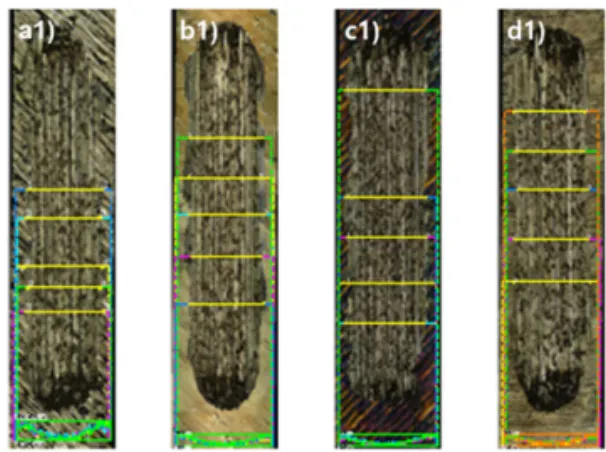
시편의 마모흔 사진과 계산된 마모율은 Fig. 8의 (a1~d1) 에 나타나 있다. 시편의 마모율 계산은 식 (1)을 통해 계산하였고 wear volume은 3D 측정 현미경으로 얻은 시편의 profile에 의해 계산되었다.

Wear rate = (1)

UNSM 처리 전후를 기준으로 시편의 마모율을 비교 하였더니 상온 처리 시편은 2.17 × 10

−7

mm

3

/Nmm 에서 2.03

× 10

−7

mm

3

/Nmm 으로 약 6% 감소하였고 고온 처리 시편 wear volume

static load sliding dis × tan ce ---

Fig. 6. Comparison in XRD patterns of the RT untreated and RT UNSM-treated specimens (a), the HT400 untreated and HT400 UNSM treated (b) specimens.

Fig. 7. Comparison in friction coefficient of the RT

untreated and RT UNSM-treated specimens (a) and

the HT400 untreated and HT400 UNSM-treated (b)

specimens.

(6)

은 2.67 × 10

−7

mm

3

/Nmm 에서 1.92 × 10

−7

mm

3

/Nmm 으로 약 28% 감소하였다. 마모율의 감소는 UNSM 처리에 의 한 표면경도의 증가와 표면거칠기의 감소 그리고 표면 에 생성된 압축잔류응력이 기인하였다고 사료된다. 상대 제로 사용된 볼의 마모흔 사진은 Fig. 8의 (a2~d2)에 나 타나 있다. 시편의 마모율이 낮을수록 원형에 가까운 마 모흔을 나타낸다.

3-5-3. 마모 메커니즘

시편의 마모흔을 SEM 촬영한 사진이 Fig. 9의 (a1

~d1) 에 나타나 있다. 상온 시편에서는 연삭마모(abrasive wear) 와 응착마모(adhesive wear)가 나타났으며 고온 시 편에서는 피로마모(fatigue wear) 또한 나타났음을 알 수 있다. 고온 처리 시편의 마모흔(c1)에서 가장 많은 손상 (damage) 이 일어났으며 이러한 손상으로 인해 마모율을 증가시켰을 것으로 사료된다.

EDS 분석 결과로 O 성분에 대한 mapping 사진이 Fig. 9 의 (a2~d2)에 나타나 있고 마찰-마모 시험 전후 O 와 Fe 성분을 비교 가능한 데이터가 (a3~d3)에 있다. 마 모흔에서 O와 Fe가 증가하여 산화물이 생성되었음을 알 수 있다. 고온 처리된 시편은 마찰-마모 시험 후 O가 수 치상으로 감소하였지만 시험을 진행하기 전에 이미 표 면에 고온 처리에 의한 산화물이 존재하였고 시험 후에

마모 영역에 O가 나타나는 것으로 보아 마찬가지로 산 화물이 생성되었다고 사료된다.

Fig. 8. Comparison in surface profiles and 3D LSM images of counter ball slid against of the RT untreated (a1, a2), RT UNSM-treated (b1, b2), HT400 untreated (c1, c2) and HT UNSM-treated (d1, d2) specimens.

Fig. 9. SEM image of selected area of the wear track, O

mapping and chemical composition generated on the

surface of the RT untreated (a1, a2, a3), RT UNSM-

treated (b1, b2, b3), HT400 untreated (c1, c2, c3) and

HT400 UNSM-treated (d1, d2, d3).

(7)

4. 결 론

본 연구에서는 SLM 방식으로 적층가공된 Ti-6Al-4V 합금에 UNSM 처리 후 내마모성 특성에 대해 연구하였 고 결과를 요약하면 다음과 같다.

- 표면경도 측정 결과 UNSM 처리 후 상온 시편은 약 10%, 고온 시편은 약 12% 증가되었다.

- 표면거칠기 R

a

값 측정 결과 UNSM 처리 후 상온 시편은 약 54%, 고온 시편은 약 60% 감소되었다.

- XRD 분석 결과 UNSM 처리 후 피크의 intensity가 감소, FWHM의 값의 증가, 곡선의 좌측 이동하였고 이 는 표면층에 나노결정구조와 압축잔류응력이 생성되었 음을 의미한다.

- 마찰계수는 고온 처리에 의해서만 감소하였으며 UNSM 처리에 의한 유의미한 변화는 없었다.

- 마모율 측정 결과 UNSM 처리 후 상온 시편은 약 6%, 고온 시편은 약28% 감소되었다.

- 상온 시편의 마모 메커니즘은 연삭마모와 응착마모 이며, 고온 시편에서는 피로마모 또한 나타났다.

- 본 연구를 통해 SLM + UNSM 조합으로 Ti-6Al- 4V 합금의 기계적 특성과 내마모성을 향상시켜 항공분 야 적용 가능성을 확인하였다. 이후 해당 특성을 wrought Ti-6Al-4V 수준까지 향상시킬 수 있도록 추가적인 연구 가 필요하다.

Acknowledgements

본 연구는 산업통상자원부의 산업기술혁신 개발 사업 의 지원으로 수행되었음(No 10067485).

References

[1] Cui, C., Hu, B. M., Zhao, L., Liu, S., “Titanium Alloy Production Technology, Market Prospects and Industry Development,” Mater. Des., 2011. https://

doi.org/10.1016/j.matdes.2010.09.011

[2] Singh, P., Pungotra, H., Kalsi, N. S., “On the Char- acteristics of Titanium Alloys for the Aircraft Appli- cations,” Mater. Today Proc., 2017, https://doi.org/

10.1016/j.matpr.2017.07.249

[3] Frazier, W. E., “Metal Additive Manufacturing: A Review,” J. Mater. Eng. Perform., 2014, https://doi.

org/10.1007/s11665-014-0958-z

[4] Liu, S., Shin, Y. C., “Additive Manufacturing of Ti6Al4V Alloy: A review,” Mater. Des., 2019, https://

doi.org/10.1016/j.matdes.2018.107552

[5] Żebrowski, R., Walczak, M., “Effect of the Shot Peening on Surface Properties and Tribological Per- formance of Ti-6Al-4V Alloy Produced by Means of DMLS Technology,” Arch. Metall. Mater., 2019, https://doi.org/10.24425/amm.2019.126263

[6] Lu, J., Lu, H., Xu, X., Yao, J., Cai, J., Luo, K.,

“High-performance Integrated Additive Manufactur- ing with Laser Shock Peening -Induced Microstruc- tural Evolution and Improvement in Mechanical Properties of Ti6Al4V Alloy Components,” Int. J.

Mach. Tools Manuf., 2020, https://doi.org/10.1016/

j.ijmachtools.2019.103475

[7] Wang, Z., Xiao, Z., Huang, C., Wen, L., Zhang, W.,

“Influence of Ultrasonic Surface Rolling on Micro- structure and Wear Behavior of Selective Laser Melted Ti-6Al-4V Alloy,” Materials, 2017, https://

doi.org/10.3390/ma10101203

[8] Zhang, H., Chiang, R., Qin, H., Ren, Z., Hou, X., Lin, D., Doll, G. L., Vasudevan, V. K., Dong, Y., Ye, C., “The Effects of Ultrasonic Nanocrystal Surface Modification on the Fatigue Performance of 3D- printed Ti64,” Int. J. Fatigue, 2017, https://doi.org/

10.1016/j.ijfatigue.2017.05.019

[9] Ro, J. S., Sanseong, C. H., Umarov, R., Pyun, Y. S., Amanov, A., “A Study on the Effect of UNSM Treat- ment on the Mechanical and Tribological Properties of STS 316L Printed by Selective Laser Melting,”

Tribol. Lubr., 2018, https://doi.org/10.9725/kts.2018.

34.6.270

[10] Amanov, A., Karimbaev, R., Maleki, E., Unal, O., Pyun, Y. S., Amanov, T., “Effect of Combined Shot Peening and Ultrasonic Nanocrystal Surface Modifi- cation Processes on the Fatigue Performance of AISI 304,” Surf. Coat. Technol., 2019, https://doi.

org/10.1016/j.surfcoat.2018.11.100

[11] Gill, A., Telang, A., Mannava S. R., Qian, D., Pyoun, Y. S., Soyama, H., Vasudevan, V. K., “Com- parison of Mechanisms of Advanced Mechanical Surface Treatments in Nickel-based Superalloy,”

Mater. Sci. Eng. A, 2013, https://doi.org/10.1016/

j.msea.2013.04.021

[12] Li, G., Qu, S. G., Pan, Y. X., Li, X. Q., “Effects of the Different Frequencies and Loads of Ultrasonic Surface Rolling on Surface Mechanical Properties and Fretting Wear Resistance of HIP Ti–6Al–4V Alloy,” Appl. Surf. Sci., 2016, https://doi.org/10.1016/

j.apsusc.2016.07.120

[13] Kermanpur, A., Sepehri Amin, H., Ziaei-Rad, S., Nourbakhshnia, N., Mosaddeghfar, M., “Failure Analysis of Ti6Al4V Gas Turbine Compressor Blades,”

Eng. Fail. Anal., 2008, https://doi.org/10.1016/j.eng- failanal.2007.11.018

[14] Pyoun, Y. S., Park, J. H., Cho, I. H., Kim, C. S.,

(8)

Suh, C. M., “A study on the Ultrasonic Nano Crys- tal Surface Modification(UNSM) Technology and It’s Application,” Transactions of the KSME, A, 2009, https://doi.org/10.3795/KSME-A.2009.33.3.190 [15] Amanov, A., Pyun, Y. S., “Local Heat Treatment

with and without Ultrasonic Nanocrystal Surface Modification of Ti-6Al-4V Alloy: Mechanical and Tribological Properties,” Surf. Coat. Technol., 2017, https://doi.org/10.1016/j.surfcoat.2017.07.064 [16] Morita, T., Hatsuoka, K., Iizuka, T., Kawasaki, K.,

“Strengthening of Ti-6Al-4V Alloy by Short-Time Duplex Heat Treatment,” Mater. Trans., 2005, https:

//doi.org/10.2320/matertrans.46.1681

[17] Amanov, A., Pyun, Y. S., Kim, J. H., Sasaki, S., “The Usability and Preliminary Effectiveness of Ultra- sonic Nanocrystalline Surface Modification Tech- nique on Surface Properties of Silicon Carbide,”

Appl. Surf. Sci., 2014, https://doi.org/10.1016/j.apsusc.

2014.05.089

수치

Table 3. Mechanical properties of SLM Ti-6Al-4V alloy Tensile strength (MPa) 1251 ± 61
Fig. 2. A photography of friction tester and schematic of contact configuration.
Fig.  3. SEM images of the before (a and c) and after (b and d) UNSM treatment at room and high temperatures of  Ti-6Al-4V alloy manufactured by SLM, respectively.
Fig. 7. Comparison in friction coefficient of the RT  untreated and RT UNSM-treated specimens (a) and  the HT400 untreated and HT400 UNSM-treated (b)  specimens.
+2

참조

관련 문서