Woo et al. Cell Death Discovery (2018) 4:29
DOI 10.1038/s41420-018-0035-8 Cell Death Discovery
A R T I C L E O p e n A c c e s s
BIX-01294 sensitizes renal cancer Caki cells to TRAIL-induced apoptosis through
downregulation of survivin expression and upregulation of DR5 expression
Seon Min Woo 1 , Seung Un Seo 1 , Kyoung-Jin Min 1 and Taeg Kyu Kwon 1
Abstract
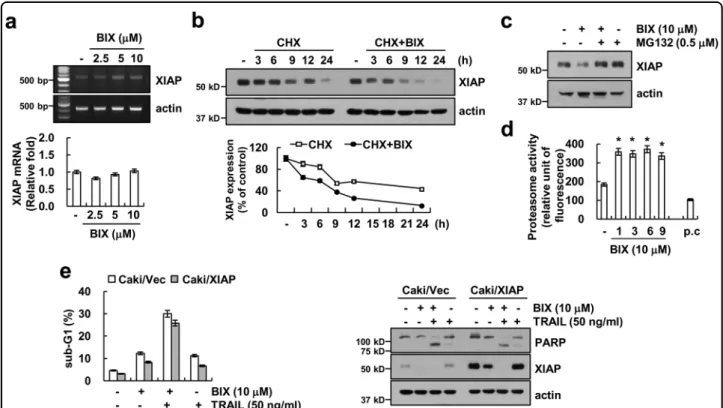
BIX-01294 (BIX), a G9a histone methyltransferase inhibitor, has been reported for its anti-proliferative and anticancer activities against various cancer cell lines. In this study, we investigated whether BIX could sensitize TRAIL-mediated apoptosis in various cancer cells. Combined treatment with BIX and TRAIL markedly induced apoptosis in human renal carcinoma (Caki, ACHN, and A498), breast carcinoma (MCF-7), and lung carcinoma (A549) cells. In contrast, BIX and TRAIL co-treatment did not induce apoptosis in normal cells, specifically mouse kidney cell (TCMK-1) and human skin fibroblast (HSF). BIX downregulated protein expression levels of XIAP and survivin at the post-translational level.
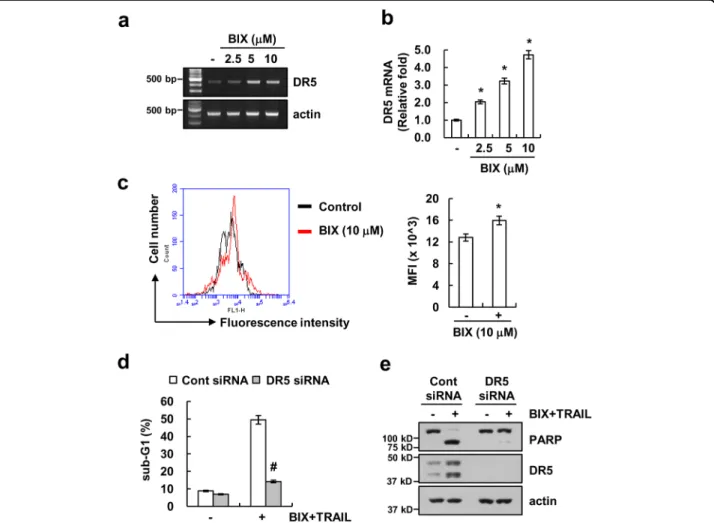
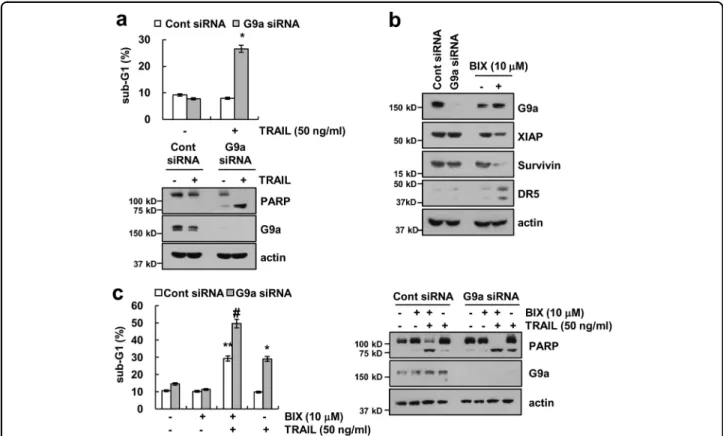
Overexpression of survivin markedly blocked combined BIX and TRAIL treatment-induced apoptosis, but XIAP had no effect. Furthermore, BIX induced upregulation of DR5 expression at the transcriptional levels, and knockdown of DR5 expression using small interfering RNAs (siRNAs) markedly attenuated BIX and TRAIL-induced apoptosis. Interestingly, siRNA-mediated G9a histone methyltransferase knockdown also enhanced TRAIL-induced apoptosis in Caki cells.
However, knockdown of G9a did not change expression levels of XIAP, survivin, and DR5. Therefore, BIX-mediated TRAIL sensitization was independent of histone methyltransferase G9a activity. Taken together, these results suggest that BIX facilitates TRAIL-mediated apoptosis via downregulation of survivin and upregulation of DR5 expression in renal carcinoma Caki cells.
▶ BIX facilitates TRAIL-mediated apoptosis in human renal carcinoma Caki cells.
▶ Downregulation of survivin contributes to BIX plus TRAIL-induced apoptosis.
▶ Upregulation of DR5 is involved in BIX plus TRAIL-mediated apoptosis.
▶ BIX-mediated TRAIL sensitization is independent of ROS production.
Introduction
Histone methylation is one of the major epigenetic modi fications and plays an important role in biological processes by regulating transcriptional activity of a target gene
1–3. Histone methyltransferase G9a, also known as euchromatic histone-lysine N-methyltransferase 2 (EHMT2), is a key methyltransferase for histone H3 lysine 9
(H3K9)
4. Moreover, it is overexpressed in malignant cells, including breast cancer
5, prostate cancer
6, bladder cancer
7, and colorectal cancer
8, and elevated levels of G9a are associated with cell survival, proliferation, and metastasis
9–11
. BIX-01294 (BIX) is a potent G9a inhibitor that induces demethylation of H3K9
12. In a previous study, BIX inhibited cell proliferation and induced mitochondrial apoptosis through downregulation of Bcl-2 expression in lung ade- nocarcinoma
13. Additionally, BIX decreased Mcl-1 expres- sion via downregulation of the deubiquitinase USP9X, leading to caspase-dependent apoptosis in bladder cancer
© The Author(s) 2018
Open Access This article is licensed under a Creative Commons Attribution 4.0 International License, which permits use, sharing, adaptation, distribution and reproduction in any medium or format, as long as you give appropriate credit to the original author(s) and the source, provide a link to the Creative Commons license, and indicate if changes were made. The images or other third party material in this article are included in the article ’s Creative Commons license, unless indicated otherwise in a credit line to the material. If material is not included in the article’s Creative Commons license and your intended use is not permitted by statutory regulation or exceeds the permitted use, you will need to obtain permission directly from the copyright holder. To view a copy of this license, visit http://creativecommons.org/licenses/by/4.0/.
Correspondence: Taeg Kyu. Kwon ([email protected])
1
Department of Immunology, School of Medicine, Keimyung University, 1095 Dalgubeoldaero, Dalseo-Gu, Daegu 42601, South Korea
Edited by N Barlev
1234567890():,; 1234567890():,;