Open Access
Psychosocial Health of Disease-Free Breast Cancer Survivors Compared with Matched Non-cancer Controls
Original Article
Purpose
The present study investigated the psychosocial health of disease-free breast cancer sur- vivors who receive health examinations compared to matched non-cancer controls in a com- munity setting.
Materials and Methods
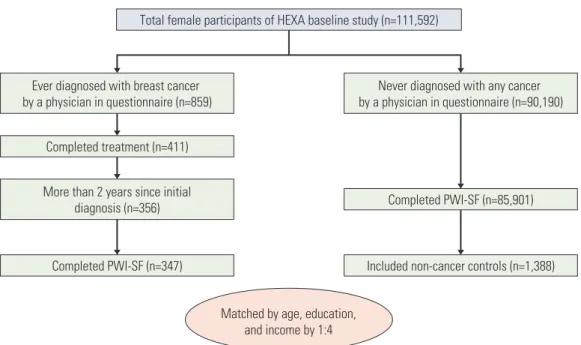
We used baseline data from the Health Examinee cohort, which is composed of subjects participating in health. The disease-free breast cancer survivors were defined as those who were 2 years from initial diagnosis of breast cancer who had completed treatment.
Females without a history of cancer were randomly selected at 1:4 ratio by 5-year age groups, education, and household income as a comparison group. We analyzed results from the Psychosocial Well-being Index-Short Form (PWI-SF) as a psychosocial health measure- ment.
Results
A total of 347 survivors of breast cancer and 1,388 matched controls were included. Total scores on the PWI-SF were lower in breast cancer survivors than matched non-cancer con- trols (p=0.006), suggesting a lower level of psychosocial stress in breast cancer survivors.
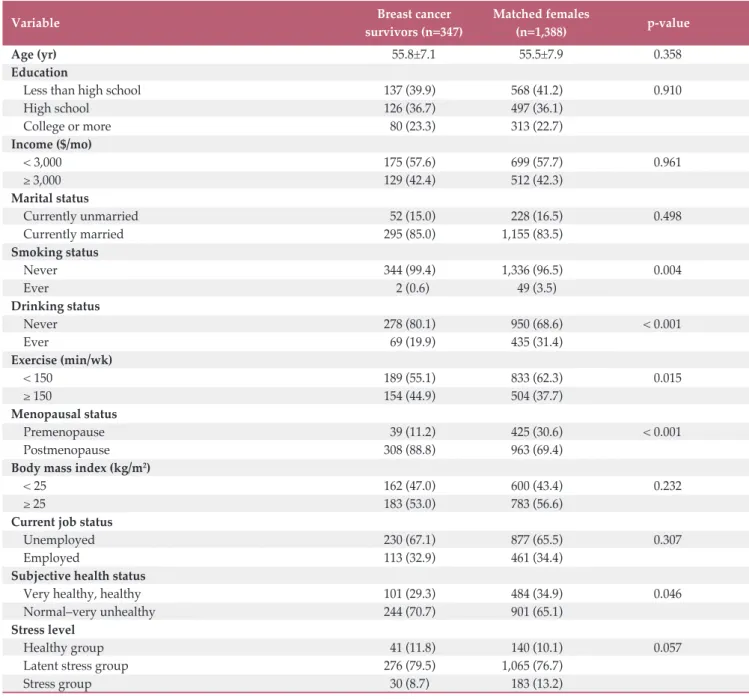
In comparison to the control group, prevalence of drinking, smoking and obesity were lower, while exercising for 150 min/wk was higher in breast cancer survivors (p < 0.05). These findings suggest that breast cancer survivors have better health behaviors than their non- cancer controls. After adjusting for other sociodemographic variables, breast cancer sur- vivors were 36% less likely to be included in the stress group (odds ratio, 0.64; 95%
confidence interval, 0.42 to 0.98).
Conclusion
The disease-free breast cancer survivors resuming daily life demonstrated better psychoso- cial health status compared to matched non-cancer controls.
Key words
Breast cancer survivors, Psychosocial health,
Psychosocial Well-being Index-Short Form, Community setting
Boyoung Park, MD, PhD
1,2Moo Hyun Lee, MD, MS
3,4Sun-Young Kong, MD, PhD
5,6Eun Sook Lee, MD, PhD
2,3,5+ + + + + + + + + + + + + + + + + + + + + + + + + + + + + + + + + + + + + + + + + + + + + + + + + + + + + + + + + + + + + + + + + + + + + + + + + + + + + + + + + + + + + + + + + + + + + + + + + + + + + + + + + + + + + + + + + + + + + + + + + + + + + + + + + + + + + + + + + + + + + + + + + + + + + + + + + + + + + + + + + + + + + + + + + + + + + + + + + + + + + + + + + + + + + + + + + + + + + + + + + + + + + + + + + + + + + + + + + + + + + + + + + + + + + + + + + + + + + + + + + + + + + + + + + + + + + + + + + + + + + + + + + + + + + + + + + + + + + + + + + + + + + + + + + + + + + + + + + + + + + + + + + + + + + + + + + + + + + + + +
Correspondence: Eun Sook Lee, MD, PhD Center for Breast Cancer, Research Institute and Hospital, National Cancer Center, 323 Ilsan-ro, Ilsandong-gu, Goyang 10408, Korea Tel: 82-31-920-1503
Fax: 82-31-920-1511 E-mail: [email protected]
Received December 10, 2017 Accepted April 3, 2018 Published Online April 5, 2018
*Boyoung Park and Moo Hyun Lee contributed equally to this work.
1
Department of Medicine, Hanyang University College of Medicine, Seoul,
2
National Cancer Center Graduate School of Cancer Science and Policy, Goyang,
3
Center for Breast Cancer, Hospital, National Cancer Center, Goyang,
4
Department of Surgery, Keimyung University School of Medicine, Daegu,
5