sensors
ISSN 1424-8220 www.mdpi.com/journal/sensors Article
Bio-Optics Based Sensation Imaging for Breast Tumor Detection Using Tissue Characterization
Jong-Ha Lee
1,*, Yoon Nyun Kim
2and Hee-Jun Park
11
Department of Biomedical Engineering, School of Medicine, Keimyung University, 1095, Dalgubeol-daero, Daegu 704-701, Korea; E-Mail: [email protected]
2
Department of Internal Medicine, Dongsan Medical Center, Keimyung University, 1095, Dalgubeol-daero, Daegu 704-701, Korea; E-Mail: [email protected]
* Author to whom correspondence should be addressed; E-Mail: [email protected];
Tel.: +86-53-393-3731 or +82-53-580-3736; Fax: +82-53-580-3746.
Academic Editor: Gary R. Pickrell
Received: 4 January 2015 / Accepted: 4 March 2015 / Published: 16 March 2015
Abstract: The tissue inclusion parameter estimation method is proposed to measure the stiffness as well as geometric parameters. The estimation is performed based on the tactile data obtained at the surface of the tissue using an optical tactile sensation imaging system (TSIS). A forward algorithm is designed to comprehensively predict the tactile data based on the mechanical properties of tissue inclusion using finite element modeling (FEM). This forward information is used to develop an inversion algorithm that will be used to extract the size, depth, and Young's modulus of a tissue inclusion from the tactile data. We utilize the artificial neural network (ANN) for the inversion algorithm. The proposed estimation method was validated by a realistic tissue phantom with stiff inclusions. The experimental results showed that the proposed estimation method can measure the size, depth, and Young's modulus of a tissue inclusion with 0.58%, 3.82%, and 2.51% relative errors, respectively.
The obtained results prove that the proposed method has potential to become a useful screening and diagnostic method for breast cancer.
Keywords: tumor detection; artificial palpation; lesion characterization; tactile sensor;
biomimetic sensor; Young’s modulus
1. Introduction
During the past two decade, various methods have been devised for measuring or estimating the soft tissue elasticity [1]. Generally this is called elasticity imaging. Elasticity imaging is currently performed using magnetic resonance elastography (MRE), atomic force microscopy (AFM), and ultrasound imaging. MRE is a dynamic approach where external oscillation is applied to the material and acoustic strain waves caused by the oscillation are visualized [2]. AFM has also been utilized to detect tissue elasticity; however, this is for small local area measurements [3]. Both MRE and AFM are extremely expensive and cumbersome techniques. Ultrasound is perhaps the most intensely investigated area for elasticity imaging [4,5]. Ultrasound can be divided into three cases: elastography, transient elastography, and sonoelastography. In elastography, compression is applied to the tissue then pre-compression and post-compression echo return signals are compared using correlation techniques to calculate the strain map in the tissue [6–8]. Transient elastography uses a low frequency transient vibration to create displacements in tissue, which are then detected using pulse-echo ultrasound [9]. Sonoelastography uses real-time ultrasound Doppler techniques to image the vibration pattern resulting from the propagation of low frequency shear waves that are propagated through the tissue [10–12]. The research on elasticity imaging shows that elastic modulus information has the potential to distinguish between malignant and benign tumors [13–15]. It is difficult to compare each technology because both technologies are at their infancy, however, from the physics point of view, ultrasound will suffer from limited contrast and resolution problems.
Breast nodule stiffness is an acknowledged indicator of breast health, with increased tissue stiffness
pointing to an increased risk of breast cancer [16]. Palpation of the breast to determine breast stiffness
is an established screening method for assessing breast health. Women are advised to undergo a clinical
breast examination (CBE) every year [17]. At present, physicians write up their findings, which are
accompanied by a hand drawing of the breast mass. Thus, it is difficult to quantify the tactile sensation
presented by the breast tumor. The efficacy of CBE is also limited by the experience of the physician. A
noninvasive method for recording and estimating the stiffness would offer great clinical utility. The
stiffness can be quantified using Young’s modulus. In addition to increased tissue stiffness, geometric
parameters such as size and depth of the stiff region are important factors in assessing the tumor. The
combined knowledge of tumor stiffness and geometry would aid tumor identification and help
physicians select an appropriate treatment strategy. The objective of this research is to develop a
methodology to estimate the mechanical properties of an embedded tumor based on the data obtained by
the tactile sensation imaging system (TSIS). We proposed the design concept for the TSIS and tactile
data processing methodology used to quantify various parameters—size, depth, and Young’s
modulus—of an embedded tumor with a geometry representative of breast pathology. For this purpose,
finite element method (FEM) and neural network (NN) algorithm are utilized. FEM is used to generate
simulated tactile data on the tissue surface over different embedded tumor parameters in the idealized
breast model. We employ a NN algorithm to map the simulated tactile data to the tumor parameters. We
then compare the NN training results with those obtained from a realistic tissue phantom. The proposed
characterization method was validated by the realistic tissue phantom with inclusions to emulate the
tumors. The phantom was made of a silicone composite having a Young’s modulus of approximately
5 kPa. The inclusion was made using another silicone composite; the stiffness of which was higher than
the surrounding tissue phantom. The Young’s modulus of each inclusion was 120 kPa, which is for fibrous tissue at 5% pre-compression with loading frequency of 4.0 Hz.
2. Sensor Design and Sensing Principle
In this section, we present the design concept of the artificial palpation sensor in detail.
2.1. Sensor Design
The TSIS incorporates an optical waveguide unit, a light source unit, a high resolution camera unit, and a computer unit. The optical waveguide is the system’s main sensing probe. The waveguide is composed of polydimethylsiloxane (PDMS), which is a high-performance silicone elastomer. In the current design, the waveguide needs to be flexible and transparent, and PDMS meets this requirement.
To achieve the level of sensation of human touch, we emulated the tissue structure of the human finger.
The human finger tissue is composed of three layers with different elastic moduli, specifically the epidermis, dermis, and subcutaneous layer. The epidermis is the hardest layer, with the smallest elastic modulus, and it is approximately 1 mm thick. The dermis is a softer layer, and it is approximately 1 to 3 mm thick. The subcutaneous is the softest layer and fills the space between the dermis and bone. It is mainly composed of fat and functions as a cushion when a load is applied to the surface. Due to the difference in hardness of each layer, the inner layer deforms more than the outmost layer when the finger presses into an object. To emulate this structure, three PDMS layers with different elastic moduli were stacked together. PDMS layer 1 is the hardest layer, the PDMS layer 2 is the layer with medium hardness, and the PDMS layer 3 is the layer with the least hardness. The height of each layer is approximately 2 mm for PDMS layer 1, 3 mm for PDMS layer 2, and 5 mm for PDMS layer 3. Figure 1 shows the schematic of the proposed sensor.
Figure 1. Schematic of the TSIS.
The high resolution camera used was a mono-cooled complementary camera with an individual pixel
size of 4.65 μm (H) × 4.65 μm (V). The maximum lens resolution was 1392 (H) × 1042 (V) with an
angle of view of 60°. The camera was placed below an optical waveguide. A heat-resistant borosilicate
glass plate was placed between the camera and the waveguide to sustain an optical waveguide without
losing the camera resolution. The internal light source was a micro-LED with a diameter of 3 mm. There
were four LED light sources placed on four sides of the waveguide to provide sufficient illumination.
The direction and incident angle of light were calibrated to be totally reflected in the waveguide.
2.2. Sensing Principle
The proposed TSIS operates on the principle of total internal reflection (TIR). According to Snell’s law, if two mediums have different refractive indices, and the light is shone through those two mediums, then a fraction of light is transmitted and the rest is reflected. If the incident angle is above the critical angle, then TIR occurs. In the current system design, since the waveguide is surrounded by the air, and has a lower refractive index than PDMS layers, the incident light directed into the waveguide is totally reflected in the waveguide. The waveguide is transparent and flexible. Consequently, if a waveguide is compressed by an external force towards a stiff inclusion, the contact area of the waveguide deforms and causes the light to scatter. The scattered light is then captured by the high-resolution camera and saved as an image. Thus, the basic principle of tactile sensation imaging lies in capturing of the light scattered due to the inclusion. Figure 2 shows the TSIS and obtained tactile image. Figure 3 shows the tactile image obtained from the tissue phantom with different size of inclusions.
Figure 2. (a) Tactile sensation imaging system and breast phantom; (b) Obtaining tactile image of a tissue inclusion (Raw gray-scale tactile image); (c) Color visualization;
(d) 3-D reconstruction.
Figure 3. (a) Tissue phantom with different size of inclusions; (b) The tactile image of 2 mm size inclusion; (c) 8 mm size inclusion; (d) 14 mm size inclusion.
3. Tactile Data Processing Algorithm
The idealized model used to estimate the various tumor parameters derived from the tactile data is
shown in Figure 4. The assumptions used in the proposed idealized model are as follows.
(1) Most breast tumors are found in the upper outer quadrant of the breast where the tissue is relatively thin and flat [18]. Therefore, in our model, the tissue is approximated as a slab of material of constant thickness that is fixed to a flat, incompressible chest wall.
(2) The inclusion is assumed to be spherical and stiffer than the surrounding tissue. Wellman et al.
used a breast modeling algorithm to investigate this assumption [19,20]. In clinical tests, they found that the results matched well with their breast modeling results under this assumption.
(3) We assume that both the tissue and the inclusion are linear and isotropic. Glandular and adipose tissues, which account for most of the breast tissue, are well modeled by isotropic materials [21].
(4) In this model, the indentation is made by the sensing probe of the TSIS with finite length. The interaction between the sensing probe and the tissue is assumed to be frictionless.
In the next section, we devise a methodology for estimating three parameters of the embedded inclusion: size (d), depth (h) and Young’s modulus (E). The estimation of these parameters will be extracted from the TSIS tactile data obtained at the tissue surface.
Figure 4. The half section of an idealized model for estimating the tumor parameters. The tumor diameter is d , the depth is h , and the Young’s modulus is E .
3.1. Forward Modeling–Finite Element Method
We use finite element method (FEM) to investigate the tactile data obtained by the TSIS on the surface of the tissue with embedded inclusion. Figure 5 presents a graphical representation of the FEM model. The FEM model consists of tissue, inclusion, and sensing probe of TSIS. The FEM model comprises 3000 finite elements. The FEM is performed by the following assumptions [22,23].
(1) The biological tissue and inclusion are elastic and isotropic. It means the properties of a material are identical in all directions.
(2) The Poisson’s ratio of each material is set to 0.49 because the breast can be considered an incompressible material. The incompressible material means the material incapable of or resistant to compression.
(3) The biological tissue is assumed to be sitting on non-deformable hard surfaces like bones.
(4) The tissue cross-section is a square with dimensions 120 mm × 120 mm. The sensing probe of the
TSIS is a square shape with dimensions of 25 mm × 25 mm, which corresponds to the sensing
probe size in the laboratory design discussed in Section 2.
All are modeled using SOLID95 3 D elements available in ANSYS. Appropriate surface-to-surface contact elements have been defined in the ANSYS database model. The cross-section FEM meshed model with tissue, inclusion, and sensing probe of the TSIS is shown in Figure 5.
Figure 5. FEM model of an 8 mm diameter inclusion embedded in tissue 20 mm thick. The inclusion is located 5 mm beneath the tissue surface. The sensing probe of the TSIS is also shown in top of the tissue model.
3.2. Tactile Data from FEM
If the sensing probe compresses against the tissue containing a stiff inclusion, the deformation occurs.
In the FEM, we capture the deformed shape in response to different parameters of inclusions. Figure 6 represents the sensing probe deformation captured by FEM. To quantify the FEM tactile data, we use the following three definitions: maximum deformation d
total, total deformation d
area, and deformation area
d
probeof sensing probe. The maximum deformation d
totalis defined as the maximum displacement of
elements from the bottom surface of the sensing probe. The unit of the maximum deformation is mm.
The total deformation d
areais defined as the displacement summation of elements from the bottom surface of the sensing probe. The unit of the total deformation is mm. The deformation area d
probeis defined as the deformed bottom surface area of the sensing probe where the displacement of finite elements is greater than 0. The unit of the deformation area is mm
2.
To investigate the relationship between (d, h, E) and ( d
total, d
area, d
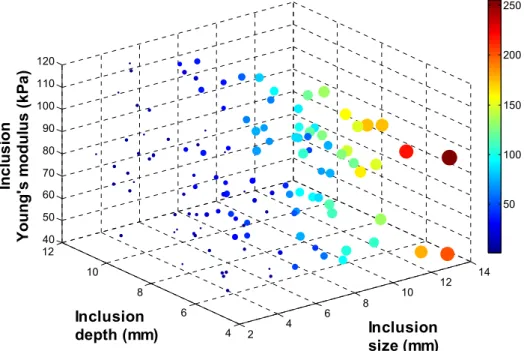
probe), 134 input data sets are randomly generated as inputs of FEM. Among 134 input data sets, 9 input data sets are used to build the calibration tissue phantom. 134 output data sets corresponding to 134 input data sets are being generated through FEM. To visualize 134 data sets in 3 D space, output data sets are rescaled to [0:255] and displayed as colored circles at the locations specified by three inputs (d, h, E). The area of each marker is determined by the values in the vector and the colors of each marker are based on the values from 0 to 255.
Figures 7–10 represent the FEM tactile data with respect to changing (d, h, E). From the results, we
notice that as the size of inclusion increases, the tactile data increases as the effect of bigger inclusion
will cause more change in the sensing probe deformation. As the depth of inclusion increases, the tactile
data decreases as the effect of stiff inclusion gets reduced and sensing probe presses the soft tissue. As
the Young’s modulus of inclusion increases, the tactile data increases as the stiff inclusion makes the
sensing probe to deform more.
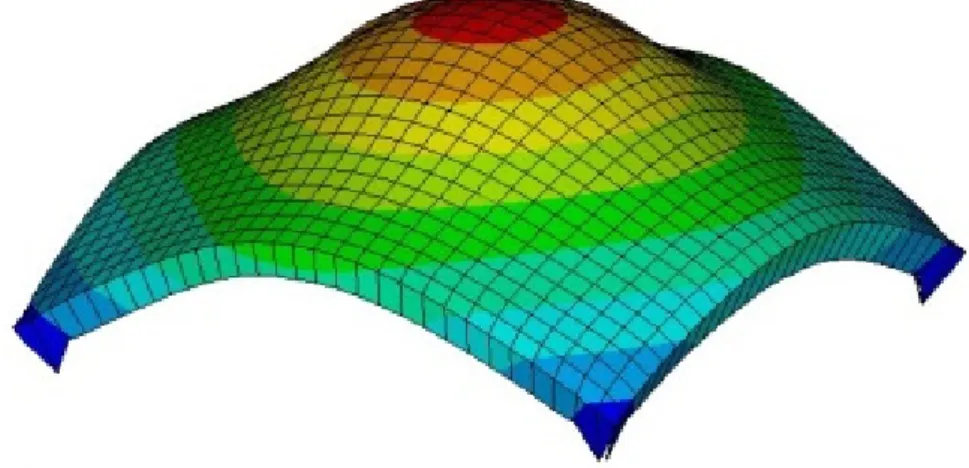
Figure 6. FEM result of sensing probe deformation. The result was obtained when the sensing probe was compressed against tissue containing a stiff inclusion embedded in tissue 20 mm thick. The inclusion was 5 mm diameter and it was located 5 mm beneath the tissue surface.
Figure. 7. The quantification of FEM tactile data. (a) The maximum deformation;
(b) The total deformation; and (c) The deformation area of sensing probe.
The diagram of input and output of FEM is shown in Figure 8.
Figure. 8. The inclusion size, depth, and Young’s modulus are the variables of FEM. The
outputs of FEM are the maximum deformation, total deformation, and deformation area of
sensing probe.
Figure 9. The maximum deformation of sensing probe depending on the inclusion size, depth, and Young’s modulus. The 4 D color dimension shows the maximum deformation value.
Figure 10. The total deformation of sensing probe depending on the inclusion size, depth, and Young’s modulus. The 4 D color dimension shows the maximum deformation value.
3.3. Tactile Data from TSIS
As we discussed in previous section, TSIS captures the dispersed light due to the sensing probe deformation and save it as an image format. To quantify the TSIS tactile data, we measure the maximum pixel value O
TSIS1, the total pixel value O
TSIS2, and the deformation area of pixel O
TSIS3in the tactile sensation image. The maximum pixel value O
TSIS1is defined as the pixel value in the centroid of the image. The range of the maximum pixel value is from 0 to 255. The total pixel value O
TSIS2is defined as the summation of pixel value in the image. The range of the total pixel value is from 0 to
2 4 6 8 10 12 14
4 6 8 10 1240 50 60 70 80 90 100 110 120
Inclusion size (mm) Inclusion
depth (mm) In c lu s io n Y o un g' s m o du lu s ( k P a )
50 100 150 200 250
255 × 1024 × 768. The deformation area of pixel O
TSIS3is defined as the number of pixel greater than the threshold value k in the image. In the current study, we set k as 5. Figure 11 represents the deformation area of sensing probe depending on the inclusion size, depth, and Young’s modulus.
Figure 11. The deformation area of sensing probe depending on the inclusion size, depth, and Young’s modulus. The 4 D color dimension shows the maximum deformation value.
3.4. Calibration: Mapping TSIS Tactile Data to FEM Tactile Data
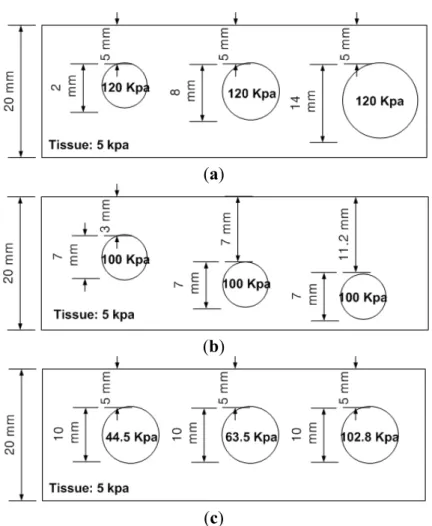
Since the FEM measures the quantity of the sensing probe deformation and the TSIS measures the quantity of the dispersed light due to the sensing probe deformation, it is necessary to relate the FEM tactile data and TSIS tactile data. This is the calibration process. For this purpose, we obtained tactile data of calibration phantom using both FEM and TSIS. The calibration phantoms consist of three phantoms, size, depth, and hardness phantoms. Each phantom contains three inclusions, resulting in a total of nine inclusions. Every inclusion have three parameters (d, h, E). The Young’s modulus of background tissue phantom is 5 kPa, and the height is set at 20 mm. The schematic of three calibration phantoms are shown in Figure 12.
To map the tactile data of TSIS to tactile data of FEM, first, we simulated tactile data of nine inclusions using FEM. The tactile data was then quantified by ( d
total, d
area, d
probe). The tactile data on the inclusions in the calibration phantoms was also obtained by the TSIS. The TSIS tactile data is quantified by ( d
total, d
area, d
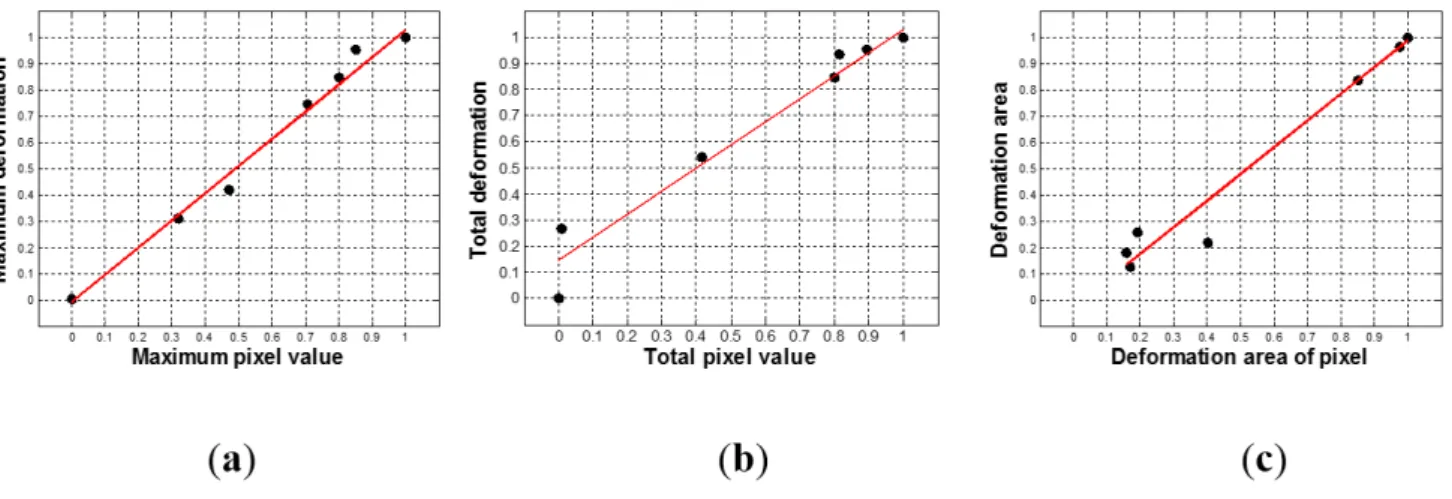
probe). Figure 13 shows the quantified TSIS tactile data results. It can be observed that the results show the similar pattern with the FEM case. To investigate the relationship between FEM tactile data and TSIS tactile data, we generated graphs of ( O
1FEM; O
TSIS1), ( O
FEM2; O
TSIS2), and ( O
FEM3; O
TSIS3) in Figure 14. Linear regression was used to model the relationship between FEM tactile data and TSIS tactile data.
2 4 6 8 10 12 14
4 6 8 10 12 40 50 60 70 80 90 100 110 120
Inclusion size (mm) Inclusion
depth (mm) In c lu s io n Y oun g' s m odu lu s ( k P a )
50 100 150 200 250
(a)
(b)
(c)
Figure 12. The schematic of calibration phantoms. The calibration phantoms are (a) Size phantom; (b) Depth phantom and (c) Hardness phantom. Each phantom includes 9 inclusions.
Figure 13. The relationship between FEM tactile data and TSIS tactile data. (a) Maximum
pixel value versus maximum deformation; (b) Total pixel value versus total deformation,
and (c) Deformation area of pixel versus deformation area.
Figure 14. The linear regression results between TSIS tactile data and FEM tactile data.
(a) The linear regression result between maximum pixel value and maximum deformation;
(b) The linear regression result between total pixel value and total deformation; and (c) The linear regression result between deformation area of pixel and deformation area.
3.5. Inversion Algorithm
The goal of the tactile data processing is to estimate inclusion’s size, depth, and Young's modulus using the tactile data. In the forward modeling, we generated 134 input data sets (d, h, E) and investigated its output data sets ( d
total, d
area, d
probe). The 134 data gets were obtained from the FEM simulation. Now, we design the inversion algorithm to estimate (d, h, E) using ( d
total, d
area, d
probe). To achieve this purpose, first we need an inversion algorithm training using 134 data sets generated in the forward modeling. In this paper, neural network (NN), is utilized for the inversion algorithm. Figure 15 shows the diagram of inputs and outputs of NN.
Figure. 15. The maximum deformation, total deformation, and deformation area of sensing probe are the inputs of artificial neural network. The outputs of the network are the inclusion size, depth, and Young’s modulus.
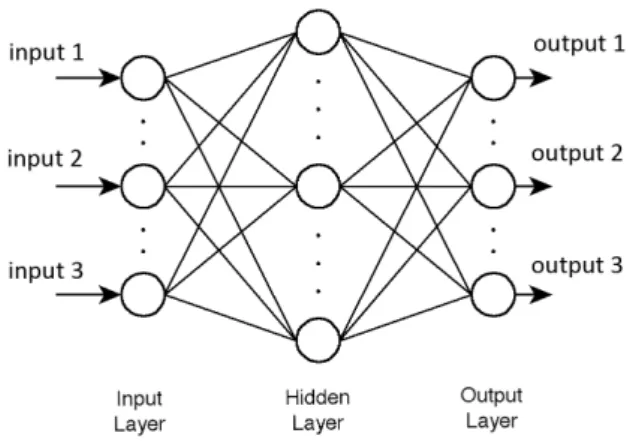
In this study, we have taken multilayered neural network. Multilayered neural network consists of neurons united in layers. Each i layer is connected with i − 1 and i + 1 layers and neurons in layer are not connected to each other. Figure 16 represents the structure of multilayered neural network.
In the structure, too many neurons would lead to over-fitting and great variance of mean squared
error (MSE) results, but not enough neurons would cause high MSE results. Thus numbers of
neurons and layers were set experimental way to three layers as follows: (1) 1st layer: three neurons,
sigmoid activation function; (2) 2nd layer: four neurons, sigmoid activation function; (3) 3rd layer: three
neurons, linear activation function.
Figure 16. The multilayered neural network structure.
For training the NN, two different algorithms were considered. The first one is the Levenberg-Marquardt algorithm (LMA) and the second one is the Scaled Conjugate Gradient algorithm (SCGA). The LMA is a very popular curve-fitting algorithm used in many software applications for solving generic curve-fitting problems. The LMA interpolates between the Gauss–Newton algorithm (GNA) and the method of gradient descent. The LMA is more robust than the GNA, which means that in many cases it finds a solution even if it starts very far off the final minimum. On the other hand, for well-behaved functions and reasonable starting parameters, the LMA tends to be a bit slower than the GNA. LMA can also be viewed as Gauss–Newton using a trust region approach. Below is the summary of the LMA.
If a function E x ( ) is to be minimized with respect to the parameter vector x , then Newton’s method would be:
2
( )
1( )
x E x
−E x
Δ = − ∇ ∇ (1)
where ∇
2E x ( ) is the Hessian matrix and ∇ E (x ) is the gradient. If E (x ) is ( )
1 2( )
N i i
E x e x
=
= , then it can be shown that:
( )
T( ) ( ) E x J x e x
∇ = (2)
2
E x ( ) J x J x
T( ) ( ) S x ( )
∇ = + (3)
where J (x ) is the Jacobian matrix and:
2 1
( ) ( )
N
i i
i
S x e e x
=
= ∇ (4)
For the Gauss-Newton method, it is assumed that S ( x ) ≈ 0 . Then Equation (1) becomes ( ) ( )
1( ) ( )
x J x J x
T
−J x e x
Δ = (5)
The Levenberg-Marquardt modification to the Gauss-Newton method is ( ) ( )
1( ) ( ) x J x J x
TI
−J x e x
Δ = + μ (6)
The parameter μ is multiplied by some factor β whenever a step would result in an increased E x ( ) .
When a step reduces E x ( ) , μ is divided by β . When the scalar μ is very large, the LMA approximates
the steepest descent method. However, when μ is small, it is the same as the GNA. Since the GNA converges faster and more accurately towards an error minimum, the goal is to shift towards the GNA as quickly as possible. The value of μ is decreased after each step unless the change in error is positive;
i.e. the error increases. For the NN mapping problem, the terms in the Jacobian matrix can be computed by a simple modification to the back-propagation algorithm.
As alternate to LMA is SCGA. The SCGA is based upon a class of optimization techniques well known in numerical analysis as the Conjugate Gradient Methods. SCGA uses second order information from the NN but requires only ( ) O N memory usage, where N is the number of weights in the network.
A brief description of SCGA goes follows. Let’s take a Taylor expansion of E x ( ) function:
...
) 2 (
) 1 ( ) ( )
( x + Δ x = E x + ∇ E x Δ x + Δ x ∇
2E x Δ x +
E
T T(7)
The Conjugate Gradient Methods are based on the general optimization strategy, but choose the search direction and the step size more carefully by using information from the second order approximation:
1
2( ) ( ) ( ) ( )
2
T T
E x + Δ ≈ x E x + ∇ E x Δ + Δ ∇ x x E x x Δ (8)
It is not desirable to calculate the Hessian matrix explicitly, because of the calculation complexity and memory usage involved. The solution is
2
( ) ( )
( )
k k k kk k k
k
E x p E x
s = ∇ E x p ≈ ∇ + σ −∇
σ (9)
The idea is to introduce a scalar λ
k, which is supposed to regulate the indefiniteness of ∇
2E ( x ) such as in LMA. This is done by setting as:
(
k k k) ( )
kk k k
k
E x p E x
s = ∇ + σ −∇ + λ p
σ (10)
and for each iteration adjusting l looking at the sign of
kd . The summary of the SCGA is as
kshown below.
Step 1: Choose weight vector x and scalars
1σ > 0 , λ
k> 0 and λ
k= 0 . Set p =
1r =
1−∇ E x ( )
1, 1
k = , and set success = true.
Step 2: If success = true then calculate second order information:
k T k k
k
k k
k k k
k k
s p
x E p
x s E
p
=
∇
− +
= ∇
=
δ
σ σ σ σ
) ( ) (
Step 3: Scale s :
k)
2(
) (
k k k k k
k k k k k
p p s
s
λ λ δ δ
λ λ
− +
=
− +
=
If σ
k≤ 0 then make the Hessian matrix positive definite:
k k k
k k k k
k k k k
k k
k k
k k
p p
p p s
s
λ λ λ
λ δ δ
λ δ λ
λ δ
=
− +
−
=
−
=
− +
=
, ) (
2 2
) 2 (
2 2
2
Step 4: Calculate step size:
, .
T k
k k k k
k
p r μ
μ α
= = δ
Step 5: Calculate the comparison parameter: [ ]
2
2 ( ) ( )
k k k k k
.
k
k
E x E x p
δ α
μ
− +
Δ =
Step 6: If Δ
k≥ 0 then a successful reduction in error can be made:
true succes
x E r
p x
x
k
k k
k k k k
=
=
−∇
= +
=
+ +
+
, 0
) (
11 1
λ
α
Step 7 a: If k mad N = 0 then restart algorithm: p
k+1= r
k+1Else create new conjugate direction:
k k k k
k k k k k
p r
p
r r r
β β μ
+
=
= −
+ +
+ +
1 1
1 2 1