Received: September 10, 2019 Revised: October 25, 2019 Accepted: November 21, 2019 Trauma and InJury
Correspondence to Haewon Roh, M.D.
Department of Neurosurgery and Focused Training Center for Trauma, Guro Hospital, Korea University College of Medicine, 148 Gurodong-ro, Guro-ru, Seoul 08308, Korea
Tel: +82-2-2626-1178 Fax: +82-2-863-1684 E-mail: rofree1st@gmaillcom
outcomes of Cranioplasty using autologous Bone or 3d-Customized Titanium mesh follow- ing decompressive Craniectomy for Traumatic Brain Injury: differences in Complications
Junwon Kim, M.D.1, Jang Hun Kim, M.D.1,2, Jong Hyun Kim, M.D., Ph.D.1, Taek-Hyun Kwon, M.D., Ph.D.1, Haewon Roh, M.D.1,3
1Department of Neurosurgery, Guro Hospital, Korea University College of Medicine, Seoul, Korea
2Trauma Center, Armed Forces Capital Hospital, Seongnam, Korea
3Focused Training Center for Trauma, Guro Hospital, Korea University College of Medicine, Seoul, Korea
Purpose: Cranioplasty (CP) is often required for survival after decompressive craniec-
tomy. Several materials, including autologous bone and various artificial materials, have been introduced for CP, but it remains unclear which material is best for CP. This study aimed to explore differences in complications between patients who underwent CP using an autologous bone flap versus a three-dimensional (3D) titanium mesh and to identify significant risk factors for post-CP complications.
methods: In total, 44 patients were enrolled in this study and divided into two groups
(autologous bone vs. 3D titanium mesh). In both groups, various post-CP complications were evaluated. Through a comparative analysis, we aimed to identify differences in complications between the two groups and, using binary logistic analysis, to determine significant factors associated with complications after CP.
results: In the autologous bone flap group, there were three cases of surgical infection
(3/24, 12.5%) and 11 cases of bone flap resorption (BFR) (11/24, 45.83%). In the 3D tita- nium mesh group, there was only one case of surgical infection (1/20, 5%) and 11 cases of various complications, including mainly cosmetic issues (11/20, 55%). A subgroup risk factor analysis of CP with an autologous bone flap showed no risk factors that predicted BFR with statistical significance, although a marginal association was found between larger bone flaps and BFR (odds ratio [OR]=1.037, p=0.090). In patients treated with a 3D titanium mesh, multivariate analysis revealed that only the existence of a ventriculo-peritoneal shunt system was strongly associated with overall post-CP com- plications (OR=18.66, p=0.021).
Conclusions: Depending on which material was used, different complications could
occur, and the rate of complications was relatively high in both groups. Hence, the material selected for CP should be selected based on individual patients’ conditions.
Keywords: Cranioplasty; Complications; Autologous bone; Titanium
outcomes of Cranioplasty using autologous Bone or 3d-Customized Titanium mesh follow- ing decompressive Craniectomy for Traumatic Brain Injury: differences in Complications
Junwon Kim, M.D.1, Jang Hun Kim, M.D.1,2, Jong Hyun Kim, M.D., Ph.D.1, Taek-Hyun Kwon, M.D., Ph.D.1, Haewon Roh, M.D.1,3
1Department of Neurosurgery, Guro Hospital, Korea University College of Medicine, Seoul, Korea
2Trauma Center, Armed Forces Capital Hospital, Seongnam, Korea
3Focused Training Center for Trauma, Guro Hospital, Korea University College of Medicine, Seoul, Korea
Purpose: Cranioplasty (CP) is often required for survival after decompressive craniec-
tomy. Several materials, including autologous bone and various artificial materials, have been introduced for CP, but it remains unclear which material is best for CP. This study aimed to explore differences in complications between patients who underwent CP using an autologous bone flap versus a three-dimensional (3D) titanium mesh and to identify significant risk factors for post-CP complications.
methods: In total, 44 patients were enrolled in this study and divided into two groups
(autologous bone vs. 3D titanium mesh). In both groups, various post-CP complications were evaluated. Through a comparative analysis, we aimed to identify differences in complications between the two groups and, using binary logistic analysis, to determine significant factors associated with complications after CP.
results: In the autologous bone flap group, there were three cases of surgical infection
(3/24, 12.5%) and 11 cases of bone flap resorption (BFR) (11/24, 45.83%). In the 3D tita- nium mesh group, there was only one case of surgical infection (1/20, 5%) and 11 cases of various complications, including mainly cosmetic issues (11/20, 55%). A subgroup risk factor analysis of CP with an autologous bone flap showed no risk factors that predicted BFR with statistical significance, although a marginal association was found between larger bone flaps and BFR (odds ratio [OR]=1.037, p=0.090). In patients treated with a 3D titanium mesh, multivariate analysis revealed that only the existence of a ventriculo-peritoneal shunt system was strongly associated with overall post-CP com- plications (OR=18.66, p=0.021).
Conclusions: Depending on which material was used, different complications could
occur, and the rate of complications was relatively high in both groups. Hence, the material selected for CP should be selected based on individual patients’ conditions.
Keywords: Cranioplasty; Complications; Autologous bone; Titanium
INTRODUCTION
As some trials have demonstrated the efficacy of decom- pressive hemicraniectomy (DC) for severe traumatic brain injury (TBI) in terms of reducing mortality and im- proving functional outcomes, it has been widely used as salvage treatment for malignant edema of the brain after TBI [1,2]. To relieve and stabilize brain edema in patients who survive for a sufficient time, cranioplasty (CP) is required to restore the appearance of the skull, protect in- tracranial tissue, and improve neurological function [3,4].
Several materials, including autologous bone and var- ious artificial materials, have been introduced for CP, but which material is best for CP still remains unclear [5-7]. Among these materials, autologous bone flaps are usually the first choice at most institutions, as they are readily available at no additional cost and yield excellent outcomes [8,9]. Autologous bone also has the potential to grow and fuse with bone at the surgical site and is psy- chologically acceptable to patients and their relatives [10].
However, complications such as surgical site infection and bone flap resorption (BFR) always remain possible [8,9]. Various artificial materials (e.g., polymethyl meth- acrylate, titanium, ceramics, and carbon fiber-reinforced polymers) have been produced to reduce these bioactive complications [5,7,11]. Of these artificial materials, titani- um mesh is generally considered the material of choice in
moderate-sized to large craniectomy defects because it is biologically inert, strong, lightweight, and inexpensive to produce [4,12]. Furthermore, as advances in technology and imaging processes have enabled the production of large three-dimensional (3D) custom-made prefabricat- ed plates, 3D customized titanium has been widely used [5]. However, several studies have reported that CP with titanium material is strongly associated with wound or cosmetic complications [3,4,6]. This study was conducted to explore differences in complications between patients who underwent CP using an autologous bone flap to those who underwent CP using a 3D titanium mesh. Fur- thermore, a subgroup analysis to identify risk factors for complications in each group was performed.
METHODS
Patients, clinical variables, and definitions of various complications
From January 2015 to December 2017, 44 patients (24 patients who underwent CP using an autologous bone flap and 20 patients who underwent CP using a 3D titani- um mesh) were enrolled (Fig. 1). They had all previously been treated with DC for refractory increased intracranial pressure resulting from trauma. Clinical data of enrolled patients were collected from their medical charts, images,
Fig. 1. Flow chart showing the inclusion criteria for this study. TBI: traumatic brain injury, PMMA: poly methacrylate, PEEK: polyther ether ketone.
Between January 2015 to December 2017, a total of 87 cranioplsty was collected.
A total of 30 cranioplasty for other reasons was excluded.
A total of 13 cranioplasty
using other materials was excluded.
(10 cranioplasty with PMMA + 3 cranioplasty with PEEK) Cranioplsty of only unilateral standard decompressive craniectomy
for severe TBI
Using only two materials:
1) autoulogus bone flap or 2) cutomized 3D titanium-mesh plate
Cranioplasty using autologous bone flap
(n=24)
Cranioplasty using customized 3D titanium mesh
(n=20)
and telephone interviews with patients or their families.
To more precisely identify the differences that resulted from the material used for CP, we excluded factors as- sociated with surgical procedures, such as postoperative subdural hematoma, epidural hematoma, and subdural hygroma. Therefore, data on patients’ demographic char- acteristics and possible risk factors—including age, sex, operative time for CP, flap size (autologous bone flap size or titanium mesh size), existence of a ventriculo-perito- neal (V-P) shunt system, and the interval between DC and CP—were collected. In order to measure the area of autologous bone flaps and customized 3D titanium mesh plates, Image J software (http://imagej.nih.gov/ij/). Us- ing that software, the surface area of the implanted bone flaps or implanted titanium mesh plates was measured by manually tracing their outlines on lateral skull plain im- ages.
Various complications after CP (e.g., postoperative surgical infections, BFR, wound dehiscence, and per- sistent pain after wound healing) were evaluated. Surgical infection was defined clinically and radiologically by any evidence of infection, including fever, erythema, swelling, and elevated levels of inflammatory markers with evi-
dence of infection on computed tomography (CT) using
contrast medium. BFR was diagnosed with serial brain
CT. We defined BFR as more than 50% thinning of the
bone flap compared to the thickness of the contralater-
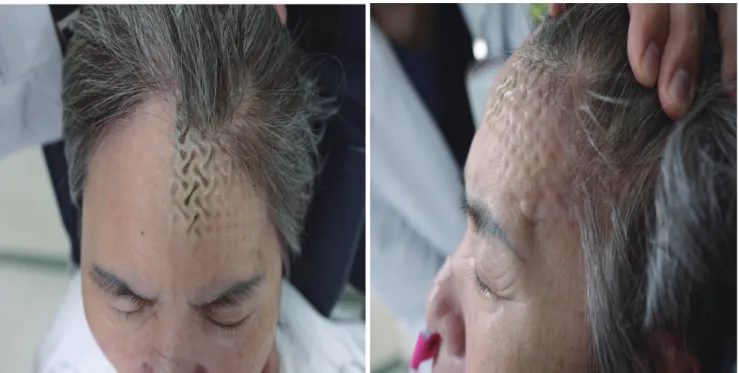
al region (Fig. 2). Mesh extrusion was defined as severe
thinning of the soft tissue and skin to show implanted
mesh patterns without wound dehiscence (Fig. 3). Per-
sistent tenderness at the surgical site was defined as severe
pain caused by a gentle touch at the surgical site after the
wound had totally healed without any dehiscence. Overall
complications were defined as all kinds of complications
after CP. We performed risk factor analysis both for over-
all complications in both groups and for specific compli-
cations (BFR and surgical site infection in the autologous
bone flap group, and surgical site infection, extrusion,
wound dehiscence, and persistent tenderness at the sur-
gical site in the 3D titanium mesh group. To summarize,
age, sex, operative time for CP, flap size (autologous bone
flap size or titanium mesh size), the existence of a V-P
shunt, and the interval between DC and CP were analyzed
as independent variables and various complications (BFR,
surgical infection, and other problems) after CP in both
groups were analyzed as dependent variables. Institutional
Fig. 2. Bone flap resorption on brain computed tomography, in axial and three-dimensional reconstructions.Review Board acceptance was obtained for this retrospec- tive study and the need for informed consent was waived (IRB No. R2019-0055-001).
DC and CP procedures
We performed DC when patients showed clinical dete- rioration resulting from refractory increased intracranial pressure despite the best possible medical treatment. All patients underwent standard unilateral frontotempo- ral-parietal craniectomy with durotomy and duroplasty using artificial dura mater. The removed bone flap was separated from the adherent tissue, packed in sterile medical towels, and stored at -80°C immediately after surgery. The choice of material for CP depended on the surgeon’s preference and the interval between DC and CP. We used a 3D titanium mesh plate in all cases with more than a 3-month interval. Before performing CP, the patient’s hair was completely removed with an aseptic medical shaver. The scalp was then washed with an aque- ous solution of chlorhexidine gluconate and left to dry, after which povidone-iodine solution was applied several times to the patient’s entire head and left to dry. The pre- vious skin incision was re-opened, and the fibrous layer
between the artificial dura and galea was dissected and prepared for insertion of the autologous bone or titanium mesh. After the bone flap was washed several times with povidone-iodine and normal saline solution, the flap was re-implanted with multiple tack-up sutures and fixed in its original position using miniature titanium plates and screws. In the final step, the skin was closed with vicryl subcutaneous sutures and nylon skin sutures with medi- cal staples.
Statistical analysis
Data were presented as the mean and standard deviation for continuous variables and as the frequency or percent- age for categorical variables. The analysis was carried out using the independent t-test and the Fisher’s exact test.
Univariate and multivariate binary logistic regression analyses for complications were conducted, and all factors that showed significance in the univariate analysis were included in the multivariate logistic regression analysis. A
p≤0.05 was considered to indicate statistical significance.All analyses in the present study were performed using SPSS version 21.0 (IBM Corp., Armonk, NY, USA).
Fig. 3. Extrusion after cranioplasty. Extrusion of a mesh was defined as severe thinning of the soft tissue and skin to show the implanted mesh patterns without wound dehiscence. The figures are displayed with permission from the patient.
RESULTS
Patients’ demographic information and clinical de- tails are presented in Table 1. The mean age of patients treated with CP using an autologous bone flap was 49.0±17.32 years (range, 16-75), while the mean age of patients who underwent CP using a 3D titanium mesh
was 53.65±11.50 years (range, 27-81). The mean flap size was 104.17±27.10 cm
2in the autologous bone flap group and 122.56±34.8 cm
2in the 3D titanium mesh group.
The mean operative time was 196.71±75.62 mintues in patients who underwent CP with an autologous bone flap and 170.37±128.30 mintues in patients who underwent CP with a 3D titanium mesh. The mean DC-CP interval was 66.29±42.23 days in the autologous bone flap group and 253.45±351.66 days in the 3D titanium mesh group.
Shunt-dependent hydrocephalus occurred in 10 patients who underwent CP with an autologous bone flap (10/24, 41.7%) and in 8 patients who underwent CP with a 3D titanium mesh (8/20, 40%). The only statistically signifi- cant difference found between the groups was in the DC- CP interval (p=0.009).
In the autologous bone flap group, there were three cases of surgical infection (3/24, 12.5%), 11 cases of BFR (11/24, 45.83%), and no other complications. In CP pa- tients with a 3D titanium mesh, there was only one case of surgical infection (1/20, 5%), while 11 cases of various complications including extrusion, wound dehiscence, and persistent tenderness at the surgical site were noted (11/20, 55%) (Fig. 4).
Table 1. Clinical demographics and statistical analysis using
the independent t-test or the Fisher’s exact test
Autologous bone (n=24)
3D titanium
(n=20) p-value
Age (years) 49.0±17.3 53.7±11.5 0.311
Sex, female (%) 6:25 10:50 0.090
V-P shunt (%) 10:41.7 10:50 0.913
Flap size (cm2) 104.2±27.1 122.6±34.8 0.055 Operation time (ninutes) 196.7±75.6 170.4±128.3 0.402 DC-CP interval (days) 66.3±42.2 253.5±351.7 0.013a 3D: three-dimensional, V-P shunt: ventriculo-peritoneal shunt, DC-CP interval: interval (days) between decompressive craniectomy and cranio- plasty.
aA p≤0.05 was considered to indicate statistical significance.
Fig. 4. Various complications in both cranioplasty groups. 3D: three-dimensional, CP: cranioplasty.
30
20
10
0 N
Complications No complications
Autologus bone 58.3%
3D titanium mesh 55%
Complications after CP with 3D titanium mesh
Total=11
79%
9% 9%
9%
Complications after CP with autoologus bone
Surgical sigte infection Extrusion
Wound dehiscence Persistent tenderness Surgical sigte infection Bone flap resorption 21.4%
78.6%
Total=14
Overall complications were defined as including all kinds of complications after CP. We performed risk factor analysis both for overall complications in both groups and for specific complications (BFR and surgical site infection in the autologous bone flap group, and surgical site infec- tion, extrusion, wound dehiscence, and persistent tender- ness at the surgical site in the 3D titanium mesh group).
In each subgroup analysis of risk factors for compli- cations, we failed to find any significant risk factors for overall complications—including BFR and surgical in- fection—in patients treated with CP using an autologous bone flap, although the univariate binary logistic analysis yielded a marginal tendency for larger bone flaps to be related to BFR (Exp [B]=1.037, p=0.090, 95% confidence interval [CI]: 0.994–1.081). However, in patients treated with a 3D titanium mesh, multivariate analysis revealed that the only the existence of a V-P shunt system was strongly associated with overall complications, including surgical infection, extrusion, wound dehiscence, and per- sistent tenderness after CP (odds ratio=18.66, p=0.021, 95% CI: 1.56–222.92).
DISCUSSION
Various complications after CP were found, and regard- less of which material was used, the rate of complications was relatively high [3,4,12-14]. In patients treated with CP using an autologous bone flap, the rate of complications after CP was 58.3% (14/24), almost all of which consist- ed of BFR. The rate of complications in the 3D titanium mesh group was also high, reaching 55%. However, a greater variety of complications was observed than in pa- tients who underwent CP with an autologous bone flap.
In the risk factor analysis, we failed to find any factors significantly related with BFR in patients treated with CP using an autologous bone flap, while in the 3D titanium mesh group, only the existence of a V-P shunt system was found to have a statistically significant association with the occurrence of complications.
BFR, which is well known to be a unique complication of autologous bone flap surgery, occurs as a result of dysregulation of osteoconduction [15]. A few previous studies reported its occurrence rate to be as high as 34.2%
[1,3,16,17]. Despite its high frequency, it is difficult to identify significant predisposing factors for BFR because CP is usually the final step after various neurocritical procedures [1]. However, some studies have succeeded in finding predictors of BFR; for example, Kim et al. [1,10]
reported that the existence of a shunting system and the DC-CP interval were associated with the risk of BFR after CP, and they also demonstrated that, in order to reduce the rate of BFR, early CP (within 45 days) should be rec- ommended. In contrast, Schuss et al. reported that the presence of multiple fractures, wound healing disturbanc- es, and abscess formation after CP were risk factors for BFR after CP [2]. In another study, a primary synthetic implant, the DC-CP interval, and younger age showed associations with BFR. In our study, we were only able to observe a marginally significant trend for larger bone flaps to be associated with BFR, which may be because larger bone flaps have a higher chance of experiencing dysregu- lated osteoconduction than small bone flaps [17-19].
Titanium mesh plates have been introduced as an alter- native material for autologous bone flap, with advantages including a low risk of tissue reaction and biological in- ertness, especially in patients with large bone defects [6].
However, in this study, the risk of minor complications—
including mainly cosmetic problems, such as extrusion, dehiscence, and exposure of the titanium mesh—was relatively high, reaching 55%. A V-P shunt system was the only significant risk factor for these overall complications after CP with a 3D titanium mesh. Although the exact mechanism has not been proven yet, we assume that the negative intracranial pressure caused by a V-P shunt sys- tem plays a critical role in depressing the patient’s skin and pulling the skin flap into the mesh print, making the mesh print of the implanted titanium visible through the thinned skin. Supporting our hypothesis, Liao and Kao [20] also proposed a similar mechanism for explaining sunken brain after DC. Hence, physicians should consid- er using other materials without a mesh print, especially in patients who already have a V-P shunt system or who may need shunting after CP.
There are some limitations of this study. The small
sample size with a relatively short-term follow-up period
and missing values due to loss to follow-up are important
limitations in drawing generalizable conclusions. Further-
more, our study had a retrospective design and enrolled patients at a single center. Hence, selection bias was not avoided.
CONCLUSION
A relatively high complication rate was observed after CP for surgical bone defects after DC for severe TBI. Differ- ent complications occurred depending on the material that was used. In order to avoid BFR after CP with an autologous bone flap, another artificial material may be a better option in patients with a larger surgical bone defect.
Furthermore, in order to reduce the rate of complications after CP with a titanium mesh plate, other artificial ma- terials—especially without a mesh print—should be rec- ommended, particularly in patients with a previous V-P shunt system or who may need a shunting system later.
ACKNOWLEDGEMENTS
As always, we thank professor J. K. O. for his consistent support and express our deep respect for his passion for treating trauma patients.
REFERENCES
1. Kim JH, Kim JH, Kwon TH, Chong K, Hwang SY, Yoon WK.
Aseptic bone flap resorption after cranioplasty with autologous bone: incidence, risk factors, and clinical implications. World Neurosurg 2018;115:e111-8.
2. Schuss P, Vatter H, Oszvald A, Marquardt G, Imöhl L, Seifert V, et al. Bone flap resorption: risk factors for the development of a long-term complication following cranioplasty after decom- pressive craniectomy. J Neurotrauma 2013;30:91-5.
3. Honeybul S, Morrison DA, Ho KM, Lind CR, Geelhoed E. A randomized controlled trial comparing autologous cranio- plasty with custom-made titanium cranioplasty. J Neurosurg 2017;126:81-90.
4. Mukherjee S, Thakur B, Haq I, Hettige S, Martin AJ. Complica- tions of titanium cranioplasty--a retrospective analysis of 174 patients. Acta Neurochir (Wien) 2014;156:989-98; discussion
998.
5. Lai JB, Sittitavornwong S, Waite PD. Computer-assisted de- signed and computer-assisted manufactured polyetherether- ketone prosthesis for complex fronto-orbito-temporal defect.
J Oral Maxillofac Surg 2011;69:1175-80.
6. Roh H, Kim J, Kim JH, Chong K, Yoon WK, Kwon TH, et al.
Analysis of complications after cranioplasty with a customized three-dimensional titanium mesh plate. World Neurosurg 2019;123:e39-44.
7. Thien A, King NK, Ang BT, Wang E, Ng I. Comparison of poly- etheretherketone and titanium cranioplasty after decompressive craniectomy. World Neurosurg 2015;83:176-80.
8. Dujovny M, Fernandez P, Alperin N, Betz W, Misra M, Mafee M.
Post-cranioplasty cerebrospinal fluid hydrodynamic changes:
magnetic resonance imaging quantitative analysis. Neurol Res 1997;19:311-6.
9. Chang V, Hartzfeld P, Langlois M, Mahmood A, Seyfried D.
Outcomes of cranial repair after craniectomy. J Neurosurg 2010;112:1120-4.
10. Kim JH, Hwang SY, Kwon TH, Chong K, Yoon WK, Kim JH.
Defining “early” cranioplasty to achieve lower complication rates of bone flap failure: resorption and infection. Acta Neuro- chir (Wien) 2019;161:25-31.
11. Lee L, Ker J, Quah BL, Chou N, Choy D, Yeo TT. A retrospective analysis and review of an institution’s experience with the complications of cranioplasty. Br J Neurosurg 2013;27:629-35.
12. Hill CS, Luoma AM, Wilson SR, Kitchen N. Titanium cranio- plasty and the prediction of complications. Br J Neurosurg 2012;26:832-7.
13. Wiggins A, Austerberry R, Morrison D, Ho KM, Honeybul S.
Cranioplasty with custom-made titanium plates--14 years experience. Neurosurgery 2013;72:248-56; discussion 256.
14. Cabraja M, Klein M, Lehmann TN. Long-term results following titanium cranioplasty of large skull defects. Neurosurg Focus 2009;26:E10.
15. Kalfas IH. Principles of bone healing. Neurosurg Focus 2001;10:E1.
16. Ewald C, Duenisch P, Walter J, Götz T, Witte OW, Kalff R, et al.
Bone flap necrosis after decompressive hemicraniectomy for malignant middle cerebral artery infarction. Neurocrit Care 2014;20:91-7.
17. Brommeland T, Rydning PN, Pripp AH, Helseth E. Cranioplasty complications and risk factors associated with bone flap resorption. Scand J Trauma Resusc Emerg Med 2015;23:75.
18. Kriegel RJ, Schaller C, Clusmann H. Cranioplasty for large skull defects with PMMA (polymethylmethacrylate) or tutoplast pro- cessed autogenic bone grafts. Zentralbl Neurochir 2007;68:182- 9.
19. Grant GA, Jolley M, Ellenbogen RG, Roberts TS, Gruss JR, Loeser JD. Failure of autologous bone-assisted cranioplasty fol-
lowing decompressive craniectomy in children and adolescents.
J Neurosurg 2004;100(2 Suppl Pediatrics):163-8.
20. Liao CC, Kao MC. Cranioplasty for patients with severe de- pressed skull bone defect after cerebrospinal fluid shunting.
J Clin Neurosci 2002;9:553-5.