A Study on the Green Roof System for Ecological Environment Education in the Early Childhood / Park, Sung-Eun ․ Bang, Kwang-Ja
한국생태환경건축학회 논문집 Vol. 4, No. 3 2004. 9 109
The UNESCO, UNEP, and UN(1988) stressed saying, “As a long-term environment strategy to maintain sustainable environment and sustainable society, nothing contributes more or plays an important role than offering environment education to the present generation and future generations. Environment education will play an important role in fostering sustainable thinking to cope with the sustainable society.” (Slocombe and Bers, 1991)
In order to seek sustainable early childhood environment education to create desirable environment behavior and in childhood when the foundation of every development sphere is being shaped, existing studies were reviewed in pedagogy, psychology, and natural science perspectives, nature experience activity programs were designed based on the advice of
* Researcher in Politecnico di Milano, Italy
** Major in Environmental Landscape Department of Environmental Plant Resources Graduate School of Sang Myung University
specialists engaged in the fields relevant areas, and they were applied to childhood in person in a field of education to measure and analyze its effect through various methods.
Therefore, this study will provide basic material that would allow performing practical and systematic nature experience activities for children in environment education field in the future. The study aims at analyzing the effect of nature experience activities of early childhood by their characteristics, comparing space-specific natural experience activities performed along a process of planning, designing, construction, and use participated by childhood in relation to creation of a Roof Biotop, and evaluating the impact of environment education designed for each activity sphere.
A Study on the Green Roof System for Ecological Environment Education in the Early Childhood
Park, Sung-Eun*, Bang, Kwang-Ja**
Key Words: Ecological education, Pro-evironmental Behavior, Nature experience activities, Roof biotope, Sensibility on environment, Environmental building
Figure 1. Flow chart of research Qualitative
Meth
Nature Experience
Activiti
Quantitative Meth
Knowing
Feeling
Acting ▪Drawing Meth
Self-report Meth Torrance CHEAKS
▪Observation ▪Monitering
Non Self-report Meth K-CBCL
A Study on the Green Roof System for Ecological Environment Education in the Early Childhood / Park, Sung-Eun ․ Bang, Kwang-Ja
Journal of the KIEAE Vol. 4, No. 3 2004. 9 110
First, in order to check and analyze the difference coming from prior nature experience activities of respondents, the effect of experience and non-experience of nature experience activities was measured in CHEAKS via a self-report method. The result showed that a group experienced in nature activities showed higher score at a significant level in recognition and activity sphere. In the parent K-CBCL result measured by an observer, which is a non-self report method, difference in the scores of 5-year-old segment was not significant. However, in case of 6-year-old segment, a group experienced in nature activities showed a significantly low score in internalizing problems, externalizing problems including attention problems, delinquent behavior, and aggressive behavior, and total behavior problems. In addition, the measurement of K-CBCL of elementary school students indicated a significant difference as the group with nature activity experiences showed a low score in total behavior problems because they scored relatively low in internalizing problems including withdrawn, anxious/depressed, somatic complaints, thought problems, sex problems, and emotional lability. In social problems, they scored high, which allowed to understand the impact of having experiences in nature activities.
When K-CBCL scores were compared based on the ages of activity-experienced children, nature experience activities seemed more effective on 5-year-olds than on 4-year-olds.
When K-CBCL scores were compared based on gender, in the boy's group, a group with experiences showed significantly low score in social problems and attention problems. In the girl's group, children with nature activity experience showed a significantly low score in sex problems. Therefore, it indicated that effect is different depending on age and gender.
Second, when activities were categorized according to the characteristics of nature experience activity spaces, it showed that activities that can touch and feel firsthand in natural environment are more effective than theoretical or knowledge delivery-oriented activities taking place indoor in forming desirable recognition and behaviors on environment.
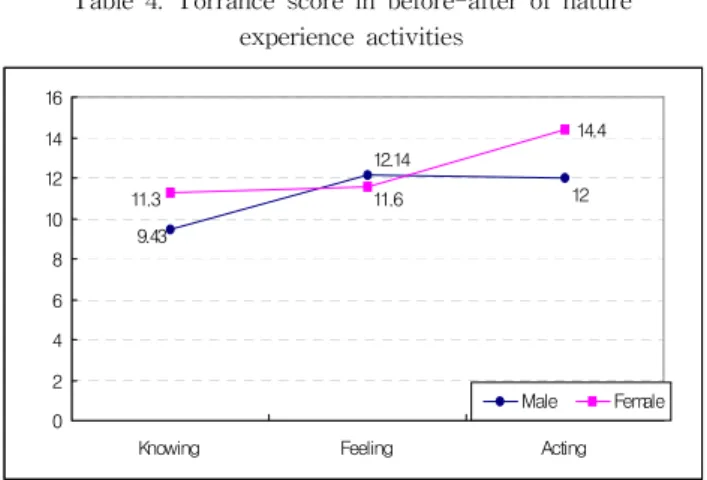
Third, comparison of the effect of the spheres of nature experience activities showed that as for before and after introducing activities, effect after doing activities was higher. The effect was even greater in the boy's group. When the difference in gender was compared for each sphere, girls scored higher in knowledge sphere and boys scored higher in
recognition. It indicated that there might be a difference in spheres depending on gender. The result of Torrance measurement, one of self-report methods, showed that creativity was strongest when it was guided up to an activity sphere. It implies that activities via experiences such as touching and feeling nature firsthand instead of knowledge delivery-focused activity are much more effective.
Table 1. K-CBCL score of nature experience activities In the early childhood
Table 2. K-CBCL score of nature experience activities in the the elementary students
Table 3. Attitude score of nature experience activities in the elementary students
50.71 34.53
50.25 32.83
48.59 47.53
47.47 46.25
47.42 46.17
0 10 20 30 40 50 60
Social Internaliz ing Problems Externaliz ing Problems Sex Problems Emotional lability
(Average)
Experience Non Experience
78.75
88.5
77.67
83.67
72 74 76 78 80 82 84 86 88 90
Before After
male female
10.53 11.82
9 10.17
10.39 13.41
0 2 4 6 8 10 12 14 16
Knowing Feeling Acting
(Average) Experience Non Experience
A Study on the Green Roof System for Ecological Environment Education in the Early Childhood / Park, Sung-Eun ․ Bang, Kwang-Ja
한국생태환경건축학회 논문집 Vol. 4, No. 3 2004. 9 111
Table 4. Torrance score in before-after of nature experience activities
Table1 5. Torrance score in step of nature experience activities
This study showed that the effect of nature experience activities includes motivating environment education by utilizing a field around, offering of direct experience opportunities, improvement of sensibility on environment, and restoration of aesthetic understanding on nature. Also, diversification of education methods and requirements to practice vivid education should be further studied and developed. For education directly experiencing artificial environment and natural environment, proactive development and introduction of programs for field experience activities in relation to environment around us and breaking away from knowledge aspect or cramming education is urgently required.
As for the limitation of this study, due to the nature that the study targets were early childhood, existing methods from other areas had to be applied. Therefore, there is a room for improvement to develop more scientific and objective evaluation standards. Also, due to a fact that this was the first study targeting early childhood's educational institution in environment education area, targets for comparison were limited. As this study linked landscape architecture with environment education, which was social science-driven such as pedagogy, sociology, and children psychology,
and was conducted in a natural science perspective, it is significant in a sense that it promotes inter-field exchanges. Therefore, in-depth study and exchanges with other areas are requested in the future for this study, which was conducted in a natural science perspective, to be actually applied in an educational field.
A series of process ranging from landscape architecture planning and designing to construction that takes place for human-driven place and time is the beginning of a study that can be utilized in the field by linking with educational features consisting the target, space, and contents of nature experience activities.
Studies in a longer term and for a more extensive target group will be left for future research.
Reference
1. 食野 雅子․ホ一ニング 睦美. 1992. インタ-プリテ一ション入門.
小學館. pp.154-155.
2. Amstrong J. B. and Impara J. C. 1991. The impact of an environmental educationprogram on knowledge and attitude, The Journal of Environmental Education. 22(4): 36-40.
3. Borden and Schettino. 1990. Implication of attitude and behavior research for environmental conservation. The Journal of Environmental Education. 22(1): 26-32.
4. Chawla L. 1998. Significant Life Experiences Revisited : A review of research on sources of environmental sensitivity. The Journal of Environmental Education. 29(3): 11-21.
5. Fien, J & Hillcoat, J. 1996. The Critical Tradition in Research In: Williams, M.(ed.) Understanding Geographical and Environmental Education. The Role of Reseaech Cassell.
6. Gross M. P. and Pizzini E. 1979. The effects of combine advance organizers and field experience on environmental orientations of elementary school children. Journal of Research in Science Teaching. 16(4): 325-331.
7. Hollman, J. 1990. The integration of science teaching through science-technology-society courses. In: Chisman, D. G.(ed.) New trehds in integrated science teaching. UNESCO.
8. Rogers, C. R. 1967. The facilitation of significant learning. In:
Siegel, L.(ed.). Introduction: Some contemporary viewpoint, Chandler, San Francisco. pp.37-54.
9. Ryan C. 1991. The effects of consevation program on schoolchildren's attitude toward the environment. The Journal of Environmental Education. 22(4): 30-35.
10. Shepard C. L. and Spleeman L. R. 1986. Affecting environmental attitudes through outdoor education. The Journal of Environmental Education. 17(2): 20-23.Jaus, H. H.
1984. The developement and retention of environmental attitudes in elementary school children. The Journal of Environmntal Education. 15(3): 33-36.
11. UNESCO. 1977. First intergovermental conference on environmental education final report, Tibilisi, USSR. Paris UNESCO.
78.75
80.25
70
88.5 77.67
72.83
71.17
83.67
0 10 20 30 40 50 60 70 80 90 100
Before Knowing Feeling Acting
male female 14.4
9.43
12.14
11.3 11.6 12
0 2 4 6 8 10 12 14 16
Knowing Feeling Acting
Male Female
A Study on the Green Roof System for Ecological Environment Education in the Early Childhood / Park, Sung-Eun ․ Bang, Kwang-Ja
Journal of the KIEAE Vol. 4, No. 3 2004. 9 112
12. Wagar, J. Alan. 1976. Evaluating the effectiveness of interpretation, Journal of Interpretation 1(1).
13. Wendling R. C. and Wuensch K. L. 1985. A Fifth-grade outdoor education program expections and effects, Journal of Interpretation. 10(1): 11-20.