전통생활문화교육에 대한 인식과 실행*
: 보육현장의 세시풍속교육을 중심으로
A Study on Child Caregivers' Awareness and Educational Training of Traditional Living Culture and Seasonal Customs in Early Childhood Education Settings
성신여자대학교 생활문화소비자학과
1)
부 교 수 주 영 애**
Dept. of Living Culture & Consumer Science, Sungshin Woman's Univ.
Associate Professor : Ju, Young-Ae
<Abstract>
The purpose of this study is to suggest basic data on the education of traditional living culture and seasonal customs.
In order to achieve the purpose of this study, a research questionnaires consisting of 46 questions was developed. The data was collected by 287 child caregivers in Incheon Metropolitan City. and the data analysis was conducted with the SPSS / Win 17.0 program.
The results of this study, they are summarized as follows.
First, child caregivers overall perception of the traditional life and culture was scored as 3.28. Their perception of the need for education on traditional life and culture was scored as 3.7, and their knowledge and interest both as 2.77. The analysis of difference according to background variables revealed, significant difference in educational experience (p. <05) and age (p.
<01).
Second, the child caregivers were unaware any other seasonal customs besides Chuseok( Korean Thanksgiving), Tano(a festival occurring on the fifth day of the fifth month of the lunar calendar), Lunar New Year's Day, and Daeboreum (the day of the first full moon of the year)
Third, child caregivers perceived 'culture' experiences as being very important for education about seasonal customs.
Forth, two of Korea's seasonal customs, Chuseok(Korean Thanksgiving) and the Lunar New Year's Day have always been celebrated with family gatherings.
Fifth, child caregivers awareness of seasonal customs is correlated with educational training. And their awareness of the traditional living culture is also correlated with educational training.
▲주요어(Key Words) : 세시풍속(seasonal customs), 전통생활문화(traditional living culture), 교육실행 (educational training)
* 이 논문은 2011년도 전기 성신여자대학교 학술연구조성비 지원에 의하여 연구되었음
** 주저자․교신저자 : 주영애 (E-mail : [email protected])
Ⅰ. 서 론
최근 대내외적으로 한국인들의 생활문화에 대한 관심이 그 어느 시기보다도 높아지고 있다. 韓 Style을 세계화시키 기 위한 노력이 국가적으로도 주요관심사가 되고 있고, 각종 한류 산업과 더불어서, 의생활 식생활 주생활 및 문화 활동 등 한국인의 생활문화가 부가가치를 창출할 수 있는 문화 및 관광 상품으로도 주목되고 있다. 이러한 가운데 ‘우리 고유의 생활 문화’가치를 재조명하고 전통생활문화를 발굴 보전하며 체험 을 통한 교육의 기회를 제공하고자 하는 노력(Moon, Min &
Choi, 2004)이 주목받기 시작한 것은 매우 고무적이다.
특히 자라나는 유아들이 급변하는 사회에 잘 적응해 나갈 수 있도록 하기 위해서는 서로 다른 다양한 문화를 접하면서 이해하고 존중할 줄 아는 교육이 필요하지만, 먼저 우리의 전통문화에 대한 이해를 바탕으로 정체성을 확립하는 교육 이 더 필요하다(Ha, 2004)고 하겠다. 생활문화교육은 어렸을 때부터 자국 문화의 정체성 확립을 위해 필요한 교육이므로, 유아를 지도하는 보육교사들의 ‘전통생활문화 및 세시풍속’
에 대한 관심과 필요성의 인식은 중요하게 연구되고, 교육을 위한 자료로 활용되어야 한다고 본다.
우리의 전통이란 조상으로부터 오랜 세월을 거쳐 장기간 성립 발달 정착되어온 사상과 종교 풍습 예술 등이 언어 또 는 일상생활을 통해서 대대로 현대까지 전해 내려오는 것을 의미(Lee, 2002)한다. 즉 전통은 우리가 오래도록 유지해 온 문화인 것이다. 유아기는 모든 분야에 대한 선호가 결정되는 시기이며 우리의 전통문화를 자랑스럽게 여기고 사랑하며 관심을 갖게 되느냐 마느냐의 중요한 갈림이 이루어지는 시 점이므로, 유아기의 전통문화 교육에 대한 연구가 필요하며, 이는 우리의 전통문화가 어울리는 외래의 문화를 선택할 수 있는 태도를 기를 수 있는 것이다(Bae, 2010).
세시풍속 교육은 하나의 단독활동으로 끝나는 것이 아니 라, 한 해의 흐름과 맞물려 있기 때문에 미리 준비하고 계획 을 세워야 하는 것으로 유아시기부터 세시풍속을 ‘생활’의 일 부로 경험시키는 것이 중요하다. 유아를 위한 세시풍속 프로 그램의 필요성에 대한 인식이 고조되면서 세시풍속 교육에 대 한 교사의 인식관련 연구(Lee et al., 2000; Park, 2001; Oh, 2002; Bae, 2010)가 이루어져 왔고, 세시풍속 적용사례와 교육 적 가치를 살핀 연구(Leem, Sim & Cho, 1999), 세시풍속 교 육에 대한 부모와 유아교육현장의 요구 분석(Jung, 2000), 세시 풍속 관련 유아교육 프로그램 모형연구(Ju & Kim, 2003), 세 시풍속 프로그램을 적용하는 현장의 실천에 관한 문화기술 적인 연구(Ha, 2004) 등도 이루어졌다.
그러나 이러한 연구들은 최근까지 지속적으로 연구 발표 되지 못하고 있는 점에 대해 다시 한번 재고해야한다고 사료
된다. 즉 사회적으로도 관심있게 다루어져 왔던 연구와 그 결 과가 어떻게 실행되고 있는지를 살펴볼 필요가 있다고 사료 되었다. 따라서 본 연구에서는 보육현장을 중심으로 최근에는 보육교사들이 전통생활문화와 세시풍속교육에 대해 어떻게 인식하고 있으며 어떻게 교육 실행을 하고 있는지에 관하여 조사하여 그 결과를 바탕으로 앞으로 보육시설에서 전통생활 문화 및 세시풍속교육 적용을 위한 기초 자료를 제공하고자 하며, 이 교육에 대한 관심과 필요성을 다시 한번 제기하고자 하고자 한다.
Ⅱ. 이론적 배경
1. 전통생활문화
전통이란 네이버국어사전에 따르면 어떤 집단이나 공동체 에서, 지난 시대에 이미 이루어져 계통을 이루며 전하여 내 려오는 사상ㆍ관습ㆍ행동 따위의 양식이며, 일상생활을 통 해서 대대로 현재까지 전해 내려우는 것을 의미(Lee, 2002) 한다. 문화란 사회구성원에 의하여 습득, 공유, 전달되는 행동 양식이나 생활양식의 과정 및 그 과정에서 이룩하여 낸 물질 적 정신적 소득을 통틀어 이르는 말이며, 의식주를 비롯하여 언어, 풍습, 종교, 학문 예술 제도 따위를 모두 포함하는 것 (http://krdic.naver.com)이다. 한편 생활문화란 개인이 일상 생활을 통해 살아가는 방식으로서 일상생활을 영위하는데 있 어서 각 집단에 따라 형성되는 의식과 양식의 총체이며 일상 적인 삶이 행해지는 소재, 즉 공간과 시간, 의복, 주거, 음식, 출산 등으로 구성되는 총체(Health Family Support Centers, 2005)라고 하며, 일상생활에서 나타나는 개인 또는 가족들의 구체적인 삶의 모습과 특성 그리고 그들이 공유하는 상징과 의미의 체계(Park, 2003)라고 하고 있다. 몇 몇 학자들이 제 시하는 전통문화에 대한 내용을 정리하여 표로 나타내 보면 다음과 같다(<Table 1> 참조).
이외에도 Kim(2009)은 전통문화의 가치를 주장한 바, 전
통문화란 오랜 역사와 함께 만들어내고 유지하면서 전승해
온 것으로 민중들의 일상적인 생활문화 속에서 여전히 남아
서 면면히 전해지고 있으며 우리 고유의 전통과 정신문화에
대해 알 수 있는 귀중한 자료가 된다고 강조하였고 전통문화
교육은 한 나라 고유의 문화에 대한 독특성이 자국민에게는
주체성과 정체성을 확립시키며 세계 여러 나라와 차별화로
존속되는 것이라고 주장하였으며, Hong and Kim(2010)은
전통문화는 자연친화적 태도, 인간관계 존중, 공동체적 생활
등과 같은 가치관과 생활태도를 담고 있고, 공동체 의식을
두텁게 하고 우리 삶의 문제점을 극복하고 삶의 질을 높이며
한 민족으로서의 미래의 삶을 준비할 수 있는 방안이 살아있
Seo, Seonok (2008), Koh, Mingyeong
(2005)
Mun, Miok (2001) Bang, Inok (2002) Seo, Hyeeun (2003)
Choi, Eunmi with others(2005)
Cho, Heejin (2009)
Traditio nal life and culture
Clothing
habits Traditional clothing Clothing habits
Tradi- tional life
Traditional
Food Traditional clothing
Tradi- tional life
Clothing habits Eating
habits Traditional food Eating habits
Traditional clothing
Traditional Food Eating
habits
Housing habits
Traditional housing Housing habits Traditional housing Housing
habits Holidays and seasons
culture
Lifetime and seasonal customs
Traditional
housing Traditional etiquette Tradi- tional etiquette
Seasonal customs
Seasonal customs
Cultural etiquette Folk religion Seasonal customs Etiquette
Traditional music
Tradi- tional art
Music Traditional etiquette Tradi- tional music
Traditional nursery
rhyme
Symbols and specialty
Traditio nal arts
and culture
Music Traditional dance Dance
Traditional rhythms Tradi-
tional art Music
Dance Art culture Art Pansori Dance
Art Traditional literature Literature Folk song Literature
Literature Traditional nursery
rhyme Play Traditional fairy tale Art
Traditio nal games culture
Play Traditional games Symbols and specialty
Traditional
games Traditional games Traditional games
※ Cho, Hee Jin(2009) with reference to the study the researchers re-name
Table 2. Early Childhood Education Research Classification Applied to the Traditional Life and Culture
Researchers Characteristics of traditional culture
Gihyeon Lee(2002)
* Pursuit of ethnic homogeneity
* Belief system and Thought-pattern formed by ancestors
* Passed down by Ideology, religion, customs, arts, language, and life.
Bokgyu Lee(2003)
* Formation by the process of a long history in particular ethnic or country
* Members' shares, succession
* Any material and mental culture
Kyonghwa Jun, Chanok Bak(2003)
* Specific customs, system, and behavior patterns.
* Cultural heritage of the ancestors
* Spiritual values, customs and common idea in the present.
* A culture of life creating a new culture.
Table 1. With Previous Studies the Characteristics of the Traditional Culture
는 것이라고 하였다. Cho(2009)는 전통문화란 한 민족의 고 유의 생활양식으로 생활을 통하여 자연스럽게 배워 나가야 하는 것으로 21세기라는 열린 사회를 살아가야 할 유아들이 우리의 전통문화를 바르게 이해하고 즐기면서 정체성과 자 긍심을 확립하고 이를 바탕으로 자신감 있게 세계화를 지향 해나가도록 하기 위해서는 유아기의 전통문화교육이 매우 중요하다고 하였다.
학자들의 견해를 종합해 볼 때, 전통생활문화는 조상의 삶 의 양식을 통해 전수되어온 관습이나 통념, 가치 문화적 유
산으로서 미래를 준비하는 방안이며, 한국인으로서의 정체 성과 자긍심을 갖게 하는 중요한 학습내용이 됨을 강조하고 있는 것을 볼 수 있다.
전통문화에 포함되는 내용의 범위를 분류함에 있어서는
학자들마다 약간씩 차이가 있었는데, 유아교육에 적용을 위한
전통생활문화의 분류는 전통생활문화, 전통예술문화, 전통놀
이 문화 등의 범주로 나누어 볼 수 있다. 특히 본고에 다루고자
하는 내용인 의식주생활 세시풍속 예절문화 등은 <Table 2>에
제시했듯이 전통생활문화의 영역(Moon, 2001; Bang, 2002; Seo,
title of the book period kind author Writing background and contents
Kyungdo Japji 18th century ethnography YuDeukgong
This is a book written by Yoo deuck gong who lived through Young Jo and Jeong Jo, King of Chosen Dynasty. It is written about nobility cul- ture in Seoul. It is summarized seasonal customs of Seoul as 19 items through Wondang to Jaeseck.
Donggook-seshigi 19th century ethnography Hong Sukmo
It is a typical seasonal custom in Korea, and it described a phenomenon of seasonal customers from month to month in order. At the end, this book included leap month and it explains events of 12 month and its customs.
It also covers origin and changes of traditional culture such as culture, re- creation, folk religion and the necessities of life from nobility to populaire.
Yulyang-Seshigi 19th century ethnography KimMaesun
Events for the year custom and events are divided into 21 items descri- bing the contents Yulyang. Which is written for upcoming events throu- ghout the year in Hanyang. This book briefly is written about court.
Table 3. Early Record About Seasonal Customs
2003; Choi et al., 2005; Koh, 2005; Seo, 2008; Cho, 2009) 에서 다루어지고 있음을 알 수 있다.
2. 세시풍속
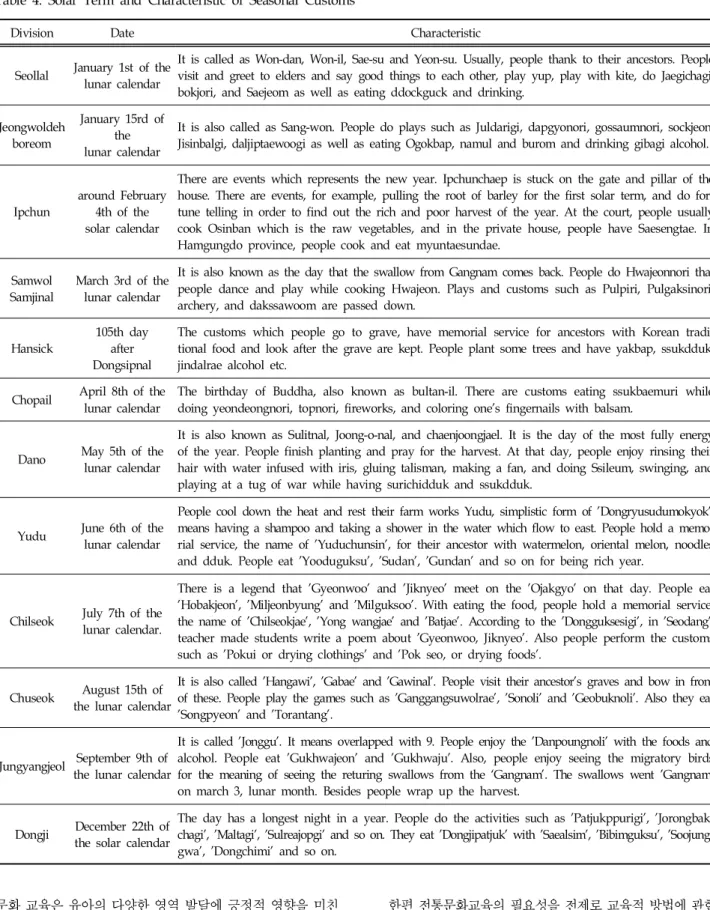
우리나라의 세시풍속은 우리 조상의 지혜와 삶의 모습이 담겨있는 1년 주기의 행사로서 언제부터 정확히 지켜왔는지 를 정확히 알 수는 없지만 <경도잡지>, <동국세시기>, <열양 세시기>가 우리나라의 세시풍속에 관한 초기의 기록을 찾아 볼 수 있다.
그 이후에 나온 세시풍속에 관한 기록들은 거의 <Table 3>
에서 제시한 세 권의 책을 토대로 기술되고 있는 실정(Park, 1997) 이다.
Kim(2005)은 세시풍속은 해마다 같은 시기에 주기적으로 반복되는 주기전승의례(週期傳承儀禮)로서 각 현상마다 다 양한 문화요소를 지니고 있으며 하나의 세시풍속 현상에 기 본적인 의식주의 문제에서부터 풍요와 건강의 희구라든가 오락 또는 예술적인 요소에 이르기까지 복합적인 요소가 포 함되어있다고 정의하였다. 그리고 Chang(2009)은 세시풍속 은 철을 따라 행해지는 풍속으로 한국인의 문화와 민족성이 나타난 계승되어야 할 문화로 정의하였으며, 우리 조상의 지 혜와 삶이 담겨 있는 1년 주기의 생활상(Lee and Lee, 2009) 이라고 정의되기도 하였다. 따라서 세시풍속은 오랜 생활문 화를 이루고 있으며 매년 반복되는 관습이어서 세시풍속이 라 하는 것이다. 세시풍속에는 놀이, 먹거리, 풍습, 의식 등의 다양한 모습이 전승되어 온 것이므로, 유아들을 위한 전통문 화교육의 중요성과 더불어 흥미롭고 다양한 내용으로 접목 할 수 있는 요소가 많다.
본 연구에서는 세시풍속을 계절의 변화에 따라 1년 동안 행해지는 우리 민족의 풍속으로 정의하고 1년 중 12가지 절기 (설, 정월대보름, 입춘, 삼월 삼짓날, 한식, 사월초파일, 단오,
유두, 칠석, 추석, 중양절, 동지)를 중심으로 연구하였다.
Kim(2003)은 세시풍속이 갖는 교육적 의의를 제시하였다.
첫째, 믿음의 심성함양, 둘째, 윤리의식의 고취, 셋째, 공동체 의식의 고취, 넷째, 예능을 통한 정서함양의 고취, 다섯째, 긴 장과 이완의 리듬을 통한 생산적 의의, 여섯째, 만남의 자리 를 마련해 주는 가정교육의 장 등을 들었으며 이를 실천화하 기 위해 어렸을 때부터 제도교육에서 세시풍속에 대한 교육 을 시켜야 하며 '사회교육'에서도 함께 하는 다각적인 방법이 모색되어야 한다고 하였다. 또한 이와 더불어 새롭게 정착된 풍속과 세시풍속, 세시풍속의 지속과 변화에 대한 교육도 있 어야 함을 제안하였다.
Chang(2009)도 세시풍속을 통해 아동 및 청소년들은 계 절의 변화에 따른 생활의 주기성을 알게 되며, 다양한 자연물 을 이용하여 많은 사람들과 어울리는 놀이문화를 체득하고, 건강한 먹거리 문화를 만들어갈 수 있으며, 우리나라 역사를 알고 조상의 삶과 지혜를 배움과 동시에 아동 및 청소년들이 물질중심적인 세계관을 극복할 수 있다고 보았다.
따라서 세시풍속 교육은 한 민족의 역사적 발전과정에서 생성된 정신적 또는 물질적 문화가 여러 세대를 통해 전승된 것이므로 매우 큰 가치가 있다고 사료된다.
3. 선행연구
유아시기에 전통문화교육의 필요성과 의의를 강조한 Jeon
and Park(2003)은 전통문화 교육은 유아기에 국가 정체성
형성을 위해 효과가 높은 교육방법이며 교사의 전통문화에
대한 인식을 변화시키는데도 효과적이라고 주장하였으며, 전
통문화 관련주제는 유아교육기관의 생활 주제로 선정되기에
충분한 가치가 있다고 하였으며 이를 교육시키기 위해서는
교사, 학부모, 지역사회 등의 공동체적인 협력이 필요하다고
하였다. Moon(2004a)의 연구에서도 우리의 전통사상과 전통
Division Date Characteristic
Seollal January 1st of the lunar calendar
It is called as Won-dan, Won-il, Sae-su and Yeon-su. Usually, people thank to their ancestors. People visit and greet to elders and say good things to each other, play yup, play with kite, do Jaegichagi, bokjori, and Saejeom as well as eating ddockguck and drinking.
Jeongwoldeh boreom
January 15rd of the lunar calendar
It is also called as Sang-won. People do plays such as Juldarigi, dapgyonori, gossaumnori, sockjeon, Jisinbalgi, daljiptaewoogi as well as eating Ogokbap, namul and burom and drinking gibagi alcohol.
Ipchun
around February 4th of the solar calendar
There are events which represents the new year. Ipchunchaep is stuck on the gate and pillar of the house. There are events, for example, pulling the root of barley for the first solar term, and do for- tune telling in order to find out the rich and poor harvest of the year. At the court, people usually cook Osinban which is the raw vegetables, and in the private house, people have Saesengtae. In Hamgungdo province, people cook and eat myuntaesundae.
Samwol Samjinal
March 3rd of the lunar calendar
It is also known as the day that the swallow from Gangnam comes back. People do Hwajeonnori that people dance and play while cooking Hwajeon. Plays and customs such as Pulpiri, Pulgaksinori, archery, and dakssawoom are passed down.
Hansick
105th day after Dongsipnal
The customs which people go to grave, have memorial service for ancestors with Korean tradi- tional food and look after the grave are kept. People plant some trees and have yakbap, ssukdduk, jindalrae alcohol etc.
Chopail April 8th of the lunar calendar
The birthday of Buddha, also known as bultan-il. There are customs eating ssukbaemuri while doing yeondeongnori, topnori, fireworks, and coloring one's fingernails with balsam.
Dano May 5th of the lunar calendar
It is also known as Sulitnal, Joong-o-nal, and chaenjoongjael. It is the day of the most fully energy of the year. People finish planting and pray for the harvest. At that day, people enjoy rinsing their hair with water infused with iris, gluing talisman, making a fan, and doing Ssileum, swinging, and playing at a tug of war while having surichidduk and ssukdduk.
Yudu June 6th of the lunar calendar
People cool down the heat and rest their farm works Yudu, simplistic form of 'Dongryusudumokyok', means having a shampoo and taking a shower in the water which flow to east. People hold a memo- rial service, the name of 'Yuduchunsin', for their ancestor with watermelon, oriental melon, noodles and dduk. People eat 'Yooduguksu', 'Sudan', 'Gundan' and so on for being rich year.
Chilseok July 7th of the lunar calendar.
There is a legend that 'Gyeonwoo' and 'Jiknyeo' meet on the 'Ojakgyo' on that day. People eat 'Hobakjeon', 'Miljeonbyung' and 'Milguksoo'. With eating the food, people hold a memorial service, the name of 'Chilseokjae', 'Yong wangjae' and 'Batjae'. According to the 'Dongguksesigi', in 'Seodang', teacher made students write a poem about 'Gyeonwoo, Jiknyeo'. Also people perform the customs such as 'Pokui or drying clothings' and 'Pok seo, or drying foods'.
Chuseok August 15th of the lunar calendar
It is also called 'Hangawi', 'Gabae' and 'Gawinal'. People visit their ancestor's graves and bow in front of these. People play the games such as 'Ganggangsuwolrae', 'Sonoli' and 'Geobuknoli'. Also they eat 'Songpyeon' and 'Torantang'.
Jungyangjeol September 9th of the lunar calendar
It is called 'Jonggu'. It means overlapped with 9. People enjoy the 'Danpoungnoli' with the foods and alcohol. People eat 'Gukhwajeon' and 'Gukhwaju'. Also, people enjoy seeing the migratory birds for the meaning of seeing the returing swallows from the ‘Gangnam'. The swallows went 'Gangnam' on march 3, lunar month. Besides people wrap up the harvest.
Dongji December 22th of the solar calendar
The day has a longest night in a year. People do the activities such as 'Patjukppurigi', 'Jorongbak- chagi', 'Maltagi', 'Sulreajopgi' and so on. They eat 'Dongjipatjuk' with 'Saealsim', 'Bibimguksu', 'Soojung- gwa', 'Dongchimi' and so on.
Table 4. Solar Term and Characteristic of Seasonal Customs
문화 교육은 유아의 다양한 영역 발달에 긍정적 영향을 미친 다고 하였으며, 따라서 유아교육의 내용과 방법에 기초가 되 는 전통문화와 사상에 대한 체계적이고 깊이 있는 연구가 지 속적으로 이루어져야 한다고 주장하였다. 유아시기의 전통 문화교육의 필요성과 당위성에 관하여 제시하였다.
한편 전통문화교육의 필요성을 전제로 교육적 방법에 관한
제시를 한 Choi, Lee and Lee(2005)의 연구에서는 충남지
역 유아교사들은 전통문화교육의 필요성에 거의 모두 공감
하고 있었으며 전통문화에 대한 관심도 상당히 높은 것으로
나타났다고 하였다. 전통문화교육의 문제점으로는 교육이 주로
Researcher Year Subject Result
Jung, Sook
joo 2000
Analysis on parents' and young children educators' needs for teaching Korean
seasonal custom
The research told that both parents and young learners' education field know its needs and they wanted to educate with the method using the combination of tra- ditional plays and activities. Also, both parents and teachers wanted training about seasonal customs. Therefore, there should be programs for young learners and train- ing courses about seasonal customs for teachers and parents at national level
Oh,Chun Ja 2002
A study on the early Childhood Tradition
Cultural Education Centering around Sesi(Time
& Seasons) Customs
It is recognized that young learners' teachers think it is surely necessary to educate seasonal customs, and they also think that it is necessary to educate certain season according to each seasons with the way of combining each activities. They are intend to participate in training about seasonal customs.
Ha Jeong
yeon 2004
The Journal of Korea Open Association for Early Childhood Education
The writer indicates that having no connection among children education institu- tions, home and local communities cause difficulties to practice a program of sea- sonal customs. It is necessary to increase the chances about practicing seasonal cus- toms by children education institution. Being a core of connection, these institu- tions have to make a connecting plan with home and local communities.
Kim, Jong
Yeon 2006
A Study on Revitalization Methods of Traditional Customs Education through
Analyzing Demand Characteristics
The necessity and importance of seasonal education is regarded as crucial things.
This is due to the fact that instructor consider the seasonal education as a rudi- mentary material in the process of educating children. Therefore, there is need to get systematic programs, teaching tools and training teachers.
Lee yoon
seon 2007
Arguments about the Ecological folklore on the
view of developing ecological infant education
Programs such as seasonal customs, traditional play, and traditional folk song are needed to include in the category of young learners' education of ecology and it should be settled and studied as the form of school system and complex.
Pyun, Hae
Moon 2007
Aspects of Acceptance of Traditional Customs by Early Childhood Education
Institutions and Going beyond Limitations)
Seasonal custom is desirable to be learned as experiencing activity, and at the young learners' facility, it could be place for alternative and practical education which takes a perfect role to meet tradition and folklore.
Kim hyun
Jeong 2008
The effect that program about seasonal customs in
young learners' education field influence to form the
habits of daily life
Seasonal custom gives positive influence to infants' basic life habits. So it is very important education in the infant's educational field which helps to develope the life habits, practice to live in community and form the positive emotion.
Lee, Suk Jae․
Lee, Bong Sun
2009
Development of an Economic Education Program Model for Young Children Related to Korean
Seasonal Customs
Features of economic education program models associated with seasonal cus- toms for infants.
1. Regarding living together with our people and nature as more important thing than monetary or rational discipline.
2. Including interdependence ad bio culture spirits along with economic know- ledge and notions transference.
3. Focusing on the teaching program related to experiencing things such as na- ture, simulation, lively hood and traditional plays.
4. Making Economic education activities associated with living styles on food, clo- thing and housing which are repeated customarily as seasons turn over.
Jeon, Mi
Gyeong 2009
Economic education's effect on infant's economic notion and prosocial behavior by
using seasonal customs.
Economic education using seasonal custom affects infants in aspect of improving economic notions and social behavior by not cramming the knowledge but experi- encing direct and indirect things.
Seasonal custom education is activities involved in the aspect of emotion and vir- tue in human relationship. Thus, providers compose diverse teaching methods which can cover the expanded spectrum up to the social and emotional aspects. Also, the programs will consist of one year programs.
Bae, Eun
Jin 2010
A study on perception and practice of the administration of a hereditary yearly customs
program in child educational center
More opportunities of teacher training courses on a hereditary yearly customs pro- gram should be provided to help change teachers' perception of a hereditary yearly customs program. Also, more teaching materials and programs on a hereditary yearly customs program should be developed.
Table 5. A Precedent Study on Seasonal Customs Education for Application of Infant Education Place
행사나 명절에 편중되어 있음을 지적하면서 전통문화교육이 특정시기에 편중되지 않고 연중실시 되도록 생활주제와 접 목시켜야 함을 주장하였다. 또한 전통문화교육을 위한 효과 적인 교수매체로 교재․교구를 가장 선호하는 것으로 나타 나 간편하게 제작, 활용할 수 있는 관련 교재․교구의 제작 과 보급에 힘써야 할 것이라고 하였다. Park(2007a)의 연구 에서도 전통교육에 대한 교육적 효과를 강조하며 전통놀이 문화 교육 프로그램 개발과 교재․교구 개발 연구 및 전통문 화 관련분야에 대한 깊이 있는 연구가 이루어져야 함을 주장 하였다. Lee(2002)는 통합적 전통문화 교육접근 방법에 대한 지침을 세 가지로 제안하였는데, 첫째 우리의 문화교육이 일 상생활을 통해 자연스럽게 몸에 배어드는 교육이 되어야 하 고, 둘째 전통문화교육은 발달적 프로그램이 아닌 "전통을 자연스럽게 몸과 마음으로 아는"교육으로 이행하여야 한다 고 하였으며, 셋째, 세시풍속 절기에 따른 자연적인 놀이감 을 이용하여 일체감을 갖는 통합적 접근 방법이 시도되어야 한다고 주장하였다.
그리고 Cho(2009)는 다섯 가지로 표준보육과정에 전통문 화교육이 포함되어야하는 당위성을 주장하였는데, 첫째, 표 준보육과정의 목표 및 내용기술에 있어서 보다 구체적으로 전통문화교육을 강조하였을 때 보육기관의 전통문화 교육의 운영에 있어 실효성을 가져올 것이다. 둘째, 표준보육과정의 전통문화 교육내용이 6개 영역 전체에 빠짐없이 분포되어 있을 때 전통문화교육을 통합적으로 운영할 수 있을 것이다.
셋째, 표준보육과정의 전통문화 교육내용이 특정 시기의 주 제에 집중되지 않고 전체 월별 주제에 골고루 분포되어 있을 때 전통문화교육이 체계적으로 이루어질 수 있을 것이다. 넷 째, 보육프로그램의 전통문화 교육의 내용을 전통문화 분류 영역별, 수준별로 보다 다양한 활동이 개발되어야 할 것이 다. 다섯째, 보육교사를 대상으로 전통문화 교육기회를 높임 으로서 전통문화교육에 대한 보육교사의 인식과 이해를 높 여 전통문화교육이 충분히 이루어지도록 해야 할 것이라는 등의 내용이었다. 또한 Hong and Kim(2010)은 우리의 전 통문화는 환경교육적 요소가 많이 내포되어 있으므로 그 교 육적 가치와 의미가 매우 크다고 하며 실제 연구결과 유아의 환경친화적 태도, 정서지능 및 창의성 증진 및 공동체 의식 증진에 효과가 크다고 하였다. 따라서 우리 고유의 전통문화 를 탐색하고 반영한 유아교육프로그램 개발이 이루어져야 할 것을 제안하였다.
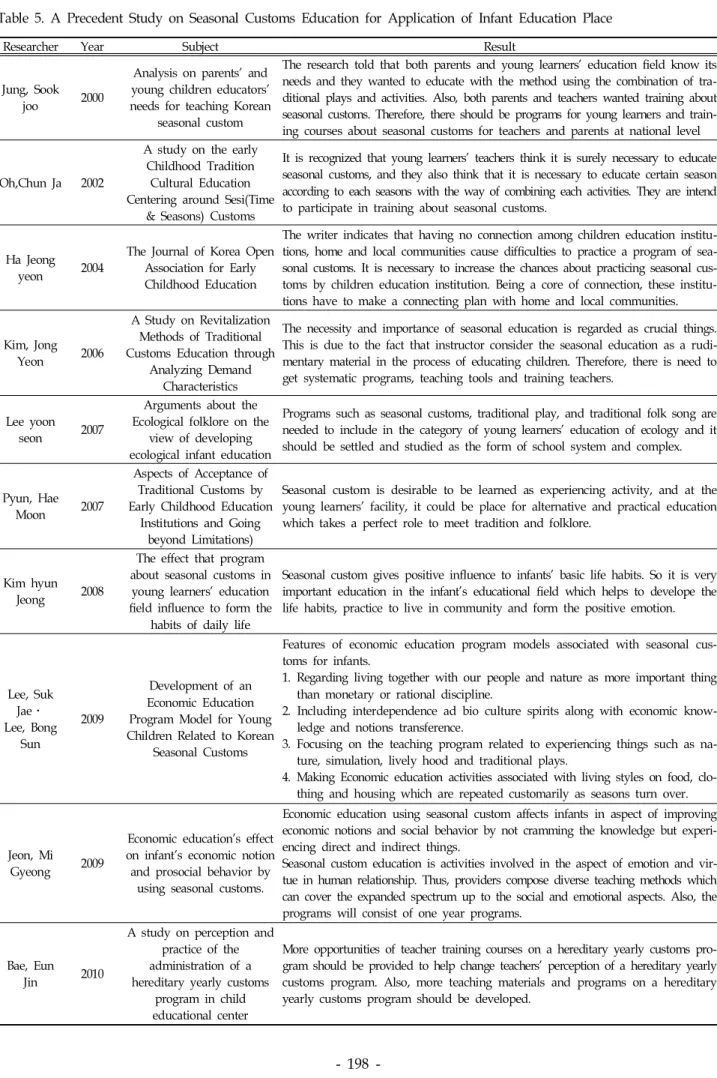
한편 유아교육현장에 세시풍속을 접목하고자 연구된 바 를 보면 <Table 5>와 같다.
이들 선행연구에 의하면, 세시풍속의 가치나 필요성에 대한 교 사들의 인식(Jung, 2000; Oh, 2002; Kim, 2006; Bae, 2010) 이 우선되어야 하고, 이를 실천하기 위한 프로그램마련(Pyun, 2007; Kim, 2008; Lee & Lee, 2009)이나, 가정과 지역사회의
연계방안(Jung, 2000; Ha, 2004) 등이 제시되었음을 볼 수 있 었다.
Ⅲ. 연구방법
1. 연구문제 및 연구 대상
본 연구에서는 보육교사들의 세시풍속에 대한 인식조사 를 토대로 하여 보육현장에서의 전통생화문화교육을 위한 기초 자료를 제공하고자 다음과 같은 구체적인 연구문제를 설정하였다
<연구문제 1> 보육교사들의 전통생활문화에 대한 인식은 어느 정도인가?
<연구문제 2> 보육교사들의 세시풍속에 대한 인식은 어느 정도인가?
<연구문제 3> 보육교사들의 전통생활문화와 세시풍속에 대 한 인식과 교육실행은 어떤 관계가 있는가?
조사대상자는 인천광역시에서 보육교사로 재직하고 있으며, 연수교육에 참여한 302명을 대상으로 1급 승급 교육 2010년 10월 9일, 2급 승급교육 11월 1일, 11월 20일의 3차에 걸쳐서 설문조사를 실시하였다.
2. 조사도구 및 자료분석
조사 도구는 문헌고찰(Ju & Kim, 2003; Kim, 2003; Choi, Lee & Lee, 2005)을 바탕으로 구성된 질문지로서 조사대상 자의 일반적 사항 5문항, 전통생활문화 및 세시풍속 교육기 초문항 7문항, 전통생활문화에 대한 인식 17개 문항, 세시풍 속에 대한 인식 12문항, 세시풍속 교육 실태 12개 문항으로 총 46문항으로 구성하였다. 전통생활문화에 대한 인식 문항 은 5점 리커트 척도로 구성되며, 세시풍속에 대한 인식문항 은 3점 리커트 척도로 구성하였다.
조사는 총 302명의 연수 참여자를 대상으로 실시하였고, 분석 자료는 15부의 부실 응답지를 제외한 287부를 활용하 였다. 본 연구에서 설정한 연구문제들을 검증하기 위하여 SPSS/win 17.0 이용하여 통계처리 하였다. 전통생활문화에 대한 인식을 보기위해 요인분석을 실시하였고, 전통생활문 화 및 세시풍속에 대한 인식에 대해 일반적 특성에 따른 차 이를 보기 위해 요인분석과 분산분석을 실시하였다. 이외 빈 도분석 및 기술통계량을 이용하여 연구 결과 도출을 하였다.
전통생활문화와 세시풍속 인식 및 교육실행은 상관관계로
분석하였다.
Variable Divide N %
Career education
less than 3years from4 to 6years from7 to 10years more than 11years
193 61 19 14
67.2 21.3 6.6 4.9
Academic career
high school graduate, complete the course of day care facility graduate from college
more than graduate from university
192 72 23
66.9 25.1 8.0
Religion
Christian Buddhism Catholicism Nonreligious, etc.
142 18 32 95
49.5 6.3 11.1 33.1
Working facility
public/corporations/work child care facility private child care facility
family day care center
21 169 97
7.3 58.9 33.8
Age
less than 25years from26 to 35years more than 36years
34 97 156
11.8 33.8 54.4
Table 6. General Properties of the Subject
Ⅳ. 결과 및 분석
1. 조사대상의 일반적 특성
본 연구의 응답자의 일반적 특성에 대해 살펴보면, 교육경 력은 ‘3년 이하‘ 67.2%, ’4~6년‘ 21.3%, ’7~10년‘ 6.6%, ’11년 이상‘ 4.9%로서 3년 이하의 비중이 높았으며, 학력은 ‘고등학 교 졸, 보육교사 교육원 수료’ 66.9%, ‘전문대학 졸업’ 25.1%,
‘대학 졸업’ 8.0% 로 과반수 이상이 고등학교 졸업 또는 교 육원 수료자들이었다.
종교는 ‘기독교’가 49.5%로 절반을 차지하고 있었고, ‘불교’
6.3%, ‘천주교’ 11.1%, ‘무교,기타’ 33.1%을 나타냈다. 재직의 경 우 민간 보육시설이 58.9%, 가정보육시설 33.8%, 국공립/법 인/직장보육시설 7.3% 순으로 나타났으며, 연령은 ‘25세이하’
11.8%, ‘26~35세이하’ 33.8%, ‘36세이상’ 54.4%였다.
전통생활문화 및 세시풍속 교육에 관한 견해를 <Table 7>
에 제시한 바를 볼 때, 세시풍속에서 가장 중요하게 다루어 야 할 내용으로 ‘문화체험’(76%)이 가장 높게 나타났고 다음 으로 ‘의미와 유래’(20.9%)로 나타났다.
세시풍속 교육을 하는 가장 중요한 이유로는 ‘전통생활문 화를 계승하고 발전시키기 위해’(50.9%)이 절반을 차지했고, 다 음으로 ‘우리민족의 주체성을 확립하기 위해’(30%), ‘우리 전통 생활문화의 우수성을 알리기 위해’(13.2%), ‘옛것을 알아 현대
와 비교하기위해’(5.6%) 순으로 나타났다. 그리고 세시풍속과 세시음식에 대한 관심도는 ‘매우 많다’(5.6%)와 ‘많다’(22.6%) 이 ‘없다’(2.8%)보다 높아 관심이 높은 편으로 나타났다.
유아들에게 가장 중요한 세시풍속 교육으로는 각 절기에 따른 ‘예의범절’(43.2%)이 가장 높게 나타났고, 다음으로 ‘전 통음식’(24.7%), ‘민속놀이’(22.6%), ‘민속행사’(8.7%)순으로 나타났다.
전통생활문화 및 세시풍속 교육 장소로는 ‘어린이집이나 유 치원’(43.9%)이 가장 높게 나타났고, 다음으로 ‘가정’(32.1%),
‘지역사회’(22.3%)순으로 나타났다. 한편 전통생활문화 및 세 시풍속 교육 을 할 때 가장 어려운 점으로 ‘어떻게 가르쳐야할 지 방법 모름’(30.3%), ‘교육 자료가 부족’(27.9%), ‘내용을 정확 히 알지 못함’(24.4%), ‘유아들이 흥미를 느끼지 못함’(13.9%) 순으로 높게 나타났다. 전통생활문화 및 세시풍속 교육 자료로 필요한 것은 ‘체험도구’(58.2%)가 가장 높게 나타났고 다음으 로 ‘영상자료’(24.7%), ‘사진과 그림 자료’(11.5%), ‘동요, 율동’
(5.2%) 순으로 나타났다. 이러한 결과는 전통생활문화나 세시
풍속 교육 내용과 방법에 대한 교사교육의 필요성과 교육자료
개발의 필요성을 시사하는 바라 하겠다. 특히 교육현장에서 교
사들에게는 유아의 체험과 시청각 교육을 위한 자료가 필요
함을 보여주는 결과이다. 이는 Choi, Lee and Lee(2005)의
선행연구에서 유아교사들은 전통문화교육을 중요하게 생각
하고 관심도가 높으며 효과적 교수매체를 필요로 한다는 연
구결과와 일치한다고 볼 수 있다.
Division N %
The most important thing at traditional life culture and
seasonal customs
culture experience meaning and origin the good things and scientific things
compare with other's custom etc.
218 60 1 7 1
76.0 20.9 0.3 2.4 0.3
The most important reason of traditional life culture and
seasonal customs
to develop traditional life culture to establish identity of our nation to inform superiority of our traditional life culture to compare with modern after knowing old things
etc.
146 86 38 16 1
50.9 30.0 13.2 5.6 0.3
interests about seasonal customs and food
the most a lot average
a few not at all
16 65 198 8 0
5.6 226 69.0 2.8 0
what is the most important thing in seasonal customs according to
season
traditional food of each season traditional festival of each season
traditional play of each season traditional manners according to each season
71 25 65 124
24.7 8.7 22.6 43.2
the suitable place at traditional life culture and seasonal customs
family kindergarten
community etc.
92 126 64 5
32.1 43.9 22.3 1.7
the most important thing when teaching traditional life culture
and seasonal customs
I don't know the exact contents the lack of educational resource
I don't know how to teach young learners aren't interested in
etc.
70 80 87 40 10
24.4 27.9 30.3 13.9 3.5
the most necessary thing as traditional life culture and seasonal custom's educational
resource
visual aid photographs and paintings
children's song, dance experience tool
etc.
71 33 15 167 1
24.7 11.5 5.2 58.2 0.3
Table 7. The View about Education of Traditional Life Culture and Seasonal Customs
2. 전통생활문화에 대한 인식
본 연구에 참여한 응답자들의 전통생활문화 인식에 대한 요인 구조를 파악하기 위하여 주성분 분석과 Varimax 회전 을 실시하였고 문항들 간의 내적 일관성을 알아보기 위하여 Cronbach's α를 구하였다.
그 결과, 요인적재량은 비교적 높게 나타났고, 타당성 검 증의 적정성을 보기 위해 변수간의 부분 상관계수 값이 작은 지를 검증하는 것으로 표본 추출 적합검증 척도인 KMO의 값은 0.797로 양호한 편이다. 요인분석 모형의 적합성을 나 타내는 Bartlett의 구형성 검정치는 유의확률이 0.000으로 타당성 검증에 이용한 변수들에 공통요인이 존재하는 것으 로 분석된다.
이러한 결과를 토대로 전통생활문화 인식에 대한 항목에
대해서 세 개의 요인으로 나누어지는 것을 볼 수 있으며 3개 의 요인으로 설명되는 총 변량은 46.01%로 나타났다. <Table 8>의 분석결과를 살펴보면 요인1은 전통생활문화에 대한 검 색, 관력 책 독서 및 공연 관람, 전통생활문화에 대한 관심과 참여의사 있는 내용을 포함하여 ‘지식 및 관심도’로, 요인2는 전통생활문화 계승 및 자긍심을 포함하여 ‘필요성’으로, 요인 3은 전통생활문화의 자신의 생활과 거리감, 경제적 가치창출 어려움 등 부정적 현실성에 대한 내용을 포함하여 ‘현실성’을 나타내는 요인으로 명명하였다.
<Table 9>에 제시한 전통생활문화에 대한 인식은 전체
3.28의 평균을 나타냈으며, 요인별로는 전통문화에 대한 필
요성이 3.7로 가장 인식이 높게 나타났고, 전통생활문화에
대한 현실성 3.57, 지식 및 관심도가 2.77로 평균 이하의 낮은
인식을 나타냈다. 이는 전통생활문화에 대하여 필요성을 많이
Generality Category M SD D F-Value
Career education
less than 3years from4 to 6years from7 to 10years more than 11years
3.25 3.33 3.20 3.55
.36 .38 .43 .44
B B B A
F=3.34*
Academic career
high school graduate, complete the course of day care facility graduate from college
more than graduate from university
3.26 3.32 3.34
.38 .35 .44
F=1.09
Religion
Christian Buddhism Catholicism Nonreligious, etc.
3.31 3.30 3.26 3.25
.39 .45 .39 .35
F=0.54
Working facility
public/corporations/work child care center private child care center
family day care centers
3.38 3.27 3.27
.39 .41 .32
F=0.73
Age
less than 25years from26 to 35years more than 36years
3.17 3.20 3.35
.35 .35 .39
B B A
F=6.01**
*p < .05, **p < .01
Table 10. Perception of Traditional Life Culture of General Properties
Factor Question Factor
loading Eigen value
Explained variance
(%)
Reliability (Cronbach's α)
factor1.
knowledge and interests
I search for traditional life culture on internet.
I read books about traditional life culture more than others.
I go to see the traditional life culture exhibition and the performance.
I'm interested in what is traditional life culture of the represent of Korea.
I have a well known knowledge of traditional life culture to introduce to foreigners.
As a young learner's teacher, I think that I'm interested in traditional life culture rather than other teacher.
I'll participated in the searching program for excavating the traditional life culture in community.
.399 .734 .710 .604 .566 .665
.489
2.86 16.8 .74
factor2.
necessity need
We should develop the Korean traditional life culture.
Endangered Korean traditional life culture is a pitiful situation.
It seems that there are a lot of unfound traditional life culture.
If I got a chance to opportunity to experience traditional life culture, I will join.
in Korea, we have something to be proud of in traditional life culture.
.594 .776 .677 .520 .655
2.74 16.1 .72
factor3.
reality
It is difficult to create financial value in traditional life culture.
Traditional life culture is far from my life.
It would be difficult to inherit the traditional life culture in our busy daily life.
Traditional life culture is just nostalgia of the past time.
Even if teaching traditional life culture to young learners, I'm not interested in.
.558 .515 .738 .721 .699
2.23 13.1 .67
KMO=0.797, Sphericity t-set statistics of Bartlett(χ2)=1080.37**
**p < .01, average of the entire satisfaction=3.28
Table 8. Analyze Factors of Recognition about Traditional Life Culture
Factor M SD Number of questions
knowledge and interests necessity need
reality totality
2.77 3.70 3.57 3.28
.45 .66 .50 .38
7 5 5 17
Table 9. Recognition for Traditional Life Culture
generality category
factor1 : knowledge and interest
factor2: necessity
need factor3: reality
M S.D D M S.D D M S.D D
Career education
less than 3years from4 to 6years from7to 10years more than 11years
2.74 2.84 2.74 2.97
.427 .505 .505 .416
3.66 3.78 3.61 4.03
.645 .705 .641 .697
3.57 3.55 3.44 3.89
.496 .484 .556 .525
Fstatistic F=1.78 F=1.88 F=2.312
Academic career
high school graduate, complete the course of day care facility
graduate from college more than graduate from university
2.75
2.80 2.86
.435
.480 .500
3.67
3.76 3.77
.661
.652 .724
3.56 3.61 3.57
.502
.516 .472
Fstatistic F=0.85 F=0.70 F=0.30
Religion
Christian Buddhism Catholicism Nonreligious, etc.
2.80 2.78 2.64 2.76
.454 .433 .511 .428
3.73 3.73 3.69 3.65
.657 .782 .689 .648
3.59 3.59 3.69 3.52
.513 .634 .422 .482
Fstatistic F=1.15 F=0.33 F=0.97
Working facility
public/corporations/work child care center private child care center
family day care centers
2.87 2.76 2.77
.411 .506 .348
3.89 3.71 3.64
.653 .675 .644
3.57 3.57 3.59
.549 .498 .503
Fstatistic F=0.58 F=1.19 F=0.08
Age
less than 25years from26 to 35years more than 36years
2.65 2.72 2.83
.539 .397 .457
B AB
A 3.69 3.59 3.76
.625 .651 .675
3.39 3.49 3.67
.525 .480 .494
B B A
Fstatistic F=3.06* F=1.98 F=6.41**
*p < .05, **p < .01
Table 11. Recognition Factors of Traditional Life Culture of General Properties
느끼는 반면 그에 대한 지식 및 관심은 높지 않아 인식과 현 실적 실행에 대한 차이가 발생함을 유추해볼 수 있다. 이는 Choi, Lee and Lee(2005)연구에서 전통문화교육의 필요성 과 관심도가 높게 나타났으나, 전통문화교육에 대해서는 잘 알지 못해 자신감이 없으며, 이에 대해 배울 기회가 없어서 라고 한 결과와 유사하다.
일반적 특성에 따라 전통생활문화 인식에 차이가 있는지를 알아보기 위하여 일원변량분석과 사후 분석으로 Duncan's test를 실시한 결과는 <Table 10, 11>에 제시한 바와 같다.
전통생활문화에 대한 전반적인 인식은 일반적 특성에 따라 서는 교육경력(p<.05)과 연령(p<.01)에 따라서 차이를 나타냈 다. 교육 경력이 ‘11년이상(3.55)’이 높게 나타났으며, 연령은
‘36세이상(3.35)‘이 다른 연령대보다 높게 나타났다. 전통생활 문화에 대한 인식을 3개의 요인별로 각각 분석한 결과에서는 지식 및 관심도(요인1)(p<.05) 및 현실성(요인3)(p<.01)에 대 해서는 일반적 특성 중 연령에서 각각 ‘36세이상(요인1:2.83, 요인3:3.67)‘이 ’25세(요인1:2.65,요인3:3.39)‘보다 통계적으로
유의하게 높은 인식을 나타냈다. 기타 교육경력이나 학력, 종교, 재직시설에 따라서는 차이가 없었다
3. 세시풍속에 대한 인식
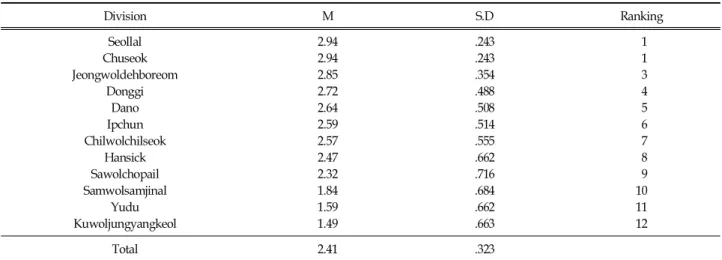
<Table 12>에 제시한 세시풍속에 대한 인식은 전체 평균 이 2점을 상회하여 2.41로 나타났다. 그 내용을 순위별로 구 체적으로 보면 설날(2.94)과 추석(2.94)이 가장 높게 나타났고, 이외 정월대보름(2.85), 동지(2.72), 단오(2.64), 입춘(2.59), 칠 월(2.57), 한식(2.47), 사월 초파일(2.32) 순으로 나타났다.
일반적 특성에 따라 세시풍속에 대한 인식에 차이가 있는지 를 알아보기 위하여 일원변량분석과 사후 분석으로 Duncan's test를 시시한 결과는 <Table 13>과 같다.
세시풍속에 대한 인식은 연령, 재직 시설에 따라 차이를
보였는데, 연령의 경우 추석(36세이상:2.97, 25세이하:2.88),
동지(36세이상:2.79, 25세이하:2.56), 입춘(36세이상:2.67, 25세
이하:2.35), 한식(36세이상:2.58, 25세이하:2.26), 사월 초파일
General propert
ies
Category
Stan dard devi ation
Seollal Chu- seok
Jeongw oldeh boreom
Donggi Dano Ipchun Chil wolchil
seok Han sick
Sawolc hopail
Samwo lsam
jinal Yudu
Kuwolj ungyan gkeol
Career educati
on
less than 3years M 2.93 2.94 2.85 2.74 2.66 2.61 2.58 2.48 2.27 1.87 1.62 1.52
from4 to 6years M 2.95 2.93 2.84 2.70 2.54 2.48 2.57 2.43 2.39 1.90 1.54 1.43
from7to 10years M 2.95 2.89 2.89 2.68 2.79 2.68 2.53 2.53 2.47 1.74 1.53 1.32
more than 11years M 3.00 2.93 2.93 2.50 2.64 2.64 2.57 2.50 2.50 1.43 1.50 1.50
F-Value .49 .24 .35 1.12 1.46 1.39 .05 .149 1.12 2.11 .40 .79
Acade mic career
high school graduate, complete the course of day care facility
M 2.94 2.94 2.85 2.73 2.65 2.61 2.56 2.49 2.34 1.86 1.59 1.51
graduate from college M 2.92 2.92 2.83 2.67 2.60 2.49 2.57 2.42 2.25 1.79 1.56 1.46
more than graduate
from university M 3.00 3.00 2.91 2.74 2.74 2.70 2.70 2.48 2.39 1.83 1.70 1.39
F-Value 1.03 1.03 .44 .53 .73 2.20 .59 .32 .52 .30 .39 .43
Reli- gion
Christian M 2.94 2.92 2.84 2.71 2.56 2.57 2.54 2.39 2.32 1.84 1.61 1.44
Buddhism M 3.00 2.94 2.89 2.72 2.72 2.72 2.61 2.61 2.61 2.00 1.61 1.89
Catholicism M 2.91 2.94 2.78 2.69 2.66 2.59 2.63 2.59 2.34 1.97 1.66 1.50
Nonreligious, etc. M 2.94 2.96 2.89 2.74 2.76 2.59 2.61 2.52 2.25 1.78 1.55 1.47
F-Value .57 .41 1.02 .10 3.23 .46 .48 1.42 1.29 .96 .27 2.46
Wor- king facility
public/corporations/
work child care center M 2.90 2.90 2.86 2.76 2.62 2.52 2.71 2.43 2.05B 1.95 1.76 1.71A private child care center M 2.94 2.92 2.83 2.70 2.63 2.54 2.56 2.46 2.27AB 1.83 1.58 1.53AB family day care centers M 2.94 2.97 2.89 2.74 2.68 2.68 2.57 2.49 2.46A 1.84 1.58 1.37B
F-Value .21 1.31 .67 .34 .37 2.36 .72 .12 3.94* .29 .74 3.06*
Age
less than 25years M 2.94 2.88B 2.82 2.56B 2.56 2.35B 2.74 2.26B 1.82C 1.79 1.62 1.59 from26 to 35years M 2.92 2.90AB 2.82 2.65AB 2.62 2.55A 2.57 2.37AB 2.16B 1.80 1.52 1.45 more than 36years M 2.95 2.97A 2.88 2.79A 2.68 2.67A 2.54 2.58A 2.53A 1.88 1.63 1.49
F-Value .50 4.12* .82 4.82** .98 5.90** 1.67 4.87** 19.0** .45 .10 .52
*p < .05, **p < .01
Table 13. Perception of Seasonal Customs of General Properties
Division M S.D Ranking
Seollal Chuseok Jeongwoldehboreom
Donggi Dano Ipchun Chilwolchilseok
Hansick Sawolchopail Samwolsamjinal
Yudu Kuwoljungyangkeol
2.94 2.94 2.85 2.72 2.64 2.59 2.57 2.47 2.32 1.84 1.59 1.49
.243 .243 .354 .488 .508 .514 .555 .662 .716 .684 .662 .663
1 1 3 4 5 6 7 8 9 10 11 12
Total 2.41 .323
Table 12. Recognition of Seasonal Customs
seasonal customs Things that is already taught to infants Things to teach
frequency ratio ranking frequency ratio ranking
Seollal Jeongwoldehboreom
Ipchun Samwol Samjinal
Hansick Sawolchopail
Dano Yudu Chilwolchilseok
Chuseok Jungyangjeol
Donggi
241 142 48 12 53 40 102 15 66 234 15 101
84.0%
49.5%
16.7%
4.2%
18.5%
13.9%
35.5%
5.2%
23.0%
81.5%
5.2%
35.2%
1 3
4
2
5
248 135 121 106 109 87 132 99 92 242 90 114
86.4%
47.0%
42.2%
36.9%
38.0%
30.3%
43.6%
34.5%
32.1%
84.3%
31.4%
39.7%
1 3 5 8 7 12 4 9 10 2 11 6 When each respondent's ratio is over 30 percent. It gives the ranking.
Table 14. Infant's Teacher's Education Realities about Seasonal Customs
seasonal customs
recognition of seasonal customs
and things that being taught
recognition of seasonal customs
and things to teach
The whole recognition of traditional life
culture
recognition of traditional life
culture (knowledge/interest)
recognition of traditional life
culture (necessity need)
recognition of traditional life
culture (reality) Seollal
Jeongwoldehboreom Ipchun Samwol Samjinal
Hansick Sawolchopail
Dano Yudu Chilwolchilseok
Chuseok Jungyangjeol
Donggi
.005 .193 .141 .175 .205 .242 .248 .097 .255 .099 .134 .247
**
*
**
**
**
**
**
*
**
.001 -.173 -.020 -.015 -.057 -.084 -.056 -.051 -.079 .001 -.022 -.202
**
**
.106 .163 .137 .084 .195 .214 .244 .077 .181 .166 .041 .256
**
*
**
**
**
**
**
**
.146 .251 .230 .216 .287 .260 .315 .209 .250 .218 .240 .291
*
**
**
**
**
**
**
**
**
**
**
**
.025 -.007 .016 -.009 .054 .088 .094 -.006 .114 .030 -.019 .149*
.056 .113 .041 -.042 .069 .106 .108 -.058 .002 .113 -.173 .097
**
*p < .05, **p < .01