Pandemic Influenza (H1N1) and
Mycobacterium tuberculosis Co-infection
Yehyun Park, M.D., Bum Sik Chin, M.D., Ph.D., Sang Hoon Han, M.D., Ph.D., Yujung Yun, M.D., Young Ju Kim, M.D., Jun Yong Choi, M.D., Ph.D., Chang Oh Kim, M.D., Ph.D., Young Goo Song, M.D., Ph.D. and June Myung Kim, M.D., Ph.D.
Division of Infectious Diseases, Department of Internal Medicine, Yonsei University College of Medicine, Seoul, Korea
We hereby observe four co-infection cases of pandemic influenza H1N1 and Mycobacterium tuberculosis with various clinical presentations. It may be prudent to consider M. tuberculosis co-infections when patients with pandemic influenza reveal unusual clinical features that do not improve despite appropriate treatments against the influenza, especially in Korea, in the endemic areas of M. tuberculosis.
Keywords: Influenza A Virus, H1N1 Subtype; Mycobacterium tuberculosis; Coinfection
of MTB has been suggested with pH1N1 influenza infection, and tuberculosis was suggested as a possible risk factor as- sociated with fatal pH1N1 influenza infection
8. However, there have been few reports about co-infection of pH1N1 and MTB, and thus we describe four patients who were infected with pH1N1 as well as being confirmed with active MTB infections.
Case Reports
1. Case 1
A previously healthy 20-year-old woman was admitted on December, 2009 because of abdominal pain, fever and 10 kg of weight loss during the previous two months. The physical examination upon admission revealed a high body tempera- ture (39.3
oC). Laboratory findings were as follows: white blood cells (WBC), 4,110/mm
3; neutrophils, 76.4%; lymphocytes, 480/mm
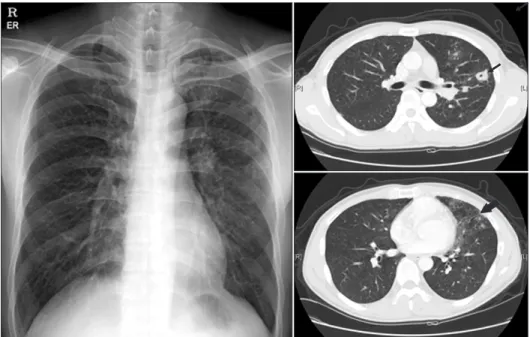
3(11.7%); hemoglobin, 10.2 g/dL; C-reactive protein (CRP), 34.9 mg/L; and erythrocyte sedimentation rate, 62 mm/hr, and a stool occult blood test was positive. A chest X-ray showed granular opacity in the bilateral apical area.
Repetitive sputum acid fast bacilli (AFB) fluorescent smear studies were negative. A computed tomographic (CT) scan of the abdomen and pelvis revealed diffuse swelling of the liver, gallbladder, distal small bowel and ascending colon. Consider- ing the influenza pandemic period and opacities in the chest X-ray, a reverse transcriptase polymerase chain reaction (RT- PCR) for pH1N1 via nasopharyngeal swab specimen was per- Copyright © 2014
The Korean Academy of Tuberculosis and Respiratory Diseases.
All rights reserved.
Introduction
Pandemic H1N1 2009 influenza (pH1N1) first appeared in March 2009 in Mexico. It rapidly spread worldwide, and a pandemic was declared by the World Health Organization in June 2009
1. Both Mycobacterium tuberculosis (MTB) and in- fluenza have been known to impair immune responses such as host T-cell immunologic reactions
2,3. Therefore, influenza may promote the emergence of active tuberculosis in persons with latent tuberculosis infections
4, and persons with tubercu- losis may be vulnerable to influenza infections
2,5. In addition, increased mortality by MTB has been observed during influ- enza pandemics
6,7.
As with other pandemic influenza strains, an additive effect
CASE REPORT
http://dx.doi.org/10.4046/trd.2014.76.2.84ISSN: 1738-3536(Print)/2005-6184(Online) • Tuberc Respir Dis 2014;76:84-87
84
Address for correspondence: Sang Hoon Han, M.D, Ph.D.
Department of Internal Medicine, Yonsei University College of Medicine, 50 Yonsei-ro, Seodaemun-gu, Seoul 120-752, Korea
Phone: 82-2-2228-1991, Fax: 82-2-393-6884 E-mail: [email protected]
Received: Aug. 31, 2013 Revised: Sep. 27, 2013 Accepted: Oct. 14, 2013
cc