Digital Infrared Thermal Imaging에 따른 수족냉증 중증도와 Heart Rate Variability의 상관관계 연구
1 경희대학교 대학원 임상한의학과, 2 경희대학교 한의과대학 한방부인과교실 우혜린 1 , 박연경 1 , 김준호 1 , 박경선 2 , 황덕상 2 , 이진무 2 , 장준복 2 , 이창훈 2
ABSTRACT
Study on the Correlation between Digital Infrared Thermal Imaging-induced Severity of Cold Hypersensitivity of Hands and Feet and Heart Rate Variability
Hye-Lin Woo 1 , Yeon-Kyeong Pak 1 , Joon-Ho Kim 1 , Kyoung-Sun Park 2 , Deok-Sang Hwang 2 , Jin-Moo Lee 2 , Jun-Bock Jang 2 , Chang-Hoon Lee 2
1 Dept. of Clinical Korean Medicine, Graduate School, Kyung-Hee University
2 Dept. of Korean Medicine Gynecology, College of Korean Medicine, Kyung-Hee University
Objectives: Cold Hypersensitivity of Hands and Feet (CHHF) has been diagnosed objectively by Digital Infrared Thermal Imaging (DITI) and has been known to be associated with autonomic nervous system (ANS), which can be assessed by Heart Rate Variability (HRV). This study evaluated the correlation between severity of CHHF and HRV variables.
Methods: We studied 155 non-menopausal women with CHHF who visited Kyung Hee University Hospital at Gangdong from 01 October 2013 to 30 April 2016. We measured DITI and HRV of each patient. We used DITI to calculate the severity of CHHF with thermal difference between upper arm (L4, 俠白穴) and palm (P8, 勞宮穴) of both hands and anterior thigh (ST32, 伏兎穴) and dorsum of foot (LI3, 太衝穴) of both feet. The correlation between severity of CHHF and HRV variables were analyzed.
Results: In time domain analysis, there was significantly positive correlation between the severity of CHHF and both SDNN and RMSSD. In frequency domain analysis, there was significantly positive correlation between the severity of CHHF and TP, HF and HF Norm while there was significantly negative correlation between the severity of CHHF and LF Norm as well as between the severity of cold hypersensitivity of both hands and LF/HF ratio.
Conclusions: The more severe CHHF is, the more increased the function of parasympathetic nerve system (PNS) and relatively decreased the function of sympathetic nerve system (SNS) is. Also, it has known that cold hypersensitivity could be caused by deficiency syndrome and qi deficiency has the same ANS tendency as CHHF. Therefore, in practical fields, this result can be helpful in planning treatment and deciding prognosis in respect of deficiency syndrome.
Key Words: Severity of Cold Hypersensitivity of Hands and Feet, Digital Infrared Thermal Imaging, Heart Rate Variability, Autonomic Nervous System
1)
Corresponding author(Chang-Hoon Lee) : Dept. of Korean Medicine Obstetrics and Gynecology, Kyung-Hee University Hospital at Gangdong, Dongnam St 892, Gangdong-gu, Seoul, Korea
Tel : 02-440-6197 E-mail : [email protected]
Ⅰ. 서 론
냉증이란 의학적으로 ‘냉각과민증(cold hypersensitivity)’이라 하고, ‘일반적으로 냉감을 느끼지 않을만한 온도에서 신체 전반 혹은 특정 부위에서 냉감을 느끼는 경우’라고 정의한다. 이 중 수족냉증은 신체의 다른 부위가 냉감을 느끼지 않는 온도에서 손과 발의 냉감을 느끼는 증상을 의미하며, 한의학적으로는 手足厥冷, 手 足逆冷이나 手足厥寒 등으로 표현된다 1) . 수족냉증은 환자의 주관적인 증상으로, 이에 대한 진단과 평가를 객관화하기 위한 여러 시도가 있어왔다. 그 결과 국내에서 는 주로 적외선 체열촬영(Digital Infrared Thermal Imaging, 이하 DITI) 2) 이나 적외 선 온도계(이하 thermometer) 3) 등을 이 용한 체표온도 측정이 객관적 평가도구 로 다용되고 있다.
현대의학에서는 냉증을 자율신경계 기능 실조로 나타나는 혈관운동 변조로 인한 전신적 순환장애로 보고 있다 4) . 자율신경계 기능은 심박변이도(Heart Rate Variability, 이하 HRV)에 영향을 주기 때문에 5) , 체온 조절 측면에서 자율신경계의 영향을 받는 수족냉증 환자는 HRV 검사를 통해 그 기능을 평가할 수 있다.
수족냉증 환자의 HRV에 관한 연구로 박 등 6) 은 수족냉증 환자와 정상인의 HRV 를 비교하였고, 남 등 7) 은 수부냉증의 중 증도와 HRV 지표의 상관관계를 분석하 였다. 하지만 남 등 7) 의 연구는 수족 모 두가 아닌 수부냉증을 호소하는 환자만을 대상으로 하였고, 연구대상자에서 체온 분포와 HRV 지표에서 폐경 이전의 여성 과 차이를 보이는 폐경 후 여성 8,9) 을 배제
하지 않았으며, 연구대상자의 수가 적어 통계적으로 유의한 결과를 도출해내는 데에 한계가 있었다 10) . 이에 저자는 수족 냉증을 모두 호소하는 환자 중 폐경을 하 지 않은 여성을 대상으로 DITI와 HRV 검사를 통해 수족냉증의 중증도와 자율 신경계 기능을 평가하고 그 상관관계를 분석하여 유의한 결과를 얻었기에 보고 하는 바이다.
Ⅱ. 방 법
1. 연구 대상
2013년 10월 1일부터 2016년 4월 30일 까지 강동경희대학교한방병원 여성건강 클리닉 외래에 내원하여 수족냉증을 호 소하는 환자 중 폐경을 하지 않은 여성 155명을 대상으로 DITI와 HRV 검사를 시행하였다.
연구 대상자 선정시 전신 냉감 혹은 수부나 족부 중 한 부위만의 냉감을 호 소하거나 수족부위의 냉감과 열감을 번 갈아 느끼는 경우는 제외하였고, 수족냉 증에 영향을 줄 수 있는 수술력이나 암 과 거력, 갑상선질환 과거력, 고혈압 이외의 심장질환 과거력이 있는 경우 역시 제외 하였다.
2. 방 법 1) DITI
수족냉증의 중증도를 판단하기 위하여
DITI를 시행하였다. DITI는 체열촬영 결
과의 표준화를 위하여 외부의 빛과 열이
차단되어 실내기류가 일정하며, 온도 25~26℃,
습도 40~50%를 유지하도록 한 검사실에
서 환자를 전신 탈의한 상태로 약 10분 간
주위온도에 적응시킨 후 시행하였다. 촬 영기는 IRCT-510(동서코퍼레이션 Inc., KOR)를 이용하였고, 양측의 전상완중심 부(LU4, 俠白穴), 수장부위(PC8, 勞宮穴), 전대퇴중심부(ST32, 伏兎穴), 족배부전면 (LI3, 太衝穴)의 온도를 측정하였다.
수부냉증의 중증도는 우측 전상완중심 부와 수장부위의 온도차(ΔT 1 ), 좌측 전 상완중심부와 수장부위의 온도차(ΔT 2 )로, 족부냉증의 중증도는 우측 전대퇴중심부 와 족배부전면의 온도차(ΔT 3 ), 좌측 전대 퇴중심부와 족배부전면의 온도차(ΔT 4 )로 산출하였다 2) .
2) HRV 검사
수족냉증에 대한 자율신경계의 영향을 평가하기 위하여 HRV검사를 시행하였다.
측정기기는 SA-3000P(Medicore Co., Ltd, Korea)를 사용하였으며, 18~23℃의 조명 이 밝고 조용한 방에서 검사를 실시하였 다. HRV의 측정은 환자를 침대에 앙와 위로 누운 상태로 안정이 되기를 기다린 후 각각 좌우 손목의 요골동맥과 발목의 종아리동맥 박동처부위에 전극을 부착한 채로 5분간 시행되었다. 5분간의 심박변 동을 측정한 후 시간영역 분석을 통해 Standard deviation of the NN interval (SDNN), The square root of the mean squared differences of successive NN intervals(RMSSD)의 지표를 산출하였으 며, 주파수영역 분석을 통해 Total Power (TP), Very Low Frequency(VLF), Low Frequency(LF), High Frequency(HF), Normalized LF(LF Norm), Normalized HF(HF Norm), LF/HF ratio의 지표를 산출하였다.
3. 통계 분석
통계 분석은 SPSS for Windows(version 23.0)를 이용하였으며, 수족냉증의 중증도 와 HRV 지표와의 상관관계 분석은 Pearson's correlation coefficient를 사용하였다. 각 분 석 결과는 p<0.05인 경우 통계적으로 유의 한 것으로 판단하였다.
Ⅲ. 결 과
1. 연구대상자들의 일반적 특성
연구 대상자 155명의 연령분포는 만 14 세부터 53세까지였으며, 평균 연령은 31.80±
7.18세, 평균 신장은 161.24±4.76 cm, 평균 체중은 54.07±6.80 kg, 평균 체질량지수(Body Mass Index, 이하 BMI)는 20.79±2.40 kg/m 2 이었다(Table 1).
Minimum Maximum Mean
±S.D.
Age
(year) 14 53 31.80
±7.18 Height
(cm) 146.0 173.8 161.24
±4.76 Body weight
(kg) 40.0 75.0 54.07
±6.80 BMI
(kg/m 2 ) 15.9 28.6 20.79
±2.40 Table 1. General Characteristics of Subjects
2. 연구대상자들의 HRV 변수 특성 연구대상자 155명의 평균 SDNN은 43.390±
19.436, 평균 RMSSD는 39.745±23.703이 었고, 평균 TP는 1658.856±1588.733, 평균 LF는 434.338±592.049, 평균 HF는 525.014±
660.395, 평균 LF/HF ratio는 1.428±2.373
이었다(Table 2).
Minimum Maximum Mean±SD Time domain
variables
SDNN 9.595 120.121 43.390±19.436 RMSSD 6.897 124.976 39.745±23.703
Frequency domain variables
TP 35.090 9259.386 1658.856±1588.733 VLF 21.295 6089.056 699.612±754.187
LF 17.979 3670.129 434.338±592.049 HF 8.337 4215.478 525.014±660.395 LF Norm 9.960 96.445 47.571±19.418 HF Norm 3.555 90.040 52.429±19.418 LF/HF Ratio 0.111 27.128 1.428±2.373
SDNN : standard deviation of normal-to-normal interval, RMSSD : the square root of the mean squared differences of successive NN intervals, TP : total power, VLF : very low frequency, LF : low frequency, HF : high frequency, LF Norm : normalized low frequency, HF Norm : normalized high frequencyTable 2. HRV Variable Characteristics of Subjects
3. 수족냉증 중증도와 시간영역 분석지 표의 상관관계 분석
시간영역 분석지표에서 수족냉증의 중 증도와 SDNN, RMSSD의 상관관계를
분석한 결과, 수족냉증 중증도와 SDNN, RMSSD는 통계적으로 유의한 양의 상관 관계가 있었다(Table 3).
ΔT 1 ΔT 2 ΔT 3 ΔT 4
SDNN Correlation coefficient 0.295 0.280 0.211 0.197 P-value 0.000** 0.000** 0.008** 0.014*
RMSSD Correlation coefficient 0.362 0.342 0.235 0.216 P-value 0.000** 0.000** 0.003** 0.007**
ΔT
1
: thermal difference between right upper arm and palm, ΔT2
: thermal difference between left upper arm and palm, ΔT3
: thermal difference between right anterior thigh and dorsum of foot, ΔT4
: thermal difference between left anterior thigh and dorsum of foot, SDNN : standard deviation of normal-to-normal interval, RMSSD : the square root of the mean squared differences of successive NN intervalsP-value was considered statistically significant by Pearson's correlation coefficient (* : p<0.05
** : p<0.01).
Table 3. Correlation between Time Domain Variables and Severity of Cold Hypersensitivity of Hands and Feet
4. 수족냉증 중증도와 주파수영역 분석 지표의 상관관계 분석
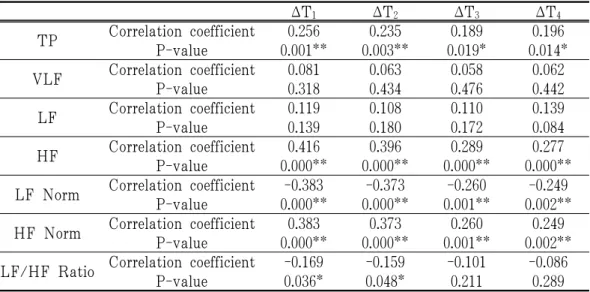
주파수영역 분석지표에서 TP, VLF, LF, HF, LF Norm, HF Norm, LF/HF ratio 를 분석한 결과, 수족냉증 중증도와 TP, HF, HF Norm은 통계적으로 유의한 양의
상관관계가 있었고, LF Norm은 통계적으
로 유의한 음의 상관관계가 있었다. LF/HF
ratio는 양측 수부냉증의 중증도와 통계
적으로 유의한 음의 상관관계가 있었으
나, 양측 족부냉증의 중증도와는 유의한
상관관계가 나타나지 않았다(Table 4).
ΔT 1 ΔT 2 ΔT 3 ΔT 4
TP Correlation coefficient 0.256 0.235 0.189 0.196 P-value 0.001** 0.003** 0.019* 0.014*
VLF Correlation coefficient 0.081 0.063 0.058 0.062 P-value 0.318 0.434 0.476 0.442 LF Correlation coefficient 0.119 0.108 0.110 0.139 P-value 0.139 0.180 0.172 0.084 HF Correlation coefficient 0.416 0.396 0.289 0.277 P-value 0.000** 0.000** 0.000** 0.000**
LF Norm Correlation coefficient -0.383 -0.373 -0.260 -0.249 P-value 0.000** 0.000** 0.001** 0.002**
HF Norm Correlation coefficient 0.383 0.373 0.260 0.249 P-value 0.000** 0.000** 0.001** 0.002**
LF/HF Ratio Correlation coefficient -0.169 -0.159 -0.101 -0.086 P-value 0.036* 0.048* 0.211 0.289
ΔT1
: thermal difference between right upper arm and palm, ΔT2
: thermal difference between left upper arm and palm, ΔT3
: thermal difference between right anterior thigh and dorsum of foot, ΔT4
: thermal difference between left anterior thigh and dorsum of foot, TP : total power, VLF : very low frequency, LF : low frequency, HF : high frequency, LF Norm : normalized low frequency, HF Norm : normalized high frequencyP-value was considered statistically significant by Pearson's correlation coefficient (* : p<0.05
** : p<0.01).