• 검색 결과가 없습니다.

Hydration Analysis of Fine Particle and Old Mortar Attached on the Surface of Recycled Aggregate

N/A
N/A
Protected

Academic year: 2021

Share "Hydration Analysis of Fine Particle and Old Mortar Attached on the Surface of Recycled Aggregate"

Copied!
8
0
0

로드 중.... (전체 텍스트 보기)

전체 글

(1)

Journal of the Korea Institute of Building Construction, Vol. 12, No. 5

http://dx.doi.org/10.5345/JKIBC.2012.12.5.460 www.jkibc.org

Hydration Analysis of Fine Particle and Old Mortar Attached on the Surface of Recycled Aggregate

Ko, Dong-Woo Choi, Hee-Bok

*

Department of Architectural Engineering, Jeju National University, Jeju-si, Jeju-do, Korea

1)

Abstract

When recycled aggregate with old mortar and particles is used in concrete mixing, such aggregates can affect hydration reaction by promoting or inhibiting it. In this study, the possibility of hydration reaction on old mortar and particle was analyzed. Hydration reaction was carried out in old mortar that is finely crushed by an impact machine in the production of recycled aggregates, and it was found that this did have an impact on the strength development of concrete. Unlike in old cement, the hydration reaction did not progress in the particles, and it had high amounts of silica powder and calcium carbonate. In conclusion, the old mortar can have the influence of improving compressive strength, but the particles can delay the setting time of recycled aggregate concrete.

Keywords : recycled aggregate, old mortar, fine grained, hydration, differential scanning calorimetry

1. Introduction

1.1 Research objective and background

The recycled aggregate generated using a strike-back type jaw crusher has old mortar on the surface, although it differs in terms of the volume and the area attached of mortar, depending on its characteristics. The sizes of cement particles usually range from 5㎛ to 55㎛, and the depth of cement particles hydrated for about 1 year stands at around 9㎛[1]. Since the hydration reaction thickness of cement is about 25㎛, there might be an interior core of unhydrated cement even though the cement appears as though it has already hydrated[2].

When produced in the strike-back type, the recycled aggregate leaves a lot of fine particles on

Received : October 17, 2011

Revision received : February 6, 2012 Accepted : February 25, 2012

* Corresponding author : Choi, Hee-Bok

[Tel: 82-64-754-3731, E-mail: [email protected]]

ⓒ2012 The Korea Institute of Building Construction, All rights reserved.

the surface after hydration due to some wear of cement caused by abrasion between aggregates in the course of production or impact, causing the unhydrated cement to expose externally. The unhydrated cement particles exposed like this could initiate a hydration reaction with water, for which the possibility of recycling it as recycled cement has actively been studied[3,4]. According to the aforementioned studies, the unhydrated cement particles attached to recycled aggregate could initiate a hydration reaction, which could have an influence on the strength of concrete by increasing the unit volume of cement.

This study aims to analyze the possibility of hydration of old mortar and fine particles using differential scanning calorimetry (DSC) developed by Sha et al.[5] to understand the influence on changes in strength of recycled concrete.

2. XRD and DSC experiment plan and method

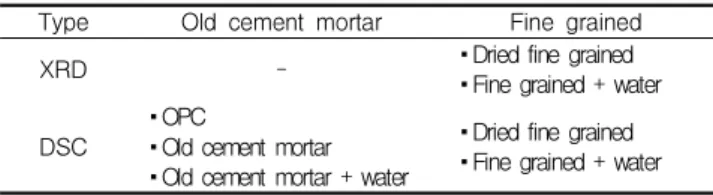
To analyze hydration and component of old mortar

(2)

the specimen was prepared as indicated in Table 1.

Type Old cement mortar Fine grained

XRD - ▪Dried fine grained

▪Fine grained + water

DSC ▪OPC

▪Old cement mortar

▪Old cement mortar + water

▪Dried fine grained

▪Fine grained + water Table 1. Specimens for XRD and DSC analysis

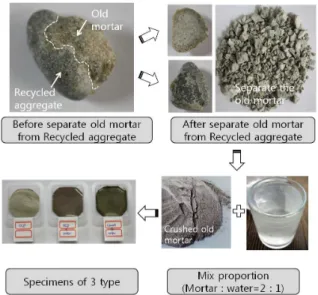
2.1 Manufacturing of specimen for XRD analysis Figure 1 indicates the manufacturing process of the specimen for the analysis of fine particles from recycled aggregate. Ultrasonic cleaning was done for 1 hour at 80℃ to separate the loose particles from the surface of recycled aggregate. Kerosene was used as cleaning solution to control the initial reaction between fine particles and water. The fine particles on the floor of the cleaning machine were dried at 100℃after the cleaning, and then filtered out using a 100 micron test sieve. XRD of the fine particles gathered through the 100 micron test sieve were analyzed before and after hydration reaction (at 28 days).

Figure 1. Specimen for XRD analysis of fine grained

2.2 Differential Scanning Calorimetry (DSC)

Ordinary Portland cement consists of four main components that can react with water: C3S, C2S, C3A, and C4AF. C3S and C2S are reacted with water, generating calcium silicate hydrate (C-S-H) and CH. Therefore, if there is still hydration

the four components mentioned above will be formed, leading to thermal changes by heat absorption or heat generation.

Thermal analysis is a means of testing changes in physical and chemical characteristics such as weight, changes of enthalpy or heat content, which are recorded in a heat or time function. Depending on the parameter to be measured, thermal analysis can be performed through one of the following methods:

differential thermal analysis (DTA), thermogravimetric analysis (TGA), and differential scanning calorimetry (DSC), which has generally been used to measure cement hydration products [6,7,8].

In this research, differential scanning calorimetry (DSC), in wide use for studies on the properties of material, was used due to its capacity for rapid, high-precision analysis of changes in the heat of material. In the analysis of a high molecule substance, crystallization temperature (Tc), melting temperature (Tm) and glass transition temperature (Tg) are indicated. Therefore, DSC, which can measure changes in thermal energy according to temperature change, is widely used in studying high molecular substances, and offers the advantage of allowing researchers to obtain accurate analysis results quickly. More detailed information can be found in the studies done by Murakami et al.[9] and Chou and Bhadeshia[10].

2.3 Manufacture of specimen for DSC analysis

2.3.1 Old mortar specimen for DSC analysis

The old mortar specimen for thermal analysis

shown in Figure 2 was detached from the surface of

recycled aggregate and then crushed. However, as

the fine particles, the main material for recycled

cement, usually obtained from the cement component,

CaO and SiO

2

are the main components. CaO was

(3)

Journal of the Korea Institute of Building Construction, Vol. 12, No. 5

http://dx.doi.org/10.5345/JKIBC.2012.12.5.460 www.jkibc.org largely decreasing while SiO

2

was doubled when

mortar or waste concrete was used as the basic material. This is because a lot of fine particles of aggregate are included in the process of manufacturing recycled cement[4,11].

First of all, if the recycled aggregate is crushed and included by impact when the old mortar from the recycled aggregate is crushed, it is possible for fine particles of the aggregate to affect thermal analysis. For this reason, the old mortar from the aggregate was crushed coarsely and filtered through a 300 micron test sieve to separate the aggregate.

Next, the old mortar sifted was crushed finely again using a ball, andsifted through a 150 micron test sieve to use old mortar only. The old mortar sifted through the 150 micron test sieve was mixed with water in the weight ratio of 1:0.5, and then cured for 7 days and 14 days to conduct a thermal analysis.

The specimen was prepared in three types: new cement paste consisting of ordinary Portland cement was mixed with water, old mortar separated from recycled aggregate, and old cement paste hydrated by adding water to old mortar separated from recycled aggregate.

Figure 2. Specimens for DSC analysis

2.3.2 Fine particle specimen for DSC analysis The fine particle specimen on the surface of the recycled aggregate for a thermal analysis was prepared in two types, as shown in Figure 3: dried fine particles and fine particle paste. The fine particle paste was prepared by mixing dried fine particles with water in the weight ratio of 1:0.5.

The thermal analysis of the specimen was performed at 14 days.

Figure 3. Specimen for DSC analysis of fine grained 2.4 DSC Test Method

2.4.1 DSC test method

The test rig used in this test was SDT Q 600DSC instrument, a simultaneous TGA/DSC analyzer. The volume of sample to be loaded on the hold for a test is less than 40mg. In this study, around 20mg was set as the test volume. The entire specimen was heated under dry nitrogen (N

2

) at a heating rate of 10℃/min until the heat reached 1000℃.

3. Results of XRD and DSC analysis of old mortar and fine particles

3.1 Chemical component analysis of old mortar

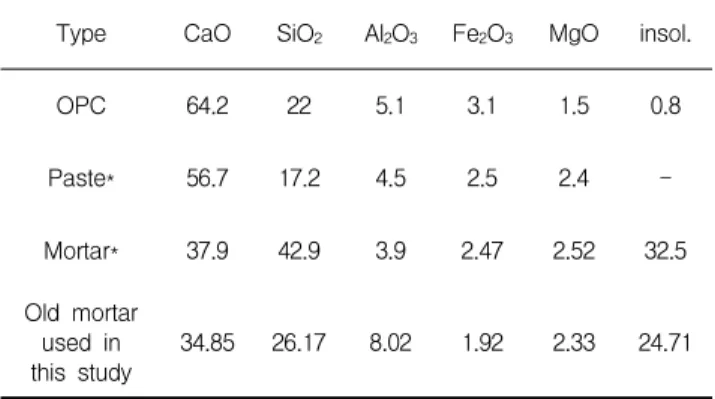
Table 2 indicates the chemical component of old

mortar separated from recycled aggregate. The

chemical component of the old mortar separated

(4)

compared with that of the recycled cement used by other researchers. The content of SiO

2

and Al

2

O

3

was reported to be 21.63% and 9.81%, respectively, by Spoon et al.[12], which was similar to the analysis results of this study.

In addition, the SiO

2

content of the specimen used in this study was shown to be similar to that of the OPC but less than that of the basic material for mortar used in the previous studies, including the study of Ahn et al.[13]; on this basis, it is believed that the fine particles used as specimen in this study obtained from old mortar attached to recycled aggregate were separated satisfactorily.

Table 2. Chemical component of cement powder according to type

Type CaO SiO

2

Al

2

O

3

Fe

2

O

3

MgO insol.

OPC 64.2 22 5.1 3.1 1.5 0.8

Paste* 56.7 17.2 4.5 2.5 2.4 -

Mortar* 37.9 42.9 3.9 2.47 2.52 32.5

Old mortar used in

this study 34.85 26.17 8.02 1.92 2.33 24.71

*Reference [11]

3.2 XRD analysis results

As shown in Figure 5, a small amount of Etringite and hydrated potassium generated in the process of hydration were found in OPC. In some cases, the main component of the cement was found to be calcium silica gate.

However, there were no big differences found in the fine particles separated from recycled aggregate before and after mixing water. CaCO

3

was identified, which could be substantial proof of reaction of silica powder (SiO

2

), the sand component, detaching from the cement mortar or paste, with CO

2

in the air.

Figure 4. XRD for the fine grained

Through the XRD analysis results, a lot of SiO

2

was included in the form of fine particles detaching from aggregate in the course of manufacturing of recycled aggregate due to crushing or wearing. This is known to form alkali silicate gel through reaction with alkali properties such as NaOH and KOH in the cleaning solution for concrete. When the alkali silicate meets water, an alkali silica reaction occurs. A series of this reaction could give rise to the potential for cracks and pop-out in the recycled concrete in the future, which may cause a deterioration in the durability of recycled concrete. SiO

2

, which is present to a high degree in the fine particles, tends to cause swelling by creating alkali-silica reaction gel alongside pozzolanic reaction. Recycled aggregate could increase in alkali due to unhydrated old mortar and fine particles, which could result in drying shrinkage crack due to alkali-silica reaction[14].

However, copper slag causes a pozzolanic reaction

(5)

Journal of the Korea Institute of Building Construction, Vol. 12, No. 5

http://dx.doi.org/10.5345/JKIBC.2012.12.5.460 www.jkibc.org that increases the consumption of calcium hydroxide

and generates more C-H-S, which can control the swelling caused by alkali-silica reaction[15,16]. For this reason, it is believed that copper slag is appropriate as an admixture for recycled concrete to control the alkali-silica reaction.

3.3 DSC analysis results of old mortar

In the case of concrete, as indicated in Table 3[13], dehydration and water evaporation take place at a low temperature, while disruption and decomposition take place at a high temperature.

Dehydration reaction of Ca(HO)

2

is found between 400-600℃ while decarboxylation reaction of CaCO

3

is found between 600-900℃.

Temperature(℃) DSC-TG Change characteristics temperature Room

~100 Water evaporation

· Evaporation of free water such as absorbed water, gel water and capillary water

· Chemically stable state

100~400

Disruption of cement hydration

and gel

· Dehydration of hydrate in Al

2

O

3

, Fe

2

O

3

and Tobermoriter gel

· (CaO)

3

SiO

2

·CaSO

4

·nH

2

O

→(CaO)

3

SiO

2

·nH

2

O↑

400~600

Decomposition of calcium hydroxide

in 481.7℃

(endothermic reaction )

· Decomposition of Ca(OH)

2

Ca(OH)

2

→CaO+H

2

O↑

600~900

Almost no weight change by decarboxylation in

60.3℃

· Decomposition of CaCO

3

CaCO

3

→CaO+CO

2

↑ Table 3. Change characteristics of concrete according to

temperature variation

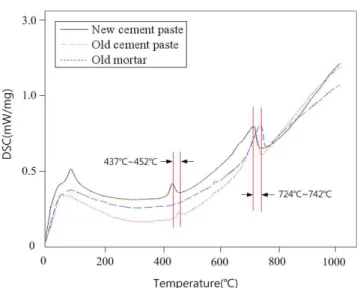
Figures 5 and 6 show the DSC analysis results of cement mortar; the peak at the upward peak is endothermic reaction and the downward peak is exothermic reaction. Identical peaks were shown at identical temperatures at 7 days and 14 days. The intensity at 14 days was stronger than that at 7 days.

The first peak was due to dehydration of free

water from within C-S-H. There was dehydration of water from within C-S-H found in the old cement paste made by adding water to old mortar, though this was small compared to the new cement paste made by adding water to OPC.

The second peak is calcium hydroxide (Ca(OH)

2

).

As age increased, the intensity of calcium hydroxide was indicated to be stronger, which is because more C-S-H and Ca(OH)

2

were generated by hydration reaction. The intensity was shown to be similar in old and new cement paste. However, there was no intensity found in the old mortar separated from recycled aggregate. It is believed that the hydrated parts of cement may have been separated or worn by crushing or impact among aggregate in the manufacturing process of recycled aggregate, as mentioned previously, or it reacted with CO

2

on an open-air storage yard, turning into CaCO

3

. In other words, through the thermal analysis it was proven there are unhydrated cement particles in the old mortar, which could react with water, though with a weak peak of CaCO

3

compared to that of new cement paste.

The third peak is CaCO

3

generated from the

reaction between Ca(OH)

2

generated through

hydration process and CO

2

in the air. It was shown

to be similar in the three specimens at each curing

day. In terms of intensity of the peak by specimen,

old and new cement paste was shown to be similar,

while old mortar was shown to be stronger than the

other two specimens in terms of the intensity of

CaCO

3

. That is, the reason why the intensity of

CaCO

3

was shown to be stronger in old mortar may

be that the Ca(OH)

2

generated through hydration

reaction was exposed in the air for a long time,

during which it was combined with CO

2

, turning into

CaCO

3,

and old mortar held more CaCO

3

than old

cement paste.

(6)

Figure 5. DSC curve of old cement paste(curing ages 7 days)

Figure 6. DSC curve of old cement paste(curing ages 14 days)

Surface are likely to be worn by impact or friction between aggregates, and unhydrated cement particles could be exposed on the surface, which means the old cement on the surface of the recycled aggregate could be hardened due to a reaction with water. When the old cement mortar reacts with water, it is possible for the old cement on the surface of the aggregate to increase the unit cement volume due to the old cement mortar, intensifying the concrete accordingly.

However, the initial strength was developed more rapidly, while the long-term strength was developed

is usually not as strong as that of OPC. Despite the increase in the unit volume of cement, the long-term strength was lower, which might be because it held a small amount of unhydrated cement particles, and the influence on strength was small.

In addition, it is believed that micro-cracks within the recycled aggregate, deterioration by the old cement mortar on the surface of the recycled aggregate, and decrease in the unit quantity by water absorption had a greater influence on the strength than the increase in strength caused by unhydrated cement particles, which means it can improve initial strength development while deteriorating long-term strength.

To minimize a decrease in the long-term strength development when using recycled aggregate, it is necessary to study concrete mixture with blast-furnace slag or copper slag in the future.

3.4 DSC analysis results of fine particles

As illustrated in Figure 7, fine particles and fine particle paste were analyzed to have one peak at around 700℃, and cement paste was analyzed to have three peaks, each of which was shown at 100℃

and 450℃, respectively, and so was at 700℃. The first peak was caused by dehydration reaction of free water from within C-S-H, the second peak is Ca(OH)

2,

the cement hydration product, and the third peak is CaCO

3.

There were no hydration products such as C-S-H

and Ca(OH)

2

found, both in fine particles and in fine

particle paste, while the intensity of CaCO

3

was

observed to be stronger than in cement paste, which

is believed to be because more CaCO

3

was generated

from old cement mortar or old cement paste. Fine

particles included in recycled aggregate weremostly

generated by abrasion between aggregates in the

(7)

Journal of the Korea Institute of Building Construction, Vol. 12, No. 5

http://dx.doi.org/10.5345/JKIBC.2012.12.5.460 www.jkibc.org manufacturing process of recycled aggregate, and

there may be few unhydrated cement particles or hydrated cement particles. The fine particles on the surface of aggregate may not directly affect the concrete strength, but CaCO

3

lowers the water absorption in concrete, which could have a positive impact on the workability with recycled concrete paste.

Figure 7. DSC curve of unhydrated fine-grained(curing ages 14 days)

4. Conclusion

1) Through DSC analysis, it was found that old mortar holds unhydrated cement particles, and could be hardened more firmly upon mixing with water.

2) Fine particles were generated through a reaction among silica powder (SiO

2

), a component of sand, with CaCO

3,

believed to be generated by combining Ca(OH)

2

with CO

2

in the air. Fine particles did not react with water, but silica powder(SiO

2

) generated an alkali silicate gel in the reaction with alkali properties.

The old cement mortar attached on the surface of recycled aggregate could reduce the unit

quantity when mixed into paste, and the initial strength can be slightly increased by the hydration reaction of unhydrated cement particles with water. However, a boundary is formed between the new mortar and old mortar or fine particles, which is believed to affect the adhesion strength between new and old mortar.

References

1. Anderegg FO, Hubbel DS. The Rate of Hydration of Cement Clinker. Proceedings America Society for Testing and Materials. 1929 29(II). p. 554-69 and 1930 30(II). p. 572-780.

2. Powers TC. The Non-Evaporable Water Content of Hardened Cement Paste: Its Significance for Concrete Research and Its Determination. 1949 May; ASTM Bulletin 158. p. 68-76.

3. Oh SG, Hong YT. The Development of High Quality Recyclable Cement Made from Waste Concrete Using Micro Separating System. Journal of the Architectural Institute of Korea. 2007 Sep;23(9):167-74.

4. Oh SG. A Study for the Hydration Recovery of Recycle Cement Using Waste Concrete Powder. Journal of the Architectural Institute of Korea. 2002 Oct:18(10):53-60.

5. Sha W, O'Neilla EA, Guoa Z. Differential scanning calorimetry study of ordinary Portland cement. Cement and Concrete Research. 1999 Sep;29(9):1487-9.

6. Bhatty J. A review of the application of thermal analysis to cement-admixture systems. Thermochim Acta. 1991 Oct;189(2):313-50.

7. Abdelrazig BEI, Main SD, Nowell DV. Hydration studies of modified OPC pastes by differential scanning calorimetry and thermogravimetry. J Thermal Analysis and caorimetry. 1992 Aug;38(3):495-504.

8. Parrott LJ, Geiker M, Gutteridge WA, Killoh D. Monitoring Portland cement hydration: Comparison of methods. Cement Concrete Research. 1990 Nov;20(6):919-26.

9. Murakami K, Mino K, Harada H, Bhadeshia HKDH.

Nonuniform recrystallisation in a mechanically alloyed Ni-base superalloy. Metallurgical and Materials Transactions A. 1933 May;24(5):1049-55.

10. Chou TS, Bhadeshia HKDH. Grain control in mechanically alloyed oxide dispersion strengthened MA957 steel.

Materials Science and Technology. 1993 Oct:9(10):890-9.

11. Ahn JC, Oh SG, Kang BH. Hydraulic Propertise of the

(8)

from Concrete Waste. Journal of the Architectural Institute of Korea. 2005 Sep;21(9):121-8.

12. Spoon CS, Shui ZH, Lam L. Effect of microstructure of ITZ on compressive strength of concrete prepared with recycled aggregate. Construction and Building Materials. 2004 July;18(6):461-8.

13. Ahn JC, Lee JH, Kang BH. Propertise of Recycled Cement made of Cementituous Powder from Concrete Waster by Conditions of Burning. Journal of the Architectural Institute of Korea. 2003 Nov;19(11):109-16.

14. JoséManuel GS, josemanuel gomez. Shrinkage of Concrete with Replacement of Aggregate with Recycled Concrete Aggregate, A: Malhotra, V.M. editor. Innovation in Design with Emphasis on Seismic, Wind and Environmental Loading, Quality Control, and Innovation in Materials/Hot Weather Concreting. ACI international conference; 2002;

Cancun, Maxico. USA: ACI; 2002. p. 475-95.

15. R. Tixier, R. Devaguptapu and B. Mobasher. The effect of copper slag on the hydration and mechanical properties of cementitious mixtures. Cement and Concrete Research.

1997;27(10):1569-80.

16. Kim YS, Jeong EC, Lee DU. Effectiveness of Copper Slag in Reducing Alkali-Silica Reaction Expansion. Journal of the Architectural Institute of Korea. 2009;25(7):71-8.

17. Chung HS, Yang KH, Kim HH. The Influence of the Quality

and the Replacement Level of Recycled Aggregate on the

Mechanical Properties of Concrete. Journal of the

Architectural Institute of Korea. 2006 June;22(6):71-8.

수치

Figure 1. Specimen for XRD analysis of fine grained
Figure 3. Specimen for DSC analysis of fine grained 2.4 DSC Test Method
Figure 4. XRD for the fine grained
Figure 5. DSC curve of old cement paste(curing ages 7 days)
+2

참조

관련 문서

Effect of Fine Particle Cement and Recycled Aggregates as Alkali Activator on the Engineering Properties and Micro-Structure of High Volume Blast Furnace Slag

임팩트 바와 임팩트 패널이 장착된 시멘트 페이스트 박리기를 이용한 콘크리트용 순환 잔골재 생산기술 소개. Introduction to Recycled Fine Aggregate for Concrete Using

Manufacturing Technology of Recycled Fine Aggregate by High Speed Impact and Dry Separation Method of Fine Particle. * 충남대학교 건축공학과 부교수 Chungnam

And, in order to examine the possibility of reusing the surface coated recycled aggregate in constructing concrete structures, we studied the mechanical properties and durability