283
and Safety
Available online at http://www.foodhygiene.or.kr
https://doi.org/10.13103/JFHS.2019.34.3.283
광주광역시 학교급식 농산물의 잔류농약 모니터링 및 위해평가
김진희1· 이다빈1· 이민규1· 류근영1· 김태순1· 강경리1· 서계원1· 김중범2*
1광주광역시보건환경연구원, 2순천대학교 식품공학과
Monitoring and Risk Assessment of Pesticide Residues in School Foodservice Agricultural Products in Gwangju Metropolitan Area
Jinhee Kim1, Davin Lee1, Mingyou Lee1, Keunyoung Ryu1, Taesun Kim1, Gyungri Gang1, Kyewon Seo1, Jung-Beom Kim2*
1Health and Environment Research Institute of Gwangju Metropolotan City, Gwangju, Korea
2Department of Food Science and Technology, Sunchon National University, Jeonnam, Korea (Received May 10, 2019/Revised June 5, 2019/Accepted June 12, 2019)
ABSTRACT - This study was performed to monitor the residual pesticides in agricultural products used in school foodservice in the Gwangju metropolitan area. Risk assessment was also carried out based on the amount of agricul- tural products consumed. A total of 320 agricultural products supplied to schools in Gwangju were analyzed from 2015 to 2017. The pre-treatment and residual pesticide analysis of these products was conducted in accordance with the second method for multi-residue analysis of pesticides in the Korean food code. The hazard index was calculated by dividing the estimated daily intake (EDI) of pesticides by the acceptable daily intake (ADI). The linearity correla- tion coefficient for the calibration curve was 0.9923 to 1.0000, LOD 0.004 to 0.019 mg/kg, LOQ 0.012 to 0.057 mg/
kg, and recovery was 79.1 to 100.2%. Residual pesticides were detected in 18 (5.6%) of 320 agricultural products used for school foodservice, and one sample of sweet potato stem (0.3%) exceeded the maximum residual limit (MRL).
The detection frequency for chili peppers and bell peppers was higher than that for other agricultural products. The frequently-detected pesticides were boscalid and acetamiprid. These results showed that residual pesticide manage- ment is needed for chili pepper, bell pepper and sweet potato stem among agricultural products supplied to schools.
The hazard index of bifenthrin in sweet potato stem showed the highest (64.18%), and the other pesticides were 0.03- 8.23%. These results indicated that agricultural products supplied to schools in Gwangju were safe for consumption.
To minimize the intake of residual pesticides, it is necessary to not only thoroughly wash agricultural products but to also ensure the expanded supply of products that are pesticide-free.
Keywords : School foodservice, Agricultural products, Pesticide residue, Monitoring, Risk assessment
학교급식은 1998년 시행되어 성장기 학생의 영양 균형 과 올바른 식습관 형성에 기여해오고 있으며 2003년부터 Hazard Analysis Critical Control Point (HACCP)가 학교급 식에 도입되어 식품안전을 확보하고자 노력하고 있다1). 청 소년기의 균형 잡힌 영양섭취는 신체발달 뿐만 아니라 정 서적, 사회적 발달에도 중요한 영향을 미치므로 학교급식 은 청소년기 학생 건강에 중요 요소로 인식되고 있다2). 학 교급식에 사용되는 식재료는 대부분 지역별 학교급식 식자
재 공급센터를 통해 공급되고 있으나3)불량 식재료에 의한 식품안전사고로 인해 식재료의 생산부터 유통 전 단계에 걸친 안전시스템 확보가 요구되고 있다4). 또한 건강한 삶 에 대한 요구로 인해 학교급식 식재료의 안전성과 더불어 고품질의 친환경 식재료에 대한 요구가 증대되고 있다5,6). 학교급식에 사용되는 친환경 식재로는 Good Agricultural Practice (GAP) 인증을 받은 우수농산물이 있으며 2007년부 터 학교급식에 무 농약, 이력추적관리 및 지리적 표시 농산 물, GAP 인증 농산물을 사용하도록 권장하고 있다7).
농약은 노동력 절감과 농산물 생산량 증대 및 품질향상 을 위해 사용되고 있으나 살포 후 장시간에 걸쳐 분해되 고 토양과 농산물에 일정기간 잔류하여 환경과 인간에게 위해를 발생시킨다8,9). 현재 1,000여종의 농약이 개발되어
*Correspondence to: Jung-Beom Kim, Department of Food Science and Technology, SunChon National University, 255 Jungangro, Suncheon, Jeonnam, 57933 Korea.
Tel : 82-61-750-3259, Fax : 82-61-750-3208 E-mail : [email protected]
사용되고 있으며 오남용 등 부적절한 사용에 따른 독성으 로 사람에게 두통, 구토, 내분비계 이상 등의 질환을 발생 시키고 있다10,11). 농약 오남용에 따른 위해를 방지하고자 각각 농약에 대해 사용량, 사용 시기, 사용 횟수 등의 농 약안전사용기준을 설정하여 관리하고 있다. 잔류농약이란 농산물에 최종적으로 잔류하는 농약의 양을 지칭하며 최 대잔류허용기준(Maximum Residue Limit; MRL)이란 유통 농산물에 잔류할 수 있는 농약의 최대 양을 의미한다12). 식품의약품안전처에서는 각각 농산물에 대한 농약의 MRL 을 설정하여 농산물의 농약 잔류량을 관리하고 있다13).
학생들의 영양 균형을 위하여 학교급식 식재료로 곡류, 서류, 채소류 및 과일류 등 농산물이 공급되고 있다. 채소 류와 과일류는 조리과정 중 열처리 없이 세척 후 바로 섭 취하고 있어 잔류농약에 노출될 경우 인체에 위해를 가할 수 있는 가능성이 있다. 따라서 학교급식 식재료로 사용 되고 있는 채소류, 과일류 등 농산물에 대한 잔류농약 모 니터링과 위해평가가 필요하다 하겠다. 그러나 현재 까지 연구를 살펴보면 충북지역 일부 채소류의 잔류농약 모니 터링14), 서울지역 유통 농산물의 잔류농약 모니터링과 위 해평가15), 광주지역 도매시장 반입농산물의 잔류농약 모니 터링16)등 유통 농산물에 대한 잔류농약 모니터링 연구가 대부분이고 학교급식 식재료에 대한 잔류농약 모니터링과 위해평가는 서울지역 학교급식 식재료의 잔류농약 모니터 링과 위해평가3) 등에 한정되어 있다. 따라서 본 연구에서 는 광주광역시 학교급식 농산물의 잔류농약을 모니터링하 고 섭취량에 따른 위해평가를 실시하여 안전하고 깨끗한 학교급식 농산물 식재료가 공급되는데 기여하고자 하였다.
Materials and Methods 실험재료
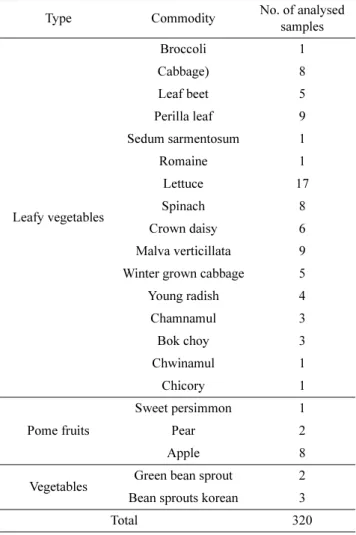
본 실험에 사용한 재료는 2015년부터 2017년 까지 광주 광역시 소재 학교에 식재료로 공급되는 농산물을 대상으로 하였다. 농산물은 신선한 상태로 수거하였으며 감귤류 1건, 곡류 28건, 과채류 106건, 근채류 24건, 두류 5건, 버섯류 19 건, 서류 9건, 엽경채류 30건, 엽채류 82건, 인과류 11건, 채 소류 5건 등 총 320건을 실험재료로 하였다(Table 1).
분석대상 농약 및 시약
분석대상 농약은 다종 농약 다성분 분석 제2법17)으로 분 석 가능한 acrinathrin 등 농약 120종을 선정하여 실험하 였다. 본 실험에 사용한 농약 표준품은 Dr. Ehrenstorfer GmbH (Augsburg, Germany)와 Wako (Osaka, Japan) 제품 을 구입하여 사용하였다. 추출용매인 acetonitrile, acetone, n-hexane, dichloromethane과 sodium chloride는 Merck (Darmstadt, Germany)사의 제품을 구임하여 사용하였다. 시 료정제는 florisil cartridge (Strata, 500 mg/ 6 mL,
Table 1. The list of collected agricultural products from school foodservice in Gwangju metropolitan city
Type Commodity No. of analysed samples
Citrus fruits Orange 1
Grains
Oats 1
Common millet 1
Wheat 1
Barley 10
Sorghum 2
Italian millet 1
Glutinous rice 3
Brown rice glutinous
rice 3
Brown rice 4
Black Rice 2
Fruit vegetables
Sweet pumpkin 3
Cucumber 22
Pumpkin 24
Eggplant 5
Pepper 25
Cherry tomato 3
Tomato 1
Paprika 11
Green pepper 12
Root vegetables
Carrot 7
Garlic 1
Radish 7
Onion 9
Beans
Mung beans 3
Adzuki beans 1
Rhynchosia nulubilis 1
Mushrooms
Oyster mushroom 4
King oyster mushroom 6
Button mushroom 1
Enoki mushroom 8
Potatoes Potato 4
Sweet potato 5
Leaf and stem vegetable
Sweet potato vines 2
Spring onion 12
Edible shoots of a fatsia 1
Water parsley 3
Chinese chive 10
Spergularia marina
griseb 2
Phenomenex, Torrance, CA, USA)와 aminopropyl cartridge (Strata, 1 g/6 mL, phenomenex)를 구입하여 사용하였다.
분석방법 및 장비
농산물 전처리 및 잔류농약 분석은 식품공전 다종 농약 다성분 분석 제2법17)에 따라 실험하였으며 gas chromatograph (GC)와 high performance liquid chromatograph (HPLC)로 분 석하였다. GC 분석농약은 GC mass selective detector (GC- MSD, 5975, Agilent, Santana Clara, CA, USA)를 이용 정성 분석 한 후 검출된 각각의 농약에 대해 GC electron capture detector (GC-ECD, 6890, Agilent)와 GC nitrogen phosphorus detector (GC-NPD, 6890, Agilent)로 정량 분석 하였다. HPLC 분석농약은 HPLC mass spectrometer (LC- MS/MS, TSQ Quantum Ultra, Thermo Fisher, Waltham, MA, USA)를 사용하여 정성 및 정량 분석하였다. GC와 HPLC 기기 분석조건은 Table 2와 3에 나타내었다.
시험법 유효성 검증
회수율 실험은 잔류농약이 검출되지 않은 고추에 각각 의 농약을 1.0 mg/kg 첨가한 후 다종 농약 다성분 분석 제 2법에 따라 3회 반복 측정하였다. 검출한계(Limit of Detection, LOD)와 정량한계(Limit of Quantification, LOQ) 는 International Conference on Harmonization (ICH)에 따 라 회귀곡선의 기울기와 잔차의 표준편차를 이용하여 다 음과 같이 산출하였다.
LOD = 3.3 × σ/S LOQ = 10 × σ/S
σ: 검량선에서 반응의 표준편차, S: 검량선의 기울기 위해성 평가
검출된 농약의 위해성 평가는 검출된 농약의 평균 잔류 량(mg/Kg)과 각각 농산물의 일일 섭취량(g/day)을 곱하여 Table 1. (Continued) The list of collected agricultural products
from school foodservice in Gwangju metropolitan city
Type Commodity No. of analysed samples
Leafy vegetables
Broccoli 1
Cabbage) 8
Leaf beet 5
Perilla leaf 9
Sedum sarmentosum 1
Romaine 1
Lettuce 17
Spinach 8
Crown daisy 6
Malva verticillata 9 Winter grown cabbage 5
Young radish 4
Chamnamul 3
Bok choy 3
Chwinamul 1
Chicory 1
Pome fruits
Sweet persimmon 1
Pear 2
Apple 8
Vegetables Green bean sprout 2 Bean sprouts korean 3
Total 320
Table 2. Analytical conditions for pesticide with GC-ECD, -NPD, and -MSD
Instrument Inlet temperature Oven temperature Column Flow rate Detector temperature
GC-ECD 250oC
190oC, 0 min → 15oC/min → 220oC, 9 min →
30oC/min → 300oC, 6 min
DB-5 1.0 mL/min 300oC
GC-NPD 250oC
190oC, 0 min → 4oC/min → 240oC, 0 min →
20oC/min → 290oC, 5 min
DB-5 1.0 mL/min 300oC
GC-MSD 250oC
190oC, 0 min → 5oC/min → 250oC, 0 min →
50oC/min → 300oC, 3 min
DB-5MS 1.0 mL/min 300oC
일일 섭취 추정량(estimated daily intake, EDI, mg/Kg g/
day)을 산출하였다. 일일 농산물 섭취량은 질병관리본부 국민영양조사18)를 참고하여 산출하였다. 잔류농약 일일 섭 취허용량(acceptable daily intake, ADI, mg/Kg b.w./day)은 식품의약품안전처의 잔류농약데이터베이스13)에서 제공하 는 자료에 한국인 평균체중인19) 65 kg을 곱하여 산출하였 다. 위해도(Hazard Index)는 EDI를 ADI로 나누어 백분율 로 나타내었다20).
Results and Discussion 시험법 유효성 검증
학교급식 식재료로 사용되는 농산물에서 검출된 잔류농 약에 대한 시험법 유효성 검증결과는 Table 4에 나타내었
다. 검량선에 대한 직선성 상관계수는 0.9923~1.0000, LOD 는 0.004~0.019 mg/kg, LOQ는 0.012~0.057 mg/kg으로 양 호하게 나타났으며 회수율은 79.1 ± 4.3~100.2 ± 0.2%로 나타났다. 이러한 결과는 1.0 mg/kg 처리수준에서 CODEX21)가 제시하는 회수율 70~110%, 분석오차 15% 이 내를 모두 충족하는 결과이었다.
잔류농약 검출현황
2015년부터 2017년 까지 광주광역시 소재 학교급식 식 재료로 공급되는 농산물에 대한 잔류농약 검출현황은 Table 5에 나타내었다. 각각 농산물에 대한 잔류농약 초과 여부 는 식품의약품안전처가 2015년부터 2017년 까지 고시한 농약잔류허용기준에 따라 판단하였으며, 식품의약품안전 처 기준이 없을 경우 CODEX기준에 따라 판단하였다22). Table 3. Analytical conditions for pesticide with UPLC-MS/MS
Instrument Injection volume Column Flow rate Mobile phase
UPLC -MS/MS
1 μL Acquity
UPLC-BEH C18 0.4 mL/min A: 0.1% formic acid in 2% methanol B: 0.1% formic acid in methanol Gradient
Time (min) A (%) B (%)
0.0 95 5
0.2 95 5
4.0 0 100
4.5 0 100
4.6 95 5
6.0 95 5
Table 4. Validation parameter of pesticides detected in school foodservice agricultural products
Pestcides Correaltion coefficient (r2) (n=3)
LOD (mg/Kg)
(n=5)
LOQ (mg/Kg)
(n=5)
Recovery ± RSD (%) (n=3)
Acetamiprid 0.9985 0.018 0.054 94.5 ± 3.3
Azoxystrobin 0.9983 0.019 0.057 89.9 ± 3.0
Bifenthrin 1.0000 0.005 0.015 100.2 ± 0.2
Boscalid 0.9998 0.019 0.059 94.2 ± 3.3
Chlorantraniliprole 0.9990 0.011 0.033 94.2 ± 1.2
Chlorothalonil 0.9988 0.014 0.042 93.6 ± 2.0
Fenazaquin 0.9923 0.009 0.027 91.1 ± 1.4
Novaluron 0.9974 0.016 0.048 79.1 ± 4.3
Procymidone 0.9996 0.004 0.012 87.9 ± 1.0
Pyraclostrobin 0.9993 0.013 0.039 97.3 ± 3.0
Pyridalyl 1.0000 0.012 0.036 94.2 ± 1.2
Tricyclazole 0.9938 0.011 0.033 84.7 ± 1.3
Trifloxystrobin 0.9972 0.019 0.057 93.2 ± 1.1
Validation data was obtained from our previous study20)
학교급식 식재료로 사용되는 농산물의 잔류농약 검출현황 을 살펴보면 전체 320건 중 18건(5.6%)에 잔류농약이 검
출되었으며, 고구마 순 1건(0.3%)이 잔류농약허용기준을 초과하였다. 잔류농약 검출율은 취나물(100%), 세발나물 (50%), 고구마 순(50%)으로 높았으며 검출빈도는 고추 8 회, 파프리카 3회, 들깻잎 2회로 다른 농산물에 비해 복수 의 검출빈도를 나타내었다. 잔류농약 검출율과 검출빈도 를 종합해 볼 때 검사건수가 1건으로 매우 낮은 참나물, 세발나물을 제외하면 학교급식 식재료로 공급되는 농산물 중 고추, 파프리카, 고구마 순, 들깨 잎에 대한 철저한 잔 류농약 관리가 필요한 것으로 나타났다. 광주광역시 도매 시장 반입 농산물의 잔류농약허용기준 초과 현황이 2015 년 1.4%, 2016년 1.7%였다는 보고16)와 2010년부터 2012 년 서울지역 학교급식 식재료로 공급되는 농산물의 잔류 농약허용기준 초과 현황이 1.9%였다는 보고3)와 비교 시 광주광역시 학교급식 농산물 식재료의 잔류농약허용기준 초과 비율 0.3%는 매우 낮아 안전성이 확보된 것으로 판 단된다.
학교급식 식재료로 공급되는 농산물에서 검출된 잔류농 약별 검출현황은 Table 6에 나타내었다. 고구마 순에서 bifenthrin이 잔류농약허용기준을 초과하여 검출되었으며, Table 5. Detection rate(%) of pesticides in school foodservice
agricultural products
Commodity No. of analysed samples
No. of detected samples
Detection rate (%)
Apple 8 1 12.5
Chwinamul 1 1 100.0
Cucumber 22 1 4.5
Paprika 11 3 27.3
Perilla leaf 9 2 22.2
Pepper 25 8 32.0
Spergularia marina
griseb 2 1 50.0
Sweet potato vines 2 1 50.0
Others 240 0 0.0
Total 320 18 5.6
Table 6. Risk assessment for pesticides detected in school foodservice agricultural products
Commodity (No.) Pesticides (No.) MRL1) (mg/Kg)
Average concentration (mg/Kg)
EDI2) (mg/man/day)
ADI3) (mg/man/day)
Hazard index4)
(%)
Apple(8) Methoxyfenozide(1) 2.000 0.100 0.005 6.500 0.08
Pepper(25)
Pyraclostrobin(1) 0.500 0.200 0.007 1.950 0.37
Boscalid(2) 3.000 0.100 0.004 2.600 0.14
Novaluron(1) 0.700 0.100 0.004 0.650 0.56
Acetamiprid(2) 2.000 0.150 0.005 4.615 0.12
Procymidone(2) 5.000 0.850 0.031 6.500 0.47
Tricyclazole(1) 3.000 0.100 0.004 3.250 0.11
Pyridalyl(1) 2.000 0.100 0.004 1.820 0.20
Chwinamul(1) Azoxystrobin(1) 3.000 2.100 0.004 13.000 0.03
Cucumber(22) Chlorothalonil(1) 5.000 0.100 0.001 1.300 0.11
Paprika(11)
Boscalid(2) 3.000 0.250 0.067 2.600 2.57
Trifloxystrobin(1) 2.000 0.200 0.053 2.600 2.06
Pyridalyl(1) 2.000 0.100 0.027 1.820 1.47
Pyraclostrobin(1) 0.500 0.100 0.027 1.950 1.37
Perilla leaf(9) Acetamiprid(1) 5.000 0.300 0.001 4.620 0.02
Fenazaquin(1) 3.000 0.200 0.001 0.325 0.16
Spergularia marina griseb(2) Bifenthrin(1) 2.000 0.200 0.053 0.650 8.23
Sweet potato vines(2) Bifenthrin(1) 0.050 1.560 0.417 0.650 64.18
Chlorantraniliprole(1) 3.000 0.100 0.027 130.000 0.02
1)MRL: Maximum residue limit
2)EDI: Estimated daily intake, average concentration (mg/Kg) × daily food intake (g/man/day) / 1000
3)ADI: Acceptable daily intake (mg/Kg b.w./day) × 65 Kg
4)Hazard index (%): EDI / ADI × 100
가장 높은 검출빈도를 나타낸 잔류농약은 boscalid(4회)와 acetamiprid(3회)로 나타났다. 또한 고추에서 7종, 파프리 카에서 4종, 들깨 잎과 고구마 순에서 2종의 잔류농약이 다중 검출되었다. 살비제로 고구마 등에 사용되는 있는 bifenthrin 농약은 pyrethoroid계 저독성 농약으로 사람에게 안전한 것으로 알려져 있었으나, 최근 신경 및 면역체계 에 독성을 나타낸다고 보고23)되고 있다. 살충제로 고추 등 에 사용되는 acetamiprid 농약은 neonicotinoid계 농약의 일 종으로 곡류, 채소류, 과일류 등에 널리 사용되고 있다24). 살균제와 살진균제로 고추 등에 사용되는 boscalid 농약은 carboxamide계 농약의 일종으로 육상동물에게 독성이 매 우 낮아 전 세계적으로 광범위하게 사용되고 농산물 중 가장 빈번하게 검출되는 잔류농약의 일종이다25). 본 실험 결과 농산물에서 검출된 잔류농약은 세계적으로 가장 빈 번하게 검출되는 저독성 농약으로 학교급식 식재료의 안 전성이 확보된 것으로 판단된다.
위해성 평가
학교급식 식재료로 공급되는 농산물에서 검출된 잔류농 약 13종에 대한 위해평가를 실시하여 Table 6에 나타내었 다. 각각 농약에 대한 위해도 평가는 일일섭취추정량(EDI) 를 일일섭취허용량(ADI)로 나누어 Hazard index로 표시하 였다. 고구마 순에서 농약잔류허용기준을 초과하여 검출 된 bifenthrin이 64.18%로 가장 높았으며, 고추에서 검출 된 boscalid 등 다른 잔류농약의 Hazard index는 0.03~8.23%로 나타났다.
이러한 결과는 서울시 학교급식 농산물의 잔류농약의 Hazard index를 분석한 결과 3.8% 이하로 나타났다는 보 고3)와 충북지역 유통 채소류의 Hazard index가 최고 50.8%
였다는 보고14)로 보와 본 실험의 Hazard index가 다소 높 거나 유사한 결과를 나타내었다. 일반적으로 Hazard index 가 100%를 초과하면 위험한 것으로 판단하나3) 본 실험결 과 학교급식 식재료 농산물 중 고구마 순에서 검출된 bifenthrin을 제외한 모든 잔류농약의 Hazard index가 10%
미만을 나타내어 안전한 수준으로 평가되었다. 그러나 학 교급식 시 다른 농산물과 함께 섭취하는 식습관을 고려할 때 고구마 순에서 검출된 bifenthrin에 대한 주의가 필요 한 것으로 판단된다. 친환경인증제도에 따라 유기합성농 약을 일체사용하지 않는 유기농산물과 무 농약 농산물의 경우 잔류농약이 검출되지 않는다. 또한 깻잎, 청경채 등 가열공정 없이 섭취하는 채소류에 procimidone을 살포한 후 수돗물, 염소수, 초음파, 오존수를 이용하여 세척한 경 우 90.5% 이상의 잔류농약 제거효율을 나타내었다는 보 고26)로 보아 고구마 순 등 채소류를 학교급식 식재료로 가 공하여 제공할 경우 잔류농약 식이섭취량을 최소화하기 위해 철저한 세척이 필요한 것으로 판단되며 친환경 농산 물 식재료 보급 확대가 필요한 것으로 판단된다.
국문요약
본 연구에서는 광주광역시 학교급식 농산물의 잔류농약 을 모니터링하고 섭취량에 따른 위해평가를 실시하였다.
2015년부터 2017년 까지 광주광역시 소재 학교에 공급되 는 농산물 320건을 실험대상으로 하였다. 농산물 전처리 및 잔류농약 분석은 식품공전 다종 농약 다성분 분석 제2법에 따라 120종의 잔류농약을 실험하였다. 검량선에 대한 직선 성 상관계수는 0.9923~1.0000, LOD는 0.004~0.019 mg/kg, LOQ는 0.012~0.057 mg/kg으로 양호하게 나타났으며 회수 율은 79.1~100.2%로 나타났다. 학교급식에 사용되는 농산 물 320건 중 18건(5.6%)에서 잔류농약이 검출되었으며, 고 구마 순 1건(0.3%)이 잔류농약허용기준을 초과하였다. 잔 류농약 검출빈도는 고추 8회, 파프리카 3회로 다른 농산물 에 비해 높은 검출빈도를 나타내었고 가장 높은 검출빈도 를 나타낸 잔류농약은 boscalid(4회)와 acetamiprid(3회)로 나타났다. 실험결과 학교급식 농산물 중 고추, 파프리카, 고구마 순에 대한 잔류농약 관리가 필요한 것으로 나타났 다. 잔류농약 위해도 평가 결과 고구마 순에서 검출된 bifenthrin이 64.18%로 가장 높았으며, 고추에서 검출된 boscalid 등의 Hazard index는 0.03~8.23%로 나타나 학교 급식 농산물의 Hazard index는 안전한 수준으로 평가되었 다. 그러나 채소류를 학교급식 식재료로 제공할 경우 잔 류농약 식이섭취량을 최소화하기 위해 철저한 세척이 필 요한 것으로 판단되며 친환경 농산물의 식재료 보급 확대 가 필요한 것으로 판단된다.
감사의 글
본 연구는 광주광역시보건환경연구원의 지원으로 수행 되었기에 감사드립니다.
References
1. Kim, Y.H., Lee, Y.K.: An evaluation of food delivery worker sanitation manegement practice that supply food to school foodservices. Korean J. Nutr., 44(1), 74-81 (2011).
2. Park, M.J., Park, K.S., Park, W.J.: Survey on meal habit, nutritional knowledge, and health state of elementary school.
Korean J. East Asia Dietary Culture, 6(13), 568-576 (2003).
3. Seo, Y.H., Moon, K.D.: Monitoring and risk assessment of pesticide in school foodservice products in Seoul, Korea.
Korean J. Food Preserv., 21(1), 69-74 (2014).
4. Kim, K.A., Kwak, T.K., Lee, K.E.: Food purchasing and quality management practices in school food service. J.
Korean Diet Assoc., 12(4), 329-341 (2006).
5. Kim, H., Heo, S.W., Oh, H.Y.: A system and estimated costs of school lunch program using environmentally friendly agriproducts. Food Mark Res., 23(1), 33-51 (2006).
6. Sung, M.J., Choi, H.S., Chang, K.J.: Perceptions on environ- ment and environment-friendly agricultural products of col- lege students in Seoul and Incheon area. J. Korean Soc. Food Sci. Nutr., 37(3), 317-324 (2008).
7. Ministry of Educational Science and Technology: Instruc- tions for school health and foodservice 2011. Ministry of Educational Science and Technology, Seoul, pp.45-46 (2010).
8. Wang, S., Wang, Z., Zhang, Y., Wang, J., Guo, R.: Pesticide residues in market foods in Shaanxi province of China in 2010. Food Chem., 138(2-3), 2016-2025 (2013).
9. Lee, H.J., Choe, W.J., Lee, J.Y., Cho, D.H., Kang, C.S., Kim, W.S.: Monitoring of ergosterol biosynthesis inhibitor(EBI) pesticide residues in commercial agricultural products and risk assessment. J. Korean Soc. Food Sci. Nutr., 38(2), 1779- 1784 (2009).
10. Sana, S., Cetin, T.: Investigation of pesticide residues in veg- etables and fruits grown in various regions of Hatay, Turkey.
Food Addit. Contam. Part B, 5(4), 265-267 (2012).
11. Berrada, H., Fernandez, M., Ruiz, M. J., Molto, J. C., Manes, J. and Font, G.: Surveillance of pesticide residues in fruits from Valencia during twenty months (2004/05). Food Con- trol, 21(1), 36-44 (2010).
12. Bhanti, M., Taneja, A.: Contamination of vegetables of dif- ferent seasons with organophosphorous pesticides and related health risk assessment in northern India. Chemo- sphere, 69(1), 63-68 (2007).
13. Korea Food and Drug Administration. Pesticide Residue Database. Available from: https://www.foodsafetyko- rea.go.kr/residue/prd/mrls/list.do?menuKey=1&subMe- nuKey=161. Accessed Apr. 21, 2019.
14. Woo, N., Ko, S.H., Park, Y.J.: Monitoring of Pesticide resi- dues in vegetables collected in Chungbuk, Korea. Korean J.
Food & Nutr., 26(4), 865-878 (2013).
15. Kim, N.H., Lee, J.S., Kim, O.H., Choi, Y.H., Han, S.H., Kim, Y.H., Kim, H.S., Lee, S.R., Lee, J.M., Yu, I.S., Jung, K.:
Monitoring of pesticide residues and risk assessment on agri- cultural products marketed in the northern area of Seoul in 2013. J. Fd Hyg. Safety, 29(3), 170-180 (2014).
16. Yang, Y., Gang, G., Lee, S., Kim, S., Lee, M.G., Choi, E., Seo, K., Kim, E., Kim, J.: Survey on pesticide residues and
risk assessment of agricultural products from wholesale mar- ket in Gwangju (2014~2016). Korean J. Pestic. Sci., 21(4), 341-354 (2017).
17. Ministry of Food and Drug Safety: Analytical Manual for Pesticide Residues in Foods, 5th Ed., Korea (2017).
18. Korea Center for Disease. Korea Health Statistics 2017:
Korea National Health and Nutrition Examination Survey (KNHANES VII-2). Available from: https://knhanes.cdc.go.kr/
knhanes/sub04/sub04_03.do?classType=7. Accessed Apr.
21, 2019.
19. Korean Statistical Information Service. Status of the average weight distribution by gender and age by city. Available from:
http://kosis.kr/statHtml/statHtml.do?orgId=350&tblId=DT_
35007_N132&vw_cd=MT_ZTITLE&list_id=350_35007_
A007&conn_path=F0&path=. Accessed Apr. 21, 2019.
20. Lee, M., Gang, G., Kim, T., Yang, Y., Kim, S., Lee, D., Kim, S., Seo, K., Cho, Y., Kim, J.: Monitoring and risk assessment of pesticide residues in dried pepper and pepper powder in Gwangju. Korean J. Pestic. Sci., 23(1), 40-50 (2019).
21. Codex Alimentarius Commission: Guidelines on good labo- ratory practice in residue analysis (CAC/GL 40-1993, Rev.1- 2003)., Italy (2003).
22. Yang, Y.S., Seo, J.M., Kim, J.P., Oh, M.S., Chung, J.K., Kim, E.S.: A survey on pesticide residues of imported agricultural products circulated in Gwangju. J. Food Hyg. Safety, 21(2), 52-59 (2006).
23. Kuang, H., Miao, H., Hou, X., Zhao, Y., Shen, J., Wu, Y.:
Determination of enantiomeric fractions of cypermethrin and cis-bifenthrtin in Chinese teas by GC/ECD. J. Sci. Food Agric., 90(8), 1374-1379 (2010)
24. Gupta, M., Shanker, A.: Persistence of acetamiprid in tea and its transfer from made tea to infusion. Food Chem., 111, 805- 810 (2008).
25. Francesc, E.T., Josep, V.M., Consuelo, A., Antonio, A.S., Antonio, A.F.: Show more highly sensitive monoclonal anti- body-based immunoassays for boscalid analysis in strawber- ries. Food Chem., 267, 2-9 (2018).
26. Oh, S.Y., Choi, S.T., Kim, J.G., Lim, C.I.: Removal effect of washing treatment on psticide residues and microorganisms in leafy vegetables. Kor. J. Hort. Sci. Technol., 23(3), 250- 255 (2005).