DOI: 10.5532/KJAFM.2015.17.2.156
ⓒ Author(s) 2015. CC Attribution 3.0 License.
Effects of Elevated Air Temperature on Yield and Yield Components of Rice
Kyu-Jong Lee
1, Duc-Nhuan Nguyen
2, Doug-Hwan Choi
1, Ho-Young Ban
1, and Byun-Woo Lee
1,*
1Department of Plant Science, College of Agriculture and Life Science, Seoul National University, Gwanakro 1, Gwanakgu, Seoul 151-921, Korea
2Department of Natural Resources and Environment, Thai Nguyen University of Agriculture and Forestry, Thai Nguyen City, Viet Nam
(Received May 9, 2015; Revised June 11, 2015; Accepted June 27, 2015)
온도 상승 조건이 벼의 수량 및 수량구성요소에 미치는 영향
이규종
1·뉴안덕
2·최덕환
1·반호영
1·이변우
1,*
1서울대학교 식물생산과학부, 2타이노이엔 농림대학 천연자원환경학부
(2015년 5월 9일 접수; 2015년 6월 11일 수정; 2015년 6월 27일 수락)
ABSTRACT
High temperature stress would affect rice production in the future as heat wave is expected to occur frequently under climate change conditions. The objective of this study was to obtain rudimentary information to assess the impact of heat stress on rice yield and its yield component in Korea. Two rice cultivars “Hwaseongbyeo” (Japonica) and “Dasanbyeo” (Tongil-type) were grown at different nitrogen fertilization levels in two seasons. These cultivars were grown in 1/5000a Wagner pot placed within four plastic houses where temperature was controlled at ambient, ambient+1.5oC, ambient+3oC and ambient+5oC throughout the rice growing season in Suwon (37o16'N, 128o59'E), Korea. The degree of temperature change affected grain yield whereas the level of nitrogen had little impact on grain yield. The number of panicle per pot and spikelet per panicle were not significantly different among temperature treatments in both cultivars tested. In contrast, 1000-grain weight and ripened grain ratio were decreased significantly under the treatments raising the air temperature to the level of 5.0oC and 1.5oC above the ambient air temperature in Dasanbyeo and Hwaseongbyeo, respectively. Reduction of 1000–grain weight and ripened grain ratio under the temperature treatments of 3.0oC and 5.0oC above the ambient air temperature resulted in significantly less grain yield for Dasanbyeo and Hwaseongbyeo, respectively. The greater sensitivity of grain yield to temperature increase in Dasanbyeo was attributable to the sharp decrease of 1000-grain weight and ripened grain ratio with the temperature rise above 23oC during ripening period. On the other hand, Hwaseongbyeo had little variation of them in the temperature range of 23-27oC. These results suggested that grain yield would decrease under future climate conditions due to grain weight decreased by shorter grain filling period as well as the ripened grain ratio reduced by spikelet sterility and early abortion of rice kernel development. Thus, it would be essential to use cultivars tolerant to heat stress for climate change adaptation, which merits further studies for developing varieties that have traits to avoid spikelet sterility and early abortion of rice kernel, e.g., early morning flowering, under heat wave.
Key words: High temperature, Yield, Yield components, Rice
* Corresponding Author : Byun-Woo Lee ([email protected])
I. Introduction
Global warming is unequivocal and becomes acceler- ated recently. Projections to the end of this century sug- gest that mean global temperature will increase by 1.0- 3.7°C, depending on representative concentration path- ways scenario (IPCC, 2014). The projected climate change characterized by the increase in both frequency and intensity of high temperature along with its large variability is expected to become a major detrimental fac- tor to rice production not only in sub-topical and tropical regions of the world where most of rice is grown pres- ently and temperature is above optimum for rice pro- duction, but also even in temperate region in the future climate.
The optimum temperature for the normal develop- ment of rice ranges from 27 to 32°C (Yin et al., 1996).
High temperature affects almost all the growth stages of rice, i.e. from emergence to ripening and harvesting (Shah et al., 2001). The developmental stage at which the plant is exposed to heat stress determines the sever- ity of the possible damage to the crop (Wahid et al., 2007).
Plant growth period can be divided into two develop- mental stages: vegetative growth period and reproductive growth period. Generally, high temperature accelerates and low temperature delays heading by reducing and lengthening the vegetative period, respectively (Ahn and Vergara, 1969; Hosoi and Tamagata, 1973). However, supra-optimal high temperature delays heading (Asa- kuma and Iwashita, 1961; Azmi, 1969). Generally, high temperature stress effect on grain yield is greater during reproductive stage than during vegetative stage (Yoshida, 1981).
High temperature during vegetative period affects grain yield mainly through the effects on tillering and eventually on panicle number. Tillering increases with rising temperature in the range of 15 to 33
oC, and tem- perature above 33
oC is unfavorable for tillering (Chaudhary and Ghildyal, 1970). And Yoshida (1973) also reported that higher temperatures increased tiller numbers but at 3-5 weeks after sowing, temperature only slightly affected the tillering rate and the relative growth rate except at the lowest temperature (22
oC) tested. After the active tillering stage, high temperature decreases the number of panicles (Yamamoto et al., 1985).
High temperature during reproductive stage would result in decrease of grain yield by less number of spike- lets produced per unit dry weight or nitrogen absorbed
(Yoshida, 1983), lower spikelet fertility (Satake and Yoshida, 1978; Tashiro and Wardlaw, 1991; Kim et al., 1996a; Kim et al., 1996b; Matsui et al., 1997), and accelerated panicle senescence of grain (Kim et al., 2011). High temperature-induced spikelet sterility has decreased rice yield in tropical Asia (Osada et al., 1973) and Africa (Matsushima et al., 1982). Sterility induction by high temperature is most sensitive at flow- ering time and next most sensitive at meiotic stage of spikelet (Satake and Yoshida, 1978). During microsporo- genesis the processes close to the meiotic stage are most sensitive to high temperature (Yoshida, 1981). A significant decrease in pollen production was found at 5
oC above ambient temperature (Prasad et al., 2006) that was attributed to impaired cell division of pollen mother cell (Takeoka et al., 1992). The varietal differ- ences in the tolerance to high temperature induced ste- rility during flowering has been well documented (Osada et al., 1973; Satake and Yoshida, 1978; Yoshida, 1981;
Jagadish et al., 2007; Matsui et al., 2001) For instance, Matsui et al. (2001) reported a 3
oC difference in critical temperature causing 50% spikelet sterility between the tolerant variety “Akitakomatch” (40
oC) and the suscep- tible variety “Hinohikari” (37
oC).
Yoshida and Hara (1977) and Oh-e et al. (2007) observed
that the rate of grain growth was faster and the grain-
filling period was shorter at higher temperatures. High
temperatures above 30
oC are generally not favorable
for ripening (Osada et al., 1973). Morita et al. (2004)
reported that the final grain weight which is the product
of the rate and duration of grain growth is affected by
high temperatures which increase growth rate in the
early ripening period but reduce the duration of grain
growth and ultimately result in decreases in final grain
weight. The length of the ripening period is inversely
correlated with daily mean temperature and, therefore,
grain filling is poor when temperature is above optimum,
although a rise in temperature increases the rate of grain
filling. The duration of grain filling, defined as the
number of days required to reach maximum weight,
was found to be 13 days at a mean temperature of
28
oC, and 33 days at 16
oC for cultivar IR20, an indica
rice. But, the cultivar Fujisaka 5, a japonica rice, took a
little longer to ripening: 18 days at a mean temperature
of 28
oC and 43 days at 16
oC (Oh-e et al., 2007). The
reduced grain filling period due to high temperature is
ascribed to the accelerated panicle senescence rather
than the earlier shortage of assimilate due to leaf senes-
cence (Kim et al., 2011).
In mid-to high-latitude regions, moderate to medium increases in temperature can have small beneficial impacts on the main cereal crops like rice at local scale (IPCC, 2007). However, even moderate temperature increases are likely to have negative yield impacts for major cereal crops in low-latitude regions. For temper- ature increases of more than 3
oC, average impacts are stressful to all crops and to all regions that encompass the majority of global cereal production area. The ongoing climate change in Korea also is projected to decrease rice yield and deteriorate grain quality in the future as the projected high temperature especially dur- ing grain filling period will reduce grain filling duration and grain weight (Yun, 1990; Lee et al., 1991; Chung et al., 2006). However, such results are based on mod- els that have limited representation of impacts on extreme events and CO
2fertilization effect. To derive short-term and long-term adaptation strategies for rice production, it would be helpful to assess the impact of climate change on rice yield by its yield component.
Although climate change due to global warming would also substantially affect rice production in Korea, the major cause of yield reduction could differ from that in other countries. Thus, it would be advantageous to obtain basic information for assessing the impact of global warming on rice production in Korea. The objectives were to examine the effect of elevated air temperature on rice yield in terms of yield components under ele- vated temperature conditions.
II. Materials and Methods
2.1. Experimental set-up
For the different temperature treatments during rice growing season pot experiments were conducted in temperature-controlled plastic houses located at the Experimental Farm of Seoul National University (37
o16’N and 126
o59’E), Suwon, Korea in 2008 and 2009. The plastic houses were controlled to three temperature regimes in 2008; ambient (T1), ambient+1.5
oC (T2) and ambient+3.0
oC (T3) in 2008, and four temperature regimes in 2009; ambient (T1), ambient+1.5
oC (T2), ambient+3.0
oC (T3), and ambient+5.0
oC (T4). In the year 2008, a japonica rice variety “Hwaseongbyeo”
was transplanted with three 25 days old seedlings per a 1/5000a Wagner pot on 8th June and grown at two nitrogen fertilizer levels of 120 kg N/ha (0.5 g/pot) and 180 kg N/ha (0.75 g/pot). In the year 2009 two rice cul- tivars “Hwaseongbyeo” (Japonica) and “Dasanbyeo”
(Tongil-type) were transplanted with three 25 days old seedlings per a 1/5000a Wagner pot on 9th June and grown at a nitrogen fertilizer levels of 120 kg N/ha (0.5 g/pot). Nitrogen fertilizers was applied in three splits;
50%, 20%, and 30% as basal, tillering, and panicle N fertilizer. Phosphorus fertilizer of 120 kg P
2O
5/ha (0.5 g/pot) was applied 100% as basal fertilizer before transplanting and potassium fertilizer of 120 kg K
2O/ha (0.5 g/pot) were applied 70% as basal and 30% at around panicle initiation stage.
2.2. Measurement of rice yield and statistical analysis
Grain yield and yield components were measured with 20 pots sampled at harvest. Final yield of rough rice was adjusted to 14% of water content.
Data were analyzed with statistical program SAS ver- sion 9.1 (SAS Inc. USA). Statistical significance of temperature treatments to nitrogen levels and rice vari- eties were analyzed by two ways nested ANOVA and Duncan’s multiple range test.
III. Results
3.1. Temperature regimes
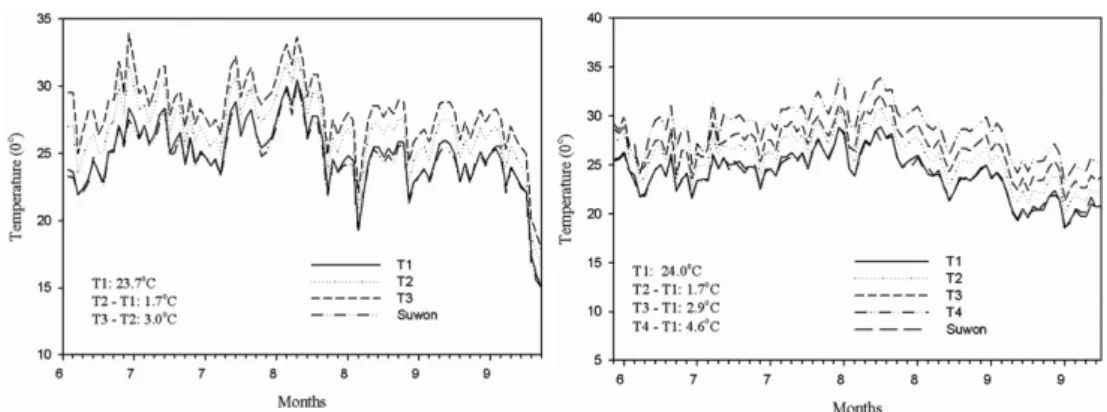
Daily series of air temperature inside the experimen- tal plastic houses in the years 2008 and 2009 are shown in Fig. 1. The recorded temperatures were a little dif- ferent from the targeted set temperature for each treat- ment. In the year 2008, mean temperatures recorded during rice growing season were 23.7
oC in ambient tem- perature (T1), and higher by 1.7 (T2) and 3.0
oC (T3) than T1. In the year 2009 mean temperatures recorded during rice growing season was 24.0
oC in ambient tempera- ture (T1), and higher by 1.7 (T2), 2.9 (T3) and 4.6
oC (T4) as compared to T1.
3.2. Responses of yield and yield components to temperature treatments
As presented in Table 1, grain yield and yield com- ponents except spikelets per panicle were not signifi- cantly different among temperature elevation treatments and showed no interactions between temperature treat- ments and N fertilizer levels in the 2008 experiment.
Spikelet number per panicle tended to increase with
temperature rise in N fertilizer level of 120 kg N ha
−1,
whereas it was not significantly different among tem-
perature treatments in N fertilizer level of 180 kg N ha
−1.
In 2009 experiment, panicle and spikelet number were
not significantly different among temperature treatments, while ripened grain ratio, 1000-grain weight, grain yield, and harvest index were significantly different among temperature treatments and showed significantly differ- ent varietal responses to temperature treatments. Ripened grain ratio was significantly reduced at the temperature elevation treatment of 5
oC (T4) above ambient temper- ature in Hwaseongbyeo but tended to decrease signifi- cantly from the temperature elevation treatments of
1.5
oC (T2) in Dasanbyeo. Similar to the ripened grain ratio, 1000-grain weight tended to decrease significantly from the temperature elevation treatment of 3
oC (T3) and 1.5
oC (T2) above ambient temperature in Hwaseong- byeo and Dasanbyeo, respectively. Owing to the reduc- tion of ripened grain ratio and 100-grain weight, grain yield tended to decrease significantly from the tempera- ture elevation treatment of 5
oC (T4) and 3
oC (T3) above ambient temperature in Hwaseongbyeo and Dasanbyeo,
Fig. 1. Daily marches of air temperature inside the experimental plastic house in 2008 and 2009 that were set at ambient tem- perature (T1), ambient+1.5oC (T2), ambient+3.0oC (T3), and ambient+5.0 (T4).Table 1. Yield components and grain yield of a rice cultivar “Hwaseongbyeo” under different air temperature regimes at two nitrogen fertilizer levels in 2008
Treatment
Panicle No.
(no./pot)
Spikelets (no./panicle)
Spikelets (no/pot)
Ripened Grain (%)
1000 grain Weight (g)
Yield (g/pot)
Harvest Index (%) N fertilizer
(Kg N/ha)
Air temperature
120
Ambient 09.25 63.33 586.75 96.54 22.95 12.89 37.79
Ambient+1.5 10.00 57.28 573.25 95.65 22.54 12.36 39.24
Ambient+3.0 09.00 68.22 608.67 96.67 22.90 13.47 42.64
Mean 09.42 62.94 589.56 96.28 22.80 12.91 39.89
180
Ambient 10.50 63.08 661.50 95.67 22.99 14.55 42.05
Ambient+1.5 11.75 67.38 793.50 95.05 22.78 17.21 42.31
Ambient+3.0 11.00 75.88 831.00 94.66 23.82 18.72 43.45
Mean 11.08 68.78 762.00 95.13 23.20 16.83 42.60
Pooled
Ambient 09.88 63.21b 624.13 96.10 22.97 13.72 39.92 b
Ambient+1.5 10.88 62.33 b 683.38 95.35 22.66 14.79 40.77 b Ambient+3.0 10.00 72.05a 719.83 95.66 23.36 16.10 43.05 a
LSD NS 05.19 NS NS NS NS 02.03
Temp.(T) - 01.39 NS 09.76** 02.07 NS 01.23 NS 00.75 NS 02.50 NS 05.66* Nitrogen(N) - 09.11** 09.11** 19.38** 06.85** 00.60 NS 20.56** 11.96**
T × N - 00.16 NS 02.97** 01.70 NS 00.99 NS 00.31 NS 01.88 NS 01.67NS NS, *, **, not significant, significant at the 0.05, 0.01 probability levels, respectively
respectively.
3.3. Responses of yield components to mean air temperature during grain filling period
The responses of yield components and harvest index to air temperature were fitted to quadratic equations as in Fig. 2. In the mean temperature range of 23-28
oC during ripening period, the temperature responses of 1000-grain weight and ripened grain ratio were quite different between two cultivars “Hwaseongbyeo” and
“Dasanbyeo”. Dasanbyeo showed very sharp decrease of 1000-grain weight and ripened grain ration with temperature rise above 23
oC. Whereas, Hwaseongbyeo showed very gentle decrease in 1000-grain weight with temperature rise and little changes in ripened grain ration within the temperature range of 23-27
oC, drop- ping sharply above this temperature range. On the con- trary to 1000-grain weight and ripened grain ration, harvest index was higher and varied less according to temperature in Dasanbyeo than in Hwaseongbyeo.
Hwaseongbyeo showed large decrease of harvest index above 27
oC.
IV. Discussion
High temperature stress would be one of the impor- tant abiotic stresses to rice production in the future cli- mate that is characterized by the increase in both frequency and intensity of high temperature along with its large variability. Results from a series of experiment under anticipated-temperature rise indicated that rice yield would be affected by 1000-grain weight and ripened grain ratio under high temperature during grain filling periods. Such findings would guide development of varieties for climate change adaptation by introducing traits on grain weight and grain filling ratio tolerant to high temperature conditions in Korea.
Grain yield and its components were affected by tem- perature elevation treatments differentially according to the tested cultivars but not according to nitrogen levels (Table 1). Among yield components, the number of panicle and spikelets per pot were not significantly dif- ferent among temperature treatments in both cultivars tested. The panicle number is determined by the differ- ence between the differentiated and the degenerated
Fig. 2. Responses of 1000-grain weight, ripened grain ratio, and harvest index to mean air temperature during grain filling period of 40 days.
tiller number. As the higher temperatures at active tillering stage increased tiller numbers (Yoshida, 1973) but high temperature after the active tillering stage increased the degeneration of tillers (Yamamoto et al., 1985), the temperature elevation treatments to which rice plants were exposed throughout the rice growing season would have not changed the panicle number significantly as compared to the ambient temperature.
On the contrary to panicle and spikelet number, 1000- grain weight and ripened grain ratio were decreased significantly under the treatments raising the air tem- perature to the level of 3.0
oC and 5.0
oC above the ambient air temperature in Dasanbyeo and Hwaseong- byeo, respectively (Table 1 and Table 2), even though these two cultivars showed similar heading dates and thus experienced similar temperature during ripening period. As shown in Fig. 2, grain weight and ripened grain ratio decreased sharply with temperature rise above 23
oC in Dasanbyeo, while very little changes in the temperature range of 23-27
oC in Hwaseongbyeo.
These indicate that Hwaseongbyeo is less sensitive to high temperature stress during grain filling period.
Optimum temperature for grain filling in japonica rice
was reported to be in the range of 21-22
oC in the aver- age temperature during 40 days after heading (Murata, 1964; Kim, 1983). At the supra-optimal temperature, grain weight generally decreases due to the reduction of grain filling period that results from the accelerated panicle senescence rather than the earlier shortage of assimilate due to leaf senescence (Kim et al., 2011).
And also genotypic differences in the sensitivity of grain filling to high temperature have been reported (Yoshida and Hara, 1977) similarly to the results of the present study. Un-ripened grains include un-fertilized grains due to spikelet sterility and partially filled grains that were aborted at early stage of grain development after fertilization. Spikelet sterility occurs at high tem- peratures during microsporogenesis and anthesis of rice (Satake and Yoshida, 1978; Tashiro and Wardlaw, 1991;
Kim et al., 1996a; Kim et al., 1996b; Matsui et al., 1997). And the varietal differences in the tolerance to high temperature-induced sterility during flowering have been well documented (Osada et al., 1973; Satake and Yoshida, 1978; Yoshida et al., 1981; Jagadish et al., 2007; Matsui et al., 2001). Early abortion of devel- oping grains occurs by high temperature during early
Table 2. Yield components and grain yield of two rice cultivars under different air temperature regimes in 2009Treatment
Panicle No.
(no./pot)
Spikelets (no./panicle)
Spikelets (no/pot)
Ripened grain (%)
1000 grain weight (g)
Yield (g/pot)
Harvest index (%) Rice
varieties Air temperature
Hwaseong byeo
Ambient 12.60 60.71 759.10 094.31 a 25.71 a 18.41 a 48.51 a Ambient+1.5 12.00 61.88 739.00 095.35 a 25.96 a 18.30 a 46.98 ab Ambient+3.0 12.70 56.81 719.40 095.15 a 24.80 b 16.93 a 45.09 b Ambient+5.0 12.40 59.76 739.30 070.04 b 21.11 c 10.78 b 31.94 c
Mean 12.43 59.79 739.20 088.71 24.40 16.10 43.13
Dasan byeo
Ambient 11.50 83.41 954.30 088.76 a 30.34 a 25.89 a 49.60 a Ambient+1.5 11.60 89.06 1024.50 081.69 b 26.95 b 22.63 a 53.24 ab Ambient+3.0 10.50 85.69 894.10 080.34 b 24.82 c 17.95 b 50.44 ab Ambient+5.0 11.50 81.39 917.90 058.90 c 22.83 d 12.59 c 47.98 b
Mean 11.28 84.89 947.70 077.42 26.24 19.76 50.31
Pooled
Ambient 12.05 72.06 856.70 091.53 a 28.03 a 22.15 a 49.05 a Ambient+1.5 11.80 75.47 881.75 088.52 ba 26.46 b 20.46 a 50.11 a Ambient+3.0 11.60 71.25 806.75 087.74 b 24.81 c 17.44 b 47.77 a Ambient+5.0 11.95 70.58 828.60 064.47 c 21.97 d 11.68 c 39.96 b
LSD NS NS NS 003.07 00.97 02.08 03.94
Temp.(T) - 00.30NS 00.95NS 001.46NS 135.53** 82.66** 43.63** 35.10**
Varieties(V) - 10.19** 126.35** 059.26** 110.60** 41.78** 27.62** 85.33**
T × V - 01.11NS 00.61NS 000.920NS 003.68* 12.15** 04.37** 16.53**
NS, *, **, not significant, significant at the 0.05, 0.01 probability levels, respectively
stage of grain filling because caryopsis loses its func- tion under high temperature (Sato and Inaba, 1976). It is not clear whether less sensitiveness of grain ripening ratio to high temperature in Hwaseongbyeo could be attributed to the less sensitiveness of spikelet sterility and/or early abortion of grain development to high temperature.
Owing to the reduction of 1000–grain weight and rip- ened grain ratio, grain yield was significantly reduced from the temperature treatments of 3.0
oC and 5.0
oC above the ambient air temperature in Dasanbyeo and Hwaseongbyeo, respectively. The greater sensitivity of grain yield response to temperature rising in Dasan- byeo than in Hwaseongbyeo was attributable to the sharp decrease of 1000-grain weight and ripened grain ratio with the temperature rise above 23
oC during rip- ening period (Fig. 2).
In conclusion, the ongoing global warming is expected to decrease the grain yield not only by decreasing the grain weight due to the grain filling period reduction but also decreasing the ripened grain ratio that results from spikelet sterility and early abortion of rice kernel development in the future. However, the yield reduc- tion would be mitigated by adopting and/or improving the less sensitive varieties to high temperature.
적 요
기후변화로 야기되는 미래의 고온 환경은 벼의 생산 성을 저하시킬 것으로 예측되고 있다. 본 연구에서는 기후변화에 따른 국내 벼 생산성의 신뢰성 있는 영향 평가 기초자료를 확보하기 위해 고온 환경에서의 벼의 수량과 수량 구성 요소의 반응을 조사하고 분석하였다.
실험은 1/5000a 와그너 포트를 이용하여 2008년과 2009년에 걸쳐 서울대학교 부속실험농장(37o16'N, 128o59'E)의 온도조절 플라스틱 하우스에서 실시되었다.
2008년에는 자포니카계의 화성벼를 공시품종으로 이용 하였으며, 시비수준을 120kg N ha−1와 180kg N ha−1 로 하였다. 온도처리는 대기온도, 대기온도 대비 +1.5oC, +3.0oC의 세 수준으로 하였다. 2009년에는 화성벼와 통일계의 다산벼를 공시품종으로 하여 120kg N ha−1 수준으로 시비하였다. 온도처리는 대기온도, 대 기온도 대비 +1.5oC, +3.0oC 및 +5.0oC 수준으로 처 리하였다. 수량 및 수량구성요소의 온도처리에 따른 영 향은 품종별로 상이한 반응을 보였다. 이삭수와 이삭당 영화수는 두 품종 모두 온도처리의 영향을 받지 않았 으나, 천립중과 등숙률에 대해 화성벼는 5.0℃, 다산벼
는 1.5oC 이상의 온도처리에서 유의하게 감소하였다.
포트당 수량은 화성벼의 경우 5.0oC, 다산벼는 3.0oC
및 5.0oC 온도처리에서 유의한 감소를 나타냈다. 등숙
기간 동안의 평균기온에 대한 천립중과 등숙률 반응
또한 품종별로 다르게 나타났다. 다산벼의 경우 23oC
이상의 평균 온도에 대해 등숙률과 천립중이 급격히 감소한데 반해, 화성벼는 23oC부터 27oC 범위에 대해 등숙률과 천립중의 변화가 크지 않았다. 기후변화에 의 한 지속적인 기온상승이 예상되는 가운데 온도상승에 따른 등숙률과 천립중의 감소는 미래 기후 환경에서의 벼의 수량 감소를 야기하는 주요 원인으로 예측된다.
다만, 상승된 기온에 대한 벼의 반응은 품종별로 상이 하기 때문에 고온에 둔감한 품종의 도입 또는 그러한 특성을 지닌 품종의 육종을 통해 기후변화에 따른 수 량 감소의 위험을 낮출 수 있을 것이다.
Acknowledgements
This work carried out with the support of “Coopera- tive Research Program for Agriculture Science & Tech- nology Development (Project No. PJ010107)” Rural Development Administration, Republic of Korea
REFERENCES
Ahn, S. B., and B. S. Vergara, 1969: Studies on responses of the rice plant to photoperiod. III. Responses of Korean vari- eties. Korean Journal of Crop Science 5, 45-49.
Asakuma, S., and T. Iwashita, 1961: Ecological studies of heading of rice. III. Some experiments about the restraint of heading by high temperature. Proceedings of the Crop Science Society of Japan 29, 334-336.
Azmi, A. R., 1969: Photoperiod and temperature effects on the growth and development of rice (Oryza sativa L.).
PhD Thesis, University of British Columbia, 182pp.
Chaudhary, T. N., and B. P. Ghildyal, 1970: Water defi- ciency in the leaves of rice plants as influenced by soil- temperature regimes. The Indian Journal of Agricul- tural Sciences 40, 24-28.
Chung, U. R., K. S. Cho, and B. W. Lee, 2006: Evaluation of site-specific potential for rice production in Korea under the changing climate. Korean Journal of Agricul- tural and Forest Meteorology 8, 229-241.
Hosoi, N., and N. Tamagata, 1973: The study of interac- tion of environmental factors for rice plant heading. Jap- anese Journal of Breeding 23, 110-111.
IPCC (Intergovernmental Panel on Climate Change) 2007:
Climate Change 2007:Impacts, adaptation and vulnera- bility.(M. L. Parry, O. F. Canziani, J. P. Palutikof, P. J.
van der Linden, and C. E. Hanson, Eds.) In: “Contribu- tion of Working Group II to Fourth Assessment Report of the Intergovernmental Panel on Climate Change”.
Cambridge University Press, Cambridge, United King- dom, 1000pp.
IPCC, 2014: Climate Change 2014: Synthesis Report. Con- tribution of Working Groups I, II and III to the Fifth Assessment Report of the Intergovernmental Panel on Climate Change [Core Writing Team, R.K. Pachauri and L.A. Meyer (eds.)]. IPCC, Geneva, Switzerland, 151 pp.
Jagadish, S. V. K., P. Q. Craufurd, and T. R. Wheeler, 2007:
High temperature stress and spikelet fertility in rice (Oryza sativa L.). Journal of Experimental Botany 58, 1627- 1635.
Kim, H. Y., T. Horie, H. Nakagawa, and K. Wada, 1996a:
Effects of elevated CO2 concentration and high tempera- ture on growth and yield of rice. I. The effect on devel- opment, dry matter production and some growth characteristics. Japanese Journal of Crop Science 65, 634-643.
Kim, H. Y., T. Horie, H. Nakagawa, and K. Wada, 1996b:
Effects of elevated CO2 concentration and high tempera- ture on growth and yield of rice. II. The effect on yield and its components on Akihikari rice. Japanese Journal of Crop Science 65, 644-651.
Kim, J. H., J. Y. Shon, C. K. Lee, W. H. Yang, Y. W. Yoon, W. H. Yanga,, Y. G. Kim, and B. W. Lee, 2011: Relation- ship between grain filling duration and leaf senescence of temperate rice under high temperature. Field Crops Research 122, 207-213.
Kim, K. (1983). Studies on the effect of temperature dur- ing the reduction division and the grain filling stage in rice plants. II. Effect of air temperature at grain filling stage in indica-japonica crosses. Korea Journal of Crop Science 28, 58-75.
Lee, B. W., J. C. Shin, and J. C. Bong, 1991: Impact of Climate Change Induced by the Increasing Atmospheric CO2 Concentration on Agroclimatic Resources, Net Pri- mary Productivity and Rice Yield Potential In Korea.
Korea Journal of Crop Science 36(2), 112-126.
Matsui, T., O. S. Namuco, L. H. Ziska, and T. Horie, 1997:
Effect of high temperature and CO2 concentration on spikelet sterility in indica rice. Field Crops Research 51, 213-219.
Matsui, T., K. Omasa, and T. Horie, 2001. The difference in sterility due to high temperatures during the flower- ing period among japonica rice varieties. Plant Produc- tion Science 4, 90-93.
Matsushima, S., H. Ikewada, A. Maeda, S. Honma, and H.
Nike, 1982: Studies on the rice cultivation in the trop- ics. 1. Yielding and ripening response of the rice plant to the extreme hot and dry climate in Sudan. Japanese Journal of Tropical Agriculture 25, 14-19.
Morita, S., K. Shirutsughi, J. Takahashi, and K. Fujita, 2004:
Effect of high temperature on grain ripening in rice plant-analysis of high night and high day temperature applied to panicle and other parts of the plant. Japanese Journal of Crop Science 73, 77-83.
Murata, Y. (1964). Influence of radiation and air tempera- ture upon the localization of paddy in Japan. Proceed- ings of the Crop Science Society of Japan 33, 59-63.
Oh-e, I., K. Saitoh, and T. Kuroda, 2007: Effects of high temperature on growth, yield and dry-matter production of rice grown in the paddy field. Plant Production Sci- ence 10, 412-422.
Osada, A., V. Saciplapa, M. Rahong, S. Dhammanuvong, and H. Chakrabandho, 1973: Abnormal occurrence of empty grains of indica rice plants in the dry, hot season in Thailand. Proceedings of the Crop Science Society of Japan 42, 103-109.
Prasad, P. V. V., K. J. Boote, L. H. Allen Jr., J. E. Sheehy, and J. M. G. Thomas, 2006: Species, ecotype and culti- var differences in spikelet fertility and harvest index of rice in response to high temperature stress. Field Crops Research 95(2-3), 398-411.
Satake, T., and S. Yoshida, 1978: High temperature-induced sterility in indica rice at flowering. Japanese Journal of Crop Science 47, 6-10.
Sato, K., and K. Inaba, 1976: High temperature injury of ripening in rice plant: V. On the early decline of assimi- late storing ability of grains at high temperature. Pro- ceedings of the Crop Science Society of Japan 45,156- 161.
Shah, F., J. Huang, K. Cui, L. Nie, T. Shah, C. Chen, and K.
Wang, 2001: Impact of high-temperature stress on rice plant and its traits related to tolerance. Journal of Agri- cultural Science, 1-12.
Takeoka, Y., A. Al Mamun, T. Wada, and P. B. Kaufman, 1992: Primary features of the effect of environmental stress on rice spikelet morphogenesis. Reproductive Adaptation of Rice to Environmental Stress. Develop- ments in Crop Science 22. Japan Scientific Societies, 141pp.
Tashiro, T. and I. Wardlaw, 1991: The effect of high tem- perature on the accumulation of dry matter, carbon and nitrogen in the kernel of rice. Australian Journal of Plant Physiology 18, 259-265.
Wahid, A., S. Gelani, M. Ashraf, and M. R. Foolad, 2007:
Heat tolerance in plants: An overview. Environmental and Experimental Botany 61, 199-223.
Yamamoto, Y., T. Tamori, and S. Kawaguchi, 1985: Relations between weather and growth of rice plant. I. Effects of air-temperature on the growth of rice plant in the first half stage. Bull. Toyama Agric. Exp. Stn. 16, 20-26.
Yin, X. Y., M. J. Kropff., and J. Goudriaan, 1996: Differen- tial effects of day and night temperature on develop- ment to flowering in rice. Annals of Botany 77, 203-213.
Yoshida, S., 1973: Effects of temperature on growth of rice
plant (Oryza sativa L) in a controlled environment. Soil Science and Plant Nutrition 19, 299-310.
Yoshida, S., 1981: Fundamentals of Rice Crop Science.
International Rice Research Institute, Los Banos, Philip- pines.
Yoshida, S. 1983: Rice. In “Potential Productivity of Field Crops Under Different Environments” (W. H. Smith and S. J. Banta, Eds.), International Rice Research Institute,
Los Banos, Philippines, 103-127.
Yoshida, S., and T. Hara, 1977: Effects of air temperature and light on grain filling of an indica and japonica rice (Oryza sativa L.) under controlled environmental condi- tions. Soil Science and Plant Nutrition 23, 93-107.
Yun, J., 1990: Analysis of the climatic impact on Korean rice production under the carbon dioxide scenario. Korean Journal of the Atmospheric Sciences 26, 263-274.