1. 서 론
미세조류는 수중에 서식하며 광합성을 통해 산 소를 생산하는 단세포 생물로써, 지구 전체의 광 합성량의 절반을 미세조류가 담당하고 있다(Ru- bio et al., 2003). 이러한 미세조류는 대사를 진 행하면서 pigments, polyunsaturated fatty acids(PUFAs), tryglycerides(TAGs) 등의 유용 물질을 생산할 수 있어 식품, 의약품, 바이오연료 생산분야 등 다방면에서 이용 가능한 생물자원이 다(Apt and Behrens 1999; Singh et al. 2005;
Berge and Barnathan 2005; Chisti 2007;
Han et al. 1999).
탄소원으로 용존 무기탄소를 이용하는 독립영 양 미세조류(autotrophic microalgae)는 대기 중의 CO2 가스로부터 생성된 CO2(aq), HCO3- (aq) 형태의 무기탄소를 이용해 대사를 진행할 수 있지만, 대기 중 CO2 농도가 0.03%로 낮아 최 대성장 및 높은 생산성을 유지하는데 필요한 무 기탄소는 공기 폭기 만으로는 부족하다(Becker, 1994).
이에 따라 충분한 CO2 공급을 위한 연구가 발 전시설 등으로부터의 배기가스를 이용하는데 초 점을 맞추어 진행되고 있으나(Tsuzuki et al.
1990; Chu et al. 1996), 방대한 양의 CO2를 고 정하기 위한 기술이 아직 정착되지 않고 있으며, 이를 저장하였다가 사용하기 위해서는 150 atm 의 높은 압력이 필요하므로 많은 비용이 발생하게
•Received 19 August 2014, revised 06 October 2014, accepted 10 October 2014.
* Corresponding author: Tel : +82-31-201-2497 Fax : +82-31-203-4589 E-mail : [email protected]
Abstract : This study investigates the effect of sodium bicarbonate (NaHCO
3) on growth of S.dimorphus . NaHCO
3concentra- tion was varied from 0 to 2 g-C/L. As a result, the increase in concentration of NaHCO
3up to 1.5 g-C/L increased dry weight of al- gae. The highest specific growth rate of S. dimorphus was 0.36 day
-1which was obtained at concentration of 0.5 g-C/L NaHCO
3. pH showed a large variation range at the concentrations lower than 0.5 g-C/L NaHCO
3whereas inorganic carbon, nitrate and phosphorus removal rates were almost same at the concentrations higher than 0.5 g-C/L NaHCO
3(0.75, 1, 1.25, 1.5, 2 g-C/L NaHCO
3). Their average inorganic carbon, nitrate and phosphorus removal rate were 70 mg-C/L/d, 11.3 mg-N/L/d, and 1.6 mg-P/L/d, respectively. Thus, NaHCO
3didn’t effect on inorganic carbon, nitrate and phosphorus removal rate of S. dimorphus .
Key words : Microalgae, Scenedesmus dimorphus, Sodium bicarbonate, Inorganic carbon source, Specific growth rate 주제어 : 미세조류, 세네데스무스 디모르푸스, 탄산수소나트륨, 무기탄소원, 비성장속도
Effects of sodium bicarbonate as an inorganic carbon source on the growth of scenedesmus dimorphus
무기탄소원으로서의 NaHCO
3
가 미세조류Scenedesmus dimorphus
의 성장에 미치는 영향 평가Sung-Jin Joo·SHAN ZHANG·Kyoung Jin Choi·SeokMin Lee·Sun-Jin Hwang
*
주성진·장산·최경진·이석민·황선진*
Department of Environmental Engineering, Kyung Hee University
경희대학교 환경공학과
이러한 점들을 고려할 때, 소규모 장치의 경 우 NaHCO3를 무기탄소원으로 이용하여 용액 에 용해시켜 공급하면, NaHCO3가 CO2 보다 용 해도가 높아 수용액에 내에서 고농도로 잔존하 므로, 대기 중으로 손실되는 CO2 양을 최소화하 면서 무기탄소를 안정적으로 공급할 수 있는데 (Hsueh et al. 2007), 이는 대기압에서도 가능 하기 때문에 높은 압력이 불필요하고, 저장 및 운송이 용이하여 비용을 크게 절감할 수 있다.
또한, 무기탄소의 공급 이외에도 bicarbonate 는 용액 중에서 완충작용이 있어 일정 pH를 유 지할 수 있는 장점도 있다.
Bicarbonate는 미세조류 종 마다 그 대사효 율이 다르고, bicarbonate 이용에 따라 조류의 생화학적 구성성분이 다소 바뀔 수도 있는 것으 로 보고되었다(Giordano et al. 2005). 즉, 과 도한 bicarbonate의 공급은 성장, 광합성, 질소 의 이용에 있어 부정적 영향을 야기할 수 있는 것 으로 나타났다(White et al. 2011).
담수성 미세조류인
Scenedesmus dimor- phus
는 녹조류에 속하는 단세포 미세조류로써 2, 4, 8 또는 16개의 세포가 군체를 형성하며 성 장하며, 탄수화물과 지질의 함량이 높아 바이오 연료 추출을 위한 생물자원으로 사용될 수 있다 (Mata et al. 2010).이상과 같은 배경 하에, 본 연구에서는 바이 오연료 추출을 위한 자원으로서 미세조류인
S.
dimorphus
의 대량배양을 위해, NaHCO3 주입 을 통한 대량배양시의 적정 농도를 도출하고자, 0 ~ 2 g-C/L의 조건에서 미세조류 성장량 및 질소, 인, 무기탄소 소비속도 등의 기본적인 특 성을 파악하는 것을 목표로 연구를 진행하였다.2. 실험방법
2.1 사용 균주 및 배지
본 연구에 사용된 미세조류는
S. dimor- phus
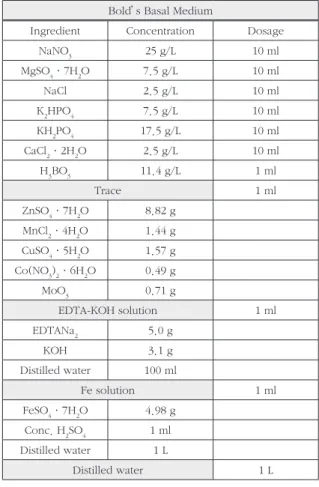
로 KORDI(Korea Ocean Research &며, 배양을 위해 사용한 배지는 Bold’s Basal Medium(BBM)으로 조성은 Table. 1과 같다.
2.2 미세조류 배양
분양받은 미세조류는 Table. 1과 같이 조성된 BBM 배지와 혼합하여 0.2 OD(Optical Den- sity)가 되도록 조정한 다음, 250 mL cell cul- ture flask를 이용하여, 온도 25℃±1, PPFD (Photosynthetic photon flux density) 100 μmol/m2/sec인 항온 광배양기(Multi-thermo chamber, HB-305M)에서 20일간 계대배양을 실시하여 1.5 OD까지 배양 후 실험에 사용하였 다.
Table 1. Composition of Bold’s Basal medium Bold’s Basal Medium
Ingredient Concentration Dosage
NaNO
325 g/L 10 ml
MgSO
4·7H
2O 7.5 g/L 10 ml
NaCl 2.5 g/L 10 ml
K
2HPO
47.5 g/L 10 ml
KH
2PO
417.5 g/L 10 ml
CaCl
2·2H
2O 2.5 g/L 10 ml
H
3BO
311.4 g/L 1 ml
Trace 1 ml
ZnSO
4·7H
2O 8.82 g MnCl
2·4H
2O 1.44 g CuSO
4·5H
2O 1.57 g Co(NO
3)
2·6H
2O 0.49 g
MoO
30.71 g
EDTA-KOH solution 1 ml
EDTANa
25.0 g
KOH 3.1 g
Distilled water 100 ml
Fe solution 1 ml
FeSO
4·7H
2O 4.98 g Conc. H
2SO
41 ml Distilled water 1 L
Distilled water 1 L
2.3 실험 방법
본 실험을 위한 배지는 질소 100 mg-N/L 및 인 10 mg-P/L 농도로 설정한 modified BBM을 제조하여 이용하였으며, 무기탄소 농 도는 다양하게 0 (control), 0.05, 0.1, 0.25, 0.5, 0.75, 1, 1.25, 1.5, 2 g-C/L로 설정하여 NaHCO3를 주입하였다. 실험을 위한 반응조는 1 L 삼각플라스크를 이용하여 운전용량 500 ml 로 진행하였다.
미세조류의 초기 접종농도는 0.2 OD로 접종 해 주었으며, 고른 광조사와 혼합을 위해서 회 전식 진탕기를 이용하여 150 rpm으로 교반하였 다. 운전온도를 25±3℃로 설정해 항온조에서 운전하였고, 운전 초기 pH는 9.5±0.5로 설정 하였으며, 0.5N HCl과 0.5N NaOH을 이용하 여 24시간 간격으로 조절해 주었다.
광 조사는 LED를 이용하여 white 파장으로 조사해 주었다. 광도는 UV 광도계(LI-1400, LI-COR)를 사용하여 측정하였으며, 광도는 80 μmol/m2/s로 유지해 주었다. 또한, 광조사 주 기는 24시간 연속으로 실시하였으며, 반응조는 batch test 형태로 5일 동안 운전하였다.
2.4 분석방법
미세조류 성장량은 Standard method에 명 시된 SS 측정방법을 이용한 dry weight과 OD 를 측정하여 평가하였으며, OD는 spectropho- tometer (Optizen POP, Mecasys Co., Ko- rea)를 이용하여 660 nm에서의 흡광도를 측 정하여 정해졌다. NO3-N과 PO4-P는 수질분 석 kit법을 이용하여 water analyzer(model HS-3300, HUMAS Inc.)로 분석하였으며, IC(inorganic carbon)는 Total Organic Car- bon Analyzer(TOC-Vcsn, Shimadzu, Ja- pan)를 이용하여 분석하였다.
미세조류의 비증식 속도(Specific Growth Rate, SGR, μ)는 아래의 Eq-(1)을 이용하여 계산하였다(Kwon et al., 2012).
μ = ln(X - X0)/(T - T0) Eq-(1)
여기서, X는 시간 T(day)에서의 미세조류 건 조중량이고, X0는 시간 T0(day)에서의 미세조류 건조중량이다.
3. 결과 및 고찰
3.1 NaHCO
3의 농도에 따른 성장량 변화
NaHCO3 주입 농도에 따른
S. dimorphus
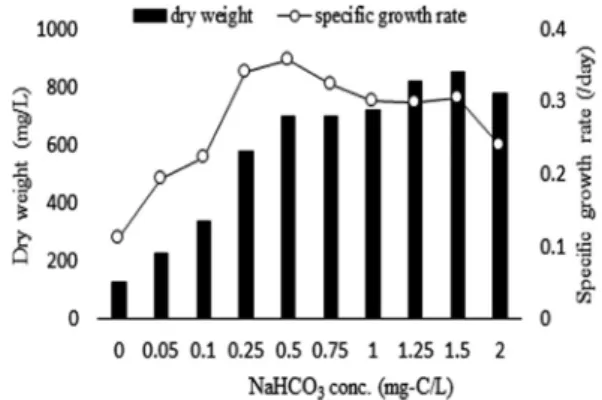
의 성장량 변화 Fig. 1과 최대 성장량 및 specific growth rate를 Fig. 2에 나타내었다. NaHCO3 주입량이 1.5 g-C/까지는 주입량이 증가할수록 미세조류의 성장량도 증가하는 경향을 나타났으 나, 2 g-C/L에서는 다소 감소하는 것으로 나 타났다.Fig. 1. S. dimorphus growth according to the NaHCO
3conc.
Fig. 2. Maximum dry weight and growth rate according to the
NaHCO
3conc.
에서는 운전초기에 미세조류의 성장이 멈춘 것 으로 나타났는데, 이는 대사에 필요한 무기탄소 가 고갈됨에 따라서 광합성 대사를 진행하지 못 한 것이 원인으로 판단되었다. 일반적으로 독립 영양 미세조류는 Eq-(2)와 같이 수중에 용해된 HCO3- 형태의 무기탄소를 이용하여 광합성 대 사를 진행한 후 biomass를 생성한다(Borowit- zka, 1998; Chevalier et al., 2000).
Eq-(2) H2O + HCO3- →
C(biomass) + 1/2 O2 + 3OH-
SGR의 경우 0.5 g-C/L 조건에서 0.36 /day 로 가장 높게 나타났으며, 그 이후부터는 점차 감소하는 경향을 보였다. Zhao(2012)의 연구에 의하면,
Scenedesmus qudricauda
를 이용하 여 NaHCO3의 농도를 0 ~ 0.01 mol/L로 설정 하여 배양시, NaHCO3의 농도가 높을수록 SGR 이 감소하는 경향이 나타나는 등 본 실험과 유 사한 결과를 얻었다고 보고되고 있다. 이에 대한 원인으로 Carvalho and Malcata (2005)에 따 르면, 미세조류는 종 마다 무기탄소의 농도에 따 라서 SGR 값은 유의적인 차이를 나타낼 수 있으 며, 이는 곧 성장에 영향을 줄 수 있는 무기탄소 의 농도가 다르기 때문인 것으로 보고되고 있다.3.2 NaHCO
3농도에 따른 pH와 IC 변화
Fig. 3에 NaHCO3 공급 농도에 따른 pH 변화 를 나타내었다. NaHCO3 주입 농도가 낮을수록 pH는 급격히 증가하는 경향을 나타내었고, 주입 농도가 높아질수록 pH 변화 폭은 좁게 나타났 다. 이는 NaHCO3의 주입 농도가 높을수록 완충 능이 커지기 때문인데, 일반적으로 미세조류는 대사의 형태나 질소원의 종류에 따라서도 pH는 다소 다르게 나타날 수 있다. 또한, Eq-(2)와 같 이 photoautotrophic 미세조류의 경우, 광합성 대사를 진행하는 과정에서 OH-를 생성하기 때 문에 pH가 증가하며, Eq-(3)과 같은 반응에 의
일 경우 pH가 증가할 수 있다.
Eq-(3) 106CO2 + 138H2O + 16NO3- →
(CH2O)106(NH3)16 + 16OH- + 138O2
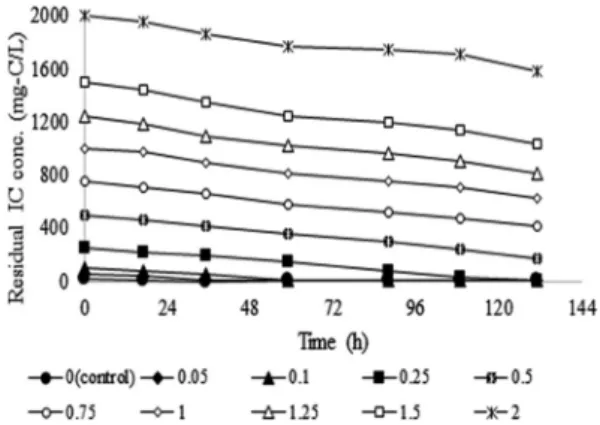
Fig. 4에 NaHCO3 주입농도에 따른 잔여 IC 변화를 나타내었다. 잔여 IC 농도는 초기 농도 0.5 g-C/L 이상인 모든 조건에서 약 70 mg-C/L/d의 속도로 소비되는 것으로 나타나, NaHCO3의 주입농도에 따른 차이가 거의 없는 것으로 판단된다.
Fig. 3. Variation of pH according to the NaHCO
3conc.
Fig. 4. Variation of residual IC conc. according to the NaHCO
3conc.
3.3 NaHCO
3의 농도에 따른 질소와 인 변화
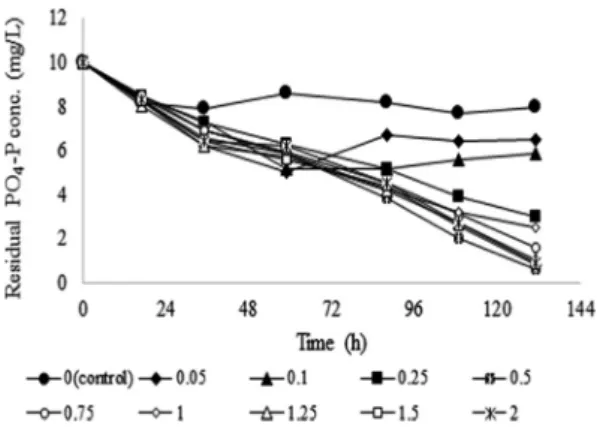
Fig. 5와 Fig. 6에 NaHCO3 주입농도에 따른 잔여 질산성 질소와 인산염의 농도를 나타내었 다. 초기 NaHCO3의 농도가 낮을수록 잔여 질 소와 인의 농도는 높게 나타났는데, 이는 무기 탄소의 고갈로 인해서S. dimorphus
의 대사가 진행될 수 없기 때문인 것으로 판단된다. 초기 NaHCO3 0.5 g-C/L 이상의 모든 조건에서 평 균적으로 질소 11.3 mg-N/L/d, 인 1.6 mg- P/L/d의 속도로 소비된 것으로 나타났다.4. 결 론
본 연구에서는 미세조류
S. dimorphus
의 배 양을 위해 무기탄소원으로 NaHCO3의 주입시 주입농도에 따른 성장 특성을 파악하여 대량배 양을 위한 적정 NaHCO3 주입농도를 도출하기 위한 기초연구을 수행하였으며, 그 결과는 다음 과 같다.NaHCO3 0 ~ 2 g-C/L의 조건에서
S. di- morphus
를 배양한 결과, NaHCO3 주입농도 1.5 g-C/L까지 dry weight는 비례적으로 증가하였 으며, 이 구간에서 비성장속도는 0.5 g-C/L 조 건에서 0.36 day-1로 가장 높게 나타났다.pH는 NaHCO3의 주입농도가 높을수록 완충 능의 영향으로 그 변화 폭이 작은 것으로 나타 났다. IC, NO3-N 및 PO4-P는 특정 농도 이상 에서는 NaHCO3 주입농도에 따른 유의한 영향 을 거의 받지 않는 것으로 나타났으며, 본 연구 에서는 0.5 g-C/L 이상인 모든 조건에서 각각 약 70 mg-C/L/d, 약 11.3 mg-N/L/d 및 약 1.6 mg-P/L/d의 속도로 소비되는 것으로 나 타났다.
따라서,
S. dimorphus
의 대량배양을 위한 적 정 NaHCO3의 주입농도는 비성장 속도(SGR)를 고려할 경우 0.5 g-C/L가 본 연구에서는 가장 최적인 것으로 판단되며, 무기탄소 주입조건 이 외에 빛, 온도, pH 등의 주요 성장조건을 고려 하여 배양한다면 보다 높은 성장량을 기대할 수 있을 것으로 사료된다.사 사
이 논문은 2013년도 정부(교육과학기술부) 의 재원으로 한국연구재단의 기초연구사업 지 원을 받아 수행된 연구입니다. (NRF-2011- 0023132)