J. Fish Pathol., 32(1) : 009~020 http://dx.doi.org/10.7847/jfp.2019.32.1.009
Introduction
Fish is often the cheapest and most commonly consumed animal source food in countries with food
and nutrition insecurity (FAO, 2014a, 2014b; World Bank, 2006). Globally, since 1961, total fish con- sumption has grown at an annual rate of 3.6% while population has grown at 1.8%, enabling a near dou- bling of per capita annual fish consumption (FAO, 2014a, 2014b). This transformation has been spear- headed by aquaculture – the farming of fish and oth-
The dietary effect of medicinal herbs extract and multiple probiotics mixture on the growth performance, innate immune response and
antibacterial activity of nile tilapia Oreochromis niloticus
Yo-Sep Hwang1, Seok Jin Bang, Tae Yun Kang, Jae Hyeok Choi, Sang Mok Jung, In Sung Kang, Se young Jeon, Kwan Ha Park and Sanghoon Choi*
Department of Aquatic Life Medicine, College of Ocean Science and Technology, Kunsan National University, 558 Daehak-ro, Gunsan-si, Jeonbuk, Korea
1Department of Biomolecular Science, University of Science and Technology (UST), Daejeon, Korea
The study investigated the dietary effects of medicinal herbs extract and multiple probiotics mixture on the growth performance, innate immune response and antibacterial activity of nile tilapia Oreochromis niloticus. Tilapia were divided in four groups. The first is a fish group fed a basal diet added with 40% medicinal herbs extract (MHE). The second is a fish group fed a basal diet supplied with 2×10⁸ CFU/g of 2 Bacillus sp, 2 Lactobacillus sp and 2 Yeast sp, respectively (PB).
The third group was fed with a mixture of probiotics (2 Bacillus sp, 2 Lactobacillus sp and 2 Yeast sp) with the medicinal herbs extract added in basal diet (MHE+PB). The fourth group was fed only a basal diet (C). In a non-specific immune parameters analysis, respiratory burst activity, lysozyme activity, phagocytic activity (PA), alternative complement pathway activity (ACH50) and superoxide dismutase (SOD) activity were significantly (p<0.05) increased in the group MHE+PB compared to other groups. Both PB and MHE groups showed a significant (p<0.05) increase in respiratory burst activity, lysozyme activity compared to the control C group, whereas no significant differences were observed in PA, ACH50 and SOD activity compared to the control group. In challenging test, fish were administered with Edwardsiella tarda (E. tarda) on 30 days after feeding with each experimental diet and viable E. tarda cell reduction was checked over 21 days post injection. MHE+PB group showed a significantly (p<0.05) reduced E. tarda cells compared to other groups. No significant antibacterial difference (p>0.05) was observed between PB and MHE only treated group. Compared to the control, a significant antibacterial difference (p<0.05) appeared in PB but not in MHE (p>0.05).
The results suggest that the probiotics and MHE mixture could be utilized as an alternative to antibiotics in the control of fish diseases caused by E. tarda.
Key words: Medicinal herbs extract, Probiotics, Innate immune response, Antibacterial activity
†Corresponding author: Sanghoon Choi Tel: +82-63-469-1886; Fax: +82-63-463-9493 E-mail: [email protected]
er aquatic organisms – which has become the most rapidly growing global food sector. Since the 1970s, aquaculture has grown at more than 8% annually.
Asia accounts for 88% of global aquaculture pro- duction, and it has seen, by far, the most dramatic growth in aquaculture. However, disease has been a primary constraint to the aquaculture industry, im- posing severe losses on farming facilities all over the world. Antibiotic drugs have the capacity to kill or inhibit the growth of micro-organisms. However, the use of antibiotics to control fish disease needs to be restricted due to the emergence of drug-resistant bac- teria and concerns about environmental hazards and food safety (Hernández Serrano, 2005). The use of antimicrobial agents in aquaculture has resulted in the increase in the frequency of strains resistant to these agents. Potentially these resistant strains can have an impact on the therapy of fish diseases, the therapy of human diseases, or the environment of the fish farms. The future development of aquaculture greatly depends on the development of alternative feed ingredients that can provide higher resistance against pathogens.
Recently, the health benefits of probiotics have at- tracted increased attention. Probiotics are defined as live microorganisms which play an important role in health and disease. Probiotics are well studied for their health benefits in improving immune system function. Probiotics are good or friendly bacteria that exert beneficial effects on the body by regulating the host’s gut microflora balance. Nowadays, concern is increasing regarding the use of probiotics as a func- tional feed in the farming fishes industry. During the past several decades, antibiotics are increasingly widely employed, owing to their therapeutic effects against disease. However, as antibiotics ultimately cause antibiotic resistance, a number of countries have recently placed restrictions on the subtherapeutic use of antibiotics. The application of probiotics con- stitutes a potential alternative to antibiotic treatment.
A large amount of studies related to probiotics have
been conducted on humans, animals, fishes and pro- biotic treatments have been associated with the bene- ficial effects, including improved growth and disease prevention.
Meanwhile, medicinal herbs, as food or medicine, can strengthen the body and increase its resistance to disease by acting on various components of the immune system. Medicinal herbs have been known as immunostimulants for thousands of years. The ap- plication of medicinal herbs as natural and innocuous compounds has potential in aquaculture as an alter- native to antibiotics and immunoprophylactics. The growing interest in these plants has increased world- wide because they are easy to prepare, cheap, and have few side effects on animals and the environment.
For this reasons, it is becoming increasingly im- perative to identify suitable antibiotic alternatives.
While various feed additives have been investigated for use in aquaculture feeds, organic acids are receiv- ing increasing attention due to their strong anti- microbial and prophylactic properties against various pathogenic bacteria (Defoirdt et al., 2006; Ng and Koh, 2011; Da silva et al., 2013).
To develop a new feed additives, the study inves- tigated a dietary effects of medicinal herbs extract and multiple probiotics mixture on the growth per- formance, innate immune response and antibacterial activity of nile tilapia Oreochromis niloticus.
Materials and Methods
Isolation and identification of probiotics (PB) To isolate PB, various samples such as cabbage kimchi, young radish kimchi, green onion kimchi, pineapple and excreta were collected. Selective me- dium was used for isolating PB in the samples. Used selective medium was Luria Bertani broth (LB, Difco) for isolating Bacillus, Lactobacilli MRS broth (MRS, Difco) for Lactobacillus and YM broth &
Potato dextrose broth (PDB, Difco) for Yeast. At first according to characteristic morphological feature of
Bacillus sp, Lactobacillus sp and Yeast sp, each PB was respectively isolated. It was being passaged cul- ture and then pure isolation. The sequence of the in- dividual clone was analyzed using universal primers (Table 1).
Medicinal herbs extract (MHE)
MHE was obtained by overnight boiling water with the by-product of a digestive medicine manu- factured from Hanpoong pharmaceutical companies.
Pathogenic strains
Edwardsiella tarda (KCTC 12267) was purchased from Korean Collection for Type Culture (KCTC) and passaged culture by using brain heart infusion (BHI) broth and Salmonella shigella (SS) agar.
Experimental diets and design
Basic folder was purchased at the (C) JEILFEED.
Co.,Ltd. Four experimental diets were formulated to be isonitrogenous isocaloric [1%/g(fish)]. A fish meal based diet was formulated and regarded as a only a basal diet (control) and three other experi- mental diets were prepared by dietary 40% medicinal herbs extract (MHE), 2×10⁸ CFU/g of 2 Bacillus sp, 2 Lactobacillus sp and 2 Yeast sp, respectively (PB) and a mixture of probiotics (2 Bacillus sp, 2 Lactobacillus sp and 2 Yeast sp) with the medicinal herbs extract added in basal diet (MHE+PB) of liquid.
All diets were thoroughly mixed with 40% distilled water, 40% MHE, PB (2×10⁸ CFU/g) and MHE+PB (being formented mixture probiotics in MHE for 3 days). The mixed feed were subsequently dried at 25ºC and stored at 4ºC until use. Tilapia was divided
in four groups. The first is a fish group fed a basal diet added with MHE. The second is a fish group fed a basal diet supplied with PB. The third fish group was fed with MHE+PB. The fourth fish group was fed control. In order to investigate growth per- formance and innate immune response, the fish were weighed after feeding 7, 14, 21 and 28 days and then collected samples. In order to investigate anti- bacterial activity, after feeding for 30 days we in- jected intraperitoneally with E. tarda(1×10⁸ CFU/
ml) and then collected samples after 0, 7, 21 and 28 days. Four experimental diets were subsequently fed after injection alike.
Growth performance
Total three groups were respectively divided as C, MHE, PB and MHE+PB (6 fish/group). The body weight (g) of group tilapia was measured before and after feeding on weekly basis for 1 month. Specific growth parameters were measured as follows:
Weight gain (g) = Final weight (g) – Initial weight (g) Percent weight gain (PWG) = [100 × (Final weight –
Initial weight)/ Initial weight]
Specific growth rate (SGR) = [{LNFinal weight (g)-LNInitial weight (g)}/DAY]×100
Feed conversation (FCR) = Total feed given (g)/
Weight gain (g) Sample collection
At the end of the weekly feeding trial, four fish were randomly selected from each tank and anes- thetized with 2-Phenoxyethanol solution (200 ppm).
And then blood samples were collected from caudal
Table 1. Universal primers for probiotics 16S rRNA
Primer name Objects Primer sequence 5′ to 3′
27F 1492R
ITS1 ITS4
16S rRNA sequence amplification 16S rRNA sequence amplification 18S rRNA sequence amplification 18S rRNA sequence amplification
AGAGTTTGATCCTGGCTCAG GGTTACCTTGTTACGACTT TCCGTAGGTGAACCTGCGG TCCTCCGCTTATTGATATGC
veins with syringes to determine lysozyme, ACH50
and superoxide dismutase (SOD) activities. Serum was separated from whole blood samples by cen- trifugation at 1200 × g for 5 min at 4 ºC. Leukocyts were collected according to the method described by Santarern et al. (1997). Harvested cells (106 cell/ml) were counted using counting chamber and utilized to determine respiratory burst activity and phagocytic activity.
Respiratory burst activity
Respiratory burst activity was determined accord- ing to Secombes et al. (1988). Collected tilapia leu- kocytes were washed with PBS and the viable cell number (1×10⁶ cell /ml) was adjusted. The 200 μl cells were placed 96 well plate and then centrifuged at 30 × g for 5 min. After washing using PBS twice the 100 ㎕ phorbol myristate acetate (PMA, 1 μg/ml) in nitroblue tetrazolium (NBT, 1μg/ml) was added and then incubated in the darkroom for 60 min. After incubation 96 well plate was centrifuged at 30 × g for 5 min and then the supernatant removed followed by washing with PBS. Washed leukocytes were fixed using 70% methanol and then washed twice followed by adding 120 μl KOH and 140 μl dimethyl sulf- oxide (DMSO, Sigma). The optical density was meas- ured at 620 nm with spectrophotometer.
Phagocytosis activity
Phagocytosis activity (PA) was determined ac- cording to the method of Pulsford et al. (2012) with a slight modification. The harvested tilapia leuko- cytes 200 μl were placed in the chamber slide (Thermo scientific, Nunc) and then incubated in darkroom for 12 hr. After incubation 10 μl zymosan (1×10⁶ cell/ml, Sigma) was added and then incubated in darkroom for 1 hr. After incubation chamber slide was centrifuged at 30 × g for 5 min and then the supernatant removed after then washed using PBS.
Washed leukocytes were fixed using 70% methanol and then washed using PBS. Cover and well of
chamber slide were removed and then dried at room temperature. After air-drying, the slide stained using wright Giemsa stain method. After staining, one hun- dred leukocytes were randomly counted for each sample under the microscope. Phagocytosis activity defined as percentage phagocytosis was expressed as
PA = phagocytic leukocytes / total leukocytes PI = zymosan in the phagocytic leukocytes / phag-
ocytic leukocytes Lysozyme activity
Serum lysozyme activity was measured according to the method described by Sheikazadeh et al. (2012).
One unit of lysozyme activity was defined as the amount of enzyme producing a decrease in absorb- ance of .001-1 min ml-1 serum
Superoxide dismutase (SOD) activity
SOD activity was measured by its ability to inhibit superoxide anion generated by xanthine and xanthine oxidase reaction system according to Wang and Chen (2005) using and SOD detection kit (Biovision co, Korea). The optical density was measured at 405 nm. SOD activity defined as percentage was ex- pressed as
SOD Activity (inhibition rate %) =
(A blank1-A blank3)-(A sample-A blank2) (A blank1-A blank3) ×100
ACH50
ACH50 activity was measured according to the method described by Yano (1992). ACH50 activity was usually assayed by using RaRBC as target cells in the presence of EGTA and Mg2+ (Inai et al., 1982). EGTA is a chelating agent for Ca2+ and was used to block the classical pathway. Different vol- umes of the diluted serum (1:15) ranging from 75 μl to 200 μl were dispensed into 96 well plate and total volume was made up to 200 μl with EGTA-Mg-GVB and then to each well is then added
100 ㎕ of RaRBC suspension (1×10⁸ cell/ml). A 100% hemolysis control and a cell blank were included. The 96 well plate were incubated at 20℃
for 90 min and then centrifuged at 30 × g for 20 min. After centrifugation, the supernatants were transferred to a new 96 well plate and then absorb- ance of the supernatants was measured at 405 nm.
The degree of hemolysis (y) was calculated by divid- ing the corrected A405 value by the corrected A405 of the 100% hemolysis control. ACH50 activity defined as unit/ ml was expressed as
(Unit/ ml) = 1/K × (reciprocal of the serum dilu- tion) × 0.5
Antibacterial activity
Antibacterial activity tests were conducted in trip- licate with 24 fish per group. After feeding each ex- perimental diet for 30 days each tilapia was injected intraperitoneally with 200 μl PBS containing 1×10⁸ CFU/ml live E. tarda from a 24 hr culture in SS me- dium at 36℃. Each experimental diet was given to the tilapia during the test. All organs were removed on day 0, 7, 14 and 21 post injection. Removed or- gans were put in the 10 ml PBS and homogenized and then centrifuged passing gauze at 1000 × g for 20 min. Organs suspension was diluted using serial dilution method and then total viable cells were
counted using streak plate method on the SS medium.
Statistical analysis
All data were subjected to one way ANOVA (analysis of variance) using SPSS 12.0 for windows.
Differences between the means were tested by Dun- can′s multiple range tests. Overall significance level P < 0.05 and the results were presented as means ± SEM (standard error of the mean).
Results
Isolation and identification of probiotics (PB) Identification result of PB was shown in Table 2.
As a sequence analysis result, 2 bacillus spp. were identified with accession number and 16S ribosomal RNA gene as B. subtilis and B. licheniformis. Two Lactobacillus spp. were identified with accession number and 16S ribosomal RNA gene as L. planta- rum and L. paracasei, and 2 Yeast spp. were identi- fied with accession number and 18S ribosomal RNA gene as S. cerevisiae and P. anomala.
Growth performance
The effect of diets containing MHE, PB and MHE +PB on growth performance was established in this study. Analyzed data on the growth performance of Table 2. Output of BLAST for probiotics supplemented in fish diets
Strains Accession Description Score (bits) Identities (%) E value
B1 KC757129.1 Bacillus subtilis strain GRSW1_B1 16S
ribosomal RNA gene, partial sequence 2575 100 0
B-5 AB743877.1 Bacillus licheniformis gene for 16S rRNA,
partial sequence, strain: BCJ 2556 100 0
L-1 JX426117.1 Lactobacillus plantarum strain CTBRBL22
16S ribosomal RNA gene, partial sequence 2582 100 0
L-2 JF965377.1 Lactobacillus paracasei strain BIM B-552D
16S ribosomal RNA gene, partial sequence 2623 100 0
Y-1 JN887919.1 Saccharomyces cerevisiae strain Wu-Y2 18S
ribosomal RNA gene, partial sequence 1353 99 0
Y-2 FJ865436.1 Pichia anomala isolate M10 18S ribosomal
RNA gene, partial sequence; 1029 100 0
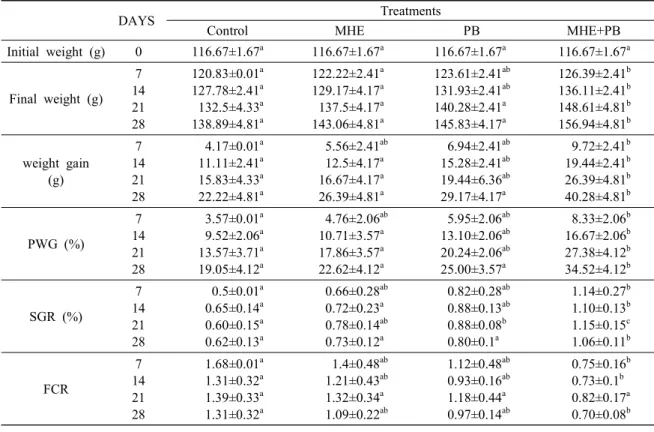
tilapia in different treatments and control, including initial weight, final weight gain, PWG, SGR and FCR are shown in Table 3). No significant differences were observed for initial weight between three other experimental diets and control at the start of the experiment. At the end of the experiment, statistical analysis showed that tilapia fed MHE+PB diets grew significantly faster than the control, MHE and PB group. Final weight, weight gain, PWG, SGR and FCR were significantly different (P < 0.05) for MHE +PB compared to the control, MHE and PB.
Respiratory burst activity
The effect of diets containing MHE, PB and MHE +PB on respiratory burst activity was shown in Fig. 1.
Statistical analysis showed that tilapia fed MHE+ PB diets increased significantly (P < 0.05) than all other
Table 3. Effects of dietary medicinal herbs extract and probiotics on the weight gain, percent weight gain, specific growth rate and feed conversion ratio in tilapia. Data represent the mean ± S.D. (n=6). Different letters above the bars indicate significant differences (p < 0.05) in different groups of the same time point
DAYS Treatments
Control MHE PB MHE+PB
Initial weight (g) 0 116.67±1.67a 116.67±1.67a 116.67±1.67a 116.67±1.67a
Final weight (g) 7 14 21 28
120.83±0.01a 127.78±2.41a 132.5±4.33a 138.89±4.81a
122.22±2.41a 129.17±4.17a 137.5±4.17a 143.06±4.81a
123.61±2.41ab 131.93±2.41ab 140.28±2.41a 145.83±4.17a
126.39±2.41b 136.11±2.41b 148.61±4.81b 156.94±4.81b
weight gain (g)
7 14 21 28
4.17±0.01a 11.11±2.41a 15.83±4.33a 22.22±4.81a
5.56±2.41ab 12.5±4.17a 16.67±4.17a 26.39±4.81a
6.94±2.41ab 15.28±2.41ab 19.44±6.36ab 29.17±4.17a
9.72±2.41b 19.44±2.41b 26.39±4.81b 40.28±4.81b
PWG (%)
7 14 21 28
3.57±0.01a 9.52±2.06a 13.57±3.71a 19.05±4.12a
4.76±2.06ab 10.71±3.57a 17.86±3.57a 22.62±4.12a
5.95±2.06ab 13.10±2.06ab 20.24±2.06ab 25.00±3.57a
8.33±2.06b 16.67±2.06b 27.38±4.12b 34.52±4.12b
SGR (%)
7 14 21 28
0.5±0.01a 0.65±0.14a 0.60±0.15a 0.62±0.13a
0.66±0.28ab 0.72±0.23a 0.78±0.14ab 0.73±0.12a
0.82±0.28ab 0.88±0.13ab 0.88±0.08b 0.80±0.1a
1.14±0.27b 1.10±0.13b 1.15±0.15c 1.06±0.11b
FCR
7 14 21 28
1.68±0.01a 1.31±0.32a 1.39±0.33a 1.31±0.32a
1.4±0.48ab 1.21±0.43ab 1.32±0.34a 1.09±0.22ab
1.12±0.48ab 0.93±0.16ab 1.18±0.44a 0.97±0.14ab
0.75±0.16b 0.73±0.1b 0.82±0.17a 0.70±0.08b
Fig. 1. Respiratory burst activity of HK leukocytes from tilapia fed the control diet (control), medicinal herbs extract diet (MHE), probiotics diet (PB), and medicinal herbs extract and probiotics mixture diet (MHE+PB) for 28 days. The absorbance was measured by micro plate reader at 620nm. Data represent the mean ± S.D.
(n=6). Different letters above the bars indicate signifi- cant differences (p < 0.05) in different groups of the same time point.
groups throughout the experiment period. In addition significant differences (P < 0.05) were showed for PB and MHE in comparison with control.
Phagocytosis activity
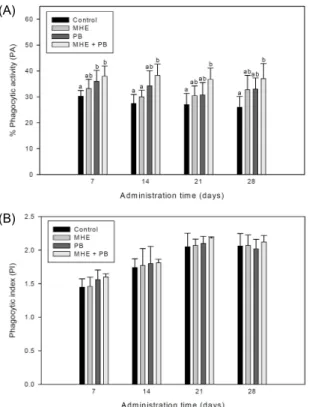
The effect of diets containing MHE, PB and MHE +PB on PA and PI was shown in Fig. 2 A & B.
PA was shown that MHE+PB group increased sig- nificantly (P < 0.05) than the control group (Fig. 2 A). However, there was no significant difference (P
> 0.05) in PI among the experimental groups (Fig.
2 B).
Lysozyme activity
Fig. 3 shows the effect of diets containing MHE,
PB and MHE+PB on lysozyme activity. In group of tilapia fed MHE+PB diets lysozyme activity was in- creased significantly (P < 0.05) compared to other groups throughout the experimental period. Com- pared to a control, significant differences (P < 0.05) were observed in each group of PB and MHE.
Superoxide dismutase (SOD) activity
The effect of diets containing MHE, PB or MHE +PB on SOD activity was shown in Fig. 4. SOD ac- tivity was significantly (P < 0.05) enhanced in the group of MHE+PB compared to a control group, whereas no significant difference was observed in the group of MHE or PB.
ACH50
Fig. 5 shows the effect of diets containing MHE, PB or MHE+PB on ACH50. No significant differ- ences were observed among the experimental groups on day 7. However, on day 14, 21 and 28 post feed- ing, ACH50 activity was significantly (P < 0.05) in- creased in the group of MHE+PB compared to a control.
(A)
(B)
Fig. 2. Phagocytic activity (A) and phagocytic index (B) of HK leukocytes from tilapia fed the control diet (con- trol), medicinal herbs extract diet (MHE), probiotics di- et (PB), and medicinal herbs extract and probiotics mix- ture diet (MHE+PB) for 28 days. Data represent the mean ± S.D. (n=6). Different letters above the bars in- dicate significant differences (p < 0.05) in different groups of the same time point.
Fig. 3. Lysozyme activity in serum of tilapia fed the control diet (control), medicinal herbs extract diet (MHE), probiotics diet (PB), and medicinal herbs extract and probiotics mixture diet (MHE+PB) for 28 days. The ab- sorbance was measured by micro plate reader at 405 nm. Data represent the mean ± S.D. (n=6). Different letters above the bars indicate significant differences (p
< 0.05) in different groups of the same time point
Antibacterial activity
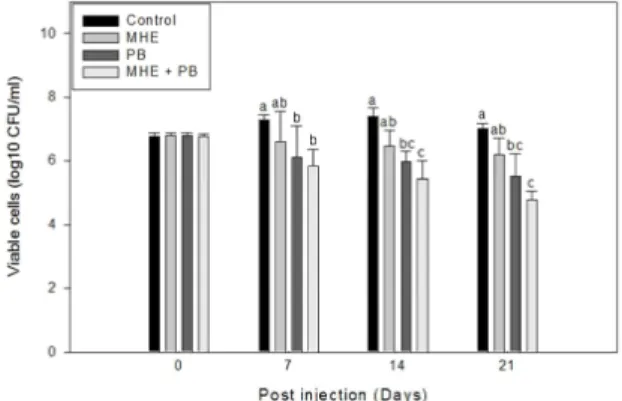
The effect of diets containing MHE, PB and MHE +PB on antibacterial activity was shown in Fig. 6.
There were no significant differences of antibacterial activity in between three other experimental diets and control on day 0. However, antibacterial activity
was significantly (P < 0.05) enhanced in MHE+PB and PB group compared to a control on day 14, 21 and 28 post feeding. No significant difference, how- ever, was observed in MHE group compared to a control.
Discussion
The immune system of fish can be influenced by a wide range of factors including diseases, pollutants, hormones and feed (nutrition). Feed formulation of fish culture is largely depending on additive ingre- dients. Manipulation if microbiota using probiotics have been reported as a worthy practice for aqua- culture in order to control or inhibit the pathogen bacteria, improve the growth performances and di- gestive enzymes, and enhance the immune responses of the host against pathogens or physical stress (Ver- schuere et al., 2000; Balcazar et al., 2006; Perez et al., 2010).
Medicinal herbs have been known as immun- ostimulants for thousands of years. The application of medicinal herbs as natural and innocuous com- pounds has potential in aquaculture as an alternative Fig. 6. Antibacterial effect of tilapia fed the control diet (control), medicinal herbs extract diet (MHE), probio- tics diet (PB), and medicinal herbs extract and probio- tics mixture diet (MHE+PB) for 30 days. Data repre- sent the mean ± S.D. (n=5). Different letters above the bars indicate significant differences (p < 0.05) in differ- ent groups of the same time point.
Fig. 4. SOD activity in serum of tilapia fed the control diet (control), medicinal herbs extract diet (MHE), pro- biotics diet (PB), and medicinal herbs extract and pro- biotics mixture diet (MHE+PB) for 28 days. The ab- sorbance was measured by micro plate reader at 405 nm. Data represent the mean ± S.D. (n=6). Different letters above the bars indicate significant differences (p
< 0.05) in different groups of the same time point.
Fig. 5. ACH50 activity in the serum of tilapia fed the control diet (control), medicinal herbs extract diet (MHE), probiotics diet (PB), and medicinal herbs extract and probiotics mixture diet (MHE+PB) for 28 days. The ab- sorbance was measured by micro plate reader at 405 nm. Data represent the mean ± S.D. (n=6). Different letters above the bars indicate significant differences (p
< 0.05) in different groups of the same time point.
to antibiotics and immunoprophylactics. The growing interest in these plants has increased world-wide be- cause they are easy to prepare, cheap, and have few side effects on animals and the environment. The goal of this study was to determine the dietary ef- fects of medicinal herbs extract and multiple pro- biotics mixture on the growth performance, innate immune response and antibacterial activity of tilapia.
In the study, MHE+PB supplemented diet fed tila- pia resulted in significant increase (P < 0.05) of final weight, weight gain, PWG, SGR and FCR (Table 3).
This indicates that the MHE and PB addition was re- quired to attain superior growth performance in tilapia. Similar results have been reported in aqua- cultured fishes, Paralichthys olivaceus fed with pro- biotics and herbal mixtures supplemented diets had enhanced the growth performance (Harikrishnan et al., 2011). Although several studies have demon- strated the beneficial effects of probiotics and medic- inal herbs on the growth performance in animals and aquacultured fishes (Aly et al., 2008; Kim et al., 2008; Chiu et al., 2010; Zokaeifar et al., 2012), the exact mechanism of action is not well understood.
The one possible explanation could be related to the action of competitive exclusion, by which probiotics may create a hostile environment for pathogen colo- nization. Another possible explanation for the im- provement of the Tilapia growth factors by pro- biotics may be due to the induction of digestive en- zymes, including protease and amylase, which con- sequently stimulate the natural digestive enzyme ac- tivity of the host (Wang, 2007; Liu et al., 2009).
In addition, it is important to mention that a better appetite was observed in tilapia fed diets containing MHE+PB than the control, MHE and PB group dur- ing the feeding period because of undigested feed residues were not found. A better feed digestion may be related to an increase of the digestive enzyme ac- tivity and subsequently increased the appetite in tilapia. In a world, MHE+PB diets could be made increase growth performance and reduce feed cost by
improving the appetite of aquacultured fishes.
Non-specific mechanism is so important in aqua- cultured fishes. Fishes rely on both specific and non- specific mechanisms to protect themselves against in- vading pathogens. The non-specific defenses include physical barriers, such as epithelial shield of scales, skin and mucus. Once a pathogen has managed to penetrate these initial barriers, chemical defenses such as serum lysozyme, lectins and complement components may coat the pathogen and opsonize them for further destruction (Fletcher, 1981).
Other components of non-specific immune system are also activated by invading stimuli (Ellis, 1981).
Also, phagocytic cells play an important role in the defense mechanisms of the host by adhering to and engulfing invading particles. Such cells include tis- sue macrophages, circulatory monocytes and neutro- phils. In this study, respiratory burst activity and phagocytosis activity were measured as an indicator of the non-specific cell-mediated immunity and lyso- zyme activity and ACH50 activity were measured an indicator of the non-specific humoral immunity.
In this study, the non-specific immune response in fish was measured on respiratory burst activity and phagocytosis activity to be a function of macrophage activity. As a result, tilapia fed MHE+PB diet was significantly increased on respiratory burst activity compared with a control, MHE or PB group. Similar results have been reported in aquacultured fishes, probiotics and herbal mixtures supplemented diets had increased the respiratory burst activity (Jhon et al., 2009; Harikrishnan et al., 2011). These cells be- come more adherent to tissue cell surfaces by the production of adhesion proteins, which facilitate their migration from the capillaries to the sites of injury (Kishimoto et al., 1985). They also exhibit increased production of oxygen radicals (O2-
, OH-) during the oxidative burst process. These reactive species are capable of destroying pathogens (Hassett and Cohen, 1989). The ability of neutrophils to adhere to glass allows NBT to be used as a differential staining to
measure the level of reactive oxygen species in the cytoplasm of cells. In the presence of oxygen radi- cals, the soluble dye changes from yellow to the in- soluble dark blue of formazan (Anderson, 1992). Also, phagocytosis activity was significantly increased similar with respiratory burst activity. Respiratory burst activity and phagocytosis activity can indicate the health status of fish. Phagocytosis activity is re- sponsible for early activation of the inflammatory re- sponse before antibody production and plays an im- portant role in antibacterial defense. The highest phagocytic activity was recorded in MHE+PB diet fishes groups. These could be increasing their de- structive and killing ability. The ability of macro- phages to kill pathogenic microbes is probably one of the most important mechanisms of protection against diseases among the fishes. The oxygen radi- cals and nitric oxide are the most destructive prod- ucts produced by activated macrophages. Increase of respiratory burst activity and reactive nitrogen spe- cies can be correlated with increase of killing and nitric oxide radicals production and increase of kill- ing activity.
Serum complement and lysozyme activity are im- portant components of the humoral innate immune system, protecting fish from potentially invasive organisms. Lysozyme is considered as one of the im- portant bactericidal enzymes and an indispensable tool of fish to fight infectious agents. Our research showed that the use of diets containing MHE+PB has significant increase on the lysozyme activity. Also, many reliable literatures have demonstrated that al- ternative complement pathway (ACP) is a suitable indicator for disease resistance in fish. The statistical analysis of our achieved results in relation to ACP revealed a significant increase of ACH50 in the serum samples collected from MHE+PB group. Similar re- sults have been reported in aquacultured fishes, pro- biotics and herbal mixtures supplemented diets had increased the lysozyme activity and ACH50 activity (Jhon et al., 2009; Harikrishnan et al., 2011). Also,
other study results in relation to medicinal herbs and probiotics had showed that treated groups followed by medicinal herbs and probiotics increased the lyso- zyme activity and ACH50 activity (Wang et al., 2008;
Aly et al., 2008; Chiu et al., 2010).
SOD is one of the most important antioxidative enzymes that alternately catalyzes the dismutation of the superoxide (O2-
) radical into either ordinary mo- lecular oxygen (O2) or hydrogen peroxide (H2O2).
Superoxide is produced as a by-product of oxygen metabolism and if not regulated causes many types of cell damage. Hydrogen peroxide is also damaging but less so and is degraded by other enzymes such as catalase. Thus, SOD is an important antioxidant defense in nearly all living cells exposed to oxygen.
Our results showed that the use of diets containing MHE+PB has significant increase on the SOD activ- ity. Similar results have been reported in aquacultured fishes (Chiu et al., 2010; Liu et al., 2012).
In this study, tilapia fed diets supplemented with MHE+PB significantly reduced viable cells of E. tar- da after being challenged with E. tarda than MHE and control group. Also, PB group decreased for via- ble cells significantly than the control group. Similar results have been reported in post larvae, M. rose- nbergii fed with BinifitTM, Lactobacillus sporogenes, B. subtilis and Saccharomyces cerevisiae, supple- mented diets had improved the survival performance (Seenivasan et al., 2011). Improvement in survival has been reported in juveniles of P. indicus fed with Latic acid bacteria (Lactobacillus acidophilus, Sac- charomyces cremoris, Lactobacillus bulgaricus-56 and L. bulgaricus-57) supplemented diets (Fernandez et al., 2011). It has been has been reported that Bacillus supplemented diets improved the survival in black ti- ger shrimp, penaeus monodon (Wang, 2007; Boonthai et al., 2011) in rainbow trout, onchorhynchus mykiss (Bagheri et al., 2008). The improved resistance of E.
tarda after challenge may be partly attributable to the increased innate immune system. By taking into ac- count of the enzyme activity and appetite stim-
ulation, together with the colonization of probiotics in the tilapia fed MHE+PB diets, healthier tilapia and higher survival rate were resulted. Therefore, the findings indicated that the increased resistance to E.
tarda was related to the enhanced immune status.
More studies are needed to find the reasons for it.
To the best of our knowledge, the exact mechanisms for these findings were not clear yet.
In conclusion, tilapia fed diets supplemented with MHE+PB showed significant differences in growth performance, innate immune responses and anti- bacterial effect compared to the control. The results suggested that diets supplemented with MHE+PB can play a crucial role in improving a natural im- munity and preventing bacterial diseases for various fishes.
References
Aly, S. M. Abdel-Galil Ahmed, Y. Abdel-Aziz Ghareeb, A. and Mohamed, M. F.: Studies on Bacillus sub- tilis and Lactobacillus acidophilus, as potential pro- biotics, on the immune response and resistance of Tilapia nilotica (Oreochromis niloticus) to challenge infections. Fish & Shellfish Immunol., 25: 128-136, 2008.
Amderson, D. P. Moritamo, T. and Grooth, R.: Neutro- phil glass-adherent, nitroblue tetrazolium assay gives early indication of immunization effectiveness in rainbow trout. Vet. Immunol Immunopathol., 30:
419-429, 1992.
Bagheri, T. Hedayati, S. Yavari, V. Alizade, M. and Farzanfar, A.: Growth, survival and gut microbial load of rainbow trout (Onchorhynchus milkiss) fry given diet supplemented with probiotic during the two months of first feeding. Turkish J. of Fisheries and Aquat. Sci., 8: 43-48, 2008.
Balcazar, J. L. de Blas I. Ruiz-Zarzuela I. Cunningham D. Vendrell D. and Muzquiz J. L.: The role of pro- biotics in aquaculture. Vet. Microbiol., 114: 173-86, 2006.
Boonthai, T. Vuthhiphandchai, V. and Nimrat, S.: Pro- biotics bacteria effects on growth and bacterial com- position of black tiger shrimp (Penaus monodon).
Aquacul. Nutr., 9: 124-130, 2011.
Chiu, C. H. Cheng, C. H. Gua, W. R. Guu, Y. K. and
Cheng, W.: Dietary administration of the probiotics, Saccharomyces cerevisiae P13, enhanced the growth, innate immune responses, and disease resistance of the grouper, Epinephelus coioides. Fish & Shefish Immunol., 29: 1053-1059, 2010.
Da Silva, B.C. Vieira, F.N. Mourino, J.L.P. Ferreira, C.S. and Seiffert, W.Q.: Salts of organic acids se- lection by multiple characteristics for marine shrimp nutrition. Aquacul., 345: 384-387, 2013.
Defoirdt, T. Halet, D. Sorgeloos, P. Bossier, P. and Ver- straete, W.: Short-chain fatty acids protect gnoto- biotic Artemia franciscana from pathogenic Vibrio campbelli. Aquacul., 261: 804-808, 2006.
Ellis A. E.: Non-specific defense mechanism in fish and their role in disease processes. Dev. Biol. Stand., 49: 337-352, 1981.
Ellis, A. E.: Immunity to bacteria in fish. Fish & Shell- fish Immunol., 9: 291-308, 1999.
Fernandez, R. Sridhar, M. and Sridhar, N.: Effect of lac- tic acid bacteria administered orally on growth per- ofrmance of Penaeus indicus (H. Milne Edwards) Juveniles. Res. J. of Microbiol., 6: 466-479, 2011.
Fletcher TC.: The identification of non-specific humoral factors in the plaice (Pleuronectes platessa L.).
Dev. Biol. Stand., 49: 332-327, 1981.
Food and Agriculture Organization of the United na- tions (FAO), 2014b. World Rev. of Fisheries and Aquacul.. World Fisheries.
Food and Agriculture Organization of the United na- tions (FAO), 2014a. World Rev. of Fisheries and Aquacul.. World Fisheries.
Harikrishnan, R. Kim, M. C. Kim, J. S. Balasundaram, C. and Heo, M. S.: Probiotics and herbal mixtures enhance the growth, blood constituents, and non- specific immune response in Paralichthys olivaceus against Streptococcus parauberis. Fish & Shellfish Immunol., 31: 310-317, 2011.
Hassett, D. J. and Cohen, M. S.: Bacterial adaptation to oxidative stress: implications for pathogenesis and interaction with phagocytic cells. Fed. Am. Soc. Exp.
Biol., 3: 2537-2581, 1989.
Hernández Serrano, P.: Responsible Use of Antibiotics in Aquaculture. FAO Fisheries Technical Paper. No.
469. FAO, Rome, IT. 2005.
Inai, S. Inoue, K. and Tamura, N.: Complementology.
Ishiyaku Publishers Inc., Tokyo. pp, 119-140. 1982.
Jhon, B. K. Kim, M. C. Kim, Y. H. and Heo, M. S.:
Effects of the culture broth of latic acid bacteria cultured in herb extracts on growth promotion and
nonspecific immune responses of aquacultured fish.
J. of Life Sci., 19(1): 87-93, 2009.
Kim, J. D. Woo, S. H. Kim, Y. C. Lee, J. H. Cho, Y.
C. Choi, M. S. and Park, S. I.: The effects of yeast β-glucan in the diet on immune response of Japanese eel, Anguilla japonica, by oral administration. J.
Fish Pathol., 21(3): 219-228, 2008.
Kishimoto, T. K. Jutila, M. A. Berg, E. L. and Butcher, E. C.: Neutrophil MAC-1 and MEL-14 adhesion proteins inversely regulated by chemotactic factors.
Science, 245: 1238-1241, 1985.
Kusuda, R. and Fukunaga, T.: Characterization of an- ti-body dependent hemolytic activity in eel serum.
Nip-pon Suisan Gakkaishi, 53: 111-121. 1987.
Liu, C. H., Chiu, C. H. Wang, S. W. and Cheng, W.:
Dietary administration of the probiotic, Bacillus subtilis E20, enhances the growth, innate immune responses, and disease resistance of the grouper, Epinephelus coioides. Fish Shellfish Immunol., 33:
699-706, 2012.
Liu, C. H. Chiu, C. S. Ho, P. L. and Wang, S. E.:
Improvement in the growth performance of white shrimp, Litopenaeus vannamei, by a protease-pro- ducing probiotics, Bacillus subtilis E20, from natto.
J App. Microbial., 107: 1031-1041, 2009.
Magnuson, D. K. Weintraub, A. Pohlman, T. H. and Maier, R. V.: Human endothelial cell adhesiveness for meutrophils, induced by Escherichia coli lip- opolysaccharide in vitro, is inhibited by Bacteroides fragilis lipopolysaccharide. J. Immunol., 143: 3024- 3033, 1989.
Ng, W.K. and Koh, C.B.: Application of organic acids in aquafeeds: impacts on fish growth, nutrient uti- lization and disease resistance. In: Luckstadt, C. (Ed), Standards for Acidifiers - Principles for the Use of Organic Acids in Animal Nutrition. Nottingham Uni- versity Press, Nottingham, United Kingdom, pp, 49- 58. 2011.
Perez, T. Balcazar, J. L. Ruiz-Zarzuela, I. Halaihel, N.
Vendrell, D. and de Blas, I.: Host-microbiota inter- actions within the fish intestinal ecosystem. Mucosal Immunol., 3: 335-360, 2010.
Santarem, M. Novoa, B. and Figueras, A.: Effect of β- glucans on the non-specific immune responses of turbot (Scophthalmus maximus L.) Fish & shellfish Immunol., 7(6): 429-437, 1997.
Secombes, C. J. Chung, S. and Jeffries, A. H.: Superox- ide anion production by rainbow trout macrophages detected by the reduction of ferricytochrome c. Dev.
Comp. Immunol., 12: 201-6, 1988.
Sheikhzadeh, N. Karimi Pashaki, A, Nofouzi, K. Heida- rieh, M. and Tayefi-Nasrabadi, H.: Effects of dietary Ergosan on cutaneous mucosal immune response in rainbow trout (Oncorhynchus mykiss). Fish Shellfish Immunol., 32: 407–41,. 2012.
Verschuere, L. R. G. Sorgeloos, P. and Verstraete, W.:
Probiotic bacteria as biological control agents in aquaculture. Microbiol. Mol. Biol., 64: 655-71, 2000.
Wang, S.H. and Chen, J.C.: The protective effect of chitin and chitosan against Vibrio alginolyticus in white shrimp, Litopenaeus vannamei Fish & Shell- fish Immunol., 19: 191-204, 2005.
Wang, Y. B.: Effect of probiotics on growth perform- ance and digestive enzyme activity of the shrimp Penaeus vannamei. Aquacul., 269: 259-264, 2007.
Wang, Y. B. Tian, Z. Q. Yao, J. T. and Li, W. F.: Effect of probiotics, Enteroccus faecium, on tilapia (Ore- ochromis niloticus) growth performance and im- mune response. Aquacul., 277: 203-207, 2008.
World Bank.: Aquaculture: changing the face of the wa- ters: Meeting the promise and challenge of sustain- able aquaculture. World Bank, Washington DC. 2006.
Yano, T.: Assay of hemolytic complement activity. In:
Stolen, J. S. Fletcher, T. C. Anderson, D. P. Hattari, S. C. Rowley, A. F. editors. Tech. in fish Immunol.
New Jersey: SOS Publications: 131-141, 1992.
Zokaeifar, H. Balcazar, J. L. Saad, C. R. Kamarudin, M. S. Sijam, K. Arshad, A. and Nejat, N.: Effects of Bacillus subtilis on the growth performance, di- gestive enzymes, immune gene expression and dis- ease resistance of white shrimp, Litopenaeus vanna- mei. Fish Shellfish Immunol., 33(4): 683-689, 2012.
Manuscript Received : Jun 5, 2019 Revised : Jun 11, 2019 Accepted : Jun 20, 2019