릴레이 기반의 해양 통신 시스템에서 기회주의적 서브채널 할당 기법
이 덕 희, 이 성 로*, 소 재 우°
An Opportunistic Subchannel Allocation Scheme in Relay-based Marine Communication Networks
Deokhui Lee, Seong Ro Lee*, Jaewoo So°
요 약
본 논문에서는 릴레이 기반의 선박 통신 네트워크에서 데이터 전송률을 높이기 위한 기회주의적 서브채널 할당 기법을 제안한다. 릴레이 시스템을 기반으로 하는 기존 연구에서, 릴레이는 매 프레임마다 기지국으로부터 수신 받 은 데이터를 선박에게 즉시 전달 해준다. 이때, 이중 홉 네트워크(기지국과 릴레이, 릴레이와 선박 간 링크)에서 전 송 가능한 최대 수율은 두 링크의 채널 상태에 의해 결정된다. 만약, 채널 상태에 따른 두 링크가 가지는 채널 용 량의 차이가 크다면 자원이 낭비되는 상황이 발생하게 된다. 이러한 문제점은 시스템의 성능을 저하시키며, 제한된 무선 자원을 효율적으로 활용하지 못하는 문제점이 발생하게 된다. 따라서 본 논문에서는 두 링크 사이에서 발생하 는 자원의 낭비를 최소화 시킴과 동시에 자원을 효율적으로 할당 할 수 있는 기법을 제안한다. 또한 제안하는 기법 의 계산 복잡도를 줄이기 위해서 차선의 기법을 제안한다. 시뮬레이션 결과를 통해서, 제안하는 기법은 기존 연구 대비 계산의 복잡도는 증가하지만 시스템의 데이터 전송률 성능이 최대 14.0% 향상됨을 확인 할 수 있다.
Key Words : Marine Communication, resource allocation, relay systems, opportunistic scheduling
ABSTRACT
This paper proposes an opportunistic subchannel allocation (OSA) scheme for relay-based marine communication networks to improve a sum-rate capacity. In most previous works for relay-based networks, each RS delivers the data received from the BS immediately to the corresponding ships in each frame. The achievable data-rate of the two-hop transmission (BS-RS and RS-ship links) is thus limited by the channel quality between BS-RS and RS-ship links. Hence, the radio resources can be wasted according to the difference in the channel quality between the BS-RS link and the RS-ship link. The proposed OSA scheme reduces the waste of radio resources by efficiently and independently allocating the radio resources at the BS-RS link and at the RS-ship link according to the channel quality of each link. The proposed OSA scheme, however, increases the computational complexity, because the BS finds the optimal OFDMA resource by checking the channel quality of all BS-RS links and RS-ship links. The simulation results show that the sum-rate capacity of the proposed OSA scheme improves maximum 14.0% compared with the conventional scheme.
논문 14-39C-07-05 The Journal of Korea Information and Communications Society '14-07 Vol.39C No.07 http://dx.doi.org/10.7840/kics.2014.39C.7.546
※ 본 논문은 미래창조과학부 및 정보통신산업진흥원의 IT융합 고급인력과정 지원사업(NIPA-2014-H0401-14-1009)과 2013년도 정부 (교육부)의 재원으로 한국연구재단의 지원을 받아 수행된 기초연구사업(NRF-2009-0093828) 및 2012년도 정부(미래창조과학부)의 재원으로 한국연구재단의 지원을 받아 수행된 연구임(No. 2012012059).
First Author:Department of Electronic Engineering, Sogang University, [email protected], 학생회원
° Corresponding Author:Department of Electronic Engineering, Sogang University, [email protected], 종신회원
* 목포대학교 정보전자공학과, [email protected], 정회원
논문번호:KICS2014-05-155, Receved May 2 2014; Revised July 9, 2014; Accepted July 9, 2014
Ⅰ. Introduction
Recently, various wireless communication techniques are adopted to a marine communication system. Because a smart ship is an important technique to lead the ship market, improved communication techniques are demanded to support integrated management, marine, and ship information[1-2]. Especially, the ship-to-ship communication is a key roll to perform above mentioned functions. If a ship is not in the coverage of the base station the multi-hop relay system can be applied to the marine communication systems in order to increase the coverage of marine communication systems. Additionally, an specific radio channel different from that of the land communication should be modeled taking the marine communication environment into consideration[3].
Meanwhile, in wireless communication systems, a relay station (RS) can provide many important benefits that improve system performance, such as capacity enhancement and coverage extension. In particular, the heavy path loss between the base station (BS) and users at a cell boundary as well as the severe signal attenuation between the BS and users in deep shadowed areas can be properly controlled by using intermediate relay stations[1]. An orthogonal frequency-division multiple-access (OFDMA) system is also considered to be an important technique to improve the system performance. Hence, standardization groups, such as IEEE 802.16j and 3GPP long term evolution (LTE)-Advanced, have been interested in relay-based OFDMA networks[2-4]. In the relay-based OFDMA networks, a BS allocates a subchannel to relays and users, where the subchannel is a basic unit of radio resource allocation and is represented by time symbols and frequency subcarriers. For this reason, the relay-based OFDMA system can be adopted to the marine communication networks to extend the transmission coverage and increase the system capacity.
Many researchers have endeavored to develop efficient subchannel allocation schemes to improve the system performance in relay-based OFDMA
networks[1,5-9]. In [5], a subchannel allocation scheme is proposed to improve the total system throughput while maintaining the throughput of cell-edge users in LTE-advanced systems. The authors of [6]
propose a subchannel allocation scheme, where the transmission time in each link is adaptively adjusted according to the channel state in an OFDMA cellular system with fixed RSs. In [1] and [7-9], the performance of the subchannel allocation scheme in two-hop relay systems has been evaluated in consideration of the quality of services (QoS) requirements of traffic models. In [1], the authors formulated a subchannel allocation problem in consideration of QoS requirements for real-time traffic and nonreal-time traffic. In [7], the authors formulated a resource optimization problem to satisfy QoS requirements of multiple source nodes.
In [8] and [9], the authors proposed a subchannel assignment scheme in consideration of a minimum data rate requirement of users.
However, although [1] and [5-9] proposed various subchannel allocation schemes to maximize the system performance, the conventional schemes do not exploit the frequency diversity in a two-hop relay link. In the conventional schemes, subchannels used in a BS-RS link and subchannels used in a RS-ship link use the same frequency band.
The contribution of this paper is as follows: First, the paper proposes an opportunistic subchannel allocation (OSA) scheme for relay-based OFDMA marine communication networks. The proposed OSA scheme improves the system capacity by dynamically allocating time and frequency resources used for both the BS-RS link and RS-ship link.
Second, the paper proposes a suboptimal algorithm to reduce the computational complexity of the proposed OSA scheme.
Ⅱ. System Model
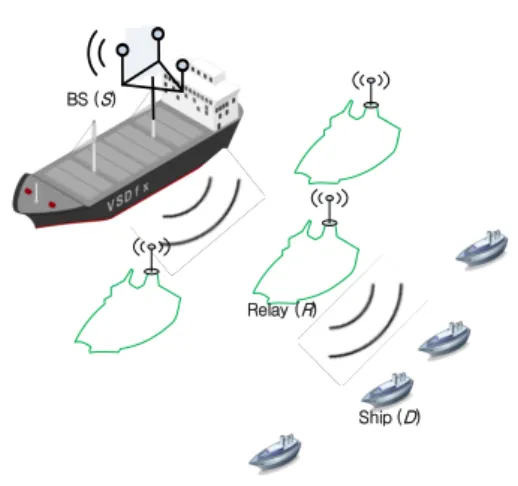
We consider the downlink of relay-based marine communication networks with a single BS, RSs, and active ships. Figure 1 shows a system model of marine communication networks. The nodes of the BS, a RS, and a ship are denoted by the symbol
Relay (R) BS (S)
BS (S)
Ship (D)
Fig. 1. A system model of marine communication networks
Fig. 2. A frame structure
of , , and , respectively. We assume a two-hop transmission from the BS to ships; that is, direct transmission from the BS to ships is not considered. Figure 2 shows a frame structure. The downlink channel is divided into OFDMA subchannels, where each subchannel consists of several numbers of subcarriers. Each frame is divided into a 1st phase and a 2nd phase with equal transmission duration. During the 1st phase, the BS transmits data to the RS; this is called a link.
During the 2nd phase, the RS forwards data received from the BS to the ship; this is called a link.
Let and be the average signal-to-noise ratio (SNR) of the link and
link, respectively. The subchannels of all links are modeled by using Rayleigh fading. We define
and
as the instantaneous SNR of
link and link on the nth subchannel, respectively. The capacity of the link and
link on the th subchannel is represented by
(1)
(2)
where the factor of 1/2 is applied because the frame duration is divided into two subframes, the 1st phase and the 2nd phase. We define the subchannel assignment indicators, (or ) as follows:
is equal to 1 if the subchannel is allocated to ship using a th relay at link; otherwise
is equals to 0.
Ⅲ. Subchannel Allocation Scheme
In relay-based marine communication networks, an achievable capacity, , can be expressed as follows:
, (3)
where and are the subchannel index at the
link and link, respectively.
3.1 Conventional Fixed Subchannel Allocation Scheme
Most previous works have focused on the selection of the RS or the ship under the assumption that a fixed channel allocation (FSA) scheme is used. In the FSA scheme, the subchannel at the
link is identically used at the link.
The relay selection for ship is determined as follows:
. (4) The ship is selected as follows:
, (5)
where is the selected ship assigned subchannel at each link. In the FSA scheme, the computational complexity that is the time required to find the
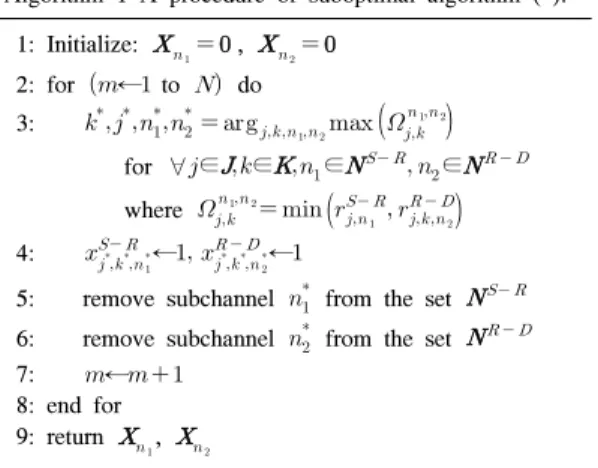
Algorithm 1 A procedure of suboptimal algorithm ( ):
1: Initialize:
,
2: for ←to do 3:
for ∀∈∈∈ ∈ where
4: ← ←
5: remove subchannel from the set 6: remove subchannel from the set 7: ←
8: end for 9: return
,
Algorithm 1. The pseudocode of suboptimal algorithm optimal relay and ship is .
3.2 Proposed Opportunistic Subchannel Allocation Scheme
The FSA scheme may lead to wasted radio resource because of the unbalance between the link quality of the link and link. To mitigate such waste of radio resource, we propose an OSA scheme. The proposed OSA scheme independently allocates the subchannel at the link and the link, respectively. Hence, in the OSA scheme, the optimal set of parameters,
, can be obtained to maximize the following utilization function:
(6)
≤, (7)
≤. (8)
Constraints (7) and (8) restrict the number of used subchannels to be less than or equal to the total number of available subchannels at each link.
The proposed OSA scheme increases the computational complexity because the OSA scheme finds the set of parameters both in the time axis and in the frequency axis, simultaneously. The computational complexity of the proposed OSA scheme is ⋅ ⋯ .
To reduce the computational complexity of the OSA scheme, we propose a suboptimal algorithm.
The sets of indices for relays and ships are denoted by ⋯ and , ⋯ respectively.
The suboptimal algorithm determines the sets
and
at each frame , where
∈∈∈ and
∈∈∈ , respectively. The pseudocode of the suboptimal algorithm for the OSA scheme is shown in Algorithm 1. At each frame ,
the suboptimal algorithm allocates the subchannels to the ship that maximizes the achievable capacity,
, from the sets of , , and . A BS determines the sets of subchannel allocation indicators,
and
. The BS removes the already allocated subchannels that form the candidate sets of
and
. The parameter is a counter that indicates the number of allocated subchannels at the
link and link. If the BS allocates all the subchannels to ships, the suboptimal algorithm procedure is completed. The computational complexity of the suboptimal algorithm is
⋯ .
Ⅳ. Simulation Results
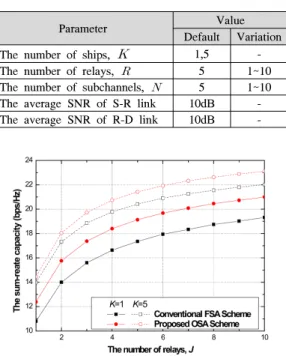
We consider relay-based OFDMA networks with a single BS, RSs, and active ships. Each ship identically and independently experiences Rayleigh fading at the link with the average SNR of the link, , and at the link with the average SNR of the link, , respectively. The average SNR and are assumed to be 10 dB. The performance of the proposed OSA scheme is compared with the performance of the conventional FSA scheme in terms of the sum-rate capacity of ships. The other simulation parameters are described in Table 1.
Figure 3 shows the sum-rate capacity as the
Parameter Value Default Variation
The number of ships, 1,5 -
The number of relays, 5 1~10 The number of subchannels, 5 1~10 The average SNR of S-R link 10dB - The average SNR of R-D link 10dB - Table 1. Simulation Parameters
Fig. 3. The sum-rate capacity versus the number of relays
Fig. 4. The sum-rate capacity versus the number of subchannels
number of relays increases. The number of active ships is fixed to or , and the number of subchannels is fixed to . As the number of relays increases, the sum-rate capacity increases, because the diversity gain increases with the number of relays. As expected, the sum-rate capacity of the proposed OSA scheme is higher than that of the FSA scheme; for example, by about 10.2% at and , and by about 4.9% at and . As the number of ships increases, the multi-ship diversity also increases. Therefore, the sum-rate capacity increases as the number of relays increases.
Figure 4 shows the sum-rate capacity as the number of available subchannels increases. As expected, the sum-rate capacity increases as the number of subchannels increases. The number of relays is equal to . The sum-rate capacity of the proposed OSA scheme is higher than that of the FSA scheme; for example, by about 14.0% for a single ship and by about 6.3% for 5 ships. As the number of subchannels increases, the OSA scheme increases the sum-rate capacity, because the diversity gain increases with the number of subchannels.
Ⅴ. Conclusion
An OSA scheme was proposed for relay-based marine communication networks with multiple ships, where the subchannels at the BS-relay link and at the relay-ship link are independently and efficiently selected to maximize the sum-rate capacity. The proposed OSA scheme increases the sum-rate capacity by as much as 14.0% in comparison with the conventional fixed subchannel allocation scheme.
Furthermore, a suboptimal algorithm was proposed to reduce the complexity of the proposed OSA scheme.
References
[1] A. Le, J. Park, Y. Cho, M. Jeong, S. Lee, and Y. Kim, “Self-interference cancellation-aided relay beamforming for multi-way relaying systems,” J. KICS, vol. 38C, no. 4, pp.
378-386, Apr. 2014.
[2] B. Ko, I. Byun, D. Rhee, K. Jeon, B. Kim, S.
Lee, and K. Kim, “Distributed multi-hop relay scheme to reduce delay-constrained broadcast outage probability,” J. KICS, vol. 38C, no. 2, pp. 219-226, Mar. 2014.
[3] M. Choi and S. Lee “Comparison study of channel estimation algorithm for 4S maritime communications,” J. KICS, vol. 38C, no. 3, pp. 288-295, Mar. 2014.
[4] W. S. Jeon, S. S. Jeong, and D. G. Jeong,
“Efficient resource allocation for OFDMA- based two-hop relay systems,” IEEE Trans.
Veh. Technol., vol. 60, no. 5, pp. 2378-2383, Jun. 2011.
[5] IEEE standard for multiple relay specification part 16: air interface for broadband wireless access systems-amendment 1. IEEE Std.
802.16j-2009, Jun. 2009.
[6] A. Ghosh, R. Ratasuk, B. Mondal, N.
Mangalvedhe, and T. Thomas, “LTE- advanced: Next-generation wireless broadband technology,” IEEE Wirel. Commun., vol. 17, no. 3, pp. 10-22, Jun. 2010.
[7] Third Generation Partnership Project(3GPP).
Further advancements for E-UTRA physical layer aspects (Release 9). 3GPP TR 36.814, March 2010; V9.0.0.
[8] B. Choi, S. Bae, K. Cheon, A. Park, and M.
Chung, “Relay selection and resource allocation schemes for effective utilization of relay zones in relay-based cellular networks,”
IEEE Commun. Lett., vol. 15, no. 4, pp.
407-409, Apr. 2011.
[9] W. Wang, J. Liu, D. Li, and Y. Xu,
“Throughput-based adaptive resource allocation algorithm for OFDMA cellular system with relay stations,” in Proc. IEEE Globecom, pp. 1-5, Dec. 2011.
[10] G. Li and H. Liu, “Resource allocation for OFDMA relay networks with fairness constraints,” IEEE J. Sel. Areas Commun., vol. 24, no. 11, pp. 2061-2069, Nov. 2006.
[11] H. Li, H. Yu, H. Luo, J. Guo, and C. Li,
“Dynamic subchannel and power allocation in OFDMA-based DF cooperative relay networks,” in Proc. Globecom, pp. 1-5, Dec.
2008.
[12] K. Chen, B. Zhang, D. Liu, J. Li, and G. Yue,
“Fair resource allocation in OFDMA two-hop cooperative relaying cellular networks,” in Proc. IEEE VTC, pp. 1-5, Sept. 2009.
이 덕 희 (Deokhui Lee)
2010년 2월 : 서강대학교 전자 공학과 학사
2012년 2월 : 서강대학교 전자 공학과 석사
2012년 3월~현재 : 서강대학교 전자공학과 박사과정
<관심분야> 자원 할당 기법, 통신 프로토콜 최적화, 릴레이 시스템, massive MIMO 시스템
이 성 로 (Seong Ro Lee)
1987년 2월 : 고려대학교 전자 공학과 공학사
1990년 2월 : 한국과학기술원 전 기 및 전자공학과 공학석사 1996년 8월 : 한국과학기술원 전
기 및 전자공학과 공학박사 1997년 9월~현재 : 목포대학교 공과대학 정보전자공학과 교수
<관심분야> 디지털통신시스템, 이동 및 위성통신시 스템, USN/텔레미틱스응용분야, 임베디드시스템
소 재 우 (Jaewoo So)
1997년 2월 : 연세대학교 전자공 학과 학사
1999년 2월 : 한국과학기술원 전 기 및 전자공학과 석사 2002년 8월 : 한국과학기술원 전
기 및 전자공학과 박사 2001년~2005년 : 아이피원, 책
임연구원 / 수석연구원 2005년~2007년 : 삼성전자, 책임연구원
2007년~2008년 : Stanford University, 전기공학과 박사후연구원
2008년~현재 : 서강대학교 전자공학과 부교수
<관심분야> 무선자원관리, 소형셀/멀티셀, 다중안테 나시스템, 인지무선통신, 방송통신융합