• 검색 결과가 없습니다.

A Study on the Variation of Ground Safety Factor by Earthworks

N/A
N/A
Protected

Academic year: 2021

Share "A Study on the Variation of Ground Safety Factor by Earthworks"

Copied!
9
0
0

로드 중.... (전체 텍스트 보기)

전체 글

(1)

333

http://dx.doi.org/10.9720/kseg.2014.3.333

A Study on the Variation of Ground Safety Factor by Earthworks

Jinhwan Kim*, O-Il Kwon, Yong Baek, and Chang-Yong Kim Geotechnical Engineering Research Division, Korea Institute of Civil Engineering

and Building Technology

Received 20 August 2014; received in revised form 1 September 2014; accepted 3 September 2014

The construction of roads, tunnels, and bridges results in changes to the local terrain that may influence the ground safety factor, which represents the stability of geotechnical structures. In this study, we assessed construction sites that had collapsed as a result of terrain change, and then simulated variation in the ground safety factor with respect to terrain change caused by road construction. We assumed steep slopes to simulate changes in terrain in a moun- tainous area and assumed that earthworks took place for road construction by cutting a platform into the slope and altering the slope angle of the terrain both above and below the road. We calculated values of the ground safety fac- tor through a stability analysis of the slope both above and below the road, and examined the variation in the safety factor of the above- and below-road slopes with respect to changes in road width. We found that if the slope angle was the same above and below the road, then the change in the ground safety factor during/after road construction occurred in the slope below the road, and if the slope angle above the road differed from that below, then the change occurred in both the above- and below-road slopes. Furthermore, the ground safety factor was essentially constant for road widths exceeding 2-6 m, depending on both above- and below-road slope angle. The findings of this study can be used to guide the management of construction sites and to assess changes in ground stability during road con- struction work, particularly in the early stages of earthworks, when the road width is narrow.

Key words : terrain change, earthworks, ground safety factor, slope stability

Introduction

In general, a weakening of the ground by a torrential rainfall is known as a major cause of slope failures and landslides. In addition to the rainfall, other factors influencing the collapse include geological structures including faults, joints, folds, fractures, weathering state of the rock that make up the ground and composition of major minerals, earthquakes which are not in common in Korea, and a number of internal and external factors such as vibrations and landform changes caused by the construction work performed around the slope (Park,

2008; Regmi et al., 2014).

Many previous studies related to factors of slope failures have mainly focused on the geological structure characteristics and weathering conditions, but there were relatively few researches on the factors such as vibrations and landform changes involved with construction work.

However, starting with the research on the damages to surrounding structures caused by underground excavation work performed before the building construction, many studies have recently been conducted with respect to the effects of the collapse occurring in connection with construction work and variation in the safety factor of the

*Corresponding author: [email protected]

ⓒ 2014, The Korean Society of Engineering Geology

This is an Open Access article distributed under the terms of the Creative Commons Attribution Non-Commercial License (http://creativecommons. org/

licenses/by-nc/3.0) which permits unrestricted non-commercial use, distribution, and reproduction in any medium, provided the original work is prop-

erly cited.

(2)

been reported to be caused by heavy rainfalls (Yang et al., 2007; Kim, 2008; Kim and Park, 2013; Zhang et al., 2014), but it is determined that external factors such as construction work can increase the likelihood of collapse only with a small amount of rainfall. In this regard, this study attempts to review slope failures that occur in connection with landform change due to construction work and discuss the effect of landform change on the variation of safety factor through a simple simulation of earthwork.

Weakening of the ground due to pore-pressure rise by torrential rainfall is known to be a major trigger of slope failures. In addition to rainfall, other factors influencing slope failure (or collapse) include geological structures such as faults, joints, folds, and fractures; the mineralogical composition and state of weathering of the host slope- forming rock; earthquakes (although these are uncommon in Korea); and various other internal and external factors such as vibrations and local changes in terrain caused by construction work performed on or near the slope (Park, 2008; Regmi et al., 2014).

Many previous studies of the factors that control slope failures have focused on the geological structure and weathering status of the host rock. A number of studies have also examined the damage caused to nearby buildings and facilities during preparatory underground excavation work. In addition, investigations have been made of slope failures occurring in connection with construction work and the associated changes in the ground safety factor with respect to either seismicity (Yi et al., 2004; Go and Lee, 2007; Go et al., 2008; Park et al., 2008; Yun et al., 2009) or heavy rainfall (Yang et al., 2007; Kim, 2008; Kim and Park, 2013; Zhang et al., 2014). These studies of the effect of rainfall have found that external factors such as

effects of vibrations and changes in terrain that are associated with construction work. In this regard, the present study investigates slope failures that occur as a result of terrain change due to construction work, and assesses the effect of terrain change on variations in the ground safety factor (a measure of slope stability) by simulating road earthworks.

Slope failures resulting from the effects of construction work

Satellite images of slope failures in Korea were analyzed and four sites considered to have been affected by a change in terrain caused by earth construction work were identified. In each case, we compared satellite images (provided by Google Earth) taken before and after the slope failure (Table 1). The comparative results confirmed that earthworks for the construction of facilities such as tunnels and highway tollgates were underway at each site both before and after the slope collapse (Kim et al., 2013).

Area A is located on National Highway No. 44 (Hongcheon-Inje). Several slope failures occurred at this site in 2004 (Fig. 1). Material from the mass movement was transported into a small river that flows in front of the collapsed slope. At this site, the road was being straightened and tunnel construction was in progress at the time of the collapse. Therefore, we consider that the ground was weakened by the blasting vibrations that occurred during the process of tunnel construction, following which heavy rainfall triggered the slope failures.

Area B is located on National Highway No. 46 (Seoul- Chuncheon) and is the site of a debris flow that occurred Table 1. Dates and locations of the identified slope failures.

Site Date of slope failure Location Remark

A 9 July 2004 Jueumchi-ri, Hwachon-myeon Hongcheon-gun, Gangwon-do - B 14 July 2009 Guam-ri, Hwado-eup, Namyangju-si, Gyeonggi-do Debris flow

C 16 July 2009 Gwisan-dong, Changwon-si, Gyeongsangnam-do -

D 15 July 2013 Myeonon-ri, Bongpyeong-myeon Pyeongchang-gun, Gangwon-do Debris flow

(3)

along the valley portion of the slope in 2009 (Fig. 2).

Tunnel construction was in progress near the southwestern part of the debris flow. Again, we consider that both a weakening of the ground strength due to tunnel blasting and the occurrence of heavy rainfall led to the occurrence of the debris flow.

Area C is the site of a house that was located in the lower reaches of a valley and which was damaged by a slope failure that occurred in the valley (Fig. 3). A national expressway and tollgate were being constructed in the upper reaches of the valley above the village. We infer that the slope failure was triggered by heavy rainfall in the

context of poor drainage in the catchment basin and the construction of the expressway above the village.

In area D, slope failure in the form of a debris flow occurred in the valley in the right side of the tunnel portal construction site. A site for building a pension in the upper part of the tunnel portal, and the collapse occurred at the boundary of the site, leading to sediments being transported into the entrance of the tunnel portal under construction (Fig. 4). We consider that the collapse occurred because of a lack of proper drainage facilities at the pension building site, which had a large catchment area.

We consider that the slope failures in areas A-D were Fig. 1. Slope failure in area A.

Fig. 2. Slope failure in area B.

Fig. 3. Slope failure in area C.

(4)

probably caused by changes in terrain due to the construction of new facilities and roads. We also consider that the changes in the catchment basin drainage due to the construction of facilities and roads, as well as blasting vibrations from tunnel construction work, had both direct and indirect impacts on the stability of the slope. The factors contributing to slope failure caused by the terrain change resulting from construction work are given in Table 2.

Simulation of variation in the ground safety factor caused by earthworks

We inferred from the satellite images of the slope failure sites A-D that weakening of the ground and change in terrain due to construction work brought about a change in the ground safety factor in each case, and that this change in the safety factor was sufficient to cause slope failure. To further explore this inference, we conducted simulations of Fig. 4. Slope failure in area D.

Table 2. Construction work affecting slope failure.

Classification Facility Factors causing slope failure

Transportation Road Poor drainage

Tunnel Vibrations due to blasting

Amenity Park Poor drainage, large catchment basin

Other Warehouse Large catchment basin

Table 3. Slope and other terrain and material conditions used in simulations of the ground safety factor.

No. Slope Angle Slope Height Road width Unit weight Cohesion Friction

angle

Case1 Above road 45

o

20 m 010 m 21 kN/m

3

30 kN/m

2

33

o

Below road 45

o

Case2 Above road 55

o

Below road 55

o

Case3 Above road 65

o

Below road 65

o

Case4 Above road 45

o

Below road 55

o

Case5 Above road 65

o

Below road 55

o

(5)

slope failure under various conditions and incorporating the change in terrain caused by earthworks specifically for road construction. We estimated the variation in the safety factor using a stability analysis program (Rocscience’s Slide 5.0) and using as model inputs the terrain conditions and ground strength parameters listed in Table 3.

The ground used in the stability analysis was assumed to be composed of weathered rock. Stability analysis was performed using wet season conditions, with the ground- water level assumed to be located at the ground surface. It was also assumed that the stability analysis section is characterized by steep terrain and that change in the terrain is caused by the construction of a road of up to 10 m in width by the cutting of a road platform and the removal of slope material both above and below the road. These simple simulation conditions, of changing both slope angle and road width, were regarded as sufficient to model

terrain change and the effects of the changes on the safety factor, given that a previous study modeled rockfall risk by varying both slope angle and berm width to account for changes in slope shape (Ji and Choi, 2010).

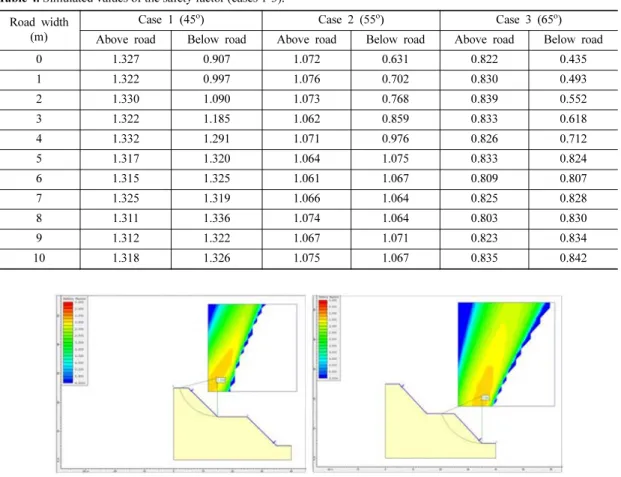
The stability analysis was performed assuming two sets of cases. In the first set (cases 1 to 3; Table 2), the road width was varied but the slope angle above the road was the same as that below the road for three different angles (45°, 55°, and 65°). The second set (cases 4 and 5; Table 3) considers road construction with the slope angle above the road being 45° or 65°, and the slope angle below the road being 55°. The road width was increased from 0 to 10 m at 1-m increments. The same analysis section was set by fixing the boundaries both above and below the road for each case.

Table 4 gives the results of the stability analysis for road widths varying from 0 to 10 m for cases 1-3, and Fig. 5

Table 4. Simulated values of the safety factor (cases 1-3).

Road width (m)

Case 1 (45

o

) Case 2 (55

o

) Case 3 (65

o

)

Above road Below road Above road Below road Above road Below road

0 1.327 0.907 1.072 0.631 0.822 0.435

1 1.322 0.997 1.076 0.702 0.830 0.493

2 1.330 1.090 1.073 0.768 0.839 0.552

3 1.322 1.185 1.062 0.859 0.833 0.618

4 1.332 1.291 1.071 0.976 0.826 0.712

5 1.317 1.320 1.064 1.075 0.833 0.824

6 1.315 1.325 1.061 1.067 0.809 0.807

7 1.325 1.319 1.066 1.064 0.825 0.828

8 1.311 1.336 1.074 1.064 0.803 0.830

9 1.312 1.322 1.067 1.071 0.823 0.834

10 1.318 1.326 1.075 1.067 0.835 0.842

Fig. 5. Results of stability analysis for case 1 for a road width of 10 m (left: above the road; right: below the road).

(6)

ground safety factor is higher for shallower slopes (Table 4). Although the variation in the ground safety factor of the slope above the road is small in any one case, the safety factor of the slope below the road increases with increasing road width from 0 to 5 m, and for road widths in excess of 5 m, it is essentially constant.

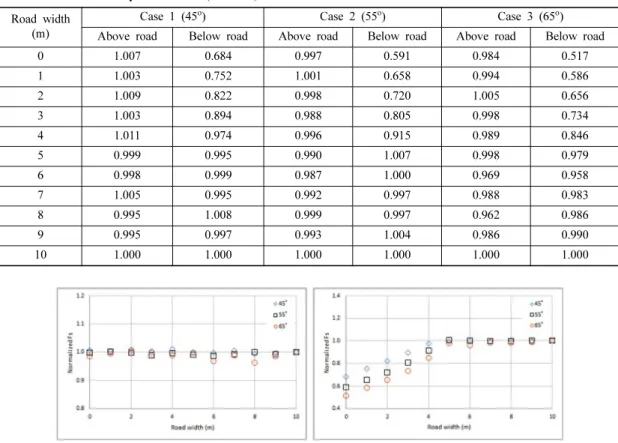
The safety factor data shown in Table 4 reflect the ground strength parameters and specific terrain conditions assumed in this study. Accordingly, we assessed the general tendency of changes in the safety factor by normalizing the values (Table 5). The reference value for the safety factor normalization in each case was set at the safety factor value calculated for a road width of 10 m.

To examine the variation in the normalized values of the safety factor, we plotted the values with respect to road width for the slope both above and below the road (Fig. 6).

For the slope above the road, there is essentially no variation in the normalized safety factor (left-hand diagram

of Fig. 6). In contrast, for the slope above the road (right- hand diagram of Fig. 6), the normalized safety factor increases as road width increases from 0 to 5 m (representing narrow roads or the early stage of construction), and is essentially constant for road widths of between 5 and 10 m (wide roads or the later stage of construction). For road widths of < 5 m, the normalized safety factor varies with above-road slope angle, being lower for slopes of higher inclination. For an assumed final road width of 10 m, the normalized safety factor is essentially constant for road widths greater than 4-5 m, which suggests the need for management of the slope below the road during the initial stages of road construction.

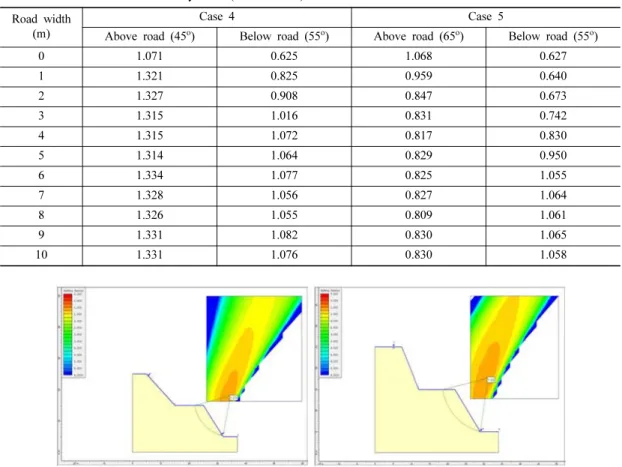
We also examined the variation in the safety factor with respect to the effects of earthworks for cases where the slope angle of the slope above the road differed from that below (cases 4 and 5 in Table 3), the results of which are

0 1.007 0.684 0.997 0.591 0.984 0.517

1 1.003 0.752 1.001 0.658 0.994 0.586

2 1.009 0.822 0.998 0.720 1.005 0.656

3 1.003 0.894 0.988 0.805 0.998 0.734

4 1.011 0.974 0.996 0.915 0.989 0.846

5 0.999 0.995 0.990 1.007 0.998 0.979

6 0.998 0.999 0.987 1.000 0.969 0.958

7 1.005 0.995 0.992 0.997 0.988 0.983

8 0.995 1.008 0.999 0.997 0.962 0.986

9 0.995 0.997 0.993 1.004 0.986 0.990

10 1.000 1.000 1.000 1.000 1.000 1.000

Fig. 6. Variation in the normalized safety factor for cases 1-3 (left: above the road; right: below the road).

(7)

given in Table 6. Diagrams of representative analyses (for the slope below the road and a road width of 10 m) are

shown in Fig. 7. The data were normalized to examine the general trends in the safety factor (Table 7), with the Table 6. Simulated values of the safety factor (cases 4 and 5).

Road width (m)

Case 4 Case 5

Above road (45

o

) Below road (55

o

) Above road (65

o

) Below road (55

o

)

0 1.071 0.625 1.068 0.627

1 1.321 0.825 0.959 0.640

2 1.327 0.908 0.847 0.673

3 1.315 1.016 0.831 0.742

4 1.315 1.072 0.817 0.830

5 1.314 1.064 0.829 0.950

6 1.334 1.077 0.825 1.055

7 1.328 1.056 0.827 1.064

8 1.326 1.055 0.809 1.061

9 1.331 1.082 0.830 1.065

10 1.331 1.076 0.830 1.058

Fig. 7. Results of stability analysis for the below-road slope for cases 4 (left) and 5 (right) for a road width of 10 m.

Table 7. Normalized safety factor values (cases 4 and 5).

Road width (m)

Case 4 Case 5

Above road (45

o

) Below road (55

o

) Above road (65

o

) Below road (55

o

)

0 0.805 0.581 1.287 0.593

1 0.992 0.767 1.155 0.605

2 0.997 0.844 1.020 0.636

3 0.988 0.944 1.001 0.701

4 0.988 0.996 0.984 0.784

5 0.987 0.989 0.999 0.898

6 1.002 1.001 0.994 0.997

7 0.998 0.981 0.996 1.006

8 0.996 0.980 0.975 1.003

9 1.000 1.006 1.000 1.007

10 1.000 1.000 1.000 1.000

(8)

values being calculated in the same way as for cases 1-3.

The pattern of variation in the normalized safety factor with respect to increased road width for the slope above the road differs according to slope angle (left-hand diagram of Fig. 8). Whereas there was essentially no variation in the normalized safety factor for the above-road slope in cases 1-3, variation in the normalized safety factor is simulated to occur during the early stage of road construction (i.e., road widths of up to 2 m). In the case where the inclination of the initial slope surface is cut at a higher angle of 55°, the safety factor tends to be lower, and where cut at a lower angle it tends to be higher. For road widths in excess of 2 m, the normalized safety factor is essentially constant.

The slope below the road for cases 4 and 5 shows a similar pattern of variation in normalized slope factor with respect to road width to that of cases 1-3. However, a constant normalized safety factor for the below-road slope is reached later in the construction process (i.e., at a wider road width) where earthworks are performed with an above-road slope angle that is higher than that of the below-road slope angle (case 5), compared with one that is lower (case 4) (Table 7 and right-hand diagram of Fig. 8).

The normalized safety factor is essentially constant once a road width of about 6 m is achieved for case 5, compared with about 4 m for case 4.

Here, we investigated the effects of local terrain change caused by road construction on variation in the ground safety factor. This was achieved by establishing a simple model of slope stability and performing simulations to estimate values of the safety factor resulting from increases in road width and from variations in both above- and below-road slope inclinations. The results give useful

insights into slope instability at road construction sites;

however, there is a need to establish a more sophisticated and complex model and to conduct more detailed simulations of slope instability in such areas.

Conclusion

In Korea, slope stability analyses have focused mainly on the slope above the road and not on the slope below.

However, the many instances of slope failure due to construction work indicate that it is necessary to perform broad-based stability assessments of the ground with respect to the terrain conditions of the area where the construction work is being conducted. Slope instability due to the construction of roads, tunnels, and bridges should be assessed by conducting a number of simulations in which a range of terrain and material parameters are varied.

In this study, we examined variations in the ground

safety factor of the above- and below-road slopes during

the process of earthworks for road construction (involving

progressively widening a road platform cut into a slope

and altering the inclinations of the above- and below-road

slopes) using a simple analytical model. The stability

analysis was performed with two sets of cases: the first

where the slope angle is the same in both the above-and

below-road slopes, and the second where the above-road

slope angle differs from that of the below-road angle. A

comparative analysis of the simulations was made. The

results show that the pattern of variation in the safety

factor with respect to changes in road width differs with

the slope angle of the terrain both above and below the

road. The ground safety factor showed a characteristic

change of 20%-50% before reaching a constant value at a

Fig. 8. Variation in the normalized safety factor for cases 4 and 5 (left: above the road; right: below the road).

(9)

road width of 2 to 6 m (depending on above- and below- road slope angles). The results suggest the need to take caution in the management of road construction sites, and in particular to maintain ground stability during the early stages of construction, when the road platform is narrow.

Acknowledgment

This research was supported by a grant (13SCIP- C069074-01) from the Ministry of Land, Infrastructure and Transport of Korean government.

References

Go, K. R. and Lee, G., 2007, The economic impact of excavation work failure on a construction project, The Korea Institute of Construction Engineering and Man- agement, 643-646 (in Korean with English abstract).

Go, K. R. Lee, G., and Choi, M. S., 2008, A case analysis of the economic impact on accidents during excava- tion, The Korea Institute of Building Construction, 8(1), 7-10 (in Korean with English abstract).

Ji, H. W., and Choi, S. O., 2010, Numerical analysis on morphologic characteristics of rock slope for reducing rockfall risk, TUNNEL & UNDERGROUND SPACE, 20(1), 15-27 (in Korean with English abstract).

Kim, B. S. and Park, S. W., 2013, Effect of rainfall-patters on slope stability in unsaturated weathered soils, Jour- nal of the Korean Society of Civil Engineers, 33(3), 1027-1035 (in Korean with English abstract).

Kim, J., Kwon, O. I., and Baek, Y., 2013, Case study on slope failure caused by construction work, Japan- Korea Joint Symposium for Landslide Disaster Mit- igation, 29-32 (in Korean with English abstract).

Kim, K. S., 2008, Characteristics of basin topography and rainfall triggering debris flow, Journal of the Korean Society of Civil Engineers, 28(5C), 263-271 (in Korean with English abstract).

Park, B. S., 2008, Characteristics and protective measures against natural hazards in the mountain areas of gang- won province, Report of Research Institute for Gang- won, 5-6 (in Korean with English abstract).

Park, D., Ahn, J., and Yun, S., 2008, Comparison of meth- ods for seismic slope stability analysis, Korean Geo- Environmental Conference, 265-269 (in Korean).

Regmi, R. K., Jung, K., Nakagawa, H., and Kang, J., 2014, Study on mechanism of retrogressive slope fail- ure using artificial rainfall, Catena, 122, 27-41.

Yang, I. T., Park, J. K., and Jeon, W. H., 2007, An assess- ment for effect of landslide on maximum continuous rainfall using GIS, The Korea Association of Geo- graphic Information Studies, 8(1), 413-423 (In Korean).

Yi, J. H., Youn, J. Y., and Yun, C. B., 2004, Seismic risk assessment of bridges using fragility analysis, Journal of the Earthquake Engineering Society of Korea, 8(6),

31-43 (in Korean with English abstract).

Yun, S., Park, D., Lee, S., and Hwang, Y., 2009, Devel- opment of novel method of seismic slope stability analysis, Journal of The Korean Geo-Environmental Society, 10(1), 49-54 (in Korean with English abstract).

Zhang, J., Huanga, H. W., Zhang, L. M., Zhuc, H. H., and Shi, B., 2014, Probabilistic prediction of rainfall- induced slope failure using a mechanics-based model, Engineering Geology, 168, 129-140.

Jinhwan Kim

Geotechnical Engineering Research Division, Korea Institute of Civil Engineering and Building Technology, 411-712, 283, Goyangdae-Ro, Ilsanseo-Gu, Goyang, Gyeonggi-Do Tel: 031-910-0099

Fax: 031-910-0561 E-mail: [email protected]

O-Il Kwon

Geotechnical Engineering Research Division, Korea Institute of Civil Engineering and Building Technology, 411-712, 283, Goyangdae-Ro, Ilsanseo-Gu, Goyang, Gyeonggi-Do Tel: 031-910-0512

Fax: 031-910-0561 E-mail: [email protected]

Yong Baek

Geotechnical Engineering Research Division, Korea Institute of Civil Engineering and Building Technology, 411-712, 283, Goyangdae-Ro, Ilsanseo-Gu, Goyang, Gyeonggi-Do Tel: 031-910-0228

Fax: 031-910-0561 E-mail: [email protected]

Chang-Yong Kim

Geotechnical Engineering Research Division, Korea Institute of Civil Engineering and Building Technology, 411-712, 283, Goyangdae-Ro, Ilsansan-Gu, Goyang, Gyeonggi-Do Tel: 031-910-0224

Fax: 031-910-0211

E-mail: [email protected]

수치

Fig. 3. Slope failure in area C.
Table 3. Slope and other terrain and material conditions used in simulations of the ground safety factor
Table 4 gives the results of the stability analysis for road widths varying from 0 to 10 m for cases 1-3, and Fig
Fig. 6. Variation in the normalized safety factor for cases 1-3 (left: above the road; right: below the road).
+2

참조

관련 문서

Background : The E133K genetic variation of AGGF1 gene that is a potent angiogenetic factor have been assumed genetic susceptible factor for Klippel-Trenaunay

Objective :::: The neovascularization is an essential a factor for the growth of solid organ cancer, and especially vascular endothelial growth factor (VEGF)

A study on the safety analysis of steam generator tube plugging level upward in Hanbit Unit #5,6..

First, as for the relationship between interest factor and self-esteem formation, human relation factor as an interest factor had a significant effect at

For example, the public’s sentiments of risk regarding nuclear power plants exceeds the risk felt by an expert in the area, and therefore the public sentiment is a negative

In the present study, the impact properties of a CFRP structural member under an impact load were intentively investigated for passenger safety protection under assuming

– Engineering economic analysis focuses on: costs, revenues and benefits that occur at different times.. – When a civil engineer designs a road, a dam, or a building:

And the objective of radiation safety control is to ensure radiation safety by limiting the probability of stochastic effects below the acceptable ALARA