자폐스펙트럼장애 아동에서 대소변 가림 여부에 따른 사회지수 및 감각처리기능 비교
이철상
1김태훈
2ǂ1
스윙대디감각행동발달센터 원장,
2ǂ동서대학교 작업치료학과 교수
Comparison of Social Quotient and Sensory Processing According to the Toileting Ability in Children with Autism Spectrum Disorder
Lee Chulsang, OT, MS
1Kim Taehoon, OT, Ph.D
2ǂ1
Swingdaddy Center for Sensory and Behavioral Development, Director
2ǂ
Dept. of Occupational Therapy, Dongseo University, Professor
Abstract
Purpose : The purpose of this study was to investigate the differences in social quotient and sensory processing function between completed-toileting and incomplete-toileting children with autism spectrum disorder (ASD). We aims to provide a basis for the training of children with autism spectrum disorders.
Methods : The subjects of this research were children with ASD, aged from 4 to 7, receiving sensory integration therapy at the H-Child Development Research Center in Busan, South Korea. After recruiting 30 parents who had children with ASD, we interviewed them and we divided their children into completed-toileting group and incomplete-toileting group based on the past researches. We assessed them using the Social Maturity Scale and Sensory Profile. Spearman correlation was used to analyze between the sensory processing score and social quotient. Mann-Whitney U test was used to compare the Sensory Profile scores of the two groups.
Results : The social quotient was correlated with the sensory processing score in the most of component as for auditory processing, vestibular processing, touch processing, multisensory processing, orosensory processing, except for visual processing. The groups of completed-toileting and incomplete-toileting group showed statistically significant intergroup difference in sensory seeking, emotional reactive, oral-sensory sensitivity, and inattention/distractibility in the sensory factor region. No statistically significant difference from intergroup was observed in any modulation areas, nor in behavioral & emotional response domains.
Conclusion : A significant intergroup difference was observed in the most of sensory processing areas, except for modulation areas and behavioral & emotional response domains. The result revealed that toileting is significantly correlated with sensory processing. Therefore, this study suggests that the sensory processing function should be considered in the toilet training of children with ASD.
Key Words : autism spectrum disorder, sensory processing, social maturity, toileting
1)
ǂ
교신저자 : 김태훈, [email protected]
논문접수일 : 2020년 7월 23일 | 수정일 : 2020년 8월 28일 | 게재승인일 : 2020년 9월 11일
※ 이 논문은 2020년도 동서대학교 “Dongseo Cluster Project” 지원에 의하여 이루어진 것임 (DSU-2020004).
Ⅰ . 서 론
자폐스펙트럼장애(autism spectrum disorder)는 사회적 상호작용 및 사회적 의사소통의 결함이 있으며, 제한되 고 반복적이며 상동증적인 행동들을 특징으로 하는 전 반적 발달 장애이다(Fuller & Kaiser, 2020). 이러한 문제 의 원인은 주변 환경에 대한 관심이 부족하고 특정 자극 을 지나치게 싫어하거나 집착하는 등 감각자극에 대해 비정상적인 반응을 보이기 때문이며, 이것은 감각처리장 애가 있을 때 발생하는 행동특징이다.
감각통합 이론에서는 감각처리장애를 환경으로부터 받은 정보를 잘못 해석하여 발생하는 증상으로 정의하 고 있다(Bundy & Lane, 2019). 감각처리장애 아동은 한 가지 또는 그 이상의 감각을 처리하여 과제를 적절하게 수행하는 데에 어려움이 있기 때문에 학습능력부진, 운 동발달지연, 부적응 행동 등을 보이는 경우가 많다 (Schaaf 등, 2018). 이것은 자폐스펙트럼장애 아동의 감각 자극에 대한 행동과 감각처리가 일반아동과 다르기 때 문이다(Kern 등, 2006; Liss 등, 2006).
기존 연구에서 자폐스펙트럼장애 아동과 일반 아동은 감각 프로파일(Sensory Profile)의 “신체자세, 촉각, 움직 임, 청각, 사회성, 시각, 미각/후각, 활동정도” 영역에서 차이를 보였다(Dunn & Brown, 1997). 자폐스펙트럼장애 아동은 감각등록이 어렵고, 청각 및 시각 자극, 구강감각 자극에 대한 민감성이 높으며, 주의 집중 및 놀이기술이 부족하고 감정 표현이 상황에 맞지 않으며, 감각추구 성 향이 지나치게 높은 양상을 보인다(Rogers 등, 2003;
Tomchek & Dunn, 2007; Watling 등, 2001). Kim(2000)의 연구에서도 자폐스펙트럼장애 아동은 “촉각 민감성, 맛/
냄새 민감성, 움직임 민감성, 과소 반응/특정 자극 찾는 행동, 청각여과하기, 활력이 부족하고 허약함, 시각/청각 민감성” 등의 항목에서 일반아동에 비해 낮은 점수를 얻 어 감각조절기능에 어려움이 있다고 하였다. 이러한 감 각처리장애는 대소변 조절을 포함한 일상생활활동의 전 영역에 영향을 미친다(Lim 등, 2008).
대소변 가림은 유아기에 달성해야 하는 가장 중요한 발달 과업이며, 대소변 가림을 하는 동안 자아성취감과 독립심이 발달하게 된다. 정상 아동의 경우 2세에 대소
변 훈련을 시작해서 4세가 되면 화장실에서 혼자 대소변 을 볼 수 있지만, 자폐스펙트럼장애 아동의 경우 대소변 을 가리는 시기가 약 5년에서 7년까지 지연될 수 있다.
또한 이 시기 이후에도 정상 아동들보다 야뇨증, 대소변 실수 및 기타 화장실 사용에 더 많은 문제를 가지고 있 다. 기존 연구에서 11~12세 일반아동의 1.6 %가 소변실 수를 하였지만(Van der Wal 등, 2005), 자폐스펙트럼장애 아동은 11.1 %가 소변실수를 하였고 6.6 %가 야뇨증이 있었다(Belva 등, 2011). 대소변 가리기를 포함한 일상생 활활동 기능은 지적장애, 의사소통장애, 소화기계통문제 와 같은 일반적 요인과 관련성이 있다고 알려져 있다 (Maskey 등, 2013). 이러한 일반적 요인 외에도 감각처리 기능 역시 중요한 요인 중 하나이다(Park 등, 2012).
기존의 연구들은 자폐스펙트럼장애 아동의 감각처리 기능이 일반 아동보다는 떨어지고, 감각처리 저하는 일 상생활활동의 전 영역에서 수행도 저하를 초래한다고 하였다. 그러나 대소변 가림을 방해하는 구체적인 감각 처리장애를 분석한 연구는 거의 없었다. 감각처리장애는 신경행동학적으로 신체도식, 움직임 실행, 자세조절, 균 형, 지각, 학습기능, 감정조절의 어려움을 초래하여 대소 변 가림의 실패를 유발할 수 있다(Tomchek & Dunn, 2007). 대소변 가림 실패 시 불쾌한 냄새가 발생하는데, 이것은 친구들의 낙인, 혐오감, 놀림 또는 따돌림을 유발 할 수 있다(Handley-More 등, 2009). 아동-청소년기에 친 구들로부터 받은 심리적 외상은 오랜 기간 동안 심리사 회적인 문제를 지속시키고, 학교, 놀이, 지역사회 참여 제한의 원인이 된다(Kovacic 등, 2015). 따라서 자폐스펙 트럼장애 아동의 활동참여를 증진하고 삶의 질을 향상 시키기 위해서는 대소변가림을 방해하는 감각처리요인 의 분석이 반드시 필요할 것이다.
기존의 문헌들을 분석한 결과 자폐스펙트럼장애 아동
에서 대소변 가림과 감각처리기능에 대한 연구는 국내
및 국외에서도 거의 없었으나(Ahmed 등, 2020), 대소변
가림은 삶의 질과 자존감에 상당한 영향을 미치는 영역
이기 때문에 이에 대한 연구는 임상적으로 중요한 의미
가 있을 것이다. 감각통합이론에서는 개인이 입력된 감
각을 처리하는 과정에서 결손이 발생하면 자조, 이동, 작
업, 의사소통, 자기관리, 사회화와 같은 적응행동의 장애
를 유발한다고 설명한다. 따라서 대소변 못가림군 및 가
림군에서 적응행동을 측정하기 위한 사회성숙도 검사 (Hyung 등, 2011)와 감각처리기능을 측정하기 위한 감각 프로파일 평가의 결과를 동시에 분석한다면, 대소변 가 림 유무에 원인이 되는 감각처리기능을 유추할 수 있을 것으로 사료된다.
본 연구의 목적은 다음과 같다.
첫째, 자폐스펙트럼장애 아동에서 사회지수와 감각처 리기능의 관련성을 분석하여, 적응행동장애에 영향을 주 는 감각처리기능의 세부요소를 추정하고자 하였다.
둘째, 대소변 못가림군과 가림군의 감각처리기능을 비 교하여, 감각처리기능의 평가 및 중재의 필요성을 제시 하고자 하였다.
Ⅱ. 연구방법
1. 연구 대상자
연구 대상자의 안전을 위하여 임상경력 10년 이상 작 업치료사 2인과 작업치료학과 교수 2인으로부터 연구목 적과 연구방법에 대한 사전 검토와 자문을 받았다. 이후 연구대상자는 2018년 1월 1일부터 12월 31일까지 부산 광역시 소재 H-아동발달센터에서 치료를 받았던 아동 중, 자폐스펙트럼장애로 진단 받고 현재 만 4~7세에 해 당하는 아동 중 41명을 1차 선정하였다. 1차 선정자 중 부모가 연구의 목적을 이해하고 참여에 서면으로 동의 한 30명을 최종 선정하였다.
2. 측정 방법
본 연구는 임상경력 20년차의 작업치료사 1인이 아동 의 부모를 대상으로 1:1 면접 형식으로, 주변 소음이 차 단된 상담실에서 총 3회 동안 평가를 실시하였다. 1차 평가에서는 부모의 보고를 기준으로 대소변 가림과 못 가림군을 선별하였는데, “일주일 동안 낮에 4번 이하의 소변실수를 하고, 한 달 동안 낮에 2번 이하의 대변 실수 를 한 경우”를 가림군으로, 그렇지 못한 경우 못가림군 으로 분류하였다(Blum 등, 2003; Francis 등, 2017). 2차
평가에서는 사회성숙도 검사를 실시하였고, 3차 평가에서 는 부모를 대상으로 감각 프로파일 검사를 실시하였다 .
3. 측정 도구
1) 사회성숙도 검사
대상자의 사회적 발달수준을 측정하기 위해서, vineland social maturity scale을 한국형으로 표준화하여 출판한 사회성숙도 검사를 사용하였다. 이 검사의 반분 신뢰도 r=.75~.97, 검사-재검사신뢰도 r=.69~.91이며, 공 인타당도는 WHODAS 2.0과 r=.54, 한국판 Weschler Intelligence Scale과 r=.61이다(Hyung 등, 2011).
이 검사는 자조, 이동, 작업, 의사소통, 자기관리, 사회 화로 구성된 117개의 항목이 발달과정 순으로 배열되어 있다. 기본점과 가산점을 합산하여 총점을 산출하며, 사 회연령 기준표에 의거하여 사회연령(social age; SA)을 환 산하였고, 사회연령을 실제생활연령으로 나눈 다음 100 을 곱하여 사회지수(social quotient; SQ)를 산출하였다.
2) 감각 프로파일
본 연구에서는 Dunn과 Brown(1997)의 Sensory Profile 을 Lim 등(2008)이 한국어로 번역한 감각 프로파일을 사 용하였다. 본 도구의 내적 일치도 계수 Cronbach’s α = .47 ∼ .91이었으며(Lim 등, 2008), 내적타당도는 .25~.76 로 나타나 각 항목이 고유의 특성을 설명하도록 구성되 었다 (Park 등, 2011).
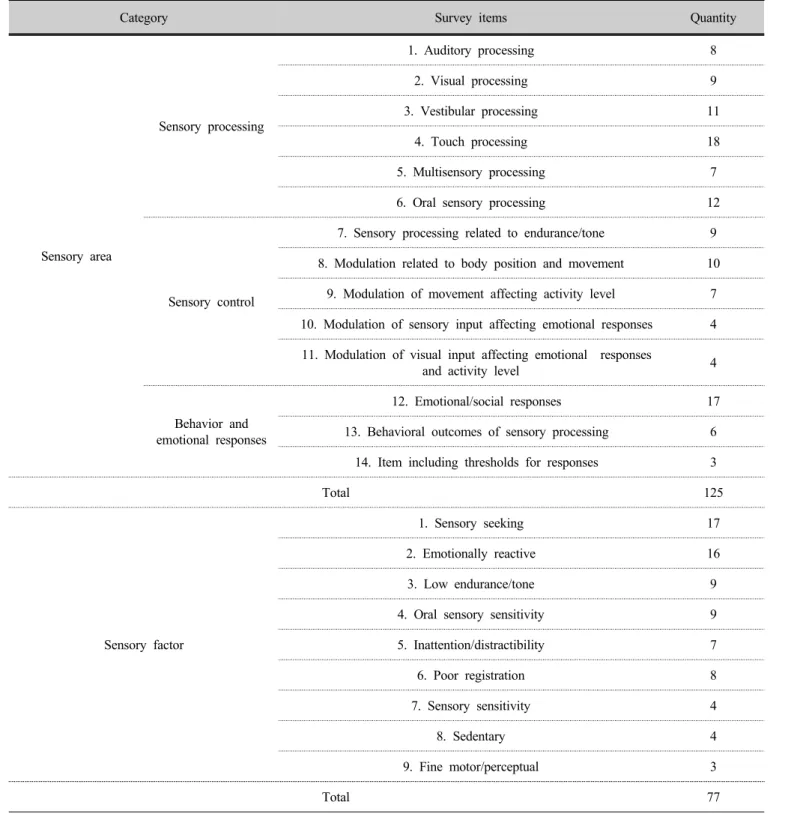
감각 프로파일은 총 125문항으로 감각처리, 감각조절, 행동 및 감정반응의 세 가지 감각영역으로 구성된다. 감 각영역의 측정 방법은 아동의 반응(5=항상 반응한다, 4=
자주 반응한다, 3=종종 반응한다, 2=가끔 반응한다, 1=
거의 /전혀 반응하지 않는다)에 따라 리커트 척도로 표기 하며 , 점수가 높을 경우 감각처리가 우수함을 나타낸다.
감각요소는 측정 후에 125개 항목을 조합해서 77개 항목
으로 재구성한 것이다. 감각요소는 감각추구, 정서 반응,
낮은 지구력/근 긴장도, 구강감각 민감성, 부주의/산만,
감각등록 저하, 감각 민감성, 앉아있으려는 성향, 미세동
작/지각력의 9개 요소로 구성되어 있다(Lim 등,
2008)(Table 1).
Category Survey items Quantity
Sensory area
Sensory processing
1. Auditory processing 8
2. Visual processing 9
3. Vestibular processing 11
4. Touch processing 18
5. Multisensory processing 7
6. Oral sensory processing 12
Sensory control
7. Sensory processing related to endurance/tone 9 8. Modulation related to body position and movement 10
9. Modulation of movement affecting activity level 7 10. Modulation of sensory input affecting emotional responses 4 11. Modulation of visual input affecting emotional responses
and activity level 4
Behavior and emotional responses
12. Emotional/social responses 17
13. Behavioral outcomes of sensory processing 6 14. Item including thresholds for responses 3
Total 125
Sensory factor
1. Sensory seeking 17
2. Emotionally reactive 16
3. Low endurance/tone 9
4. Oral sensory sensitivity 9
5. Inattention/distractibility 7
6. Poor registration 8
7. Sensory sensitivity 4
8. Sedentary 4
9. Fine motor/perceptual 3
Total 77
Table 1. Construction of sensory profile
3. 자료 분석
수집된 자료는 SPSS 18.0 프로그램을 사용하여 분석
하였다. 연구 대상자의 일반적인 특성은 기술통계로 산
출하였고, 사피로-윅스 검정(Sapiro-Wilks test)을 통해 측
정 변수의 정규성 여부를 확인한 결과 정규분포를 만족
하지 않아 비모수적 방법(non-parametric test)으로 분석하 였다. 만-휘트니 검정(Mann-Whitney U test)으로 대소변 가림군과 못가림군의 사회성숙도 검사 및 감각 프로파 일 점수를 각각 비교하였고, 스피어만 상관계수 (Spearman correaltion)으로 감각처리 영역의 하위 항목과 사회성숙도의 관련성을 분석하였다. 유의수준 α는 .05 로 하였다.
Ⅲ . 결 과
1. 대상자의 일반적 특성
대상자의 연령은 4세가 16명(53.3 %), 5세가 4명(13.3
%), 6세가 4명(13.3 %), 7세가 6명(20.0 %)이고, 남자는 25명(83.3 %), 여자는 5명(16.6 %) 이었다. 대소변을 가리 는 아동이 14명(46.7 %), 못 가리는 아동이 16명(53.3 %) 이었다(Table 2).
Variables Total
(n=30)
Completed-toileting group (n=14)
Incompleted-toileting group (n=16)
Gender Male 25 12 13
Female 5 2 3
Age
4 years old 16 7 9
5 years old 4 2 2
6 years old 4 2 2
7 years old 6 3 3
Table 2. General characteristics of participants
2. 대소변 가림군과 못가림군의 사회지수 비교
사회성숙도 검사 결과 대소변 못가림군은 가림군보다 사회연령과 사회지수가 유의하게 낮았다(p<.01)(Table 3).
Completed-toileting group (n=14)
Incompleted-toileting group
(n=16) Z p
Social age (year) 3.99±.79 1.40±.09 -4.70 .00
**Social quotient (%) 77.47±17.12 28.54±7.03 -4.66 .00
****
p<.01, Values are mean±SD
Table 3. Compare social maturity scale between completed-toileting group and incompleted-toileting
group (unit: score)
3. 감각 프로파일
1) 감각영역
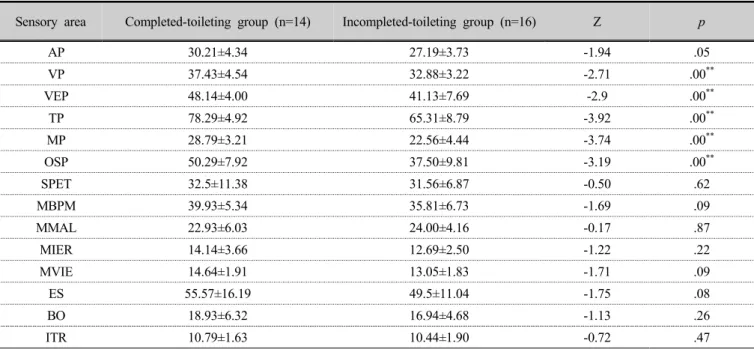
감각영역을 비교한 결과, 대소변 못가림군은 감각처리
에서 시각, 전정감각, 촉각, 다감각, 구강감각의 다섯 개
요소에서만 유의하게 낮은 점수를 보였다(p<.01). 감각처
리 영역에서 청각 처리, 다섯 개의 조절 요소, 세 개의
행동 및 감정반응에서는 모두 유의한 차이가 없었다
(p>.05)(Table 4).
Sensory area Completed-toileting group (n=14) Incompleted-toileting group (n=16) Z p
AP 30.21±4.34 27.19±3.73 -1.94 .05
VP 37.43±4.54 32.88±3.22 -2.71 .00
**VEP 48.14±4.00 41.13±7.69 -2.9 .00
**TP 78.29±4.92 65.31±8.79 -3.92 .00
**MP 28.79±3.21 22.56±4.44 -3.74 .00
**OSP 50.29±7.92 37.50±9.81 -3.19 .00
**SPET 32.5±11.38 31.56±6.87 -0.50 .62
MBPM 39.93±5.34 35.81±6.73 -1.69 .09
MMAL 22.93±6.03 24.00±4.16 -0.17 .87
MIER 14.14±3.66 12.69±2.50 -1.22 .22
MVIE 14.64±1.91 13.05±1.83 -1.71 .09
ES 55.57±16.19 49.5±11.04 -1.75 .08
BO 18.93±6.32 16.94±4.68 -1.13 .26
ITR 10.79±1.63 10.44±1.90 -0.72 .47
**
p<.01, Values are mean±SD; AP=auditory processing, VP=visual processing, VEP=vestibular processing, TP=touch processing, MP=multisensory processing, OSP=oral sensory processing, SPET=sensory processing related to endurance/tone, MBPM=modulation related to body position and movement, MMAL=modulation of movement affecting activity level, MIER=modulation of sensory input affecting emotional responses, MVIE=modulation of visual input affecting emotional responses and activity level, ES=emotional/social responses, BO=behavioral outcomes of sensory processing, ITR= item indicating thresholds for response
Table 4. Compare the sensory processing function between completed-toileting group and
incompleted-toileting group (unit: score)
2) 감각요소
감각요소를 비교한 결과, 대소변 못가림군은 가림군보 다 감각추구, 감정반응, 구강감각 민감성, 부주의/산만에 서 유의하게 점수가 낮았다(p<.01; p<.05; p<.01; p<.05).
낮은 지구력/근긴장도, 감각등록의 저하, 감각 민감성, 앉아있으려는 성향, 미세동작/지각력에서는 못가림군과 가림군은 유의한 차이가 없었다(p>.05)(Table 5).
Sensory factor
Completed-toileting group (n=14)
Incompleted-toileting group
(n=16) Z p
SS 68.43±8.03 54.75±11.19 -3.20 .00**
ER 53.43±12.75 44.13±9.79 -2.08 .04*
LET 32.07±10.37 31.44±7.01 -.44 .66
OSS 37.21±6.47 26.94±9.96 -2.57 .01*
ID 25.21±4.48 21.75±4.06 -2.61 .00**
PR 32.21±4.48 30.00±3.72 -1.76 .08
SS 15.36±3.91 15.25±4.65 -.19 .85
SE 13.14±5.22 16.00±4.23 -1.74 .08
FMP 8.86±3.23 6.64±3.27 -1.99 .05
*p<.05; **p<.01, Values are mean±SD; SS=sensory seeking, ER=emotionally reactive, LET=low endurance/tone, OSS=oral sensory sensitivity, ID=inattention/distractibility, PR=poor registration, SS=sensory sensitivity, SE=sedentary, FMP=fine motor/perceptual Table 5. Compare the sensory factor between completed-toileting group and incompleted-toileting group
(unit: score)
4. 사회지수와 감각처리기능의 상관관계
사회지수와 감각처리기능의 상관관계를 분석한 결과, 사회지수는 촉각처리(r=.64; p=.00) 및 다감각처리(r=.64;
p=.00) 점수와 강한 양의 상관관계, 청각처리(r=.40;
p=.03), 전정처리(r=.53; p=.00), 구강감각처리(r=.46;
p=.01) 점수와 중간정도 양의 상관관계를 보였고, 시각처 리(r=.32; p=.08)와는 유의한 관련성이 나타나지 않았다 (Table 6).
AP VP VEP TP MP OSP
r (with social quotient) .40 .32 .53 .64 .64 .46
p .03
*.08 .00
**.00
**.00
**.01
**