․교신저자: Kang-keyng Sung 543-8, Juwol-dong, Nam-gu, Gwangju-si. Republic of Korea
Dept. of Internal medicine, Hospital of Oriental medicine Won-Kwang
TEL: 062-670-6411 FAX: 062-670-6767 E-mail: [email protected]
․This paper was supported by Won-Kwang University in 2009.
Effects of Electroacupuncture on Immobilization Stress Responses : A Study on Inhibitory Avoidance Task, Forced Swimming Test,
and Stress Hormones
So-yeon Kwon, Min-soo Kim*, Sang-kwan Lee, Jun-tae Je, Jae-gun Oh, Jong-deok Lee, Kang-keyng Sung Dept. of Internal medicine, College of Oriental medicine Won-Kwang, Dept. of Statistics, Chonnam National University
Effects of Electroacupuncture on Immobilization Stress Responses :
A Study on Inhibitory Avoidance Task, Forced Swimming Test, and Stress Hormones
So-yeon Kwon, Min-soo Kim*, Sang-kwan Lee, Jun-tae Je, Jae-gun Oh, Jong-deok Lee, Kang-keyng Sung Dept. of Internal medicine, College of Oriental medicine Won-Kwang, *Dept. of Statistics, Chonnam National University
ABSTRACT
Objectives :
This study investigated the effects of electroacupuncture on memory, depression, and plasma stress hormone levels in rats that were under immobilization stress.
Materials and Methods :
The immobilization-only group was given two hours of immobilization stress for 10 consecutive days. The immobilization and high frequency EA group was given two hours of immobilization stress simultaneously with high frequency (100Hz) electroacupuncture stimulation on the right ST-36 (Zusanli) for 10 consecutive days. We conducted the inhibitory avoidance and forced swimming tests to recognize whether immobilization stress and electroacupuncture have effects on memory and depression. We collected blood samples from the tail of each rat at 30, 60, 90, and 120-minute intervals during the immobilization stress and EA stimulation to measure plasma concentrations of ACTH, corticosterone, melatonin, and norepinephrine induced by immobilization stress and electroacupuncture.
Results :
There was a significant effect of high frequency on the increase in anamnesis based on the result of the inhibitory avoidance test, but there was no significant effect of decreasing depression based on the result of the forced swim test. Also, there was no significant effect on the response indicated by stress hormones.
Conclusions :
1. High frequency electroacupuncture (100Hz) improved anamnesis in immobilization stress states under the inhibitory avoidance task.
2. High frequency electroacupuncture (100Hz) did not reduce depression induced by immobilization stress under the forced swimming test.
3. High frequency electroacupuncture (100Hz) did not decrease stress hormones through blood sampling.
Key words : Immobilization stress, Electroacupuncture, Inhibitory avoidance task, Forced swimming test, Stress hormone
Ⅰ. Introduction
Acupuncture therapy has demonstrated efficacy
in several clinical areas, and of these areas the
understanding of stress-related disease has progressed
immensely
1. According to some results of animals and clinical studies, the action of acupuncture for compensating physiological malfunction in stress condition is evoked by the autonomic nervous system and endocrine system. Acupuncture may modulate the imbalance of the autonomic nervous system when homeostatic potentialities are crushed by chronic stress condition
2. Chronic stress affects brain areas that are involved in learning and emotional responses
3. Immobilization stress is a simple and effective stressor which produces large increases in heart rate, blood pressure, and plasma levels of norepinephrine and epinephrine
4. Electroacupuncture (EA) is known to affect various autonomic functions such as blood pressure regulation, immune modulation, and the improvement of disorders concerning autonomic functions
5.
The effect of EA can improve the symptoms of memory deficit and depression
6. Acupuncture reduces noradrenaline levels in perfusates of certain brain areas as well as in blood circulation
7.
Although it has been reported that EA has a controlling effect on memory, depression, and stress hormones, the mechanism of treatment of EA is mostly about pain, and the evidence responsible for these effects in chronic stress status was not enough. We experimented to know if EA can have a significant effect on memory and depression symptoms. We designed only high frequency EA and ruled out low frequency EA because high frequency EA had effects on cortisol but not in low frequency EA
8.
To investigate the effect of EA on memory and depression caused by chronic immobilization stress, the inhibitory avoidance task and forced swimming test were carried out after the immobilization stress and high frequency (100Hz) EA stimulation. After
the last acquisition trial (24 hrs), the latency until stepping through toward the dark side was recorded in the absence of an electrical shock (retention trial) and was taken as a measure of long-term memory
9. The forced swimming test (FST) is the most reliable method to assess antidepressant activity in rodents. In the FST, the animal undergoes two trials (24hrs apart) in which it is placed into a cylinder of water, and active escape behavior and immobility time are measured
10.
To investigate the effect of EA on corticosterone, melatonin, ACTH, and noradrenaline response caused by chronic immobilization stress, we measured the plasma ACTH, corticosterone, melatonin, and noradrenaline concentration at 30, 60, 90, and 120 min after the beginning of the immobilization stress and high frequency (100Hz) electroacupuncture stimulation on Zusanli acupuncture point.
Ⅱ. Materials and Methods
1. Animal Handling
Healthy adult male Sprague-Dawley rats weighing
320-330 g were utilized. All procedures were performed
in accordance with the National Institute of Health
Guidelines for Animal Research (Guide for the Care
and Use of Laboratory Animals) and approved by
the Institutional Animal Care and Use Committee
at Wonkwang University. Animals were housed in
groups of five in a vivarium with 12-hr light/dark
cycle (lights on at 7:00), 50–60% humidity, and
free access to food and water. The animals were
acclimatized to the laboratory seven days before
the beginning of experiments.
2. Immobilization Stress and Electroacupuncture Treatment
Rats were randomly assigned to 4 groups. The control group did not receive treatment; 5 rats under immobilization (immo) group underwent immobilization stress for 2 hours for 10 days; 5 rats under immobilization +1day acupuncture (immo+1ACU) group underwent immobilization stress for 2 hours for 10 days and EA on the last day; 5 rats under immobilization +10days acupuncture (immo+10ACU) group underwent immobilization stress for 2 hours for 10 days and EA for 10 days as well. Immo +1ACU group and immo +10ACU group were given 2 hours immobilization stress simultaneously with high frequency (100Hz) EA stimulation each day for 10 days. The immobilization stress was given by attaching the four limbs of each animal in a prone position to a wooden board with adhesive tape.
Immobilization stress was carried out for 10 days between 09:00 AM and noon. All the experiments were completed between 09:00 and noon to minimize variability due to circadian rhythm.
Right ST-36 (Zusanli) was chosen for acupuncture stimulation. This point is on between the head of fibula and the tibial tuberosity of the rat which corresponds to human ST-36. A pair of stainless steel pins with a 0.3 mm diameter were inserted with a depth of 5 mm into the right ST-36 and a point about 5 mm far from the right ST-36. The two needles were connected with the output terminals of an EA device (Dual Impedance Research Stimulator, Harvard Apparatus, USA). Electro frequency was 100Hz, electro pulse duration and width were 1 ms, electro current was 3 mA and electro waveform was rectangular.
3. Inhibitory Avoidance Task
The inhibitory avoidance task box was divided into two compartments of different sizes (30 × 20 × 16 cm and 60 × 20 × 16 cm). The two compartments were made of black panels. One compartment was illuminated with a lamp placed on top of the chamber (350 lux). The other compartment was not illuminated (4 lux). The two compartments were separated by a guillotine door.
The double-trial acquisition protocol consisted of two successive acquisition trials separated by 120 sec, which were followed by a single retention trial 24 hours later. Each time, a rat was placed in the illuminated starting compartment. When the rat stepped through to the dark compartment, a guillotine door separating the two compartments closed, and a foot shock (0.7 mA, 3 sec) was delivered. The rat was removed from the dark compartment and then was in home cage for 120 s. After 120 sec, the rats that did not step through after 300 sec during the second acquisition trial were gently pushed to the dark side, and then a foot shock (0.7 mA, 3 sec) was delivered. This shock intensity was above threshold intensity and was followed by the vocalization of the animals upon receiving the shock. The rat was removed from the dark compartment after termination of the foot shock. Retention trial was performed 24 hours after the acquisition trial. The latency until stepping through toward the dark side was recorded in the absence of an electrical shock and was taken as a measure of long-term memory.
4. Forced Swimming Test
The forced swimming test (FST) was conducted using a cylindrical Plexiglass container (45 cm high
× 25 cm diameter) filled with tap water up to 30
cm and maintained at room temperature during
testing (25 ± 1.0 ℃). Rats used in this study were unable to touch the bottom of the tank filled up to 30 cm. The rats were pre-tested for 15 min, and after 24 hours, the rats were forced to undergo swimming test for 5 min. Behavior was videotaped during that period when it occurred. We classified the behavior into 3 categories. Struggling was movement of the forelimbs, usually directed at the walls of the cylinder, in which the forepaws break the surface of the water, swimming was paddling with forelimbs and limbs causing the rat to move through at least two quadrants of the cylinder within 5 sec and immobility was making only the movement necessary to keep its head above water, so that the rat stays within a single quadrant. After forced swimming testing, the rats were towel-dried. Each record of 15 min pretest and 5 min test session of FST was analyzed to score behaviors: struggling, swimming, and immobility.
5. Blood Sample Collection and Storage
We measured the ACTH, corticosterone, melatonin, and noradrenaline levels in separate groups of rats that were given immobilization stress and EA procedure as described above. To determine the plasma concentrations of stress hormones in detail, blood samples were taken from the tail of each rat at 30, 60, 90, and 120 min intervals during immobilization stress and EA stimulation.
Blood samples were allowed to clot for 20 min before centrifugation for 30 min at 3000 xg. Plasma was separated and stored at ≤-20 °C.
6. ACTH, Corticosterone, and Melatonin Immunoassay Millipore's Milliplex Map Rat Stress Hormone Panel was utilized to measure plasma ACTH, corticosterone, and melatonin. Luminex uses proprietary
techniques to internally color-code microspheres with two fluorescent dyes. The 100 distinctly colored bead sets can be created—each of which is coated with a specific capture antibody. After an analyte from a test sample is captured by the bead, a biotinylated detection antibody is introduced. The reaction mixture is then incubated with Streptavidin-PE conjugate, the reporter molecule, to complete the reaction on the surface of each microsphere. The microspheres are allowed to pass rapidly through a laser which excites the internal dyes making the microsphere set. A second laser excites PE, the fluorescent dye on the reporter molecule. Finally, high-speed digital-signal processors identify each individual microsphere and quantify the result of its bioassay based on fluorescent reporter signals.
7. Noradrenaline Enzyme-linked Immunosorbent Assay Rat noradrenaline Enzyme-linked immunosorbent assay (ELISA) kit (Cat BA E-5200 LDN, Co.) was utilized to measure plasma noradrenaline. ELISA is a biochemical technique used mainly in immunology to detect the presence of an antibody or an antigen in a sample. In ELISA, an unknown amount of antigen is affixed to a surface, and then a specific antibody is applied over the surface so that it can bind to the antigen. This antibody is linked to an enzyme, and in the final step a substance that the enzyme can convert to some detectable signal is added, most commonly a color change in a chemical substrate. Performing an ELISA involves at least one antibody with specificity for a particular antigen.
The sample with an unknown amount of antigen is
immobilized on a solid support either non-specifically
(via adsorption to the surface) or specifically (via
capture by another antibody specific to the same
antigen, in a "sandwich" ELISA). After the antigen
is immobilized the detection antibody is added, forming a complex with the antigen. The detection antibody can be covalently linked to an enzyme, or can itself be detected by a secondary antibody which is linked to an enzyme through bioconjugation. Between each step the plate is typically washed with a mild detergent solution to remove any proteins or antibodies that are not specifically bound. After the final wash step, the plate is developed by adding an enzymatic substrate to produce a visible signal, which indicates the quantity of antigen in the sample.
8. Statistical analysis
The effects of immobilization, high frequency EA on inhibitory avoidance test, and FST were analyzed using repeated analyses of variance (ANOVA) followed by Dundan's post-hoc. All statistical analyses were performed using SPSS 15.0.
Ⅲ. Results
1. Effects of EA on Inhibitory Avoidance Task in Immobilization Stress
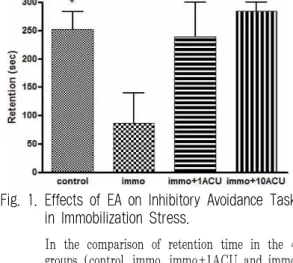
There was a significant effect of high frequency EA (100Hz) on elevating anamnesis in immobilization stress states.
There were significant differences among the groups in retention time (F
3,16=4.46; p=0.0186).
Fig. 1 shows the retention time 24 hours after acquisition trial of the four groups with the respective treatment. Retention time of immo+10ACU (284±16 sec) was the longest in other groups; that of immo (85.8±54.37 sec) was the shortest. The retention time of control (252±31.57 sec) was longer than that of immo+1ACU (239.25±60.75 sec). By Duncan's post-hoc test, the retention times of three groups were longer than that of immo group (p<0.05 for all).
Fig. 1. Effects of EA on Inhibitory Avoidance Task in Immobilization Stress.
In the comparison of retention time in the 4 groups (control, immo, immo+1ACU and immo +10ACU), the values represent mean ± SEM (n=5). There were significant differences among the groups in retention time (F3.16=4.46; P=
0.0186). * represents p<0.05 level compared to immo group.
2. Effects of EA on Forced Swimming Test in Immobilization Stress
There was no significant effect of high frequency EA (100Hz) on improving depression induced by immobilization stress in chronic stress states.
In analysis of struggle, results showed no difference among the groups (F
3,16=2.12; p=0.1384), and also in analysis of swimming, results showed no difference among the groups (F
3,16=2.96; p=0.0639). There were significant differences among the groups in immobility time (F
3,16=4.41; p=0.0192).
Fig. 2 shows the behavior time of the FST with the respective treatment. Immobility time of control (190.8±28.76 sec) was the longest in other groups, and immo+1ACU (78.75±27.81 sec) was the shortest.
Immobility time of immo (89.8±35.10 sec) was longer
than immo+10ACU (71.2±20.37 sec). By Duncan's
post-hoc test, the immobility times of three groups
were shorter than that of control group (p<0.05 for all).
Fig. 2. Effects of EA on Forced Swimming Test in Immobilization Stress.
In the comparison of behavior time in the 4 groups (control, immo, immo+1ACU and immo +10ACU), the values represent mean ± SEM (n=5). There were significant differences among the groups in immobility time (F3.16=4.41; P=
0.0192). * represents p<0.05 level compared to control group in immobility.
3. Effects of EA on Plasma ACTH Concentration in Immobilization Stress
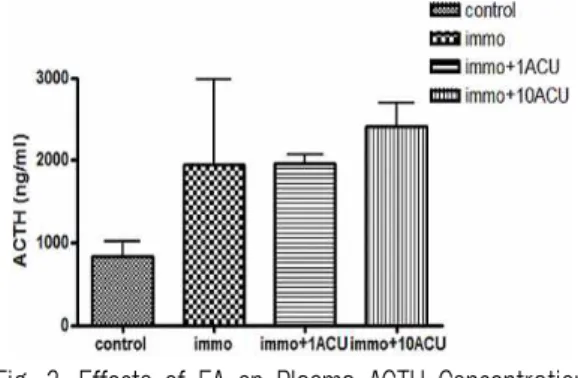
There was no significant effect of high frequency EA on decreasing plasma ACTH level induced by immobilization stress in chronic stress states. There were not significant differences among the groups in ACTH responses to immobilization stress (F
3,16=1.53;
p=0.2445). Fig. 3 shows the total ACTH level for 2 hours in the 4 groups with the respective treatment.
Plasma ACTH level of control was 828 ± 180.255 ng/ml. In immo, ACTH level was 1950 ± 1029.353 ng/ml. In immo+1ACU, ACTH level was 1962 ± 109.103 ng/ml. In immo+10ACU, ACTH level was 2403 ± 284.614 ng/ml.
Fig. 3. Effects of EA on Plasma ACTH Concentration in Immobilization Stress.
In the comparison of total plasma ACTH concentration in the 4 groups (control, immo, immo+1ACU and immo+10ACU), the values represent mean ± SEM (n=5). There were not significant differences among the groups in ACTH responses to immobilization stress (F3,16=1.53; p=0.2445).
4. Effects of EA on Plasma Corticosterone Concentration in Immobilization Stress
There were significant differences in the immobilization stressed groups compared to control group on plasma corticosterone level induced by immobilization stress in chronic stress states. There were significant differences among the groups in corticosterone responses to immobilization stress (F
3,16=12.56;
p=0.0002). Fig. 4 shows the total corticosterone level for 2 hrs in the 4 groups with the respective treatment.
Plasma corticosterone level of control was 10044
± 2552.036 ng/ml. In immo, corticosterone level was 27027 ± 2514.087 ng/ml. In immo+1ACU, corticosterone level was 31353 ± 6844.96 ng/ml. In immo+10ACU, corticosterone level was 27576 ± 2907.803 ng/ml.
By Duncan's post-hoc test, the plasma corticosterone
concentrations of three groups were higher than that
of control group (p<0.05 for all).
Fig. 4. Effects of EA on Plasma Corticosterone Concentration in Immobilization Stress.
In the comparison of total plasma corticosterone concentration in the 4 groups (control, immo, immo+1ACU and immo+10ACU), the values represent mean ± SEM (n=5). There were significant differences among the groups in corticosterone responses to immobilization stress (F3,16=12.56; p=0.0002). * represents p<0.05 level compared to control group.
5. Effects of EA on Plasma Melatonin Concentration in Immobilization Stress
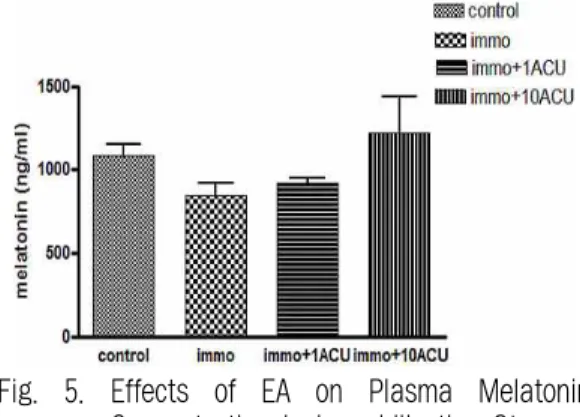
There was no significant effect of high frequency EA on decreasing plasma melatonin level induced by immobilization stress in chronic stress states.
There were not significant differences among the groups in melatonin responses to immobilization stress (F
3,16=1.69; p=0.2099). Fig. 5 shows the total melatonin level for 2 hrs in the 4 groups with the respective treatment.
Plasma melatonin level of control was 1080 ± 75.897 ng/ml. In immo, melatonin level was 843 ± 79.897 ng/ml. In immo+1ACU, melatonin level was 921 ± 28.461 ng/ml. In immo+10ACU, melatonin level was 1221 ± 218.204 ng/ml.
Fig. 5. Effects of EA on Plasma Melatonin Concentration in Immobilization Stress.
In the comparison of total plasma melatonin concentration in the 4 groups (control, immo, immo+1ACU and immo+10ACU), the values represent mean ± SEM (n=5). There were not significant differences among the groups in melatonin responses to immobilization stress (F3,16=1.69; p=0.2099).
6. Effects of EA on Plasma Noradrenaline Concentration in Immobilization Stress
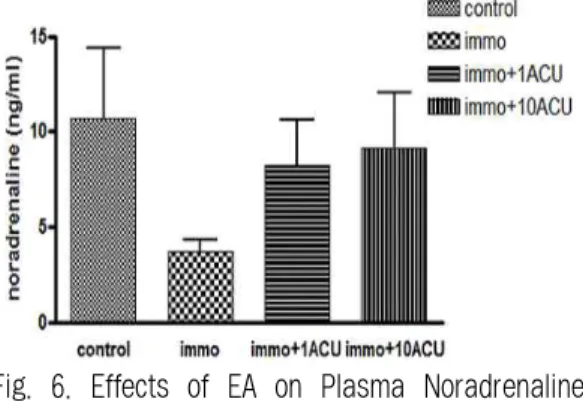
There was no significant effect of high frequency EA on decreasing plasma noradrenaline level induced by immobilization stress in chronic stress states.
There were not significant differences among the groups in noradrenaline responses to immobilization stress (F
3,16=1.37; p=0.2365). Fig. 6 shows the total noradrenaline level for 2 hrs in the 4 groups with the respective treatment.
Plasma noradrenaline level of control was 10.701
± 3.638 ng/ml. In immo, noradrenaline level was
3.69 ± 0.617 ng/ml. In immo+1ACU, noradrenaline
level was 8.19 ± 2.467 ng/ml. In immo+10ACU,
noradrenaline level was 9.12 ± 2.941 ng/ml.
Fig. 6. Effects of EA on Plasma Noradrenaline Concentration in Immobilization Stress.
In the comparison of total plasma noradrenaline concentration in the 4 groups (control, immo, immo+1ACU and immo+10ACU), the values represent mean ± SEM (n=5). There were not significant differences among the groups in noradrenaline responses to immobilization stress (F3,16=1.37; p=0.2365).
Ⅳ. Discussion
The main aim of this study was to look into electroacupuncture (EA) effects on chronic immobilization stress for memory, depression and stress hormone responses.
The present results show that EA can increase memory deficit that was induced by chronic immobilization stress, and immobilization stress gives rise to amnesia and depression.
In comparing control, immo, immo +1ACU and immo+10ACU, it is interesting that most rats in the immo+10ACU group stepped through with a retention latency close to 300 sec but most rats in the immo group stepped through with a retention latency close to 100 sec.
There were significant differences among the groups in retention time (F
3,16=4.46; p=0.0186).
By Duncan's post-hoc test, the retention times of three groups were longer than that of immo group
(p<0.05 for all). The results show that EA increases memory.
Chronic stress affects brain areas involved in learning and emotional responses
11. Several studies have shown that the hippocampus is involved in the regulation of stress response by way of the hypothalamic-pituitary-adrenal (HPA) axis and is sensitive to stress-related damage
12.
Hippocampal volume contractions, which have been observed in patients with major depression, may be related to emotional and memory damage
13. These alterations may contribute to the cognitive deficits of major depression
14.
In the analysis of forced swimming test responses to immobilization stress, the control group was high at immobility and the immo group was high at struggle. We guessed that moderate stress gived vitality. There were significant effects among the groups compared to control in immobility. The result shows that immobilization stress increases immobile behavior in the FST, but EA cannot decrease immobile behavior.
The results above show that EA increases memory, but it does not reduce depression induced by chronic immobilization stress.
Depression is a complex disorder, and the mechanisms underlying its pathogenesis remain unrevealed. Clinical and preclinical evidence indicate that stressful life events and chronic stress are risk factors for developing depression. Chronic stress is involved in cognitive problems such as memory deficit, depression, anxiety disorders
15.
There was no significant effect of high frequency EA on decreasing plasma ACTH, melatonin, and noradrenalin level induced by immobilization stress in chronic stress states.
Only in corticosterone level were significant differences
among the groups compared to the control group (F
3,16=12.56; p=0.0002). The immobilization stress and EA had efficacy on corticosterone stress hormone.
Among the groups, the level of plasma ACTH in the immo+10ACU group was the highest (2403
± 284.614 ng/ml) while that of the control group was the lowest (828 ± 180.255 ng/ml). In terms of the level of plasma corticosterone, that of the immo+1ACU group was the highest (31353 ± 6844.96 ng/ml) and that of the control group was the lowest (10044 ± 2552.036 ng/ml). This shows that immobilization stress increases stress hormone such as ACTH and corticosterone.
Among the groups, the level of plasma melatonin of the immo+10ACU group was the highest (1221
± 218.204 ng/ml) and that of the immo group was the lowest (843 ± 79.897 ng/ml). The plasma melatonin level of the control group was 1080 ± 75.897 ng/ml while its plasma noradrenaline level is the highest at 10.701 ± 3.638 ng/ml. On the other hand, that of the immo group was the lowest (3.69
± 0.617 ng/ml). As for the immo+10ACU group, its level of plasma noradrenaline was 9.12 ± 2.941 ng/ml. In the melatonin and noradrenaline level, the immo group was the lowest. The results above show that the control group was the lowest in ACTH and corticosterone, and it was the highest in noradrenaline level. This shows that immobilization stress hasnot increase stress hormone such as melatonin and noradrenaline.
Chronic stress can affect the hypothalamic pituitary adrenal axis in many ways. For example, it can lead to impaired negative feedback of the HPA axis, to slower recovery from stressors, and to either higher or lower cortisol levels
16-17. A considerable body of research has linked depression and chronic stress to elevated stress hormones, mainly cortisol
and catecholamines
18-20. Acting systems that are affected in response to stress are the sympathetic adrenal-medullary system and pituitary adrenocortical system secreting epinephrine, norepinephrine, and corticosteroid
21. Stress activates the sympathetic nervous system and the hypothalamic-pituitary-adrenal (HPA) axis, leading to heightened levels of epinephrine, norepinephrine ,and glucocorticoids
22.
Corticosteroid hormones secreted by the adrenal cortex are considered to be essential for cognitive performance. Corticosteroids have been shown to induce positive or negative cognitive changes
23. The released corticosterone has been suggested as a critical component of stress-induced learning and memory impairment
24. Increased plasma levels of corticosteroids and catecholamines occurring as a response to training in motivated learning paradigms appear to be crucial for memory formation in the task
25.
Melatonin has been associated with the regulation of cognitive and emotional processes such as memory and anxiety
26. In the rat pineal gland, melatonin content increases in response to physical immobilization and forced swimming
27.
Stress-increased the levels of circulating noradrenaline in rats, and the stress-related high plasma melatonin concentration is probably produced through stimulation of circulating noradrenaline. Chronic stress increases the synthesis and release of noradrenaline from the adrenal medulla and activates the sympathetic-adrenergic -noradrenergic system of the stress response
28.
During immobilization stress, EA and immobilization stress hadnot affect stress hormone responses. It is probable that blood sampling executes after immobilization stress.
The results above show that EA increases memory,
but it does not reduce depression and stress hormones
induced by chronic immobilization stress.
These results indicate that EA may be used for the treatment of stress-induced diseases such as amnesia.
Ⅴ. Conclusions
Some conclusions were derived from the study on the effect of on memory, depression and stress hormone response to immobilization stress.
1. High frequency electroacupuncture (100Hz) improved
anamnesis in immobilization stress states under the inhibitory avoidance task.
2. High frequency electroacupuncture (100Hz) had not reduce depression induced by immobilization stress under the forced swimming test.
3. High frequency electroacupuncture (100Hz) had not decrease stress hormones through blood sampling.
These results showed that EA improved not
depression, but amnesia induced by immobilization
stress.
전기침이 결박 스트레스 반응에 미치는 영향
: 억제성 회피 과제, 강제 수영 시험, 스트레스 호르몬 반응 연구
권소연, 김민수*, 이상관, 제준태, 오재건, 이종덕, 성강경 원광대학교 한의과대학 심계내과학 교실, *전남대학교 통계학과
초록목적 :
본 연구는 결박 스트레스를 시행한 백서의 기억력, 우울, 스트레스 호르몬의 혈중 농도에 대한 전기침의 효과를 관 찰하였다.
재료와 방법 :
결박 그룹은 10일 동안 2시간의 결박 스트레스를 받았다. 결박 스트레스 및 고주파수 전침 그룹은 2시간 의 결박 스트레스를 받는 동시에 100Hz의 전침을 우측 족삼리 (ST-36)에 시행하였다. 기억력과 우울에 미치는 결박 스트레스 와 침의 효과를 비교하기 위하여 억제성 회피 과제와 강제 수영 검사를 실시하였다. 결박 스트레스 및 전기침으로 유도된 코르 티코스테론과 멜라토닌, 부신피질자극호르몬, 노르아드레날린의 농도를 측정하기 위하여 결박 스트레스 및 전기침 자극이 시작 된 30분, 60분, 90분, 120분 후에 백서의 꼬리에서 혈액 샘플을 채취하였다.
결과 :
억제성 회피 과제에서 전기침을 시행한 그룹은 시행하지 않은 그룹에 대해서 장기 기억의 증진에 유의한 변화가 있었다. 강제 수영 검사 결과에서는 우울에 유의한 변화가 없었으며, 스트레스 호르몬 반응 결과에서도 유의한 변화가 없었다.
결론 :