ABSTRACT Soyasaponin I, II, III and V contents were investigated in seed, cotyledons and sprouts of soybean (Glycine max (L.) Merill) subjected to germination over five days. High-performance liquid chromatography coupled with tandem mass spectrometric (HPLC-MS/MS) method was used to evaluate the content of soyasaponins. Soyasaponins contents were different according to the varieties. Germination of soybeans dramatically increased soyasaponin contents in soybean sprouts in a time-dependent manner. Cotyledons had a higher contents of soyasaponins compared to dried seed (p<0.05). After five days of germination, Soyasaponin I and II increased 10 times higher after germination. Soyasaponin I and II are major metabolites in cotyledons and hypocotyls. Soyasaponin III and V were also detected in seed and increased depended on the germination stage.
Soyasaponin V was at its highest levels in the hypocotyl, almost 7 times higher than the initial content in soybean seeds. Therefore, the germination of soybean sprouts significantly increased soyasaponin content.
Keywords : Soy sprout, Soyasaponin, Soybean
ⓒ 본 학회지의 저작권은 한국작물학회지에 있으며, 이의 무단전재나 복제를 금합니다.
This is an Open-Access article distributed under the terms of the Creative Commons Attribution Non-Commercial License (http://creativecommons.org/licenses/by-nc/3.0) which permits unrestricted non-commercial use, distribution, and reproduction in any medium, provided the original work is properly cited.
1경희대학교 식품영양학과 (Department of Food and Nutrition, Kyung Hee University, Seoul 02447, Korea)
2한국방송통신대학교 농학과 (Dept. of Agricultural Science, Korea National Open University, Seoul 03087, Korea)
†
Corresponding author: Sangjun Han; (Phone) +82-2-3668-4632; (E-mail) [email protected]
<Received 22 February, 2016; Revised 23 February, 2016; Accepted 24 February, 2016>
콩
[Glycine max (L.) Merill]은 우리나라에서 중요한 주곡 작물로 동북아시아를 원산지로 하며, 용도에 따라 장콩, 기 름콩, 나물콩, 밥밑콩, 풋콩 등 예로부터 우리 식생활의 주 요한 식품자원으로 개발되었다. 콩은 영양학적으로 훌륭한 식물성 단백질원이며, 식이섬유와 미네랄, 각종 비타민의 주요 공급원 역할을 담당하고 있으며(Ruiz et al., 1996), 최 근 건강에 대한 관심이 높아지면서 기능성 건강 식품원료 로 콩에 대한 관심과 수요가 증가하고 있다.
콩에는 생리활성 물질로 레시틴, phytate, phytosterols, isoflavone 등이 알려져 있으며, 이들은 항암활성 및 치매억 제 기능 등이 알려져 있다(Kennedy, 1995; Messina, 1995).
콩의 대표적 천연성분으로 isoflavone은 갱년기 증상의 강 도와 심혈관계 질환의 위험도를 낮추며, 폐경 후 여성의 골 밀도를 높여주는 것으로 보고 되었다(Peterson & Barnes, 1991; Lee et al., 2003). 이 밖에도 콩에는 사포닌 성분들도 알려져 있는데, 사포닌은 다양한 식물에 널리 분포하는 배 당체 형태의 천연화합물로 수용성 용매에서 비누와 같은 거
품을 형성하는 특징을 갖고 있다.
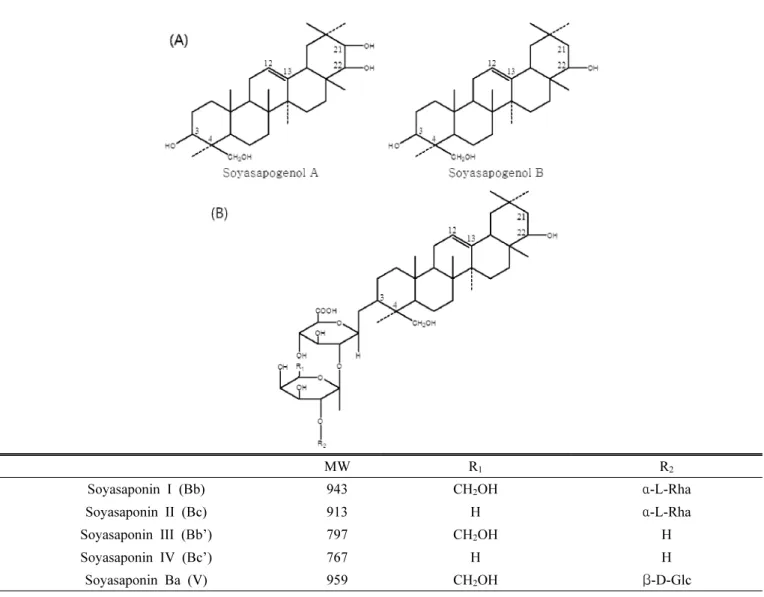
콩 사포닌은 oleanane계열의 triterpenoid로 분류되며 두 과작물에서 주로 발견된다(Daveby et al., 1998; Ruiz et al., 1996). 콩에 함유된 soyasaponin은 aglycone의 구조에 따라 A 그룹과 B그룹으로 나뉘는데, aglycone의 구조와 종류는 Fig. 1 과 같다. 콩 사포닌은 함량이 4% 미만의 미량이고, isoflavonoid 계열 화합물과 물리적 특성이 유사하여 순수 정제가 쉽지 않아 생리활성에 대한 연구가 상대적으로 미 진하였다(Zhang et al., 2009). 그러나 최근 생리활성 성분 으로 그 기능이 다시 주목 받기 시작하면서 관련연구가 활 발히 이루어지고 있다(Zhang & Popovich, 2008).
우리나라에서 콩은 식품으로 바로 이용하기도 하며, 장
류 등 가공형태로 이용되기도 한다. 또한 콩을 발아시켜 나
물로 이용하기도 하는데, 콩이 발아하여 생장하는 동안에
여러 형태의 대사가 이루어져 본래의 성분과는 차이가 나
타나는 것으로 알려지고 있다(Kim et al., 2009; Kim et al.,
2002; Kim et al., 1998). 그 동안 콩나물에 함유된 soyasaponin
MW R
1R
2Soyasaponin I (Bb) 943 CH
2OH α-L-Rha
Soyasaponin II (Bc) 913 H α-L-Rha
Soyasaponin III (Bb’) 797 CH
2OH H
Soyasaponin IV (Bc’) 767 H H
Soyasaponin Ba (V) 959 CH
2OH β-D-Glc
Glc, glucose Rha, rhamnose
Fig. 1. Chemical structures of soyasaponins. (A) chemical structures of soyasapogenol A and soyasapogenol B. (B) Chemical structures of group B soyasaponins.
함량의 변화에 대한 보고가 있었으나 모두 aglycone을 대 상으로 한 것으로 soyasaponin 개별 화합물의 함량변화에 대한 내용은 전무한 실정이다. 본 연구는 가공식품원료로 서 콩의 발아 중 soyasaponin의 함량의 변화를 이해함으로써 콩 재배 확대를 위한 기초 자료로 활용하고자 수행하였다.
재료 및 방법
재 료
Soyasaponin, I (Bb), II (Bc), III (Bb ΄) 및 V (Ba)는 대두 methanol 추출물로부터 순수 분리한 것을 이용하였다(Han, 2011). Methanol, acetonitrile 및 초순수 증류수는 J.T. Baker
(Mallinckrodt Baker, Inc., NJ, USA) 에서, formic acid는 Sigma-Aldrich (St. Louis, Mo. USA) 에서 각각 구입하 였다.
콩나물 재배
본 연구에 이용된 콩은 일반용으로 다올콩, 대원콩, 대풍 콩, 천상콩 등 4품종과, 밥밑용으로 청자3호 등 모두 5개 품종으로 모두 2015년도에 재배 생산된 것을 이용하였다.
콩나물 재배는 공시된 품종 50 g을 1시간 수침 한 후 선별
하여 콩나물 재배기(신창 INC: SC-9000A)에 넣고 연속 수
주하며 25°C에서 재배하였고, 매일 수확하여 분석재료로
사용하였다.
Fig. 2. Representative multiple reaction monitoring (MRM) chromatograms of soybean sprout: (A) soyasaponin V (Ba); (B) soyasaponin I (Bb); (C) soyasaponin III (Bb’); (D) soyasaponin II (Bc).
Table 1. Conditions for soyasaponin analysis by LC-MS/MS in MRM mode.
Soyasaponins Precursor ion (M+H
+) Product ion Fragmentor voltage Collision energy
Soyasaponin I (Bb) 941 205 200 60
Soyasaponin II (Bc) 911 113 250 65
Soyasaponin III (Bb’) 795 113 250 55
Soyasaponin V (Ba) 957 221 150 60
출기와 자동시료주입기가 조합된 Agilent 1200 Series (Agilent Co., USA) 를 이용하였다. HPLC 분석을 위한 컬럼은 Zorbax Eclipse XDB-C
18(150 mm × 4.6 mm, 1.8 μm, Agilent Co., USA) 로 0.3 mL min
-1의 유속으로 시료 3 μL를 주입하였다.
모든 시료는 3회 반복하였으며, 수집된 분석자료는 SAS
(Statistical Analysis System, 9.4 ver.) 를 통하여 분산분석
하였다. 평균간 다중비교를 위해 5% 유의수준(p<0.05)에서
Duncan’s multiple range test 를 수행하였다.
Table 2. Contents of soyasaponin I (Bb) and soyasaponin II (Bc) in samples of soybean varieties subjected to different germination times (µg/seed).
Varieties Days After Treatment
Soyasaponin I Soyasaponin II
Cotyledon Hypocotyl Total Cotyledon Hypocotyl Total
Daolkong
0 86.3 ± 6.8c 86.3 ± 6.8d 57.5 ± 6.8d 57.5 ± 6.8e
1 458.5 ± 67.3b 458.5 ± 67.3c 282.1 ± 33.2c 282.1 ± 33.2d
2 568.2 ± 53.7b 568.2 ± 53.7bc 410.6 ± 5.1a 410.6 ± 5.1a
3 555.5 ± 36.5b 60.4 ± 30.0b 615.9 ± 35.0b 371.0 ± 6.6b 0.1 ± 0.1c 371.2 ± 6.7b 4 508.0 ± 94.9b 133.9 ± 17.8a 641.9 ± 112.3b 350.9 ± 14.6b 0.5 ± 0.1b 351.4 ± 14.6b 5 723.2 ± 44.4a 149.1 ± 9.3a 872.3 ± 47.6a 311.1 ± 12.6c 0.9 ± 0.1a 312.0 ± 12.6c
Daewonkong
0 74.0 ± 6.1d 74.0 ± 6.1c 35.2 ± 3.7c 35.2 ± 3.7c
1 503.9 ± 66.0bc 503.9 ± 66.0b 318.8 ± 65.8b 318.8 ± 65.8b
2 546.7 ± 8.3b 546.7 ± 8.3b 290.7 ± 10.6b 290.7 ± 10.6b
3 454.4 ± 8.7c 123.2 ± 27.5b 577.6 ± 28.2b 313.1 ± 36.4b 4.1 ± 2.8a 317.2 ± 35.3b 4 712.1 ± 56.5a 224.9 ± 74.1a 937.0 ± 129.5a 393.6 ± 6.3a 4.9 ± 4.3a 398.5 ± 10.6a 5 641.5 ± 77.8a 269.7 ± 45.5a 911.2 ± 123.2a 411.2 ± 36.4a 5.0 ± 6.9a 416.2 ± 31.0a
Daepungkong
0 68.7 ± 3.5d 68.7 ± 3.5d 24.1 ± 1.6d 24.1 ± 1.6d
1 434.1 ± 48.2c 434.1 ± 48.2c 200.8 ± 13.4c 200.8 ± 13.4c
2 470.3 ± 57.8c 470.3 ± 57.8c 197.8 ± 10.8c 197.8 ± 10.8c
3 581.9 ± 27.2b 85.7 ± 6.1b 667.6 ± 33.0b 283.5 ± 36.0b 3.0 ± 0.6c 286.5 ± 36.4b 4 699.1 ± 79.7a 382.0 ± 11.0a 1081.1 ± 86.1a 303.3 ± 9.8b 2.1 ± 0.3b 305.4 ± 9.9b 5 683.9 ± 53.8a 361.4 ± 33.8a 1045.2 ± 82.3a 345.4 ± 19.2a 5.4 ± 1.0a 350.8 ± 18.4a
Cheonsangkong
0 192.7 ± 22.6d 192.7 ± 22.6c 78.2 ± 5.4c 78.2 ± 5.4c
1 680.3 ± 97.0bc 680.3 ± 97.0b 319.3 ± 7.0b 319.3 ± 7.0b
2 786.0 ± 46.3a 786.0 ± 46.3b 371.0 ± 47.0ab 371.0 ± 47.0ab
3 649.7 ± 14.7c 114.4 ± 38.0b 764.1 ± 34.8b 357.3 ± 47.2ab 0.4 ± 0.1c 357.7 ± 47.2ab 4 758.1 ± 64.3ab 281.1 ± 30.5a 1039.2 ± 64.2a 401.3 ± 20.1a 1.0 ± 0.2b 402.3 ± 20.1a 5 721.9 ± 19.0abc 297.8 ± 55.6a 1019.6 ± 74.1a 400.0 ± 10.7a 5.4 ± 0.3a 405.3 ± 11.0a
Cheonja #3
0 177.0 ± 2.2c 177.0 ± 2.2c 141.6 ± 12.1c 141.6 ± 12.1c
1 629.6 ± 9.9b 629.6 ± 9.9b 239.0 ± 8.7c 239.0 ± 8.7c
2 706.1 ± 40.5b 706.1 ± 40.5b 375.2 ± 6.0b 375.2 ± 6.0b
3 664.9 ± 36.1b 117.4 ± 22.1b 782.3 ± 42.2b 386.2 ± 54.6b 1.7 ± 0.3b 387.9 ± 54.5b 4 901.4 ± 73.1a 299.6 ± 81.0a 1201.0 ± 94.9a 553.2 ± 64.4a 1.3 ± 1.2b 554.6 ± 64.8a 5 902.7 ± 170.8a 362.1 ± 28.0a 1264.8 ± 172.8a 413.2 ± 108.3b 10.4 ± 9.3a 423.6 ± 109.6b The data represent the mean±SD of at least three replicates.
Different letters by row indicate significant differences, p<0.05.
결과 및 고찰
Soyasaponin I and II
콩에 함유된 soyasaponin I 및 soyasaponin II의 함량이 발아 과정을 통해 어떻게 변화하는지를 조사하였다. 분석 에 이용된 콩은 장류나 두부용으로 사용되는 대두품종과
밥밑용 콩이다. 콩에 들어 있는 개별 soyasaponin은 물리 ·
화학적 특성들이 매우 유사하여 기존의 HPLC 만으로는
baseline separation 뿐만 아니라 UV 검출도 용이하지 않아
개별 사포닌의 함량을 분석하는데 어려움의 원인이 되고 있
다. 따라서 콩함유 개별 사포닌 정량을 위해 고감도 HPLC-
MS/MS 법을 이용하였다.
Treatment Cotyledon Hypocotyl Total Cotyledon Hypocotyl Total
Daolkong
0 1.8 ± 0.3d 1.8 ± 0.3d 7.8 ± 0.8d 7.8 ± 0.8d
1 12.3 ± 1.3c 12.3 ± 1.3c 36.2 ± 1.9a 36.2 ± 1.9cd
2 14.2 ± 1.0c 14.2 ± 1.0c 36.5 ± 1.0a 36.5 ± 1.0cd
3 13.3 ± 1.2c 0.6 ± 0.2b 13.9 ± 1.0c 21.0 ± 1.6c 40.8 ± 17.2b 61.8 ± 17.3bc 4 18.0 ± 1.3b 1.0 ± 0.4b 19.1 ± 0.9b 25.0 ± 1.1b 61.7 ± 27.2ab 86.7 ± 27.3ab 5 23.8 ± 1.3a 1.6 ± 0.6a 25.4 ± 1.3a 19.3 ± 1.8c 88.8 ± 37.0a 108.1 ± 36.6a
Daewonkong
0 2.5 ± 0.5d 2.5 ± 0.5d 6.8 ± 0.7c 6.8 ± 0.7c
1 17.2 ± 6.7c 17.2 ± 6.7c 31.2 ± 2.8ab 31.2 ± 2.8bc
2 15.7 ± 0.8c 15.7 ± 0.8c 37.9 ± 2.0a 37.9 ± 2.0bc
3 15.2 ± 1.7c 2.7 ± 1.6ab 18.0 ± 0.6c 23.1 ± 1.8abc 37.7 ± 11.9b 60.8 ± 10.8b 4 30.9 ± 2.7b 2.3 ± 0.6b 33.2 ± 3.1b 14.3 ± 7.9bc 98.7 ± 28.5a 113.0 ± 36.3a 5 36.6 ± 1.9a 3.7 ± 0.7a 40.2 ± 2.0a 31.9 ± 24.6ab 115.7 ± 28.0a 147.5 ± 39.2a
Daepungkong
0 3.5 ± 0.4d 3.5 ± 0.4d 7.6 ± 0.1c 7.6 ± 0.1d
1 22.9 ± 2.5c 22.9 ± 2.5c 28.8 ± 0.5a 28.8 ± 0.5c
2 23.1 ± 3.0c 23.1 ± 3.0c 35.2 ± 1.2a 35.2 ± 1.2c
3 24.3 ± 1.2c 1.3 ± 0.2c 25.6 ± 1.0c 19.1 ± 3.9b 41.1 ± 11.5b 60.2 ± 9.1b 4 38.4 ± 3.8b 4.4 ± 0.1b 42.8 ± 3.7b 12.2 ± 3.3c 139.4 ± 18.9a 151.6 ± 21.5a 5 46.0 ± 2.7a 5.2 ± 0.5a 51.2 ± 2.2a 21.5 ± 8.9b 144.4 ± 17.1a 165.9 ± 14.6a
Cheonsangkong
0 8.8 ± 0.3b 8.8 ± 0.3d 21.8 ± 0.2b 21.8 ± 0.2d
1 41.2 ± 1.3a 41.2 ± 1.3c 62.2 ± 3.1a 62.2 ± 3.1c
2 44.1 ± 4.9a 44.1 ± 4.9bc 64.6 ± 3.5a 64.6 ± 3.5c
3 42.2 ± 2.5a 1.3 ± 0.2b 43.5 ± 2.4bc 25.2 ± 24.6b 66.2 ± 20.3b 91.4 ± 31.2b 4 44.4 ± 5.2a 3.5 ± 0.8a 47.8 ± 5.9ab 11.3 ± 4.0b 145.7 ± 16.1a 157.0 ± 12.5a 5 46.1 ± 1.4a 4.6 ± 2.1a 50.7 ± 2.0a 9.9 ± 1.8b 155.6 ± 12.9a 165.5 ± 12.7a
Cheonja #3
0 32.5 ± 0.9c 32.5 ± 0.9f 45.1 ± 0.7ab 45.1 ± 0.7c
1 20.1 ± 1.1d 20.1 ± 1.1e 57.2 ± 4.9a 57.2 ± 4.9c
2 24.5 ± 2.4d 24.5 ± 2.4d 56.7 ± 3.2a 56.7 ± 3.2c
3 39.4 ± 1.5b 1.5 ± 0.5cb 40.9 ± 1.8c 45.5 ± 8.6ab 45.3 ± 24.8b 90.8 ± 27.7b 4 57.9 ± 3.3a 6.2 ± 6.2ab 64.1 ± 4.5b 31.3 ± 3.4c 125.0 ± 19.1a 156.3 ± 17.2a 5 60.7 ± 4.5a 8.3 ± 4.1a 69.0 ± 0.8a 34.2 ± 14.6bc 143.0 ± 14.7a 177.1 ± 0.1a The data represent the mean±SD of at least three replicates.
Different letters by row indicate significant differences, p<0.05.
I 의 함량변화와 매우 유사하여, 침종 하루 만에 200~318 µg/seed 수준으로 급격히 증가하였다. 발아가 진행되면서 성장한 배축에서도 soyasaponin II를 검출할 수 있었는데 품종에 따라 차이는 있었지만 soyasaponin I에 비해 그 양은 극히 낮은 수준(0.9~10 µg/seed)이었다.
Soyasaponin III and V
콩에 함유된 soyasaponin III과 soyasaponin V의 함량은 soyasaponin I 이나 soyasaponin II에 비해 적었다. Soyasaponin III 의 경우 종자 당 함유량은 2~30 µg 수준이었고, soyasaponin V 는 7~45 µg 수준이었다. Soyasaponin III 역시 침종 후 함 량이 급격히 증가하여 종자 당 12~40 µg 수준까지 늘어났 으며, 새로 자라난 배축에서도 1~8 µg 수준의 함량을 검출 할 수 있었다(Table 3).
Soyasaponin V 의 경우는 종자 상태에서는 함량이 낮았 으나, 침종 후 발아가 시작되면서 자라난 배축에서 급격한 함량의 증가를 확인할 수 있었다. 조사된 다른 soyasaponin 의 경우 발아 후 신장한 배축에서 검출된 함량이 비슷하게 증가하는 현상을 보였으나, 떡잎보다는 상대적으로 낮은 비율이었다. 그러나 soyasaponin V의 경우는 발아 5일 차 에서 조사된 결과 떡잎보다 최고 10배 이상 높은 비율을 나 타내었다. 따라서 soyasaponin V는 발아와 더불어 생합성 이 왕성하게 이루어지고 또 대부분이 배축부분으로 이동하 는 것으로 보여진다.
콩의 성분은 발아하여 생장하는 과정 중에 상당한 변화를 보이는 것으로 보고되고 있다(Youn et al., 2011). Soyasaponin 의 경우도 발아과정 중 함량의 변화가 상당하였는데, Guajardo- Flores et al. (2012)의 발아 중 배축에서 soyasaponin B의 함량이 떡잎보다 높은 수준으로 증가했다는 보고와도 일치 한다. 이처럼 콩의 발아 중 saponins 함량이 증가하는 것은 발아 중 이차 대사산물을 합성하고 종자의 구조를 변형시 켜 구조를 약화시키는 효소와 관련이 있으며, 이를 통해 용 매추출이 용이해지는데 그 원인이 있는 것으로 알려져 있 다(Kurosawa et al., 2002; Yoshiki et al., 1998). 우리나라 에서 이루어지는 콩의 소비 형태는 주로 식품으로 가공된 후이기 때문에 기능성 성분으로서의 soyasaponin의 이용효 율을 높이기 위해서는 적절한 가공방법에 대한 고찰이 있 어야 할 것이다.
적 요
콩 재배 및 이용확대를 위한 기초자료를 얻기 위해 발아 과정 중 기능성 성분인 soyasaponin의 함량 변화를 조사하
였다.
1. Soyasaponin I 과 soyasaponin II의 함량은 품종에 따 라 차이가 있었으나 발아과정 중 떡잎부위에서 함량 이 10배 이상 증가하였고, soyasaponin I은 배축에서 도 종자 당 이 140~360 µg 수준의 함량을 나타내었다.
2. Soyasaponin III 및 soyasaponin V의 함량은 발아를 통해 증가하는 경향이었고, soyasaponin V의 경우 배 축에서 그 함량이 급격히 증가하는 것으로 나타났다.
사 사
본 논문은 2012년도 한국방송통신대학교 학술연구비 지 원을 받아 작성된 것임.
인용문헌(REFERENCES)