― 447 ―
Korean J. Appl. Entomol.
*Corresponding author. E-mail: [email protected]
Steinernematid와 Heterorhabditid 곤충병원성 선충을 이용한 담배거세미나방 ( Spodoptera litura )의 생물적 방제
김형환
1ㆍ조성래2ㆍ추호렬3ㆍ이상명4ㆍ전흥용1ㆍ이동운*경북대학교 생물응용학과, 1원예연구소 원예환경과, 2경남농업기술원 기술지원과, 3경상대학교 응용생물환경학과, 농업생명과학연구원,
4국립산림과학원 남부산림연구소
Biological Control of Tobacco Cutworm, Spodoptera litura (Lepidoptera:
Noctuidae) by Steinernematid and Heterorhabditid Entomopathogenic Nematodes
Hyeong Hwan Kim1, Sung Rae Cho2, Ho Yul Choo3, Sang Myeong Lee4, Heung Yong Jeon1 and Dong Woon Lee*
Department of Applied Biology, Kyungpook National University, Sangju, Gyeongbuk, 742-711, Korea
1Horticultural Environment Division, National Horticultural Research Institute, Suwon 441-440, Korea
2Division of Technology Service, Gyeongnam Agricultural Research and Extension Services, Jinju, Gyeongnam, 660-360, Korea
3Department of Applied Biology and Environmental Sciences, Institute of Agriculture and Life Sciences, Gyeongsang National University, Jinju, Gyeongnam, 660-701, Korea
4Southern Forest Research Center, Korea Forest Research Institute, Jinju, Gyeongnam, 660-300, Korea
ABSTRACT : Five effective strains against tobacco cutworm, Spodoptera litura (Lepidoptera: Noctuidae),
Steinernema carpocapsae (GSN1), Steinernema sp. (GSNUS-10), Steinernema sp. (GSNUS-14), Heterorhabditis bacteriophora Hamyang (HbH), and Heterorhabditis sp. (GSNUH-1) were selected among 14 isolates of Korean entomopathogenic nematode in laboratory tests. LC50 values of above five strains against tobacco cutworm were various by different nematode strains and developmental stages of tobacco cutworm. LC50value of S. carpocapsae (GSN1) was the lowest by 4.0~8.3 infective juveniles (Ijs) and 2nd instars of tobacco cutworm was most susceptible. Pathogenicity of five effective strains against tobacco cutworm depends on nematode strain, concentration, and application times. The most effective strain was determined as S. carpocapsae (GSN1). Two or three times of applications were effective regardless of nematode strain, or concentration. Efficacy of S. carpocapsae (GSN1), Steinernema (GSNUS-10), Steinernema (GSNUS-14), and Heterorhabditis (GSNUH-1) was variable depending on nematode strain, concentration, application times, and host variety. S. carpocapsae (GSN1) was the most effective and inoculation of 100,000 infective juveniles per m2 (720,000 Ijs/7.2 m2=1×10⁹ Ijs/ha) resulted in higher efficacy. Three times of application of nematodes led to higher control efficacy than one or two applications. Efficacy of nematodes was higher on Chinese cabbage than cabbage or kale.
KEY WORDS : Steinernema carpocapsae, pathogenicity, biological control, entomopathogenic nematode,
Spodoptera litura초 록
: 14계통의 한국산 steinernematid와 heterorhabditid 선충들의 담배거세미나방에 대한 실내 병원성 검정 결과, Steinernema carpocapsae (GSN1), Steinernema sp. (GSNUS-10), Steinernema sp. (GSNUS-14), Heterorhabditis bacteriophora Hamyang (HbH), Heterorhabditis sp. (GSNUH-1) 5계통들을 선발하였다.곤충병원성 선충 5계통들은 담배거세미나방에 대한 반수치사농도(LC50)를 조사한 결과, 2령충이 가장 감수적이었고, S. carpocapsae (GSN1) 계통이 4.0-8.3 마리로 가장 낮았다. 곤충병원성 선충 5계통들의 pot에서의 병원성 실험결과 선충 계통이나 처리농도 및 처리횟수에 따라 차이가 있었다. 1회 살포보다 2-3회 살포 시 병원성이 높았으며 3회 살포를 제외하고는 처리 농도가 높을수록 병원성이 높았다.
시설 내 배추, 양배추 및 케일 포장에서 S. carpocapsae (GSN1) 계통과 Steinernema sp. (GSNUS-14), Heterorhabditis (GSNUH-1) 계통의 담배거세미나방에 대한 방제효과는 선충 계통이나 처리농도, 처리횟 수 및 엽채류의 종류에 따라 다양하게 나타났다. 선충 계통 간에는 S. carpocapsae GSN1이 방제효과가 높았고, 처리농도는 m2당 100,000마리(720,000마리/7.2 m2=1×10⁹마리/ha)가 다른 두 농도처리보다 높았 다. 처리횟수에서는 3회 처리가 1회와 2회 처리보다 높았고, 엽채류 종류에 따라서는 배추에서의 병원성이 양배추나 케일에서보다 높았다.
검색어 : Steinernema carpocapsae, 병원성, 생물적 방제, 곤충병원성 선충, Spodoptera litura
담배거세미나방은 화본과 목초를 비롯하여 전작물과 화훼, 잡초 등을 가해하는 광식성 해충으로(Minamikawa, 1937; Moussa et al., 1960; Nasr et al., 1960) 150여종의 기주식물을 가해하고(Rao et al., 1993), 우리나라의 남부 지방 전작물에 주로 피해를 주고 있는 해충이다(Kim and Shin, 1987; Bae and Park, 1999). 본 해충은 지역과 작물 에 따라 다소 차이가 있고, 발생생태에 관해서 정확하게 밝혀지지는 않았지만, 전국에 걸쳐 년 4~5회가 발생하며 (Bae et al., 2004), 8월 이후에는 작물 재배지에서 발생밀 도가 상승할 뿐만 아니라 다양한 생육 단계가 혼재되어 피해를 준다(Bae et al., 2007). 최근에는 해마다 발생밀도 의 차이는 있지만, 기온상승과 강우의 저하와 같은 기상이 변이 잦아 피해는 증가할 것으로 추정된다(Bae et al., 2004).
담배거세미나방의 유충은 약제에 대한 높은 내성과 낮 은 감수성으로 3령 이하 어린 유충기를 제외한 3령 이상의 유충은 약제방제가 매우 어려운 가장 대표적인 난방제 해충이다(Kim et al., 1998; Bae et al., 2003; Sayyed et al., 2008). 또한 대표적인 피해 작물인 배추나 양배추, 케일은 잎 자체를 생식용으로 이용하고, 생육기간이 짧기 때문에 살충제 사용과 작기 중에 약제 살포 시기가 제한적 이어서 담배거세미나방과 같은 나방류 해충의 방제에 어 려움이 많다. 담배거세미나방은 주간에는 토양에 숨어 있다가 야간이 되면 식물체로 이동하여 피해를 주고, 번데 기 때는 토양 속에 서식하기 때문에 농약의 효과가 충분히 미치지 못하는 문제점을 가지고 있다. 이로 인하여 대체 방제수단에 대한 관심이 높은데, 난 기생봉인 Telenomus nawai (Fukuda et al., 2007)와 핵다각체바이러스(NPV) (Guo et al., 2007), Bacillus thuringiensis (Wan et al.,
2008), 곤충병원성곰팡이(Jayanthi and Padmavathamma, 2001) 및 식물추출물(Wheeler et al., 2001) 등이 담배거 세미나방의 생물적 방제 인자로 활발히 연구되고 있으며 곤충병원성선충도 유력한 생물적 방제인자의 하나이다 (Kondo and Ishibashi, 1984). 우리나라에서는 곤충병원 성 세균 B. thuringiensis (Lee et al., 2006; Kim et al., 2006a)와 핵다각체병 바이러스(Im et al., 1990; Kim et al., 2003), 천연화합물로 이루어진 친환경농자재(Jeong et al., 2007), 곤충병원성 선충(Kim and Shin, 1987; Choo et al., 1988; Han et al., 1999) 등의 연구가 수행되었다.
곤충병원성 선충 Steinernema와 Heterorhabditis 속은 원예작물에 피해를 주고 있는 거의 대부분의 곤충목에 병원성을 유발할 정도로 기주범위가 넓은데, 특히 토양서 식 해충에 효과적이다(Kaya and Gaguler, 1993; Grewal et al., 2001). 곤충병원성선충은 기주체로의 신속한 침투 와 기주체내에서 공생세균에 의한 패혈증 유발로 24시간 에서 48시간 이내에 기주를 치사 시킬 수 있는 빠른 병원 성 발현과 자발적 이동이 가능한 생물적 방제인자로 (Kaya and Gaguler, 1993) 우리나라에서도 상용화되어 시설재배지와 골프장을 중심으로 이용되고 있다. 곤충병 원성선충은 동일 기주라도 선충의 종이나 계통에 따라 병원성이 상이하고, 동일 선충이라도 대상해충에 따라 병원성이 다르게 나타난다(de Doucet et al., 1999; Ebssa et al., 2004; Rosa and Simốes, 2004). 또한 생물적 방제인 자들의 병원성은 실내조건과 야외조건의 차이가 있고, 처리방법별에 따라서도 병원성에 차이가 있다(Mannion and Jansson, 1993; Williams et al., 2002; Cottrell and Shapiro-Ilan, 2006).
따라서 본 연구는 우리나라 토양에서 분리한 steinernematid
선충과 heterorhabditid 선충을 이용하여 국내 엽채류 재 배지에서 발생하여 많은 피해를 주고 있는 담배거세미나 방의 환경친화적 방제를 위하여 실내와 포트 실험을 통해 병원성을 검정하고, 엽채류 재배 포장에서 생물적 방제 인자로서의 적용 가능여부를 실험하였다.
재료 및 방법
곤충병원성 선충의 분리 및 대량증식
실내 Petri dish 검정 실험에 이용한 곤충병원성 선충, steinernematid 11계통[Steinernema sp. GSNUS-1 (GSNUS -1), Steinernema sp. GSNUS-2 (GSNUS-2), Steinernema sp. GSNUS-3 (GSNUS-3), Steinernema sp. GSNUS-4 (GSNUS-4), Steinernema sp. GSNUS-6 (GSNUS-6), Steinernema sp. GSNUS-7 (GSNUS-7), Steinernema sp.
GSNUS-8 (GSNUS-8), Steinernema sp. GSNUS-9 (GSNUS- 9), Steinernema sp. GSNUS-10 (GSNUS-10), Steinernema sp. GSNUS-13 (GSNUS-13), Steinernema sp. GSNUS-14 (GSNUS-14)]과 heterorhabditid 3계통[Heterorhabditis sp.
GSNUH-1 (GSNUH-1), Heterorhabditis sp. GSNUH-2 (GSNUH- 2), Heterorhabditis sp. GSNUH -3 (GSNUH-3)]들과 pot 및 포장 실험에 추가된 S. carpocapsae GSN1 (GSN1), H. bacteriophora Hamyang (HbH) 계통은 꿀벌부채명나 방(Galleria mellonella) 유충을 미끼로 하여 Bedding and Akhurst (1975)의 방법으로 토양에서 분리하였다. 순수 분리한 선충은 다시 꿀벌부채명나방 노숙 유충에서 Dutky et al. (1964)의 방법으로 대량 증식한 후, White trap을 이용하여 수확하여 약 10,000마리/ml 농도로 500 ml 용량의 tissue culture container에 30 ml씩 넣어 10℃
냉장고에 보관하였다. 실험에는 수확한지 21일 이내의 선충을 이용하였다(Woodering and Kaya, 1988; Kaya and Stock, 1997).
공시충의 채집 및 사육
대상 해충은 담배거세미나방(Spodoptera litura)을 이용 하였는데 실내 사육이 어려워 공주와 아산의 고구마와 콩에서 발생하고 있던 유충을 채집하여 실험에 이용하였 다. 채집한 유충들은 실험실로 가져와 기생봉과 기타 병원 성 미생물에 자연기생 혹은 감염된 유충을 실험에서 배제 하기 위하여 50~55일된 배추와 케일 유묘 5주가 들어있는
곤충사육 상자(30×30×28.5 cm)에 각각 100마리씩의 유 충을 나누어 넣고, 2일 동안 사육한 후 활력이 좋은 유충만 을 실험에 이용하였다.
곤충병원성 선충 효과 실내 선발
병원성 검정
담배거세미나방에 대한 한국산 곤충병원성 선충 중에서 14계통 [steinernematid 11계통(GSNUS-1, GSNUS-2, GSNUS-3, GSNUS-4, GSNUS-6, GSNUS-7, GSNUS-8, GSNUS-9, GSNUS-10, GSNUS-13, GSNUS-14)과 heter- orhabditid 3계통(GSNUH-1, GSNUH-2, GSNUH-3)]의 병 원성을 조사하였다. 실험을 위하여 채집한 담배거세미나 방 유충을 2~3령과 4~5령 유충으로 구분하여 처리하였다.
각 유충은 플라스틱 Petri dish (5.5×1.5 cm)에 직경 5.0 cm filter paper (Whatmann #2) 2장을 깔고 그 위에 직경 5.0 cm의 배추 잎을 넣었다. 그리고 유충 한 마리가 들어 있는 각 Petri dish에 25마리/0.5 ml의 농도로 선충 현탁액 을 만들어 micro pipette으로 0.5 ml씩 처리하였다. 처리 후 Petri dish를 랩으로 싼 다음 25±2℃, 상대습도 60±5%, 16L:8D 광 조건의 항온기에 넣었다. 그리고 선충 처리 후 24시간 간격으로 5일 동안 선충에 의한 담배거세미나 방 유충의 치사유무를 육안 및 해부현미경하에서 관찰하 였다. 실험은 10마리의 유충을 1반복으로 하여 5반복 실 험하였다.
공시충의 령기별 병원성
병원성과 증식율이 우수하였던 GSNUS-10, GSNUS-14, GSNUH-1 계통, 그리고 대조선충으로 시판중인 GSN1 계통과 1995년에 토양에서 분리하여 실험실에서 누대사 육 중이던 HbH 계통을 이용하여 담배거세미나방 유충을 대상으로 실내에서 병원성을 검정하였다. 담배거세미나 방은 실내에서 사육한 유충과 포장에서 채집한 유충들 중 건강한 유충을 선발하여 실험에 사용하였으며, 2령, 3령, 4령, 5령충으로 구분하여 실험을 수행하였다. 선발 된 유충은 플라스틱 Petri dish (5.5×1.5 cm)에 직경 5.0 cm의 여과지(Whatmann #2) 2장을 깔고 직경 5.0 cm의 배추 잎을 올려놓은 다음, 그 위에 한 마리씩을 넣었다. 그리고는 각각의 Petri dish에 5, 10, 20, 40, 80, 160마리/0.5 ml의 농도로 선충 현탁액을 만들어 micro pipette으로 0.5 ml씩 처리하였다. 무처리는 살균수만 0.5 ml 처리하였다. 처리 후 Petri dish를 랩으로 싼 다음 25±2℃, 상대습도 60±5%, 16L:8D 광 조건의 항온기에 넣었다. 선충 처리 후 24시간
간격으로 5일 동안 령기별로 선충에 의한 담배거세미나 방의 치사유무를 육안 및 해부현미경하에서 관찰하였으 며, 실험은 10마리 유충을 1반복으로 하여 5반복 실험하 였다.
곤충병원성 선충효과 pot 실험
담배거세미나방을 대상으로 실내 병원성을 검정한 결과, 병원성과 증식율이 우수하였던 GSNUS-10, GSNUS-14, GSNUH-1계통과 대조선충으로 시판중인 S. carpocapsae GSN1 계통과 1995년에 토양에서 분리하여 실험실에서 누대사육 중이던 H. bacteriophora Hamyang 계통을 이용 하여 pot 실험을 수행하였다. 담배거세미나방은 50~55일 된 유묘 5주가 들어있는 곤충사육 상자(30×30×28.5 cm)에 각각 100마리씩 넣고, 2일 동안 관찰한 후 건강한 유충만 을 실험에 사용하였다. 50~60일 배추묘 한 주가 심겨져 있는 육묘용 pot (8×7 cm) 한 개씩을 곤충사육 상자(30×
30×28.5 cm)에 넣고 2령충과 3령충 5마리씩을 잎에 부착 시켜 잎에 완전히 정착된 것을 확인한 후, GSNUS-10, GSNUS-14, GSNUH-1계통과 시판중인 GSN1 계통과 HbH 계통을 1,000마리, 3,000마리, 9,000마리/30 ml 농도로 조절 하여 가정용 소형분무기로 3일 간격으로 각각 1회, 2회, 3회 살포하였다. 무처리는 살균수 30 ml만을 살포하였다.
선충 처리 후 곤충사육 상자는 25±3℃, 60±5% 상대습도, 16L:8D 광 조건의 항온기에 보관하였고, 5일후 유충의 치사유무를 조사하였다. 실험은 한 개의 상자를 1반복으 로 하여 5반복으로 수행하였다.
곤충병원성 선충 효과 야외실험
7월 23일 원예연구소 유리온실에서 50일 생육시킨 배추, 양배추 및 케일을 정식하여 담배거세미나방의 발생상황을 조사하면서, 첫 발생 후 일주일 만에 GSN1, GSNUS-14, GSNUH-1 계통을 처리한 후 방제효과를 조사하였다. 온 실 내 각 시험구의 면적은 1.2×6.0 m (7.2 m2)였고, 40 cm 간격으로 14주씩 28주를 두 줄로 심었다. 선충 처리농도 는 구당 3 L의 물에 720,000마리(=109마리/ha)와 240,000 마리(=3.3×10⁸마리/ha), 80,000마리(=1.1×10⁸마리/ha)의 농도로 각각 희석하여 20 L의 배부식분무기로 살포하였 다. 선충 처리는 주로 오후 4시 이후에 살포하였고, 3일 간격으로 1회, 2회, 3회 살포하였다. 방제효과는 최종 살 포 후 7일째 유충의 밀도를 조사하여 사전조사 밀도와 비교하여 생충률로 방제가를 구하였다. 시설 내 배추, 양 배추 및 케일은 관행재배법으로 관리하였다. 실험은 한
개의 구를 1반복으로 하여 완전임의배치법 5반복으로 하 였고, 해충의 밀도는 구당 10주를 임의로 선택하여 조사 하였다.
통계분석
담배거세미나방에 대한 일대 일 검정(One-on-one assay) 은 2~3령, 4~5령 유충에 대한 유충 치사율에 대하여 요인 분석과 Tukey’s HSD test로 처리평균간 유의성 차이를 검정하였으며, 령기에 따른 곤충병원성 선충의 농도별 병원성은 유충 치사율을 백분율로 환산하여 arcsin 변환 하여 Student-Newman-Keuls test로 처리평균간 유의성 차이를 검정 하였으며(PROC ANOVA), LC50은 probit 분석하여(PROC ANOVA) 유충 령기에 대한 선충 처리농 도를 결정하였다(Cho, 1996).
Pot 실험에서 곤충병원성 선충의 처리농도와 처리횟수 에 따른 유충 치사율에 대하여 요인분석과 Tukey’s HSD test로 처리평균간 유의성 차이를 검정하였다(PROC ANOVA) (Cho, 1996). 시설 하우스에서 곤충병원성 선충 의 계통, 처리농도, 처리횟수 및 엽채류 종류에 따른 선충 의 방제효과는 무처리구와 비교한 생충률 {[무처리구 생 충률(%)-처리구 생충률(%)]/[무처리구 생충률(%)]×100}
로 전환하여 Tukey’s HSD test로 처리간 유의성 차이를 분석하였다(Cho, 1996). 모든 Student-Newman-Keuls test와 Tukey test의 유의성은 ⍺=0.05에서 검정하였다.
결과는 평균±표준편차로 표기하였다.
결 과
곤충병원성 선충의 실내 병원성 검정
국내에서 탐색된 곤충병원성 선충 steinernematid 11계 통과 heterorhabditid 3계통들은 담배거세미나방 2~3령충 과 4~5령충 각각에 대하여 다양한 병원성으로 나타내었 다(Fig. 1). 담배거세미나방 2~3령충은 4~5령충보다 곤충 병원성 선충에 감수적이었는데 2~3령충에 대하여 병원성 이 높았던 것은 GSNUS-4 계통이었으며(F=13.83, df=41, 168, P<0.0001) 4~5령충에 대해서는 GSNUS-10 계통에 의한 치사율이 80%를 보여 병원성이 가장 높게 나타났으 며, GSNUH-1 계통에 의한 유충 치사율은 72%를 보였다 (F=24.55, df=41, 168, P<0.0001) (Fig. 1).
Fig. 1. Pathogenicity of entomopathogenic nematodes (EPN), steinernematids and heterorhabditids against Spodoptera litura in Petri dish. S1; Steinernema sp. GSNUS-1, S2; Steinernema sp. GSNUS-2, S3; Steinernema sp. GSNUS-3, S4; Steinernema sp. GSNUS-4, S6; Steinernema sp. GSNUS-6, S7; Steinernema sp. GSNUS-7, S8; Steinernema sp. GSNUS-8, S9; Steinernema sp. GSNUS-9, S10;
Steinernema sp. GSNUS-10, S13; Steinernema sp. GSNUS-13, S14; Steinernema sp. GSNUS-14, H1; Heterohrhabditis sp. GSNUH-1, H2; Heterorhabditis sp. GSNUH-2, and H3; Heterorhabditis sp. GSNUH-3. Mortality was checked everyday for 5 days after nematode inoculation. The same lowercase and uppercase letters above bars are not significantly different (Tukey’s HSD test P<0.05).
Table 1. Lethal concentration against Spodoptera litura as determined by Petri dish bioassay for the infective juveniles of entomopathogenic nematodes
Stage LC50 (95% fiducial limit)*
GSNUS-10** GSNUS-14 GSN1 GSNUH-1 HbH
2nd 5.2 (3.6-6.6) 5.5 (3.9-6.9) 4.0 (2.4-5.4) 5.6 (4.0-7.1) 4.5 (2.9-5.9)
3rd 6.0 (4.3-7.7) 6.4 (4.8-8.0) 5.2 (3.6-6.7) 6.4 (4.2-8.6) 5.2 (3.4-7.0)
4th 6.7 (4.5-8.7) 7.3 (5.3-9.2) 5.6 (3.7-7.4) 7.8 (5.2-10.5) 5.9 (3.8-7.9)
5th 10.2 (7.6-13.0) 10.2 (7.6-13.0) 8.3 (5.9-10.7) 11.5 (8.4-14.7) 9.1 (6.3-11.9)
*LC50 was expressed as number of infective juveniles per larva. **GSNUS-10; Steinernema sp. GSNUS-10, GSNUS-14; Steinernema sp.
GSNUS-14, GSN1; Steinernema carpocapsae GSN1, GSNUH-1; Heterorhabditis sp. GSNUH-1, HbH; Heterorhabditis bacteriophora Hamyang. Mortality was checked everyday for 5 days after nematode inoculation.
곤충령기별 선충 병원성 조사
한국산 곤충병원성 선충 Steinernema 3종과 Heterorhabditis 2종에 대한 담배거세미나방 유충의 치사율은 선충의 계통 이나 령기에 따라 차이가 있었다(Table 1).
담배거세미나방에서의 반수치사농도는 선충의 계통에 관계없이 담배거세미나방 유충의 령기가 높을수록 감수성이 감소하였다. 반수치사농도가 가장 낮았던 것은 GSN1 계통으 로 2령충에서 4.0마리였고, 가장 높았던 것은 GSNUH-1 계통으로 5령충에서 11.5마리였다.
곤충병원성 선충 효과 pot 실험
실내 실험에서 병원성과 증식율이 우수하였던 GSNUS-14,
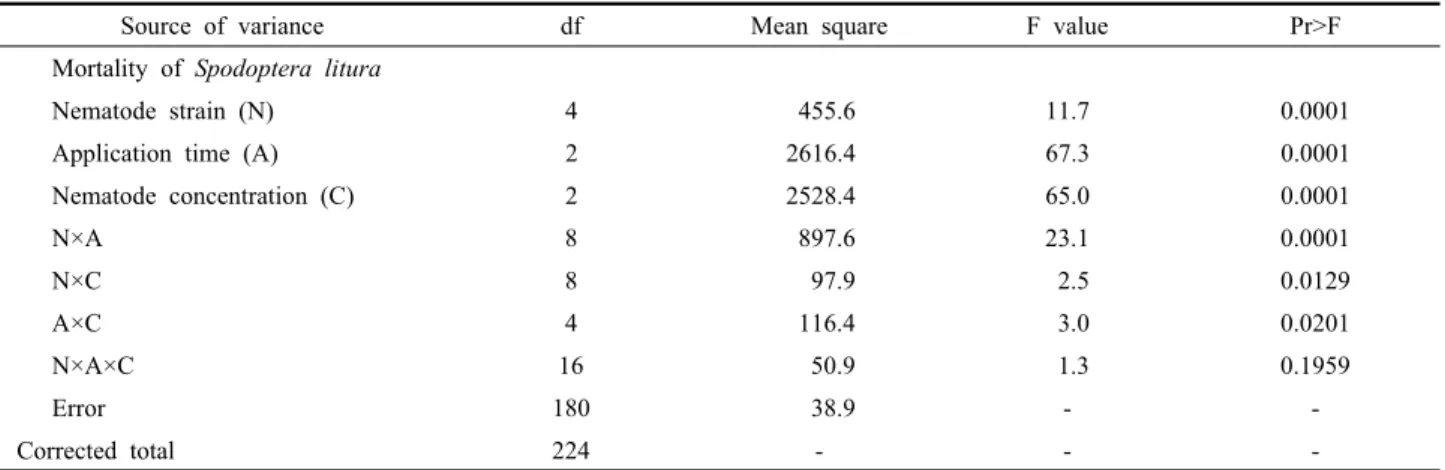
GSNUS-10, GSNUH-1 계통과, 대조선충인 GSN1, HbH 계통의 담배거세미나방에 대한 pot에서의 병원성은 선충 의 계통, 처리농도 및 처리횟수에 따라 차이가 있었다 (Table 2, 3). 병원성이 가장 높았던 선충 계통은 GSN1 계통이었고, 처리횟수에 따른 처리농도와 선충 계통에 의한 치사율은 1회보다는 2회와 3회의 처리에서 높은 효 과를 보였으나, 2회와 3회 처리 간에는 차이가 없었다 (Table 3). 담배거세미나방 유충에 대해서 GSN1, GSNUS- 14, GSNUS-10 계통을 3,000마리/30 ml의 농도로 1회 처리하였을 때와 5계통들의 선충을 9,000마리/30 ml의 농도로 1회 이상 처리하였을 때 치사율은 80% 이상으로 나타났다. 그리고 GSN1 계통을 9,000마리/30 ml의 농도 로 1회 처리한 것과 3,000마리/30 ml의 농도로 2회 이상 처리한 것에서는 치사율이 90% 이상으로 나타났다.
Table 2. Analysis of variance for main effects and interaction of entomopathogenic nematode strain, concentration, and application time on mortality of vegetable caterpillar, Spodoptera litura in pot
Source of variance df Mean square F value Pr>F
Mortality of Spodoptera litura
Nematode strain (N) 4 455.6 11.7 0.0001
Application time (A) 2 2616.4 67.3 0.0001
Nematode concentration (C) 2 2528.4 65.0 0.0001
N×A 8 897.6 23.1 0.0001
N×C 8 97.9 2.5 0.0129
A×C 4 116.4 3.0 0.0201
N×A×C 16 50.9 1.3 0.1959
Error 180 38.9 - -
Corrected total 224 - - -
Table 3. Mortality of 2nd and 3rd instars of Spodoptera litura exposed to entomopathogenic nematodes, steinernematids and heterorhabditids application in potted Chinese cabbage
EPN
Larval mortality(%)±SD
One time application* Two times application Three times application 1,000 Ijs** 3,000 Ijs 9,000 Ijs 1,000 Ijs 3,000 Ijs 9,000 Ijs 1,000 Ijs 3,000 Ijs 9,000 Ijs GSN1*** 74±8.9a**** 84±5.5a 92±4.5a 86±5.5a 96±8.9a 100±0.0a 100±0.0a 100±0.0a 100±0.0a GSNUS-10 72±8.4a 80±7.1ab 90±10.0a 82±8.4a 90±7.1a 96±5.5a 92±8.4a 100±0.0a 100±0.0a GSNUS-14 70±7.1a 82±8.4ab 92±8.4a 86±11.4a 90±0.0a 100±0.0a 96±5.5a 100±0.0a 100±0.0a HbH 74±5.5a 76±5.5ab 90±0.0a 94±5.5a 94±8.9a 100±0.0a 100±0.0a 100±0.0a 100±0.0a GSNUH-1 70±7.1a 70±7.1b 86±5.5a 86±11.4a 90±10.0a 100±0.0a 98±4.5a 100±0.0a 100±0.0a
*Entomopathogenic nematodes was sprayed one hour after placement on Chinese cabbage at the first application, on 3rd day at the second application, and 6th day at the third application, respectively. **Concentration (Ijs/30 ml/pot). ***GSN1; Steinernema carpocapsae GSN1, GSNUS-10, Steinernema sp. GSNUS-10, GSNUS-14; Steinernema sp. GSNUS-14, HbH; Heterorhabditis bacteriophora Hamyang, GSNUH-1; Heterorhabditis sp. GSNUH-2. ****Means within a column followed by different lowercase letters are significantly different by Tukey's HSD test (P<0.05).
곤충병원성 선충 효과 야외실험
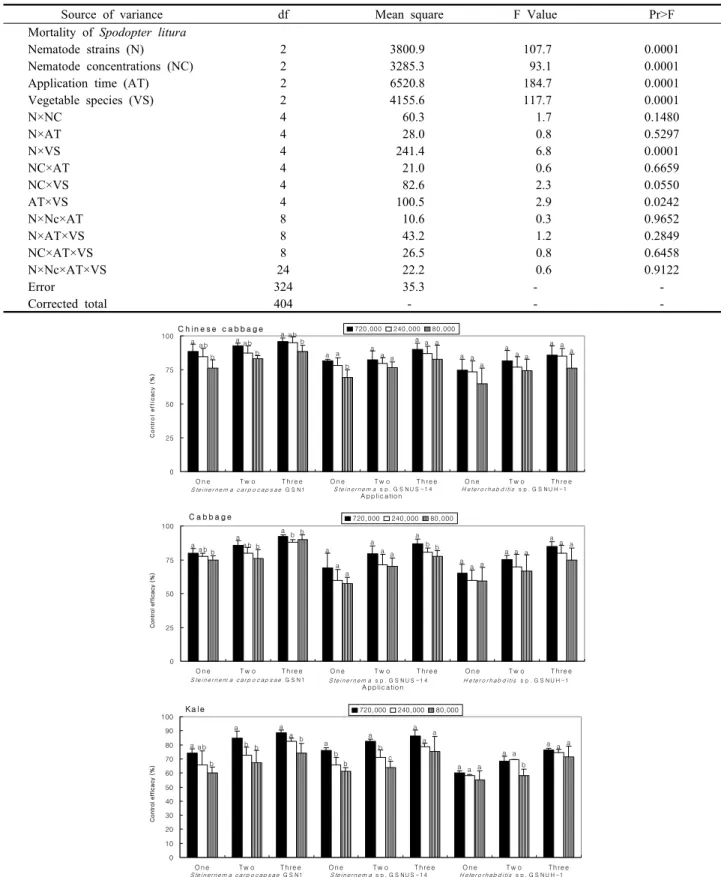
3종류의 엽채류 시설재배지에서 담배거세미나방에 대 한 방제효과는 선충 계통, 처리농도, 처리횟수 및 엽채류 의 종류에 따라 차이가 있었다(Table 4, Fig. 2). GSN1 계통 처리구에서 담배거세미나방 방제효과가 가장 높았 고, 처리농도에서는 720,000마리(1×10⁹마리/ha)의 처리 에서 방제효과가 가장 높았다. 그리고 처리횟수 간에는 1회와 2회 처리보다 3회 처리에서 방제효과 높았고, 엽채 류 종류에 따라서는 양배추나 케일에서보다 배추에서 방 제효과가 상대적으로 높았다(F=22.41, df=44, 180, P<0.0001) (Fig. 2). 배추에서의 담배거세미나방에 대한 방제효과는 선충 계통과 처리횟수 간에는 뚜렷한 차이를 보였지만 처리농도 간에는 뚜렷한 차이를 보이지 않았다.
즉, 선충 계통간의 방제효과는 GSN1 계통의 처리에서 가장 높았고, GSNUS-14 및 GSNUH-1 계통 순으로 낮아
졌으며, 처리횟수에서는 3회 처리에서 가장 높았고, 2회, 1회 처리 순으로 낮아졌다. 그러나 처리농도 간에는 720,000마리(1×10⁹마리/ha) 처리에서와 240,000 (3.3×10⁸ 마리/ha)마리 처리에서 유의적인 차이를 보이지 않았다.
이들 처리 중에서 방제효과가 가장 높았던 것은 GSN1 계통을 720,000마리(1×10⁹마리/ha)의 농도로 3회 처리하 였을 때 95.9%였고, 방제효과가 가장 낮았던 것은 GSNUH-1 계통을 80,000마리(1.1×10⁸마리/ha)의 농도로 1회 처리하 였을 때 64.9%였다(F=7.03, df=26, 108, P<0.0001). 양배 추에서의 담배거세미나방에 대한 방제효과가 처리횟수 간에는 뚜렷한 차이를 나타내었으나 선충 계통과 처리농 도 간에는 뚜렷한 차이가 없었다. 즉, GSNUS-14와 GSNUH-1 계통 간에 방제효과의 유의적인 차이가 없었 고, 240,000마리(3.3×10⁸마리/ha)의 농도 처리와 80,000 마리(1.1×10⁸마리/ha)의 농도 처리 사이에도 유의적인 차 이가 없었다. 담배거세미나방의 방제효과는 GSN1 계통
Table 4. Analysis of variance for main effects and interaction of entomopathogenic nematodes, concentration, application time, and vegetable species on mortality of caterpillars in greenhouse
Source of variance df Mean square F Value Pr>F
Mortality of Spodopter litura
Nematode strains (N) 2 3800.9 107.7 0.0001
Nematode concentrations (NC) 2 3285.3 93.1 0.0001
Application time (AT) 2 6520.8 184.7 0.0001
Vegetable species (VS) 2 4155.6 117.7 0.0001
N×NC 4 60.3 1.7 0.1480
N×AT 4 28.0 0.8 0.5297
N×VS 4 241.4 6.8 0.0001
NC×AT 4 21.0 0.6 0.6659
NC×VS 4 82.6 2.3 0.0550
AT×VS 4 100.5 2.9 0.0242
N×Nc×AT 8 10.6 0.3 0.9652
N×AT×VS 8 43.2 1.2 0.2849
NC×AT×VS 8 26.5 0.8 0.6458
N×Nc×AT×VS 24 22.2 0.6 0.9122
Error 324 35.3 - -
Corrected total 404 - - -
a a a a a a a a
a a
a a a a a
a b a b a b
a a a a a b b b b
0 25 50 75 100
O n e T w o T h re e O n e T w o T h re e O n e T w o T h re e
A p p lic a tio n
Control efficacy (%)
720,000 240,000 80,000
C h i n e s e c a b b a g e
a
S te i n e r n e m a c a r p o c a p s a e G S N 1 S te i n e r n e m a s p . G S N U S - 1 4 H e te r o r h a b d i ti s s p . G S N U H - 1
a a a a a
a a a
a a
a a b a a b
a b a b a
a a a b
a b b b
0 25 50 75 100
O n e T w o T h re e O n e T w o T h re e O n e T w o T h re e
A pplic a tio n
Control efficacy (%)
720,000 240,000 80,000
C a b b a g e
S te i n e r n e m a c a r p o c a p s a e G S N 1 S te i n e r n e m a s p . G S N U S - 1 4 H e te r o r h a b d i ti s s p . G S N U H - 1
a a a a a a a a
a a
a a a b b
a
a b b a
a b a
b c b b b
0 10 20 30 40 50 60 70 80 90 100
O n e Tw o Th re e O n e Tw o Th re e O n e Tw o Th re e
A pplic ation
Control efficacy (%)
720,000 240,000 80,000
Ka l e
a
S te i n e r n e m a c ar p o c ap s ae G S N1 S te i n e r n e m a s p . G S NU S -14 H e te r o r h ab d i ti s s p . G S N U H -1
Fig. 2. Control efficacy of entomopathogenic nematodes against Spodoptera litura on Chinese cabbage, cabbage, and kale in greenhouse.
Control efficacy: [(% living larvae of treatment-% living larvae of control)/% living larvae of control)]×100. The same lowercase letters above bars for a application are not significantly different (Tukey’s HSD test P<0.05).
을 720,000마리(1×10⁹마리/ha)의 농도로 3회 처리하였을 때 92.2%로 가장 높았고, GSNUS-14 계통을 240,000마 리(3.3×10⁸마리/ha)의 농도로 1회 처리하였을 때에는 57.3%로 가장 낮았다(F=11.43, df=26, 108, P<0.0001).
케일에서의 담배거세미나방에 대한 방제효과는 처리농도 와 처리횟수에 따라서는 유의적인 차이가 있었지만, 선충 계통 간에는 뚜렷한 차이가 없었다. 즉, GSN1과 GSNUS-14 계통 간에 방제효과의 유의적인 차이는 없었다(F=5.26, df=26, 108, P<0.0001). 방제효과가 가장 높았던 것은 GSN1 계통을 720,000마리(1×10⁹마리/ha)의 농도로 3회 처리했을 때 88.6%였고, 가장 낮았던 것은 GSNUH-1 계통을 80,000 (1.1×10⁸마리/ha)마리의 농도로 1회 처리 했을 때 55.3%였다.
고 찰
우리나라에서 분리된 토착 곤충병원성선충들의 담배거 세미나방 유충에 대한 효과는 계통이나 담배거세미나방 유충의 령기에 따라 다양하게 나타났다. 담배거세미나방 에 대하여 우수한 방제가를 가지는 선충의 선발을 위한 1차 실내 검정에서 25마리의 곤충병원성선충을 담배거세 미나방에 처리하였을 때 2-3령충에서 88% 이하의 방제가 를 보였다. 곤충병원성선충의 효과검정을 위한 처리 농도 의 선정은 해충의 종류에 따라 선충에 대한 감수성의 차이 가 많아 적정 농도를 결정하는데 어려움이 있다. Choo et al. (1995)이 복숭아명나방이나 노랑털알락나방에 대 한 Steinernema sp. 한림계통의 병원성 검정에서는 20마 리를 처리하였을 경우에도 100% 치사율을 보였으나 배추 좀나방의 경우 432마리를 처리하였을 때 100% 치사율을 보여 대상해충에 따라 병원성 검정을 위한 적정 농도의 편차가 심한편이다. 본 실험에서는 25마리 농도에서 실험 을 수행하였는데 이는 Choo et al. (1988)의 선행연구에서 S. feltiae가 50마리 처리농도에서 담배거세미나방 3령충 을 100% 치사시켰기 때문에 설정을 하였는데 선충 계통 별로 병원성의 변별력을 보였다.
한편 담배거세미나방 2~3령에 비하여 4~5령에서는 선 충에 대한 감수성이 감소하여 령기별에 따른 병원성의 차이 를 보였는데 이러한 경향은 농약에 대한 약제감수성의 경우 도 동일한 경향을 보이고 있고(Bae et al., 2003), Choo et al. (1988)이 실내에서 수행한 실험의 결과와도 일치하는 것이었다. 그러나 Han et al. (1999)은 S. carpocapsae를 담배거세미나방에 처리할 경우 반수치사농도는 3령충에
서 16.88마리, 5령충에서 15.99마리로 5령충의 반수치사 농도가 낮은 것과는 상반되는 결과였고, 잎벌류의 경우 2령보다는 4령충이 감수적이었으며(Yang et al., 2007) 배추좀나방도 노숙화 될수록 감수성이 증가하였다(Kim et al., 2006b). 한편 곤충탈피호르몬길항제 RH5848을 이 용하여 담배거세미나방 령기별 치사농도 실험에서는 령 기별로 감수성차이가 없었다(Park et al., 1992). 곤충병원 성선충의 기주별 감수성의 차이는 곤충의 발육단계가 노 숙화 되면서 감수성이 증가되는 경우, 기주곤충으로 침입 할 수 있는 영역의 확대나 섭식량 증가로 인한 선충의 유입 확률 증가 등으로 추정할 수 있으며 반대의 경우 노숙화 될 수록 체내 면역력의 증가로 감수성이 감소될 수 있다(Fuxa et al., 1988).
Pot실험에서 처리농도와 엽채류의 종류는 모두 선충의 병원성에 영향을 미쳤다. 1,000마리/pot 처리에 비하여 3,000마리/pot 처리에서는 담배거세미나방의 치사율이 10% 정도 상승하였으며 9,000마리/pot 처리에서는 20%
정도 상승하였다. 전체적으로는 9,000마리 농도로 2회 살포나 3,000마리 농도로 3회 살포 시 Steinernema sp.
GSNUS-14 계통을 제외하고 100% 치사율을 보여 선충의 처리 농도와 처리 횟수가 담배거세미나방 방제에 있어 중요한 요소였다. 곤충병원성선충의 농도는 병원성과 지 속성, 기주침입력, 증식 등에 영향을 미치는 가장 중요한 인자의 하나이다(Cabanillas & Raulston, 1996; Ebssa et al., 2004; Hang et al., 2007).
곤충병원성선충의 계통과 처리농도, 처리 횟수 및 엽채 류 종류는 담배거세미나방의 효과에 영향을 주는 요인들이 었다. 모든 처리에서 처리한 선충의 농도가 증가할수록 방제 효과가 높았는데 병원성이 비교적 낮은 Heterorhabditis sp.
GSNUH-1 계통은 양배추와 배추에서 방제효과의 차이가 없었다. 처리횟수별로는 병원성이 높은 S. carpocapsae GSN1 계통의 경우 배추에서는 차이가 없었으나 양배추 와 케일에서는 처리 횟수가 많을수록 방제가가 높아지는 경향을 보였으며 전체적으로 병원성이 낮은 계통이나 방 제효과가 떨어지는 식물체에서 방제가의 차이가 있었다.
따라서 야외에서 담배거세미나방과 같은 해충을 방제하 기 위하여 선충을 살포할 경우 살포농도와 더불어 살포 횟수를 증가시켜야 충분한 방제효과를 거둘 수 있을 것으 로 판단된다.
엽채류 종류별로도 선충의 병원성에 차이를 보여 배추 에서 병원성이 가장 높았고, 다음이 케일, 양배추 순이었 다. 엽채류 종류별 병원성의 차이는 엽면에 생존하는 병원 성선충이 식물의 종류에 따라 다르기 때문으로 생각된다
(Kim et al., 2006c). 즉 배추에서 생존 선충수가 케일이나 양배추에서 보다 현저히 높았고, 특히 어린 유묘기 때에는 15배 이상의 선충이 생존하였다. 따라서 케일이나 양배추 와 같이 상대적으로 곤충병원성선충의 엽면 부착력이 떨 어지는 작물에 선충을 처리 할 경우 처리 횟수를 조절하거 나 엽면 부착력을 증가시킬 수 있는 부재를 함께 사용하는 것이 필요할 것으로 생각된다. 한편 Kondo & Ishibashi (1986)는 토양에 곤충병원성선충을 처리하였을 경우 우 화한 담배거세미나방 암컷 성충의 43.8%가 선충에 감염 이 되었다고 하였는데 담배거세미나방은 3령 이후에는 낮에 토양 속에 숨어있다 야간에 식물을 가해하고, 번데기 때는 토양 속에 서식하기 때문에(Omino et al., 1973) 이 시기에 토양에 선충을 처리하는 방법도 유용한 방제 방법 의 하나로 생각된다. 특히 Cabanillas & Raulston (1996) 이 옥수수 재배지에서 Helicoverpa zea 방제를 위해 사용 한 밭고랑 관수와 같은 방법을 활용한다면 담배거세미나 방의 방제효과를 증대시킬 수 있을 것으로 생각된다. 특히 시설고추 재배지와 같이 점적관수 시설이 되어 있는 곳은 곤충병원성선충의 엽면살포와 함께 선충의 지면 관수를 통해 방제가 가능할 것으로 생각된다. 한편 담배거세미나 방의 밀도가 높을 때에 비하여 낮을 때 곤충병원성 선충의 효과가 높게 나타나 해충의 밀도가 곤충병원성선충의 효 과에 영향을 미치는 인자로 알려져 있다(Kondo, 1987).
따라서 야외에서 담배거세미나방 유충을 방제 할 경우, 초기 발생 시기에 밀도가 낮고, 령기가 어릴 때를 중심으 로 1×10⁹마리/ha 농도로 3일 간격으로 2회 이상 선충을 살포하면 방제효과를 높일 수 있을 것으로 생각된다.
사 사
본 연구는 농림수산식품부 농림기술개발사업의 지원과 농촌진흥청 원예연구소의 박사후 연수 과정에 의해 수행 한 결과입니다.
Literature Cited
Bae, S.D., B.R. Choi, Y.H. Song and H.J. Kim. 2003. Insecticide susceptibility in the different larva of tobacco cutworm, Spodoptera litura Fabricius (Lepidoptera: Noctuidae) collected in the soybean fields of Milyang, Korea. Korean J. Appl.
Entomol. 42: 225-231.
Bae, S.D., H.J. Kim, Y.K. Hong and H.J. Cho. 2004. Effects of sublethal concentration of insecticides on the pupal duration,
emergence, adult longevity and oviposition of tobacco cutworm, Spodoptera litura (Fab.) (Lepidoptera: Noctuidae). Korean J.
Appl. Entomol. 43: 175-180.
Bae, S.D., H.J. Kim, G.H. Lee and S.T. Park. 2007. Seasonal occurrence of tobacco cutworm, Spodoptera litura Fabricius and beet armyworm, Spodoptera exigua Hűbner using sex pheromone traps at different locations and regions in Yeongnam district.
Korean J. Appl. Entomol. 46: 27-35.
Bae S.D., and K.B. Park. 1999. Effects of temperature and food source on pupal development, adult longevity and oviposition of the tobacco cutworm, Spodoptera litura Fabricius. Korean J. Appl. Entomol. 38: 23-28.
Bedding, R,A. and R.J. Akhurst. 1975. A simple technique for the detection of insect parasitic rhabditid nematodes in soil.
Nematologica 21: 109-110.
Cabanillas, H.E., and J.R. Raulston. 1996. Effects of furrow irrigation on the distribution and infectivity of Steinernema riobravis against corn earworm in corn. Fundam. Appl. Nematol.
19: 273-281.
Cho, I.H. 1996. Practice and application of SAS. Sungandang Pub.
Co. 665pp.
Choo, H.Y., H.K. Kaya and D.R. Reed. 1988. Biological control of onion maggot and tobacco cutworm with insect-parasitic nematodes, Steinernema feltiae and Heterorhabditis heliothidis.
Korean J. Appl. Entomol. 27: 185-189.
Choo, H.Y., S.M. Lee, B.K. Chung, Y.D. Park and H.K. Kim.
1995. Pathogenicity of Korean entomopathogenic nematodes (Steinernematidae and Heterorhabditidae) against local agricultural and forest insect pests. Korean J. Appl. Entomol. 34: 314-320.
Cottrell, T.E. and D.I. Shapiro-Ilan. 2006. Susceptibility of the peach tree borer, Synanthedon exitiosa, to Steinernema carpocapsae and Steinernema riobrave in laboratory and field trials. J.
Invertebr. Pathol. 92: 85-88.
de Doucet, M.M.A., M.A. Bertolotti, A.L. Giayetto and M.B.
Miranda. 1999. Host range, specificity, and virulence of Steinernema feltiae, Steinernema rarum, and Heterorhabditis bacteriophora (Steinernematidae and Heterorhabditidae) from Argentina. J.
Invertebr. Pathol. 73: 237-242.
Dutky, S.R., J.V. Thompson and G.E. Cantwell. 1964. A technique for the mass propagation of the DD-136 nematode.
J. Insect Pathol. 6: 417-422.
Ebssa, L., C. Borgemeister and H. -M. Poehling. 2004. Effectiveness of different species/strains of entomopathogenic nematodes for control of western flower thrips (Frankliniella occidentalis) at various concentrations, host densities, and temperatures. Biol.
Control. 29: 145-154.
Han, S.C., S.S. Lee and Y.G. Kim. 1999. Pathogenicity and multiplication of entomopathogenic nematode, Steinernema carpocapsae Weiser, on beet armyworm, Spodoptera exigua (Hűbner) and tobacco cutworm, Spodoptera litura (Fabricius).
Korean J. Appl. Entomol. 38: 255-260.
Hang, D.T., H.Y. Choo, D.W. Lee, S.M. Lee, H.K. Kaya and C.G.
Park. 2007. Temperature effects on Korean entomopathogenic nematodes, Steinernema glaseri and S. longicaudum, and their symbiotic bacteria. J. Microbiol. Biotechnol. 17: 420-427.
Fukuda, K., S. Wakamura, N. Arakaki and K. Yamagishi. 2007.
Parasitism, development and adult longevity of the egg para- sitoid Telenomus nawai (Hymenoptera: Scelionidae) on the eggs of Spodoptera litura (Lepidoptera: Noctuidae). Bull. Entomol.
Res. 97: 185-190.
Fuxa, J. R., A. R. Richter, and F. Agudelo-Silva. 1988. Effect of host age and nematode strain on susceptibility of Spodoptera frugiperda to Steinernema feltiae. Journal of Nematology 20:
91-95.
Grewal, P.S., E.A.B. De Nardo and M.M. Aguillera. 2001. Ento- mopathogenic nematodes: potential for exploration and use in South America. Neotropical Entomology, 30: 191-205.
Guo, H.F., J.G. Fang, J.P. Wang, W.F. Zhong and B.S. Liu. 2007.
Interaction of Xestia c-nigrum granulovirus with peritrophic matrix and Spodoptera litura nucleopolyhedrovirus in Spodoptera litura. J. Econ. Entomol. 100: 20-25.
Im, D.J., B.R. Jin, K.M. Choi and S.K. Kang. 1990. Microbial control of the tobacco cutworm, Spodoptera litura (Fab.), using S. litura nuclear polyhedrosis virus. III. Field evaluation of the viral insecticides. Korean J. Appl. Entomol. 29: 252-256.
Jayanthi, P.D.K. and K. Padmavathamma. 2001. Joint action of microbial and chemical insecticides on Spodoptera litura (Fab.) (Lepidoptera: Noctuidae). J. Trop. Agri. 39: 142-144.
Jeong, H.U., H.H. Im, S.K. Chang, C.H. Paik, T.H. Han, I.S. Kim and I.S. Kim. 2007. Test of larvicidal effect of some commercial natural products on lepidoptran Plutella xylostella and Spodoptera litura larvae. Int. J. Indust. Entomol. 15: 87-91.
Kaya, H.K. and R. Gaugler. 1993. Entomopathogenic nematodes.
Annu. Rev. Entomol. 38: 181-206.
Kaya, H.K. and S.P. Stock. 1997. Techniques in insect pathology.
In L.A. Lacey (eds). Manual of techniques in insect pathology.
Academic Press, San Diego. pp. 281-324.
Kim, C.H. and H.Y. Shin. 1987. Studies on bionomics and control of tobacco cutworm, Spodoptera litura Fabricius in southern part of Korea. J. Inst. Agr. Res. Util. Gyeongsang Natl. Univ.
21: 105-122.
Kim, D.A., J.S. Kim, M.R. Kil, Y.N. Youn, D.S. Park and Y.M.
Yu. 2006a. Isolation and activity of insect pathogenic Bacillus thuringiensis strain from soil. Korean J. Appl. Entomol. 45:
357-362.
Kim, H.H., S.R. Cho, D.W. Lee, H.Y. Jeon, C.G. Park and H.Y.
Choo. 2006b. Biological control of diamondback moth, Plutella xylostella with Korean isolates of entomopathogenic nematodes (Steinernematid and Heterorhabditid) in greenhouse. Korean J.
Appl. Entomol. 45: 201-209.
Kim, H.H., H.Y. Jeon, S.R. Cho, D.W. Lee and H.Y. Choo. 2006c.
Persistence of entomopathogenic nematode, Steinernema carpocapsae GSN1 strain on vegetable leaf in greenhouses. Kor. J. Hort. Sci.
Technol. 24: 198-204.
Kim, S.G., D.I. Kim, J.D. Park, H.G. Choi and Y.M. Yu. 2003.
Pathogenicity of Spodoptera litura nucleopolyhedrovirus with different temperatures. Korean J. Appl. Entomol. 42: 159-163.
Kim, Y.G., J.R. Cho, J.I. Lee, S.Y. Kang, S.C. Han, K.J. Hong, H.S. Kim, J.K. Yoo and J.O. Lee. 1998. Insecticide resistance in the tobacco cutworm, Spodoptera litura (Fabricius) (Lepidoptera:
Noctuidae). J. Asia-Pacific Entomol. 1: 115-122.
Kondo, E. and N. Ishibashi. 1984. Infectivity and multiplication of Steinernema feltiae (str. Mexican) on the common cutworm, Spodoptera litura. Jap. J. appl. Ent. Zool. 28: 229-236.
Kondo, E. and Ishibashi, N. 1986. Infection efficiency Steinernema feltiae (DD-136) to the common cutworm, Spodoptera litura (Lepidoptera: Noctuidae), on the soil. Appl. Ent. Zool. 21: 561-
571.
Kondo, E. 1987. Size-related susceptibility of Spodoptera litura (Lepidoptera: Noctuidae) larvae to entomogenous nematode, Steinernema feltiae (DD-136). App. Ent. Zool. 22: 560-569.
Lee, S.G., K.H. Choi, Y.S. Lee, K.S. Oh, J.H. O and S.W. Choi.
2006. Insecticidal activities against major lepidopteran pests and culture condition of Bacillus thuringiensis sp. aizawai collected in Korea. Korean J. Pest. Sci. 10: 131-137.
Mannion, C.M. and R.K. Jansson. 1993. Infectivity of five ento- mopathogenic nematodes to the sweetpotato weevil, Cylas formicarius (F.), (Coleoptera: Apionidae) in three experimental arenas. J. Invertebr. Pathol. 62: 29-36.
Minamikawa, H. 1937. Survey on the tobacco cutworm, Spodoptera litura Fabricius. Taiwan Central Res. Inst. Arg. Report 70: 1-66.
Moussa, M., A. Zaher and F. Kotby. 1960. Aboundance of the cotton leafworm, Prodenia litura (F.) [S. litoralis], in relation to host plants, I. host plants and their effect on biology (Lepi- doptera: Agrotidae-Zenobiinae). Bull. Soc. Entomol. Egypt 44:
241-251.
Nasr, E.S., M.A. Moussa and A. S. Hassan. 1960. Soil moisture in worm, Prodenia litura Fabricius. Bull. Soc. Entomol. Egypt XLIV: 377-382.
Omino, T., S. Youki, and H. Tsuji. 1973. Experimental studies on the daytime behaviour of noctuid larvae, the cabbage arm- yworm, Mamestra brassicae, the tobacco cutworm, Spodoptera litura, and black cutworm, Agrotis ipsilon. Jap. J. Appl. Ent.
Zool. 17: 215-220.
Rao, G.V.R., J.A. Wightman and D.V. Ranga Rao. 1993. World review of the natural enemies and diseases of Spodoptera liluta (F.) (Lepidoptera: Noctuidae). Insect Sci. Appl. 14: 273-284.
Rosa, J.S., and N. Simốes. 2004. Evaluation of twenty-eight strains of Heterorhabditis bacteriophora isolated in Azores for biocontrol of the armyworm, Pseudaletia unipuncta (Lepidoptera:
Noctuidae). Biol. Control. 29: 409-417.
Sayyed, A.H., M. Ahmad and M.A. Saleem. 2008. Cross-resistance and genetics of resistance to indoxacarb in Spodoptera litura (Lepidoptera: Noctuidae). J. Econ. Entomol. 101: 472-479.
Wan, P., K. Wu, N. Huang, D. Yu and J. Wu. 2008. Population dynamics of Spodoptera litura (Lepidoptera: Noctuidae) on Bt cotton in the Yangtze river valley of China. Environ. Entomol.
37: 1043-1048.
Wheeler, D.A., M.B. Isman, P.E. Sanchez-Vindas, and J.T. Arnason.
2001. Screening of Costa Rican Trichilia species for biological activity against the larvae of Spodoptera litura (Lepidoptera:
Noctuidae). Biochem. Syst. Ecol. 29: 347-358.
Williams, R.N., D.S. Fickle, P.S. Grewal and J.R. Meyer. 2002.
Assessing the potential of entomopathogenic nematodes to control the grape root borer Vitacea polistiformis (Lepidoptera:
Sesiidae) through laboratory and greenhouse bioassay. Biocontrol Sci. Technol. 12: 35-42.
Woodring, J.L. and H.K. Kaya. 1988. Steinernematidae and hetero- rhabditidae nematodes: a handbook of techniques. Southern Coop.
Ser. Bull. 331, Alkansas Agri. Exp. Stn. Fayetteville, AR. 29 pp.
Yang, J.Y., H.H. Kim, D.W. Lee, S.M. Lee, H.C. Shin and H.Y.
Choo. 2007. Biological control of Arge captiva, Arge papana, and Arge similis with entomopathogenic nematodes. Jour. Korean For. Soc. 96: 1-6.
(Received for publication October 5 2008;
revised October 6 2008; accepted December 3 2008)