DOI: https://doi.org/10.14579/MEMBRANE_JOURNAL.2019.29.4.223
1)
†
Corresponding author(e-mail: [email protected], http://orcid.org/0000-0002-5858-1747)
PBEM-POEM 공중합체와 Poly(ethylene glycol)의 폴리머 블렌드를 이용한 이산화탄소 분리막 제조
문 승 재⋅민 효 준⋅김 나 운⋅김 종 학†
연세대학교 화공생명공학과
(2019년 8월 22일 접수, 2019년 8월 28일 수정, 2019년 8월 28일 채택)
Fabrication of Polymeric Blend Membranes Using PBEM-POEM Comb Copolymer and Poly(ethylene glycol) for CO
2Capture
Seung Jae Moon, Hyo Jun Min, Na Un Kim, and Jong Hak Kim
†Department of Chemical and Biomolecular Engineering, Yonsei University, 50 Yonsei-ro, Seodaemun-gu, Seoul 03722, South Korea
(Received August 22, 2019, Revised August 28, 2019, Accepted August 28, 2019)
요 약: 본 논문에서는 이산화탄소 친화적인 PBEM-POEM (PBE) 공중합체를 기반으로 고분자 블렌드 분리막을 제조하 는 방법을 제시한다. PBE 공중합체는 자유 라디칼 중합 반응을 통해 손쉽게 합성이 가능하며, 이를 상용 고분자인 PEG와 다 양한 비율로 혼합하여 이산화탄소/질소 분리막을 제조하였다. 이산화탄소/질소 분리 성능을 테스트한 결과, PEG의 함량이 높 을수록 이산화탄소 투과도는 감소하는 반면 이산화탄소/질소 선택도는 크게 증가하는 상충(trade-off) 관계가 나타났다. 그러 나 PBE/PEG (9 : 1)과 PBE/PEG (7 : 3)을 비교하면 이산화탄소 투과도는 단지 8.3% 감소한 반면에 질소 투과도는 69.1%나 감소하였다. 따라서 이산화탄소/질소 선택도가 33.8에서 100.3으로 크게 증가하였다. 이것은 PBE 공중합체의 80%를 차지하 는 POEM 사슬이 PEG와 상호작용하여 더욱 조밀한 구조가 되었기 때문이며, 이를 FT-IR, XRD, SEM 분석으로 확인하였다.
PBE/PEG (7 : 3) 블렌드 막이 가장 최적의 기체 분리 성능을 가졌고, 이산화탄소투과도는 170.5 GPU, 이산화탄소/질소 선택 도는 100.3이었다.
Abstract: In this paper, we develop a polymeric blend membrane based on CO
2-philic poly(2-[3-(2H-benzotriazol-2-yl)- 4-hydroxyphenyl] ethyl methacrylate)-poly(oxyethylene methacrylate) (PBEM-POEM) comb copolymer, which was synthesized by facile free radical polymerization. The PBEM-POEM (PBE) comb copolymer was blended with a commercial oligomer, low-molecular-weight poly(ethylene glycol) (PEG, M
w= 200 gmol
-1) with various ratios to prepare CO
2/N
2separation membranes. From the result of CO
2/N
2separation test of the PBE/PEG blend membranes with the various PEG contents, we could conclude that with increasing PEG content, the CO
2/N
2selectivity significantly increased while the CO
2permeability decreased showing trade-off relationship. However, when comparing the performance of the PBE/PEG (9 : 1) with the PBE/PEG (7 : 3) membrane, the CO
2permeance decreased by only 8.3%, while the N2 permeance decreased by 69.1%.
Therefore, the CO
2/N
2selectivity dramatically increased from 33.8 to 100.3. This could be because the POEM chains, which account for 80% of the PBE copolymer, favorably interact with PEG and lead to a more compact chain structure, which was confirmed by FT-IR, XRD and SEM analysis. The PBE/PEG (7 : 3) blend membrane had the most optimal gas separation performance, showing a CO
2permeance of 170.5 GPU and CO
2/N
2selectivity of 100.3.
Keywords: blend membrane, comb copolymer, CO
2, poly(ethylene glycol)
1. Introduction
Gas separation using membrane technology over the last 30 years has been commercialized for a variety of processes such as air separation, hydrogen separation and flue gas treatment[1-3]. Among these processes, CO
2separation from gas mixtures is known as one of the most important topics because of its huge market and global warming by the greenhouse effect. Membrane technologies have attracted attention due to their low energy consumption, simple processing and environ- ment-friendly properties[4]. Various materials have been used to fabricate gas separation membranes and poly- mer-based membrane was one of the most attractive membranes due to its low cost and easy processability [5-8]. However, in the case of a polymeric membrane, there is a problem due to a trade-off relationship be- tween gas permeability and selectivity[9,10]. Therefore, various studies have been conducted to address such a problem. For example, there have been many studies on CO
2separation polymeric membrane that were carried out to introduce polymers having functional groups with high affinity for CO
2[11-18].
Poly(ethylene glycol) (PEG) is a commercially avail- able hydrophilic polymer, and soluble in various polar solvents such as water or alcohol. Therefore, PEG has been widely used as the hydrophilic moiety of amphi- philic block or graft copolymers. In addition, PEG has numerous ether (C-O-C) groups which can enhance the CO
2solubility, thereby leading to an increase in CO
2permeability when it is incorporated in the polymer membranes. This results from the strong Lewis acid-base interaction between the ether group acting as a Lewis base and the CO
2molecule acting as a Lewis acid [18,19]. In this study, a low-molecular-weight PEG was introduced into the polymer matrix to increase the CO
2solubility. As PEG has a high tendency to crystallize when its molecular weight is high, it becomes difficult to form a defect-free membrane. Therefore, we choose the PEG oligomer with a molecular weight of 200 gmol
-1as an additive.
In this study, CO
2-philic and alcohol-soluble PBE comb copolymer was synthesized by free radical poly- merization and blended with PEG at various weight ratios. Subsequently, the PBE/PEG blend solution was coated onto a poly(1-(trimethylsilyl-1-propyne))-coated polysulfone substrate to prepare a thin-film composite membrane. The CO
2/N
2separation properties were mea- sured at a constant pressure of 2 bar at room temper- ature (25 °C) according to the PEG loading in the blend membranes. The results were analyzed by using Fourier transform infrared spectroscopy (FT-IR), X-ray diffraction (XRD) and scanning electron microscopy (SEM).
2. Experimental Section
2.1. Materials
2-[3-(2H-Benzotriazol-2-yl)-4-hydroxyphenyl] ethyl methacrylate (BEM, M
w= 323 gmol
-1), poly(oxyethylene methacrylate) (POEM, poly(ethylene glycol) methyl ether methacrylate, M
n= 500 gmol
-1), azobisisobutyr- onitrile (AIBN) and poly(ethylene glycol) (PEG, M
w= 200 gmol
-1) were purchased from Sigma-Aldrich. N,N-di- methylformamide (DMF), isopropyl alcohol (IPA) and methanol were obtained from J. T. Baker. Poly(1-(trime- thylsilyl-1-propyne)) (PTMSP) was purchased from Gelest.
n-Hexane was obtained from Duksan. Cyclohexane was purchased from Daejung. All solvents and chemicals were used as received without further purification.
2.2. Synthesis of PBE comb copolymer
PBE copolymer was synthesized with a weight ratio
of BEM : POEM = 2 : 8. First, 2 g of BEM and 8 g
of POEM were completely dissolved in 100 mL of
DMF by stirring for 5 h. Then 0.002 g of AIBN was
added to the solution as an initiator, followed by purg-
ing with N
2gas. The mixed solution was placed in a
90 °C oil bath for 24 h. After reaction, the PBE sol-
ution was precipitated in IPA : n-hexane (1 : 3) mixed
solvent. To purify the PBE copolymer, this precipitation
process was repeated three times, and then the obtained
copolymer was dried completely in a vacuum oven.
2.3. Preparation of PBE/PEG thin-film com- posite membranes
First, 30 wt% of PEG and PBE solutions were pre- pared respectively by using methanol as a solvent. Then these solutions were mixed together with varying the PBE : PEG ratios of 9 : 1, 8 : 2 and 7 : 3 and stirred for 5 h. Besides, 1 wt% PTMSP solution in cyclo- hexane was prepared, and coated onto the microporous polysulfone support (Toray Chemical Inc.) as a gutter layer using a RK Control coater (Model 101, Control RK Print-Coat Instruments Ltd., UK). After that, the PBE/PEG mixed solutions (10 : 0, 9 : 1, 8 : 2 and 7 : 3 weight ratio) were coated onto the PTMSP-coated polysulfone support. After coating, the membranes were dried in a vacuum oven overnight to remove the sol- vent completely. As a control group, the neat PBE membrane without a gutter layer was also prepared.
2.4. Gas permeation measurements
The gas permeance of the thin-film composite mem- branes was measured by using gas separation equip- ment provided by Airrane Co. Ltd. (Korea). Pure gas permeability (CO
2and N
2) was measured in gas per- meation units (GPU) (1 GPU = 10
-6cm
3(STP) / (s cm
2cmHg)), and the selectivity was determined by the ra- tio of the permeance for each component. (CO
2per- meance/N
2permeance) Five thin-film composite mem- branes were tested, and the average estimated error in the gas permeation measurement was approximately.
2.5. Characterization
FT-IR spectra of the polymer blends were obtained with a Spectrum 100 spectrometer (PerkinElmer, USA) over the wavenumber range of 4,000~500 cm
-1. XRD patterns were measured by using a SmartLab (Rigaku, Japan). The morphologies of the polymer blends were characterized by using a JEOL-7610F-Plus field-emis- sion scanning electron microscope (FE-SEM, JEOL Ltd., Japan).
O O HO
N N N
CH2 CH3
O O
H3C O
9
BEM POEM
O O
CH3 O
O O
HO N N N
x y
9
H O
nOH AIBN, DMF
90 oC, 24h
PBE (PBEM-POEM)
PEG
Scheme 1. Preparation of PBE/PEG blend membranes and their chemical structures.
3. Results and Discussion
3.1. Synthesis and spectroscopic characteri- zation
The neat polymers (PBE, PEG) were mixed in three different ratios (i.e. 9 : 1, 8 : 2, 7 : 3). The PBE comb copolymer was synthesized via a one-step free radical polymerization using AIBN as the initiator, as shown in Scheme 1. This polymerization involves a relatively facile reaction. PBE chains have three tertiary amine groups in triazole which can improve the capacity for CO
2loading through specific interactions between the basic amines and acidic CO
2. PEG has polar etheric oxygen atoms in their main chains which favorably in- teract with CO
2molecules[18]. For these reasons, this polymer blends are expected to have high affinity to- ward CO
2, resulting in higher CO
2solubility in the membranes.
FT-IR spectra were obtained to confirm the chemical
structure and interactions of the polymer blends. The
FT-IR spectra of neat PBE, PEG and PBE/PEG blends
with various ratios are shown in Fig. 1. It was con-
firmed that the PBE comb copolymer synthesis was
carried out successfully because the C=C band that ap-
pearing near 1,638 cm
-1was not observed in the spec-
trum of the PBE. The O-H stretching vibration band in
the PBE (3,499 cm
-1) was observed at higher wave-
number than that of PEG (3,411 cm
-1). With increasing
PEG loading, the O-H band appeared at a gradually
Membrane Permeance (GPU) CO2/N2
selectivity
N2 CO2
PBE (without PTMSP) 44.3 97.1 2.2 (defect)
PBE 9.9 279.4 28.1
PBE/PEG (9 : 1) 5.5 186.0 33.8
PBE/PEG (8 : 2) 2.0 98.2 50.1
PBE/PEG (7 : 3) 1.7 170.5 100.3
Table 1. Gas Permeances and CO
2/N
2Selectivity of PBE/
PEG Blend Membranes at 25 °C.
4000 3500 3000 2500 2000 1500 1000 500 1097 1727
3499 3478 3456 3445 3411
2867
Absorbance (a.u.)
Wavelength (cm-1) PEG
7:3 8:2 9:1 PBE
1517 750
Fig. 1. FT-IR spectra of neat PBE comb copolymer, PEG oligomer, and PBE/PEG blend membranes (9 : 1, 8 : 2 and 7 : 3 weight ratios).
lower wavenumber and its intensity also increased.
This is because the PBE comb copolymer and the PEG oligomer contain identical functional groups in their structures, therefore the PBE and PEG blend is ex- pected to be a miscible and interacting system. There were no band shifts at 1,727 and 1,097 cm
-1corre- sponding to the carbonyl (C=O) groups and the ether (C-O-C) groups, respectively. It indicates that there was no hydrogen bonding between the O-H groups and the carbonyl groups nor between the O-H groups and the ether groups. The intensity of small C-C stretching vibration (in-ring) bands at 1,517 cm
-1and sharp C-H aromatic stretching bands at 750 cm
-1in PBE comb copolymer gradually decreased with increasing PEG contents, which confirms the incorporation of PEG into the PBE comb copolymer matrix.
5 10 15 20 25 30 35 40
PEG PBE/PEG (8:2) PBE/PEG (7:3)
Intensity (a.u.)
2 Theta (degree) 19.4
21.4 19.5
19.7 19.9
PBE PBE/PEG (9:1)
Fig. 2. XRD patterns of PBE/PEG blend membranes with various ratios.
3.2. Structural and morphological properties The microstructures of neat PBE, PEG and their blends were characterized using XRD, as shown in Fig.
2. There was no sharp crystalline peaks, which indicates that these polymer blends have amorphous natures. The neat PBE comb copolymer exhibited one broad halo centered at 2θ = 19.4°, and it shifted to a higher 2θ value with increasing PEG loading. In the case of PBE/PEG (7 : 3) blend, 2θ was centered at 19.9°.
According to the Bragg’s law (2 dsinθ = nλ), the in- creased 2θ causes lower d-spacing value. Therefore, the shift indicates that the d-spacing decreased with in- creasing PEG composition. In neat PBE, the d-spacing was determined to be 4.58 Å and that of PBE/PEG (7 : 3) blend was 4.46 Å. This phenomenon is because both POEM in PBE and PEG are hydrophilic chains, and possibly interacts with each other. These XRD re- sults indicate that PEG oligomer interacts with the hy- drophilic groups in PBE (POEM).
The morphologies of PBE/PEG blend membranes were
observed using SEM, as shown in Fig. 3. According to
the cross-sectional SEM images, both neat PBE and
PBE/PEG (9 : 1) blend had a dense structure and there
were no obvious structural defects through which gas
molecules pass without selectivity. This confirms the
good compatibility and miscibility between the PBE
comb copolymer and PEG oligomer. The thicknesses
of the selective layer were approximately 400~500 nm.
Fig. 3. Cross-sectional SEM images of (a) neat PBE and (b) PBE/PEG (9 : 1) blend membranes.
Fig. 4. Surface SEM images of (a) neat PBE and (b) PBE/
PEG (9 : 1) blend membranes.
The surface SEM images are shown in Fig. 4. The membranes showed typical smooth dense polymer struc-
tures, and there was no significant difference between the neat PBE and PBE/PEG blends. It indicates that the PBE comb copolymer has high affinity for PEG oligomer.
3.3. Gas separation performances
First, the performance of neat PBE membrane with- out PTMSP gutter layer was measured using gas sepa- ration equipment. This membrane exhibited very low CO
2/N
2selectivity due to the formation of structural defects. It is attributed to the penetration of PBE chains into the pores of polysulfone supports. Therefore, PTMSP with a high permeability was used as a gutter layer. When PTMSP was coated onto polysulfone sup- port, the membranes exhibited significantly increased CO
2/N
2selectivity. It is possible that the PTMSP gutter layer effectively prevents the PBE/PEG coating sol- ution from penetrating through the pores of polysulfone support. It is noteworthy that PTMSP was coated with a dilute solution of 1 wt% concentration, therefore it could have little effect on the permeance of the mem- branes.
The pure gas permeance and CO
2/N
2selectivity
through the PBE/PEG blend membranes are shown in
Table 1 and Fig. 5. The permeance of each pure gas
was measured at a constant pressure of 2 bar at room
temperature (25 °C). As the content of PEG increased,
the CO
2permeance decreased gradually while the CO
2/
N
2selectivity increased significantly. This might be due
to the reduced distance between polymer chains, which
was proved by XRD analysis. From XRD results, it
was confirmed that the d-spacing decreased with in-
creasing PEG content, which indicates that the free
volume which gas molecules can pass through was
reduced. Therefore, the N
2permeance decreased at a
greater rate than CO
2permeance due to its larger ki-
netic diameter than CO
2[20]. The PBE/PEG (7 : 3)
blend membrane showed the highest CO
2/N
2selectivity
up to 100.3 with a moderate CO
2permeance of 170.5
GPU. This performance represents high values reported
for polymer blend membranes without inorganic filler
such as metal organic frameworks, zeolites, porous car-
(a)
(b)
(c)
Fig. 5. Gas separation performance of PBE/PEG blend membranes according to PEG contents: (a) N
2permeance, (b) CO
2permeance, and (c) CO
2/N
2selectivity.
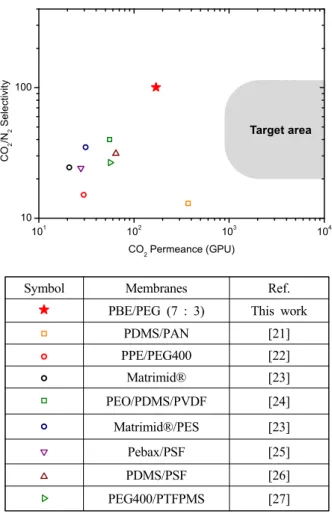
bons or mesoporous metal oxides[21-27]. The PBE/
PEG (7 : 3) blend membrane was compared with other polymer blend membranes reported in the literatures as shown in Fig. 6.
Target area
101 102 103 104
10 100
CO2/N2 Selectivity
CO2 Permeance (GPU)
Symbol Membranes Ref.
PBE/PEG (7 : 3) This work
PDMS/PAN [21]
PPE/PEG400 [22]
Matrimid® [23]
PEO/PDMS/PVDF [24]
Matrimid®/PES [23]
Pebax/PSF [25]
PDMS/PSF [26]
PEG400/PTFPMS [27]
Fig. 6. Plot of CO
2permeance vs. CO
2/N
2selectivity of PBE/PEG (7 : 3) membrane comparing with other polymer blend membranes reported in the literatures.
4. Conclusions
In this study, PBE/PEG blend membranes were pre- pared by incorporating a commercial PEG oligomer in- to the CO
2-philic PBE comb copolymer. The CO
2/N
2separation properties of the membranes were analyzed according to the PEG contents. The PBE comb copoly- mer was synthesized via free radical polymerization, which is economical and facile reaction. Specific inter- actions between the PBE comb copolymer and PEG oligomer were confirmed by FT-IR analysis. Upon the incorporation of PEG into PBE comb copolymer, no significant shifts were observed in the FT-IR spectra.
Furthermore, from the XRD analysis, it was confirmed
that the POEM chain showed a more compact structure
as the PEG loading increased. The change in polymer structure influenced the gas permeance of the PBE/PEG blend membranes. As the PEG content increased, the gas permeability gradually decreased while the selec- tivity significantly increased. For the PBE/PEG (7 : 3) membrane, the CO
2permeance decreased from 279.4 GPU to 170.5 GPU while the CO
2/N
2selectivity in- creased from 28.1 to 100.3, when compared with the neat PBE.
Acknowledgements
This work was supported by the National Research Foundation (NRF) of South Korea funded by the Mi- nistry of Science and ICT, Republic of Korea (NRF-20- 17R1D1A1B06028030).
Reference
1. R. W. Baker, “Future directions of membrane gas separation technology”, Ind. Eng. Chem. Res., 41, 1393 (2002).
2. N. W. Ockwig and T. M. Nenoff, “Membranes for hydrogen separation”, Chem. Rev., 107, 4078 (2007).
3. P. Bernardo, E. Drioli, and G. Golemme, “Mem- brane gas separation: A review/state of the art”, Ind. Eng. Chem. Res., 48, 4638 (2009).
4. W. S. Chi, J. H. Lee, M. S. Park, and J. H. Kim,
“Recent research trends of mixed matrix membranes for CO
2separation Won Seok”, Membr. J., 25, 373 (2015).
5. S. Kwon and J. Rhim, “Facilitated transport sepa- ration of carbon dioxide using aminated polyetheri- mide membranes”, Membr. J., 25, 248 (2015).
6. P. Nugent, Y. Belmabkhout, S. D. Burd, A. J.
Cairns, R. Luebke, K. Forrest, T. Pham, S. Ma, B.
Space, and L. Wojtas, “Porous materials with opti- mal adsorption thermodynamics and kinetics for CO
2separation”, Nature, 495, 80 (2013).
7. D. M. D’Alessandro, B. Smit, and J. R. Long,
“Carbon dioxide capture: Prospects for new materi- als”, Angew. Chem. Int. Ed., 49, 6058 (2010).
8. C. Park, J. Lee, M. Park, and J. Kim, “Facilitated transport: Basic concepts and applications to gas separation membranes”, Membr. J., 27, 205 (2017).
9. H. Lin and M. Yavari, “Upper bound of polymeric membranes for mixed-gas CO
2/CH
4separations”, J.
Membr. Sci., 475, 101 (2015).
10. L. M. Robeson, “Correlation of separation factor versus permeability for polymeric membranes”, J.
Membr. Sci., 62, 165 (1991).
11. C. Park, J. Jung, J. Lee, and J. Kim, “Enhancement of CO
2permeance by incorporating CaCO
3in mixed matrix membranes”, Membr. J., 28, 55 (2018).
12. P. Guan, J. Luo, W. Li, and Z. Si, “Enhancement of gas permeability for CH
4/N
2separation membranes by blending SBS to Pebax polymers”, Macromol.
Res., 25, 1007 (2017).
13. Y. Choi and S. W. Kang, “Effect of 4-hydrox- ybenzoic acid on CO
2separation performance of poly(ethylene oxide) membrane”, Macromol. Res.,
24, 1111 (2016).14. W. S. Chi, S. U. Hong, B. Jung, S. W. Kang, Y.
S. Kang, and J. H. Kim, “Synthesis, structure and gas permeation of polymerized ionic liquid graft copolymer membranes”, J. Membr. Sci., 443, 54 (2013).
15. C. H. Park, J. H. Lee, J. P. Jung, B. Jung, and J.
H. Kim, “A highly selective PEGBEM-g-POEM comb copolymer membrane for CO
2/N
2separation”, J. Membr. Sci., 492, 452 (2015).
16. S. H. Ahn, J. A. Seo, J. H. Kim, Y. Ko, and S.
U. Hong, “Synthesis and gas permeation properties of amphiphilic graft copolymer membranes”, J.
Membr. Sci., 345, 128 (2009).
17. J. H. Lee, J. P. Jung, E. Jang, K. B. Lee, Y. S.
Kang, and J. H. Kim, “CO
2-philic PBEM-g-POEM comb copolymer membranes: Synthesis, character- ization and CO
2/N
2separation”, J. Membr. Sci., 502, 191 (2016).
18. A. Ghadimi, R. Gharibi, H. Yeganeh, and B.
Sadatnia, “Ionic liquid tethered PEG-based polyur- ethane-siloxane membranes for efficient CO
2/CH
4separation”, Materials Science and Engineering: C,
102, 524 (2019).