—25—
INTRODUCTION
Medaka species, the small egg-laying teleosts belong- ing to the genus Oryzias possess many advantageous merits as experimental model animals such as small adult size, easiness of laboratory maintenance, year-round spawning and short generation time. Of more than twenty Oryzias species, the Japanese medaka, Oryzias latipes has already been a popular model for a variety of resear- ches including genomics, toxicology and environmental studies (Au et al., 2009; Hobbie et al., 2009). Oryzias dancena, a related medaka species to O. latipes is a eury- haline species with the great adaptability to seawater salinity (Takehana et al., 2005; Chen et al., 2009). Direct transfer of adult fish from freshwater to seawater causes no adverse effect on its viability, and it has usually been known to perform normal reproduction in seawater (Inoue
and Takei, 2002). Due to its efficient osmoregulatory capacity, this species has been given much attention as a useful model system to study molecular mechanisms of seawater adaptation in teleosts (Inoue and Takei, 2002;
Song et al., 2009a). In addition, such euryhaline medaka species including O. dancena are considered as alterna- tive test models to the Japanese medaka in address pollu- tion-caused risk assessment of marine and brackish envi- ronment, since the Japanese medaka, a freshwater-orig- inating species, often represents depressed performance in viability and development under high salinity condi- tions (Yu et al., 2006; Chen et al., 2008; Kong et al., 2008).
Recently, we have reported the basic features of embr- yogenesis and early ontogenesis for O. dancena under a given brackish (10‰) condition (Song et al., 2009b).
More importantly, we also found that tolerant capacity of this species to salinity change is extremely high and they are able to be acclimated to the salt concentration as high as 75‰ that is more than two times salinity found
Spawning Performance, Embryonic Development and Early Viability under Different Salinity Conditions in a Euryhaline Medaka Species, Oryzias dancena
By Young Sun Cho, Sang Yoon Lee
1, Dong Soo Kim
1and Yoon Kwon Nam
1,*
Institute of Marine Living Modified Organisms (IMLMO)
1Department of Marine Bio-Materials & Aquaculture, Pukyong National University, Busan 608-737, Korea
ABSTRACT Effects of different salinity levels on spawning performance, embryonic development and early viability of a euryhaline medaka species, Oryzias dancena, were examined. O. dancena were able to spawn eggs in a wide range of salinity from 0 to 70‰, however, the spawning frequency was lowered in complete freshwater (0‰) and in highly salted water (70‰). Fertilization success was nega- tively affected when the environmental salinity was higher than the salt concentration found in normal seawater. Embryonic viability and hatching success were also inversely related with the salinity levels.
Typical abnormality was observed in developing embryos incubated at high salinities (30, 45 and 60‰). In addition, the time to hatch was significantly delayed with increasing salinities: peak hatching occurred at 12~~14 days post fertilization (dpf) in freshwater and at least at 17 to 18 dpf in 60‰. Mean survival rates of the hatched larvae up to 7 days post hatching (dph) were at least 97% in salinity levels ranging from 0 to 30‰. However, larvae reared in 45 and 60‰experienced significant mortali- ty, especially in the early phase, resulting in only 75% and 64% survival rates up to 7 dph, respec- tively.
Key words : Egg spawning, embryonic development, early viability, Oryzias dancena
*Corresponding author: Yoon Kwon Nam Tel: 82-51-629-5918, Fax: 82-51-629-5908, E-mail: [email protected]
Accepted : March 20, 2010
http://www.fishkorea.or.kr
in normal seawater (Cho et al., 2010). To date, several previous articles mentioned that O. dancena could dis- play basically the same degree of reproductive perform- ance in freshwater and seawater (Inoue and Takei, 2003;
Takei, 2008). However, empirical data on their spawning and developmental characteristics have still remained to be further exploited. In addition, because most post- mortem studies have claimed the reproductive perform- ance of this species only based on the comparison bet- ween freshwater, brackish and normal seawater salinities, it is not clear whether or not this highly euryhaline speci- es could exhibit the similar performance on reproduction and embryonic development even in the salt concentra- tion higher than that of normal seawater, which is one of important issues for gaining a deeper insights into the osmoregulatory capacity of this species.
In line with our long-term goal to explore the molecular mechanism (s) underlying their great capability to salinity adaptation, the objective of this study was to examine their reproduction, embryonic development and early viability under different salinity conditions ranging from freshwater to highly salted water.
MATERIALS AND METHODS
1. Fish specimen
Experimental O. dancena specimens were imported from Malaysia, propagated and maintained in the Institute of Marine Living Modified Organisms, Pukyong Nation- al University, Busan, Korea. Except for experimental treatments requiring specific salinity regimes, they were managed in brackish water adjusted to 10‰. Fish were fed with commercial diet for flounder larvae (Woosung Feed Co., Korea) for general laboratory maintenance.
2. Spawning and fertilization under different salinity conditions
To examine the reproductive performance of O. dance- na under different salinity conditions, adults were pre- acclimated to different salinity levels (0, 10, 30, 50 and 70‰) as described by Cho et al. (2010). After two weeks of acclimation period, ten females (0.38±0.10 g) and five males (0.47±0.12 g) were allocated to one of two repli- cate tanks (30 L) each containing 20 L of well-aerated water at one of desired salinities. Reproductive perform- ance including number of females spawned, number of eggs spawned and fertilization rate was evaluated for 1 week on a daily basis. During examination, light and dark cycle was 14L : 10D and temperature was adjusted at 25±1�C. Fertilization rate was calculated as the per- centage of normally developing embryos (judged at about 2~4 cells stages) out of total eggs taken from each fe- male.
3. Development of embryo exposed to different salinity
To examine whether the fertilized eggs of O. dancena could be tolerable to abrupt change of external salinity, fertilized eggs collected from brood fish maintained in 10‰ were directly transferred to 0, 15, 30, 45 or 60‰.
Eggs collected at 10‰ were pooled and one-celled em- bryos, which identified by microscopic examination, were randomly assigned into one of salinity groups. Each embryo batch contained 100 to 110 embryos, and three replicate batches per salinity group were prepared. At 3, 6, 9 and 12 days after incubation, number of survived embryos and their developmental stages as well as the incidence of abnormality were checked based on our previous information on the embryogenesis of this species (Song et al., 2009b). Temperature was 25±1�C through- out the embryonic development and dissolved oxygen was 6±1 ppm for all the replicate incubators.
4. Hatchability of embryos under different salinity conditions
Hatchability of O. dancena embryos developed at dif- ferent salinities was examined. Similarly as above, one- celled embryos collected from the 10‰ spawning tanks were allocated to 0, 15, 30, 45 or 60‰, and incubated until hatch. Dead embryos were removed daily. Approxi- mately 120 embryos were assigned to each of three repli- cates per salinity group. Other incubation conditions were the same as described above. Number of hatched larvae was daily scored in each replicate batch and imme- diately removed. The counting of hatched larvae was kept until 18 days post fertilization (dpf), and overall hatchability was estimated based on the cumulative num- ber of hatched larvae until 18 dpf.
Based on the finding on the first experiment above, direct exposure of embryos that had been developed at high salinity to lower salinities was conducted in order to examine if the treatment of those embryos with lower salinity could induce the hatch-out. Again, embryos were incubated at 60‰ until 14 dpf as described above. At 14 dpf, morphologically normal but non-hatched embryos (n==20) were selected from 60‰-incubator based on the microscopic examination and then directly transferred to 0, 15, 30 or 45‰. A handling control (i.e., a transfer from 60‰ to 60‰) was also prepared similarly. Hatching of the transferred embryos was checked at 12 and 24 h after exposure. Two replicate examinations were made for each salinity treatment.
5. Early viability and early growth
Early viability of O. dancena larvae under different salinity conditions was examined. Embryos were incu- bated at 0, 15, 30, 45 or 60‰ until hatching and hatched larvae were collected. Due to quite a low hatching suc-
cess and delayed hatching, it is difficult to obtain suffi- cient number of hatched larvae from 60‰ simultaneous- ly at the same day. For this reason, the evaluation of lar- val viability at 60‰ was conducted three replicate exam- inations in an independent fashion, in which each trial was based on the 18 to 28 larvae. On the other hand, the early viability of larvae belonging to remaining one of four salinity groups (0, 15, 30 and 45‰) was assessed at an identical period with the larvae (n==24 per replicate) hatched at the same day. Hatched larvae from each salin- ity group were transferred to experimental tanks (8 L) at 25�C and survival rate was monitored daily for 7 days.
Larvae were fed with commercial diet (150μm of size for flounder larvae; Woosung Feed Co., Korea) and Arte- mia nauplii on an ad libitum basis. Water exchange rate was 20% per day and the salinity of each tank was check- ed at the time of water exchange. During the examination, dead individuals were removed immediately. At 7 days post transfer, eight to twelve individuals were randomly sampled from each replicate tank and total length was individually measured nearest 0.1 mm under stereomicro- scope.
6. Statistics
Differences among means from experimental groups or treatments were assessed by ANOVA followed by Duncan’s multiple range tests using SPSS software (ver.
10.1.3). Difference was considered significant when P⁄
0.05.
RESULTS
1. Spawning frequency, fecundity and fertilization rate
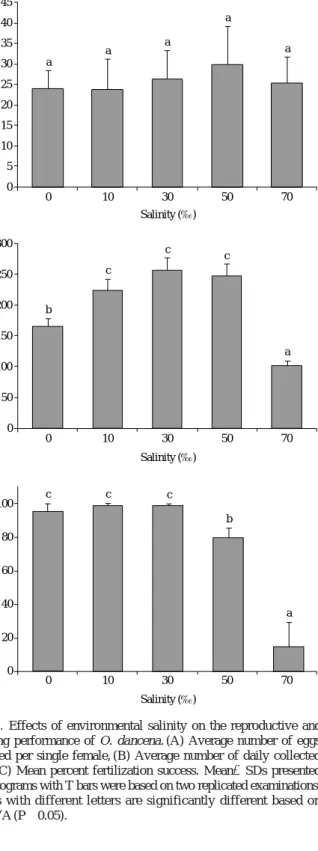
Marine medaka O. dancena was able to spawn eggs in all the salinity levels ranging from 0 to 70‰ tested in this study (Fig. 1). Furthermore, the average number of eggs laid per single female at each time was similar among salinity groups: from the 1-week-observation, the average number of eggs per female was 23.8 in 0‰, which was not different from those found in other salini- ty groups (23.8 to 29.8 eggs) (P¤0.05) (Fig. 1A). How- ever, the average number of eggs collected per day (i.e., reflecting number of spawned females per day) was clear- ly different among groups. With ten females and five males per tank in this study, the average number of eggs daily collected was the lowest in 70‰ (101 eggs per day) (P⁄0.05). The score in 0‰ (165 eggs) was also signifi- cantly lower than those in other three salinity groups (10, 30 and 50‰; 224 to 247 eggs) (P⁄0.05). Converse- ly, those three salinity groups showed the similar num- bers for daily collection of eggs one another (P¤0.05) (Fig. 1B).
Fertilization success was largely affected by the high salinity. Brood fish stocked in freshwater (0‰), brackish (10‰) and normal seawater (30‰) exhibited the similar level of fertilization success, which was higher than 90%
in average (P¤0.05). However, higher salinity groups (i.e., 50 and 70‰ in this study) resulted in the marked
a
a a
a
a
a b
c
c c
a b
c c c
45 40 35 30 25 20 15 10 5 0
No. eggs laid per femaleNo. eggs collected per dayFertilization success(%)
0 10 30 50 70
Salinity ( )
0 10 30 50 70
Salinity ( )
0 10 30 50 70
Salinity ( )
(A)
(B)
(C)
300 250
200
150
100
100
80
60
40
20
0 50
0
Fig. 1. Effects of environmental salinity on the reproductive and spwning performance of O. dancena. (A) Average number of eggs spawned per single female, (B) Average number of daily collected eggs, (C) Mean percent fertilization success. Mean±SDs presented by histograms with T bars were based on two replicated examinations.
Means with different letters are significantly different based on ANOVA (P⁄0.05).
reduction of the fertilization success. Mean fertilization rates in 50 and 70‰ were 80 and 20%, respectively (P⁄
0.05) (Fig. 1C).
2. Embryonic development and incidence of abnormality
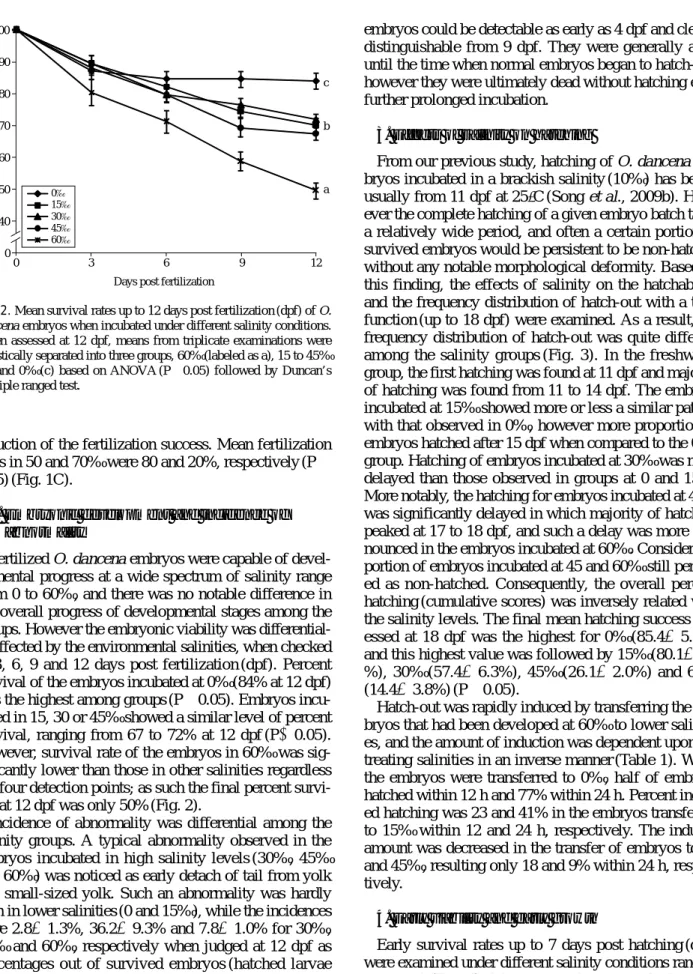
Fertilized O. dancena embryos were capable of devel- opmental progress at a wide spectrum of salinity range from 0 to 60‰, and there was no notable difference in the overall progress of developmental stages among the groups. However the embryonic viability was differential- ly affected by the environmental salinities, when checked at 3, 6, 9 and 12 days post fertilization (dpf). Percent survival of the embryos incubated at 0‰ (84% at 12 dpf) was the highest among groups (P⁄0.05). Embryos incu- bated in 15, 30 or 45‰ showed a similar level of percent survival, ranging from 67 to 72% at 12 dpf (P¤0.05).
However, survival rate of the embryos in 60‰ was sig- nificantly lower than those in other salinities regardless the four detection points; as such the final percent survi- val at 12 dpf was only 50% (Fig. 2).
Incidence of abnormality was differential among the salinity groups. A typical abnormality observed in the embryos incubated in high salinity levels (30‰, 45‰
and 60‰) was noticed as early detach of tail from yolk and small-sized yolk. Such an abnormality was hardly seen in lower salinities (0 and 15‰), while the incidences were 2.8±1.3%, 36.2±9.3% and 7.8±1.0% for 30‰, 45‰ and 60‰, respectively when judged at 12 dpf as percentages out of survived embryos (hatched larvae included in the number of survived). Those abnormal
embryos could be detectable as early as 4 dpf and clearly distinguishable from 9 dpf. They were generally alive until the time when normal embryos began to hatch-out;
however they were ultimately dead without hatching even further prolonged incubation.
3. Effects of salinity on hatching
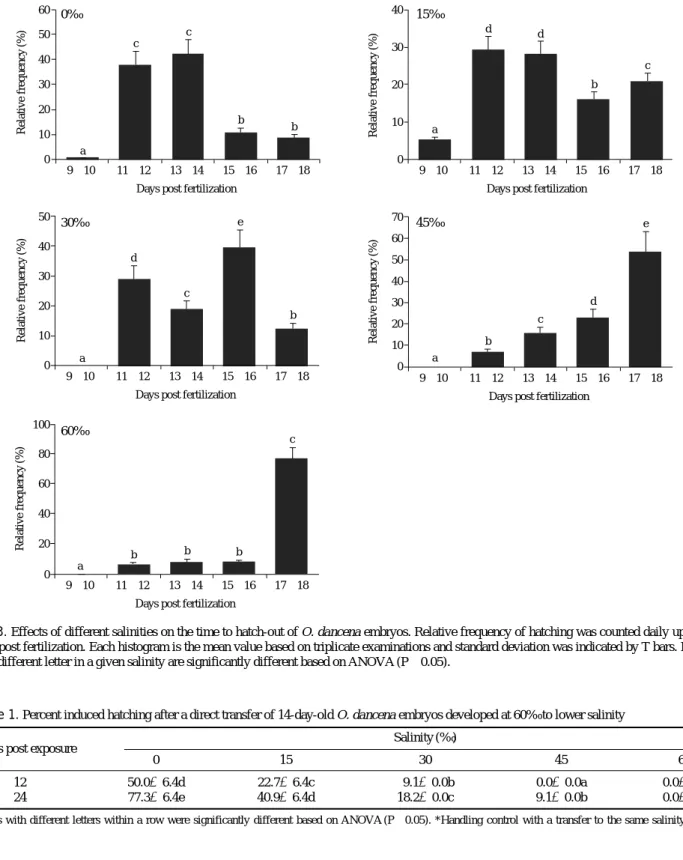
From our previous study, hatching of O. dancena em- bryos incubated in a brackish salinity (10‰) has begun usually from 11 dpf at 25�C (Song et al., 2009b). How- ever the complete hatching of a given embryo batch takes a relatively wide period, and often a certain portion of survived embryos would be persistent to be non-hatched without any notable morphological deformity. Based on this finding, the effects of salinity on the hatchability and the frequency distribution of hatch-out with a time function (up to 18 dpf) were examined. As a result, the frequency distribution of hatch-out was quite different among the salinity groups (Fig. 3). In the freshwater group, the first hatching was found at 11 dpf and majority of hatching was found from 11 to 14 dpf. The embryos incubated at 15‰ showed more or less a similar pattern with that observed in 0‰, however more proportion of embryos hatched after 15 dpf when compared to the 0‰- group. Hatching of embryos incubated at 30‰ was more delayed than those observed in groups at 0 and 15‰.
More notably, the hatching for embryos incubated at 45‰
was significantly delayed in which majority of hatching peaked at 17 to 18 dpf, and such a delay was more pro- nounced in the embryos incubated at 60‰. Considerable portion of embryos incubated at 45 and 60‰ still persist- ed as non-hatched. Consequently, the overall percent hatching (cumulative scores) was inversely related with the salinity levels. The final mean hatching success ass- essed at 18 dpf was the highest for 0‰ (85.4±5.1%) and this highest value was followed by 15‰ (80.1±4.1
%), 30‰ (57.4±6.3%), 45‰ (26.1±2.0%) and 60‰
(14.4±3.8%) (P⁄0.05).
Hatch-out was rapidly induced by transferring the em- bryos that had been developed at 60‰ to lower saliniti- es, and the amount of induction was dependent upon the treating salinities in an inverse manner (Table 1). When the embryos were transferred to 0‰, half of embryos hatched within 12 h and 77% within 24 h. Percent induc- ed hatching was 23 and 41% in the embryos transferred to 15‰ within 12 and 24 h, respectively. The induced amount was decreased in the transfer of embryos to 30 and 45‰, resulting only 18 and 9% within 24 h, respec- tively.
4. Early viability and early growth
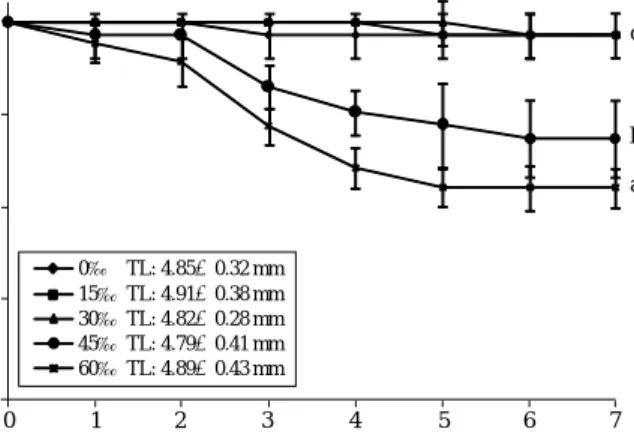
Early survival rates up to 7 days post hatching (dph) were examined under different salinity conditions ranging 0 to 60‰ (Fig. 4). Mean survival rates of the hatched
a b c 100
90
80
70
60
50
40
0
Percent embryos survived
0 3 6 9 12
Days post fertilization 0
15 30 45 60
Fig. 2. Mean survival rates up to 12 days post fertilization (dpf) of O.
dancena embryos when incubated under different salinity conditions.
When assessed at 12 dpf, means from triplicate examinations were statistically separated into three groups, 60‰ (labeled as a), 15 to 45‰
(b) and 0‰ (c) based on ANOVA (P⁄0.05) followed by Duncan’s multiple ranged test.
larvae up to 7 dph were at least 97% in the groups reared at salinities of 0, 15 or 30‰, in which no significant dif- ference was observed among the three groups (P¤0.05).
However adverse effect on viability was observed in the groups reared in 45 and 60‰, in which the mean surviv-
al rates up to 7 dph for the groups at 45 or 60‰ were 75 and 64%, respectively (P⁄0.05). During the examination, most mortality detected in 45 and 60‰ occurred between 2 and 4 dph, and stabilized in later phase. Although the larvae reared in high salinities experienced significant
Table 1. Percent induced hatching after a direct transfer of 14-day-old O. dancena embryos developed at 60‰ to lower salinity
Hours post exposure Salinity (‰)
0 15 30 45 60*
12 50.0±6.4d 22.7±6.4c 9.1±0.0b 0.0±0.0a 0.0±0.0a
24 77.3±6.4e 40.9±6.4d 18.2±0.0c 9.1±0.0b 0.0±0.0a
Means with different letters within a row were significantly different based on ANOVA (P⁄0.05). *Handling control with a transfer to the same salinity (60 to 60‰).
a
b b c
c
c d d
b
a
a
b c
d
e
a
b
c
d
e
a
b b b
c 50
40 30 20 10 0
50 40 30 20 10 0
Relative frequency(%)Relative frequency(%)Relative frequency(%) Relative frequency(%)
9~10 11~12 13~14 15~16 17~18
60
50 40 30 20 10 0
Relative frequency(%)
60 70
9~10 11~12 13~14 15~16 17~18
Days post fertilization
9~10 11~12 13~14 15~16 17~18
Days post fertilization
9~10 11~12 13~14 15~16 17~18
Days post fertilization
9~10 11~12 13~14 15~16 17~18
Days post fertilization
Days post fertilization 40
30
20
10
0
100 80 60 40 20
0
Fig. 3. Effects of different salinities on the time to hatch-out of O. dancena embryos. Relative frequency of hatching was counted daily up to 18 days post fertilization. Each histogram is the mean value based on triplicate examinations and standard deviation was indicated by T bars. Means with different letter in a given salinity are significantly different based on ANOVA (P⁄0.05).
0‰ 15‰
30‰ 45‰
60‰
mortality, the survived fish until 7 dph represented the similar values of total length regardless salinity groups (P¤0.05).
DISCUSSION
Euryhaline medaka, O. dancena was capable of spawn- ing in a wide range of salinity from complete freshwater to two times normal seawater (70‰ in this study), and the number of eggs laid per female at a given time was not significantly affected by the environmental salinity, It suggests that potential fecundity of this species may be basically similar even in such a extremely high salin- ity. However, in the sense of efficiency, their spawning was affected by the lowest (0‰) and highest (70‰) salin- ities, because only limited number of females would par- ticipate in mating for these salinity groups and/or that spawned females might need a relatively longer interval for next spawning. Currently the mechanism behind this phenomenon has not been yet clearly illuminated. Survey of differentially expressed genes and proteins as well as measuring hormonal levels related with sexual maturation and spawning behavior would be helpful for casting more opportunity to gain a deeper insight into the molecular mechanism behind the salinity-dependent spawning effi- ciency (Boutet et al., 2006; Tomy et al., 2009). Among the various salinity levels tested, fertilization would be highly successful only in the salinity range from 0‰ to 30‰, suggesting that fertilizing ability of the spermato- zoa should be significantly depressed in the salt concen- trations higher than 30‰ (Inoue and Takei, 2002, 2003).
Osmotic or ionic stimuli is the most important parame-
ters to activate the sperm motility in teleosts in which sperm of seawater fish species and seawater-adapted fishes are activated by the increase of osmotic or ionic pressure (Morisawa and Suzuki, 1980; Morita et al., 2003). Hence the in vitro assay of the sperm motility under different salinity conditions could be valuable in future study (Yang and Tiersch, 2009).
In spite of significantly depressed fertilization effici- ency, once fertilized, the resultant fertilized eggs are able to precede the embryonic development even in very high salinity (60‰ in this study), although embryonic viabil- ity at such a high salt concentration was negatively affect- ed. One of notable findings on embryonic development is the occurrence of a typical abnormality in the embryos incubated in high salinities, which can be hardly seen in freshwater-incubated embryos. Typical ‘syndrome-like’
phenomenon is the early detach of tail from yolk and small sized yolk. Those embryos kept their viability for a relatively long time during embryogenesis, without notable difference in other microscopic features including heart pumping, blood circulation and pigmentation when compared to normal embryos. Such abnormal embryos were detected even at the salinity close to that of normal seawater, which is different from the previous study reporting no difference in embryonic development of this species between freshwater and seawater (Inoue and Takei, 2003). The incidence of abnormality was peaked in the embryo group incubated at 45‰ but again decreas- ed at 60‰. Developmental mechanism underlying the formation of such abnormal embryos has not been under- stood yet, and also the reason why the incidence of the abnormality in 60‰ is lower than that in 45‰ has also been unclear. One plausible, but untested, assumption is that embryonic development seems to be somewhat accel- erated unnecessarily in the early phase of development under high salinity conditions, which may cause earlier consumption of energy and/or nutrients in yolk and con- sequently resulting in unwanted detach of tail and size decrease of the yolk. However, extensive further study based on much finer observation of embryonic develop- ment should be needed to more solidify this hypothesis.
From this study, hatchability of the embryos was nega- tively affected by the increase of environmental salt concentrations. In addition, the time to hatch was signifi- cantly delayed with increasing salinities, in which the peak of hatching in a given egg batch was 12 to 14 dpf in freshwater whilst at least 17 to 18 dpf in 60‰. Our finding is in agreement with previous report on the slight- ly lowered hatching rates of O. dancena embryos in sea- water and brackish (half concentration of seawater) than in freshwater (Inoue and Takei, 2003). In that previous study, authors suggested that salinity-dependent perfor- mance of hatching enzymes such as high choriolytic en- zyme (HCE) and low choriolytic enzyme (LCE) might be responsible for differential hatchability of Oryzias
0 1 2 3 4 5 6 7
15 30 0
45 60
TL: 4.85±0.32 mm TL: 4.91±0.38 mm TL: 4.82±0.28 mm TL: 4.79±0.41 mm TL: 4.89±0.43 mm
a b 100 c
80
60
40
0
Survival rate(%)
Days post hatching
Fig. 4. Early viability up to 7 days post hatching (dph) of O. dancena larvae reared in different salinities ranged from 0 to 60‰. When assessed at the end of examination (7 dph), larvae in 45 and 60‰
experienced significantly higher mortality than those in salinity range from 0 to 30‰ based on ANOVA (P⁄0.05). Average total length (TL) of 7-day-old larvae belonging to each salinity group was also shown based on the measurement of at least 24 larval samples.
embryos (Yasumasu et al., 1992). However, those hatch- ing enzymes have not been yet characterized in O. dan- cena, which is one of important subjects for future study.
Also it is not clarified yet which expression step (tran- scriptional, translational or enzymatic levels) of these two enzymes is blocked under high salinity conditions.
However, data from this study suggest that delay of hatch- ing might be more associated with the insufficient enzy- matic activity at high salt concentration rather than the lack of transcription or translation, since the persistently non-hatched embryos developed at 60‰ were proven to hatch out immediately after directly transferred to lower salinities.
O. dancena larvae could survive and develop without any adverse effect on viability in salinity levels up to normal seawater, but the larvae experienced significant mortality during early ontogenesis in 45 and 60‰. How- ever, despite the high mortality in early phase, such adverse effect was soon diminished and there was no significant difference in total length among the survived larvae at 1-week-age. Further extension of growth trial is on-going to examine the effects of salinity on their growth performance more in detail. It suggests that O.
dancena be able to adapt to high salt environment rapid- ly in early phase of their life span. However despite their high adaptability to environment with constant salinity, it has also been reported that tolerant capability to acute salinity increase was much less in larval stage than in adult stage (Cho et al., 2010). In overall, data from this study are congruent with previous observations on the natural habitat of this euryhaline medaka species, near the coast and/or brackish regions (Naruse et al., 1993;
Roberts, 1998). However when based on the present findings on the spawning performance, embryonic devel- opment and hatchability, this species may prefer a slightly salted brackish water rather than seawater for spawning and egg development. Data from this study would be a fundamental basis for designing and preparation of vari- ous researches with this candidate model species, in terms of experimental exposures and assay of responses at cellular and organismal levels.
ACKNOWLEDGMENTS
This study was supported by a grant from the Ministry of Land, Transport, and Maritime Affairs, Republic of Korea (Project #20088033-1).
REFERENCES
Au, D.W.T., H.O.L. Mok, L.W. Elmore and S.E. Holt. 2009.
Japanese medaka: A new vertebrate model for study- ing telomere and telomerase biology. Comp. Biochem.
Physiol., 149C: 161-167.
Boutet, I., C.L. Long Ky and F. Bonhomme. 2006. A tran- scriptomic approach of salinity response in the eury- haline teleost, Dicentrarchus labrax. Gene, 379: 40- 50.
Chen, X., V.W.T. Li, R.M.K. Yu and S.H. Cheng. 2008.
Choriogenin mRNA as a sensitive molecular biomark- er for estrogenic chemicals in developing brackish medaka (Oryzias melastigma). Ecotoxicol. Environ.
Saf., 71: 200-208.
Chen, X., L. Li, C.K.C. Wong and S.H. Cheng. 2009. Rapid adaptation of molecular resources from zebrafish and medaka to develop an estuarine/marine model. Comp.
Biochem. Physiol., 149C: 647-655.
Cho, Y.S., S.Y. Lee, D.S. Kim and Y.K. Nam. 2010. Toler- ance capacity to salinity changes in adult and larva of Oryzias dancena, a euryhaline medaka species. Ko- rean J. Ichthyol., 22: 9-16 (in press).
Hobbie, K.R., A.B. DeAngelo, L.C. King, R.N. Winn and J.M. Law. 2009. Toward a molecular equivalent dose:
Use of the medaka model in comparative risk assess- ment. Comp. Biochem. Physiol., 149C: 141-151.
Inoue, K. and Y. Takei. 2002. Diverse adaptability in Oryzias species to high environmental salinity. Zool. Sci., 19:
727-734.
Inoue, K. and Y. Takei. 2003. Asian medaka fishes offer new models for studying mechanisms of seawater adapta- tion. Comp. Biochem. Physiol., 136B: 635-645.
Kong, R.Y.C., J.P. Giesy, R.S.S. Wu, E.X.H. Chen, M.W.L.
Chiang, P.L. Lim, B.B.H. Yuen, B.W.P. Yip, H.O.L.
Mok and D.W.T. Au. 2008. Development of a marine fish model for studying in vivo molecular responses in ecotoxicology. Aquatic Toxicol., 86: 131-141.
Morisawa, M. and K. Suzuki. 1980. Osmolality and potassi- um ion: their roles in initiation of sperm motility in teleosts. Science, 210: 1145-1147.
Morita, M., A. Takemura and M. Okuno. 2003. Requirement of Ca (2++) on activation of sperm motility in euryha- line tilapia Oreochromis mossambicus. J. Exp. Biol., 206: 913-921.
Naruse, K., A. Shima, M. Matsuda, M. Sakaizumi, T. Iwa- matsu, B. Soeroto and H. Uwa. 1993. Description and phylogeny of rice fish and their relatives belong- ing of the suborder Adrianichthyoidei in Sulawesi, Indonesia. Fish. Biol. J. MEDAKA, 5: 11-15.
Roberts, T.R. 1998. Systematic observations on tropical Asian medakas or ricefishes of the genus Oryzias with des- criptions of four new species. Ichthyol. Res., 45:
213-224.
Song, H.Y., Y.K. Nam, I.C. Bang and D.S. Kim. 2009a.
Early gonadogenesis and sex differentiation of a ma- rine medaka, Oryzias dancena (Beloniformes; Teleo-
stei). Korean J. Ichthyol., 21: 141-148. (in Korean) Song, H.Y., Y.K. Nam, I.C. Bang and D.S. Kim. 2009b.
Embryogenesis and early onteogenesis of a marine medaka, Oryzias dancena. Korean J. Ichthyol., 21:
227-238. (in Korean)
Takehana, Y., K. Naruse and M. Sakaizumi. 2005. Molecular phylogeny of the medaka fishes genus Oryzias (Bel- oniformes: Adrianichthyidae) based on nuclear and mitochondrial DNA sequences. Mol. Phylogenet.
Evol., 36: 417-428.
Takei, Y. 2008. Exploring novel hormones essential for sea- water adaptation in teleost fish. Gen. Comp. Endocri- nol., 157: 3-13.
Tomy, S., Y.M. Chang, Y.H. Chen, J.C. Cao, T.P. Wang and C.F. Chang. 2009. Salinity effects on the expres- sion of osmoregulatory genes in the euryhaline black
porgy Acanthopagrus schlegeli. Gen. Comp. Endocri- nol., 161: 123-132.
Yang, H. and T.R. Tiersch. 2009. Sperm motility initiation and duration in a euryhaline fish, medaka (Oryzias latipes). Theriogenology, 72: 386-392.
Yasumasu, S., S. Katow, T.S. Hamazaki, I. Iuchi and K.
Yamagami. 1992. Two constituent proteases of a tel- eostean hatching enzyme: concurrent syntheses and packaging in the same secretory granules in discrete arrangement. Dev. Biol., 149: 349-356.
Yu, R.M.K., M.M.L. Wong, R.Y.C. Kong, R.S.S. Wu and S.H. Cheng. 2006. Induction of hepatic choriogenin mRNA expression in male marine medaka: A highly sensitive biomarker for environmental estrogens.
Aquatic Toxicol., 77: 348-358.
서로 다른 염분도 조건하에서 광염성 송사리 Oryzias dancena의 산란, 발생 및 초기 생존
조영선∙이상윤1∙김동수1∙남윤권1
부경대학교 해양수산형질전환생물연구소, 1부경대학교 해양바이오신소재학과
요 약 :광염성 송사리 Oryzias dancena를 대상으로 서로 다른 염분도 조건이 산란, 발생 및 초기 생존 형질에 미치는 영향을 평가하고자 하였다. 송사리는 본 연구에서 설정한 모든 염분도 조건(0~70‰)에서 산란이 가능하 였으나 암컷의 산란 참여 빈도 및 산란 주기는 염분도별로 차이가 관찰되어 담수(0‰) 및 70‰에서 다른 염분도 그룹(10~50‰)에 비해 낮은 값을 나타내었다. 조사한 염분도 조건 중 0~30‰ 구간에서만 수정률의 저하가 없 었으며 염분도가 그 이상 높아질 경우 수정률의 유의적인 감소가 관찰되었다. O. dancena 수정란은 본 연구의 0, 15, 30, 45 및 60‰ 부화조건에서 모두 발생이 가능하였으나 염분도가 상승 할수록 배(embryo)의 생존율과 부화 율이 저하되는 경향을 나타내었고, 특히 고염분의 조건에서는 기형 유발과 부화의 지연이 관찰되었다. 부화 자어 를 대상으로 다양한 염분도 조건에서 부화 후 7일째까지의 초기 생존율을 관찰한 결과, 45‰ 이상의 염분도에서 초기 발달 과정 중 유의적인 폐사가 관찰되었으나 이후 안정화되는 경향을 나타내었다.
찾아보기 낱말 :광염성 송사리, 산란, 난 발생, 초기생존, 염분도 조건