서 론
우리나라 하천은 근대화가 진행되면서 대형댐과 하구둑, 저 수지, 보 등의 건설과 준설, 하천정비공사 등의 다양한 공사 와 인구 증가, 산업화에 따른 생활하수와 공장폐수의 유입 등 으로 인한 수질 악화, 외래종들의 도입 등으로 인해 심각한 교 란을 받고 있다(Jang et al., 2006; Kwater, 2007; ME, 2011c;
NIBR, 2011). 이러한 영향으로 인해 수생 생물의 다양성이 감 소하고 많은 종들의 서식지와 개체수가 급격히 감소하면서 멸 종위기에 놓이거나 일부 종들은 멸종한 것으로 보고되고 있 다(Sala et al., 2000; Sutherland et al., 2009; NIBR, 2011). 현재 우리나라 어류에 있어서는 서호납줄갱이 Rhodeus hondae와 종어 Leiocassis longirostris가 멸종한 것으로 알려졌고(Kim, 1997; Kim and Park, 2007), 환경부는 멸종위협이 높은 27종(I 급 11종, II급 16종)을 멸종위기 야생생물로 지정하여 보호하 고 있다(ME, 2017). 이러한 멸종위기종의 보전과 복원을 위한
정책과 관리전략은 과학적인 연구를 기반으로 만들어져야 효 율적이기 때문에(Meffe, 2002), 멸종위기종을 직접적으로 이 해할 수 있는 생태학적 연구는 무엇보다 중요하다.
본 연구종인 미호종개 Cobitis choii는 잉어목(Cypriniformes), 미꾸리과(Cobitidae)에 속하는 저서성 소형어류로, 1984년 Kim and Son에 의해 신종으로 발표되었다. 신종 발표 당시 미 호종개는 금강 중·하류 지역에 폭넓게 서식하고 있었으나 (Kim and Son, 1984; Hong, 2004), 서식지의 준설과 하천오염, 각종 공사 등으로 인해 근래에는 백곡저수지와 갑천, 유구천, 지천 하류부에만 서식하는 것으로 보고되어 급격한 서식지 축 소가 일어났다(CHA, 2009; Ko et al., 2012a, 2012b). 최근 신 규 분포지로 러시아의 아무르강에 미호종개의 서식이 알려져 주목되고 있으나(Bogutskaya et al., 2008), 지리적 거리 등으 로 인해 분류학적 검토가 요구되고 있다.
미호종개는 좁은 서식지와 개체수 감소 경향 등으로 1998 년부터 환경부 멸종위기종(현재 멸종위기 야생생물 I급)으 로 지정되었으며(ME, 1998, 2005, 2012, 2017), 문화적 가치 및 학술적 중요성 등으로 종(2005년, 제454호)과 서식지인 지 천 하류부(2011년, 제533호)가 천연기념물로 지정되어(CHA,
—92 — http://www.fishkorea.or.kr
* Corresponding author: In-Chul Bang Tel: 82-41-530-1286, Fax: 82-41-530-1493, E-mail: [email protected]
멸종위기어류 미호종개 Cobitis choii (Pisces: Cobitidae)의 섭식생태
고명훈·방인철1,
*
이화여자대학교 에코과학부, 1순천향대학교 생명시스템학과
Feeding Ecology of the Endangered Korean Endemic Miho Spine Loach, Cobitis choii (Pisces: Cobiti
dae) in Geumgang River, Korea
by Myeong-Hun Ko and In-Chul Bang1,* (Division of ecoScience, ewha Womans university, Seoul 03760, republic of Korea; 1Department of life Sciences and Biotechnology, Soonchunhyang university, asan 31538, republic of Korea)ABSTRACT Feeding ecology of endangered Korean endemic miho spine loach, Cobitis choii, was investigated in Jicheon Stream, Geumgang River, Korea to provide ecological characteristics and baseline data for its restoration. C. choii is active during daylight hours above sand from March to October when the water temperature exceeded 13
ºC, but tended hibernate in the stream bottoms (sand) in the winter months (November~February) when the water temperature was lower than 13
ºC.
They fed (index of relative importance, IRI) mainly Diptera (69.9%), Copepoda (23.2%), Arcellidae (2.3%), Branchiopoda (2.0%) and Ploima (2.0%). And their small juvenile (age 0 +) fed mainly small size, Ploima and Branchiopoda, however, they ate mainly large size, Chilonomidae, while growing to adult fish (age 2 +~3+).
Key words: Cobitis choii, endangered fish, feeding ecology, activity period
2017) 법적 보호를 받고 있다. 미호종개의 보전학적 연구는 2004년 현황과 보존에 대해 논의된 이후(Hong, 2004), 2006 년부터 환경부의 복원학적 연구가 진행되면서 유전자 분석과 인공증식기술개발, 복원기술 등이 연구되어(ME, 2009, 2011a) 유전자 분석(Bang et al., 2008; Kim et al., 2008; Lee et al., 2008)과 초기생활사(Song et al., 2008), 분포 및 서식개체수 추정(Ko et al., 2012a, 2012b) 등이 보고되었고, 그 밖에 핵형 (Lee et al., 1986)과 난막구조(Park and Kim, 2003), 백곡천 집 단의 서식개체수 추정 및 생태특성(Bae et al., 2012; Ko et al., 2014), 서식지 특성과 연령추정(Ko and Bang, 2018) 등이 있 다.
멸종위기종의 복원 및 보전에 있어 종의 생태학적 특징은 복원전략 및 방향 등에 매우 중요한 기초 연구 분야이다. 하지 만 아직까지 미호종개의 생태학적 연구 보고는 많지 않은 편 이다. 따라서 본 연구에서는 미호종개의 생태학적 특성인 섭 식생태를 조사하여 생물학적 특징을 밝히고 보전학적으로 활 용하고자 하였다.
재료 및 방법
연구는 미호종개 C. choii의 개체군이 가장 크고 안정적으 로 서식하고 있는 지역인 충청남도 청양군 청남면 인양리 일 대(ME, 2009; Ko et al., 2012a)의 금강 지류 지천에서 2011년 에 실시하였다. 미호종개의 채집은 청양군청을 경유 문화재청 의 포획허가를 받은 후 실시하였다. 연중 활동주기를 확인하 기 위하여 1월부터 12월까지 매달 14~16일 사이에 기온과 수 온, 활동여부 등을 조사하였고, 일 활동주기는 수위가 안정되 는 9월 16~17일에 면적 50m2 안에서 3시간 간격으로 24시간 동안 스킨다이빙(30분씩 조사)으로 활동개체수와 섭식개체수, 기온, 수온 등을 조사하여 추정하였다.
소화관내용물 분석을 위한 채집은 섭식이 왕성한 4월에 실 시하였다. 채집은 투망(망목 6 ×6mm)과 족대(망목 4 ×4, 1×1mm) 등을 이용하였으며, 채집된 개체는 현장에서 마취제 MS-222(Sindel, Canada)로 마취한 후 수컷 가슴지느러미에 나타나는 골질반(lamina circularis)의 유무에 따라 치어와 암 컷, 수컷으로 구분하여 전장을 측정한 후 대부분 바로 방류하 였다. 소화관내용물 분석 개체수는 연령별로 5개체씩 선별하 여 10% 포르말린 수용액에 바로 고정하였으며, 연령은 전장빈 도분포법(Ricker, 1971)으로 추정하여 구분하였다.
고정된 개체는 실험실로 옮겨 복부를 절개한 후 소화관 내용물을 해부현미경(Olympus SZX9, Japan)과 광학현미 경(Olympus BX50, Japan) 상에서 수서곤충은 Yun(1995)과 Won et al.(2005), 동물성플랑크톤은 Jo(1993), 조류는 Jeong (1993) 등에 따라 분류·동정하여 계수하고 부피를 계산하였
다. 먹이생물은 개체수(%N)와 부피(%W), 출현빈도(%F)를 이용하여 상대중요성지수(index of relative importance, IRI)를 Pinkas et al.(1971)의 방법으로 계산(IRI=(%N+%W)×%F) 한 후 백분율로 환산하여(%IRI) 비교하였다. 또한 성장에 따 른 먹이변화는 상대중요성지수를 근거로 연령별 비율을 계산 하여 추정하였고, 연령별 먹이크기 변화는 상대중요성지수가 가장 높고 연령별 크기 변화가 큰 깔다구과를 측정하여 밝혔 다.
결 과
1. 전장빈도분포
4월에 채집된 미호종개 C. choii의 전장빈도분포도는 Fig.
1과 같았다. 전장 24~45mm는 당년생 치어로 암컷과 수컷 이 구별되지 않았으나 1년생 이상의 개체는 수컷의 가슴지 느러미 제2기조에 골질반이 형성되어 암·수가 구별되었다.
암컷은 46~67mm가 1년생(1+), 68~79mm가 2년생(2+), 80~110mm가 3년생 이상(3 +≤)으로 추정되었고, 수컷은 52~69mm가 1년생(1+), 70~87mm가 2년생 이상(2+≤)으 로 추정되었다.
2. 활동시기
연 활동시기를 조사한 결과, 수온 13℃ 이상 되는 3월부터 10월까지 모래 밖으로 나와 먹이활동을 하거나 유영하는 것 이 관찰되었으나 13℃ 이하인 11월부터 2월까지는 모래 속에 파고들어가 월동하였다(Fig. 2).
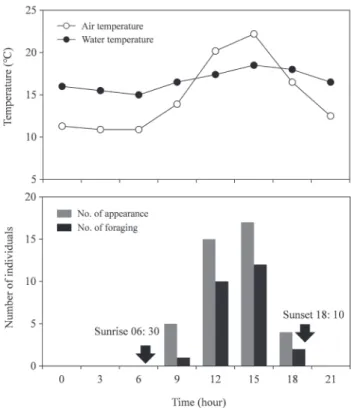
일 활동시기를 조사한 결과, 일출 전인 06시에는 수온이 15.9℃로 낮았으며 모래 밖으로 나와 활동하는 개체는 관찰되 지 않았다. 06시 30분 일출 이후에 수온은 급격히 상승하는 경 Fig. 1. Total length frequency distribution of Cobitis choii(n=179) in the Jicheon Stream of Geumgang River, Inyang-ri, Cheongnam-myeon, Cheongyang-gun, Chungcheongnam-do, Korea, April 2011.
향을 보였고, 9시(수온 16.5℃)부터 모래 밖으로 나와 활동하 면서 섭식하는 개체도 관찰되기 시작하였으며, 이후 12시(수 온 17.4℃)에는 활동개체수 15개체, 섭식개체수 10개체가, 15 시(수온 18.5℃)에는 활동개체수 17개체, 섭식개체수 12개체 가 관찰되어 정점을 보였다. 이후 18시(수온 18.0℃)에는 일 몰이 다가오면서 점점 어두워져 활동개체수와 섭식개체수가 각각 4개체, 2개체로 급격히 감소하였다. 일몰(18시 10분) 이 후의 야간에는 모두 모래 속으로 파고들어가 활동개체는 관찰 되지 않았다(Fig. 3).
3. 섭식생태
1) 소화관 내용물 분석
스킨다이빙으로 섭식행동을 관찰한 결과 낮 동안에만 모 래 밖으로 나와 바닥 표면의 가는 모래를 여과하면서 먹이 를 섭식하였다. 위 내용물을 연령별로 나누어 상대중요성지수 (%IRI)를 조사한 결과 Table 1과 같이 나타났는데, 동물성 먹 이 99.9%, 식물성 먹이 0.1%로 거의 대부분이 동물성 먹이였 다.
먹이생물의 개체수는 곤충강(Insecta)의 파리목(Diptera) 이 39.1%로 가장 높았고, 그 다음으로 요각목(Copepoda) 이 38.0%, 새각목(Branchiopoda) 6.5%, 윤충강(Rotatoria)의 유영목(Ploima) 6.3%, 근족충강(Rhizopoda)의 꽃병벌레과 (Arcellidae)가 5.9% 순으로 우세하게 나타났으며 그 밖에 완 보동물문(Tardigrada, 1.7%), 녹조식물문(Chlorophyta)의 규 조강(Bacillariophyceae, 1.6%), 와편모충목(Dinoflagelliada, 0.7%), 쌍선충강(Phasmidia, 0.3%) 등의 순으로 출현하였다.
이 중 파리목은 깔다구과(Chironomidae, 37.5%)가 대부분 을 차지하였고, 새각목은 코끼리물벼룩과(Bosminidae, 3.4%) 와 물벼룩과(Daphniidae, 1.8%), 둥굴레물벼룩과(Chydoridae, 1.3%) 등의 순으로, 유영목은 주머니윤충과(Asplanchnidae,
3.6%)와 장삼윤충과(Euchlannidae, 1.8%), 쥐꼬리윤충과(Tri- chocericdae, 0.9%) 순으로 비율이 높았다. 부피에서는 파리목 이 93.0%로 대부분을 차지하고 있었고, 그 다음으로 요각목 6.0%, 새각목 0.6%, 유영목 0.2%, 꽃병벌레과 0.2% 등의 순 으로 나타났다. 출현빈도는 주요 분류군별로 계산한 결과 파 리목이 95%로 가장 높았고, 그 다음으로 요각목 85%, 유영 목 80%, 새각목 75%, 꽃병벌레과 60% 등으로 나타났다. 먹 이생물의 개체수와 부피, 출현빈도를 포함한 상대중요성지수 (IRI)로 계산한 결과 파리목이 69.9%(깔다구과 69.0%)로 가 장 중요한 먹이였으며, 그 다음으로 요각강 23.2%, 꽃병벌레 과 2.3%, 새각목 2.0%, 유영목 2.0% 등의 순으로 중요한 먹이 생물이었다. 식물성먹이는 규조강(Bacillariophyceae)만 관찰 되었는데, 전체 개체수비가 1.6%, 출현빈도가 35%였지만 부 피가 상대적으로 적어 상대중요성지수는 0.1%로 낮았다.
2) 성장에 따른 먹이와 크기 변화
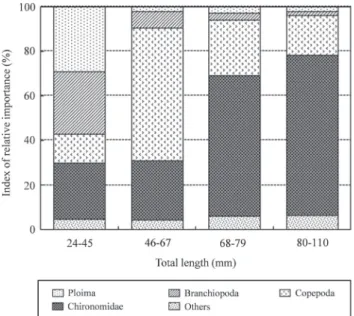
연령별 상대중요성지수로 먹이변화를 조사한 결과(Fig. 4), 당년생 치어(전장 24~45mm)는 크기가 작은 유영목(29.2%) 과 새각목(28.4), 깔다구과(25.5%) 등을 주로 섭식하였고, 1년 생(46~67mm)은 요각강(59.7%)과 깔다구과(26.7%) 등을 주 로 섭식하였다. 2년생(68~79mm)과 3년생 이상(80~110mm) 은 크기가 큰 깔다구과를 각각 62.9%, 71.9%로 가장 많이 섭 Fig. 2. The distinction between activity and hibernation period by
temperature of Cobitis choii in the Jicheon Stream, Korea, 2011.
Fig. 3. Changes in temperature and number of individuals of Cobitis choii in the Jicheon Stream, Korea, oberved at three-hour intervals on September 16~17, 2011.
식하였고 그 다음으로 요각목(각각 25.1%, 17.9%)을 많이 섭 식하였으며 그 밖에 새각목(3.0~3.1%), 유영목(2.0~2.2%) 등 을 섭식하였다.
먹이생물 중 깔다구과는 전 연령대에서 공통적으로 중요한 먹이로 나타났다. 하지만 연령별 깔다구과의 먹이크기는 큰 차이를 보였는데, 당년생이 섭식한 깔다구과의 크기는 0.10±
0.04(0.05~0.15) mm로 매우 작은 크기였으나 1년생은 0.37±
0.21mm, 2년생은 0.64±0.31mm, 3년생 이상은 0.68±0.45 mm로 연령이 높아짐에 따라 점점 커지는 것으로 나타났다 (Fig. 5). 통계적 유의성은 당년생, 1년생, 2~3년생은 유의한 차이를 보였으나(p<0.01), 2년생과 3년생 이상은 차이가 없 었다(p>0.05).
고 찰
우리나라는 4계절이 뚜렷하여 계절에 따른 기온이 큰 폭으 로 변하며, 이에 따라 담수어류도 수온에 따라 활동기와 월 동기로 나누어지는 경향을 보인다. 지금까지 조사된 미꾸리 과(Cobitidae) 어류 왕종개 Iksookimia longicorpa와 줄종개 Cobitis tetralineata, 점줄종개 C. lutheri, 참종개 I. koreensis, 북방종개 I. pacifica 등은 공통적으로 수온이 약 13℃(종에 따 라 10~15℃) 이상 되는 3월부터 10월까지는 활동기로 기질 밖으로 나와 활동 및 섭식행동 등을 하지만 수온이 약 13℃
이하 되는 11월부터 2월까지는 월동기로 기질 속으로 들어가 은신하는 것으로 보고된 바 있어(Kim and Ko, 2005; Kim et Table 1. Composition of the intestine contents of Cobitis choii (n=20) by the frequency of number, volume, occurrence and index of relative importance (IRI) in the Jicheon Stream, Korea, April 2011
Prey organisms
Age(total length (mm), number)
Number (%) Volume
(%) Occurence
(%) IRI IRI
0+ (%)
(24-45, n=5) 1+
(46-67, n=5) 2+
(68-79, n=5) 3+≤
(80-110, n=5) Total Zooplankton
Phylum Sarcomastigophora Order Dinoflagellida
Family Peridinidae 2 3 5 0.7 0.1 10.0 7.1 +
Class Rhizopodea
Family Arcellidae 14 18 13 45 5.9 0.2 60.0 370.0 2.3
Phylum Trochelminthes Class Rotatoria Order Ploima
Family Trichocercidae 1 1 2 3 7 0.9 + 20.0 18.9 0.1
Family Asplanchnidae 1 6 12 8 27 3.6 0.1 60.0 222.1 1.4
Family Euchlannidae 6 1 4 3 14 1.8 + 40.0 75.5 0.5
Phylum Nematoda Class Phasmidia
Unidentification 2 2 0.3 + 5.0 1.4 +
Phylum Arthropoda Class Crustacea Order Branchiopoda
Family Daphniidae 3 3 5 3 14 1.8 0.2 45.0 89.9 0.6
Family Bosminidae 1 10 9 6 26 3.4 0.3 50.0 185.0 1.1
Family Chydoridae 5 2 3 10 1.3 0.1 30.0 42.6 0.3
Order Copepoda
Unidentification 3 105 95 85 288 38.0 6.0 85.0 3737.9 23.2
Class Insecta Order Diptera
Family Chironomidae 4 47 93 140 284 37.5 79.5 95.0 11107.1 69.0
Unidentification 12 12 1.6 13.5 10.0 150.8 0.9
Phylum Tardigrada
Unidentification 2 1 10 0 13 1.7 0.1 40.0 71.0 0.4
Phytoplankton
Class Bacillariophyceae
Fragilaria sp. 1 1 0.1 + 5.0 0.7 +
Synedra spp. 2 1 1 4 0.5 + 15.0 7.9 +
Nabicula spp. 1 1 1 3 0.4 + 15.0 5.9 +
Cymbella spp. 1 2 1 4 0.5 + 15.0 7.9 +
Pinnularia sp. 1 1 0.1 + 5.0 0.5 +
+: less than 0.1%.
al., 2006; Ko et al., 2009; Ko, 2015) 본 연구종인 미호종개 C.
choii와 유사한 연 활동주기를 보였다. 또한 이들은 공통적으 로 월동기에 섭식을 하지 않으며 성장 또한 거의 멈추는 것으 로 보고된 바 있는데, 미호종개는 포획개체수 제한으로 월동 기에 섭식유무를 확인하지 못하였지만 월동기에 거의 활동과 성장을 하지 않는 점으로 볼 때(Ko and Bang, 2018), 미호종개 도 월동기에는 섭식을 하지 않는 것으로 추정되었다.
일 활동기는 활동시간대에 따라 주행성과 야행성으로 나 누어지는 경향을 보인다. 미꾸리과 어류 중에서는 왕종개와
줄종개, 점줄종개, 참종개, 동방종개가 시간대별 활동개체수 및 섭식개체수 조사로 주행성 어류로 보고되어(Kim and Ko, 2005; Kim et al., 2006; Ko et al., 2009, 2018) 미호종개와 동 일하였다. 하지만 얼룩새코미꾸리 Koreocobitis naktongensis 는 시간대별 섭식량 분석에서 주로 야간에 섭식을 하고(ME, 2011b), 북방종개는 시간대별 활동개체수 및 섭식량 분석을 통해 12시부터 24시까지 주로 활동하는 것으로 보고되어(Ko, 2015) 본 종과 차이를 보였다.
미호종개의 소화관 내용물을 상대중요성지수(IRI)로 분석한 결과 파리목(Diptera)의 깔다구과(Chironomidae)가 69.0%로 가장 중요한 먹이원으로 나타났고 그 밖에 요각목(Copepoda) 23.2%, 꽃병벌레과(Arcellidae) 2.3%, 새각목(Branchiopoda) 2.0%, 윤충강(Rotatoria) 2.0%, 조류(algae) 0.1% 등 99.9%가 동물성 먹이를 섭식하는 것으로 나타나, Hong(2004)의 조류 (algae)만을 주로 섭식한다는 보고와 큰 차이를 보였다. 지금 까지 조사된 우리나라 미꾸리과 어류는 조류를 일부 섭식하 지만 대부분 깔다구과와 하루살이과 등의 수서곤충과 요각목, 새각목(물벼룩류), 윤충강 등의 동물성 먹이를 주로 섭식하 는 것으로 보고되어 본 결과와 비교적 유사하였다(Kim, 1978, 2008; Kim and Lee, 1984; Chong, 1986; Choi, 2003; Kim and Ko, 2005; Ko, 2005, 2009; Kim et al., 2006; Byeon, 2007;
Choi and Byeon, 2009; Ko et al., 2009; Hong et al., 2011; Park, 2016). 따라서 Hong(2004)의 결과는 채집한 지역이 환경적으 로 교란되어 서식지가 안정화 되지 않았거나 홍수기 이후 먹 이생물이 급격히 감소한 시기에 채집하였기 때문으로 의심되 었다. 모래에 주로 서식하는 미꾸리과 어류 미호종개와 줄종 개(Kim et al., 2006), 점줄종개(Ko et al., 2009), 기름종개(Ko, 2009), 북방종개(Ko, 2015)는 공통적으로 깔다구과가 가장 중 요한 먹이원이었다. 하지만 자갈과 돌에 주로 서식하는 왕종 개(Kim and Ko, 2005)와 참종개(Kim, 1978; Ko et al., 2009), 남방종개(Park, 2016)는 공통적으로 하루살이목과 깔다구과가 가장 중요한 먹이원으로, 소하천의 돌과 자갈이 많은 곳에 서 식하는 좀수수치는 날도래목과 깔다구과가 가장 중요한 먹이 로 나타나 서식지에 따라 먹이생물의 차이를 보였다.
미호종개는 연령에 따라 먹이생물에 차이를 보였는데, 당년 생 치어는 윤충강과 새각목을 주로 섭식하였지만, 1년생은 요 각강과 깔다구과를, 2년생 이상은 주로 깔다구과를 섭식하여 성장함에 따라 크기가 큰 먹이생물로의 먹이전환이 일어났다. 같은 과의 줄종개는 치어기에 꽃병벌레과와 윤충강, 새각목을 (Kim et al., 2006), 점줄종개는 완보동물문(Tardigrada)과 꽃병 벌레과, 새각목을(Ko et al., 2009), 북방종개는 윤충류 등을 주 로 섭식하여(Ko, 2015) 초기 먹이생물의 차이는 있지만 공통 적으로 크기가 작은 먹이생물에서 성장함에 따라 모두 먹이크 기가 큰 깔다구과로의 먹이전환이 일어나 유사한 경향을 보였 다.
Fig. 4. Ontogenetic changes in the composition in intestine contents by index of relative importance (IRI) of Cobitis choii (n=20) in the Jicheon Stream, Korea, April 2011.
Fig. 5. Ontogenetic changes in the size of prey organisms (Chirono- midae) of Cobitis choii (n=20) in the Jicheon Stream, Korea, April 2011. Circles and bars represent the mean and range of the prey size.
본 연구를 통하여 미호종개의 활동기와 월동기를 구분하고 일 중 활동시간대를 밝혔으며, 먹이생물을 상대중요성지수로 중요도를 계산하고 연령별 먹이변화 양상 및 크기변화를 밝혔 다. 이러한 섭식생태학적 연구는 미호종개를 관리·보전하고 복원하는데 중요한 자료로 활용될 수 있을 것이다.
요 약
멸종위기종 미호종개 C. choii의 생태학적 특징을 밝히고 복원의 기초자료를 확보하기 위해 섭식생태를 충청남도 청 양군 청남면 인양리의 금강지류 지천에서 조사를 실시하였 다. 미호종개는 3월부터 10월까지 활동기로, 11월부터 2월까 지는 월동기로 나누어졌으며, 활동기에는 주행성 어류로 기 질(모래) 밖으로 나와 활동하였다. 소화관내용물을 상대중 요성 지수(index of relative importance, IRI)로 분석한 결과, 파리목(Diptera) 69.9%, 요각목(Copepoda) 23.2%, 꽃병벌 레과(Arcellidae) 2.3%, 새각목(Branchiopoda) 2.0%, 유영목 (Ploima) 2.0% 등의 순으로 높게 나타났다. 크기가 작은 당년 생 치어(0년생)는 유영목과 새각목을 주로 섭식하였으나, 성 어(2~3년생)는 크기가 큰 깔다구과(Chironomidae)를 주로 섭 식하여 차이를 보였다.
사 사
본 연구는 환경부 멸종위기 담수어류(퉁사리 등 4종) 증 식·복원(2011년) 연구와 순천향대학교의 연구비 지원으로 수행되었습니다.
REFERENCES
Bae, D.Y., W.K. Moon, M.H. Jang, K.S. Jang, J.B. Seo, W.J. Kim, J.O. Kim and J.K. Kim. 2012. Applying the Jolly-Seber mod- el to estimate population size of miho spine loach(Cobitis choii) in the Backgok Stream, Korea. Korean J. Limnol., 45:
322-328.(in Korean)
Bang, I.C., W.J. Kim and I.R. Lee. 2008. Characterization of poly- morphic microsatellite loci in the endangered Miho spine loach(Iksookimia choii) and cross-species amplification within the Cobitidae family. Molecular Ecol. Res., 9: 281- 284.
Bogutskaya, N.G., A.M. Naseka, S.V. Shedko, E.D. Vasil’eva and I.A. Chereshnev. 2008. The fishes of the Amur River: up- dated check-list and zoogeography. Ichthyol. Explor. Fresh- waters, 19: 301-366.
Byeon, H.K. 2007. Ecology of Koreocobitis rotundicaudata(Cobit- idae) in the Naerin Stream, Korea. Korean J. Ichthyol., 19:
299-305.(in Korean)
CHA(Cultural Heritage Administration). 2009. Habitat Status Basic Research of Natural Monument fish. Institute of Biodiversi- ty, 117pp. (in Korean)
CHA(Cultural Heritage Administration). 2017. Natural Monument Designation. Retrieved from http://www.cha.go.kr/korea.
verson(12/2017)(in Korean)
Choi, E.K. 2003. Biology of the Southern Spined Loach, Iksookimia hugowolfeldi(Pisces, Cobitidae). Master Thesis, Chonbuk National University, Jeonju, 42pp.(in Korean)
Choi, J.K. and H.K. Byeon. 2009. Ecological characteristics of Co- bitis pacifica(Cobitidae) in the Yeongok Stream. Korean J.
Limnol., 42: 26-31.(in Korean)
Chong, D.S. 1986. Morphological and bionomical studies of Ni- waella multifasciata(Wakiya et Mori). Master Thesis, Chonbuk National University, 37pp.(in Korean)
Hong, Y.P. 2004. The Present Status and Conservation of the Criti- cally Endangered Species, Iksookimia choii, in Korea. Ab- stract 2004 Autumn Meeting of the Ichthyological Society of Korea, pp. 59-75.(in Korean)
Hong, Y.K., H. Yang and I.C. Bang. 2011. Habitat, reproduction and feeding habit of endangered fish Koreocobitis naktongensis (Cobitidae) in the Jaho Stream, Korea. Korean J. Ichthyol., 23: 234-241.(in Korean)
Jang, M.H., G.J. Joo and M.C. Lucas. 2006. Diet of introduced largemouth bass in Korean rivers and potential interactions with native fishes. Ecol. Freshw. Fish, 15: 315-320.
Jeong, J. 1993. Illustration of the Freshwater Algae of Korea. Acad- emy Publishing Company, Seoul, 496pp.(in Korean) Jo, K.S. 1993. Illustration of the Freshwater Zooplankton of Korea.
Academy Publishing Company, Seoul, 387pp.(in Korean) Kim, E.J. 2008. Conservation Biology of Dwarf Loach, Kichulchoia
brevifasciata. Master Thesis, Chonbuk National University, Jeonju, 58pp.(in Korean)
Kim, I.S. 1978. Ecological studies of cobitid fish, Cobitis koreensis in Jeonju-cheon Creek, Jeonrabug-do province, Korea. Ko- rean J. Ecol., 2: 9-14.(in Korean)
Kim, I.S. 1997. Illustrated Encyclopedia of Fauna & Flora of Korea, Vol. 37, Freshwater Fishes. Ministry of Education, Yeongi, 329pp.(in Korean)
Kim, I.S. and M.H. Ko. 2005. Ecology of Iksookimia longicorpa (Cobitidae) in the Seomjin River, Korea. Korean J. Icthyol., 17: 112-122.(in Korean)
Kim, I.S., M.H. Ko and J.Y. Park. 2006. Population ecology of Ko- rean sand loach Cobitis tetralineata(Pisece; Cobitidae) in the Seomjin River, Korea. J. Ecol. Field Biol., 29: 277-286.
(in Korean)
Kim, I.S. and Y.M. Son. 1984. Cobitis choii, a new cobitid fish from Korea. Korean J. of Zool., 27: 49-55.
Kim, I.S. and J.Y. Park. 2007 Freshwater Fishes of Korea. Kyohak Publishing, Seoul, 467pp.(in Korean)
Kim, I.S. and W.O. Lee. 1984. Morphological and ecological as- pects on the population of Cobitis koreensis Kim(Pisces:
Cobitidae) in the Begchon Stream, Puan-gun, Cholla-bug- do, Korea. Korean J. Ecology, 7: 10-20.(in Korean) Kim, K.Y., S.Y. Lee, I.C. Bang and Y.K. Nam. 2008. Complete
mitogenome sequence of an endangered freshwater fish, Iksookimia choii (Teleostei; Cypriniformes, Cobitidae), Mi- tochondrial DNA, 19: 438-445.
Ko, M.H. 2005. Ecological Studies of Cobitis tetralineata and Ik- sookimia longicorpa (Cobitidae) in the Seomjin River, Ko- rea. Chonbuk National University Master Thesis, 69pp.(in Korean)
Ko, M.H. 2009. Reproductive Mechanisms of the Unisexual Dip- loid-triploid Hybrid Complex between the Spined Loach Cobitis hankugensis and Iksookimia longicorpa(Teleostei, Cobitidae) in Korea. Doctoral Thesis, Chonbuk National University, Jeonju, 160pp.(in Korean)
Ko, M.H. 2015. Habitat characteristics and feeding ecology of the Korean endemic Species, Iksookimia pacifica(Pisces: Co- bitidae) in the Bukcheon(stream), Korea. Korean J. Ichthy- ol., 27: 275-283.(in Korean)
Ko, M.H., H.J. Kim, R.Y. Myung and Y.J. Won. 2018. The Activity period and feeding ecology of the Korean eastern spined loach, Iksookimia yongdokensis (Pisces: Cobitidae). Korean J. Ichthyol., 30: 27-35.(in Korean)
Ko, M.H. and I.C. Bang. 2018. Habitat characteristics and estima- tion of the age of the endangered miho spine Loach, Cobitis choii(Pisces: Cobitidae) in Ji Stream, Geum River, Korea.
Korean J. Ichthyol., 30: 46-54.(in Korean)
Ko, M.H., I.R. Lee and I.C. Bang. 2012a. Distribution status and estimation of population size of the endangered species, Cobitis choii (Pisces: Cobitidae) in Geum River, Korea.
Korean J. Ichthyol., 24: 56-61.(in Korean)
Ko, M.H., J.Y. Park and S.H. Kim. 2009. Habitat enviornment and feeding habitat of Iksookimia koreensis and Cobitis lutheri (Pisces: Cobitidae) in the Mangyeong River, Korea. Korean J. Ichthyol., 21: 253-261.(in Korean)
Ko, M.H., S.J. Moon, S.J. Lee and I.C. Bang. 2012b. Community structure of fish and inhabiting status of endangered spe- cies, Cobitis choii and Gobiobotia naktongensis in the Ji Stream, a tributary of the Geum River drainage system of Korea. Korean J. Limnol., 45: 356-367.(in Korean) Ko, M.H., Y.K. Hong, H.L. Kim and I.C. Bang. 2014. Community
structure of fish and inhabiting status of natural monument Cobitis choii in the Baekgok Stream, a tributary of the Geum River drainage systrem of Korea. Korean J. Ichthyol., 26:
99-111.(in Korean)
Kwater. 2007. A Guidebook of Rivers in South Korea. Kwater, Dae- jeon, 582pp.(in Korean)
Lee, I.R., Y.A. Lee, H. Shin, Y.K. Nam, W.J. Kim and I.C. Bang.
2008. Genetic diversity of an endangered fish, Iksookimia choii(Cypriniformes), from Korea as assessed by amplified fragment length polymorphism. Korean J. Limnol., 41: 98-
103.(in Korean)
Lee, H.Y., H.S. Lee and C.S. Park. 1986. Karyotype analysis and geographical polymorphism in Korean Cobitis. Korean J.
Genetics, 8: 65-74.(in Korean)
ME(Ministry of Environment). 1998. Natural Environment Conser- vation act(Law No. 5392).(in Korean)
ME(Ministry of Environment). 2005. Enforcement of Wildlife Laws(Law No. 7167).(in Korean)
ME(Ministry of Environment). 2009. Development of Genetic Diversity Analysis, Culture and Ecosystem Restoration Techniques for Endangered Fish, Iksookimia choii. Soon- chunhyang University, Asan, 537pp.(in Korean)
ME(Ministry of Environment). 2011a. Culture and Restoration Re- search of Endangered Freshwater Fish(four species includ- ing Liobagrus obesus). Soonchunhyang University, Asan, 359pp.(in Korean)
ME(Ministry of Environment). 2011b. Development of Culture Techniques and Construction of Monitoring System for Released Seedlings of Endangered Fish Koreocobitis na- ktongensis. Soonchunhyang University, Asan, 250pp.(in Korean)
ME(Ministry of Environment). 2011c. Ecological Risk Manage- ment Master plan of Exotic Species. Ministry of Environ- ment of Korea, 290pp.
ME(Ministry of Environment). 2012. Conservation and Manage- ment Laws of Wildlife(Law No. 10977).(in Korean) ME(Ministry of Environment). 2017. Conservation and Manage-
ment Laws of Wildlife(Law No. 737).(in Korean) Meffe, G.K. 2002. Connecting science to management and policy in
freshwater fish conservation. In: Conservation of freshwater fishes: options for the future(Collares-Pereira, M.J., I.G.
Cowx and M.M. Coelho, eds.). Iowa State University Press, Iowa, pp. 363-372.
NIBR(National Institute of Biological Resources). 2011. Red Data Book of Endangered Fishes in Korea. Ministry of Environ- ment, Incheon, 202pp.(in Korean)
Park, C.W. 2016. Ecology of the Endemic Korean Southern King Spine Loach, Iksookimia hugowolfeldi. Master Thesis, Chonbuk National University, Jeonju, 56pp.(in Korean) Park, J.Y. and I.S. Kim. 2003. Variability of egg envelopes in Kore-
an spined loaches(Cobitidae). Folia Biol., 51: 187-192.
Pinkas, L., M.S. Oliphant and I.K.K. Ivrson. 1971. Food habits of albacore, bluefin tuna, and bonito in California water. Fish.
Bull., 152: 1-105.
Ricker, W.E. 1971. Methods for assessment of fish production in freshwater. IBP hand book, 3: 112-113.
Sala, O.E., F.S. Chapin, J.J. Armesto, E. Berlow, J. Bioomfield, R.
Dirzo, H.S. Elisabeth, L.F. Huenneke, R.B. Jackson, A.
Kinzig, R. Leemans, M.L. David, H. Mooney, A.O. Martin, N.L. Poff, T.S. Martin, B.H. Walker, W. Marilyn and D.H.
Wall. 2000. Global biodiversity scenarios for the year 2100.
Science, 287: 1770-1774.
Song, H.Y., W.J. Kim, W.O. Lee and I.C. Bang. 2008. Morphologi-
cal development of egg and larvae of Iksookimia choii(Co- bitidae). Korean J. Limnol., 41: 104-110.(in Korean) Sutherland, W.J., W.M. Adams, R.B. Aronson, R. Aveling, T.M.
Blackburn, S. Broad, G. Ceballos, I.M. Cote, R.M. Cowl- ing, G.A.B. Da fonseca, E. Dinerstein, P.J. Ferraro, E.
Fleishman, C. Gascon, M. Hunter Jr., J. Hutton, P. Kareiva, A. Kuria, D.W. Macdonald, K. Mackinnon, F.J. Madgwick, M.B. Mascia, J. Mcneely, E.J. Milnergulland, S. Moon, C.G.
Morley, S. Nelson, D. Osborn, M. Pai, E.C.M. Parsons, L.S. Peck, H. Possingham, S.V. Prior, A.S. Pullin, M.R.W.
Rands, J. Ranganathan, K.H. Redford, J.P. Rodriguez, F.
Seymour, J. Sobel, N.S. Sodhi, A. Stott, K. Vance-borland and A.R. Watkinson. 2009. One hundred questions of im- portance to the conservation of global biological diversity.
Conserv. Biol., 23: 557-567.
Won, D.H., S.J. Kwon and Y.C. Jeon. 2005. Aquatic Insects of Ko- rea. Korean Ecosystem Service, Seoul, 360pp.(in Korean) Yun, I.B. 1995. Aquatic Insects of Korea. Jeonghang Publishing
Company, Seoul, 262pp.(in Korean)