Comparative Study on Various Growth Performances of Korean Oge and White Leghorn Chickens
Kyung Soo Kang1, Hyun-Jun Jang1, Hyung Chul Lee1, Sung Kyu Kim1, Jae-Hwan Kim2, Seong-Bok Choi2, Deivendran Rengaraj1 and Jae Yong Han1,†
1WCU Biomodulation Major, Department of Agricultural Biotechnology, Seoul National University, Seoul 151-921, Korea
2National Institute of Animal Science, R.D.A., Namwon 590-830, Korea
ABSTRACT Genetic resource conservation of indigenous species is important to conserve terrestrial, aquatic and avian spe- cies throughout the world. The native Korean Oge (KO) chickens are important and protected indigenous avian species in Korea. This KO breed is very popular in Korea because of its external appearances of blackish color. The characterization of morphology and growth performances of KO were performed since 1980s, however the information is still not sufficient for breed selection. In this study, we compared various growth performances including body growth, tibia length, shank length, chest width, chest grith and length of tail feather between male and female chickens of KO and widely known White Leghorn (WL) breeds at 1 week, 2 weeks, 5 weeks, 10 weeks, and 24 weeks. We observed differences on various growth performances at different aged groups between KO and WL chickens. This study may help for the selection of chicken breeds based on age, body growth and meat production.
(Key words : Korean Oge (KO), White Leghorn (WL), growth performances)
†To whom correspondence should be addressed : [email protected]
INTRODUCTION
The Nagoya protocol on access to genetic resources and the fair and equitable sharing of benefits arising from their utili- zation was made in connection with the Conference of the Par- ties to the Convention on Biological Diversity at its 10th mee- ting on October 2010 in Nagoya, Japan. The Nagoya protocol is an international agreement which aims at sharing appro- priate access to genetic resources, appropriate transfer of rele- vant technologies, and appropriate funding thereby contribu- ting to the conservation of biodiversity (Protocol: Booklets http://www.cbd.int/abs/doc/protocol/nagoya-protocol-en.pdf).
There are few indigenous species being very popular in Ko- rea, particularly Hanwoo cattle, Jindo dogs and Korean Oge (KO) chickens have plentiful genetic resources. These indige- nous species are widely used by Korean researchers for the research works on improvement of meat quality, milk produc- tion and egg production. KO chickens are the indigenous avian species in Korea, and important genetic resources in poultry industry and avian biotechnology. KO chickens have been recognized as a natural monument since 1980 for its genetic important and characteristic appearances.
KO chickens were previously characterized to investigate
its hereditary characters and some economical traits (Han et al., 1988). However it has not been registered as new breed because of fewer studies on characteristic feature. The gene- tic background of KO was biased on breeding. General descrip- tion of KO chickens are: short rectangular shaped body with six to eight pointed stands up straight reddish black color comb on the head; black colored with a white tip medium length of beak; round and black eyes; reddish black and fea- therless face; small and varied colors of ear lobes; medium size and elongated reddish black wattles; greyish black tongue;
shank of medium length with four greyish black toes; the body covered by dark black feathers; greyish black skin; and greyish black bone cortex (Nahm, 1997). The genetic charac- teristics of KO chickens are a highly inbred line and closely related to the Korean native yellow fowl by DNA finger- printing study (Lee et al., 1995). The native KO chickens share the features of Japanese, Chinese and Indian chicken popu- lations which represent the high genetic variability (Lee et al., 2007). White Leghorn (WL) chickens are the most com- monly known avian breed for egg laying. WL chickens were first reported in Tuscany in Italy and exported to North Ame- rica. WL chickens have single comb, legs are yellow in color, and ear-lobes are white in color. It was tested for environ-
mental stress effect for their body weight growth (Gross and Siegel, 1980). WL chickens are also very good resource for genetic studies such as quantitative trait locus (QTL) (Tsudzuki et al., 2007; Ankra- Badu et al., 2010; Podisi et al., 2011), genetic differentiation (Tadano et al., 2011), and gene poly- morphism (Cao et al., 2007).
Analysis of patterns of growth performances is very im- portant for understanding feed utilization and meat production in poultry. Several studies were previously conducted to com- pare growth patterns between different breeds of avian spe- cies. Some studies have been reported on environmental con- ditions that influence chicken growth. For example, early hatched chicks grow faster than late hatched chicks (Martin, 1929). Some other considerable factors are also influencing the size of hatchlings, early growth (Martin, 1929), early fea- thering (Jaap and Morris, 1937), sex difference (Burke and Sharp, 1989), breed difference (Asmundson and Lerner, 1934), and shank length (Jull et al., 1943). However, the available information is not enough to have a clear conclusion on breed specific features. In this study, we compared KO and WL chickens on growth patterns of six different parameters for providing additional information to the characteristic features of KO chickens.
MATERIALS AND METHODS
1. Bird Management
The care and experimental use of chickens were approved by the Institute of Laboratory Animal Resources of Seoul Na- tional University (SNU-070823-5). KO and WL chickens were maintained according to a standard management program at the University Animal Farm, Seoul National University. Ani- mal management and reproduction were performed in accor- dance with standard protocols of Lab of Animal Genetic En- gineering, SNU, Korea. Chickens were kept in individual cages and maintained at a photoperiod of 16 hrs light: 8 hrs dark schedule. All birds were allowed to free access food and water throughout the day.
2. Analysis of Growth Performances of KO and WL Chickens
The data of growth performances were collected from indi-
genous avian breed (KO) with foreign breed (WL) that were reared equally for up to 1 week, 2 weeks, 5 weeks, 10 weeks and 24 weeks of ages. In total hundred KO chickens and 50 WL chickens were used for the measurements of growth per- formances at 1 week, 2 weeks and 5 weeks. Further, 30 male and female chickens of each KO and WL were used for the measurements of growth performances at 10 weeks, and 24 weeks. Growth performances including body weight, tibia length, shank length, chest width, chest grith, and length of tail feather were measured at appropriate ages. The length of tibia was measured in between the metatarsus (hock joint) and femur (thigh joint). The length of shank was measured between the foot and middle hock joint. The length of tail feather was measured from the pygostyle end in chickens ageing above 2 weeks old. The chest width was measured on the top of keel (breast bone) and chest girth was measured on top of keel though between body and humerus part. All growth performances were compared between KO chickens and WL chickens of same sex and age group. In addition, we compared the growth performances between male and female chickens within KO and WL breeds. Data collection was performed during 1 week to 24 weeks old age chicken.
3. Statistical Analysis
Data was used for statistical analysis and standard devia- tion (SD) calculation. Statistical analysis was performed to determine significant differences existed in the measured data by using the general linear model (PROC-GLM) of SAS software (SAS Institute, Inc. USA), and the least-significant difference (LSD) method. A P-value of less than 0.05 was considered to be statistically significant. Graphical data on growth performances were prepared using GraphPad (Prism 5) software (GraphPad Software, USA).
RESULTS
1. Comparison of Body Weight between KO and WL Chickens
The average body weight of male and female KO and WL chickens were obtained from 1 week to 24 weeks of ages. These were significantly lower than those of WL males and females
(45.80 g and 44.52 g, respectively) at 1 week. At 2 weeks, the average body weights of WL males and females were 31.09 g and 16.99 g higher, respectively than those of KO male and female chickens. At 5 weeks, the average body weights of WL males and females were 38.32 g and 21.04 g higher, respectively than those of KO male and female chic-
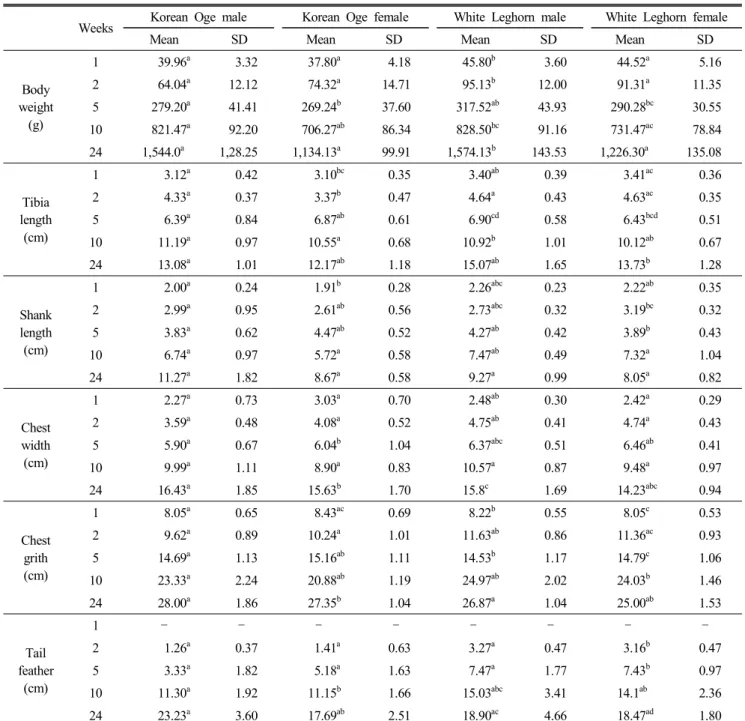
Table 1. Comparative growth performances of Korean Oge and White Leghorn chickens from 1 week to 24 weeks of age
Weeks Korean Oge male Korean Oge female White Leghorn male White Leghorn female
Mean SD Mean SD Mean SD Mean SD
Body weight (g)
1 39.96a 3.32 37.80a 4.18 45.80b 3.60 44.52a 5.16
2 64.04a 12.12 74.32a 14.71 95.13b 12.00 91.31a 11.35
5 279.20a 41.41 269.24b 37.60 317.52ab 43.93 290.28bc 30.55
10 821.47a 92.20 706.27ab 86.34 828.50bc 91.16 731.47ac 78.84
24 1,544.0a 1,28.25 1,134.13a 99.91 1,574.13b 143.53 1,226.30a 135.08
Tibia length (cm)
1 3.12a 0.42 3.10bc 0.35 3.40ab 0.39 3.41ac 0.36
2 4.33a 0.37 3.37b 0.47 4.64a 0.43 4.63ac 0.35
5 6.39a 0.84 6.87ab 0.61 6.90cd 0.58 6.43bcd 0.51
10 11.19a 0.97 10.55a 0.68 10.92b 1.01 10.12ab 0.67
24 13.08a 1.01 12.17ab 1.18 15.07ab 1.65 13.73b 1.28
Shank length
(cm)
1 2.00a 0.24 1.91b 0.28 2.26abc 0.23 2.22ab 0.35
2 2.99a 0.95 2.61ab 0.56 2.73abc 0.32 3.19bc 0.32
5 3.83a 0.62 4.47ab 0.52 4.27ab 0.42 3.89b 0.43
10 6.74a 0.97 5.72a 0.58 7.47ab 0.49 7.32a 1.04
24 11.27a 1.82 8.67a 0.58 9.27a 0.99 8.05a 0.82
Chest width (cm)
1 2.27a 0.73 3.03a 0.70 2.48ab 0.30 2.42a 0.29
2 3.59a 0.48 4.08a 0.52 4.75ab 0.41 4.74a 0.43
5 5.90a 0.67 6.04b 1.04 6.37abc 0.51 6.46ab 0.41
10 9.99a 1.11 8.90a 0.83 10.57a 0.87 9.48a 0.97
24 16.43a 1.85 15.63b 1.70 15.8c 1.69 14.23abc 0.94
Chest grith (cm)
1 8.05a 0.65 8.43ac 0.69 8.22b 0.55 8.05c 0.53
2 9.62a 0.89 10.24a 1.01 11.63ab 0.86 11.36ac 0.93
5 14.69a 1.13 15.16ab 1.11 14.53b 1.17 14.79c 1.06
10 23.33a 2.24 20.88ab 1.19 24.97ab 2.02 24.03b 1.46
24 28.00a 1.86 27.35b 1.04 26.87a 1.04 25.00ab 1.53
Tail feather
(cm)
1
2 1.26a 0.37 1.41a 0.63 3.27a 0.47 3.16b 0.47
5 3.33a 1.82 5.18a 1.63 7.47a 1.77 7.43b 0.97
10 11.30a 1.92 11.15b 1.66 15.03abc 3.41 14.1ab 2.36
24 23.23a 3.60 17.69ab 2.51 18.90ac 4.66 18.47ad 1.80
SD, standard deviation.
a~dThere is a significantly difference between the different superscripts (P<0.05).
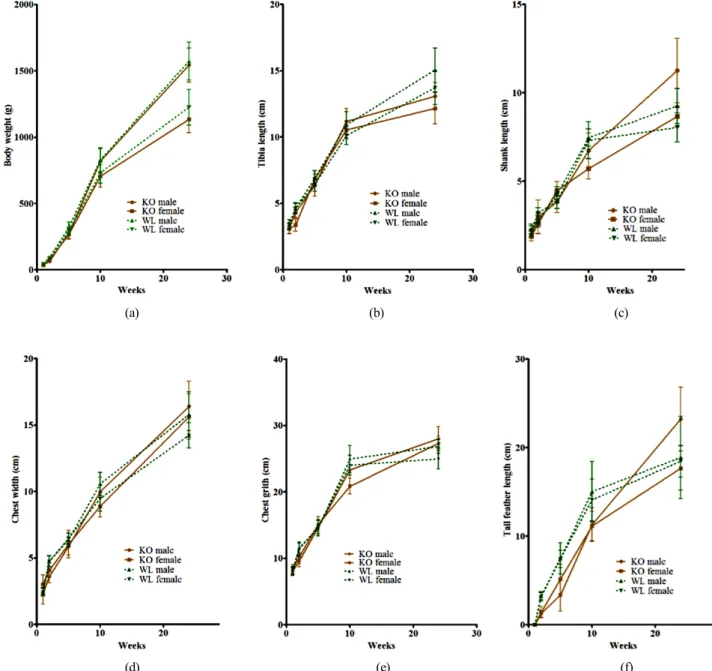
kens. At 10 weeks, the average body weights of WL males and females were 7.03 g and 25.2 g higher, respectively than those of KO male and female chickens. At 24 weeks, the average body weights of WL males and females were 30.13 g and 92.17 g higher, respectively than those of KO male and female chickens (Table 1 and Fig. 1a).
2. Comparison of Tibia Length between KO and WL Chickens
The lengths of tibia in male and female chickens of KO and WL were observed from 1 week to 24 weeks of ages.
At 1 week and 2 weeks, the tibia length was higher in male than that of female chickens in both KO and WL. At 1 week, the lengths of tibia were measured 0.28 cm and 0.31 cm higher in WL male and female, respectively than those of KO male and female chickens. At 2 weeks, the length of tibia
(a) (b) (c)
(d) (e) (f)
Fig. 1. Comparative growth pattern on (a) body weight, (b) tibia length, (c) shank length, (d) chest width, (e) chest grith, (f) tail feather length of KO and WL chickens at 1 week, 2 weeks, 5 weeks, 10 weeks, and 24 weeks. Bar, standard deviation (SD).
showed 0.31 cm and 1.26 cm higher in WL males and female, respectively compare to KO male and female. At 5 weeks and 10 weeks, the growth of tibia showed different patterns in male and female chickens of KO and WL. The lengths of male tibia were longer in WL chickens at these ages but the length of female tibia was longer than that of male chickens in KO at 5 weeks. At 24 weeks, the growth of tibia was higher in both male and female chickens of WL than those of KO chickens. In addition, the average growth pattern of tibia was
observed higher in KO and WL males when compared to their female partners at all age groups (Table 1 and Fig. 1b).
3. Comparison of Shank Length between KO and WL Chickens
The lengths of shank in male and female chickens of KO and WL were observed from 1 week to 24 weeks of ages.
The shank growth showed interestingly different patterns at all age groups of KO and WL chickens. At 1 week, the lengths of shank were 0.26 cm and 0.31 cm longer in male and female chickens of WL, respectively than those in KO male and female chickens. At 2 weeks, the length of shank was longer in KO males than that of WL males but WL females were longer than KO females. Reversely, at 5 weeks, the length of shank was longer in WL males than that of KO males and KO females were longer than WL females. At 10 weeks, the lengths of shank were 0.73 cm and 1.6 cm longer in male and female WL chickens, respectively compared to those in KO male and female. The lengths of shank showed longer in KO chickens compared to WL chickens in both male and female at 24 weeks. The lengths of shank were observed 2.0 cm and 0.62 cm longer in male and female KO chickens when compared to WL chickens but the difference in shank length was not statistically significant (Table 1 and Fig. 1c).
4. Comparison of Chest Width in KO and WL Chickens
The width of chest in male and female chickens of KO and WL were observed from 1 week to 24 weeks of ages.
At 1 week, the width of chest was 0.21 cm higher in WL males compared to KO males and 0.61 cm higher in KO females compared to WL females. From 2 weeks to 10 weeks, the widths of chest were continuously observed higher in male and female chickens of WL breed compared with their counterparts in KO breed. However, there was not much significantly different at 10 weeks. In contrast, the chest width of KO chickens was observed remarkably higher in males and females when compared with their counterparts in WL breed at 24 weeks of age (Table 1 and Fig. 1d). Compared between male and female in KO breed, the width was shown higher in females from 1 week to 5 weeks, thereafter the width was shown higher in males. At the other hand, the
width of male WL chickens was shown higher at 1 week, 2 weeks, 10 weeks, and 24 weeks.
5. Comparison of Chest Grith in KO and WL Chickens
The grith of chest in male and female chickens of KO and WL were observed from 1 week to 24 weeks of ages. At 1 week, the grith of chest was 0.17 cm higher in WL males compared to KO males and 0.38 cm higher in KO females compared to WL females. Thereafter, the growth performance of chest grith was different between KO and WL chickens.
Particularly, the growth of chest grith was shown higher in male and female WL chickens at 2 weeks and 10 weeks compared to male and female KO chickens. In contrast, the growth of chest grith was shown higher in male and female KO chickens at 5 weeks and 24 weeks compared to male and female WL chickens (Table 1 and Fig. 1e). In addition, the length of chest grith grew more rapidly in KO females than KO males at 1 week to 5 weeks. From 10 weeks, the length of chest grith was longer in KO males than that of KO females.
6. Comparison of Tail Feather Length in KO and WL Chickens
The tail feather was not obviously grown enough for the measurement at first week of age in KO and WL chicks.
Thus, we measured the tail feather length in male and female chickens of KO and WL from 2 weeks to 24 weeks of ages.
The tail feathers continuously grew in KO and WL chickens from 2 weeks to 24 weeks. However, the tail feather length was shown longer in male and female WL chickens at 2 weeks, 5 weeks, and 10 weeks when compared with the male and female KO chickens of the same age. At 24 weeks, the length of tail feather was 4.33 cm longer in KO males com- pared to WL males and 0.78 cm longer in WL females compared to KO females (Table 1 and Fig. 1f). Furthermore, the tail feather length was observed longer in KO females than KO males at 2 weeks and 5 weeks. From 10 weeks, the tail feather length was observed longer in KO males than KO females. In WL chickens, the tail feather length was conti- nuously longer in males than females at 2 weeks to 24 weeks.
DISCUSSION
Korean Oge (KO) is one of the important indigenous avian species in Korea. KO was announced as a protected avian species under the Korean government (Protected Species Act No. 265) (Nahm, 1997). The general characteristics, morpho- logy, anatomy and breeding behaviors of KO chickens were briefly reported early. The native KO chickens are commonly known as black chickens because of its external appearances including blackish color of the beak, eyes, face, earlobes, wattle, tongue, shank, toes, feathers, skin and bones (Nahm, 1997).
The egg color is brown, and the average egg production rate is about 100 eggs annually (Ohh, 1989; Nahm, 1997). KO chickens shares some of the characteristic features with the native chickens from neighboring countries of Korea (Lee et al., 2007). KO chickens are nervous and easily frightened by mankind disturbances. During the brooding period, KO chic- kens are very sensitive to inappropriate environmental con- ditions, inadequate ventilation and poor protection from di- seases, but their ability to adjust to environmental changes increases with age (Ohh, 1989). There were few studies on the growth performances of KO chickens in 1980s, parti- cularly they concentrated on the body weight, meat and egg production (Han et al., 1988). However, studies on the cha- racteristic and morphological features of KO chickens after 1980s remain to be investigated. Therefore, in this study, we concentrated on several growth performances such as body weight, tibia length, shank length, chest width, chest grith, and tail feather length of male and female KO chickens aged from 1 week to 24 weeks. We compared all these growth performances with the male and female chickens of WL chickens at the same age groups. We found many differences between our results and earlier publications on body weight and other growth performances and this discrepancy was caused from environmental changes and differences in the experi- mental trails.
Comparative analysis on the growth performances between KO and WL chickens performed in this investigation shows many significant differences on body weight, tibia and shank lengths, chest width and girth, and tail feather length. All analyzed parameters were continuously increased in KO and WL chickens according to their ages and growth, however
they also showed different patterns; KO males vs. WL males, KO females vs. WL females, KO males vs. KO females, and WL males vs. WL females. Many quantitative trait loci (QTL), growth hormones or factors were closely associated with various growth performances in chickens. In the body weight, significant difference was shown in WL males at 1 week, 2 weeks, and 24 weeks, and in both WL males and females at 5 weeks to 10 weeks compared with correspon- ding KO chickens. QTL on chromosome 2 and 4 are very strong candidate for body growth (Rowe et al., 2006; Ankra- Badu et al., 2010). However, in a recent study, Insulin-like growth factor 1 is an essential growth factor required for rapid postnatal growth. Insulin-like growth factor 1 associated genes such as SPOT14 homolog also plays an important role on body weight (Cao et al., 2007; Marquez et al., 2010).
Chickens feed with carbohydrate or insulin injections greatly increase SPOT14 mRNA expression. Additionally, POU do- main, class 1, transcription factor 1 (PIT1, growth hormone factor 1) gene polymorphisms was found related to chicken body growth (Nie et al., 2008). Thus, molecular and endo- crine focus is needed to predict which factor is inducing the significant growth in WL chickens.
Examination of growth performances on tibia length and shank length helps for the selection of breeds and studies on bone development in chickens (Gao et al., 2011). The overall length of tibia was measured longer in WL females at 1 week, WL males at 2 weeks, 5 weeks and 24 weeks, and KO males at 10 weeks. Similarly, the overall length of shank was measured longer in WL males at 1 week and 10 weeks, WL females at 2 weeks, KO females at 5 weeks, and KO males at 24 weeks. Different QTL which located on chicken chro- mosomes 1, 4 and 24 were responsible for shank growth at different ages (Tsudzuki et al., 2007; Gao et al., 2010).
Particularly, In total, 14 single nucleotide polymorphism (SNP) were found on chromosome 1 for 12 on bone traits, and the retinoblastoma 1 (RB1) gene has strong relation with bone traits (Zhang et al., 2011). Examination of growth perfor- mances on chest width and chest grith helps for the under- standing and selection of breeds for the meat production and weight. The overall look on chest width and grith suggest si- milar growth pattern rendered in KO and WL at the observed ages. The QTL for breast muscle were identified in chicken
chromosome 1 (Park et al., 2006). At last, we examined the comparative length of tail feather in KO and WL chickens.
The length of tail feather was significantly longer in WL chickens up to 10 weeks, but the feather length became longer in KO male chickens at 24 weeks. The feather development is one of the secondary sexual characteristics influenced by steroid hormones and thyroxin hormone (Harenberg, 2003).
Nutrient supply further add as necessary factor for feather growth (Zhang et al., 2002).
In conclusion, we compared various growth performances between the native KO chickens and widely known WL chickens. The overall findings of our study suggest that 1) body weight was higher in WL chickens, 2) tibia length was longer in WL chickens, 3) chest width and grith were longer in KO chickens and 4) tail feather was longer in KO chic- kens. Our study will largely help for the selection of breeds at different age groups in accordance with growth and meat production.
ACKNOWLEDGEMENTS
This research was supported by a grant from World Class University program (WCU, R31-10056) through the National Research Foundation of Korea funded by the Ministry of Education, Science and Technology, and also supported by a grant from Regional Subgenebank Support Program of Rural Development Administration, Republic of Korea.
LITERRATURE CITED
Ankra-Badu GA, Le Bihan-Duval E, Mignon-Grasteau S, Pitel F, Beaumont C, Duclos MJ, Simon J, Carre W, Por- ter TE, Vignal A, Cogburn LA, Aggrey SE 2010 Mapping QTL for growth and shank traits in chickens divergently selected for high or low body weight. Anim Genet 41:
400-405.
Asmundson VS, Lerner IM 1934 Interitance of rate of growth of the domestic fowl. III. Comparative rates of growth of Leghorns and Rocks. Poultry Sci 13:348-352.
Burke WH, Sharp PJ 1989 Sex differences in body weight of chicken embryos. Poultry Sci 68:805-810.
Cao ZP, Wang SZ, Wang QG, Wang YX, Li H 2007 Asso-
ciation of Spot14alpha gene polymorphisms with body weight in the chicken. Poultry Sci 86:1873-1880.
Gao Y, Du ZQ, Feng CG, Deng XM, Li N, Da Y, Hu XX 2010 Identification of quantitative trait loci for shank length and growth at different development stages in chicken.
Anim Genet 41:101-104.
Gao Y, Feng CG, Song C, Du ZQ, Deng XM, Li N, Hu XX 2011 Mapping quantitative trait loci affecting chicken body size traits via genome scanning. Anim Genet 42:670- 674.
Gross WB, Siegel PB 1980 Effects of early environmental stresses on chicken body weight, antibody response to RBC antigens, feed efficiency, and response to fasting. Avian Dis 24:569-579.
Han SW, Ohh BK, Kim SH 1988 Studies on the hereditary characteristics and some economic traits of Korean native Ogol fowl. IV. Body growth and meat productivity. Ko- rean Journal of Poultry Sci 15:1-19.
Harenberg J 2003 Treatment of thrombosis with low-mole- cular-weight heparin. Comparison of body weight-adjusted and fixed dosage. Med Klin 98:493-498.
Jaap RG, Morris L 1937 Genetic differences in eigth week weight and feathering. Poultry Sci 16:44-48.
Jull MA, Phillips RE, Williams CS 1943 Meat contributed by breast, humeri, and legs of fryers in relation to shank length. United States Egg Poultry Magagene 49:364-365.
Lee SJ, Hwang KC, Choi KD, Lee HK, Shin YS, Han JY 1995 Genetic analysis of Korean native Ogol chickens through DNA fingerprinting. Kor J Anim Sci 37:207-215.
Lee YJ, Bhuiyan MSA, Chung HJ, Jung WY, Choi KD, Jang BG, Paek WK, Jeon JT, Park CS, Lee JH 2007 Mito- chondrial DNA diversity of Korean Ogol chicken. Asian- Aust J Anim Sci 20:477-481.
Marquez GC, Siegel PB, Lewis RM 2010 Genetic diversity and population structure in lines of chickens divergently selected for high and low 8-week body weight. Poultry Sci 89:2580-2588.
Martin JH 1929 Rate of feather growth in Barred Plymount Rock chicks. Poultry Sci 8:167-183.
Nahm KH 1997 Korean native Ogol fowl. World Poult Sci J 53:71-77.
Nie Q, Fag M, Xie L, Zhou M, Liang Z, Luo Z, Wang G, Bi W, Liang C, Zhang W, Zhang X 2008 The PIT1 gene
polymorphisms were associated with chicken growth traits.
BMC Genet 9:20.
Ohh BK 1989 The History of the Poultry Production in Ko- rea. Sun-Jin Publishing Co.:42-52.
Park HB, Jacobsson L, Wahlberg P, Siegel PB, Andersson L 2006 QTL analysis of body composition and metabolic traits in an intercross between chicken lines divergently selected for growth. Physiol Genomics 25:216-223.
Podisi BK Knott SA, Dunn IC, Law AS, Burt DW, Ho- king PM 2011 Overlap of quantitative trait loci for early growth rate, and for body weight and age at onset of sexual maturity in chickens. Reproduction 141:381-389.
Rowe SJ, Windsor D, Haley CS, Burt DW, Hocking PM, Griffin H, Vincent J, De Koning DJ 2006 QTL analysis of body weight and conformation score in commercial broiler chickens using variance component and half-sib analyses.
Anim Genet 37:269-272.
Tadano RN, Goto N, Tsudzuki M 2011 Genetic differentia-
tion among White Leghorn lines: Application of individual- based clustering approaches. Poultry Sci 90:725-730.
Tsudzuki M, Onitsuka S, Akiyama R, Iwamizu M, Goto N, Nishibori M, Takahashi H, Ishikawa A 2007 Identification of quantitative trait loci affecting shank length, body weight and carcass weight from the Japanese cockfighting chic- ken breed, Oh-Shamo (Japanese Large Game). Cytogenet Genome Res 117:288-295.
Zhang H, Liu SH, Zhang Q, Zhang YD, Wang SZ, Wang QG, Wang YX, Tang ZQ, Li H 2011 Fine-mapping of quan- titative trait loci for body weight and bone traits and po- sitional cloning of the RB1 gene in chicken. J Anim Breed Genet 128:366-375.
Zhang Y, Clark CB, Davies LR, Karlsson G, Zimmerman MB, Kerber RE 2002 Body weight is a predictor of biphasic shock success for low energy transthoracic defibrillation.
Resuscitation 54:281-287.
(received: 2012. 3. 7, revised: 2012. 6. 1, accepted: 2012. 6. 7)