• 검색 결과가 없습니다.

Taxonomic Review of the Umbelliferous genus Sium L. in Korea: Inferences based on Molecular Data

N/A
N/A
Protected

Academic year: 2021

Share "Taxonomic Review of the Umbelliferous genus Sium L. in Korea: Inferences based on Molecular Data"

Copied!
6
0
0

로드 중.... (전체 텍스트 보기)

전체 글

(1)

Taxonomic Review of the Umbelliferous genus Sium L. in Korea:

Inferences based on Molecular Data

Byoung-Yoon Lee, Jeongran Lee

1

and Sung-Chul Ko

2

*

Division of Vascular Plants, National Institute of Biological Resources, Incheon 404-170, Korea

1.

National Academy of Agricultural Science, Suwon 441-100, Korea

2

Department of Biological Sciences, Hannam University, Daejeon 305-811, Korea (Received 7 September 2010 : Accepted 25 November 2010)

분자생물학적 자료에 의한 한국산 개발나물속의 분류학적 고찰

이병윤·이정란1·고성철2*
국립생물자원관 고등식물연구과,

1

국립농업과학원 농업유전자원센터,

2

한남대학교 생명과학과

ABSTRACT: The taxonomy of umbel genus Sium L., Apiaceae in Korea was reviewed on the basis of molecular phylogenies derived from sequences of nuclear ribosomal DNA internal transcribed spacer (ITS) regions. The ITS sequence-derived phylogeny indicates that S. heterophyllum, endemic to Korea, is identical to S. tenue, which is known as endemic to Ussuri regions. Comparisons of sequence pairs across both spacer regions gave divergence values and revealed the identity between S. tenue and S. heterophyllum on Mt. Moonsoo. On the other hand, the ITS sequences support species delimitation of S. ternifolium, as reported recently as a new species that differs from other Sium species. The ITS sequence divergence values of 1.4 and 1.6% support species delimitation between S. serra and S. ternifolium.

Keywords: Apiaceae, Umbelliferae, Sium ternifolium, Sium heterophyllum

적 요: 핵 리보좀 DNA ITS 구간의 염기서열 정보를 이용하여 한국산 산형과 개발나물속의 분자 계통학적

연구를 수행하였다. ITS 계통수는 한반도 고유종인 대암개발나물(S. heterophyllum)이 한반도에 생육이 보고된 바 없는 러시아 우수리지역의 고유종인 S. tenue와 동일한 종임을 밝혔다. ITS 1과 ITS 2 구간의 염기서열 비교 시 S. tenue와 인천 문수산에 생육하고 있는 대암개발나물이 100% 일치함을 확인할 수 있었다. 또한 ITS 구간의 염기서열은 최근 신종으로 발표된 세잎개발나물(S. ternifolium)이 개발나물속의 다른 분류군과 뚜렷하게 구 별됨을 지지하고 있었다. 세잎개발나물은 유연관계가 가장 가까운 일본 고유종 S. serra의 ITS 염기서열 비교시

1.4 와 1.6%의 차이점을 가지고 있음이 확인되어 종으로서의 처리가 적합함을 확인할 수 있었다.

주요어: 산형과, 세잎개발나물, 대암개발나물

The genus Sium L. belonging to the tribe Oenanthe Dumort.

of the family Apiaceae comprises about 14 species that often live in moist to wet areas (Hardway et al., 2004; Pimenov and Leonov, 1993). Most species of the genus Sium are Eurasian, and eastern Asia is the major center of endemism of five species including S. ninsi, S. tenue, S. serra, and S. suave (Spalik and Downie, 2006). Among sepceis belonging to the genus Sium, four species have been reported in Korea; S. suave Walter, S. ninsi L.,

S. heterophyllum Y. Lee, and S. ternifolium B.Y.Lee & S.C.Ko.

(Lee, 1980; Lee, 1993; Lee, 2007; Lee and Ko, 2009).

S. suave is distinguished from S. ninsi by the presence of stout rays, seven to eleven leaflets, and broader leaflets (Ohwi, 1965).

In addition to these two indigenous species, a couple of Sium species endemic to Korea were reported. Sium heterophyllum found first in Mt. Daeamsan and Daekwanryoung pass Gangwon-do is allied to S. ninsi, but was characterized from the latter by the presence of heterophyllous leaves and by the absence of bulbils on the

*Author for correspondence: [email protected]

(2)

axils (Lee, 1993). Another endemic species, S. ternifolium was characterized by the presence of only tri-foliated leaflets and the absence of involucral bracts (Lee and Ko, 2009). Although S. heterophyllum and S. ternifolium were erected as new species, their taxonomic states and ranks within the genus have not been investigated in detail until the recent evolutionary study of Sium sensu lato was conducted by Spalik and Downie (2006). The molecular study of Sium sensu lato concluded that S. heterophyllum was a cultivated form of S. sisarum by the common features of tuberous roots (Spalik and Downie, 2006). However, it is not reasonable to make a taxonomic treatment of the Korean endemic species by the experimental results without Korean materials included in the analysis. Taxonomic problems of S.

ninsi have occurred all the time by recognizing the species as S. sisarum by several authors (Hiroe and Constance, 1958; Ohwi, 1965; Lee, 1980; Lee, 1993; Ohba, 1999; Lee, 2006). Furthermore, Lee (2006) treated S. ninsi and S. heterophyllum as synonyms of S. sisarum. The taxonomic problems of Korean species of Sium are uncertain with two endemic species of dubious affinity, and their states and phylogenetic relationships are not well recognized. Here, all the possible accessions of Korean taxa of Sium and its putative relatives have been investigated in

order to ascertain the taxonomic status and position of two Korean endemic species.

Material and Methods

Nuclear ribosomal DNA internal transcribed spacer (ITS) sequences of Sium taxa were obtained in earlier phylogenetic analyses of the Sium sensu lato (Saplik and Downe, 2006).

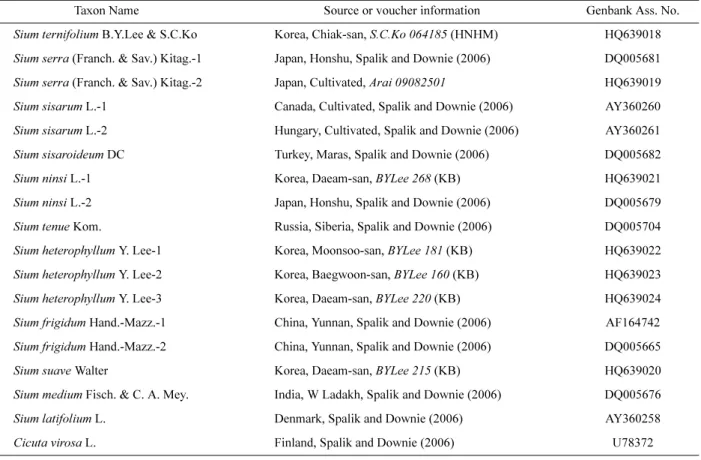
Several additional taxa (e.g., S. heterophyllum, S. ninsi, S. serra, and S. ternifolium) have been incorporated into the previous data matrix (Table 1). A total of 18 accessions were used for molecular phylogenetic analyses including Cicuta virosa as an outgroup. Total genomic DNA was extracted from fresh leaves and herbarium preserved tissue using the modified CTAB procedure of Doyle and Doyle (1987). Double stranded DNAs of the complete ITS regions in each genomic DNA were PCR(polymerae chain reaction)-amplified using primers “ITS 5” and “ITS 4” (White et al., 1990). Details of the amplification reactions, purification, and alignment were the same as described in Lee (1998). Pairwise nucleotide differences of unambiguously aligned positions were determined from the distance matrix option in Phylogenetic Analysis Using Parsimony (PAUP*, Swofford, 2000). Phylogenetic

Table 1. 18 accessions of the genus Sium and an outgroup examined for nuclear ribosomal DNA internal transcribed spacer sequences (ITS) variation. Accession numbers of newly investigated sequences start with the letter H. Herbarium Acronyms: HNHM = Hannam Natural History Museum, Daejeon; KB = National Institute of Biological Resources, Incheon.

Taxon Name Source or voucher information Genbank Ass. No.

Sium ternifolium B.Y.Lee & S.C.Ko Korea, Chiak-san, S.C.Ko 064185 (HNHM) HQ639018 Sium serra (Franch. & Sav.) Kitag.-1 Japan, Honshu, Spalik and Downie (2006) DQ005681 Sium serra (Franch. & Sav.) Kitag.-2 Japan, Cultivated, Arai 09082501 HQ639019

Sium sisarum L.-1 Canada, Cultivated, Spalik and Downie (2006) AY360260

Sium sisarum L.-2 Hungary, Cultivated, Spalik and Downie (2006) AY360261

Sium sisaroideum DC Turkey, Maras, Spalik and Downie (2006) DQ005682

Sium ninsi L.-1 Korea, Daeam-san, BYLee 268 (KB) HQ639021

Sium ninsi L.-2 Japan, Honshu, Spalik and Downie (2006) DQ005679

Sium tenue Kom. Russia, Siberia, Spalik and Downie (2006) DQ005704

Sium heterophyllum Y. Lee-1 Korea, Moonsoo-san, BYLee 181 (KB) HQ639022

Sium heterophyllum Y. Lee-2 Korea, Baegwoon-san, BYLee 160 (KB) HQ639023

Sium heterophyllum Y. Lee-3 Korea, Daeam-san, BYLee 220 (KB) HQ639024

Sium frigidum Hand.-Mazz.-1 China, Yunnan, Spalik and Downie (2006) AF164742 Sium frigidum Hand.-Mazz.-2 China, Yunnan, Spalik and Downie (2006) DQ005665

Sium suave Walter Korea, Daeam-san, BYLee 215 (KB) HQ639020

Sium medium Fisch. & C. A. Mey. India, W Ladakh, Spalik and Downie (2006) DQ005676

Sium latifolium L. Denmark, Spalik and Downie (2006) AY360258

Cicuta virosa L. Finland, Spalik and Downie (2006) U78372

(3)

analyses of the ITS sequences data sets were carried out using the heuristic search strategies of PAUP*. All searches were conducted with 100 random-addition replicates using tree bisection- reconnection (TBR) branch swapping. In order to identify weakly supported nodes, decay analyses (Bremer, 1988) were conducted until tree storage memory was exhausted. A bootstrap analysis was done using 100 resampled data sets. All trees were rooted with Cicuta virosa, the most closely related genus to the Sium sensu lato.

Results

1) ITS sequence analysis

Alignment of all 18 complete ITS 1 and ITS 2 sequences, representing all possible accessions of the genus Sium and the outgroup resulted in a matrix of 443 characters. On average, the ITS 1 region was shorter than ITS 2. The length of ITS 1 region in the taxa surveyed ranged from 209 bp in S. suave, S. medium, and S. latifolium to 212 bp in all taxa belonging to S. ninsi, S. tenue, and S. heterophyllum (mean 211 bp). The length of ITS 2 region of the taxa surveyed ranged from 226 bp in S. suave, S. ninsi, S. tenue, S. heterophyllum, S. medium, and S. latifolium to 229 bp in S. sisarum and S. sisaroides (mean 227 bp). Overall length variation of both spacer regions across

all 18 accessions ranged from 435 bp to 439 bp. These sizes are comparable to those values reported for other Apiaceae(Downie et al., 1998; Lee and Downie, 1999). Of the 443 initial alignment positions, four positions were deleted due to alignment ambiguities.

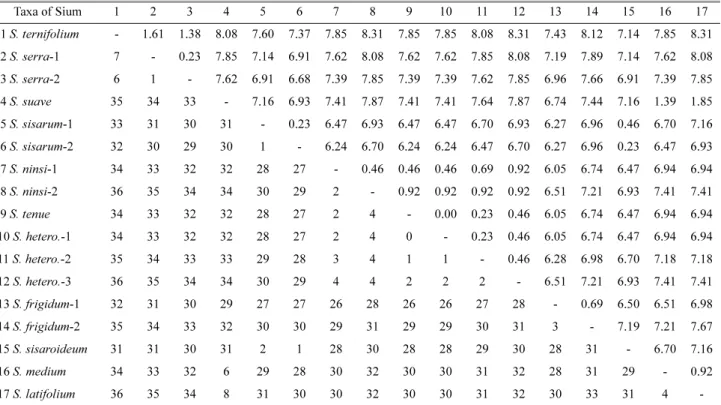
Of the remaining 439 unambiguously aligned positions, 71 (16.2%) were potentially parsimony informative, 336 (76.5%) were constant, and 32 (7.3%) were autapomorphic. Both spacers contributed comparable numbers of informative nucleotide substitutions to the phylogenetic analysis. Values of direct pairwise ITS sequence divergence of the examined 17 accessions of the genus Sium (using PAUP’s DISTANCE MATRIX option) are presented in Table 2. The sequence divergence values ranged from identity (between S. tenue and S. heterophyllum at mt. Moonsoo) to 8.3% (between S. ternifolium and S. ninsi, S. heterophyllum).

The pairwise nucleotide divergence among Sium species and the outgroup varied from 8.8% with S. medium to 10.2% with S. ninsi or S. heterophyllum.

2) Phylogenetic analyses and resolution

The results of the analyses of combined data sets are presented;

separate analyses of each spacer region alone was not done.

The parsimony analysis of 18 combined ITS sequences using equally weighted character states resulted in two maximally parsimonious trees, and the consensus of these two trees with

Table 2. Pairwise sequence divergence of ITS 1 and ITS regions among representatives of Sium. Mean distances (100 × values) are calculated above the diagonal, and actual numbers of unambiguous divergence sites from pairwise sequence comparisons appear below the diagonal. S. hetero. = S. heterophyllum.

Taxa of Sium 1 2 3 4 5 6 7 8 9 10 11 12 13 14 15 16 17

1 S. ternifolium - 1.61 1.38 8.08 7.60 7.37 7.85 8.31 7.85 7.85 8.08 8.31 7.43 8.12 7.14 7.85 8.31 2 S. serra-1 7 - 0.23 7.85 7.14 6.91 7.62 8.08 7.62 7.62 7.85 8.08 7.19 7.89 7.14 7.62 8.08 3 S. serra-2 6 1 - 7.62 6.91 6.68 7.39 7.85 7.39 7.39 7.62 7.85 6.96 7.66 6.91 7.39 7.85 4 S. suave 35 34 33 - 7.16 6.93 7.41 7.87 7.41 7.41 7.64 7.87 6.74 7.44 7.16 1.39 1.85 5 S. sisarum-1 33 31 30 31 - 0.23 6.47 6.93 6.47 6.47 6.70 6.93 6.27 6.96 0.46 6.70 7.16 6 S. sisarum-2 32 30 29 30 1 - 6.24 6.70 6.24 6.24 6.47 6.70 6.27 6.96 0.23 6.47 6.93 7 S. ninsi-1 34 33 32 32 28 27 - 0.46 0.46 0.46 0.69 0.92 6.05 6.74 6.47 6.94 6.94

8 S. ninsi-2 36 35 34 34 30 29 2 - 0.92 0.92 0.92 0.92 6.51 7.21 6.93 7.41 7.41

9 S. tenue 34 33 32 32 28 27 2 4 - 0.00 0.23 0.46 6.05 6.74 6.47 6.94 6.94

10 S. hetero.-1 34 33 32 32 28 27 2 4 0 - 0.23 0.46 6.05 6.74 6.47 6.94 6.94

11 S. hetero.-2 35 34 33 33 29 28 3 4 1 1 - 0.46 6.28 6.98 6.70 7.18 7.18

12 S. hetero.-3 36 35 34 34 30 29 4 4 2 2 2 - 6.51 7.21 6.93 7.41 7.41

13 S. frigidum-1 32 31 30 29 27 27 26 28 26 26 27 28 - 0.69 6.50 6.51 6.98

14 S. frigidum-2 35 34 33 32 30 30 29 31 29 29 30 31 3 - 7.19 7.21 7.67

15 S. sisaroideum 31 31 30 31 2 1 28 30 28 28 29 30 28 31 - 6.70 7.16

16 S. medium 34 33 32 6 29 28 30 32 30 30 31 32 28 31 29 - 0.92

17 S. latifolium 36 35 34 8 31 30 30 32 30 30 31 32 30 33 31 4 -

(4)

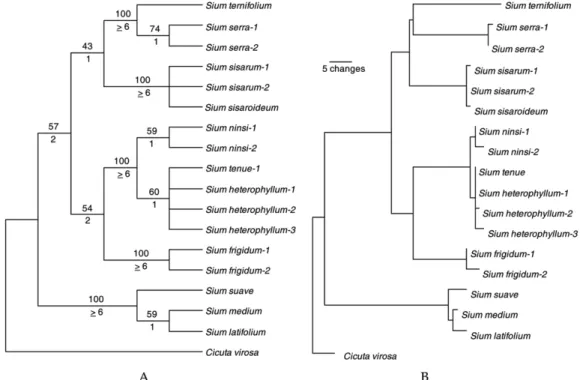
accompanying bootstrap and decay values, and is presented in Fig. 1. The parsimonious tree has a length of 123 steps, consistence index (CI) of 0.935 and 0.912, with and without uninformative characters, respectively, and a retention index (RI) of 0.957. In each of these trees, five major groups of taxa can be discernable;

each one with a bootstrap value of 100 and a decay value of more than 6. The first group includes S. ternifolium endemic to Korea and S. serra endemic to Japan. The second group includes S. sisarum and S. sisaroideum, and the third one comprises S. ninsi, S. tenue, and S. heterophyllum. The fourth one is a monotypic clade comprising only accessions of S. frigidum. The last one including S. suave, S. medium, and S. latifolium is sister to all other taxa of Sium examined in this study.

Discussion

The major objective in carrying out this study was to ascertain the taxonomic states and positions of S. heterophyllum and S.

ternifolium, endemic to Korea. S. heterophyllum was recognized by the presence of heterophyllous leaves, that is, heart-shaped leaves at the lower stem and narrowly divided leaf segments at the upper stem (Lee, 1993). On the basis of the ITS-derived phylogeny, S. heterophyllum was closely related to S. tenue. However, the

phylogeny did not support monophyly of S. heterophyllum, revealing no synapomorphic characters. Comparisons of sequence pairs across both spacer regions gave divergence values and revealed identity between S. tenue and S. heterophyllum at Mt.

Moonsoo. Although some variation of sequence divergence between S. ninsi and the other two accessions of S. heterophyllum were shown from 0.23 to 0.46%, the sequence differences between these two species are quite below those of other taxa belonging to Apiaceae. Among different species of the same genus of Apiaceae, pairwise nucleotide divergence varied in 0.3-0.5% of Lisaea, 0.8-1.0% of Agrocharis, 2.3~5.9% of Orlaya, and 0.8~6.9%

of Torilis (Lee and Downie, 1999; Lee, 2002). Therefore, S.

heterophyllum described as a new species by Lee (1993) might be identical to S. tenue that was described as an endemic of Ussuri regions (Schischikin, 1950). The taxonomic opinion that S. heterophyllum was a cultivated form of S. sisarum by the common features of tuberous roots (Spalik and Downie, 2006) might be reconsidered. S. tenue was very closely related to S. ninsi based on ITS ribosomal DNA phylogenies (Spalik and Downie, 2006). While basal leaves of S. tenue are often entire, those of S. ninsi are pinnately dissected. Both species have ternate leaves at the upper stem that are shared with S. serra and S. ternifolium.

Both S. ninsi and S. tenue, however, are almost identical

Fig. 1. Cladograms inferred from the analysis of 18 nuclear ribosomal DNA ITS1 and ITS2 sequences from the genus Sium and an outgroup.

Numbers above nodes indicate the number of times a monophyletic group occurred in 100 bootstrap replicates; decay values are presented below. A. The

strict consensus of two minimal length 123-step trees derived from equally weighted maximum parsimony analysis of combined nuclear rDNA ITS1

and ITS2 sequences (CI's with and without uninformative characters = 0.935 and 0.912, respectively; RI = 0.957); B. one of two minimal length 123-

step trees derived from equally weighted maximum parsimony analysis of combined nuclear rDNA ITS1 and ITS2 sequences from 18

accessions of Sium and an outgroup.

(5)

morphologically with the exception of basal leaf forms and also the low sequence divergence between these two species support their close relationships, ranging from 0.46 to 0.92%.

S. tenue is a probably infraspecific taxon of S. ninsi based on low sequence divergence between these two. S. ninsi has been treated as a conspecific taxon with S. sisarum by several authors (Hiroe and Constance, 1958; Ohwi, 1965; Lee, 1980; Lee, 1993;

Ohba, 1999; Lee 2006), but is clearly distinguished from the latter by the absence of axile bulbils on the stem. In several Korean flora, morphological characters of S. ninsi were described mixed with those of S. sisarum following the Japanese treatments (Lee, 1980; Lee, 2003; Lee 2006). S. ternifolium recently reported as a new species is similar to S. serra sharing characters such as long- acuminated apex of leaflets, numbers of very slender rays, but identified by the presence of several features including trifoliated leaflets (rarely entire at the basal), and branchless stems (Lee and Ko, 2009). The phylogeny constructed with inclusion of two accessions of S. serra and a single acession of S. ternifolium revealed the strong monophyly of the clade with 100 of bootstrap values and more than 6 of decay values. The 1.4 and 1.6% of ITS sequence divergence values support the species delimitation between S. serra and S. ternifolium.

Key to the species of Korean Sium L.

1. Stems branched, number of rays 7−12, apex of leaflets acuminate

2. Roots not thickened, upper cauline leaves dissected pinnately, rays stout ··· 1. S. suave 2. Roots thickened, upper cauline leaves dissected ternately,

rays slender

3. Basal leaves entire ··· 2. S. tenue 3. Basal leaves pinnately dissected··· 3. S. ninsi 1. Stems branched rarely, number of rays 2−6, apex of leaflets long acuminate ··· 4. S. ternifolium

Acknowledgement

This research was supported by grants from Hannam University (Project No: HNU2010). The authors thank Stephen Downie and Krzysztof Spalik for their advice over the course of this project.

Literature cited

Bremer, K. 1998. The limits of amino acid sequence data in angiosperm phylogenetic reconstruction. Evolution 42: 795-803.

Downie, S. R., S. Ramanath, D. S. Katz-Downie and E. Llanas. 1998.

Molecular systematics of Apiaceae subfamily Apioideae: phyloge-

netic analysis of nuclear ribosomal DNA internal transcribed spacer and plastid rpoC1 intron sequences. Amer. J. Bot. 85:

563-591.

Doyle, J. J. and J. L. Doyle. 1987. A rapid DNA isolation procedure for small quantities of fresh leaf tissue. Phytochem. Bull. 19: 11-15.

Hardway, T. M., K. Spalik, M. W. Watson, D. S. Katz-Downie and S. R.

Downie. 2004. Circumscription of Apiaceae tribe Oenantheae.

South African J. Botany 70: 393-406.

Hiroe, M. and L. Constance. 1958. Umbelliferae of Japan. University of California Publications in Botany 30: 1-144.

Kitagawa, M. 1941. Miscellaneous notes on Apiaceae (Umbelliferae) of Japan and Manchuria (IV). J. Jap. Bot. 17: 557-562.

Lee, B. Y. 1998. A phylogenetic study of Apiaceae tribe Caucalideae.

Ph.D. thesis, University of Illinois at Urbana-Champaign.

Lee, B. Y. 2002. Taxonomic review on the African Umbelliferous genus Agrocharis: inferences based on molecular data. Israel Journal of Plant Sciences. 50: 211-216.

Lee, B. Y. 2007. Sium L. In The genera of vascular plants of Korea.

Park, C.-W. (ed.), Academy Publishing Co., Seoul. Pp. 753-754.

Lee, B. Y. and S. C. Ko. 2009. Sium ternifolium (Apiaceae), a new species from Korea. Korean J. Pl. Taxon. 39: 130-134.

Lee, B. Y. and S. R. Downie. 1999. A molecular phylogeny of Api- aceae tribe Caucalideae and related taxa: inferences based on ITS sequence data. Syst. Bot. 24: 461-479.

Lee, T. B. 1980. Illustrated flora of Korea. Hyangmoonsa, Seoul.

Pp. 584.

Lee, T. B. 2003. Colored Flora of Korea. Vol. 1. Hyangmoonsa, Seoul.

Pp. 837.

Lee, Y. 1993. New taxa on Korean Flora (5). Korean J. Pl. Taxon.

23: 263-268.

Lee, Y. N. 2006. New flora of Korea. Vol. I. Kyo-Hak publishing co. Seoul. Pp. 975.

Ohba, H. 1999. Umbelliferae. In Flora of Japan, vol. 2c. Iwatsuki, K.

et al. (eds.), Kodansha, Tokyo. Pp. 268-303.

Ohwi, J. 1965. Flora of Japan. Smithsonian Institution. Washington D. C. Pp. 676-677.

Pimenov, M. J. and M. V. Leonov. 1993. The genera of the Umbel- liferae. Royal Botanic Gardens, Kew. Pp. 105.

Schischikin, B. K. 1950. Sium L. In Flora SSSR. Schischikin, B. K.

(ed.), Izdatekstvo Akademii Nauk SSSR, Moscow. vol. 16:

466-468.

Spalik, K. and S. R. Downie. 2006. The evolutionary history of Sium sensu lato (Apiaceae): dispersal, vicariance, and domestication as inferred from ITS rDNA phylogeny. Amer. J. Bot. 93: 747-761.

Swofford, D. L. 2000. PAUP*. Phylogenetic analysis using parsimony.

Version 4, beta 4a. Sinauer Associates, Sunderland. M.A.

White, T. J., T. Bruns, S. Lee and J. Taylor. 1990. Amplification and

direct sequencing of fungal ribosomal RNA genes for phylo-

(6)

genetics. In PCR Protocols: a guide to methods and applications.

Innis, M. A., Gelfand, D. H., Sninsky, J. J. and T. J. White (ed.), Academic Press, San Diego, Pp. 315-322.

Appendix. Specimens examined in the study

1. S. suave Walter, Fl. Carol. 115, 1788.

Korean name: Gae-bal-na-mul

Specimens examined. Jeollanam-do: Gokseong-gun, Gonbang- san, 25 Aug. 2005, C.W. Park et al. 2005-352 (KB). Gyeongsangbug- do: Gyeongjoo-si, Nam-san, 11 Aug. 2007, H.J. Kim et al. 353 (KB).

Gangwon-do: Inje-gun, Daeam-san, 19 Sep. 2009, B.Y. Lee 215 (KB)

2. S. tenue Kom. in Bull. Jard. Bot. Petersberg. 16:174, 1916.

- S. heterophyllum Y. Lee. Korean J. Pl. Taxon. 23: 263-268. 1993.

Korean name: Dae-am-gae-bal-na-mul

Specimens examined. Gangwon-do: Teongwol-eup, Jang-neung wetland, 24 Sep. 2009, B.Y. Lee 240 (KB). Gyeonggi-do: Gimpo- si, Moonsoo-san, 24 Sep. 2009, B.Y. Lee 181 (KB); Suwon-si, Chilbo-san, 4 Sep. 2004, H.I. Lim & H. Choi 0454 (KB).

Gyeongsangbuk-do: Gimcheon-si, Gaje-san, 15 May 2004, G.Y.

Chung & G.H. Nam s.n. (KB); Sangju-si, 746.3 hill, 28 Sep. 2009, S.C. Ko & D.C. Son s.n. (HNHM); Sangju-si, Poseong-bong, 30 Aug. 2009, S.C. Ko & H.J. Kim s.n. (HNHM); Seongju-gun, Ja- san, 16 Oct. 2004, G.Y. Chung & G.H. Nam s.n. (KB); Goryeong- gun, Misoong-san, 21 Oct. 2006, S.H. Cho et al. 3127 (KB).

Gyeongsangnam-do: Milyang-si, Hwaak-san, 6 Sep. 1998, M.G.

Chung & J.M. Chung 2356 (KB). Incheon metropolitan city:

Yeongjong-do, Baegwoon-san, 21 Sep. 2009, B.Y. Lee 160 (KB).

Jeollanam-do: Iksan-si, Hamla-san, 31 Aug. 2001, M. Kim 5393 (KB). Ulsan metropolitan city: Seosaeng-myon, Yonggok-san, 8

Oct. 2005, S.H. Cho et al. 1251 (KB).

3. S. ninsi L. Sp. Pl. 251, 1753.

Korean name: Gam-ja-gae-bal-na-mul

Specimens examined. Chungcheongbuk-do: Yeongdong-gun, Cheongwan-san, 4 Sep. 2005, J.H. Kim & S.W. Lee 0900 (KB);

Eumseong-gun, Deogseong-san, 10 Aug. 2004, J.H. Kim & J.B.

Lee 199 (KB). Daejeon metropolitan city: Secheon-dong, Sigjang- san, 14 Sep. 2007, G.H. Tae s.n. (HNHM). Gangwon-do: Inje-gun, Daeam-san, 6. Sep. 2000, K.C. Yang & J.D. Jung s.n. (KB).

Gyeonggi-do: Paju-si, 30 Aug. 2006, H.Y. Park & M.N. Kim s.n. (KB); Yangpyeong-gun, Geumwang-san, 9 Sep. 2005, K.T. Yeo

& K. Heo 4425 (KB). Gyeongsangbuk-do: Gumi-si, Geomeonjae- san, 3 Oct. 2004, B.U. Oh et al. 203 (KB); Sangju-si, Poseong- bong, 30 Aug. 2009, S.C. Ko & H.J. Kim s.n. (HNHM);

Cheongdo-gun, Hwaak-san, 29 Aug. 2007, J.H. Kim & Y.H.

Kim s.n. (KB). Gyeongsangnam-do: Yangsan-si, Sinbul-san, 16 Aug. 2003, B.Y. Lee & S.G. Kwon 2118 (KB). Jeollanam-do:

Gokseong-eup, Hyeongje-bong, 20 Oct. 2007, H. Kim 3751 (KB); Sooncheon-si, 24 Oct. 1998, H.T. Lim 102411 (KB);

Sinan-gun, Imja-do, 30 Aug. 1997, H.T. Im 49551 (KB)

4. S. ternifolium B.Y. Lee & S.C. Ko. Korean J. Pl. Taxon.

39: 130-134. 2009.

Korean name: Se-ip-gae-bal-na-mul

Specimens examined. Gangwon-do: Wonju-si, Chiak-san (Holotype of S. ternifolium B.Y. Lee & S.C. Ko, 20 Aug. 2009, S.C. Ko 064185 (HNHM); Wonju-si, Chiak-san (Isotype, 20 Aug. 2009, S.C. Ko 064189, 064191 (HNHM); Wonju-si, Chiak-san (Paratype, 20 Aug. 2009, S.C. Ko 064190, 064192, 064193 (HNHM), 064186 (KB).; Won-ju si, Chiak-san, 2 Sep.

2008, S.C. Ko 064183 (KB)

수치

Table 1. 18 accessions of the genus Sium and an outgroup examined for nuclear ribosomal DNA internal transcribed spacer sequences (ITS) variation
Table 2. Pairwise sequence divergence of ITS 1 and ITS regions among representatives of Sium
Fig. 1. Cladograms inferred from the analysis of 18 nuclear ribosomal DNA ITS1 and ITS2 sequences from the genus Sium and an outgroup.

참조

관련 문서