http://dx.doi.org/10.7236/JIIBC.2016.16.5.173
JIIBC 2016-5-26
V2X 시스템 기반 교차로 네트워크 자동 신호시스템 개발에 관한 연구
Development of Network Equipment Based on V2X System for Automatic Intersection Traffic Signal Control
오재곤
*, 김형진
**, 강정진
***Jeakon Oh
*, Hyungjin Kim
**, JeongJin Kang
***요 약 우리나라는 현재 심각한 교통체증과 차량집중현상으로 많은 사회적 문제 및 경제적 손실을 겪고 있다. 출퇴근 시간, 주말 저녁 시간, 명절 등에 국도 상에서의 차량정체는 누구나 한번씩 다 겪어본 경험이 있을 것이다. 특정한 기 간, 시기에 발생하는 차량정체 이외에도 인구를 밀집을 유도하는 관련시설, 놀이공원, 대형마트 등이 입점하게 되어 차 량정체가 생기는 경우도 비일비재하다. 현재 우리나라 신호시스템 운영방식인 현시(한 신호주기에서 변하지 않는 일정 한 시간구간)는 교통영향분석과 관련 도로의 교통량을 측정하여 적정 현시 종류를 구분하고, 단계별(Phase)로 주기 및 각 신호 시간을 정하게 된다. 이 수집 값에 교차로 인근 지점 검지기인 루프검지기를 통해 교통량을 측정한 값과 구간 검지기인 노변장치(Roadside Equipment) 등을 통해 수집한 교통정보를 접합 및 가공하여 신호현시에 적정성을 부여하 게 된다. 교통량에 따라 현시를 정할 때마다 장비의 유지보수 비용, 추가 구축비용, 인력, 시간 등이 많이 투자하게 되 는 것이 현실이다. 이렇듯 많은 비용과 시간을 투자해서 신호 현시를 정하여 운영을 한다 하여도 때에 따라 변화되는 운전자 특성과 교통량 집중에는 한계가 있다. 신호 대기로 도로상에서 낭비되는 시간, 극심한 정체로 도로 상에서 멈춰 있는 차량 등이 한계가 될 수 있는 것이다. 따라서 본 연구에서는 기존 현시 산정 방식에 변화를 주어 실시간 유동적 으로 변화할 수 있는, 그리고, 교통상황에 맞는 맞춤식 신호체계를 구현해보고자 한다. V2X를 주 기반으로 하는 교차 로 네트워크 자동 신호시스템을 개발하여, 고정 신호 체계가 아닌 자동신호 체계를 구현하고, 특정 상황에서의 정체를 해소하고 불필요한 신호 대기 시간을 없애 교통 문제 해결에 이바지 하고자 한다.
Abstract
Korea, the traffic and transportation problems are significant because private cars are increasing constantly. Therefore, it is imperative to improve traffic condition so as to solve the problems such as traffic congestion and accidents which may occur due to the increase of vehicles in a limited area through the signal control. However, the current operating system for traffic control cannot provide car users the optimal signal but it generates a time delay of vehicles, traffic congestions etc. In this paper, we propose and implement the system based on V2X based automatic controller, which reduces the waste of time and the driver’s psychological stress on the road intersection.Key Words :
V2X controller, traffic control, intersection*
정회원, 전북대학교 IT 응용시스템공학과(교신저자)
**
정회원, 전북대학교 IT 응용시스템공학과
***
종신회원, 동서울대학교 정보통신공학과
접수일자 : 2016년 9월 22일, 수정완료 : 2016년 10월 6일 게재확정일자 : 2016년 10월 7일
Received: 22 September, 2016 / Revised: 6 October, 2016 / Accepted: 7 October, 2016
*
Corresponding Author: [email protected]
Dept. of IT Applied System Engineering, Chonbuk National
University, korea
Ⅰ. The Main Body
1. Current Traffic Signal Control System The current traffic control in Korea is operated in conjunction with traffic control and management center control system. Fig.1 shows the organization and concept diagram of traffic signal control system[1].
그림 1. 신호제어시스템 운영 구성도
Fig. 1. The conceptual organization diagram of traffic signal control system
In general, there have been the local lights and signs such as signal controllers in the 3-way and 4-way intersection, which are wirelessly connected to a high-tech center and traffic information center. The operating person within the center monitors and controls the signal seeing the display screen.
However, calculating the existing traffic control is the system according to the value of considering only traffic through the detectors. Moreover, it does not reflect the vehicles and the traffic increase due to the factors which is induced by the floating population areas due to construction.
In addition, it requires the personnel and program development to analyze the collected traffic by the detectors. The control signal also has the disadvantage that the control operation is performed directly through the terminal personnel. This would only apply to the data collected through a V2I(Vehicle to Infrastructure) detectors(loop detectors)[2].
Therefore, it is merely efficient, by optimization only for artificial traffic control. However, it is difficult to be operated daily through a display of traffic control. The loop detector is the only equipment to collect traffic data, which generates the quantitative sensor values,
from the current collecting apparatus in operation. In this study, we investigate V2X based signal control system to overcome the shortcomings of the video detector, which has shortcomings of high detection failure, and to overcome the shortcomings of loop detector, which has the high maintenance cost.
2. The Content of Research
V2X is the collective concepts of integrating such as V2V(Vehicle to Vehicle), V2I(Vehicle to Infrastructure) and V2P(Vehicle to Person). It means the road traffic and intelligent transportation information gathering / providing system, in which the information system is made up of organic and information-sharing system provided by target for the situation. Fig.2 shows the traffic system based on VTX and Fig.3 shows the conceptual diagram of VTX network system[3].
그림 2. V2X를 기반으로 한 교통체계 개념도 Fig. 2. The Traffic System based on VTX
그림 3. V2X-intersection 기본 개념도
Fig. 3. The Conceptual Diagram of VTX network system
The calling terminal device with GPS function is
attached in each vehicle by default, and the adjacent
infrastructure is also built to have a reception/
transmission function of information. Finally, the center processes and purifies the information to provide contextual information through convergence control the flow of traffic.
The information, which is produced in each vehicle such as speed of the vehicle, separation distance between adjacent vehicles, the position of the vehicle, travel time, vehicle-specific information and it is shared.
The population of generated information collected through on-site facilities, loop detectors, radar detectors, RSE(road side equipment), is transferred to the traffic information center.
After receiving the information, the center processes and fuses it, so that it generates average driving speed, occupancy, travel time, communication information.
And it provides the drivers the information by VMS.
In addition, the V2P communication can be done between the terminals apparatus in possession of personal terminal(smart phone) and also it can be done between adjacent pedestrian. Furthermore, the unexpected jaywalking accidents between vehicles and pedestrians can be prevented through the exchange of information[4].
Ⅱ. The Proposed Method
1. Traffic Control Simulator
Since the V2X traffic simulation reflecting our current concept does not exist, we consider the limitations using the commercialized VISSIM(traffic simulation tool) by evaluating the effectiveness of the automatic signal system through the virtual intersection[5].
We first made a four-lane intersection to find out the linkage system between the vehicle and signal. We omitted the right turn interval, which are not affected by the signal, Here, we analyzed the signaling system under an assumption because the pedestrian signals, RSE and one-site equipment are difficult to be implemented within the simulator. In addition, to go straight and to turn left simultaneously, was applied in order to maximize the equity in each direction, in the
signaling system of the four lane intersection.
We got the following results after simulation. The total cycle time was 128 seconds, yellow signal is 3 seconds. The total green flash time is only 4 seconds, which is only given differentiated. The traffic assigned to each road was applied to reflect the value of traffic information from the local roads intersection. It can be obtained in the traffic information system.
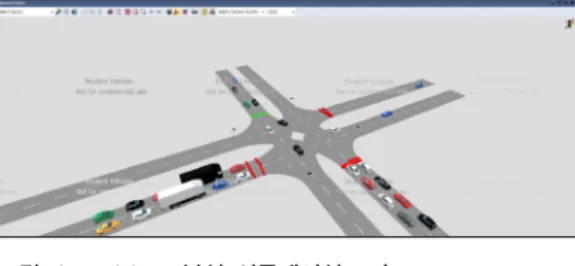
The display shows the standard look before the analysis by assuming the value specified by the Traffic Impact Analysis. The following results were obtained through the VISSIM Simulator Analysis. Next, we assumed the data to incorporate the V2X based automatic signal system in the VISSIM tool. Fig.4 shows the appearance of VISSIM for analysis.
그림 4. VISSIM 분석 시뮬레이션 모습
Fig. 4. The appearance of VISSIM for traffic analysis
As mentioned before, the green time dynamically changes every cycle in the V2X based automatic signaling system in real time. However, since the V2X is not implemented in VISSIM, we studied only the linkage on the traffic. We reflected the future requirements and limitations in the simulation.
그림 5. 수정 된 현시 구성
Fig. 5. The display of modified configuration
Unit:sec
Sort Red Amber Green Amber
Phase 1 90 4 31 3
Phase 2 104 4 17 3
Phase 3 92 4 29 3
Phase 4 98 4 23 3
표 1. 수정 된 교통 현시 구성
Table.1 The traffic signal matrix of modified configuration
Next, we set the green time criteria and changed it dynamically to obtain results. We set the percentage ratio of traffic input and the vehicles of left turn on each roads, then we distributed them in the total cycle.
The modification of each display is shown in Fig.5. and the traffic signal matrix is shown in Table.1.
2. The Analysis and Comparison
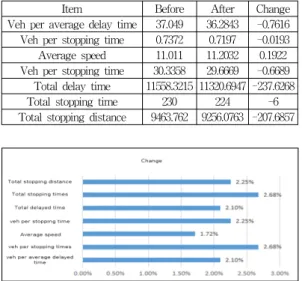
Like as shown in the table, we can see the total traffic flow was enhanced at a glance. Although, the result data is collected for an hour, V2X changes the traffic signal flexibly reflecting the adjacent traffic information for each cycle, so more efficient traffic control is possible. Table.2 shows the modified configuration for traffic control and Fig.6 shows the output display according to the modified configuration.
Item Before After Change
Veh per average delay time 37.049 36.2843 -0.7616 Veh per stopping time 0.7372 0.7197 -0.0193 Average speed 11.011 11.2032 0.1922 Veh per stopping time 30.3358 29.6669 -0.6689 Total delay time 11558.3215 11320.6947 -237.6268 Total stopping time 230 224 -6 Total stopping distance 9463.762 9256.0763 -207.6857
표 2. 수정 된 교통제어시스템Table. 2 The modified configuration for traffic control
그림 6. 개선 된 교통 현황 도표
Fig. 6. The display output of modified configuration
As you can see, the graph shows all the traffic items were improved by more than 2% on average. In this study, the signal was controlled only by considering the green signal time. As a result, if we implement it in the real traffic, we can obtain the enhanced results and contribute to enhance the traffic.
Ⅲ. Conclusion
By implementing the proposed V2X based traffic control system, the following results can be obtained.
(1) It can reduce the reconstruction time of traffic signal control when the big traffic change occurs.
(2) Optimal traffic control is done automatically rather than manually in conjunction with traffic interval of vehicles.
(3) Since the traffic control is remotely performed, the traffic controller boxes can removed, which can reduce the costs and improve the road aesthetics.
(4) The traffic accidents between men and vehicles can be reduced
As a result, the proposed system can be a new alternative for ITS which is being developed now and it will be implemented in u-City. By developing the proposed system, we can meet the speed, reliability and efficiency to satisfy of traffic users.
References
[1] Kim kyung chul, ITS Technology Trends survey and study on domestic adoption. KOTI (2013) [2] C.J. Messer et al., Traffic Flow Theory A Monograph.
special report 165 Transportation Research Board National Research Council Washington, D.C., (1997) [3] Go kwang young, Smart Signal Control System
Status and Future of the individual intersections, KOSTA (2015), 44-50
[4] Dho chul woong, Transportation Engineering
principles. 423-521, Korea, Cheongmungak (2005) [5] Lee young in, Han dong hee, Journal of Transportation to micro- simulator for signal evaluation of control strategies, advanced signal system, Seoul Nation University, Korea transportation Academy (2003)
[6] You-Sik Hong, Myeong-Bok Choi, Design for Forecasting of Real Time Traffic Situation using Artificial Intelligence, The Journal of the Institute of Internet, Broadcasting and Communication (2005) [7] Hyun-Soo Jin, A Study on the Internet based Traffic Intersection control, The Journal of the Institute of Internet, Broadcasting and Communication(2008)
저자 소개
오 재 곤(정회원)
∙He is currently a Ph.D. from the IT Applied System Engineering, Chonbuk National University. LG Hitachi public sales manager is working. Research interests: Traffic Engineering Systems, Ubiquitous, Sensor Networks, Computer Vision, Image Processing, Smart Media.
김 현 진(정회원)
∙He received M.S.and ph.D. degrees in Department of Information and Communication Engineering from Kunsan National University.
Currently an associate professor in Department ofIT Applied System Engineering, Chonbuk National University. Research interests :Multimedia Systems, Ubiquitous, Sensor Networks, Computer Vision, Image Processing, Smart Media.
강 정 진(종신회원)
∙He is currently the faculty of the Department of Information and Communication at Dong Seoul University in SeongNam, Korea since 1991. During 3 years from Feb. 2007 to Feb. 2010, he worked as a Visiting Professor at the Department of Electrical and Computer Engineering, The Michigan State University. He was a lecturer of the Department of Electronic Engineering at (Under) Graduate School(1991-2005), The Konkuk University.