Citation: Park HR, Eum SH, Roh SH, Sun DW, Seo J, Cho SK, Lee JG, Kim BW. 2017. Growth curve estimates for wither height, hip height, and body length of Hanwoo steers (Bos taurus coreanae). Korean Journal of Agricultural Science 44:384-391.
DOI: https://doi.org/10.7744/kjoas.20170030
Editor: Jung Min Heo, Chungnam National University, Korea
Received: November 16, 2016
Revised: February 21, 2017
Accepted: February 23, 2017 Copyright: © 2017 Korean Journal of Agricultural Science.
This is an Open Access article distributed under the terms of the Creative Com- mons Attribution Non-Commercial License (http:
//creativecommons.org/licenses/by-nc/4.0/) which permits unrestricted non-commercial use, distribution, and reproduction in any medium, provided the original work is properly cited.
OPEN ACCESS
ANIMAL
Growth curve estimates for wither height, hip height, and body length of Hanwoo steers (Bos taurus coreanae)
Hu-Rak Park 1 , Seung-Hoon Eum 1 , Seung-Hee Roh 2 , Du-Won Sun 3,4 , Jakyeom Seo 1 , Seong-Keun Cho 1 , Jung-Gyu Lee 4 , Byeong-Woo Kim 1*
1 Department of Animal Science, College of Natural Resources and Life Science ․ Life and Industry Convergence Research Institute, Pusan National University, Miryang, Gyeongnam 50463, Korea
2 Hanwoo Improvement Center, National Agriculture Cooperative Federation, Seosan 31948, Korea
3 Department of Animal Science, Gyeongsang National University, Jinju 52828, Korea
4 Institute of Agriculture & Life Science, Gyeongsang National University, Jinju 52828, Korea
*Corresponding author: [email protected]
Abstract
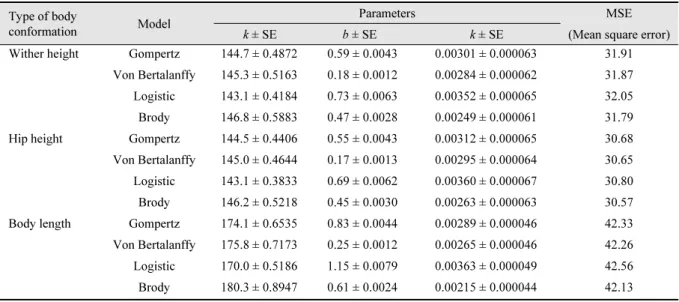
Growth curves in Hanwoo steers were estimated by Gompertz, Von Bertalanffy, Logistic, and Brody nonlinear models using growth data collected by the Hanwoo Improvement Center from a total of 6,973 Hanwoo ( Bos taurus coreanae) steers 6 to 24 months old that were born between 1996 and 2015. The data included three parameters: A, mature size of body measurement; b, growth ratio; and, k, intrinsic growth rate. Nonlinear regression equations for wither height according to Gompertz, Von Bertalanffy, Logistic, and Brody models were
, ,
, and , respectively, while those for hip height were
, ,
, and , respectively. Equations for body length
, , , and , respectively, for the same models. Among the four models, the Brody model resulted in the lowest mean square error, with mean square errors of 31.79, 30.57, and 42.13, respectively, for wither height, hip height, and body length.
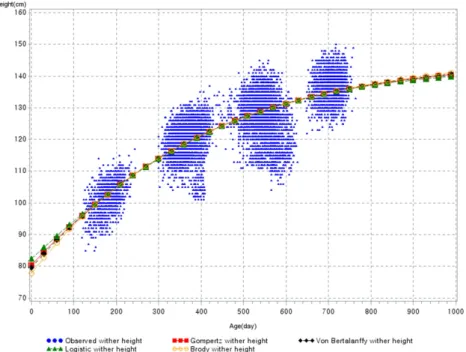
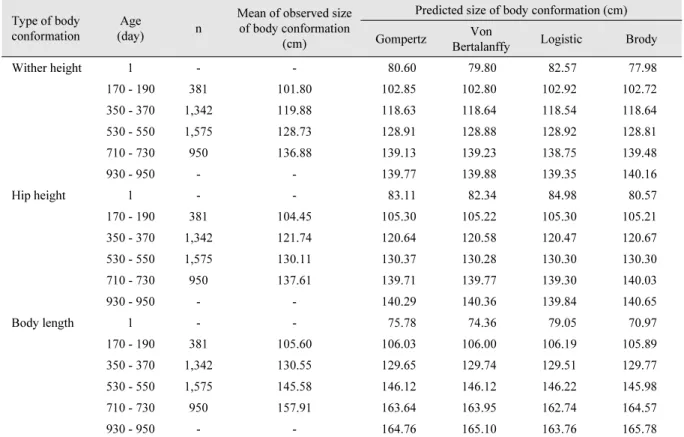
Also, an estimated birth wither height, birth hip height, and birth body length (77.98, 80.57, and 70.97 cm, respectively) were lower in the Brody model than in other models. An inflection point was not observed during the growth phase of Hanwoo steer according to the growth curves calculated using Gompertz, Von Bertalanffy, and Logistic models. Based on the results, we concluded that the regression equation using the Brody model was the most appropriate among the four growth models. To obtain more accurate parameters, however, using data from a wider production period (from birth to shipping) would be required, and the development of a suitable model for body conformation traits would be needed.
Keywords: body length, growth curve, Hanwoo, hip height, wither height
Introduction
한우와 같은 육용 경제동물에게 있어서 성장특성에 관한 연구는 매우 중요한 요소이다. 특정 품종, 성별과 같은 개체의 특성에 따른 체중 및 체형형질의 성장특성의 파악을 통해 그에 적합한 사양방법의 선택, 적정 출하시기의 선택 및 종축으로 선정하기 위한 평가 등은 가축 개량에 필수적이라 할 수 있다.
개체의 출생부터 출하시기까지의 일령에 따른 체중 및 체형 파악을 위해 연속적인 자료를 수집하는 데에는 많은 어려움이 따르기 때문에 측정하지 못한 시기에 따른 측정치를 파악하기 위해서 이용되는 한가지 방법으로 비선형 모델을 이용한 성장곡선 추정이 이용된다(Brown et al., 1976). Gompertz (Winsor, 1932), Brody (Brody, 1945), Von Bertalanffy (Von Bertalanffy, 1957) 및 Logistic (Nelder, 1961) 등의 비선형 회귀식을 이용한 육우의 성장곡선을 추 정을 위한 많은 연구가 해외에서부터 이루어졌으며(Brown et al., 1976; Nelsen et al., 1982; Menchaca et al., 1996) 국내에서도 한우를 이용한 연구가 진행되었다(Kim et al., 1996; Cho et al., 2002; Kim et al., 2002; Lee et al., 2003;
Yun et al., 2016). 또한 개체에 적절한 성장 특성 파악을 통해 성장기 체형치로 성숙 시 수치를 추정하여 종모축 조 기 선발 및 비육우의 사양관리에 이용할 수 있을 것으로 기대된다.
국내에서 이루어진 대부분의 연구들은 일령 및 월령에 따른 체중에 관한 연구였으며, 체고, 십자부고와 같은 체 형형질에 대한 연구는 이루어지지 않았다. 체형형질은 종축의 선발에 있어 체중, 초음파와 함께 평가항목에 포함 되며, 한우의 외형을 결정하는 중요한 형질이다. 또한 Mukai et al. (1995)과 Sun et al. (2008)의 연구에 따르면 체형 형질과 주요 경제형질인 도체형질과는 표현형, 유전적으로 유의적 상관이 있다고 보고하여 체형형질 성장 특성 연 구를 통해 간접적으로 도체형질의 성장특성을 파악할 수 있을 것으로 사료된다.
따라서 본 연구는 거세우의 일령별 체고, 십자부고 및 체장 자료를 이용하여 체형형질에 적합한 성장곡선을 추 정하고 한우 거세우의 성장특성을 알아보며, 이를 통해 한우 종모축의 조기 선발 및 비육우의 사양관리를 위한 기 초자료로 이용하고자 한다.
Materials and Methods
공시재료
분석에 이용된 자료는 후보종모우의 유전능력 평가를 위한 후대검정시 측정된 후대검정우 6,973두의 월령에 따 른 체형형질(체고, 십자부고 및 체장) 측정치를 이용하였다. 후대검정우는 1996년부터 2015년사이에 출생하였으 며, 후대검정(농림축산식품부고시 제2014-128호 ‘가축검정기준’) 절차에 따라 사양관리되었고, 5 - 6개월령에 거 세하여 6개월령부터 시작하여 출하시기까지 검정을 실시하였다(연도별로 검정기준 변경에 따른 측정 시기의 차 이가 있다). 월령에 따른 체형형질 측정치는 측정일과 생년월일간의 차이를 통해 일령에 따른 체형형질 측정치로 변환하였으며 측정 월령별 측정일의 분포는 Table 1과 같으며 분석에 이용된 체고, 십자부고 및 체장의 측정위치 는 다음과 같다.
체고(wither height): 기갑의 정점에서 지면까지의 수직거리 십자부고(hip height): 십자부에서 지면까지의 수직거리
체장(body length): 어깨전단에서 좌골후단을 직선으로 이은 수평거리
개체당 측정 횟수는 고려하지않고 측정월령별 체형데이터를 모두 이용하였으며, 한우 거세우 집단의 측정 월령
별 체형형질의 평균에서 과도하게 벗어나는 이상치를 제거하고, 검정기간 중은 성장기이므로 동일한 개체 내에서
직전 측정치보다 감소하는 측정치는 이상치로(측정 또는 입력상의 오류 및 비정상적 개체) 간주하여 제거하여 총
12,879 개의 일령에 따른 체고, 십자부고 및 체장 데이터를 이용하였다. 월령에 따른 체형형질의 일반통계량은 Table 2 와 같다. 측정개월령이 증가함에 따라 변동계수는 증가하지않아 개체간의 변이가 증가하지 않음을 알 수 있었으며, 이는 체형형질의 경우 성장함에 따라 환경적 변이가 크게 작용하지 않은 것으로 사료된다.
통계분석 방법