Study on the Crack Growth Control in Blasting Using a Notched Charge Hole
Seung-Hwan Park, Sang-Ho Cho (Chonbuk National University) Kwang-Yeom Kim, Dong-Gyou Kim (KIST) Yuichi Nakamura (Yatsushiro National College of Technology, Japan) Katsuhiko Kaneko (Hokkaido University, Japan)
1. INTRODUCTION
Crack-controlled blasting method which utilizes a notched charge hole or a charge holder has been proposed and studying to achieve crack-propagation along estimated direction as well as to minimize rock mass damage for surrounding rock mass by means of blasting method. The fracture control technique is of interest in practical applications including partial removal of a concrete. To achieve more precise controlling of growth direction and length of cracks, it is necessary to examine the stress and fracture fields around the notched charge hole considering shape of the notches and the explosive charging conditions (Fourney et al.
1978; Mohanty 1990; Nakamura et al., 1992; Choi and Lee, 2000; Cho et al. 2004).
The major difficulty involved in exploring crack growth inside opaque materials such as rock and concrete may, however, be the complete experimental observations are difficult to obtain although some attempts have been made using various techniques (Nakamura et al., 1992; Kaneko et al, 1995; Cho et al, 2008).
In this study, the blast models , which have a regular charge hole and notched charge hole, were analyzed using dynamic fracture process analysis (DFPA) software(Cho et al., 2003 and 2008) to investigate the effect of the geometry of a notched charge hole on crack growth control in blasting. The analysis models considered different lengths of the notches, angles of the notch tips and decoupling indexes of the charge hole. The stress fields and cracks generated in the vicinity of the notched charge hole were compared.
2. DYNAMIC FRACTURE PROCESS ANALYSES (DFPA) IN BLASTING USING A NOTCHED CHAREGE HOLE
2.1 Description of numerical approach
This study improves the dynamic fracture process analysis (DFPA) code (Cho et al, 2003 and Cho et al., 2008) to describe a more reasonable simulation of the onset and propagation of multi-cracks in
한국암반공학회 국제학술회의
2008 / 2008.10.21 - 10.23
blasting. In the dynamic fracture process analysis the increment displacement form of a dynamic finite element method is used to explain large displacement behavior. A re-meshing algorithm is used to model crack propagation, assuming that tensile fractures, i.e., crack initiation, propagation, and interconnection, occur at element boundaries. Therefore, cracks are modeled as separations from element boundaries that do not change the shape of the elements. At each element boundary, the fracture potential is checked at every time-step. The fracture potential is calculated from the ratio of the normal stress and tensile strength at the element boundary. If the fracture potential of two elements exceeds 1, the node between the elements is separated into two nodes. Since the cracking and fracture processes are treated as the separation of elements, contact problems, i.e., overlapping of the separated elements, may occur due to the perpendicular compression stress that is applied to the separated elements. This problem is solved iteratively to prevent meshing overlaps when the separated elements are in contact with each other.
2.2 Fracture processes in blasting model having a regular charge hole
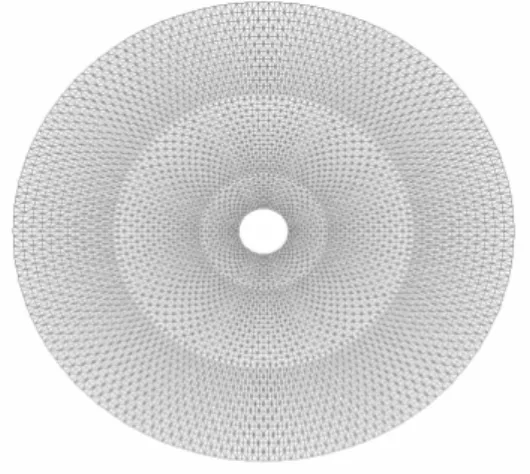
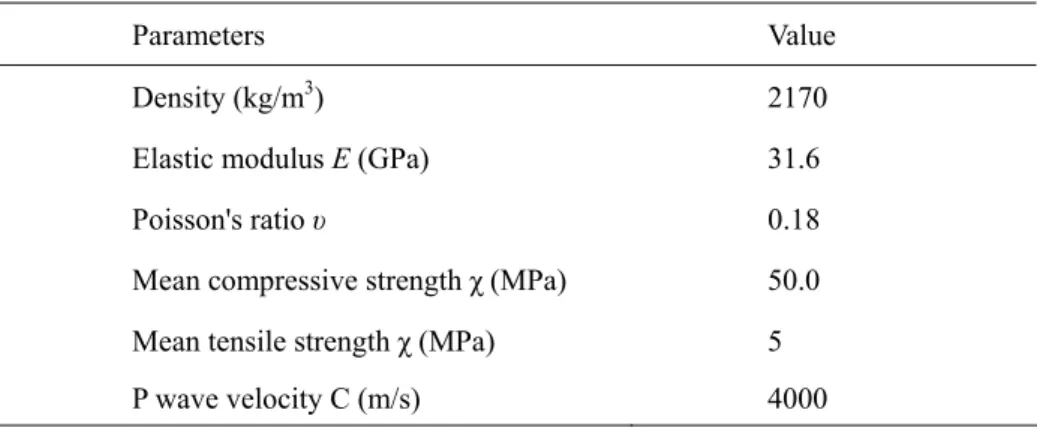
In this study, the dynamic fracture process analysis (DFPA) code was employed to simulate the generation and propagation of cracks in rock which has a regular charge hole. Figure 1 shows the finite element layout for the analysis models which has a circumferential free face and a circular charge hole in the center of the model. The model was divided into triangular elements. The diameter of outside boundary and the charge hole is 200mm and 20mm, respectively. The parameters used and calculation conditions are listed in Table 1.
Fig. 1 Finite element layout for the analysis model having a regular charge hole
To apply a blast pressure to the hole boundary, the following pressure function P(t) with respect to time ‘t’ was used:
P(t)=Pjwl(V(t))Ps(t)
Where, Pjwl(V(t)) is the JWL pressure, which has been extensively used to describe the isentropic expansion of detonation products, and is called the JWL equation of state, and Ps(t) denotes a trapezoidal function with 1μs rise time. V(t) is the relative volume, Ve(t)/V0. Here Ve(t) is the volume of gas produced and V0 is the volume of the explosive. In this study Ve(t) is calculated from the expanded volume of charge hole. The pressure Pjwl(V(t)) as a function of V(t) at constant entropy can be written as
Pjwl(V(t)) = Aexp(-R1 V)+exp(-R2V)+CV-(ω+1)
Where, A=1032(GPa), B=90.57(GPa), C= 3.73(GPa), R1 = 6.0, R2 = 2.6, and ω = 0.57. These parameters apply for PETN explosive.(Cho et.al.2004)
Table 1) The parameters used and calculation conditions.
Parameters Value
Density (kg/m3) 2170
Elastic modulus Ε (GPa) 31.6
Poisson's ratio υ 0.18 Mean compressive strength χ (MPa) 50.0
Mean tensile strength χ (MPa) 5 P wave velocity C (m/s) 4000
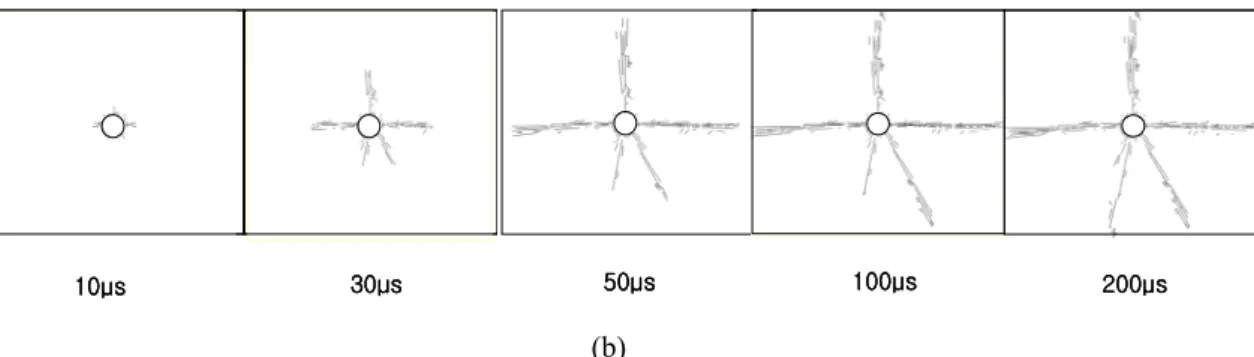
Figures 2 (a) and (b) show maximum principal stress distributions and crack propagation in the blast model which have a circular charge hole. At 10 μs after the initiation of the blast pressure, tangential tensile stresses due to applied blast pressure initiate the radial multi-cracks from the boundary of the charge hole. After 90 μs, the predominant tensile cracks arrive at the out-boundary with different propagation velocities.
Ultimately, the fracture processes break the circular material into 5 pieces. Note that the cracks shown in Fig.
2(b) include opening cracks and micro-cracks within the fracture process zone.
10MPa
-2MPa
10μs 30μs 50μs 100μs 200μs
10MPa
-2MPa 10MPa
-2MPa 10MPa
-2MPa
10μs 30μs 50μs 100μs 200μs
(a)
10μs 30μs 50μs 100μs 200μs
10μs 30μs 50μs 100μs 200μs
(b)
Fig.2 Maximum principal stress distributions and crack propagation in blasting using a regular charge hole.
2.3 Fracture processes in blasting model having a notched charge hole Figure 3 shows the finite element layout for the analysis models which has a circumferential free face and a notched charge hole in the center of the model. The model was divided into triangular elements.
The diameter of outside boundary and the charge hole is 200mm and 20mm, respectively. The charge hole has two wedge type notches on the both side of hole boundary. The opening distance and the deep of the notches is 5mm and 7.5mm, respectively. The minimum size of the elements used in this study is 1mm.
The number of the nodal points and elements are 7254 and 14148, respectively. The analysis model applied the same parameters used and calculation conditions as listed in Table 1.
100mm
20mm 7.5mm
5mm
100mm
20mm 7.5mm
100mm
20mm 7.5mm
100mm
20mm
100mm
20mm
100mm
20mm 7.5mm
5mm
Fig. 3 Finite element layout for the analysis model having a notched charge hole
10MPa
-2MPa
10μs 30μs 50μs 100μs 200μs
10MPa
-2MPa 10MPa
-2MPa 10MPa
-2MPa
10μs 30μs 50μs 100μs 200μs
(a)
10μs 30μs 50μs 100μs 200μs
10μs 30μs 50μs 100μs 200μs
(b)
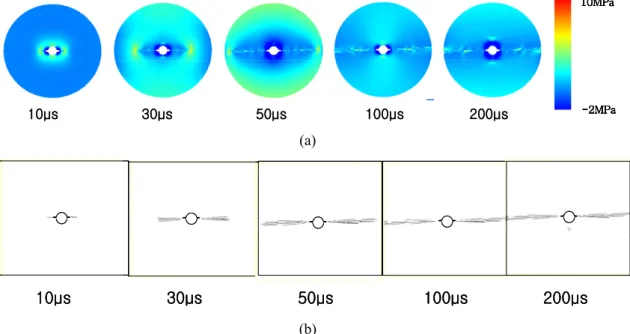
Fig.4 Maximum principal stress distributions and crack propagation in blasting using a notched charge hole.
Figures 4 (a) and (b) show maximum principal stress distributions and crack propagation in the blast model which have a notched charge hole. At 10 μs, the analysis model shows crack generation from the tips of the notches initiated by tangential tensile stress fields. At 30 μs, the radiating tensile cracks propagate longer than that in Fig. 2. This means that the notches accelerate the speed of crack propagation.
The fracture processes resulted in two predominant cracks similar as hydraulic fracture and ultimately the circular model was broken into 2 pieces.
The results show that the notched charge hole is effective on the control of crack propagation control in blasting. Furthermore, introduction of notched charge hole results in more straight fracture plane.
3. THE EFFEC OF THE GEOMETRY OF NOTCHES ON THE CRACK GROWTH
In order to investigate the effect of the geometry of the notch on the onset and propagation of cracks, three blast geometries were model as shown Table 2.
Table 2. Conditions of the analysis models used
Model type Notch length (mm) Mouth opening of the notch (mm)
Model 1 7.5 5.0
Model 2 3 5.0
Model 3 7.5 6.5
3.1 The effect of the notch length on the crack growth controlling
As mentioned above, the notched charge hole leads to higher speed of crack propagation and results in hydraulic fracture patterns. To investigate the effect of the differences of notch length on the crack growth, the analysis model used in section 2.3 was modified.
Figures 5 (a) and (b) compare the results from the blast model, which has the notch length of 3mm and mouth opening of the notches of 5mm, with that shown in Fig. 4. The analysis model having smaller notch length hit more generations of crack and show multi-crack propagations. This result implies that decreasing notch length leads to less tensile stress concentration around the tips of the notches and this causes the multi-radial crack propagations.
Model 2 Model 1 Model 2 Model 1
(a) (b)
Fig.5 Comparing the simulation results of from blasting models having different notch lengths.
3.2 The effect of the mouth opening of notch on the crack growth controlling
In this section, the analysis model used in section 2.3 was modified to investigate the effect of the differences of mouth opening of notch on the crack growth. Note that the change of the mouth opening makes a difference the angle at the tip of the notches.
Figures 6 (a) and (b) compare the results from the blast model, which has the notch length of 7.5 mm and the mouth opening of the notches of 6.5mm, with that shown in Fig. 4. The results show similar crack generations. The increment of the mouth opening does not affect crack growth controlling in blasting when compared to the notch length.
It is conceivable that the notch length is more important factor for controlling the crack growth in blasting using a notched charge hole.
50μs 50μs
50μs 50μs
50μs 50μs50μs50μs
50μs 50μs
10MPa -2MPa
50μs 50μs
10MPa -2MPa
50μs 50μs
10MPa -2MPa
Model 1 Model 3 Model 1 Model 3
(a) (b)
Fig.6 Comparing the simulation results of the blasting models having with different mouth opening of the notches.
4. CONCLUSION
In this study, the blast models, which have a regular charge hole and notched charge hole, were analyzed using dynamic fracture process analysis (DFPA) software to investigate the effect of a notched charge hole on crack growth control in blasting. In addition, the effect of the geometry of on crack growth control in blasting was examined. The blast model having a regular charge hole showed the multi-crack propagations and results in the fragments of 5 pieces. The blast model having a notched charge hole resulted in two predominant cracks similar as hydraulic fracture and ultimately the model was broken into the fragments of 2 pieces. The results showed that the notched charge hole is effective on the control of crack propagation control in blasting. Furthermore, introduction of notched charge hole results in more straight fracture plane. The results from the blast models which have different notch lengths showed that decreasing notch length leads to less tensile stress concentration around the tips of the notches and this causes the multi-radial crack propagations. The results from the blast models which have different mouth opening of the notch lengths showed that the increment of the mouth opening does not affect crack growth controlling in blasting
ACKNOWLEDGEMENTS
This research was supported by a grant from High-tech Urban Development Program (HUDP) funded by Ministry of Land, Transportation and Maritime Affairs(MLTM) of Korean government.
50μs 50μs
50μs
50μs 50μs50μs50μs
50μs 50μs
10MPa -2MPa
50μs 50μs
10MPa -2MPa
50μs 50μs
10MPa -2MPa
REFERENCES
1. Forney, W.L, Dally, J.W. and Holloway, D.C., 1978, Controlled blasting with ligmented charge holders, Int J. Rock Mech Min Sci & Geomech. Abstract Vol. 15, pp. 121-129.
2. Dally,J.,W., And Fourney, W.,L.,1978, Fracture Control in Construction Blasting, Proc.18th U.S.
Symp. On Rock Mechanics, 2A6 1~2A6 7
3. Nakamura Y, Matsunaga H, Yamamoto M, and Sumiyoshi K, 1992, Blasting method for crack control by utilling charge holders, Kayaku, Vol 53, No 1, pp. 31-37.
4. Nakamura Y, S.H. Cho, M. Yoneoka, M. Yamamoto and K. Kaneko, Model experiments on crack propagation between two charge holes in blasting, Sci Technol Energetic Mater 65 (2004), pp. 34–39.
5. Y.K.Choi, C.I.Lee 2000, A Study on the Control of Blasting Fractures using Notched-hole and Charge Holder, Korean institute of mineral and energy resources engineers, Vol.37. pp. 315 ~ 326(in Korean)
6. B. Mohanty, Explosive generated fractures in rock and rock like materials, Eng Fract Mech (1990), pp. 889–898.
7. K. Kaneko, Y. Matsunaga and M. Yamamoto, Fracture mechanics analysis of fragmentation process in rock blasting, J Jpn Exp Soc 58 (3) (1995), pp. 91–99 [in Japanese].
8. D.H. Jeong , S.J.Moon, D.J.An, W.J.Jeong, E.K. Kim, D.G.Kim,2007, A Study on Notch Bit System for Controlling Blast Vibration and Over-break in Rock Mass, Tunnel & underground space Vol. 17, No. 3, pp.216~224
9. Cho, S.H, Nakamura, Y. and Kaneko, K., 2004, Dynamic fracture process of rock subjected to stress wave and gas pressurization, Int. J Rock Mech. and Mining Sci., Vol. 41, No. 3, pp. 439.
10. Cho S.H., Y. Nakamura and K. Kaneko, Dynamic fracture process of rock subjected to stress wave and gas pressurization, Int J Rock Mech Min Sci 41 (2004), p. 439