40(3) : 184 189 (2009)
184
황련과 단삼의 독성평가를 위한 성분분석 및 안정성 시험
이미경·이준석·곽승준1·김지명1·강태석1·이제현2·우미희·최재수3·배기환4·민병선
*
대구가톨릭대학교약학대학
,
1국립독성과학원독성연구부,
2동국대학교한의과대학,
3부경대학교식품생명공학부
,
4충남대학교약학대학Analysis and Stability test of the Extract of Coptidis Rhizoma and Salviae Miltiorrhizae Radix for Toxicity Study
Mi Kyoung Lee, Jun Seok Lee, Seung Jun Kwack
1, Ji Myoung Kim
1, Tae Suk Kang
1, Je Hyun Lee
2, Mi Hee Woo, Jae Sue Choi
3, KiHwan Bae
4and Byung Sun Min
*College of Pharmacy, Catholic University of Daegu, Gyeongsan, Gyeongbuk 712-702, Korea
1
Department of Toxicological Research, National Institute of Toxicological Research, Seoul 122-704, Korea
2
College of Oriental Medicine, Dongguk University, Gyeongju 780-714, Korea
3
Faculty of Food Science and Biotechnology, Pukyoung National University, Busan 608-737, Korea
4
College of Pharmacy, Chungnam National University, Daejeon 305-764, Korea
Abstract −
A simple and reliable reverse phase HPLC method of Coptidis Rhizoma and Salviae Miltiorrhizae Radix were developed to determine pharmacologically active marker compounds. The water-extract of two natural medicines were eval- uated by the HPLC methods. The stability test for two extract were examined for five months. However, no significant change in the content of the marker compounds of each extract observed during the time of investigation.
Key words −
Coptidis Rhizoma, Salviae Miltiorrhizae Radix, Water-extract, Stability test, HPLC
최근세계적으로식물자원을이용한고부가치식
,
의약품의개발이활발하게시도되고있으며정부도천연물신약연 구개발촉진법을통하여이를지원하고있다
.
천연물을이용한다양한외국의식
,
의약품이이미건강보조식품으로유통되고있으며독일
,
프랑스 같은나라에서는천연물추출물자체또는 분획물
(
은행잎,
겨우살이등)
을이용하여식
,
의약품개발로거대한시장을창출하고있다.
우리나라는전통적으로사용하는각종한약재외에도천연물의약품 및건강기능성식품의형태로많은 생약이사용되고있다
.
규격을설정하여관리하는생약은대한약전에
130
종과생약규격집에
385
종으로총515
종의한약재가수재되고관리되고있으나이들의인체에대한안전성연구는매우미흡 한실정이다
.
1)특히마두령(Aristolochiae Fructus)
은쥐방울과
(Aristolochiaceae)
의쥐방울덩굴( Aristolchia contorta )
과실로뱀독의해독제나진통
,
소염제등으로사용되었던생약재이다
.
마두령의주성분은aristolochic acid
으로알려져있으며최근여러동물실험에서발암성
,
유전독성및신장독성이확인되었고
,
사람에게서도aristolochic acid
가다량함유된다이어트제재를장기복용한경우신장독성과 발암성이보고되면서생약재의독성에대한관심이높아지 고있어생약에대한과학적이고체계적인안전성평가자 료확보가절실히필요하다
.
2-5)국립독성과학원에서는국가의독성물질관리사업의일환 으로생약의일반독성시험및유전독성시험을진행중에있 다
.
독성시험결과와이에대한과학적근거확보를위해시험물질에대한신뢰성및재현성있는분석결과가요구된 다
.
생약은산지,
채집시기등에따라원료생약의유효성분함량및품질차이가있고
,
건조상태,
가공법에따라지표성분등의차이가있어원료생약에대한기준규격시험이필 요하며규격화된시료를독성시험에이용하여야한다
.
또한생약은건강식품
,
의약품보조제등의질병예방을위해장기적으로복용하는경우
,
안정성확인시험이필수이며안정성이확보된시료를사용하여독성시험할경우신뢰할 수있는독성자료를얻을수있다
.
*교신저자(E-mail): [email protected] (Tel):053-850-3613
황련
(Coptidis Rhizoma)
의berebrine
은광범위한항미생물작용과6)사람의장내세균의생장을억제하는7)활성이있 어세균성설사에대한지사약및소염성고미건위약으로세 균성설사
,
복통,
폐결핵,
구토,
비출혈,
하혈,
소갈,
눈충혈,
구내염등에응용한다
.
황련의isoquinoline
계alkaloid
는암세포에세포독성
,
8)SNU-688 gastric cancer cell
에apoptosis
작용
,
9)anti-feeding
활성,
10)aldose reductase
억제활성,
11)해독작용12)등이보고되어있고
, lignan
계화합물은항염증작용이13)보고되어져있다
.
단삼(Salviae Miltiorrhizae Radix)
은활혈
,
소종,
진통약으로월경부조,
복통,
경폐,
산후의구토와복통
,
류마티스등에사용하며부인병에사용되는생약으로주요성분은붉은색을띠는
diterpene
계화합물이다.
단삼의생리활성연구로는동맥경화개선작용
,
14)고지방개선작용
,
15)IL-2
과IFN-gamma gene
생성억제16) 및prostaglandin
생성억제,
17)뇌세포보호작용,
18)항산화작용,
19)간세포보호작용이20)보고되어있다
.
단삼의항암작용에관한연구로는
dihydrotanshinone I
화합물이anti-angiogenetic
활성
,
21)tanshinone I
이human breast cancer
세포인MDA-MB-231
의부착을조절하여세포성장억제작용과22)estrogen receptor-positive (MCF-1), lung carcinoma
세포세포독성과23)
estrogen receptor-negative (MDA-MB-231) breast cancer
세포에apoptosis
유도작용이있으며,
24)단삼의
alkaloid
계성분은HeLa, HepG2, OVCAR-3
등의암세포에 세포독성
,
25)diterpene
계 화합물이hypoxia-inducible factor-1 (HIF-1)
축척억제작용이26)보고되어있다.
본연구는황련과단삼
2
종생약을대상으로HPLC-UV
를이용하여지표성분의분석법을확립하였으며
,
확립된분석법을이용해생약의표준화된추출물을확보하고실온과 냉장의보관조건에서지표성분의변화를확인함으로써독 성시험에사용하는생약추출물의안정성을확인하고자하 였다
.
재료 및 방법
실험재료 − 본연구에사용한
2
종의생약,
황련과단삼은유통되는생약을기원별
,
산지별로구입하여기원,
성상,
색상
,
냄새등을기준으로생약감별자문위원회(
한국생명공학연구원
,
이형규박사;
충남대학교,
김영호교수;
한국화학연구원
,
유시용박사;
충남대학교,
배기환교수;
대구가톨릭대학교
,
민병선교수)
의감별을거쳐선별하였고선정된시료는대구가톨릭대학교약학대학표본실에보관되어있다
(
황련, CUD-3171-1;
단삼, CUD-2617-1).
황련(Coptidis Rhizoma)
과단삼(Salviae Miltiorrhizae Radix)
모두중국산을사용하였다
.
각생약은식품의약품안전청고시2003-17,
안전성유효성심사규정에준한표준탕제제조법에따라열 수추출하고이를농축한후동결건조하여사용하였다
.
27)시약 및 기기 −
berberine, coptisine, palmatine
및epiberberine
은황련(Coptidis Rhizoma)
에서분리하여사용하였고
, tanshinone I, tanshinone II, cryptotanshinone
및dihydrodanshinone
은단삼(Salviae Miltiorrhizae Radix)
에서분리한화합물을안동대학교손건호교수님에게제공받아 사용하였다
. HPLC system
은Gilson
사의306 pump, 811C dynamic mixer, UV/VIS-156 detector, 231 XL sample injector
및GILSON UniPoint data
를사용하였으며column
은
Agilent Technologies
사의Agilent Eclipse XD8-C18 (5
µm, 4.6×150 mm)
를사용하였다. HPLC
용매는Burdick
& Jackson
사의Methanol
및acetonitrile
을사용하였고, H
2O
는
Milli-Q
로처리한물을사용하였다.
황련지표물질분리 − 황련
(Coptidis Rhizoma) 10 kg
을MeOH
로3
시간동안3
회반복환류냉각열탕추출하고여과한 후감압 농축하여
2.2 kg
의MeOH
엑스를 얻었다. MeOH
엑스를10% MeOH
로현탁하고CH
2Cl
2, BuOH
및H
2O
순으로계통분획하여각각230 g, 1100 g, 840 g
의분획물을얻었다
. BuOH
분획물을silica gel, MCI-CHP20
및Sephadex LH-20 column chromatography
와CH
2Cl
2-MeOH
의용매를사용하여
berberine, coptisine, palmatine
을분리하였다
.
물 분획물을MCI-CHP20
및Sephadex LH-20 column chromatography
와CH
2Cl
2-MeOH
의용매를사용하여
epiberberine
을분리하였다.
28)Coptisine
−yellow amorphous powder; UV
λmax(MeOH):
226, 239, 264, 356;
1H-NMR (400 MHz, CD
3OD): 9.71 (1H, s, H-8), 8.71 (1H, s, H-13), 7.87 (1H, d, J = 8.3 Hz, H-11), 7.83 (1H, d, J = 8.0 Hz, H-12), 7.63 (1H, s, H-1), 6.84 (1H, s, H-4), 6.45 (2H, s, OCH
2O), 6.09 (2H, s, OCH
2O), 4.89 (2H, m, H-6), 3.23 (2H, m, H-5);
13C- NMR (100 MHz, CD
3OD): 151.0 (C-10), 148.8 (C-3), 148.1 (C-2), 144.6 (C-8), 144.1 (C-9), 137.8 (C-13a), 133.2 (C-12a), 130.6 (C-4a), 121.9 (C-12), 121.6 (C- 13b), 120.7 (C-11), 112.5 (C-8a), 108.2 (C-4), 105.3 (C- 1), 105.0 (OCH
2O), 102.5 (OCH
2O), 56.0 (C-6), 27.0 (C-5).
Palmatine
−yellow amorphous powder; mp, 208
oC; UV
λmax
(EtOH): 228, 240, 268, 276, 343, 350, 433;
1H-NMR
(400 MHz, CD
3OD): 9.78 (1H, s, H-8), 8.88 (1H, s, H-
13), 8.10 (1H, d, J = 8.0Hz, H-11), 8.00 (1H, d, J = 8.0
Hz, H-12), 7.63 (1H, s, H-1), 7.03 (1H, s, H-4), 4.87
(2H, m, H-6), 4.19 (3H, s, 9-OCH
3), 4.08 (3H, s, 10-
OCH
3), 3.97 (3H, s, 2-OCH
3), 3.92 (3H, s 3- OCH
3),
3.52 (2H, m, H-5);
13C-NMR (100 MHz, CD
3OD): 152.6
(C-3), 150.7 (C-10), 149.7 (C-2), 145.2 (C-8), 144.5 (C-
9), 138.6 (C-13a), 134.0 (C-12a), 128.9 (C-4a), 126.8 (C-
12), 123.3 (C-11), 122.1 (C-13b), 120.1 (C-13), 119.3 (C-
8a), 111.0 (C-4), 108.7 (C-1), 61.3 (C-9, OCH
3), 56.4 (C- 10, OCH
3), 56.1 (C-2, OCH
3), 55.8 (C-3, OCH
3), 55.4 (C-6), 26.6 (C-5); LC-ESI-MS/MS m/z : 352 [M]
+.
Berberine
−yellow amorphous powder; mp, 158-160
oC;
UV
λmax(EtOH): 230, 266, 352, 432;
1H-NMR (400 MHz, CD
3OD): 9.75 (1H, s, H-8), 8.69 (1H, s, H-13), 8.10 (1H, d, J = 8.3 Hz, H-11), 7.98 (1H, d, J = 8.4 Hz, H-12), 7.64 (1H, s, H-1), 6.94 (1H, s, H-4), 6.09 (2H, s, OCH
2O), 4.91 (2H, t, J = 6.4 Hz, H-6), 4.18 (3H, s, 9- OCH
3), 4.09 (3H, s, 10-OCH
3), 3.24 (2H, t, J = 6.4 Hz, H-5);
13C-NMR (100 MHz, CD
3OD): 151.0 (C-10), 150.8 (C-3), 148.7 (C-2), 144.6 (C-9), 145.2 (C-8), 138.5 (C- 13a), 134.0 (C-12a), 130.7 (C-4a), 126.8 (C-11), 123.3 (C- 12), 122.1 (C-8a), 120.7 (C-13b), 120.3 (C-13), 108.2 (C- 4), 105.3 (C-1), 102.5 (OCH
2O), 61.3 (C-9, OCH
3), 56.4 (C-10, OCH
3), 56.0 (C-6), 27.0 (C-5).
Epiberberine
−yellow amorphous powder; mp, 260
oC;
UV
λmax(EtOH): 227, 245, 268, 361;
1H-NMR (400 MHz, CD
3OD): 9.70 (1H, s, H-8), 8.81 (1H, s, H-13), 7.88 (1H, d, J = 8.0 Hz, H-11), 7.83 (1H, d, J = 8.0 Hz, H-12), 7.63 (1H, s, H-1), 7.03 (1H, s, H-4), 6.45 (2H, s, OCH
2O), 4.88 (2H, m, H-6), 3.97 (3H, s, 2-OCH
3), 3.92 (3H, s, 3-OCH
3), 3.26 (2H, m, H-5);
13C-NMR (100 MHz, CD
3OD): 152.6 (C-3), 149.7 (C-2), 147.9 (C-10), 144.5 (C-9), 144.1 (C-8), 137.9 (C-13a), 133.3 (C-12a), 128.7 (C-4a), 121.8 (C-12), 121.1 (C-11), 121.0 (C-13), 119.3 (C-13b), 112.5 (C-8a), 111.0 (C-4), 108.5 (C-1), 104.9 (OCH
2O), 56.2 (C-6), 55.8 (C-2, OCH
3), 55.5 (C-3, OCH
3), 26.5 (C-5).
표준액 및 분석용 검액 조제 − 생약추출물
100 mg
에70% MeOH 10 mL
를가하여HPLC
분석용시료로사용하였다
. Coptisine, palmatine, berberine, epiberberine, tanshinone I, tanshinone II, cryptotanshinone
및dihydrodanshinone
각각70% MeOH
로1 mg/mL
농도로녹여표준액으로사용하였다
.
분석용 표준액과검액은membrane filter
로여과한 후사용하였다
.
지표물질정량 − 문헌등의자료를토대로지표물질을선 정하였고
, Table I
과같은조건으로분석하였다.
각각의지표성분은검량선을작성하여생약추출물의함량을평가하 였다
.
추출물안정성 실험 −
2
종의생약의열수추출물을동결건조한분말의안정성실험을위해시료를실온과냉장에
5
개월보관하면서0, 1, 2, 3, 5
개월에각각의시료를설정된
HPLC
조건에서분석하였다.
각각의시료는일정양씩3
개의EP-tube
에 취하고60
분간sonication
후membrane filter
로여과한후HPLC
로분석하였다.
결과 및 고찰
황련지표물질구조동정 − 황련의지표성분분리를위해
10 kg
을MeOH
로추출하고추출액을10% MeOH
로현탁한후
CH
2Cl
2, BuOH
순으로용매분획하였다. BuOH-soluble fraction
과물층을silica gel, MCI-CHP20
및Sephadex LH- 20 column chromatography
를반복실시하고일부분획물은MeOH
로재결정하여4
종의화합물을분리하였다. 4
종의화합물은1
H-NMR
과13C-NMR spectroscopic data
로coptisine, palmatine, berberine, epiberberine
임을확인할 수있었으며 이들의
NMR data
는문헌에 보고된data
와일치하였다
.
29-30)생약추출물지표성분정량 − 일반적으로생약의분석에 서지표성분은그약리활성을대표하거나각생약의특이 한활성을갖는성분을선정하는것이원칙이나
,
활성성분이나특이성분을설정하기어려운경우에는주성분을지표 성분으로한다
.
1)본연구에서는2
종의생약에대표적인생리활성을보이며주성분인황련
(Coptidis Rhizoma)
에서는coptisine, palmatine, berberine
및epiberberine
을지표성분으로
,
단삼(Salviae Miltiorrhizae Radix)
은tanshinone I, tanshinone II, cryptotanshinone
및dihydrodanshinone
을 지표성분으로각각 설정하였다
(Fig. 1).
각각의지표성분HPLC
분석은Table I
의조건으로4
가지성분이resolution
2
이상으로완전히분리되어성분의농도결정에방해를받지않았다
.
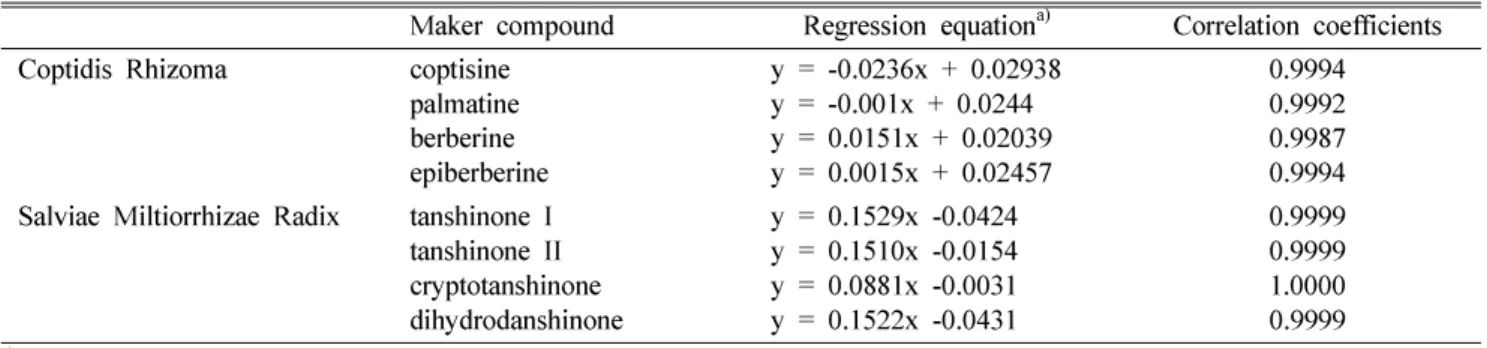
상기의분석조건으로각지표성분의검량선을작성한결과
r
2이0.995
이상으로높은직선성이확인되었다
(Table II).
Table I.
HPLC conditions for Coptidis Rhizoma and Salviae Miltiorrhizae Radix
Coptidis
Rhizoma Marker compounds: coptisine, palmatine, berberine, epiberberine
Column: Agilent Eclipse XD8-C18 (5
µm, 4.6×150 mm)
Mobile phase: 10 mM hexanesulfonic acid- Na : acetonitrile = 85:15
→65:35 (20 min)
→20:80 (40 min) Detector: 254 nm
Flow rate: 1 mL/min Column Temp.: 30
oC Salviae
Miltiorrhizae Radix
Marker compounds: tanshinone I, tanshinone II, cryptotanshinone, dihydrodanshinone Column: Agilent Eclipse XD8-C18 (5
µm, 4.6×150 mm)
Mobile phase: 0.1% formic acid : acetonitrile
= 60:40
→20:80 (60 min) Detector: 280 nm
Flow rate: 1 mL/min
Column Temp.: 30
oC
열수추출물안정성시험 − 황련과단삼의생약추출물에대 한안정성자료를얻고자
,
각각의추출물을실온과냉장에보관하고
5
개월간일정기간간격(1, 2, 3, 5
개월)
으로육안관찰하고유효성분함량평가를수행하였다
.
육안관찰에서는실온과냉장장기보관시험조건에서색등의변화가 관찰되지않았고
, 5
개월장기보관에따른고체상태로굳어지는현상도없었다
.
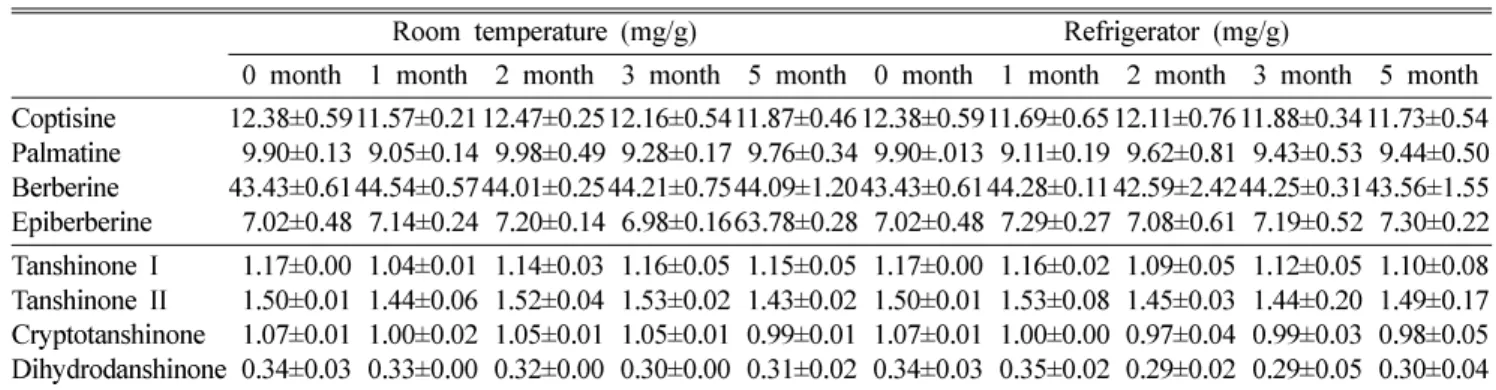
지표성분의함량은
Fig. 2
와Table III
과같으며황련의추출물
HPLC
분석결과epiberberine, coptisine, palmatine
및berberine
이 분석조건에서 검출되었고, 4
가지 성분 중Fig. 1.
Chemical structures of maker compounds.
Table II.
Calibration data of HPLC-UV
Maker compound Regression equation
a)Correlation coefficients
Coptidis Rhizoma coptisine
palmatine berberine epiberberine
y = -0.0236x + 0.02938 y = -0.001x + 0.0244 y = 0.0151x + 0.02039 y = 0.0015x + 0.02457
0.9994 0.9992 0.9987 0.9994 Salviae Miltiorrhizae Radix tanshinone I
tanshinone II cryptotanshinone dihydrodanshinone
y = 0.1529x -0.0424 y = 0.1510x -0.0154 y = 0.0881x -0.0031 y = 0.1522x -0.0431
0.9999 0.9999 1.0000 0.9999
a)
y = peak area, x = amount (
µg)
Fig. 2.
HPLC chromatogram.
(A) standard compounds of Coptidis Rhizoma, (B) extract of
Coptidis Rhizoma, (C) standard comounds of Salviae
Miltiorrhizae Radix, (D) extract of Salviae Miltiorrhizae Radix
berberine
이주요성분으로확인되었다.
대한약전에서황련의
berberine
의함량은4.2%
이상으로규정하고있어규격에적합한시료이다
.
31)그러나황련의분석에서주로4
가지성분이검출되었고다른성분은상기의
HPLC
분석조건에서검출되지않아
4
가지성분이황련의주요alkaloid
임을확인하였다
. 5
개월동안실온과냉장조건에서보관한시료도추출시분석한시료의함량에는차이가없어황련의물
추출물은안정함을확인할수있었다
.
단삼의추출물HPLC
분석 결과
dihydrotanshinone, cryptotanshinone, tanshinone I
및tanshinone II
가상기의분석조건에서검출되었고, 4
가지성분중
dihydrotanshinone
이주요성분으로확인되었으며
tanshinone II
는시험에사용한단삼에서는검출되지않았다
. 5
개월동안실온과냉장조건에서보관한시료도추출시분석한시료의
chromatogram
과차이가없으며성분함량도일정하여단삼의물추출물은안정성이확보되었다
.
결 론
생약재의독성실험을위한추출물은식약청고시
2003-17,
표준탕제제조법에따라추출제조하였다
.
추출물의함량분석을 위해 황련의 지표성분은
epiberberine, coptisine, palmatine
및berberine
으로,
단삼의지표성분은dihydrotan- shinone, cryptotanshinone, tanshinone I
및tanshinone II
로선정하였다
.
각각의성분은HPLC-UV detector
와RP C-18
column
으로분석이가능하였다.
추출생약재의장기보존에따른안정성시험을위해시료는실온과냉장고에보관하 였고
,
실험기간은각각5
개월간HPLC
로분석하여각각의peak
의pattern
과함량으로2
종생약의안정성을확인하였다
.
이러한생약시료의표준화와안정성결과는독성시험결과의신뢰성을확보하고생약의유통과정의효율적품질 관리개선에도활용이가능하다고기대된다
.
사 사
본연구는식품의약품안전청용역연구사업
“KNTP
독성시험을위한원료물질확보및분석연구
(II)” (08152
독관리414)
에의해수행되었으며이에감사드립니다
. 인용문헌
1. Kim, S. H., Choi, E. J., Kim, D. H., Lee, K. Y., Lee, M., Baek, S. W., Kwak, S. J., Kang, T. S., Kim, Y. C. and Sung, S. H. (2008) Stability test of the extracts of Cimicifugae Rhi- zoma, Achyranthis Radix, Artemisia Capillaris Herba, Mou- tan Cortex Radicis and Arecae Semen for toxicity study. Kor.
J. Pharmacogn.
39: 241-245.
2. Park, C. H. and Kwack, S. J. (2009) The effects of aris- tolochic acid on reproductive function in female rats. Kor. J.
Pharmacogn.
40: 89-98.
3. Frei, H., Wurgler, F. E., Juon, H., Hall, C. B. and Graf, U.
(1985) Aristolochic acid is mutagenic and recombinogenic in Drosophila genotoxicity tests. Arch. Toxicol .
56: 158-166.
4. Mengs, U. (1987) Acute toxicity of aristolochic acid in rodents. Arch. Toxicol .
59: 328-331.
5. Arlt, V. M., Annie, P. L., Cosyns, J. P. and Schmeiser, H. H.
(2001) Analyses of DNA adducts formed by ochratoxin A and aristolochic acid in patiens with Chinese herbs neph- ropathy. Mutat. Res .
494: 143-150.
6. Park, H., Kim, M. S., Jeon, B. H., Kim, T. K., Kim, Y. M., Ahnn, J., Kwon, D. Y., Takaya, Y., Wataya, Y. and Kim, H.
S. (2003) Antimalarial activity of herbal extracts used in tra- ditional medicine in Korea. Biol. Pharm. Bull .
26:1623- 1624.
7. Chae, S. H., Jeong, I. H., Choi, D. H., Oh, J. W. and Ahn, Y.
J. (1999) Growth-inhibiting effects of Coptis japonica root- derived isoquinoline alkaloids on human intestinal bacteria. J.
Agric. Food Chem .,
47: 934-938.
8. Min, Y. D., Yang, M. C., Lee, K. H., Kim, K. R., Choi, S. U.
and Lee, K. R. (2006) Protoberberine alkaloids and their reversal activity of P-gp expressed multidrug resistance (MDR) from the rhizome of Coptis japonica Makino. Arch.
Pharm. Res .
29: 757-761.
9. Park, H. J., Kim, Y. J., Leem, K., Park, S. J., Seo, J. C., Kim, H. K. and Chung, J. H. (2005) Coptis japonica root extract
Table III.
Contents of marker compounds during the period of stability test (n = 3)
Room temperature (mg/g) Refrigerator (mg/g)
0 month 1 month 2 month 3 month 5 month 0 month 1 month 2 month 3 month 5 month Coptisine
Palmatine Berberine Epiberberine
12.38±0.59 09.90±0.13 43.43±0.61 07.02±0.48
11.57±0.21 09.05±0.14 44.54±0.57 07.14±0.24
12.47±0.25 09.98±0.49 44.01±0.25 07.20±0.14
12.16±0.54 09.28±0.17 44.21±0.75 06.98±0.16
11.87±0.46 09.76±0.34 44.09±1.20 63.78±0.28
12.38±0.59 09.90±.013 43.43±0.61 07.02±0.48
11.69±0.65 09.11±0.19 44.28±0.11 07.29±0.27
12.11±0.76 09.62±0.81 42.59±2.42 07.08±0.61
11.88±0.34 09.43±0.53 44.25±0.31 07.19±0.52
11.73±0.54 09.44±0.50 43.56±1.55 07.30±0.22 Tanshinone I
Tanshinone II Cryptotanshinone Dihydrodanshinone
1.17±0.00 1.50±0.01 1.07±0.01 0.34±0.03
1.04±0.01 1.44±0.06 1.00±0.02 0.33±0.00
1.14±0.03 1.52±0.04 1.05±0.01 0.32±0.00
1.16±0.05 1.53±0.02 1.05±0.01 0.30±0.00
1.15±0.05 1.43±0.02 0.99±0.01 0.31±0.02
1.17±0.00 1.50±0.01 1.07±0.01 0.34±0.03
1.16±0.02 1.53±0.08 1.00±0.00 0.35±0.02
1.09±0.05 1.45±0.03 0.97±0.04 0.29±0.02
1.12±0.05 1.44±0.20 0.99±0.03 0.29±0.05
1.10±0.08
1.49±0.17
0.98±0.05
0.30±0.04
induces apoptosis through caspase-3 activation in SNU-668 human gastric cancer cells. Phytother. Res .
19: 189-192.
10. Park, I. K., Lee, H. S., Lee, S. G., Park, J. D. and Ahn, Y. J.
(2000) Antifeeding activity of isolquinoline alkaloids iden- tified in Coptis japonica roots against Hyphantria cunea (Lepidoptera: Arctiidae) and Agelastica coerulea (Coleoptera:
Galerucinae). J. Econ. Ebtomol .
93: 331-335.
11. Takanashi, K., Shitan, N., Sugiyama, A., Kamimoto, Y., Hamamoto, M., Iwaki, T., Takegawa, K. and Yazaki, K.
(2008) Galactinol synthase gene of Coptis japonica is involved in berberine tolerance. Biosci. Biotechnol. Biochem .
72
: 398-405.
12. Fang, Z. Y., Lin, R., Yuan, B. X., Liu, Y. and Zhang, H.
(2007) Tanshinone IIA inhibits atherosclerotic plaque for- mation by down-regulating MMP-2 and MMP-9 expression in rabbits fed a high-fat diet. Life Sci .,
81: 1339-1345.
13. Cho, J. Y., Kim, A. R. and Park, M. H. (2001) Lignans from the rhizomes of Coptis japonica differentially act as anti- inflammatory principles. Planta Med .
67: 312-316 . 14. Fang, Z. Y., Lin, R., Yuan, B. X., Yang G. D Liu, Y. and
Zhang, H. (2008) Tanshinone IIA downregulates the CD40 expression and decreases MMp-2 activity on atherosclerosis induced by high fatty diet in rabbit. J Ethnopharmacol .
115: 217-222.
15. Ji, W. and Gong, B. Q. (2008) Hypolipidemic activity and mechanism of purified herbal extract of Salvia miltiorrhiza in hyperlipidemic rats. J Ethnopharmacol ,
119: 291-298.
16. Wu, M. H,. Tsai, W. J., Don, M. J., Chen, I. S. and Kuo, Y.
C. (2007) Tanshinlactone A from Salvia miltiorrhiza mod- ulatesinterleukin-2 and interferon-gamma gene expression. J Ethnopharmacol .
113: 210-217.
17. Jeon, S. J., Son, K. H., Kim, Y. S., Choi, Y. H. and Kim, H.
P. (2008) Inhibition of prostaglandin and nitric oxide pro- duction in lipopolysaccharide-treated RAW 264.7 cells by tanshinones from the roots of Savia miltiorrhiza Bunge. Arch.
Pharm. Res .
31: 758-763.
18. Zhang, F., Zheng, W., Pi, R., Mei, Z., Bao, Y., Gao, J., Tang, W., Chen, S. and Liu, P. (2009) Cryptotanshinone protects primary rat cortical neurons from glutamate-induced neu- rotoxicity via the activation of the phosphatidylinositol 3- kinase/Akt signaling pathway. Exp. Brain Res .
193: 109-118.
19. Kim, JY., Kim, HS., Kang, HS., Choi, JS., Yokozawa, T. and Chung, H. Y. (2008) Antioxidant potential of dimethyl lithos- permate isolated from Salvia miltiorrhiza (red sage) against
peroxynitrile. J. Med. Food ,
11: 21-28.
20. Yin, H. Q., Choi, Y. J., Kim, Y. C., Sohn, D. H., Ryu, S. Y.
and Lee, B. H. (2009) Salvia miltiorrhiza Bunge and its active component cryptotanshinone protects primary cultured rat hepatocytes from acute ethanol-induced cytotoxicity and fatty infiltration. Food Chem. Toxicol .
47: 98-103.
21. Bian, W., Chen, F., Bai, L., Zhang, P. and Qin, W. (2008) Dihydrotanshinone I inhibits angiogenesis both in vitro and in vivo. Acta Biochim. Biophys. Sin. (Shanghai),
40: 1-6.
22. Nizamutdinova, I. T., Lee, G. W., Lee, J. S., Cho, M. K., Son, K. H., Jeon, S. J., Kang, S. S., Kim, Y. S., Lee, J. H., Seo, H.
G., Chang, K. C. and Kim, H. J. (2008) Tanshinone I sup- presses growth and invasion of human breast cancer cells, MDA-MB-231, through regulation of adhesion molecules.
Carcinogenesis
29: 1885-1892.
23. Lee, C. Y., Sher, H. F., Chen, H. W., Liu, C. C., Chen, C. H., Lin, C. S., Yang, P. C., Tsay, H. S. and Chen, J. J. (2008) Anticancer effects of tanshinone I in human non-small cell lung cancer. Mol. Cancer Ther .
7: 3527-3538.
24. Nizamutdinova, I. T., Lee, G. W., Son, K. H., Jeon, S. J., Kang, S. S., Kim, Y. S., Lee, J. H., Seo H. G, Chang K. C. and Kim H. J. (2008) Tanshinone I effectively induces apoptosis in estrogen receptor-positive (MCF-7) and estrogen receptor- negative (MDA-MB-231) breast cancer cells. Int. J Oncol .
33
: 485-491.
25. Don, M. J., Shen, C. C., Lin, Y. L., Syu, W. J., Ding, Y. H., and Sun, C. M. (2005) Nitrogen-containing compounds from Salvia miltiorrhiza . J. Nat. Prod .
68: 1066-1070.
26. Dat, N. T., Jin, X., Lee, J. H., Lee, D., Hong, Y. S., Lee, K., Kim, Y. H. and Lee, J. J. (2007) Abietane diterpenes from Salvia miltiorrhiza inhibit the activation of hypoxia-inducible factor-1. J. Nat. Prod .
70: 1093-1097.
27.
식의약청고시2003-17,
안전성유효성심사규정.
28. Jung, H. A., Yoon, N. Y., Bae, H. J., Min, B. S. and Choi J.
S. (2008) Inhibitory activities of the alkaloids from Coptidis Rhizoma against aldose reductase. Arch. Pharm. Res .
31: 1405-1412.
29. Grycova, L., Dostal, J. and Marek, R. (2007) Quaternary pro- toberberine alkaloids. Phytochemistry
68: 150-175.
30. Lee, H. Y. and Kim, C. W. (1997) Studies on the constituents of Berberis amurensis Ruprecht. Kor. J. Pharmacogn .
28: 257-263.
31.
편집부:
대한약전(
제8
개정),
약업신문(2002).
(2009년 7월 30일 접수)