• 검색 결과가 없습니다.

IEG 환경지질연구정보센터

N/A
N/A
Protected

Academic year: 2021

Share "IEG 환경지질연구정보센터"

Copied!
7
0
0

로드 중.... (전체 텍스트 보기)

전체 글

(1)

≪ Research Paper ≫

Environmental Impact of Phosphogypsum on the Ecotoxicity of A. salina, D. magna, O. latipes, and S. capricornutum

Soo-Ho Park

1

·Bing Han

1

·Woo-Bum Lee

1

*·Jongo Kim

2

1

Department of Environmental system Engineering, Chonnam National University

2

Department of Environmental Education, Mokpo National University

ABSTRACT

The objective of this study was to determine the feasibility of recycled phosphogypsum (PG) as an embankment material with soil by performing batch and column ecotoxicity experiments. A. salina, D. magna, O. latipes and S. capricornutum were selected for the experiment. The effective concentration (EC

50

) of D. magna was the lowest value, 1.29 mg/L. The survival rates of A. salina, D. magna and O. latipes were more than 90% in the presence of PG leachate in the column test. The toxicity unit (TU) for the organisms was less than 1, indicating that no significant ecotoxicity effect was found.

These findings suggested that PG could be recycled for use as an embankment and landfill material with soil.

Key words : Embankment, Landfill, Phosphogypsum (PG), Recycle, Toxicity

1. Introduction

Phosphogypsum (PG) is a by-product from the phosphate fertilizer industry. PG is produced during the manufacture of phosphoric acid by a chemical reaction of rock phosphate with sulfuric acid. Worldwide PG production is estimated to be about 100-280 million tons per year (Tayibi et al., 2009), whereas 1.6 million tons of waste PG have been produced as a result of fertilizer manufacturing in South Korea (Lee and Hyun, 2006).

PG may contain natural radionuclides (Radium, Uranium and Radon), phosphates, sulfates, fluoride, heavy metals, and other trace metals (Carvalho and Raij, 1997; El-Shall, 2000; Papastefanou et al., 2006). In particular, cadmium (Cd) is a major heavy metal, and Radium is a major radionuclide in PG. These toxic constituents will affect natural surroundings when PG is reused. Tayibi et al. (2009) reviewed the environmental impact of PG storage and treatment, physical, chemical, and thermal types. PG is generally located in coastal areas near a phosphate fertilizer plant, where it occupies large space and causes many environmental damages. Renteria-Villalobos et al. (2010)

reported the radiological, chemical and morphological characterizations of PG in order to evaluate the behavior of toxic elements. They found that toxic elements (Barium;

Ba, Cadmium; Cd, Copper; Cu, La; Lanthanum, Lead; Pb, Selenium; Se, and Strontium; Sr) are not distributed homogeneously within PG, and could easily be mobilized by leaching or erosion.

PG is currently being used for commercial purposes in the United States, including (a) as a soil conditioner, (b) as a back-fill and road-base material in roadways, (c) as an additive to concrete, and (d) in mine reclamation (Ho and Zimpfer, 1985; Pericleous and Metcalf, 1996; Reijnders, 2007). However, such applications are restricted to some extent due to the harmful minor elements in PG and to leaching, which may cause release of these elements to the aquatic environment or soils. Approximately fifty-eight percent of PG has been recycled for cement materials and gypsum boards (Godinho-Castro, 2012). Singh (2002) attempted to purify PG for cement and gypsum plaster, and Portland slag cement was produced using purified PG.

Garg et al. (1996) and Shen et al. (2007) reported that phosphogypsum with a mixture of lime and ash could have

*Corresponding author : [email protected]

Received : 2015. 11. 20 Reviewed : 2016. 1. 13 Accepted : 2016. 2. 4

Discussion until : 2016. 6. 30

(2)

sufficient durability for construction or as a road-base material. Guo (1998), and Azam and Abduljauwad (2000) studied the physical characteristics of gypsum with clays and suggested that the gypsum could be used for cements.

Therefore, studies on the ecotoxicity and environmental effects of recycled PG on aquatic life are required.

The objective of this study was to determine the feasibility of recycled phosphogypsum (PG) as an embank- ment material with soil by means of batch and column ecotoxicity experiments. To facilitate safe use of PG, investigations on the pH, radioactive, heavy metal, and acute toxicity test were also conducted. A. salina, D. magna, O. latipes and S. capricornutum were selected because they are used frequently for toxicity testing of aquatic organisms.

2. Materials and methods

2.1. Phosphogypsum and soil

1.6 million tons of waste PG has been generated annually as a result of fertilizer manufacture in South Korea (Lee and Hyun, 2006). The PG samples used in this study were col- lected from one fertilizer plant, which is located in the Yeosu Industrial Complex. This plant manufactures phos- phate fertilizer by a dehydration process. A rock phosphate processing plant was consuming phosphorite (Ca

3

(PO

4

)

2

), and a by-product gypsum, CaSO

4.

2H

2

O, was produced. The dehydration process, also known as the wet fertilizer pro- cess, provides a moist PG. Soil was normally collected to obtain a sample mixed with PG from a coastal area at Yeosu City, South Korea.

2.2. Selection of organisms

For the ecotoxicity experiment, a typical species in the food chain was chosen. In this study, A. salina, D. magna, O. latipes and S. capricornutum were selected because they are frequently used for ecotoxicity testing. A. salina and D.

magna are often used in many researches, and D. magna is in the middle of the fresh water food chain. S. capricornu- tumI, a kind of algae, is an important source for fish in sea water.

2.3. Standard reference toxicity test

The standard toxicity test determines the sensitivity of

selected organisms to a toxic material. In this study, potas- sium dichromate (K

2

Cr

2

O

7

) was used as the toxic material.

Potassium dichromate was selected as a toxic compound because it has been widely used for eco-toxicity studies.

Concentrations of potassium dichromate were between 1 mg/L and 60 mg/L.

2.4. Acute toxicity in batch test

For a batch study, a 500 mL glass bottle containing extracted water sample was used to investigate the mobili- zation and immobilization rates of A. salina, D. magna and O. latipes. The test was repeated three times to enhance the accuracy of the results. The water sample was extracted in the presence of PG according to the waste standard methods. Ten A. salina, five D. magna and ten O. latipes were used for the 24-hr and 48-hr experiments. The bottle was placed at room temperature (20-25

o

C). During the course of the experiment, water samples from the bottle were taken for analysis of pH and DO values at each sam- pling time. To assess the acute toxicity of S. capricornutum, extracted leachate was used at an inoculum density of 1 × 10

4

cells/mL. Carbon dioxide was supplied into a bottle containing S. capricornutum. The bottle was incubated at 23

o

C and an illumination density of 6,000 lux for three days on a stirrer.

2.5. Acute toxicity in column test

Three column reactors constructed of acrylic were made, each of 74.2-L capacity (inner diameter: 30 cm and height:

105 cm). The volume of mixed materials was 105,975 cm

3

. A moisture content meter, a sprinkler, and timer were installed with the reactors. The reactors were placed in a 20

o

C temperature-controlled environmental room, and filled with mixed PG and soil. For example, PG50 indicates 50%

PG with the remainder comprising soil applied. After water was added to the column at 1,000 L/day, leachate samples were collected daily according to operation time intervals (1-, 7- and 13-week) from the bottom of column for measurement of pH and DO values.

2.6. Analytical methods

The heavy metals, pH, DO, and nutrients for PG samples

were analyzed in accordance with the Standard Methods

(3)

(APHA, 1998). 100 g of PG sample was put into 1,000 mL purified water adjusting pH (5.8-6.3) with HCl. The mixed sample was extracted using a glass fiber filter (1.0 um). The samples were also analyzed for their metal constituents as standard test procedures using the ICP/MS (ICPM-8500, Shimadzu, Japan). Coolant gas flowrate, plasma gas flow- rate, and carrier gas flowrate were 7.0 L/min, 1.5 L/min, and 0.56 L/min, respectively. The ICP RF power was 1200 W. Method detection limit for Cr, Cd and As was 0.0002 mg/L, and that for Hg was 0.0005 mg/L. The ecotoxicity of A. salina was analyzed according to the Acute Toxicity Test Method of A. salina suggested by US EPA (2002). The determination of radionuclide concentrations was per- formed by gamma spectrometry analysis using the Natural Radioactivity Measurement System (Canberra Industries Inc., USA).

3. Results and Discussion

3.1. Characteristics of soil and PG

The physicochemical characteristics of the waste PG are shown in Table 1. The radioactive concentration of Radium (Ra)-226 at 50% PG (PG50) was 7.97 pCi/g, which is below the U.S. EPA regulation (10 pCi/g). However, 100% PG (PG100) contained 13.12 pCi/g of Ra-220. Uranium (U)- 238 ranged between 1.188 pCi/g and 1.647 pCi/g according to the PG mixing ratio. The concentration of two other radioactive isotopes, Pb-210 and Polonium (Po)-210, were detected at low ranges. Mercury, cadmium, and arsenic con- centrations according to mixing ratio were ND (not detected), 0.01 mg/L, and 0.001 mg/L, respectively. Initial total nitro- gen and phosphorus concentrations with PG50 were 14.8 and 0.059 mg/L, respectively. The specific gravity of the

waste PG was 2.343. The pH of PG ranged from 2.2 to 2.6, whereas the pH of the soil used in this study was 5.8.

PG comprises mainly calcium sulfate dihydrate (CaSO

4

· 2H

2

O) with some impurities. Its physical and chemical properties are comparable to those of gypsum, with the exception of the presence of different minor constituents, some of which are naturally occurring radioactive isotopes.

Concentrations of radioactive and heavy metals in PG were below standard regulations. This preliminary investigation suggested that waste PG could be utilized as an embank- ment material.

3.2. Acute toxicity test of S. capricornutum

As shown Fig. 1 and Table 2, the 72hr-E

r

C

50

in terms of the reduction in for S. capricornutum growth rate was 1.23 mg/L, which was below the US EPA ecotoxicity standards.

E

r

C

50

is defined as the effective concentration in terms of 50% reduction of growth rate after exposure to potassium dichromate. Because stationary phase was reached within 6 days, the results for three days were used for the batch acute toxicity test. After 24-hr, the specific growth rates for PG30,

Table 1. Characteristics of PG waste according to mixing ratio

Parameter T-N

(mg/L)

T-P

(mg/L) pH Cd

(mg/L)

Cr (mg/L)

As (mg/L)

U-238 (pCi/g)

Ra-226 (pCi/g)

Std. in USA 1.0 5.0 5.0 10

SL100 42.2 0.03 5.77 0.011 0.004 ND < 0.567 0.783

PG30 22.1 0.038 5.49 0.001 0.001 ND 1.188 4.131

PG50 14.8 0.059 5.39 0.010 0.003 ND 1.485 7.965

PG100 − − 3.42 0.010 0.003 0.001 1.647 13.122

Note: SL 100; Soil 100%, PG30; Phosphogypsum 30%+Soil 70%, PG50; Phosphogypsum 50%+Soil 50%, Cd; Cadmium, Cr; Chrome, As; Arsenic, U; Uranium, Ra; Radium, ND; Not detected.

Fig. 1. Effective concentrations for S. capricornutum and D.

magna.

(4)

PG50, and PG100 were 1.61 day

−1

, 1.3 day

−1

, and 0 day

−1

, respectively.

Column toxicity testing of different leachate samples was also performed. As illustrated in Fig. 2, more than 100 × 10

4

cells/mL was detected with SL100 regardless of leachate samples after 72 hrs. A similar result was obtained using PG30 leachate samples, as shown in Fig. 3 (Park and Kim, 2012). However, for a 1-week leachate sample, cell growth was reduced by 50% with PG50 (Fig. 4). The other leachate samples had no effect on cell growth. In the batch and column tests, PG30 exhibited no inhibit effect. In other

words, an appropriate pH value facilitated the growth of S.

capricornutum. For 13-week leachate samples, pH values with PG30 and SL100 increased to 8.65 and 9.32, respectively.

However, PG50 and PG100 resulted in a severe inhibitory effect.

3.3. Toxicity test of D. magna

As shown in Fig. 1, it was observed that effective concentration (EC

50

) of D. magna was 1.29 mg/L (Han et al., 2011). EC

50

is defined as the effective concentration of an organism that causes 50% immobilization after exposure to potassium dichromate. The EC

50

was determined when immobilization ratio for each organism was 50% from Fig.

1. The mobilization and immobilization rates for five D.

magna in batch test are shown in Fig. 6. During a 48-hr test, the immobilization rates for PG30 and PG50 were 25 and 45%, respectively. No mobilization of D. magna occurred with PG100. As shown in Table 3, survival of five D.

magna was observed according to mixing ratio using 1- week and 13-week leachates in a column test. When PG50 was applied in a 1-week leachate sample, 85% mobilization was found due to the low pH (6.11). After 48 hr, PG50 resulted in the lowest survival.

Table 2. Result of standard toxicity tests using potassium dichromate for four organisms

Organism EC

50

or E

r

C

50

from EPA (mg/L)

EC

50

or E

r

C

50

from this study (mg/L) Avg.

(mg/L)

1 2 3

S. capricornutum

1

0.92~1.46 (72 h) 1.27 1.19 1.23 1.23

A. salina

2

25.4~37.4 (24 h) 32.15 35.00 30.20 32.45

D. magna

2

0.9~2.0 (24 h) 1.32 1.26 1.29 1.29

O. latipes

2

30~47.7 (48 h) 38.51 33.56 42.70 38.26

Note: 1: E

r

C

50

; Effective concentration in reduction, 2: EC

50

; Effective concentration.

Fig. 2. Variation of S. capricornutum in terms of leachate samples with SL100 condition.

Fig. 3. Variation of S. capricornutum in terms of leachate samples with PG30 condition.

Fig. 4. Variation of S. capricornutum in terms of leachate

samples with PG50 condition.

(5)

D. magna was more sensitive to potassium dichromate than A. salina. The toxicity unit for D. magna was also less than 1, indicating no significant eco-toxicity effect. In a batch test, the PG mixing ratio strongly affected the survival of D. magna because of the low pH. As shown in Fig. 6, when mixing ratios were more than 50%, D. magna mobilization dropped rapidly. The pH of pure PG was 2.2, and was increased upon mixing with soil. The pH during the test of D. magna was below 6 and no mobilization was observed for PG100. Low pH may affect the mobilization rate of organisms.

The mobilization rate increased with the increase in pH over time. Low pH may influence the survival of organ- isms, as suggested by the results of the batch test. During the test, the lowest DO concentration was 8.2. No significant eco-toxicity effect of PG on the aquatic environment was observed in the column test. Because the column test was operated relatively longer time, its result could be useful for field application of PG as an embankment material. These findings suggested that PG generated by fertilizer production could be recycled in the presence of sufficient soil.

3.4. Toxicity test of A. salina

The standard toxicity test was conducted for 24 hrs or 48

hrs using potassium dichromate. As shown in Fig. 5, it was observed that the 24-hr median EC

50

value of A. salina was 32.45 mg/L (Han et al., 2011). Fig. 6 shows mobilization and immobilization rates of A. salina according to mixing ratio in the batch test. Ten A. salina were used in the beginning of the experiment. After a 24-hr toxicity test, the immobilization rate of A. salina was 2% with 50% PG (PG50), compared to 5% at PG100. The immobilization rate ranged from 27 to 35% after 48 hr.

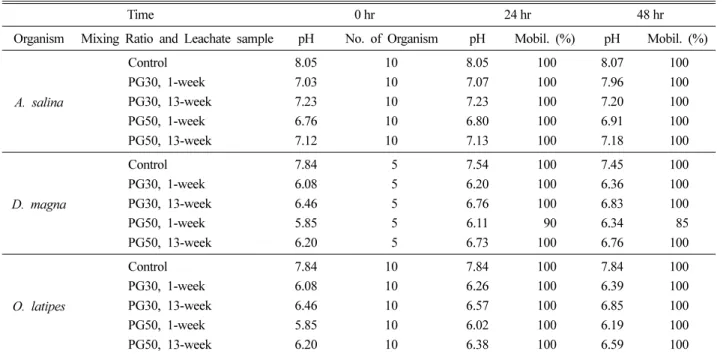
In the column test, pH ranged from 6.76 to 8.23 in 1- week and 13-week leachate samples using PG30 and PG50 (Table 3). No immobilization rates occurred in the 13-week Table 3. Mobilization of A. salina, D. magna and O. latipes from column test

Time 0 hr 24 hr 48 hr

Organism Mixing Ratio and Leachate sample pH No. of Organism pH Mobil. (%) pH Mobil. (%)

A. salina

Control 8.05 10 8.05 100 8.07 100

PG30, 1-week 7.03 10 7.07 100 7.96 100

PG30, 13-week 7.23 10 7.23 100 7.20 100

PG50, 1-week 6.76 10 6.80 100 6.91 100

PG50, 13-week 7.12 10 7.13 100 7.18 100

D. magna

Control 7.84 5 7.54 100 7.45 100

PG30, 1-week 6.08 5 6.20 100 6.36 100

PG30, 13-week 6.46 5 6.76 100 6.83 100

PG50, 1-week 5.85 5 6.11 90 6.34 85

PG50, 13-week 6.20 5 6.73 100 6.76 100

O. latipes

Control 7.84 10 7.84 100 7.84 100

PG30, 1-week 6.08 10 6.26 100 6.39 100

PG30, 13-week 6.46 10 6.57 100 6.85 100

PG50, 1-week 5.85 10 6.02 100 6.19 100

PG50, 13-week 6.20 10 6.38 100 6.59 100

Mobil.: Mobilization

Fig. 5. Effective and lethal concentrations for A. salina and O.

latipes.

(6)

sample. In other words, no toxic effect of mixing ratios on the survival of A. salina was found up to 13 weeks. pH and DO values were at least 6.7 and 8.07, respectively.

The standard toxicity test is a significant factor to determine whether organisms are susceptible to toxic compounds.

Potassium dichromate was selected as a toxic compound because it has been widely used for eco-toxicity studies. A.

salina was less sensitive to potassium dichromate than D.

magna. The toxicity unit (TU) was less than 1, which indicated no significant eco-toxicity effect. In case of the A.

salina, a total of 300 organisms were subjected to the same column test 30 times, and all of them were survived. A reference test in the absence of PG was conducted simultaneously, and showed 100% survival of A. salina.

The survival rate of A. salina was greater than that of D.

magna at each mixing ratio due to the higher pH values.

Proper pH and DO may have affected on the survival of organism in the batch test.

3.5. Acute toxicity test of O. latipes

The survival of ten O. latipes was investigated in a column test. As summarized in Table 3, 100% survival was observed in 1-week and 13-week leachate samples with both PG30 and PG50. In other words, an appropriate pH values facilitated growth of O. latipes. In the case of O.

latipes, a total of 150 organisms were subjected to the same column test 15 times, and all survived. Like A. salina and D. magna, the toxicity unit of O. latipes was less than 1, indicating no significant eco-toxicity effect. Therefore, PG generated by fertilizer production could be recycled in the presence of soil.

4. Conclusion

Batch and column toxicity tests of four organisms were performed in order to investigate the feasibility of recycled PG as an embankment material. In the column test, survival rates for all organisms were 100% using 1-week and 13- week leachates. It was likely that A. salina and D. magna survived well with PG30 or PG50 in the column tests. In a 48-hr batch test, the mobilization rates of A. salina and D.

magna with PG50 were 73 and 55%, respectively. In the batch and column tests, PG30 exhibited no inhibit effect.

The toxicity unit (TU) for three organisms (A. salina, D.

magna and O. latipes) was less than 1, indicating no significant ecotoxicity effect. An appropriate pH value with PG was an important factor for the growth of three organisms. These findings suggested that PG30 could be recycled for use as an embankment and landfill material with soil.

Acknowledgement

This work was partially supported by grant No. R05- 2001-000-01275-0 from the EIP Research Project of Minis- try of Information and Economy, South Korea.

References

APHA, AWWA, WEF, Standard Methods for the Examination of Water and Wastewater, 1998, 20

th

ed., American Public Health Assoc. Washington, DC, USA.

Azam, S. and Abduljauwad, S.N., 2000, Influence of gypsification on engineering behaviour of expansive clay, J.

Geotech. Geoenviron. Eng., 126, 538-542.

Carvalho, M.C.S. and Raij, B.V., 1997, Calcium sulfate, phos- phogypsum and calcium carbonate in the amelioration of acid subsoils for root growth, Plant and Soil, 192, 38-48.

El-Shall, H., Abdel-All, E.A., and Moudgil, B.M., 2000, Effect of surfactants on phosphogypsum crystallization and filtration during wet-process phosphoric acid production, Sep. Sci. Tech- nol., 35, 395-410.

Garg, M., Singh, M., and Kumar, R., 1996, Some aspects of the durability of a phosphogypsum-lime-flyash binder, Constr.

Build. Mater., 10, 273-279.

Godinho-Castro, A.P., Testolin, R.C., Janke, L., Corrêa, A.X.,

and Radetski, C.M., 2012. Incorporation of gypsum waste in

Fig. 6. Survival rate of A. salina and D. magna in batch tests.

(7)

ceramic block production: Proposal for a minimal battery of tests to evaluate technical and environmental viability of this recycling process, Waste Manage., 32, 153-157.

Guo, T., 1998, Determination of Optimal Composition of Stabi- lized Phosphogypsum Composites for Saltwater Application, Ph.D. Dissertation, Louisiana State University, USA.

Han, B., Park, S.-H. Lee, W.-B., Kim, S.-U., and Kim, J., 2011, Investigation of toxicity and respiration of used phosphogyp- sum for recycling, J. Korea Soc. Waste Manag., 28, 793-799.

Ho, R. and Zimpfer, W., 1985, Comments on the Investigation of Phosphogypsum for Embankment Construction, Proceedings of the Second Workshop on By-products of Phosphate Indus- tries, Miami, Florida, USA.

Lee, Y.S. and Hyun, J.H., 2006, Adsorption of heavy metal into phosphogypsum admixed granite soil, J. Korea Soc. Waste Manag., 23, 38-44.

Papastefanou, C., Stoulos, S., Ioannidou, A. and Manolopoulou, M., 2006, The application of phosphogypsum in agriculture and the radiological impact, J. Environ. Radioact., 89, 188-198.

Pericleous, V.P. and Metcalf, J.B., 1996, Resilient modulus of cement stabilized phosphogypsum, J. Mater. Civ. Eng., 8, 7-10.

Park, S. and Kim, J., 2012, Ecotoxicity evaluation of phospho- gysum recycle for algae and daphnia magna, J. Korean Soc.

Environ. Eng., 34, 528-532.

Reijnders, L., 2007, Cleaner phosphogypsum, coal combustion ashes and waste incineration ashes for application in building materials: A review, Build. Environ., 42, 1036-1042.

Renteria-Villalobos, M., Vioque, I., Mantero, J., and Manjon, G., 2010, Radiological, chemical and morphological characteriza- tions of phosphate rock and phosphogypsum from phosphoric acid factories in SW Spain, J. Hazrd. Mater., 181, 193-203.

Shen, W., Zhou, M., and Zhao, Q., 2007, Study on lime-fly ash- phosphogypsum binder, Constr. Build. Mater., 21, 1480-1485.

Singh, M., 2002, Treating waste phosphogypsum for cement and plaster manufacture, Cem. Concr. Res., 32, 1033-1038.

Tayibi, H., Choura, M., Lopez, F.A., Alguacil, F.J., and Lopez- Delgado, A., 2009, Environmental impact and management of phosphogypsum, Environ. Manage., 90, 2377-2386.

U.S. EPA, 2002, Method for Measuring the Acute Toxicity of

Effluents and Receiving Waters to Freshwater and Marine

Organisms, EPA-821-R02-121, 275.

수치

Fig. 1. Effective concentrations for S. capricornutum and  D.
Table 2. Result of standard toxicity tests using potassium dichromate for four organisms
Fig. 5. Effective and lethal concentrations for A. salina and O.

참조

관련 문서

A laboratory experiment was performed to investigate the removal of nitrogen and phosphorus from plating factory effluent using the soil column.. Soil,

Objective: The purpose of this study was to investigate the relationship between the awareness of death and the ethical attitude to Do-Not-Resuscitate (DNR) among some

Objective : The study aim was to estimate the prevalence of sleep disturbance and depressive symptoms as well as to examine the moderating effect of

This retrospective chart review was conducted to determine the effectiveness of antipsychotics when given as antidepressant augmentation agents to inpatients

In this study, two experiments were conducted to understand the effects of additional charge on the detailed growth mechanism of Alq 3 and to determine the effect of

In this context, this study compared and analyzed a variety of soil decontamination methods used to evaluate the wide-area soil contaminated with Cs:

The purpose of this study was to provide primary material in discussing methods to activate the treatment effects of diabetes and reduce the rate of

ƒ Performing the selection as early as possible reduces the size of Performing the selection as early as possible reduces the size of the relation to be joined... number of