www.earticle.net
근육 부위 및 숙성에 따른 한우 경산우육의 유리 아미노산과 향기 성분
강선문 ․ 강근호 ․ 성필남 ․ 김현섭 ․ 정석근 ․ 박범영 ․ 김동훈 ․ 조수현* 농촌진흥청 국립축산과학원
Free Amino Acids and Aroma Compounds of Hanwoo (Korean Cattle) Cow Beef by Muscle Parts and Aging
Sun Moon Kang, Geunho Kang, Pilnam Seong, Hyunsup Kim, Seokgeun Jung, Beomyoung Park, Donghun Kim and Soohyun Cho*
National Institute of Animal Science, Rural Development Administration
ABSTRACT1)
This study was carried out to investigate the effect of muscle part and aging period on free amino acids and aroma compounds of Hanwoo (Korean cattle) cow beef. The M. longissimus (ML) and M. semitendinosus (MS) from 101 mon-old-cows were aged at 2℃ for 14 d. The free amino acids concentration increased in both ML and MS on 14 d of aging. In ML, asparagine, glutamine, histidine, glycine, threonine, arginine, tyrosine, phenylalanine, isoleucine, leucine and lysine were significantly (p<0.05) higher than those in MS. Varieties of aldehydes, ketones, alcohols, hydrocarbons, nitrogen and sulfur compounds were detected in both ML and MS and majority of these compounds showed increasing trend on aging. The ML had higher 14 aldehydes (acetaldehyde, 2-methylpropanal, 3-methylbutanal, 2-methylbutanal, pentanal, hexanal, heptanal, E-2-heptanal, octanal, 2-octenal, 2-nonenal, E-2-decenal, E,E-2,4-decadienal and 2-undecenal), 5 ketones (2-propanone, 2,3-butanedione, 2-butanone, 2-heptanone and 2,3-octanedione), 4 alcohols (ethanol, 1-pentanol, 1-hexanol and 1-octanol), 3 hydrocarbons (3-ethyl-2-methyl-1,3-hexadiene, 3-methyldecane and 2,2-dimethyloctane) significantly (p<0.05) compared with MS. However, the MS had higher 5 nitrogen and sulfur compounds (methanethiol, dimethyldisulfide, fufural, 2,5-dimethylpyrazine and 2-octylfuran) significantly (p<0.05) compared with ML.
(Key words: Free amino acids, Aroma compounds, Aging, Hanwoo cow beef)
Ι .
서론식육의 소비 경향은 시대의 흐름에 따라 바뀌고 있다. 과 거 소비자들은 식육의 양적인 측면을 중요시 하여 더 싼 값 에 더 많은 양의 고기를 구입하여 먹고자 하였다. 하지만 현 재의 고소득 시대로 접어들면서 소비자들은 질적인 가치를 중요하게 여겨 비싼 값을 지불할지라도 품질이 더 좋은 고 기를 먹기를 원하고 있다(Stezer 등, 2008). 또한 현대 소비자 들이 가장 고려하는 품질 요인은 기호도와 건강 기능성이다.
식육의 관능적 기호도는 생산 가축의 품종, 성별, 사육조 건 및 도축 전후의 처리 방법, 가열 방법 등 다양한 요인들 에 의해 영향을 받으며(Risvik, 1994), 이를 결정짓는 항목은 연도, 다즙성, 맛과 향으로서 높은 상관성을 가지고 있다고 보고되었다(Monson 등, 2005). 특히 국내 소비자들을 대상 으로 한 Cho 등(2008a)의 관능 평가에서는 연도, 다즙성, 맛 과 향기가 각각 0.51, 0.19, 0.30의 맛 만족도 가중치를 받아 서양인들이 중시하는 연도(Maher 등, 2004) 이외에도 맛과 향기가 기호도에서 아주 큰 부분을 차지함이 밝혀졌다.
* Corresponding author: Soohyun Cho, Animal Products Research and Development Division, National Institute of Animal Science, R.D.A., Suwon 441-706, Korea. Tel: +82-31-290-1703, E-mail: [email protected]
[Provider:earticle] Download by IP 118.70.52.165 at Monday, December 20, 2021 8:04 PM
www.earticle.net
식육의 향미는 단맛, 신맛, 쓴맛, 짠맛, 우마미(umami)의 기본 맛과 휘발성 성분들의 복합 작용에 의한 산물이며 (MacLeod, 1994), 이를 위한 전구 물질로서 당, 아미노산, 펩타이드, 핵산 및 지방산에 의해 영향을 받는다(Shahidi, 1998). 그 중 아미노산은 Maillard 및 Strecker 반응을 통해 휘발성 향기 성분을 생성하며(Ventanas 등, 1992), 특히 유 리 아미노산의 경우 맛에 직접적으로 관여하거나(Kato 등, 1989) 간접적으로 다양한 악취 물질을 생성한다(Hidalgo와 Zamora, 2000). 한편 지방산은 불포화지방산의 산화 반응을 통해 여러 가지의 특이 향기들을 발생시키며, 특히 인지질 과 다가불포화지방산의 산화는 알데하이드 계열의 성분들 (hexanal, heptenal, pentanal 등)을 생성시켜 저농도에서도 불쾌한 악취를 느끼게 한다(Melton, 1990).
숙성은 생화학적 변화를 통해 고기의 맛과 향기를 변화시 키고, 이 기간 동안 발생한 지방산화물과 카르보닐은 고기의 향미에 현저하게 영향을 준다(Gorraiz 등, 2002; Mottram, 1998). 그러므로 숙성기간에 따라 고기의 향미 특성이 바뀌 게 되며, Yancey 등(2006)은 35일간 숙성시킨 쇠고기에서 금 속취(metallic flavor)의 증가를 보고한 바 있다.
우리나라 한우 고기는 맛과 마블링이 우수하여 수입 쇠고 기에 비해 고가임에도 불구하고 국내 소비자들 사이에서는 고급 브랜드육으로 인식되어 선호되고 있다. 이 뿐만 아니 라 Hwang 등(2004)과 Yang 등(2007)의 연구에서도 관능평 가를 통해 한우육의 향미가 수입 쇠고기보다 뛰어나다고 보 고된 바 있다. 하지만 한우육의 맛과 향기의 근원이 되는 전 구 물질들의 정량과 이들을 통해 생성된 향기 성분들의 프 로파일링에 대한 연구가 거의 이루어져 있지 않아 한우육 향미의 우수성에 대한 과학적인 근거 자료가 부족한 실정이 다. 따라서 본 연구는 부위별로 숙성한 한우 경산우육에서 향미의 주요 전구 물질 중 하나인 유리 아미노산과 휘발성 향기 성분을 구명하고자 실시하였다.
Ⅱ. 재료 및 방법
1. 시험동물 및 시료의 처리
시험동물은 국립축산과학원 한우시험장에서 공시한 101
±25개월령의 한우 경산우 6두(2±1산차)를 (사)평창기업에서 도축하여 1℃에서 1일 동안 냉각한 후 지육등급사에 의해 육질 등급을 1등급(3두)과 2등급(3두)으로 판정받았다. 6두 의 도체들을 평창 소재 A육가공장으로 운송하여 발골 처리 하였으며, 본 실험을 위한 시료로서 6두의 좌도체에서 등심
(M. longissimus)과 우둔(M. semitendinosus)을 채취하였다.
이후 등심과 우둔의 등지방, 결체조직 및 혈액을 깨끗이 제 거한 다음 1/2 분할 및 진공포장하여 2℃/암실에서 14일 동 안 숙성하였다. 숙성이 완료된 시료는 작게 절단하여 액체 질소로 급속 냉각시킨 후 가정용 믹서(FM-909W, Hanil Electric, Korea)를 이용하여 분말의 형태로 갈아 실험 직전 까지 -60℃에 보관하였다.
2. HPLC를 이용한 유리 아미노산 분석
유리 아미노산은 Aristoy와 Toldrá(1991)의 방법에 의해 실시하였다. 냉동 분말 시료 1 g과 얼음에 냉각시킨 0.01 N HCl 용액 5 mL를 15,000 rpm(T25 digital Ultra-Turrax, Ika Werke GmbH & Co., Germany)에서 1분 동안(20초×3회) 균질한 후 2℃/10,000 g(SCR20BA Himac Centrifuge, Hitachi Ltd., Japan)에서 20분 동안 원심분리하였다.
Whatman filter paper No. 1으로 여과한 상등액 300 μL를 내부 표준물질(25 nmol hydroxyproline/μL) 10 μL와 함께 acetonitrile(HPLC grade) 690 μL를 첨가한 후 단백질을 제 거하기 위해 실온에서 30분 동안 방치한 다음 2℃/10,000 g 에서 15분 동안 원심분리하였다. 준비된 상등액은 0.45 μm syringe filter로 여과하여 Bidlingmeyer 등(1987)의 방법에 의해 유도체화시켰다. 이후 유도체화물은 Zorbax Eclipse XDB-C18 column(Analytical 4.6 mm×150 mm×5 μm, Agilent Technologies, USA)과 diode array detector가 장착 된 HPLC(Agilent 1200, Agilent Technologies, USA)를 이용 하여 338 nm에서 분석하였다. 또한 mobile phase A와 B는 각각 10 mM Na2HPO4-10 mM Na2B4O7(pH 8.2)-0.5 mM NaN3 용액과 acetonitrile-methanol-water(45:45:10) 용액을 이용하였으며, 각각의 아미노산들은 고기 1 g당 μmol로 산 출하였다.
3. SPME-GC/MS를 이용한 향기 성분 분석
휘발성 향기 성분은 Ji 등(2010)의 방법에 의해 실시하였 다. 냉동 분말 시료 1 g을 40 mL 용량의 headspace vial (CAT No. 27010-U, 29×82 mm, Supelco, USA)에 정확히 취 하여 polytetrafluoroethylene/silicone septum cap으로 닫은 후 autoclave(ACCE-860, Choongwae Medical Corp., Korea)를 이용하여 132℃에서 30분 동안 가열하였다. 가열 된 시료들은 4℃에서 냉각하여 소형 magnetic bar와 내부 표준물질(0.816 μg 3-methyl-2-heptanone/μL methanol) 1 μL를 넣고, SPME(solid-phase microextraction)용 75 μm
[Provider:earticle] Download by IP 118.70.52.165 at Monday, December 20, 2021 8:04 PM
www.earticle.net
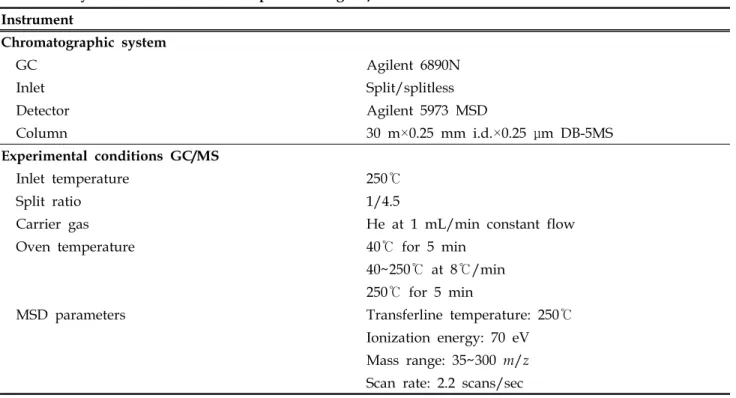
Table 1. Analytical method of aroma compounds using GS/MS Instrument
Chromatographic system
GC Agilent 6890N
Inlet Split/splitless
Detector Agilent 5973 MSD
Column 30 m×0.25 mm i.d.×0.25 μm DB-5MS
Experimental conditions GC/MS
Inlet temperature 250℃
Split ratio 1/4.5
Carrier gas He at 1 mL/min constant flow
Oven temperature 40℃ for 5 min
40~250℃ at 8℃/min 250℃ for 5 min
MSD parameters Transferline temperature: 250℃
Ionization energy: 70 eV Mass range: 35~300 m/z Scan rate: 2.2 scans/sec
carboxen/polydimethylsiloxane fiber(Cat No. 57344-U, Supelco, USA)를 septum에 꽂은 다음 60℃ water bath (VS-8480SR, Vision Scientific, Korea)에서 5분 동안 열평형 시켰다. 열평형이 완료된 후 magnetic stirrer를 작동시키고 fiber를 vial 내부로 노출시켜 55분 동안 향기 성분들을 흡착 시켰다.
이때 fiber를 사용하기 직전 250℃의 GC(gas chromatography) injector에서 1시간 동안 conditioning시켰다. 흡착된 성분들 은 250℃의 GC injector에서 5분 동안 탈착시켜 DB-5MS column(30 m length×0.25 mm i.d.×0.25 μm film thickness, J & W Scientific, USA)이 장착된 GC(6890N, Agilent Technologies, USA)/mass spectrometry(MS, 5973 Mass Selective Detector, Agilent Technologies, USA)에 의해 분 석하였다. 그 외 GC/MS의 자세한 조건은 Table 1과 같다.
향기 성분들의 동정은 Wiley Registry of Mass Spectral Data(7th ed), NIST Chemstry WebBook(6th ed), Sigma- Aldrich(USA) 및 Fluka(Switzerland)의 표준 시약들 (pentanal, hexanal, heptanal, octanal, octenal, nonanal, E-2-heptenal, E-2-octenal, E,E-2,4-nonadienal, E,E-2,4- decadienal, E-2-nonenal, phenylacetaldehyde, 2-octanone, 1-octanol, pyrazine, 2-methylpyrazine, 1-pentanol, 1-octen- 3-ol, naphtalene, 2-heptanone, 2-hexanone, decanal)을 이용 하였으며, retention time index로 C8-C20 alkane standard
solution(CAT No. 04070, Fluka, Switzerland)을 이용하였 다. 또한 각 성분들의 수치는 분석된 피크들의 면적과 내부 표준물질의 농도를 이용하여 고기 1 g당 ng으로 산출하였다.
4. 통계분석
본 실험을 통해 얻은 모든 자료는 SPSS(2009) program의 ANOVA(analysis of variance)에 의해 분석하였으며, 각 평 균들간의 유의성 차이는 Duncan's multiple range test에 의 해 5% 수준에서 검증하였다.
Ⅲ. 결과 및 고찰
1. 유리 아미노산 비교
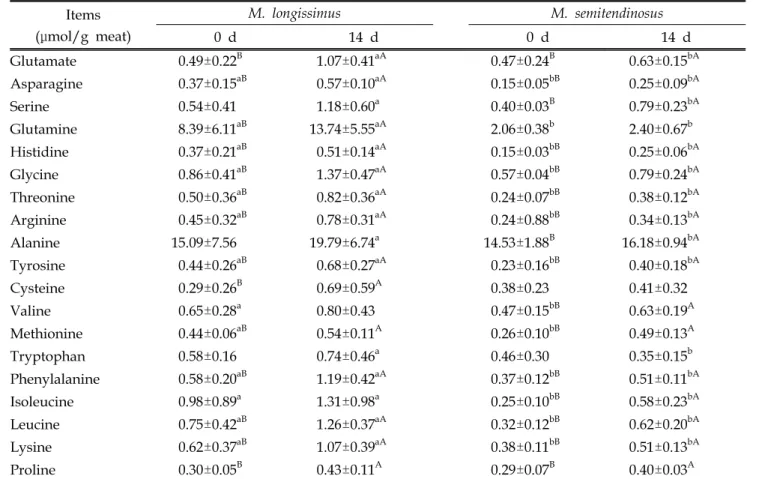
근육 부위와 숙성기간이 한우 경산우육의 유리 아미노산 에 미치는 영향은 Table 2와 같다. 본 실험에서는 등심(M.
longissimus) 및 우둔(M. semitendinosus) 모두에서 단맛 계열 의 아미노산인 asparagine, glutamine, serine, glycine, threonine, alanine, cysteine, methionine, lysine, proline과 신맛 계열의 glutamate, 쓴맛 계열의 histidine, arginine, tyrosine, valine, tryptophan, isoleucine, leucine(Field 등,
[Provider:earticle] Download by IP 118.70.52.165 at Monday, December 20, 2021 8:04 PM
www.earticle.net
Table 2. Effects of muscle part and aging period on free amino acids of Hanwoo (Korean cattle) cow beef Items
(μmol/g meat)
M. longissimus M. semitendinosus
0 d 14 d 0 d 14 d
Glutamate 0.49±0.22B 1.07±0.41aA 0.47±0.24B 0.63±0.15bA Asparagine 0.37±0.15aB 0.57±0.10aA 0.15±0.05bB 0.25±0.09bA
Serine 0.54±0.41 1.18±0.60a 0.40±0.03B 0.79±0.23bA
Glutamine 8.39±6.11aB 13.74±5.55aA 2.06±0.38b 2.40±0.67b Histidine 0.37±0.21aB 0.51±0.14aA 0.15±0.03bB 0.25±0.06bA Glycine 0.86±0.41aB 1.37±0.47aA 0.57±0.04bB 0.79±0.24bA Threonine 0.50±0.36aB 0.82±0.36aA 0.24±0.07bB 0.38±0.12bA Arginine 0.45±0.32aB 0.78±0.31aA 0.24±0.88bB 0.34±0.13bA
Alanine 15.09±7.56 19.79±6.74a 14.53±1.88B 16.18±0.94bA
Tyrosine 0.44±0.26aB 0.68±0.27aA 0.23±0.16bB 0.40±0.18bA
Cysteine 0.29±0.26B 0.69±0.59A 0.38±0.23 0.41±0.32
Valine 0.65±0.28a 0.80±0.43 0.47±0.15bB 0.63±0.19A
Methionine 0.44±0.06aB 0.54±0.11A 0.26±0.10bB 0.49±0.13A
Tryptophan 0.58±0.16 0.74±0.46a 0.46±0.30 0.35±0.15b
Phenylalanine 0.58±0.20aB 1.19±0.42aA 0.37±0.12bB 0.51±0.11bA Isoleucine 0.98±0.89a 1.31±0.98a 0.25±0.10bB 0.58±0.23bA Leucine 0.75±0.42aB 1.26±0.37aA 0.32±0.12bB 0.62±0.20bA Lysine 0.62±0.37aB 1.07±0.39aA 0.38±0.11bB 0.51±0.13bA
Proline 0.30±0.05B 0.43±0.11A 0.29±0.07B 0.40±0.03A
a,b Means±S.D. with different superscripts indicate significant differences between different muscle parts in the same aging period (p<0.05).
A,B Means±S.D. with different superscripts indicate significant differences between different aging periods in the same muscle part (p<0.05).
1971; Parrish 등, 1969)의 19종 아미노산들이 동정되었다.
이 중 asparagine, glutamine, histidine, glycine, threonine, arginine, tyrosine, phenylalanine, isoleucine, leucine 및 lysine이 등심에서 우둔보다 유의적으로 높게 나타났다 (p<0.05). 특히 단맛과 관련한 아미노산 중 glutamine이 약 4~6배, 신맛과 관련한 아미노산 중 asparagine이 약 2.3~2.5 배, 쓴맛과 관련한 아미노산 중 2.3~3.9배로 가장 높은 함량 을 보였다. Cho 등(2007)은 한우 비거세우육(24개월령 이하) 의 부위별 성분에 관한 연구에서 등심이 우둔보다 높은 glutamine 및 낮은 alanine, isoleucine, leucine을 보였다고 보고하였다. 또한 Cho 등(2008b)은 1++등급의 한우 거세우 육(24~28개월령)에 관한 연구에서는 등심이 우둔보다 높은 glutamine, arginine 및 낮은 alanine, leucine을 보였다고 하 였다. 따라서 본 실험과 선행연구들의 결과들 간에 일부 유 리 아미노산들에서 차이를 보였으나, 한우의 연령, 성별 및 등급에 관계없이 모두 동일하게 등심의 glutamine 함량이
우둔보다 높은 것으로 나타났다. 또한 이러한 결과는 등심 에서 단맛이 우둔보다 강하는 것을 의미한다고 사료된다.
한편 숙성기간에 따른 유리 아미노산들의 변화를 살펴보 면, 전반적으로 19종의 모든 유리 아미노산들의 함량이 숙 성 14일째에 증가하는 경향을 나타냈다. 특히 등심과 우둔 두 부위 모두에서 공통적으로 단맛과 관련한 asparagine, glycine, threonine, methionine, lysine, proline, 신맛과 관련 한 glutamate, 쓴맛과 관련한 histidine, arginine, tyrosine, phenylalanine, leucine이 유의적으로 증가하였다(p<0.05).
또한 단맛과 관련한 glutamine, cysteine은 등심에서만 유의 적으로 증가하였으며(p<0.05), cysteine의 경우 약 2.4배로 다른 유리 아미노산들에 비해 가장 높은 증가율을 보여 주 었다. 반면에 단맛과 관련한 serine, alanine, 쓴맛과 관련한 valine, isoleucine은 우둔에서만 유의적으로 증가하였으며 (p<0.05), isoleucine의 경우 약 2.3배로 가장 높은 증가율을 보였다. Parrish 등(1969)의 연구에서도 본 실험결과와 유사
[Provider:earticle] Download by IP 118.70.52.165 at Monday, December 20, 2021 8:04 PM
www.earticle.net
하게 쇠고기의 숙성 14일째 glutamine의 증가가 보고되었으 며, Field 등(1971)의 연구에서도 쇠고기의 숙성 중 arginine, glutamine, histidine, methionine, phenylalanine, isoleucine, leucine의 증가가 보고되었다. 이렇게 고기의 숙성 중 유리 아미노산의 함량이 증가하는 이유는 고기 내 여러 가지 단백 질 관련 효소들의 분해 작용이 일어나기 때문이다(Toldrá 등, 1995). 최초 단계에서는 calpain, cathepsin 및 multicatalytic proteinase complex에 의해 polypeptide로 분해된 다음 dipeptidyl peptidase, tripeptidyl peptidase 및 carboxipeptidase와 같은 peptidase에 의해 작은 분자의 peptide로 분해된다. 이후 마지막 단계에서 aminopeptidase, dipeptidase 및 tripeptidase의 작용에 의해 유리 아미노산들 이 생성된다. 따라서 고기의 향미를 좋고 깊게 하기 위해서 는 숙성을 통한 적절한 단백질 분해 작용이 관건이다. 하지 만 본 실험에서의 한우육과는 다르게 Koutsidis 등(2008)의 Charolais 거세우육 숙성 실험에서는 glutamine과 alanine 이 숙성기간 동안 동일한 수준으로 유지되었다고 보고되었 다. 이러한 이유는 두 품종간의 유전적 차이로 인한 단백질 분해 관련 효소들의 특성 차이 때문인 것으로 사료된다.
2. 향기 성분 비교
근육 부위 및 숙성기간이 한우 경산우육의 휘발성 향기 성분에 미치는 영향은 Table 3과 같다. 본 실험결과에서 등 심의 경우 21종의 알데하이드류, 6종의 케톤류, 5종의 알코 올류, 6종의 탄화수소류, 12종의 질소 및 황 화합물이 검출 된 반면, 우둔의 경우 22종의 알데하이드류, 5종의 케톤류, 4 종의 알코올류, 6종의 탄화수소류, 17종의 질소 및 황 화합 물이 검출되었다. 알데하이드류의 경우 숙성기간 동안 등심 에서는 acetaldehyde, 2-methylpropanal, 3-methylbutanal, 2-methylbutanal, pentanal, hexanal, heptanal, E-2-heptenal, octanal, 2-octenal, 2-nonenal, E-2-decenal, E,E-2,4- decadienal, 2-undecenal이 유의적으로 높게 나타난 반면 (p<0.05), 우둔에서는 undecenal, tetradecanal, hexadecanal, alpha-bezenacetaldehyde가 유의적으로 높게 나타나(p<0.05) 등심이 우둔보다 많은 수의 알데하이드류들을 생성하는 것 으로 나타났다. 또한 숙성 14일째 많은 종류의 알데하이드 류들이 유의적으로 증가하였으며(p<0.05), 특히 tetradecanal 의 경우 등심 및 우둔에서 각각 15 및 4.2배, hexadecanal의 경우 8.9 및 3.2배, E-2-decenal의 경우 4.7 및 3.7배, benzenacetaldehyde의 경우 5.4 및 19배로 현저하게 높은 증가율을 보여 주었다. 대부분의 알데하이드류는 지방산의 자동산화를 통해 생성된다(Forss, 1972). 이 성분들은 저농도
의 함량으로도 육제품의 향기에 강력한 영향을 주며, 특히 butter, sweet, floral, green 등의 향기를 발생시킨다 (Stahnke, 1998). 또한 몇몇 알코올류 역시 지방산화 반응을 통해 생성되기 때문에 상대적으로 alcohol dehydrogenase 에 의한 알코올류의 증가에 따라 그 생성량이 감소된다 (Shahidi, 1994). 대표적인 n6 지방산인 linoleic acid(C18:
2n6)의 산화에 의해 생성되는 알데하이드류에는 hexanal, E-2-heptenal, E-2-octenal, E,E-2,4-decadienal이 있으며, n3 지방산인 linolenic acid(C18:3n3)의 산화에 의해 생성되는 알데하이드류에는 benzaldehyde, E,E-2,4-heptadienal, E,Z-2,4-heptadienal이 있다(Elmore 등, 2002; López 등, 1992). 하지만 3-methylbutanal과 2-methylpropanal은 isoleucine과 valine의 분해를 통해 생성되며(Ho 등, 1994), benzenacetaldehyde는 phenylalanine의 Strecker 분해 반응 을 통해 생성된다(Belitz와 Grosch, 1997). 본 실험결과에서 등심이 우둔에 비해 많은 수의 알데하이드류에서 높은 함량 을 보이고 숙성 중 높은 증가율을 보인 이유는 1++등급 한우 거세우육의 지방산 조성을 부위별로 비교한 결과 등심과 우 둔간에 큰 차이가 없었다는 Cho 등(2008)의 보고로 미루어 볼 때, 등심의 마블링이 우둔에 비해 상대적으로 높아 이에 따라 지방과 관련된 알데하이드류의 생성량이 높았기 때문 으로 사료된다. 또한 본 실험에서 유리 아미노산의 결과로 미루어 볼 때 등심이 향기와 관련한 phenylalanine 등의 유 리 아미노산을 우둔보다 고농도로 함유하였기 때문으로 사 료된다. 한편 Machiels 등(2004)은 Belgian Blue, Limousin 및 Aberdeen Angus 쇠고기의 향기 성분 비교 실험에서 21 종의 성분, 특히 알데하이드류(2,4-nonadienal, nonenal, heptanal, 2-methylpropanal, 2-methylbutanal, 2-octenal, 3-diethyl-5 -methylpyrazine, 2-acetylthiazole, methanethiol, 2-octanone, dimethyl trisulfide, 2,3-pentanedione, ethylacetate, 2-butanone)에서 현저한 차이를 발견하였으며, 이러한 이유 는 두 품종간에 지방산 조성의 차이 때문이라고 보고하였 다. 한우육의 경우도 방목 사육하는 호주산 쇠고기와는 달 리 옥내에서 곡류 비육을 시켜 이들과 지방산 조성이 달라 지기 때문에, 둘간에 향기 성분을 비교하게 된다면 많은 종 의 알데하이드류에서 큰 차이가 나타날 것으로 예상된다.
케톤류는 3-hydroxy-2-butanone을 제외한 2-propanone, 2,3-butanedione, 2-butanone, 2-heptanone, 2,3-octanedione 이 등심에서 숙성기간 동안 유의적으로 높게 나타났으며 (p<0.05), 또한 숙성 14일째 2-heptanone이 등심 및 우둔에 서 약 2배, 2,3-octanedione이 등심에서 52배 증가하는 것으 로 나타났다(p<0.05). 케톤류 중 straight chain ketone류 역 시 지방산화에 의해 발생되며(Belitz와 Grosch, 1997),
[Provider:earticle] Download by IP 118.70.52.165 at Monday, December 20, 2021 8:04 PM
www.earticle.net
Table 3. Effects of muscle part and aging period on aroma compounds of Hanwoo (Korean cattle) cow beef
Items (ng/g meat)
Retention time (min)
M. longissimus M. semitendinosus
0 d 14 d 0 d 14 d
Aldehydes
Acetaldehyde 3.13 129.4±45.5aB 214.9±74.5aA 70.8±23.6b 63.9±15.6b 2-methylpropanal 3.96 21.9±9.9aA 5.7±13.4B 11.6±6.5b 15.1±7.5 2-butenal 5.35 6.2±7.1 1.2±3.7 1.2±2.8 1.1±2.5 3-methylbutanal 5.46 121.2±45.6a 85.2±46.9 46.7±25.4bB 102.9±31.5A 2-methylbutanal 5.64 116.8±64.1aA 13.8±24.1aB 56.5±26.3b 58.7±17.9b Pentanal 6.44 204.9±51.1a 256.2±76.6a 79.8±41.1b 58.0±16.5b Hexanal 9.40 824.4±221.8aB 1383.8±409.9aA 294.7±162.0b 266.0±147.1b Heptanal 12.27 320.9±140.3aB 740.7±292.9aA 113.8±68.5bB 209.0±100.8bA E-2-heptenal 13.68 61.5±25.5a 99.1±59.7 10.6±23.6b N.D.1) Benzaldehyde 13.87 925.4±312.2B 1232.0±175.1A 845.9±443.9B 1541.4±460.5A Octanal 14.78 388.6±163.1aB 852.1±338.4aA 191.0±120.5bB 368.3±163.9bA Benzenacetaldehyde 15.76 9.6±16.7B 54.0±53.4A N.D.1) 19.2±9.8 2-octenal 16.01 49.4±16.6aB 135.3±47.8aA 17.0±8.0b 25.7±10.0b Nonanal 16.98 350.8±102.4B 892.6±254.1aA 275.2±152.4B 641.0±232.0bA 2-nonenal 18.10 27.2±15.4a 102.5±41.4a 12.4±14.3bB 18.9±10.9bA Decanal 18.97 11.3±6.6B 37.1±17.7A 19.5±14.1B 47.2±16.2A E-2-decenal 20.01 22.8±10.0B 107.7±45.5aA 16.4±11.4B 58.5±58.2bA Undecenal 20.80 0.6±2.0B 5.2±8.6bA 7.8±5.8B 24.1±7.7aA E,E-2,4-decadienal 21.03 7.0±7.7B 43.2±11.7aA 8.2±7.0B 17.6±4.7bA 2-undecenal 21.78 10.1±7.8B 65.9±26.8aA 14.8±10.1B 35.2±21.4bA Tetradecanal 25.62 0.5±1.7bB 15.4±6.9bA 9.3±8.5aB 37.9±15.3aA Hexadecanal 28.40 22.3±13.6bB 197.3±59.9bA 137.3±90.1aB 438.9±142.1aA
Ketones
2-propanone 3.48 49.1±22.7a 54.5±23.0a 21.3±10.3b 24.6±7.8b 2,3-butanedione 4.28 25.2±12.7 38.7±20.1a 15.9±7.9 11.7±5.2b 2-butanone 4.37 92.1±28.8a 96.6±28.1a 52.8±21.7b 44.4±14.1b 3-hydroxy
-2-butanone 6.72 83.0±40.8 54.0±69.4 73.6±43.1B 34.4±9.1A 2-heptanone 11.93 34.5±24.8aB 69.5±38.5aA 12.5±10.6bB 24.7±13.5bA
2,3-octanedione 14.31 N.D.1) 0.052±0.053 N.D. N.D.
Alcohols
Ethanol 3.35 N.D. 7.9±13.6 N.D. N.D.
1-pentanol 8.43 87.2±20.6aB 124.7±38.3aA 37.6±17.1b 43.4±12.5b
a,b Means±S.D. with different superscripts indicate significant differences between different muscle parts in the same aging period (p<0.05).
A,B Means±S.D. with different superscripts indicate significant differences between different aging periods in the same muscle part (p<0.05).
1) N.D.: Not detected.
[Provider:earticle] Download by IP 118.70.52.165 at Monday, December 20, 2021 8:04 PM
www.earticle.net
Table 3. Continued
Items (ng/g meat)
Retention time (min)
M. longissimus M. semitendinosus
0 d 14 d 0 d 14 d
1-hexanol 11.37 25.3±12.3aB 60.5±20.4aA 7.9±9.6b 10.7±8.8b 1-octen-3-ol 14.22 140.5±49.2 146.9±49.7 90.2±66.7 110.8±28.6 1-octanol 16.24 33.4±16.8B 78.6±40.3A 23.2±12.6B 52.9±19.0A
Hydrocarbons 3-ethyl-2-methyl-1,3
-hexadiene 15.48 51.4±28.7 70.3±25.3a 21.1±48.6 8.9±4.8b 3-methyldecane 15.91 18.3±15.0a 18.4±11.7 3.2±4.3bB 11.2±4.4A 2,2-dimethyloctane 16.12 28.0±11.3a 15.6±15.8 6.3±7.2b 4.9±8.0 Dodecane 18.83 5.2±5.6b 11.1±14.5b 13.7±9.4aB 31.1±10.6aA Tridecane 20.63 3.6±4.8bB 26.3±10.3bA 14.4±8.1aB 41.6±11.1aA
Tetradecane 22.33 N.D.1) N.D. 4.3±3.0B 13.1±3.4A
Pentaecane 23.91 N.D. 5.9±11.0a 5.1±5.1B 22.1±6.7bA Nitrogen and sulfur compounds
Methanethiol 3.22 N.D. N.D. N.D. 9.5±7.5
Dimethyldisulfide 7.74 30.3±16.1A 4.2±13.4bB 18.4±11.1B 49.6±24.8aA Methylpyrazine 10.18 40.2±24.9a 42.3±12.7 15.1±6.6bB 32.7±7.9A Fufural 10.33 25.3±26.2 9.1±16.0b 15.3±8.9B 31.6±6.4aA 2-furanmethanol 10.94 17.7±11.7B 47.8±21.6aA 10.7±6.4 16.4±6.9b
2-butylfuran 11.97 N.D.1) 13.9±23.6 N.D. 10.9±14.3
Methional 12.41 N.D. N.D. N.D. 16.3±11.9
2,5-dimethylpyrazine 12.58 59.1±32.8 38.0±22.1b 36.5±15.8B 84.3±20.9aA Dimethyltrisulfide 14.08 161.4±75.5aA 102.7±24.9B 45.6±61.3bB 141.0±80.5A 2-pentylfuran 14.47 609.2±171.5aB 1220.5±345.0aA 384.8±201.8b 652.1±362.0b
2-acetylpyrrole 16.13 N.D. N.D. 4.4±7.1B 15.5±9.5A
4-methyl-2-propylfuran 16.48 N.D. N.D. N.D. 18.3±8.9
2-hexylfuran 16.68 16.0±8.6B 47.1±21.4A 22.7±13.3B 45.2±15.0A 2-formyl-1-methylpyrrole 18.55 N.D. N.D. 5.0±6.2B 13.0±5.3A 2-heptylfuran 18.71 8.4±7.5B 35.9±19.3A 14.7±12.8B 31.8±14.5A 2-octylfuran 20.54 8.2±6.2bB 40.4±14.8bA 26.0±18.0aB 79.6±31.1aA Diethylphthalate 25.29 13.8±12.3 24.6±12.3a 7.9±8.9 11.5±6.6b
a,b Means±S.D. with different superscripts indicate significant differences between different muscle parts in the same aging period (p<0.05).
A,B Means±S.D. with different superscripts indicate significant differences between different aging periods in the same muscle part (p<0.05).
1) N.D.: Not detected.
1-hydroxy-2-propanone, 3-hydroxy-2-butanone, acetoin(3- hydroxy-2-butanone), 3-methyl-2-pentanone은 glucide의 미생물 발효에 의해 생성된다(Kandler, 1983). 2-butanone과 그 외 기타 methyl-ketone류들은 미생물에 의한 포화지방산
의 β-oxidation을 통해 생성되며(Sunesen과 Stahnke, 2003), 특히 2-ketone의 경우 ethereal, butter, spicy, blue cheese 등의 향기를 발생시킨다(Lecanu 등, 2002). 알코올류는 ethanol, 1-pentanol, 1-hexanol, 1-octanol이 숙성기간 동안
[Provider:earticle] Download by IP 118.70.52.165 at Monday, December 20, 2021 8:04 PM
www.earticle.net
등심에서 유의적으로 높게 나타났으며(p<0.05), ethanol과 1-hexanol의 경우 등심이 8배 및 3~5.5배로 높은 함량을 보 였다. 또한 숙성기간에 따른 차이는 우둔에서는 1-octanol 한 가지 성분만이 유의적으로 증가한 반면(p<0.05), 등심에 서는 ethanol, 1-pentanol, 1-hexanol, 1-octanol 모두에서 유 의적인 증가를 보였다(p<0.05). 알코올류 중 chain alcohol은 다가불포화지방산의 산화에 의해 생성되는 반면(Forss, 1972), ethanol, 2-butanol, branched alcohol 등의 저분자 성 분들은 대부분 미생물 발효를 통해 발생된다(Sunese 등, 2001). octanol은 oleic acid(C18:1n9)의 산화에 의해 생성되 고(Flores 등, 1997), 3-methylbutanol과 2-methylbutanol은 leucine과 isoleucine의 Strecker 분해 반응을 통해 생성된 3-methylbutanal과 2-methylbutanal이 환원됨으로서 생성된 다(Muriel 등, 2004). 또한 알코올류 성분들은 herbaceous, woody, fatty, green 등의 향기를 발생시킨다(García와 Timón, 2001).
탄화수소류는 3-ethyl-2-methyl-1,3-hexadiene, 3-methyldecane, 2,2-dimethyloctane의 경우 숙성기간 동안 등심이 유의적으 로 높게 나타났으며(p<0.05), 특히 3-ethyl-2-methyl-1,3- hexadiene과 2,2-dimethyloctane은 7.8배 및 3.2~4.7배로 높 은 함량을 보였다. 하지만 dodecane, tridecane, tetradecane, pentadecane의 경우 우둔이 유의적으로 높게 나타났다 (p<0.05). 숙성기간에 따른 차이는 등심에서는 tridecane만 이 숙성 14일째 6.5배로 증가했던 반면(p<0.05), 우둔에서는 3-methyldecane, dodecane, tridecane, tetradecane, pentadecane이 숙성 14일째에 약 3~4배로 증가하였다(p
<0.05). 탄화수소류 중 aromatic hydrocarbon은 가축 사료가 체내 지방에 축적됨으로서 생성되며(Timón 등, 2001), methyl benzene과 같은 탄화수소는 지방산화물로부터 생성 된 unsaturated carboxylic chain의 cyclation을 통해 생성된 다(Min 등, 1977).
질소 및 황화합물은 methylpyrazine, 2-furanmethanol, dimethyltrisulfide, 2-pentylfuran, diethylphthalate가 숙성 기간 동안 등심에서 유의적으로 높게 나타났다(p<0.05). 하 지만 methanethiol, dimethyldisulfide, fufural, 2,5- dimethylpyrazine, 2-octylfuran의 경우 우둔에서 유의적으로 높게 나타났으며(p<0.05), 특히 methanethiol과 dimethyldisulfide 는 9배 및 12.5배로 높은 함량을 보였다. 또한 숙성 14일째 등심에서는 2-furanmethanol, 2-pentylfuran, 2-hexylfuran, 2-heptylfuran, 2-octylfuran에서 유의적인 증가를 보였으며 (p<0.05), 2-heptylfuran과 2-octylfuran은 4.5배 및 5배로 현저 하게 증가하였다. 숙성 14일의 우둔에서는 2-furanmethanol,
2-pentylfuran, diethylphthalate를 제외한 모든 성분들이 유 의적으로 증가하였으며(p<0.05), 특히 methanethiol, 2-butylfuran, methional, 4-methyl-2-propylfuran은 약 9~18배로 증가하 였다. 질소 및 황화합물의 경우 주로 아미노산으로부터 발 생되며, 특히 황화합물의 경우 cysteine, methionine과 같은 황함유 아미노산과 2,3-pentadione과 같은 지방산화물로부 터 생성된 carboxylic compound간의 반응을 통해 발생된다 (Ruiz 등, 2002). 또한 sulphuric, cauliflower, onion과 같은 향기를 발생시키며(Meynier 등, 1999), 낮은 농도로도 다른 향기 성분들과는 다르게 강력한 효과를 발휘한다(Edwards 등, 1999). 본 실험결과에서는 등심에 비해 우둔이 많은 수 의 질소 및 황화합물을 고농도로 함유한 이유는 상대적으로 우둔이 등심보다 지방 함량이 적고 단백질 함량이 높아 지 방보다는 단백질(아미노산)과 관련한 향기 성분들이 더욱 많이 생성되었기 때문으로 사료된다.
Ⅳ. 요약
본 연구는 근육 부위 및 숙성이 한우 경산우육의 유리 아 미노산 및 향기 성분에 미치는 영향을 구명하고자 실시하였 다. 시료의 처리는 101개월령 한우 경산우들의 등심(M.
longissimus)과 우둔(M. semitendinosus)을 2℃에서 14일 동안 숙성하였다. 유리 아미노산은 숙성 14일째 등심과 우둔 모 두에서 증가하였으며, asparagine, glutamine, histidine, glycine, threonine, arginine, tyrosine, phenylalanine, isoleucine, leucine, lysine에서 등심이 우둔보다 높았다 (p<0.05). 특히 glutamine의 경우 약 4~6배로 가장 높았다.
휘발성 향기 성분은 다양한 알데하이드류, 케톤류, 알코올 류, 탄화수소류, 질소 및 황화합물이 등심과 우둔에서 검출 되었으며, 다수의 성분들이 숙성 14일째 증가하는 경향을 보 였다. 또한 등심에서는 14종의 알데하이드류(acetaldehyde, 2-methylpropanal, 3-methylbutanal, 2-methylbutanal, pentanal, hexanal, heptanal, E-2-heptanal, octanal, 2- octenal, 2-nonenal, E-2-decenal, E,E-2,4-decadienal, 2-undecenal), 5종의 케톤류(2-propanone, 2,3-butanedione, 2-butanone, 2-heptanone, 2,3-octanedione), 4종의 알코올류 (ethanol, 1-pentanol, 1-hexanol, 1-octanol), 3종의 탄화수소 류(3-ethyl-2-methyl-1,3-hexadiene, 3-methyldecane, 2,2- dimethyloctane)에서 우둔에 비해 현저하게 높았다(p<0.05).
반면에 우둔에서는 5종의 질소 및 황화합물(methanethiol, dimethyldisulfide, fufuralll, 2,5-dimethylpyrazine, 2-
[Provider:earticle] Download by IP 118.70.52.165 at Monday, December 20, 2021 8:04 PM
www.earticle.net
octylfuran)이 등심에 비해 현저하게 높았다(p<0.05).
사사
본 연구는 농촌진흥청 박사후연수과정 지원사업(과제번 호: PJ907000022011)에 의해 이루어졌으며, 이에 감사드립니 다.
Ⅴ. 인용문헌
1. Aristoy, M. C. and Toldrá, F. 1991. Deproteinization techniques for amino acids analysis in fresh pork muscle and dry-cured ham. J. Agric. Food Chem.
39:1792-1795.
2. Belitz, H. D. and Grosch, W. 1997. Quuímica de los alimentos. 2nd ed, Acribia, Zaragoza, Spain.
3. Bidlingmeyer, B. A., Cohen, S. A., Tarvin, T. L. and Frost, B. A. 1987. New rapid high sensitivity analysis of amino acids in food type samples. J. Assoc. Anal.
Chem. 70:214-247.
4. Cho, S. H., Kim, J. H., Seong, P. N., Choi, Y. H., Park, B. Y., Lee, Y. J., In, T. S., Chun, S. Y. and Kim, Y. K.
2007. Cholesterol, free amino acid, nucleotide-related compounds, and fatty acid composition of Korean Hanwoo bull beef. Korean J. Food Sci. Ani. Resour.
27:440-449.
5. Cho, S. H., Kim, J. H., Seong, P. N., Park, B. Y., Kim, K. E., Seo, G., Lee, J. M. and Kim, D. H. 2008a.
Prediction of palatability grading model with tenderness, juiciness, flavor-likeness and overall acceptability of Korean Hanwoo steer beef. Proc.
Korean J. Anim. Sci. pp. 136.
6. Cho, S. H., Seong, P. N., Kim, J. H., Park, B. Y., Baek, B. H., Lee, Y. J., In, T. S., Lee, J. M., Kim, D. H. and Ahn, C. N. 2008b. Calorie, cholesterol, collagen, free amino acids, nucleotide-related compounds and fatty acid composition of Hanwoo steer beef with 1++
quality grade. Korean J. Food Sci. Ani. Resour. 28:333 -343.
7. Edwards, R. A., Ordóñez, J. A., Dainty, R. H., Hierro,
E. M. and De la Hoz, L. 1999. Characterization of the headspace volatile compounds of selected Spanish dry fermented sausages. Food Chem. 64:461-465.
8. Elmore, J. S., Campo, M. M., Enser, M. and Mottram, D. S. 2002. Effect of lipid composition on meat-like model systems containing cysteine, ribose and polyunsaturated fatty acids. J. Agric. Food Chem. 50 :1126-1132.
9. Field, R. A., Ricly, M. L. and Chang, Y. O. 1971. Free amino acid changes in different aged bovine muscles and their relationship to shear value. J. Food Sci.
36:611-612.
10. Flores, M., Grimm, C. C., Toldrá, F. A. and Spanier, A.
M. 1997. Correlations of sensory and volatile compounds of Spanish "Serrano" dry-cured ham as a function of two processing times. J. Agric. Food Chem.
45:2178-2186.
11. Forss, D. A. 1972. Odor and flavor compounds from lipids. In Progress in chemistry of fats and other lipids. R. T. Holman (Ed.), Pergamon Press, Oxford, England, pp. 177-181.
12. García, C. and Timón, M. L. 2001. Los compuestos responsables del "flavour" del jamón Ibérico.
Variaciones en los distintos tipos de jamones.
Technología del jamón Ibérico: de los sistemas tradicionales a la explotación racional del sabor yel aroma. Ediciones Mundi-Prensa, Madrid, pp. 391-418.
13. Gorraiz, C., Beriain, M. J., Chasco, J. and Insausti, K.
2002. Effect of ageing time on volatile compounds, odor, and flavor of cooked beef from Pirenaica and Friesian bulls and heifers. J. Food Sci. 67:916-922.
14. Hidalgo, F. K. and Zamora, R. 2004. Strecker-type degradation produced by the lipid oxidation products 4,5-epoxy-2-alkenals. J. Agric. Food Chem. 52:7126 -7131.
15. Ho, C. T., Oh, Y. C. and Lee, B. M. 1994. The flavour of pork. In flavor of meat and meat products, F.
Shahidi (Ed.), Blackie Academic and Professional, London, U.K., pp. 38-51.
16. Hwang, I. H., Park, B. Y., Cho, S. H., Kim, J. H. and Lee, J. M. 2004. Meat quality of highly marbled imported beef with reference to Hanwoo. Korean J.
Anim. Sci. & Technol. 46:659-666.
[Provider:earticle] Download by IP 118.70.52.165 at Monday, December 20, 2021 8:04 PM
www.earticle.net
17. Ji, J. R., Park, K. M., Choe, H. S. and Hwang, I. 2010.
Objective meat quality and volatile components as a function of cooking temperature in beef longissimus lumborum. Korean J. Food Sci. Ani. Resour. 30:373-384.
18. Kandler, O. 1983. Carbohydrate metabolism in lactic acid bacteria. Antonie van Leeuwenhoek 49:209-224.
19. Kato, H. and Nishimura, T. 1987. Taste components and conditioning of beef, pork and chicken. In Umami: one of the basic tastes, Y. Kawarmura and Kare, M. R. (Eds.), Marcel Dekker, N.Y., U.S.A.
20. Kato, H., Ra Rhue, M. and Nishimura, T. 1989. Role of free amino acids and peptides in food taste. In Flavor chemistry, trends and developments, R. Teranishi, Buttery, R. G. and Shahidi, F. (Eds.), ACS Symposium series 388, ACS, Washington, U.S.A., pp. 158-174.
21. Koutsidis, G., Elmore, J. S., Oruna-Concha, M. J., Campo, M. M., Wood, J. D. and Mottram, D. S. 2008.
Water-soluble precursors of beef flavour. Part Ⅱ:
Effect of post-mortem conditioning. Meat Sci. 79:270 -277.
22. Lecanu, L., Ducruet, V., Jouquand, C., Gratadoux, J. J.
and Feigenbaum, A. 2002. Optimization of headspace solid-phase microextraction (SPME) for the odor analysis of surface-ripened cheese. J. Agric. Food Chem. 50:3810-3817.
23. López, M. O., De la Hoz, L., Cambero, M. I., Gallardo, E., Reglero, G. and Ordosimnez, J. A. 1992. Volatile compounds of dry hams from Iberian pigs. Meat Sci.
31:267-277.
24. Machiels, D., Istasse, L. and van Ruth, M. S. 2004. Gas chromatography -olfactometry analysis of beef meat originating from differently fed Belgian Blue, Limousin and Aberdeen Angus bulls. Food Chem. 86:377-383.
25. MacLeod, G. 1994. The flavor of beef. In Flavor of meat and meat products, F. Shahidi (Ed.), Blackie Academic and Professional, London, U.K., pp. 4-37.
26. Maher, S. C., Mullen, A. M., Keane, M. G., Buckley, D.
J., Derry, J. P. and Moloney, A. P. 2004. Decreasing variation in the eating quality of beef through homogeneous pre-and post-slaughter management.
Meat Sci. 67:33-43.
27. Melton, S. L. 1990. Effects of feeds on flavor of red
meat: A review. J. Anim. Sci. 68:4421-4435.
28. Meynier, A., Novelli, E., Chizzolini, R., Zanardi, E.
and Gandemer, G. 1999. Volatile compounds of commercial milano salami. Meat Sci. 54:175-183.
29. Min, D. B. S., Ina, K., Peterson, R. J. and Chang, S. S.
1977. The alkylbenzenes in roast beef. J. Food Sci.
42:503-505.
30. Monson, F., Sanudo, C. and Sierra, I. 2005. Influence of breed and ageing time on sensory meat quality and consumer acceptability in intensively reared beef.
Meat Sci. 71:471-479.
31. Mottram, D. S. 1998. Flavour formation in meat and meat products: A review. Food Chem. 62:415-424.
32. Muriel, E., Antequera, T., Petrón, M. J., Andrés, A. I.
and Ruiz, J. 2004. Volatile compounds in Iberian dry-cured loin. Meat Sci. 68:391-400.
33. Parrish, F. C. Ⅱ, Goll, D. E., Newcomb, W. J. Ⅱ, Lumen, B. O., Chaudhry, H. M. and Kline, E. A. 1969.
Molecular properties of post-mortem muscle: 7.
Changes in nonprotein nitrogen and free amino acids of bovine muscle. J. Food Sci. 34:196-202.
34. Risvik, E. 1994. Sensory properties and preferences.
Meat Sci. 36:67-77.
35. Ruiz, J., Muriel, E. and Ventanas, J. 2002. The flavour of Iberian ham. In Research advances in the quality of meat and meat products. F. Toldrá (Eds.), Research Signpost, Trivandrum, India.
36. Shahidi, F. 1994. Assessment of lipid oxidation and off-flavour development in meat and meat products.
In Flavor of Meat and Meat Products. Blackie academic and Professional, London, U.K., pp. 247-266.
37. Shahidi, F. 1998. Flavor of muscle foods: An overview.
In Flavor of Meat, Meat Products, and Seafoods, F.
Shahidi (Ed.), Blackie Academic and Professional, London, U.K., pp. 1-4.
38. SPSS. 2009. PASW Statistics 18, SPSS Inc., Illinois, U.S.A.
39. Stahnke, L. H. 1998. Character impact aroma compounds in fermented sausage. 44th Int. Cong.
Meat Sci. Technol., Barcelona, Spain, pp. 786-787.
40. Stezer, A. J., Cadwallader, K., Singh, T. K., Mckeith, F.
K. and Brewer, M. S. 2008. Effect of enhancement and
[Provider:earticle] Download by IP 118.70.52.165 at Monday, December 20, 2021 8:04 PM
www.earticle.net
ageing on flavor and volatile compounds in various beef muscles. Meat Sci. 79:13-19.
41. Sunesen, L. O. and Stahnke, L. 2003. Mould starter cultures for dry sausages-selection, application and effects. Meat Sci. 65:935-948.
42. Timón, M. L., Ventanas, J., Carrapiso, A. I., Jurado, A.
and García, C. 2001. Subcutaneous and intermuscular fat characterisation of dry-cured Iberian hams. Meat Sci. 58:85-91.
43. Toldrá, F., Flores, M. and Aristoy, M. C. 1995. Enzyme generation of free amino acids and its nutritional significance in processed pork meats. In Food flavors:
generation analysis and process influence, G.
Charalambous (Ed.), Elsevier Science Publishers, Amsterdam, The Netherlands, pp. 1303-1322.
44. Ventanas, J., Córdoba, J. J., Antequera, T., García, C., López-Bote, C. and Asensio, M. A. 1992. Hydrolysis
and maillard reactions during ripening of Iberian cured ham. J. Food Sci. 57:813-815.
45. Yancey, E. J., Grobbel, J. P., Dikeman, M. E., Smith, J.
S., Hachmeister, K. A., Chambers, E. C., Ⅳ, Gadgil, P., Milliken, G. A. and Dressler, E. A. 2006. Effects of total iron, myoglobin, hemoglobin, and lipid oxidation of uncooked muscles on livery flavor development and volatiles of cooked beef steaks. Meat Sci. 73:680 -686.
46. Yang, S. Y., Lim, S. D., Jeon, K. H., Nam, K. B., Kwon, S. A. and Park, J. E. 2007. Comparison of vitamin A, E, and cholesterol contents and the sensory properties of chilled Hanwoo and Australian beef. Korean J.
Food Sci. Resour. 27:262-266.
(투고일: 2011.10.28. 수정일: 2011.11.11. 판정일: 2011.11.12.)
[Provider:earticle] Download by IP 118.70.52.165 at Monday, December 20, 2021 8:04 PM