I. 서 론
가축사육에 있어 생산능력에 지대한 영향을 주는 것은 축사환경이다. 최근 양돈 사육형태가 집약적이 고 대규모화됨에 따라 사양관리 및 작업환경제어가 용이한 밀폐형 돈사의 보급이 보편화되었다. 한정된 밀폐 공간 내에서 많은 수의 돼지를 사육하여 사료
와 분뇨가 오랜 기간 동안 돈사 내부에 집적되어 작 업자의 건강에 해로운 미세입자와 가스가 발생하게 된다(Clark et al., 1983; Aarnink et al., 1999). 돈사 내 부유 미세입자의 경우 크게 분진과 부유 미생물 로 분류할 수 있으며, 돈사 내 발생되는 부유 미생물 은 직경 5 ㎛이하의 미세분진으로 돈사 작업장 내 근 로자의 호흡기계 질환을 유발하게 된다. 돈사 작업자
*Corresponding author: Ki Youn Kim, Tel: 051-510-0635, E-mail: [email protected]
Department of Industrial Health, Catholic University of Pusan, 57 Oryundae-ro Geumjeoung-gu, Pusan 609-7 Received: September 1, 2016, Revised: February 28, 2017, Accepted: March 8, 2017
This is an Open-Access article distributed under the terms of the Creative Commons Attribution Non-Commercial
License(http://creativecommons.org/licenses/by-nc/3.0) which permits unrestricted non-commercial use, distribution, and reproduction in any medium, provided the original work is properly cited.
https://doi.org/10.15269/JKSOEH.2017.27.1.70
공기정화기 적용에 따른 돈사 작업장내 입자상 물질 및 생물학상 물질 저감 효과에 관한 연구
김기연*
부산가톨릭대학교 산업보건학과
Reduction Effect of Air Cleaner on Particulate Matters and Biological Agents in a Swine Facility
Ki Youn Kim*
Department of Industrial Health, Catholic University of Pusan
ABSTRACT
Objectives: This on-site study was performed to evaluate the reduction efficiency of an air cleaner on particulate matters and biological agents in a swine facility.
Materials and Methods: Particulate matter was measured using a real-time monitoring recorder and biological agents were sampled with a one-stage impactor and then analyzed based on the microbial culture method. An experimental process for the reduction effect on airborne pollutants through air cleaner operation consisted of three conditions: no treatment, wet scrapper by water spray and wet scrapper by disinfectant spray.
Results: Geometric mean levels of particulate matter(TSP, PM
10, PM
2.5and PM
1) were presented at 1,608 ㎍/㎥, 1,373.8 ㎍/㎥, 401.8 ㎍/㎥ and 144.5 ㎍/㎥ for no treatment; 1,503 ㎍/㎥, 1,017 ㎍/㎥, 159.4 ㎍/㎥ and 69.8 ㎍/㎥ for wet scrapper by water spray; and 1,222.17 ㎍/㎥, 477.17 ㎍/㎥, 33.2 ㎍/㎥ and 11.1 ㎍/㎥ for wet scrapper by disinfectant spray, respectively. In the case of biological agents, the geometric averaged concentrations of total airborne bacteria and fungi were as follows: 45,371 cfu/
㎥ and 13,474 cfu/㎥ for no treatment, 43,286 cfu/㎥ and 8,610 cfu/㎥ for wet scrapper by water spray, and 2,440 cfu/㎥ and 1,867 cfu/ for wet scrapper by disinfectant spray, respectively. Regardless of particulate matter and biological agent, the highest concentrations were found for no treatment, while the lowest concentrations were found with wet scrapper by disinfectant spray.
Conclusions: Based on the results obtained from this on-site evaluation, there was a significant reduction effect on particulate matter and biological agents through the application of an air cleaner in this study.
Key words: air cleaner operation, particulate matter, airborne microorganisms, swine facility
들의 건강을 대상으로 실시한 연구에서도 천식, 비 염, 기관지염 등의 호흡기계 관련 증상 및 질환 발생 이 보고되었다(Iversen et al., 1988; Donham et al., 1989; Zejda et al., 1993).
다른 시설에서 발생되는 미세입자의 농도에 비해 상대적으로 고농도로 발생되며, 그에 따라 환경오염 과 작업자의 건강보건학적 문제들에 대한 관심 및 규제가 국내외적으로 한층 증가되고 있는 실정이다.
또한 돈사 내 정화조 내부 청소 작업 도중 황화수소 등 유해물질로 인해 작업자 2명이 사망하는 중대재 해도 발생하였다(KOSHA, 2014). 최근 국내에서도 산업안전보건법의 개정됨에 따라 5인 미만 사업장에 도 확대되었고, 작업환경 측정도 옥내외 구분 없이 실시되고 있어 축산업 근로자들의 건강보호에 관심 을 가지게 되었다 (MOL, 2013).
축산시설에서 발생되는 고농도의 미세입자를 제어 하기 위해 가장 기본적으로 활용 중인 제어 방법은 기계적 환기에 의해 외부배출을 적용하고 있다. 현재 국내에서 시중에 판매되고 있는 공기정화기 필터를 이용한 건식 방식, 물을 이용한 습식 방식, 그리고 이 두 방식의 기능을 극대화하기 위한 목적으로 전 기집진 방식, 음이온 방식, UV 조사를 통한 광촉매 방식 등을 추가한 복합 방식으로 구분 할 수 있다 (Kim, 2002). 하지만 공기정화기 별 제어성능에 대한
객관적 검증 절차가 마련되어 있지 않고 있으며, 축 사 실내 환경 맞춤형 공기정화기는 아직 실용화 단 계에 이르지 못하고 있는 상황이다.
따라서 본 연구에서는 공기정화가 설치된 경남 김 해에 한 개 돈사 사업장을 선정하여 공기정화기 제 어 단계별 입자상 오염물질 및 생물학상 오염물질을 대상으로 제어 효율성을 평가하였다.
Ⅱ. 연구 대상 및 방법
1. 연구 대상
경남 김해에 위치한 공기정화기가 설치된 한 개 돈 사 사업장을 선정하여 돈사 내 발생되는 입자상 물질 및 생물학상 물질을 대상으로 공기정화기 제어 단계 별 제어 효율성에 대하여 평가를 실시하였다. 연구대 상 돈사의 경우 비육돈사로서 250두를 사육하고 있 으며 분뇨처리 방식은 슬래트 형식을 구성되어 있다.
본 연구에 적용된 공기정화기(L × W × H = 250 cm
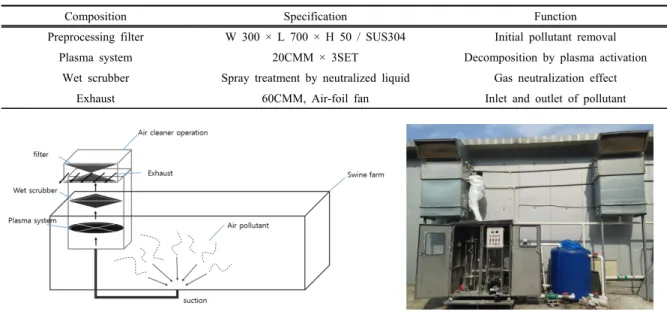
× 150 cm × 250 cm)의 경우 돈사 내 설치된 후드를 통해 오염물질을 챔버 내부로 흡입 후 일차적으로 전 처리 필터에서 먼지세정을 실시한다. 세정된 먼지를 플라즈마 이온 활성화 방식을 통해 제어 후 습식중화 단계를 통해 처리되며 최종적으로 배출구내 필터를 통과하여 배출되게 된다(<Table 1>, <Figure 1> 참조).
Composition Specification Function
Preprocessing filter W 300 × L 700 × H 50 / SUS304 Initial pollutant removal
Plasma system 20CMM × 3SET Decomposition by plasma activation
Wet scrubber Spray treatment by neutralized liquid Gas neutralization effect
Exhaust 60CMM, Air-foil fan Inlet and outlet of pollutant
Figure 1. Schematic diagram of operation process(left) and on-site photo(right) of air cleaner applied to the pig house
Table 1. Detailed information of air cleaner applied to the pig house
2. 측정 및 분석 방법
공기정화기 적용에 따른 돈사 내 입자상 오염물질 및 생물학상 오염물질의 저감 효과 평가는 4가지 조 건으로 분류하여 다음과 같이 실시하였다. 첫째, 흡 입 및 배기팬만을 가동(무처리 조건), 둘째, 일반적인 원수를 이용한 습식세척 가동, 셋째, 살균제가 포함 된 원수를 이용한 습식 세척 가동 시. 각 공기정화기 가동 조건별 무처리 조건과 비교하여 오염물질의 농 도 저감율을 통해 평가하였다.
측정값의 통계적 객관성을 확보하기 위해 측정 시 3회 반복 측정한 수치를 평균하여 대표치로서 산출 하였다. 측정위치는 <Figure 1>의 공기정화기의 배출 구 중앙으로 설정하였다. 입자상 오염물질의 경우 직 독식 측정장비(Dust mate, Turnkey instruments, USA) 로 작동원리는 광산란 방식으로 측정 1시간 전 최적 의 환경 조건을 설정하기 위해 측정 장소에서 보정 을 실시하였다. 측정항목은 TSP, PM10, PM2.5, PM1을 대상으로 10분 동안 모니터링 하였다. 생물학상 오염 물질의 경우 부유세균과 부유진균을 대상으로 28.3 ℓ/min으로 유량이 설정된 1단 관성충돌기(Buck bio-culture pump, Buck Inc., USA)를 이용하여 입자 상 오염물질과 동일한 지점에서 2분, 1분, 30초로 3 회씩 측정하였다.
채취된 부유세균 과 진균의 배양조건은 Table 2>
와 같다. 배양 후 배지에 형성된 집락을 계수하여 채 취된 공기량으로 나우는 방법을 통해 부유 세균과 진균의 농도를 나타내었다(Equation 1,2). 조사대상 돈사 작업장 환경인자로 온도와 상대습도는 직독식 측정장비(IAQ surveyor, Gray-wolf instruments., USA) 를 이용하여 공정 조건별 시료 채취 시 3회 측정하 였다.
통계처리는 SPSS package(SPSS/stat 18.0, IBM Corp., USA)를 이용하여 돈사 작업장 내 공기정화기
공정 조건별 분진과 부유미생물의 농도 차이는 분산 분석을 통해 통계적 유의성을 검증하였다.
CFU (Colony Forming Unit)/m³ = Colony counted on agar plate / Air volume(m³)...Equation (1)
Air volume (m³) = 28.3ℓ/min × sampling time (min)/10³...Equation (2)
Ⅲ. 연구 결과 및 고찰
1. 입자상 물질 저감효과 평가
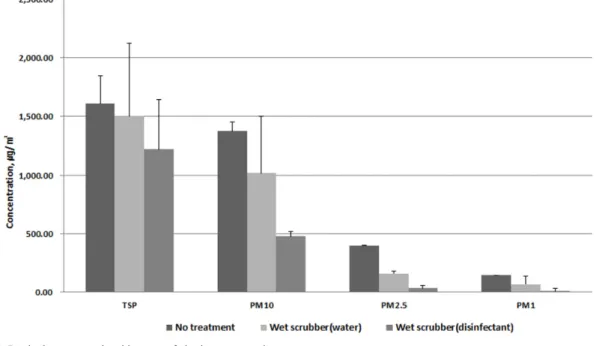
Figure 3과 Table 3은 공기정화기 가동 조건에 따 른 입자상 물질의 농도 양상을 보여주고 있다. TSP 의 경우 무처리 시 1,608(SD:419.5) ㎍/㎥, 습식원수 처리 시 1,503.3(SD:622.8) ㎍/㎥, 살균제를 포함한 습 식 처리 시 1,222.17(SD:236.3) ㎍/㎥으로 측정되었으 며(p>0.05), PM10은 무처리 시 1,373.8(SD:38.9) ㎍/㎥, 습식원수 처리 시 1,017.3(SD:488.4) ㎍/㎥, 살균제를 포함한 습식 처리 시 477.17(SD:79.1) ㎍/㎥으로 관찰 되었다(p<0.05). PM2.5는 무처리 시 401.8(SD:23.6) ㎍ /㎥, 습식원수 처리 시 159.4 (SD:20.4) ㎍/㎥, 살균제 가 포함된 습식 처리 시 33.2(SD:1.6) ㎍/㎥으로 나타 났고 (p<0.05), PM1의 경우 무처리 시 144.5(SD:20.7)
㎍/㎥, 습식원수 처리 시 69.8(SD:69.8) ㎍/㎥, 살균제 가 포함한 습식 처리 시 11.1(SD:0.5) ㎍/㎥으로 측정 되었다(p<0.05).
입자상물질 측정결과 모든 물질에서 무처리 조건, 습식원수 처리 공정, 살균제가 포함된 습식처리 공정 순으로 고농도로 나타났다. 측정 결과를 근거로 하였 을 때, 본 연구에 적용된 공기정화기의 처리공정은 입자상 물질에 대한 저감효과는 적정수준 나타나는 것으로 판단된다. 무처리 조건 대비 각 처리공정별
Media Incubation
Temperature Period Airborne bacteria
Trypticase Soy Agar(TSA) - Including cycloheximide 500 ㎎
- Lot 2087730, Becton Dickinson and Company, USA
37 ℃ 1 ∼ 2 days
Airborne mold
Malt Extract Agar(MEA)
- Including chloramphenicol 100 ㎎
- Lot 3111376, Becton-Dickinson and Company, USA
20 ∼ 25 ℃ 3 ∼ 5 days
Table 2. Analysis condition of airborne bacteria and fungi
저감 효율을 분석해보았을 때, 습식원수 처리 조건은 TSP 76.01%, PM10 34.73%, PM2.5 8.27%, PM1 7.69%
나타났으며, 살균제가 포함된 습식 처리 시 TSP 93.49%, PM10 74.05%, PM2.5 36.67, PM1 48.30%로 각각 관찰되었다. 살균제가 포함된 습식 처리 시 입 자상 물질에 대한 가장 높은 저감효과가 발생되었으 며, 이는 살균제 내 포함된 성분에 따라 분석된 결과 라 판단된다.
이번 연구 결과는 습식처리 시 발생되는 습윤화로 인해 축사 내부의 입자상 물질의 농도가 저감되는 것을 보고한 Oh et al.(2006)의 선행 연구 결과와 유 사한 것으로 조사되었다. 본 선행 연구 내용을 고찰
해 보면 습식 공기정화기를 설치한 양돈 사업장의 TSP 경우 가동 전 227 ㎍/㎥, 장치 가동 후 195 ㎍/
㎥, PM10은 가동 전 135 ㎍/㎥, 가동 후 143 ㎍/㎥이 며, PM2.5 가동 전 56 ㎍/㎥, 가동 후 59 ㎍/㎥인 것으 로 나타났다(Oh et al., 2006). 본 연구 결과에 비해 상대적으로 낮은 입자상 물질의 농도가 측정된 것인 데, 이는 측정 위치의 상이함에 따른 차이로 사료된 다. 본 연구의 경우 공기정화기 배출구에서 측정한 반면 선행 연구는 돈사 내에서 공기정화기 가동 전, 후로 구분하여 측정을 실시하였다. 또한 본 연구의 경우 돈사 내부 흡입된 오염물질이 처리공정을 거쳐 배출됨에 따라 배출구 내 필터 및 주변 유속 등 환경
Figure 3. Particulate matters level by type of air cleaner operation process
Table 3. Concentrations of particulate matter in treatment processing
N.T
†W.S(water) W.S(disinfectant)
p-value
GM
·GSD
‥GM GSD GM GSD
TSP
*1,608 419.5 1,503.3 622.8 1,222.17 236.3 0.589
PM
10*1,373.8 38.9 1,017.3 488.4 477.17 79.1 0.024
PM
2.5*401.8 23.6 159.4 20.4 33.2 1.6 0.000
PM
1*144.5 20.7 69.8 69.8 11.1 0.5 0.000
*
Unit : ㎍ / ㎥
†
N.T : No treatment
‡
W.S : Wet scrubber
·
GM : Geometric Mean
‥
GSD : Geometric Standard Deviation
적 요인이 측정결과에 영향을 미쳤을 거라 판단된다.
한편 Kim et al.(2010)은 양돈 작업장내 플라즈마 이 온 공기정화기 적용에 따른 실험군과 대조군의 오염 물질 발생농도를 비교하였다. 습식공기정화기와 비 교 시 돈사 내 발생 농도는 높았지만, 공기정화기 적 용에 따른 오염물질 저감율은 약 54%정도 인 것으 로 나타났다.
본 현장 연구에 적용된 공기정화기는 습식세척과 플라즈마 이온 방식의 두 가지 처리공정으로 오염물 질이 제어되는 시스템이다. 현장 측정 시 공기정화기 의 운용상의 하드웨어적 문제로 플라즈마 이온 장치 에 대한 제어 효율 평가를 실시하지 못한 점이 본 연 구의 제한점으로 볼 수 있다. 또, 측정 위치가 배출구 라는 점에서 외부 환경적 요인 및 기타 요인이 본 측 정결과에 많은 영향을 미쳤다고 판단되고, 이는 다른
국외 선행 연구 보고들에서도 언급된 바 있다(Grub et al., 1965; Yoder & Wicklen.,; 1988 Pedersen, 1993).
2. 생물학상 오염물질 저감효과 평가
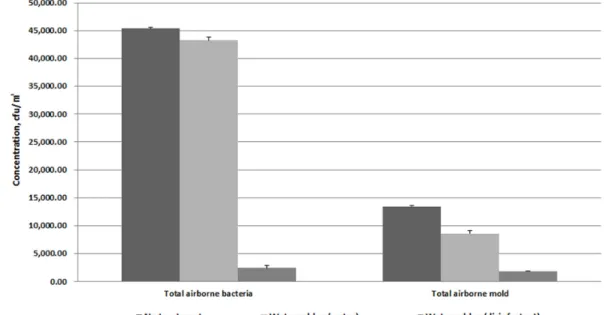
공기정화기 적용에 따른 돈사 내 생물학상 오염물질 저감효과는 Figure 4와 Table 4에 제시되었다. 총부유 세균의 경우 무처리 시 45,371(SD:24,269) CFU/㎥, 원 수를 이용한 습식 처리 시 43,286(SD:3,077) CFU/㎥, 살균제가 포함된 습식 처리 시 2,440(SD:1,135) CFU/
㎥로 나타났다(p<0.05). 총부유진균은 무처리시 13,474 (SD:3,719) CFU/㎥, 원수를 이용한 습식 처리 시 8,610 (SD:4,429) CFU/㎥, 살균제가 포함된 습식 처리 시 1,867(SD:403) CFU/㎥로 측정되었다(p>0.05). 본 측정 결과 생물학상 오염물질 처리조건에 따른 총부유세균 의 농도는 총부유진균보다 일반적으로 더 높은 것으로
Figure 4. Airborne microorganisms level by type of air cleaner operation process
Table 4. Concentrations of airborne microorganisms in treatment processing
N.T
†W.S(water)
‡W.S(disinfectant)
p-value
GM
·GSD
‥GM GSD GM GSD
Total airborne bacteria
*45,371 24,269 43,286 3,077 2,440 1,135 0.102
Total airborne mold
*13,474 3,719 8,610 4,429 1,867 403 0.015
*
Unit : CFU/ ㎥
†
N.T : No treatment
‡
W.S : Wet scrubber
·
GM : Geometric Mean
‥
GSD : Geometric Standard Deviation
분석되었다. 입자상 물질 결과와 동일하게 살균제가 포함된 습식 처리 시 가장 낮은 농도로 측정되었으며, 무처리 시 가장 높은 농도로 분석되었다.
본 현장 측정 결과는 많은 선행 연구에서 보고된 바와 같이 미생물의 경우 입자상 물질에 흡착되어 운반되기 때문에 입자상 물질 측정결과와 동일하게 나타난 것으로 사료된다(Donaldson, 1978; Robertson and Frieben, 1984). 각 처리공정별 무처리 조건 대비 저감 효과 분석 시 원수를 이용한 습식 처리 시 총 부유세균 5.38%, 총 부유진균 13.86%, 살균제가 포 함된 습식 처리조건의 경우 총 부유세균이 95.40%, 총 부유진균 63.91%로 각각 분석되었다. 일반적으로 원수에 대한 습식 처리에 비해 살균제가 포함된 습 식처리 시 현저하게 높은 저감 효과가 나타났으며, 이는 살균제에 포함된 미생물 제균 물질이 영향을 주어 높은 저감 효과가 나타난 것으로 판단된다.
Kim et al.(2005)은 돈사 유형별 생물학상 오염물 질 발생농도 정량화에 관한 현장조사를 실시하였다.
본 현장 측정 대상과 동일한 슬랫돈사와 측정결과 비교 시 선행연구의 경우 부유세균은 자연환기 시 331 CFU/㎥, 기계환기는 6,790 CFU/㎥, 부유진균은 자연환기 시 69 CFU/㎥, 기계환기는 562 CFU/㎥으 로 나타났다. 본 측정 결과와 비교 시 살균제를 포함 한 습식처리 조건을 제외한 두 공정(무처리, 습식원 수처리)에 비해 상대적으로 낮은 농도로 나타난 것 으로 조사되었다. 이는 선행 연구와 달리 본 연구에 설치 적용된 기계적 환기 시스템 및 공기정화기 가 동 시 발생되는 소음 및 진동이 돈사 내 입식된 돼지 들의 활동성 증가를 유발하여 돈사 바닥에 침전된 미생물을 포함한 미세입자들이 돈사 작업장 내부 공 기 중으로 비산되어 높은 농도로 나타난 것으로 추 정된다.
Ⅳ. 결 론
본 연구는 돈사 내 입자상 오염물질 및 생물학상 오염물질을 대상으로 공기정화기 적용 시 오염물질 저감효과를 평가하기 위해 수행하였다. 입자상 오염 물질은 공기정화기 처리공정별 살균제가 포함된 습 식처리 공정에서 가장 낮은 농도로 측정되었으며, 무 처리 조건에서 가장 높은 농도로 나타났다. TSP는
습식원수 처리 시 76.01%; 살균제가 포함된 습식처 리 시 93.49%, PM10 습식원수 처리 시 34.73%; 살균 제가 포함된 습식처리 시 74.05%, PM2.5 습식원수 처 리 시 8.26%; 살균제가 포함된 습식처리 시 39.67%, PM1의 경우 습식원수 처리 시 7.68%; 살균제가 포함 된 습식처리 시 48.30%로 각각 저감 효과가 관찰되 었다. 생물학상 오염물질도 동일하게 살균제가 포함 된 습식처리 시 가장 낮은 농도로 분석되었으며, 무 처리 조건에서 가장 고농도로 측정되었다. 처리공정 별 총부유세균과 총부유진균의 저감효과는 습식원수 처리 시 5.38%, 13.86%이며 살균제가 포함된 습식처 리 시 95.40%, 63.91%로 나타났다. 본 연구 결과는 부유 미생물이 입자상 물질에 흡착되어 운반된다는 점, 측정 지점이 배출구라는 점을 고려할 때 습식처 리 공정 시 발생되는 수분입자 및 기타 환경적 요인 이 측정 장비에 영향을 미친다는 점, 그리고 공기정 화기 가동에 따른 소음과 진동의 발생으로 인해 돼 지들의 활동성이 증가되었다는 점을 고려하여 해석 해야 할 것이다. 결론적으로 본 현장 연구에 적용된 습식 및 플라즈마 방식의 공기정화기는 돈사 작업장 내 입자상 및 생물학상 오염물질에 대해 상당한 제 어 효율이 있는 것으로 판단된다.
본 현장조사는 극단적인 계절조건(여름&겨울)을 고려하여 계절별 입자상 및 생물학상 오염물질의 제 어효율을 평가하지는 못한 점이 본 연구의 제한점이 다. 향후 계절적 조건에 따른 오염물질(입자상 오염 물질 및 생물학상 오염물질)에 대한 제어효율 평가 를 지속적으로 수행할 예정이다.
감사의 글
본 결과물은 농림축산식품부의 재원으로 농림수산 식품기술기획평가원의 농생명산업기술개발사업과 첨 단생산기술개발사업의 지원을 받아 연구되었음(과제 번호 : 313042-03-3-HD030와 315031-03-1-HD030)
References