Corresponding Author: E-Hwa Yun
Researcher, Cancer risk appraisal & prevention branch, National Cancer Control Institute, National Cancer Center
Ilsanro 323, ilsandong-gu, Goyang-si, Geyonggi-do, 410-769, South Korea Tel: +82-21-920-2920, Fax: _82-31-920-2929, E-mail: [email protected] Article submitted 21 November 2009, Revised 11 December 2009, Approved 12 December 2009
Intervention Effect on Health Efficacy and Knowledge in Cardiovascular Health Promotion Behaviors in Children
Young-Ran Tak*, E-Hwa Yun**†
* Department of Nursing, College of Medicine, Hanyang University
** Cancer risk appraisal & prevention brach, National Cancer Control Insitute, National Cancer Center
Ⅰ. Introduction
Lifestyle behaviors such as physical inactivity and unhealthy eating contribute significantly to cardiovascular disease (CVD), which is the leading cause of premature death in many countries (Jones et al., 2007; Korea National Statistical Office, 2006;
Labarthe, 1998). Overweightness has been one of the independent risk factors for stroke and CVD, both at population and individual levels. Given the increasing trends of obesity and other chronic diseases during the last 10 years, there have been extensive efforts to promote health behaviors to decrease modifiable risks for CVD and to encourage the population to adopt healthy dietary habits and increase their physical activity (Flynn et al., 2006;
Zhou et al., 2002).
CVD occurs at middle age but atherosclerosis, which is a cause of CVD, begins in childhood (Luepker, 1994). Study of the patho-biological determinants of atherosclerosis in the Youth and the Bogalusa Heart study showed the relationship of early atherosclerosis to modifiable cardiovascular
risk factors, including body mass index, high level of low density lipoprotein, total cholesterol and triglyceride, low level of high density lipoprotein, and hypertension (Berenson et al., 1998; Strong et al., 1999). Also, Berenson et al. (1998) reported that children and young adults with multiple CVD risk factors had more severe atherosclerosis lesions than those with non CVD risk factors. The Bogalusa heart study also reported that these risk factors begin in childhood and persist into adulthood; therefore, children with multiple risk factors have a high possibility of occurrence of CVD in adulthood (Berenson, 2002).
During childhood and adolescence, habits
emerge that influence and reinforce physical
activity, eating, and tobacco-use behaviors. These
health behaviors can affect the development of
cardiovascular disease, cancer, and diabetes, which
are now the major causes of premature death and
disability (World Health Organization, 2002). Public
health professionals are interested in school-based
health promotion programs that can provide a
foundation for lifelong healthy behaviors and
thereby significantly reduce the burden of preventable chronic disease for both individuals and society (Melnyk et al., 2007, Rizzo et al., 2007).
These findings indicate that children do have potential risk factors for future CVD and suggest that early interventions for preventing CVD in childhood are needed. Therefore, health education and health promotion are important for the prevention of CVD in children.
As researchers have become more aware of the importance of prevention of behaviors which lead to CVD in childhood, many intervention studies for cardiovascular health have been conducted. Studies have targeted modifiable cardiovascular risk factors, including dyslipidemia, low physical fitness, hypertension, high fat food intake, physical inactivity, and obesity, and have aimed at changing health behaviors related to cardiovascular health (Edmunson et al., 1996; Harrell et al., 1996; Harrell et al., 1998). A school-based intervention, the Cardiovascular Health in Children Study (CHIC) showed that children in the intervention group had lower total cholesterol, more heart health knowledge, and higher physical activity than those in the control group (Harrell et al., 1996). The Child and Adolescent Trial for Cardiovascular Health (CATCH), designed to test the intervention effect of health behaviors for preventing CVD in elementary school children, reported that intervention in schools led to a greater increase in the intensity of physical activity and a greater reduction in energy intake from fat than in the control schools (Luepker et al., 1998; Nader et al., 1999).
However, it is essential that health interventions for children be guided by theoretical perspectives that consider the child's social context. Schools have been identified as ideal environments for the initiation of healthy lifestyle education for youth
(Vieno et al., 2007). Studies on health related behaviors have already used Social Cognitive Theory (SCT) as a theoretical framework (Edmunson et al., 1996; Milligan et al., 1997; Rutter and Quine, 2002; Winters et al., 2003). SCT proposes that behaviors are an outcome of the constant interaction of environment and person (Bandura, 1997) and explains the behavior mechanism, which is how information and psychosocial factors related to behavior influence health behaviors or actions (Bandura, 2004).
Self-efficacy, as the integrated view of a person's perceived ability, is a cognition factor in SCT, including a variety of perceptions of facilities and obstacles to control health behaviors among people of varying health status, age, and ethnicity (Bandura, 1997; Norman et al., 2000). However, self-efficacy is a key construct in understanding and modifying health behaviors, but it may vary with the specific health behavior outcomes in question (Jones et al., 2007; Zebracki and Drotar, 2004).
Some programs to change health behaviors related to CVD have been underpinned by SCT (Bandura, 1997; Edmunson et al., 1996; Rimal, 2001). The CATCH study reported the intervention effects on self-efficacy and health knowledge (Edmunson et al., 1996). In a study of an after-school nutrition intervention, Rinderknecht and Smith (2004) found that dietary efficacy improved after the intervention.
Norton et al. (2003) pointed out the effect of
parental influence on the prevention of CVD in
children. The fact that parents play a key role in
establishing health behaviors in childhood was
reported by a study of perceived parental monitoring
and health risk factors (Li et al., 2000). In the
CATCH study (Nader et al., 1999), they reported
that the degree of family participation during the
intervention study influenced children's attitudes, knowledge, and beliefs on cardiovascular health.
Golan et al. (1999) reported parents' role as modeling health behavior for the treatment of child obesity. Also, Glowinska et al. (2002) reported that children with a family history of CVD have more CVD risk factors than children without a family history of CVD. These findings support the importance of family influence on child cardiovascular health and suggest the need to implement family participation in school-based intervention.
Thus, this study was designed using social cognitive theory and conducted to identify the intervention effect on health efficacy and health knowledge for the promotion of cardiovascular health in children.
Ⅱ. Methods
1. Design
This study was a school-based repeated measure study of a sample of 5th grade healthy children at an elementary school in a suburban city in Korea.
It was an eight-week, school-based intervention designed to improve health efficacy and health knowledge about cardiovascular health promotion in school-aged children. The intervention consisted of a school-based curriculum and parental involvement in an educational program. The school-based intervention focused on four domains of health education: promoting cardiovascular health, promoting the health knowledge of the cardiovascular system and function, promoting physical activity and healthy eating, and preventing smoking. The parent intervention consisted of four
weekly newsletters aimed for adult readers that had the same contents as the curriculum. Newsletters were sent to parents with the students' homework to make parents aware of the program and to help them do homework with their children regarding the cardiovascular health program contents. The curriculum intervention was conducted one hour per week for 4 weeks in own their classroom as regular class and the parent intervention once a week for 4 weeks in their own home as homework after completion of the curriculum class intervention.
2. Participants
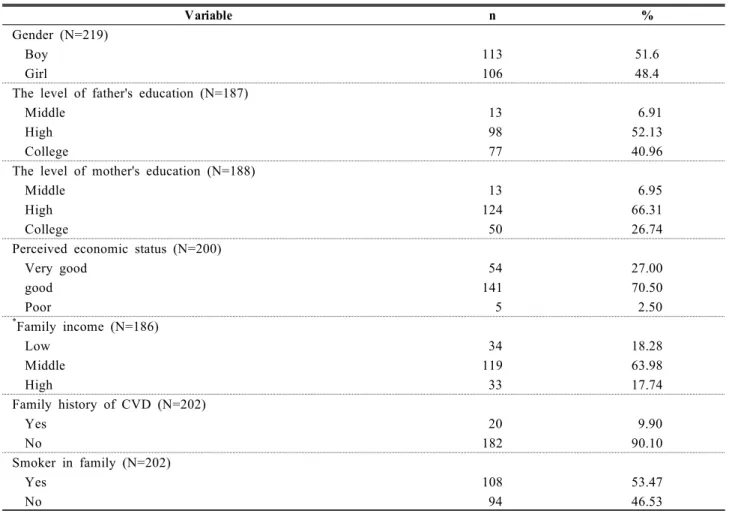
The participants were 5th graders in one elementary school that was randomly selected in a suburban area. The data were collected from March to July 2004 in one elementary school. The total number of participants was 225 but only 219 were included the final analysis. These Six participants were excluded because of missing data due to discontinuation. Of the 219 participants who completed questionnaires, 51.6% were boys, and 48.4% girls. The mean age was 11 years old. The majority of the parents of the participants were highly educated. In economic status, 81% were over middle class. In 53.5%, at least one family member was a smoker. The demographic characteristics are presented in Table 1.
3. Procedure
After submitting a study proposal to the
Education Board of the City and the school
administration committee, permission and consents
for this study were obtained before the spring
semester began. The children and their parents
received written information about the purpose and
the content of the study. Written informed consent was obtained from one of the parents for all the
participants.
Variable n %
Gender (N=219)
Boy 113 51.6
Girl 106 48.4
The level of father's education (N=187)
Middle 13 6.91
High 98 52.13
College 77 40.96
The level of mother's education (N=188)
Middle 13 6.95
High 124 66.31
College 50 26.74
Perceived economic status (N=200)
Very good 54 27.00
good 141 70.50
Poor 5 2.50
*
Family income (N=186)
Low 34 18.28
Middle 119 63.98
High 33 17.74
Family history of CVD (N=202)
Yes 20 9.90
No 182 90.10
Smoker in family (N=202)
Yes 108 53.47
No 94 46.53
* Income (U.S. dollar per year); Low (≤12,000$), Middle (12,000$ > and 36,000$ ≤), High (36,000>)
§ 1,000 won per 1 dollar
Table 1. The demographic characteristics of participants
4. Data collection
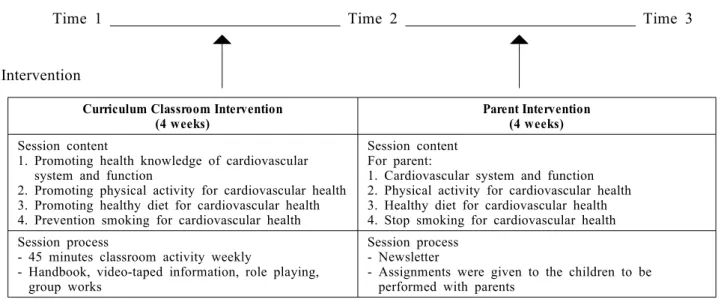
Participants were assessed at three time points, baseline (pre-intervention as the first test: labeled as T1), the second test (T2) after the curriculum intervention, and the third test (T3) after the entire intervention, following the curriculum and the parent intervention (see Figure 1).
5. Intervention
The conceptual framework for the intervention
assumes a causal model in which psychosocial risk
factors influence behavioral risk factors (dietary,
physical activity, and smoking), which influence
physiological risk factors resulting in that finally
determine the morbidity and mortality of
cardiovascular disease. In this model, psychosocial
risk factors were the most proximal targets for
change by the intervention. The first step of the process included identification of the behaviors we wanted the children to adopt, specifically, reduced
fat and sodium intake, to increase participation in moderate to vigorous physical activity, and to resist the initiation of smoking.
Data collection
Time 1 Time 2 Time 3
Intervention Curriculum Classroom Intervention
(4 weeks) Parent Intervention
(4 weeks) Session content
1. Promoting health knowledge of cardiovascular system and function
2. Promoting physical activity for cardiovascular health 3. Promoting healthy diet for cardiovascular health 4. Prevention smoking for cardiovascular health
Session content For parent:
1. Cardiovascular system and function 2. Physical activity for cardiovascular health 3. Healthy diet for cardiovascular health 4. Stop smoking for cardiovascular health Session process
- 45 minutes classroom activity weekly
- Handbook, video-taped information, role playing, group works
Session process - Newsletter
- Assignments were given to the children to be performed with parents
Figure 1. Overview of data collection procedure and intervention. Baseline (Time 1), beginning of the study; Time 2, after curriculum classroom intervention; Time 3, after parent intervention.
Intervention was designed for achieving high levels of health efficacy for health related behaviors in order to decrease their risk of cardiovascular disease and to specifically target self-efficacy for cardiovascular health promoting behaviors among children. Self-efficacy is especially critical to the initiation of skill acquisition. Efficacy activated processes include cognitive, motivational, affective and selection processes. The curriculum was designed to increase self-efficacy and selected efficacy-activated processes during skill acquisition.
The interventions included a series of skill-based classroom curriculum and home-based activities.
The school-based intervention based on social cognitive theory in this study for eight-weeks consisted of four sessions of 45-minute classroom
activity weekly for children and four sessions for their parents following classroom education. This curriculum was developed and applied by a research team of clinical nurse specialists, experts in health education and a doctoral student of nursing science.
The cardiovascular health promoting intervention for children focuses on changing the behavior of elementary school children, both in and out of school. All sessions in the classrooms had instructors use prepared, age-appropriate handbooks and interactive curriculum, such as videotaped information, role playing, and group work.
Children in regular classes practiced new skills
designed to improve their physical activity, healthy
eating, and health behaviors. After four weeks of
classroom sessions, reading materials and quiz
sheets were given for the parents to do with their
children. The purpose of these assignments were to inform parents of what their children learned how they can help them to have a healthy lifestyle by doing assignments together.
6. The scales
Health knowledge and health efficacy were measured to identify the intervention effects.
Perceived parental monitoring was measured to explore the effect of parental influence on health knowledge and health efficacy. Health efficacy, health knowledge, and perceived parental monitoring were assessed at three time points.
Health knowledge. Health knowledge as an outcome variable was developed for this study based on the intervention contents. This scale had 4 categories with a total of 12 items: the function of the heart and circulation, exercise, healthy diet, smoking, and CVD. A sum score was used for analysis. A higher score reflects greater knowledge related to cardiovascular health and health behaviors.
Health efficacy. Health efficacy was measured using the School Health Efficacy Questionnaire (SHEQ) (Froman & Owen, 1991; Froman & Owen, 1999). This scale was originally developed for adolescents. Thus, 6 items were deleted because they were considered inappropriate for elementary school children. The instrument used contained 2 subscales: physical and mental health efficacy.
Physical health efficacy (17 items) examined healthy eating habits, hygiene, alcohol use, optimal weight maintenance, and regular exercise, while mental health efficacy (17 items) included anxiety, peer relationships, happiness, social activity, and health beliefs. In this study Cronbach's alpha was .79 in physical health efficacy and .87 in mental
health efficacy.
Perceived parental monitoring. Perceived parental monitoring (PPM) was modified from the Parental Monitoring Assessment (Small & Kerns, 1993) and the Parental Monitoring scale (Li et al., 2000). In this study, PPM focused on the child's perception of their parents' knowledge of where they are, with whom they are, what they do after school, and so on. DiClemente et al. (2001) suggest that children's perception of parent monitoring is more influential than the parent report of what the parent doing monitored their children for protecting factors of health risk behavior. This scale consisted of 10 items and the mean score was used for analysis.
Cronbach's alpha was .85 in this study.
7. Ethical considerations
Beforehand, a consent form with information about the aims of the study was sent to the participants' parents. Before the subjects answered the questionnaire, the teacher assured them that confidentiality and anonymity would be rigorously maintained. To encourage the subjects to participate in the research, the researchers provided T-shirts printed with the logo of the research as gifts.
8. Data analysis
The repeated- measure ANOVA was conducted
to determine whether the health efficacy and health
knowledge varied over time to simultaneously
identify the intervention effect at the second test
(T2) and the third test (T3). A generalized
estimating equation (GEE) analysis of repeated
measures regression was used to assess the
time-related intervention effect before and after
intervention (Twisk, 2003). It tests whether perceived
parental monitoring was a significant predictor of knowledge and health efficacy . The baseline value was controlled as a fixed covariate in these models.
Ⅲ. Results
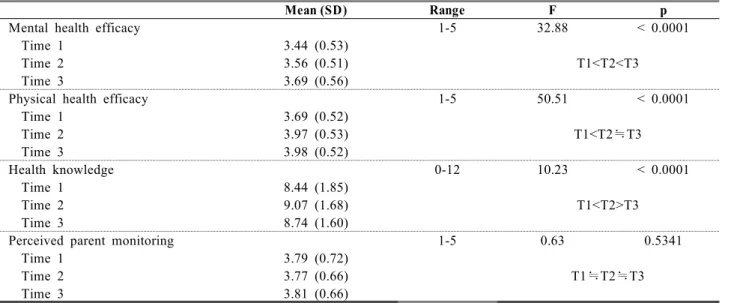
Summary of health efficacy, health knowledge and perceived monitoring at each time point are presented in Table 2. Figure 2 and 3 present the results for health efficacy and knowledge related behavior for cardiovascular health. The intervention effect was sure and these effects were sustained at relatively high during maintenance period. In detail, health efficacy was more sharply to increase from baseline or the first test (T1) to the third test (T3).
However, the health knowledge was more notably to increase from baseline (T1) to the second test (T2), and likely to decrease from T2 to T3. In fact, the perceived parental monitoring was relatively stable over time.
1. Health efficacy
1) Mental health efficacy
Mental health efficacy significantly increased during intervention (F = 32.88, P < 0.0001) (Figure 2.) The mean of mental health efficacy improved from 3.44 at T1 to 3.56 at T2 in Table 2 (t = - 3.74, p = 0.0002), and the difference between mental health efficacy at T1 and T3 was significant (t = -7.84, p < 0.0001). Also, mental health efficacy at
T3 was higher than at T2 (t =- 5.25, p < 0.0001).
2) Physical health efficacy
Physical health efficacy also increased significantly during intervention (F = 50.51, p <
0.0001) (Figure 2). Post hoc analysis found that, compared to physical health efficacy at each time point, physical health efficacy at T2 was higher than that at T1 (t = -8.30, p < 0.0001) and T3 (t = -9.61, p < 0.0001). In contrast, the difference in physical health efficacy between T2 and T3 was not statistically significant (t = -.59, p = 0.5530).
3) Health knowledge
Health knowledge improved significantly from T1 to T2 (F = 0.63, p =0.5341) (Figure 3). Health knowledge at T2 (t = -4.47, p < 0.0001) and T3 (t
= -2.10, p = 0.0365) was higher than at T1, and the difference in health knowledge between T1 and T2 was statistically significant (t = 2.64, p = 0.0089).
Health knowledge increased significantly after curriculum intervention but relatively declined after parent intervention, even though overall knowledge mainly increased from the baseline.
4) Perceived parental monitoring
Perceived parental monitoring did not changed
during intervention (F = 10.23, p < 0.0001) (Table
2). Although perceived parental monitoring was
likely to increase during intervention, the significant
change did not showed statistically.
Mean (SD) Range F p
Mental health efficacy 1-5 32.88 < 0.0001
Time 1 3.44 (0.53)
T1<T2<T3
Time 2 3.56 (0.51)
Time 3 3.69 (0.56)
Physical health efficacy 1-5 50.51 < 0.0001
Time 1 3.69 (0.52)
T1<T2≒T3
Time 2 3.97 (0.53)
Time 3 3.98 (0.52)
Health knowledge 0-12 10.23 < 0.0001
Time 1 8.44 (1.85)
T1<T2>T3
Time 2 9.07 (1.68)
Time 3 8.74 (1.60)
Perceived parent monitoring 1-5 0.63 0.5341
Time 1 3.79 (0.72)
T1≒T2≒T3
Time 2 3.77 (0.66)
Time 3 3.81 (0.66)
Time 1: baseline or the first test
Time 2: the second test (after curriculum intervention)
Time 3: the third test (after curriculum and parent intervention)
Table 2. Means and standard deviations (SDs) for the variables designated in time
(N=219)
Time 1: baseline or the first test
Time 2: the second test (after curriculum intervention) Time 3: the third test (after curriculum and parent intervention)
Figure 2. Effects of intervention on mental and physical health efficacy related behavior for
cardiovascular health over time
Time 1: baseline or the firtst test
Time 2: the second test (after curriculum intervention) Time 3: the third test (after curriculum and parent intervention)
Figure 3. Effects of intervention on health knowledge related behavior for cardiovascular health over time
2. Effect of perceived parental monitoring on health efficacy and knowledge
Based on results from the GEE analysis of
repeated measure regression, the perceived parental
monitoring (β = 0.2890, p < 0.0001) was a significant
predictor of physical health efficacy. In addition, the
physical health efficacy after the intervention was
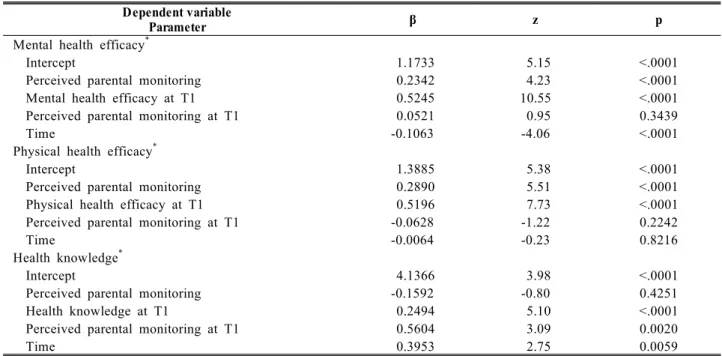
affected by physical health efficacy before the intervention (β = 0.5196, p < 0.0001). However, the perceived parental monitoring before the intervention did not have a significant effect on mental health efficacy (β = -0.06284, p = 0.2242) (Table 3).
Perceived parental monitoring (β = 0.2342, p <
0.0001) was a significant predictor of mental health efficacy, and mental health efficacy after the intervention was affected by mental health efficacy before the intervention (β = 0.5245, p < 0.0001).
However, perceived parental monitoring before the intervention did not have a significant effect on mental health efficacy (β = 0.0521, p = 0.3439).
Perceived parental monitoring did not have an effect on health knowledge (β = -0.15927, p = 0.4251), but health knowledge before the intervention (β = 0.2494, p < 0.0001) and perceived parental monitoring before the intervention (β = 0.56041, p = 0.0020) had a significant impact on health knowledge after the intervention.
Dependent variable
Parameter β z p
Mental health efficacy
*Intercept 1.1733 5.15 <.0001
Perceived parental monitoring 0.2342 4.23 <.0001
Mental health efficacy at T1 0.5245 10.55 <.0001
Perceived parental monitoring at T1 0.0521 0.95 0.3439
Time -0.1063 -4.06 <.0001
Physical health efficacy
*Intercept 1.3885 5.38 <.0001
Perceived parental monitoring 0.2890 5.51 <.0001
Physical health efficacy at T1 0.5196 7.73 <.0001
Perceived parental monitoring at T1 -0.0628 -1.22 0.2242
Time -0.0064 -0.23 0.8216
Health knowledge
*Intercept 4.1366 3.98 <.0001
Perceived parental monitoring -0.1592 -0.80 0.4251
Health knowledge at T1 0.2494 5.10 <.0001
Perceived parental monitoring at T1 0.5604 3.09 0.0020
Time 0.3953 2.75 0.0059
T 1: baseline(before intervention)
* Multiple logistic regression model was adjusted for gender, perceived economic status, education level of respondent parent, smoker in family, and family history of CVD.
Table 3. The effect of perceived parental monitoring on mental health efficacy, physical health efficacy and health knowledge over time
Ⅳ. Discussion
This study was designed to promote health behaviors related to cardiovascular health promotion
in childhood for healthy lifestyle. The rationale is
that the 5th graders, aged 11~12 years old children,
is a transition period from childhood to adolescence,
and this childhood period is easier than adolescence
to establish health promotion behaviors, including
physical activity, eating habits and prevention of smoking before risky habits are formed in early childhood. Therefore, an eight week school-based intervention was conducted to increase health efficacy and health knowledge for promoting cardiovascular health through change of risk health behaviors. The program provided motivation to change and perform health behaviors. The findings showed that the intervention had a significant and positive influence on health efficacy and health knowledge for promoting cardiovascular health in children.
Psychosocial factors such as efficacy need to be maintained over time, and the relationship between self-efficacy and behavior change is circular (Bandura, 1997; Rimal, 2001). Therefore, it is important to increase efficacy for changing behavior in children to prevent risk behaviors and promote healthy habits. Self-efficacy plays a key role in performing health behavior as a predictor factor within SCT (Bandura, 1997). In fact, in a study of the mediation effect on self-efficacy of a school-based physical activity intervention, Dishman et al. (2004) reported that baseline self-efficacy had an impact on physical activity before intervention, and intervention had a mediating effect on physical activity after intervention through self-efficacy. Therefore, this study evaluated health efficacy as an outcome variable on intervention for changing behaviors. The result, consistent with other studies based on the SCT, affirms that the school-based health intervention has a significant impact on health efficacy (physical and mental) (Edmunson et al., 1996; Bandura, 1997; Norman et al., 2000; Frenn et al., 2003; Wu & Jwo, 2005).
DiClemente et al. (2001) reported that perceived parental monitoring was associated with child risk
health behavior such as substance abuse. They suggested that perceived parental monitoring could be an indirect indicator of the parent-child relationship or reflect parent involvement and concern for their children. As a result, high perceived parental monitoring was more likely to increase physical health efficacy as an antecedent factor for changing health behaviors. This can be understood in terms of previous research (DiClemente et al., 2001). Positive self-perception and supportive relationships have been identified as resources that promote successful adaptation in youth (Vieno et al., 2007). The result of the relationship between perceived parental monitoring and health efficacy suggests that further study that aims at changing or modifying health behavior should be focused on a conceptual framework of behavior change by health education with social support including parent monitoring.
According to Bandura (2004), to obtain a goal in children who have high preexisting health efficacy is easier to achieve than in children with low preexisting health efficacy. In other words, low health efficacy can be an obstacle to performing positive health behavior. Also, Klein-Hessling et al.
(2005) reported that efficacy did not have an impact on negative health behaviors but did on positive health behaviors in elementary school children.
They suggested that intervention in health behavior would be better to begin in elementary school children and should include health efficacy. That is, efficacy plays a protective role in health behavior and is an important factor to encourage positive behavior in children. This finding shows that target intervention could be effective in specific health efficacy.
Results show that the perceived parental
monitoring during intervention does have an impact
on the health efficacy, but the one before intervention does not. According to Nash et al.
(2005), perceived parental monitoring was indirectly or directly associated with health behavior and had an influence on self-efficacy. This finding suggests that perceived parental monitoring was an antecedent factor for performing health behavior, and programs that facilitate parent involvement should be included in intervention for school-aged children to improve health behavior and health efficacy. The effect of perceived parental monitoring on health efficacy indicates that school-based interventions should be designed and interplay within theory that posits that the child is in the center of multiple, interrelated levels of a social system (Bronfenbrenner, 1979).
The result of this study showing the relationship between perceived parental monitoring and health knowledge supports other studies that also report that parenting has a crucial impact on knowledge in children (Macaulay et al., 2005). And the results are consistent with the notion of SCT that knowledge plays a key role to encourage health behavior and is usually used as an indicator of the intervention effect. Also, our findings from the perceived parental monitoring before intervention indicate that the family environment can be a resiliency factor in terms of health behavior. The CATCH and CHIC studies emphasized family environment for cardiovascular health and conducted a family-based intervention. They explained the importance of parent supervision of the health behavior of the child among the family environment . However, they did not report the effect of parent supervision.
However, this study showed that parental monitoring was an important factor in health efficacy. To be most effective, parental monitoring should be appropriate to the child's age and
particular risk factors. Health care providers in school settings and the community should involve parents in programs that develop and assist successful parental monitoring strategies and perform programs for improving child health.
Knowledge suggested the fundamental factors for yielding the motivation to change behaviors (Ma et al., 2005). Knowledge about the health contribute to the attitude or belief formation toward the health.
And then this attitude or belief may drive to change the health risk behaviors. Therefore, the delivery of health information is very important, and the delivery process for children is doing within school setting usually. In this study, the effect of knowledge on intervention was temporary. This result suggest the development of education skill or method to effectively deliver the health information for children. This study made an effort to induce the participant of children within class and to bring on the interesting using handbook, video-taped information, role playing, and group works.
However, the education effect was not to long. This result suggest the variant content of health information, the variant tool for the children to induce the motivation of behavior change, the booster education to maintain the health behaviors.
School settings provide an opportunity to carry
out educational programs in stable and established
settings (Hayman et al., 2004). School-based
intervention can change the school health
environment (Bandura, 2004). The change in school
health environment facilitates the ability of children
to perform health behaviors and reduces
impediments to access health services within
schools. Although this study did not assess change
in the school health environment, we can reasonably
expect that awareness of cardiovascular health was
heightened through this study.
The findings of this study provide evidence that health efficacy based on a social cognitive theoretical framework applied to school-based intervention can improve cardiovascular health promoting behaviors and prevent future cardiovascular disease. In addition, perceived parental monitoring, a critical factor for child health and development, was confirmed as a mediating effect on health efficacy and health knowledge related to promoting a healthy lifestyle for cardiovascular health promotion and prevention. Further studies should incorporate a family intervention design with parental monitoring
The benefits of this intervention are as follows: (1) although this intervention was focused on cardiovascular health, the intervention improved health behaviors consisting of confidence in general health behaviors including a healthy diet, physical activity, and a positive attitude toward health behaviors; (2) it can be easier to induce family concern because school-based intervention can create a school climate to encourage positive health behaviors.
The study have some limitations. As a sample consisted of only one single elementary school in a suburban city, the findings should be took into account in generalization. This study with only one intervention group could not identified other social contextual factors, which influenced on health behaviors. Other limitation of this study is that change of health behaviors was not evaluated directly, and then the mediating factors was evaluated such as heath self efficacy, knowledge, and parental influence, instead of health behaviors.
The last one is relatively short intervention period to yield the behaviors change, and the follow-up test wasn't. Therefore, the validity of the result in this study may affected by other confounding factors.
Ⅴ. Conclusion
The findings support a school-based cardiovascular health promotion intervention as effective in improving health efficacy and health knowledge. Based on a theoretical framework and prevention strategies for a healthy lifestyle, this study shows an evidence for school-based health promotion intervention in children. In addition, parental influence on child health behavior is significant. It supports parental monitoring is a determining factor to reduce risk behaviors in childhood. Parental influence should also be considered to maintain improved health efficacy and health knowledge by cognition process in the intervention of school-aged children. Health promotion programs for children should be planned and implemented within a partnership with family, school, and community as proximal environment for children. It is essential that health promoting intervention be guided by a social ecological model that considers the child's social context. Moreover, school is identified as an ideal environment for the initiation of a healthy lifestyle education for children.
Further studies should elicit active parent involvement for intervention and develop a strategy for active participation in cardiovascular health promotion. We would recommend the use of a longitudinal design including comprehensive school- based intervention to promote cardiovascular health in children.
References
Bandura, A. 1997. Self-efficacy - The exercise of
control. W.H. Freeman and Company NY:
USA.
Bandura, A. 2004. Health promotion by social cognitive means. Health Education & Behavior 31(2):143-164.
Berenson, G., Srinivasan, S., Bao, W., Newman, W., Tracy, R. & Wattigney W. 1998. Association between multiple cardiovascular risk factors and atherosclerosis in children and young adults.
The New England Journal of Medicine 338(23):1650-1656.
Berenson, G. 2002. Childhood risk factors predict adult risk associated with subclinical cardiovascular disease: The Bogalusa Heart Study. American Journal of Cardiology 90(supp):3L-7L.
Bronfenbrenner, U. 1979. The ecology of human development: experiment by nature and design.
Cambridge: Harvard University Press.
DiClemente, R., Wingood, G., Crosby, R., Sionean, C., Cobb, B., Harrington, K., Davis, S., Hook, E. III & Oh M. 2001. Parental monitoring:
Association with adolescents' risk behaviors.
Pediatrics 107(6):1363-1368.
Dishman, R., Motl, R., Felton, G., Ward, D., Dowda, M. & Pate, R. 2004. Self-efficacy partially mediates the effect of a school-based physicalactivity intervention among adolescent girls. Preventive Medicine 38:628-636.
Edmunson, E., Parcel, G., Feldman, H., Elder, J., Perry, C., Johnson, C., Williston, B., Stone, E., Yang, M., Lytle, L., Webber, L. The effects of the child and adolescent trial for cardiovascular health upon psychosocial determinants of diet and physical activity behavior. Preventive Medicine 1996;25:442-454.
Flynn, M., McNeil, D., Maloff, B., Mutasingwa, D., Wu, M., Ford, C. & Tough, S. 2006. Reducing obesity and related chronic disease risk in children and youth: A synthesis of evidence with ‘best practice’ recommendations. Obesity Review 7(Suppl. 1):7-66.
Frenn, M., Malin, S. & Bansal, N. 2003. Stage- based intervention for low-fat diet with middle school students. Journal of Pediatric Nursing 18(1):
36-45.
Froman, R. & Owen, S. 1991. High school student's perceived self-efficacy in physical and mental health. Journal of Adolescent Research 6:
181-196.
Froman, R. & Owen, S. 1999. American and Korean adolescent's physical and mental health self- efficacy. Journal of Pediatric Nursing 14(1):51-58 Glowinska, B., Urban, M. & Koput, A. 2002.
Cardiovascular risk factors in children with obesity, hypertension and diabetes: lipoprotein (a) levels and body mass index correlate with family history of cardiovascular disease.
European Journal of Pediatrics 161:511-518.
Golan, M., Weizman, A. & Fainaru, M. 1999. Impact of treatment for childhood obesity on parental risk factors for cardiovascular disease.
Preventive Medicine 29:519-526.
Harrell, J., Gansky, S., McMurray, R., Bangdiwala, S., Frauman, A. & Bradley, C. 1998. School- based interventions improve heart health in children with multiple cardiovascular disease risk factors. Pediatrics 102(2):371-380.
Harrell, J., McMurray, R., Baggett, C., Pennell, M., Pearce, P. & Bangdiwala, S. 2005. Energy costs of physical activities in children and adolescents. Medicine & Science in Sports and Exercise 37:329-336.
Harrell, J., McMurray, R., Bangdiwala, S., Frauman, A., Gansky, S. & Bradley, C. 1996. Effects of a school-based intervention to reduce cardiovascular disease risk factors in elementary- school children: The Cardiovascular Health in Children (CHIC) Study. Journal of Pediatrics 128(6):797-805.
Harrell, J., McMurray, R., Gansky, S., Bangdiwala, S.
& Bradley, C. 1999. A public health vs. a risk-based intervention to improve cardiovascular health in elementary school children: The Cardiovascular Health in Children study.
American Journal of Public Health 89(10):
1529-1535.
Harrell, J., Pearce, P., Markland, E., Wilson, K.,
Bradley, C. & McMurray, R. 2003. Assessing
physical activity in adolescents: Common
activities of children in 6th-8th grades. Journal
of the American Academy of Nurse Practitioners
15:170-178.
Hayman, L., Williams, L., Daniels, S., Steinberger, J., Pridon, S., Dennison, B. & McCrindle, B. 2004.
Cardiovascular Health Promotion in the Schools: A Statement for Health and Education Professionals and Child Health Advocates From the Committee on Atherosclerosis, Hypertension, and Obesity in Youth (AHOY) of the Council on Cardiovascular Disease in the Young.
American Heart Association. Circulation 110:
2266-2275.
Jones, E., Renger, R. & Kang, Y. 2007. Self- efficacy for health-related behaviors among deaf adults.
Research in Nursing & Health 30: 185-102.
Klein-Hessling, J., Lohaus, A. & Ball, J. 2005.
Psychological predictors of health-related behavior in children. Psychology, Health & Medicine 10(1):31-43.
Korean National Statistical Office. 2006. Annual Report on the Cause of Death Statistics 2006.
Retrieved from: URL: http://www.nso.go.kr/
nso2006/.
Labarthe, D. 1998. Epidemiology and prevention of cardiovascular disease: A global challenge.
Aspen publishers, Maryland: USA.
Leupker, R., Perry, C., Osganian, V., Nader, P., Parcel, G., Stone, E., Webber, L. 1998. The child and adolescent trial for cardiovascular health (CATCH). Journal of Nutrition and Biochemistry 9:525-534.
Li, X., Feiglman, S. & Stanton, B. 2000. Perceived parental monitoring and health risk behaviors among urban low-income African-American children and adolescents. Journal of Adolescent Health 27:43-48.
Luepker, R.V. 1994. Primer in Preventive Cardiology.
American Heart Association, Texas: USA.
Ma, G., Shive, S., Tan, Y., Toubbeh, J., Fang, C. &
Edwards, R. 2005. Tobacco use, secondhand smoke exposure and their related knowledge, attitudes and behaviors among Asian Americans.
Addictive Behaviors 30:725-740.
Macaulay, A., Griffin, K., Gronewold, E., Williams, C. & Botvin, G. 2005. Parenting practices and adolescent drug-related knowledge, attitude,
norms and behavior. Journal of Alcohol & Drug Education 49(2):67-83
Melnyk, B., Small, L., Morrison-Beedy, D., Strasser, A., Spath, L., Kreipe, R, Crean, H., Jacobson, D., Kelly, S. & O'Haver, J. 2007. The COPE healthy lifestyles TEEN program: Feasibility, preliminary efficacy, & lessons learned from an after school group intervention with overweight adolescents. Journal of Pediatric Health Care 21(5):315-322.
Milligan R., Burke V., Beilin L., Richard D., Dunbar D., Spencer M., Balde E. & Gracey M. 1997.
Health-related behaviors and psycho-social characteristics of 18 year-old Australians. Social Science & Medicine 45(10):1549-1562.
Nader, P.R., Stone, E.J., Lytle, L.A., Perry, C.L., Osganian, S.K. & Kelder, S., et al. 1999.
Three-year maintenance of improved diet and physical activity. Archieves of Pediatrics &
Adolescent Medicine 153(7):695-704.
Nash, S., McQueen, A. & Bray, J. 2005. Pathways to adolescent alcohol use; family environment, peer influence, and parental expectations.
Journal of Adolescent Health 37:19-28.
Norman, P., Abraham, C. & Conner, M. 2000.
Understanding and changing health behavior - from health beliefs to self-regulation. Harwood academic publishers, UK.
Norton, D., Forelicher, E., Waters, C. & Carrieri- Kohlman, V. 2003. Parental influence on models of primary prevention of cardiovascular disease in children. European Journal of Cardiovascular Nursing 2:311-322.
Rimal, R. 2001. Longitudinal influences of knowledge and self-efficacy on exercise behavior: Tests of a mutual reinforcement model. Journal of Health Psychology 6(1):31-46.
Rinderknecht, K. & Smith, C. 2004. Social cognitive theory in an after-school nutrition intervention for urban Native American Youth. Journal of Nutrition Education and Behavior 36:298-304.
Rizzo, N., Ruiz, J., Hurtig-Wennof, A., Ortega, F. &
Sjostrom, M. 2007. Relationship of physical
activity, fitness, and fatness with clustered
metabolic risk in children and adolescents: The
European youth heart study. Journal of
Pediatrics 150:388-394.
Rutter, D. & Quine, L. 2002. Changing health behavior: Intervention and research with social cognitive theory. Derek R. Rutter and Lyn Quine (Eds.). Open University Press, PA: USA.
Small, S. & Kerns, D. 1993. Unwanted sexual activity among peers during early and middle adolescence: incidence and risk factors. Journal of Marriage and the Family 55(4):941-952.
Strong, J., Malcom, G., McMahan, C., Tracy, R., Newman III, W., Herderick, E. & Cornhill, J.
1999. Prevalence and extent of atherosclerosis in adolescents and young adults. The journal of the American Medical Association 281(8):727-735.
Twisk, J. 2003. Applied longitudinal data analysis for epidemiology. Cambridge University Press, Cambridge: UK.
Vieno, A., Santinello, M., Pastore, M. & Perkins, D.
2007. Social support, sense of community in school, and self-efficacy as resources during early adolescence: an integrative model.
American Journal of Community Psychology 39:
177-190.
Winters, E., Petosa, R. & Charlton, T. 2003. Using social cognitive theory to explain discretionary,
“leisure-time” physical exercise among High school students. Journal of Adolescent Health 32:436-442.
World Health Organization. 2002. The world health report: Reducing risks, Promoting healthy life.
WHO, Geneva: Switzerland.
Wu, T. & Jwo, J. 2005. A prospective study on changes of cognitions, interpersonal influences, and physical activity in Taiwanese youth.
Research Quarterly for Exercise and Sport 76:1-12.
Zebracki, K. & Drotar, D. 2004. Outcome expectancy and self-efficacy in adolescent asthma self-management. Children's Health Care 33(2):
133-149.
Zhou, B., Wu, Y., Yang, J., Li, Y., Zhang, H. &
Zhao, L. 2002. Overweight is an independent
risk factor for cardiovascular disease in Chinese
populations. Obesity Review 3(3):147-156.
ABSTRACT
Objectives: This study was conducted to identify the intervention effects on health efficacy and health knowledge related to health behaviors for improving cardiovascular health in elementary school children.
Methods: A repeated measure, pre-post-test design was used to identify the intervention effect on health efficacy and health knowledge among 5th grade school children. Intervention consisted of a curriculum classroom intervention and parent intervention. Health efficacy, health knowledge, and perceived parental monitoring were measured for testing intervention effect. A sample of 219 participants completed a baseline pre-test and two tests during intervnetion and after intervention from March to July 2004.
Results: Mental health efficacy improved significantly from baseline test to the test after intervention (F = 32.88, p < 0.0001). Physical health efficacy also significantly increased during intervention (F = 50.51, p < 0.0001), but did not significantly change after parent intervention. Health knowledge increased significantly from baseline test to the test after education (F =10.23, p < 0.0001), but decreased after parent intervention. Perceived parental monitoring had a significant impact on mental health efficacy and physical health efficacy.
Conclusion: The findings support school-based cardiovascular health promotion intervention as effective in improving health efficacy and health knowledge. Parental influence should also be considered to maintain improved health efficacy and health knowledge by thinking process in the intervention for elementary school children.
Key Words: Health knowledge, Health promotion, School children, Health efficacy, Parents, Cardiovascular disease
<국문 초록>