Clostridium perfringens is a Gram-positive, rod-shaped, anaerobic, spore-forming pathogenic bacterium, which belongs to the Clostridiaceae family. C. perfringens causes diseases including food poisoning in vertebrates and intestinal tract of humans.
Bacteriophages that can kill target bacteria specifically have been considered as one of control methods for bacterial pathogens.
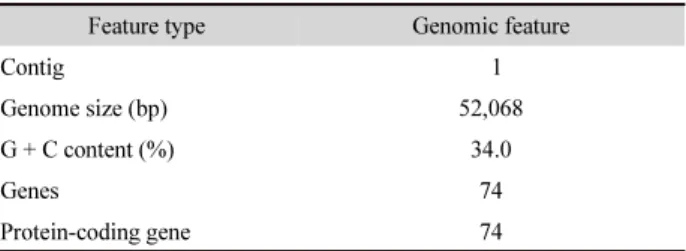
Here, we report a draft genome sequence of the bacteriophage CP3 effective to C. perfringens. The phage genome comprises 52,068 bp with a G + C content of 34.0%. The draft genome has 74 protein-coding genes, 29 of which have predicted functions from BLASTp analysis. Others are conserved proteins with unknown functions. No RNAs were found in the genome.
Keywords: Clostridium perfringens, bacteriophage CP3, draft genome sequence, illumina
Clostridium perfringens is a Gram-positive, rod-shaped, anaerobic, spore-forming pathogenic bacterium, which belongs
to Clostridiaceae family (Volozhantsev et al., 2012). C. perfringens is commonly present in the intestines of vertebrates including humans and animals, and it has been reported that this pathogen plays a significant role in human foodborne disease as well as non-foodborne diseases such as food poisoning and acute gastroenteritis (Seal et al., 2011).
Bacteriophages are very specific to their host bacteria and kill the host by internal replication and bacterial lysis which are mediated with structural and regulatory genes (Seal, 2013).
This specificity provides potential alternatives to treat bacterial pathogens particularly showing antibiotic resistance. Thus identifying and analyzing the genomic properties of bacteriophage genomes and the attributes of the gene content is fundamental. The bacteriophage CP3 was infected with various bacterial species including C. perfringens, Klebsiella pneumoniae, Salmonella enterica, Escherichia coli, Bacillus cereus, Bacillus subtilis, Staphylococcus aureus, Listeria monocytogenes, Lactobacillus plantarum, Enterococcus faecium, and Enteroroccus faecalis, and it showed the host specificity only to C. perfringens. In pursuit of a better understanding of the bacteriophage CP3
Korean Journal of Microbiology (2018) Vol. 54, No. 2, pp. 149-151 pISSN 0440-2413
DOI https://doi.org/10.7845/kjm.2018.8006 eISSN 2383-9902
Copyright ⓒ 2018, The Microbiological Society of Korea
Draft genome sequence of lytic bacteriophage CP3 infecting anaerobic bacterial pathogen Clostridium perfringens
Youngju Kim
1†, Seyoung Ko
2†, Young Eun Yeon
1, Hoa Thi Le
2, Beom Ku Han
1, Hyunil Kim
1, Chang-Sik Oh
3, and Donghyuk Kim
2*
1
Optipharm Inc., Cheongju 28158, Republic of Korea
2
Department of Genetic Engineering and Graduate School of Biotechnology, College of Life Sciences, Kyung Hee University, Yongin 17104, Republic of Korea
3
Department of Horticultural Biotechnology, College of Life Sciences, Kyung Hee University, Yongin 17104, Republic of Korea
혐기성 병원균 Clostridium perfringens를 감염시키는 용균 박테리오파지 CP3의 유전체 염기서열 초안
김영주
1†・ 고세영
2†・ 연영은
1・ Hoa Thi Le
2・ 한범구
1・ 김현일
1・ 오창식
3・ 김동혁
2*
1
㈜옵티팜,
2경희대학교 생명공학원/유전공학과,
3경희대학교 원예생명공학과
(Received February 9, 2018; Revised April 23, 2018; Accepted April 23, 2018)
†
These authors contributed equally to this work.
*For correspondence. E-mail: [email protected];
Tel.: +82-31-201-2683; Fax: +82-31-203-4969
150 ∙ Kim et al.
미생물학회지 제54권 제2호
genome, we present here its draft genome sequence and the genome annotation.
The bacteriophage CP3 was isolated from sewage samples near a swine farm in Chungcheongnam-do, South Korea. In addition, to analyze the phage exhibiting a lytic activity against bacteria, the soft agar overlay method was applied to the C.
perfringens strain isolated from Optipharm Inc, South Korea.
Genome sequencing was performed at Macrogen, Inc. using high throughput sequencing pipeline. Quality filtered data were assembled to a single contig with 200× coverage using de novo assembler, Platanus v1.2.1. Genes in the resulting draft genome sequence were predicted with RASTtk (Brettin et al., 2015). The functions of genes were identified with BLASTp search (https://blast.ncbi.nlm.nih.gov).
The draft genome of bacteriophage CP3 was generated from genome sequencing with next-generation sequencing (NGS) technology. Assembly analysis provided a genomic sequence of a 52,068 bp genome with G + C content of 34.0% (Table 1).
The average length of 74 identified genes in the CP3 genome was 640.5 bp and the average spacer distance was 63 bp. A total of 91.0% of the genome was occupied with protein-coding genes. There are 74 open reading frames (ORFs) in the CP3 genome. No putative RNA genes were predicted in genome.
The gene functions were predicted with BLASTp (Camacho et al., 2009). Total 43 ORFs were predicted as putative functional proteins, while the rest of ORFs were annotated as hypothetical proteins. In the CP3 genomes, the genes with predicted functions might involve in packaging, dissolution, regulation, structural role, and DNA replication(Seguritan et al., 2012). In addition, potential genes for host lysis were annotated such as pitrilysin, bacteriocin, and endolysin.
In conclusion, the draft genome sequence of the bacteriophage CP3 was presented in this study. Host infection experiments showed that the bacteriophage CP3 had specificity to C. perfringens.
Thus, the genomic content of CP3 from this study can provide useful knowledge to understand host specificity of this bacteriophage to C. perfrigens and further to treat the C.
perfrigens pathogen showing anti-microbial resistance.
Nucleotide sequence accession numbers
C. perfringens bacteriophage CP3 strain has been deposited in Korean Culture Center of Microorganisms (KCCM) with the deposit ID KFCC11699P. The draft genome sequences of bacteriophage CP3 has been deposited in the GenBank under the accession number MF001357.1.
적 요
Clostridium perfringens는 그람 양성, 막대 모양, 혐기성, 포 자 형성을 하는 병원균으로서 Clostridiaceae과에 속한다. C.
perfringens 는 인간의 장관과 척추동물 내에서 식중독을 포함 하는 질병을 유발한다. 높은 특이성으로 목표 세균을 죽이는 박테리오파지는 병원세균을 제어하는 방법들 중 하나로 여겨 져 왔다. 본 연구에서는 C. perfringens를 감염시킬 수 있는 박 테리오 파지 CP3의 유전체 염기서열 초안을 보고한다. 본 박 테리오파지의 G + C 비율은 34.0%이며, 52,068 bp로 구성된 유전체 DNA를 지니고 있었다. 이 유전체는 74개의 단백질 유 전자를 포함하고 있었으며, RNA는 확인되지 않았다.
References