송라(Usnea longissima)추출물로부터
균핵병 병원균(Sclerotinia sclerotiorum)에 대한 항균 활성물질 탐색*
1)
권유빈
**․최용화
***Isolation of Antimicrobial Active Substance from Usnea longissima against Sclerotial Rot (Sclerotinia sclerotiorum)
Kwon, Yubin․Choi, Yong-Hwa
To develop environment-friendly agricultural products with anti-microbial activity against Sclerotinia sclerotiorum as a pathogen of sclerotium disease, Usnea longissima was extracted by methanol and its extract was fractionated into several solvent fractions. The chloroform fraction, which showed the highest antimicrobial activity, was separated by silica gel-column chromatography and obtained into nine group subfractions. The nine group fractions were searched the antifungal activities by bioassay. The most active No. 3 subfraction was analyzed by GC-MS. Each mass spectra, corresponding to each peak of chromatogram, was compared to data- base of Wiley library. As a result, Usnic acid was identified as main compounds.
In conclusion, Usnic acid isolated from Usnea longissima was antimicrobial chemical against Sclerotinia sclerotiorum as a pathogen of sclerotium disease.
Key words : antifungal active substance, sclerotinia sclerotiorum, usnea longissima, usnic acid
*
이 논문은 2014학년도 농촌진흥청 농업과학기술개발사업(과제번호 : PJ00941102)의 지원에 의해 이 루어졌습니다.
**
경북대학교 대학원 생태환경시스템학과
***
Corresponding author, 경북대학교 생태환경대학 생태환경시스템학부([email protected])
Ⅰ. 서 론
균핵병 중 Sclerotinia 속에 의한 병은 기주의 감염부위나 환경조건에 따라 솜털썩음병, 흰곰팡이병, 물렁썩음병, 줄기썩음병, 초관썩음병, 꽃썩음병 등으로 나타난다. 기주범위는 매 우 넓으며 채소, 화훼류 등 여러 종류의 식물에 큰 병을 일으킨다. 균핵병은 유묘, 성숙한 식 물체, 수확물 등 생육 전반에 걸쳐서 침입을 한다(Agrios, 1998). 그 중 Sclerotinia sclerotiorum 은 식물병원균 중에서 가장 비특이적이고 전 세계적으로 존재하는 토양 서식균으로서(Purdy, 1979), 75과 278속 408종의 폭넓은 기주를 가지고 있는 경제적으로 중요한 식물 병원균이다 (Boland et al, 1994). S. sclerotiorum은 토양전염 혹은 공기전염을 하는 병원균으로 일반적으 로 자낭포자를 통해 전염을 하고 포장 간 전반에 중요한 역할을 하며 균핵 형태로 혹은 감 염된 기주 식물체 조직내의 균사체에 의한 전염이 이루어지고, 균핵 밀도의 증가는 병 발생 증가의 원인이 된다(Abawi & Grogan, 1979; Schwartz & Steadman, 1978; Kora et al., 2003).
우리나라의 경우 고랭지 채소재배지, 십자화과 채소재배지, 시설재배지에서 주로 발병된다 고 보고되어 있다(Cho, 1976; Kim et al., 1999, 2003, 2006; Shin et al., 1987). S. sclerotiorum 에 의한 균핵병 중 상추균핵병은 미국에서 1890년에 보고되었고(Subbarao, 1998), 우리나라 에서는 1976년에 처음 보고되었다(Kim, 1976). 미국과 유럽에서는 S. sclerotiorum이 자낭포 자를 통해 주로 감염되는 것으로 보고되었다(Abawi & Grogan, 1975; Whipps et al, 2002). 또 한 과수에서 S. sclerotiorum에 의한 포도나무 균핵병에 대한 발생보고가 되어 있으나(Boland
& Hall, 1994; Hall et al, 2002; Latorre & Guerrero, 2001), 우리나라에는 아직까지 발생보고 가 없다(KSPP, 2004). 그러나 오디나무에서 오디 균핵병은 S. sclerotiorum균이 야기 시키는 것으로 보고되었으나, 실제 우리나라에서 균핵병의 병원균은 자낭반의 형태에 따라 컵모양 의 자낭반을 가진 Ciboria shiraiana, 곤봉 모양의 자낭반을 가진 Scleromitrula shiraiana로 동 정되었고, 지역에 따라서도 다소 차이가 있는 것으로 보고되었다(Hong et al., 2007). 오디 열매가 자라는 뽕나무는 뽕나무과(Moraceae)의 뽕나무속(Morus)에 속하는 교목성 낙엽수이 며 과거 대부분 양잠을 위한 뽕잎 공급 및 일부 한약재로서 이용되었다. 그러나 최근 들어 양잠산업은 침체되고 뽕나무 잎이나 열매인 오디의 다양한 효능이 밝혀짐에 따라 재배 면 적이 늘었다(Kim, 2005; Kim et al., 2010). 오디 생산용 뽕나무의 재배면적이 2002년 50 ha 정도에서 2009년 1,544 ha로 급속히 증가한 것을 알 수 있다(RDA, 2010). 그러나, 오디균핵 병에 의한 피해로 심한 농가의 경우, 매년 20% 이상으로 전혀 수확을 하지 못하기도 한다.
농가에서는 오디 균핵병 방제를 위해 시판, 자가 조제된 친환경 자재를 살포하거나 토양을 피복하고 석회를 시용하는 다양한 방법을 적용하였으나 효과는 낮았다.
과채류 균핵병 방제방법에는 화학적인 방법으로 지오판 수화제, 지오판 리프졸수화제 등 과 같은 보호살균제를 토양에 처리할 경우 균핵병 원인균이 억제되어 과채류의 이병율이 낮아진다고 보고하였다(Hong et al., 2007). 그러나 토양에 토착되어 있는 병원균을 근본적
으로 방제하지 못할 뿐만 아니라 주로 침투성 살균제로서 식물 내에서 잔류 문제를 야기시 킬 가능성이 높으므로, 잔류독성의 우려가 낮은 친환경농자재의 개발이 필요하다.
송라과(Usnea longissima) 지의류인 송라는 고산 지대에서 자라거나 온대 지방의 높은 산 에서 한대에 걸쳐서 자란다. 한국에서는 중북부에 분포하며, 일본, 중국 등지에도 분포한다.
나무의 줄기, 가지, 바위에 늘어져 달리며, 음습한 산지의 소나무, 잣나무, 구상나무, 삼나무 등인 침엽수에 기생한다. 다른 이름으로는 송락, 가락지 송라, 여라, 설풍등, 송상기생소나 무겨우살이, 실송라라고도 한다. 송라(Usnea longissima) 추출물에는 다양한 생리활성 물질 이 있어 항진균, 항세균 활성 이외에도 제초효과까지 인정되어 농업용 신규천연물질로 개 발 가능성이 매우 높다고 보고하였다(Krȁmer 등, 1995).
따라서 송라로부터 Sclerotinia sclerotiorum에 항균활성을 갖는 항균물질을 탐색하여 추후 친환경 농자재 개발에 이용하고자 본 연구를 수행하였다.
Ⅱ. 재료 및 방법
1. 실험재료
본 연구에 사용된 균핵병 병원균인 Sclerotinia sclerotiorum은 전북대학교 생명공학부 (Prof. 이귀재)에서 분양받았으며, 경북대학교 대학원 생태환경시스템학과 식물자원환경전 공 천연물화학연구실에 보관하여 배양한 뒤 사용하였다. 식물재료인 송라(Usnea longissima) 는 라오스 약재상에서 구매하였다.
2. 시약 및 기기
용매분획과 Silica gel column chromatography를 위한 MeOH, n-hexane, CHCl3, EtOAc, n-BuOH 등은 덕산약품공업(주)회사의 extra pure grade를 사용하였다. Bioassay에 사용된 PDA배지는 Becton, Dickinson & Co., Paper disc는 Advantec사, Petri dish는 SPL사, silica gel (7734)은 Merck사 제품이었다. Gas chromatography-Mass spectrometry (GC-MS)는 Agilent의 7890A 기종을 사용하였고, Column은 HP-5MS capillary를, Detector는 Agilent 5975C를, library는 Wiley (W9N08.L)를 사용하였다.
3. 실험 병원균의 배양조건
균핵병균의 배양 배지는 B.D사의 PDA를 1 L 조건으로 Petri dish에 조제하였다. 병원균
(Sclerotinia sclerotiorum)은 Cork borer (8 mm)로 채취하여 배지의 중앙에 치상 시킨 후 18℃
로 배양 후 사용하였다.
4. MeOH 용매추출
건조시킨 송라 시료 500 g을 blender를 이용해 잘게 분쇄하고 99.5% MeOH로 실온에서 24시간 침지 후 추출하였으며 MeOH 침지와 추출과정을 3회 반복하였다. 상등액을 여과지 (Sanyo 185 ㎜ Ø, No 2, Japan)를 사용하여 고형물을 걸러내고 40℃에서 rotary evaporator로 감압 ․ 농축 건조하여 MeOH 추출물(38.29 g)을 얻었다.
5. MeOH 추출물 용매분획
MeOH 추출물(38.29 g)을 증류수(H2O)에 현탁시킨 후 n-hexane, CHCl3, EtOAc, n-BuOH을 사용하여 순차적으로 용매분획해서 Hexane fraction (0.3 g), CHCl3 fraction (4.00 g), EtOAc fraction (1.83 g), BuOH fraction (11.81 g), Aqueous layer (20.30 g)을 얻었다.
6. 생물검정
항균 활성 탐색을 위해 Kang et al. (2013)의 방법을 응용하여 고압 멸균한 PDA배지를 Petri dish (90×15 mm)에 분주하여 평판배지를 만든 다음 완전히 굳히고, 추출물을 MeOH로 10,000 ppm으로 만들어 Paper disc (∅8 mm)에 50 µl씩 점적하였다. MeOH이 완전히 휘발된 다음 PDA 평판배지 가장자리에 Paper disc를 치상하였다. 시험 균주는 Cork borer (8 mm)로 채취하여 배지 중앙에 치상하고, 18℃ incubator에서 각각의 시험균주가 다 자랄 때까지 배 양하였다. 균이 다 자라면 clean zone의 형성유무를 확인하여 항균 활성 여부를 조사하였다.
분리한 화합물의 균핵병 생육억제능을 평가하기 위해서는 고압멸균 한 PDA 배지에 0 ppm, 1 ppm, 10 ppm, 100 ppm 농도로 화합물을 첨가하여 Petri dish (90×15 mm)에 분주 평 판배지를 만들었다. 평판배지를 완전히 굳히고 Cork borer (8 mm)로 채취한 시험 균주를 배 지 중앙에 치상하여 18℃ incubator에서 균주의 생장속도를 보며 항균 활성 여부를 조사하 였다.
7. Chloroform fraction의 정제
활성이 우수한 Chloroform fraction의 활성물질을 탐색하기 위하여 Silica gel (Merck 7734, 700 g)을 glass column (50 mmØ × 860 mm)에 충진 시킨 후 CHCl3 fraction (4.00 g)을 chloro-
form에 용해시켜 column chromatograph에 charge하였다. CHCl3 : Methanol (1, 10, 20, 30...
50% in CHCl3, v/v)의 용매계로 순차용출(step-wise) 시켜 40개의 subfractions을 받았으며, 각 각의 subfraction을 TLC에 전개하여 spot을 확인하여 9개의 그룹(G1, G2, …, G9)으로 나누었다.
8. G3 subfraction의 항균 활성물질 탐색
생물검정에서 활성을 나타낸 G3 subfraction을 GC-MS로 분석하였다. GC-MS에서 얻어진 peak를 Wiley library Data base와 비교하였고 이를 통해 G3 subfraction에 함유된 물질들의 화학구조를 동정하였다.
Ⅲ. 결과 및 고찰
균핵병의 원인균인 S. sclerotiorum에 대한 송라(Usnea longissima) 추출물의 용매분획의 항균활성을 조사한 결과, Hexane fraction, CHCl3 fraction, EtOAc fraction에서 강한 항균활성 을 보였다(Fig. 1).
Fig. 1. Antibacterial activities of MeOH extract and solvent fractions of Usnea longissima extract against Sclerotinia sclerotiorum. (C) Control; (MeOH) methanol extract;
(Hex) hexane fraction; (CHCl3) chloroform fraction; (EtOAc) ethylacetate fraction;
(BuOH) butanol fraction; (AQ) aqueous layer.
활성을 나타낸 fraction들 중에 CHCl3 fraction을 silica gel column chromatography에 충진하 고 용매계 (CHCl3 : Methanol)로 step-wise 방법으로 용출하여 분획별 300 ml 씩 총 40개의
subfractions을 얻어 TLC 분석으로 이들을 다시 9개의 그룹으로 나누었다. 이들 9개의 sub- fractions (G1, G2, …, G9)을 대상으로 항균활성을 조사한 결과, G3 subfraction에서 가장 강 한 활성을 나타내었다.
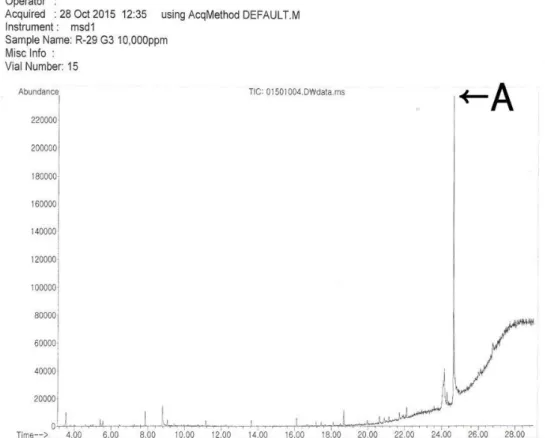
G3 subfraction의 주요화합물을 구명하고자 GC-MS로 분석한 결과 GC chromatogram은 Fig. 2과 같았다.
Fig. 2. GC Chromatogram data of G3 subfraction.
G3 subfraction의 GC Chromatogram에서 검출된 peak들 중에서 주요 화합물인 24.607 min 에 검출된 A peack 화합물의 화학적 구조를 구명하고자 MS spectra와 Wiley library를 비교 하여 구조를 확인하였다. 그 결과, 화합물은 Usnic acid 화합물로 동정되었다(Fig. 3).
Fig. 3. Mass spectra of A peak (ⓐ) and Usnic acid (ⓑ) in Wiley library.
검출된 화합물은 Usnic acid로써 항균활성물질로 추정되며 Usnic acid의 항균활성을 검정 하기 위하여 표준품 Usnic acid을 구매하여 PDA 배지에 0 ppm, 1 ppm, 10 ppm, 100 ppm 농 도로 화합물을 배지에 첨가하여 실험배지를 만들었다. 시험균주를 배지 중앙에 치상하여 약액배지혼합방법으로 항균활성을 검정하였다. 검정결과 100 ppm 농도에서 균핵병 원인균 인 S. sclerotiorum균의 생육이 완벽하게 억제됨이 관찰되었고 10ppm 농도에서도 강하게 생 육을 억제하는 것으로 나타났다(Fig. 4). 따라서 본 연구에서는 송라로부터 분리한 Usnic acid 화합물이 활성물질인 것으로 추정 되었으며, 항균력이 강한 송라 추출물 또는 Usnic acid 화합물을 주성분으로 하는 추출물을 채소류 또는 과수 균핵병에 대한 친환경농자재의 개발이 가능할 것으로 판단되었다.
Fig. 4. Antibacterial activity of Usnic acid against Sclerotinia sclerotiorum. (A) Control;
(B) 1 ppm Usnic acid; (C) 10ppm Usnic acid; (D) 100ppm Usnic acid.
Ⅳ. 적 요
본 연구는 균핵병의 원인균인 Sclerotinia sclerotiorum에 대해 항균활성을 갖는 친환경 유 기농자재를 개발할 목적으로 송라(Usnea longissima)로부터 활성물질을 분리하였다. 송라를 MeOH로 추출하여 용매분획을 하였고, 용매분획 중에서 강한 활성을 나타낸 CHCl3 fraction 을 column chromatography로 분리하여 40개의 subfractions을 얻었고 9개의 그룹으로 나누었 다. 9개의 subfractions을 bioassay한 결과 G3 subfraction에서 강한 활성을 나타내었다. G3 subfraction을 GC-MS로 분석하여 chromatogram 상의 활성물질로 추정되는 peak의 mass spectrum과 Wiley library를 비교하여 profiling한 결과, Usnic acid가 주요 물질로 검출되었다.
항균활성물질로 추정되는 Usnic acid 화합물의 항균활성을 검정하기 위하여 표준품을 사용 하여 생물검정한 결과 이 화합물이 강한 활성을 나타내었다. 따라서 송라로부터 분리한 Usnic acid가 균핵병의 원인균인 Sclerotinia sclerotiorum에 대한 항균 활성물질인 것으로 추 정하였다.
[Submitted, November. 06, 2015; Revised, November. 12, 2015; Accepted, November. 16, 2015]
References
1. Abawi, G. S. and Grogan, R. G. 1975. Source of primary inoculum and effects of tempera- ture and moisture on infection of beans by Whetzelinia sclerotiorum. Phytopathology. 65:
300−309.
2. Abawi, G. S. and Grogan, R. G. 1979. Epidemiology of disease caused by Sclerotinia species.
Phytopathology. 69: 899-904
3. Agrios, G. N. 1998. Plant pathology. 4rd ed., Academic Press. p. 635.
4. Bardin, S. D. and Huang, H. C. 2001. Research on biology and control of Sclerotinia diseases in Canada. Can. J. Plant Pathol. 23: 88-98.
5. Baskar K., Sasikumar S., Muthu C., Kingsley S., and Ignacimuthu S. 2011. Bioefficacy of Aristolochia tagala Cham. against Spodoptera litura Fab. (Lepidoptera: Noctuidae). Saudi Journal of Biological Sciences. 18: 23-27.
6. Boland, G. J. and Hall, R. 1994. Index of host plants of Sclerotinia sclerotiorum. Canadian journal of Plant Pathol. 16: 93-108.
7. Cho, C. T. 1976. Present Status and Problems for the Control of Vegetable Diseases in the Vinyl house. Korean J. Plant Protection. 154: 215-222
8. Hall, B. H., R. L. McMahon, and T. J. Wicks. 2002. First report of Sclerotinia sclerotiorumon grape (Vitis vinifera) in South Australia. Australasian Plant Pathol. 31: 417-418.
9. Hong, S. K., W. G. Kim, G. B. Sung, S. H. Nam, and J. S. Kim. 2007. Aspects of Popcorn Disease Occurrence on Mulberry Fruits in Korea. Res. Plant Dis. 13(3): 131-136
10. Hwang, J. Y., C. K. Shim, K. Y. Ryu, D. H. Choi, and H. J. Jee. 2006. Selection of Brevibacillus brevis B23 and Bacillus stearothermophilus B42 as biological control agents against sclerotinia rot of lettuce. Res. Plant Dis. 12: 254-259. (In Korean)
11. Kang, J. Y., D. H. Kim, D. G. Lee, I. S. Kim, M. G. Jeon, J. D. Lee, I. H. Kim, and Sanghyun Lee. 2013. Screening of Antifungal Activities of Medicinal Plants for the Control of Turfgrass Fungal Disease. Weed Turf. Sci. 2(1): 70-75.
12. Kim, E. O., Y. J. Lee, H. H. Leem, I. H. Seo, M. H. Yu, D. H. Kang, and S. W. Choi.
2010. Comparison of nutritional and functional constituents, and physicochemical characteris- tics of mulberrys from seven different Morus alba L. cultivars. J. Kor. Soc. Food Sci. Nutr.
39(10): 1467-1475.
13. Kim, H. B. 2005. Anti-oxidative capacity analysis of water-soluble substances according to varieties and maturity stages in mulberry leaves and fruits. Kor. J. Seric. Sci. 47(2): 62-67.
14. Kim, H. W., K. Y. Lee, J. W. Baek, H. J. Kim, J. Y. Park, J. W. Lee, S. J. Jung, and B.
J. Moon. 2004. Isolation and identification of antagonistic bacterium active against Sclerotinia sclerotiorum causing sclerotinia rot on crisphead lettuce. Res. Plant Dis. 12: 254-259. (In Korean)
15. Kim, K. C. 1976. The effect of ray on sclerotia formation of sclerotium disease. Korean J.
Plant Protect. 15: 223-243. (In Korean)
16. Kim, W. G., W. D. Cho, and H. J. Jee. 1999. Occurrence of Sclerotinia rot on cucurbi- taceous vegetable crops in greenhouses. Korean J. Mycol. 27: 198-205
17. Kim, W. G. and W. D. Cho. 2003. Occurrence of Sclerotinia rot in cruciferous crops caused by Sclerotinia spp. Plant Pathol. J. 19: 69-74
18. Kim, W. G., S. K. Hong, and S. Y. Lee. 2006. Occurrence of Sclerotinia rot in four leguminous crops caused by Sclerotinia sclerotiorum. Plant Pathol. J. 22: 16-20
19. Kora, C., M. R. McDonald, and G. J. Boland. 2003. Sclerotinia rot of carrot: An example of phenological adaptation and bicyclic development by Sclerotinia sclerotiorum. plant Dis.
87: 456-470.
20. The Korean Society of Plant Pathology. 2004. List of Plant Diseases in Korea. p. 779.
21. Krȁmer, P., U. Wincierz, G. Grȕber, J. Tschakert, W. Voelter, and H. Mayer. 1995. Rational approach to fraction, isolation and characterization of polysaccharides from the lichen Cetraria islandica. Drug Research. 45: 72-731
22. Latorre, B. A. and M. J. Guerrero, 2001. First report of shoot blight of grapevine caused by Sclerotinia sclerotiorum in Chile. Plant Dis. 85: 1122.
23. Purdy, L. H. 1979. Sclerotinia sclerotiorum: History, diseases and symptomatology, host range, geographic distribution, and impact. Phytopathology 69: 875-880.
24. Rural Development Administration (RDA). 2010. Culivation techniques of Mulberry. pp. 6-7, 62.
25. Schwartz, H. F. and J. R. Steadman. 1978. Factors affecting sclerotium populations of, and apothecium production by Sclerotinia sclerotiorum. phytopathology 68: 383-388.
26. Shin, D. B. and J. T. Lee. 1987. Ecological studies on lettuce drop disease occurring under controlled cultivation conditions in drained paddy fields. Korean J. Plant Pathol. 3: 252-260 27. Subbarao, K. V. 1998. Progress toward integrated management of lettuce drop. Plant Dis.
82: 1068-1078.
28. Thirugnanasampandan R., G. Mahendran and V. Narmatha Bai. Antioxidant properties of some medicinal Aristolochiaceae species. African Journal of Biotechnology. 7(4): 357-361.
29. Whipps, J. M., S. P. Budge, S. McClement, and D. A. C. Pink. 2002. A glasshouse cropping method for screening lettuce lines for resistance to Sclerotinia sclerotiorum. Eur. J.
Plant Pathol. 108: 373-378.