The Influence of Entrepreneurial Leadership on Team Performance –Focusing on the Mediating Role of Team Efficacy
Huan-Huan Wang
1, Yan-Nan LI
2*, Jong-Kwan Kim
31
Doctor candidate, School of Business, Pusan National University
2
Guest professor, Graduate School of Technology Management, Kyung Hee University
3
Professor, School of Business, Pusan National University
기업가적 리더십이 팀 성과에 미치는 영향 – 팀 효능감의 매개효과를 중심으로
왕환환
1, 이염남
2*, 김종관
31
부산대학교 경영학과 박사과정,
2경희대학교 테크노경영대학원 객원교수
3
부산대학교 경영학과 교수
Abstract With the advent of the Fourth Industrial Revolution, companies pursue innovation and opportunities, and corporate performance is also newly defined. As a result, the demand for new leadership is stronger. This paper conducted an empirical analysis to examine the role of team efficacy between entrepreneurial leadership and team performance. Using the SPSS 21.0 and AMOS 20.0 Statistics Package, 530 members in 79 work teams in China collected data was analyzed. The results showed that entrepreneurial leadership has a positive (+) effect on team performance, and team efficacy has a partial mediating effect between entrepreneurial leadership and team performance. This study deepened the understanding of entrepreneurial leadership and revealed the importance of entrepreneurial leadership in organizations. Future research can focus on multi-level research involving self-efficacy and individual entrepreneurial intent.
Key Words : Entrepreneurial Leadership, Team Performance, Team Efficacy, Team, Leadership.
요 약 조직성과를 창출하기 위해 리더십에 대해 끊임없이 많은 연구가 있어왔지만, 4차 산업혁명 시대의 변화에 적응 하기 위해 팀 리더들의 역할에 주목한 연구는 많이 없었다. 이에, 본 연구에서는 현 시대의 필요한 리더의 기업가적 리더십이 팀 성과 사이에서 팀 효능감을 매개변수로 하여 어떠한 영향을 미치는지에 대해 연구하고자 한다. 이를 검증 하기 위해 중국 소재 기업의 총 79개 팀, 530명의 팀원을 대상으로 데이터를 수집하고 SPSS와 AMOS을 사용하여 분석한 결과, 기업가적 리더십이 팀 성과에 정(+)의 영향이 있으며, 기업가적 리더십과 팀 성과 간의 관계에서 팀 효능 감이 긍정적인 매개역할을 하는 것으로 나타났다. 따라서 본 연구에서는 사람과 성과를 동시에 추구하는 팀워크 관점에 서 팀 리더들의 기업가적 리더십의 중요성과 팀 효능감을 향상시키는 중요성을 밝힌 것에 그 의의가 있다. 향후 팀 차원뿐만 아니라 개인 차원의 자기효능감과 창업의향을 포함한 폭 넓은 연구를 계속 진행할 계획이다.
주제어 : 기업가적 리더십, 팀 성과, 팀 효능감, 팀, 리더십.
*Corresponding Author : Yan-Nan LI([email protected])
Received July 27, 2020 Revised August 14, 2020
Accepted October 20, 2020 Published October 28, 2020
1. Introduction
1.1 Research Background
The past decade has witnessed the most spectacular and powerful emergence of entrepreneurial activities in the world. The entrepreneurial revolution has redefined the economy, creating new jobs, new products and even new industries[1]. From the advent of smart phone to artificial intelligence, human lifestyles and ways of thinking have changed dramatically.
With a series of high-tech continuous fermentation, entrepreneurs are now described as aggressive catalysts for change in the world of business, individuals who recognize opportunities where others see chaos, contradiction, or confusion[2].
The creation and sustainable development of new businesses require not only vision and financial capital but also the need to lead others to transform that vision and financial capital into a reality of success[3]. Consensus has been reached on the positive role of leadership in affecting individual and organizational performance in the field of organization management[4, 5]. To some extent, leaders’
capable of sustaining innovation in adapting to rapidly changing environment has been emphasized[6]. Obviously, attention should be paid to the occurrence of a strong presence of factors that are of the entrepreneurs-leaders.
Cogliser and Brigham (2004) remark that one of the potential areas where entrepreneurship researchers might benefit from is the successes of leadership researches[7]. Entrepreneurial leadership emerges as the only concept that can reconcile various gaps, which is considered as a combination of entrepreneurship and leadership.
The necessary to integrate entrepreneurship research and theory into the more established traditions of leadership and management was also emphasized by Vecchio(2003) [8]. Combining the importance of entrepreneurship in the
company's economic development and reconstruction, integrating entrepreneurship and leadership can be regarded as the GAP of existing research, and the gaps and limitations in the protean literature are worth explaining[9].
1.2 Research Questions and Purposes Entrepreneurial leadership is not a new concept, but it has only recently received attention in both western and Asian academic world. While considerable academic research has explored the skills and abilities demanded of entrepreneurs, limited research has been devoted to the leadership issues[3]. The internal process of how the entrepreneurial leadership influence organizational/ individual innovation and performance has also attracted the attention of scholars [10-13]. But at present, there is none research focusing on efficacy in team level related with team performance.
O'Reilly, Snyder & Boothe (1993) emphasized that executive team’s experience is a very important determinant of the team’s functioning[14]. Team members may be influenced by leaders’ entrepreneurial leadership and identified an entrepreneurial mind-set to be more confident in their team to discover new opportunities and to engaged in entrepreneurial activities.
Moreover, team creative efficacy was found to exert a mediating role between entrepreneurial leadership and employee creativity[25]. Follow this logic, we consider team efficacy as an associator with team performance. Thus, this paper aimed at exploring the latent influence relationship between leader’s entrepreneurial leadership and team performance, focusing on team members' efficacy on their team.
2. Literature Review
2.1 Entrepreneurial Leadership
Entrepreneurial leadership is emerging as a critical issue in our understanding of the hyper competitive context and the dynamics of economic development in the 21
stcentury[15].
Similar with the leadership development, in the early researches, the entrepreneurial leadership has been defined from the trait view that the entrepreneurial leadership is an ability of an individual to influence others [16, 17]. In other words, the entrepreneurial leadership has been recognized as an ability of an individual. Others imply that the entrepreneurial leadership should be considered as part of general leadership, which influencing subordinates by role modeling[8]. Renko, Tarabishy, Carsrud &
Brännback (2015) defined the entrepreneurial leadership, different from management, as influencing and directing the performance of group members toward the achievement of organizational goals that involve recognizing and exploiting entrepreneurial opportunities[19].
Reviewing relevant literature, previous researchers are identifying the most important fundamental attributes that reflect entrepreneurial leadership, including vision, opportunity, impact, planning, motivation, creativity, achievement orientation, flexibility, persistence, patience, risk-taking, high degree of ambiguity, tolerance, self-confidence, tenacity, power-orientation, positive behavior, sustainable and internal control points [20, 21]. Most of scholars consider entrepreneurial leadership as a single component concept [12, 22, 23].
The positive link between the entrepreneurial leadership and innovative is confirmed, but its nature is unclear. For instance, Chen (2007) found that the entrepreneurial leadership positively correlated with creativity in entrepreneurial teams, while none significant correlation was found between the entrepreneurial leadership and patent creation[22]. While Huang, Ding & Chen (2014) indicated that entrepreneurial leadership leads to
organizational innovation and creativity, which further positively influenced new venture performance [12]. Paudel (2019) also confirmed a significant positive effect of entrepreneurial leadership on business performance of small and medium enterprises[39]. As entrepreneurial leaders have been described as one who creating opportunities and setting goals, we inferred that there should be a positive relationship between the entrepreneurial leadership and team performance. Thus, we make hypothesis as follows:
Hypothesis 1: Entrepreneurial leadership is positively related to team performance.
2.2 Team Efficacy
Team-efficacy has recently attracted a great deal of attention on variables that are important for explaining team-level performance. Cai et al.
(2018) expected entrepreneurial leadership motivates and challenges employees to engage in creative behaviors and outcomes, which associated with the courage or confidence to take a new step[25]. In this vein, past researches have also suggested that leaders' behaviors may motivate team members to increase their efficacy on their team. According to the entrepreneurial leadership theory, entrepreneurial leaders benefit a lot by building effective venture teams to accomplish innovative goals[26]. In other words, such research highlights the role of entrepreneurial leadership in team-level attributes regarding higher business performance, such as pushing team members to be more interdependent and act in a more innovative way, which may contribute to higher team efficacy[38].
Lord et al. (2001) suggested that team members who have been supervised by the same leader tend to form a collective view of their joint efficacy to generate entrepreneurial outcomes[27].
Entrepreneurial leaders motivate co-workers to
follow and join the opportunity-driven process as one part of the collective by being committed to the identification and exploitation of opportunities, which is useful for efficacy formation [28]. Thus, we proposed the following hypothesis considering the suggesting relationship between entrepreneurial leadership and team-efficacy.
Hypothesis 2: Entrepreneurial leadership is positively related to team members’ team efficacy.
2.3 Entrepreneurial Leadership, Team Efficacy and Team Performance
Existing conceptual and empirical studies has found a positive relationship between team efficacy and team performance[40]. Specially, individuals are motivated through the establishment of high goals to attain effective outcomes[24]. The team goal commitment expectations, which are influenced by their efficacy on their team, are likely to motive them to devote effort to generating team effectiveness[29].
Entrepreneurial leaders were described as leaders who can maintain innovation and adaptability in high-speed and uncertain environments[4]. While influencing others to exploring opportunities and changes, he or she must be act as a passionate role model. The passionate entrepreneurial leaders showed can have a contagious effect on members' confidence on their team's ability, which was positively related to team level work performance [30].
Moreover, confidence generated by team efficacy can helps motivate and direct efforts to complete the team's goals[41].
Srivastava, Bartol & Locke (2006) has examined the relationship between empowering leadership, team-efficacy, knowledge sharing and team performance[31]. According to their research, knowledge sharing, and team-efficacy partially mediated the positive relationship
between empowering leadership and team performance. As entrepreneurial leaders have been described as one who pushes others to act in a more innovative way[19], we inferred that there should be a positive relationship between the entrepreneurial leadership and team performance, and team efficacy may mediate this relationship. Thus, we make hypothesis as follows.
Hypothesis 3: Team efficacy mediates the relationship between entrepreneurial leadership and team performance.
3. Research Methods
3.1 Sampling and Procedure
Data collection was carried out targeting at
general work teams in eleven Chinese
companies. Personal networking was used when
conducting the survey. And the convenience
sampling methods were used which refers to the
samples can be secured by the researchers,
instead of random sampling or probability
sampling. In order to avoid common method
bias, we set a time interval when we collected
the questionnaire from different sources, and
anonymity was adopted in the questionnaire
distribution process. We first interviewed senior
managers to acquire the permission, and asked
them about team age and team size. Then we
choose several teams randomly and sent
questionnaire to team members(including
demographics, team performance and team
efficacy) through e-mails and web links. The
instructions in the questionnaire inform
participants that the survey was designed to
learn more about the organization, how
employees think about team leaders and the
performance of their teams, and how they see
themselves on the capability of the team. Each
survey packet begins with an indication, followed by several instruments to evaluate each variable.
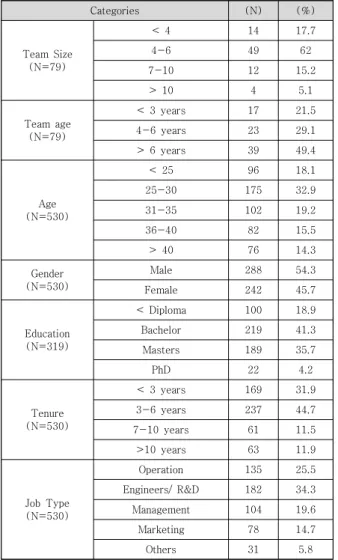
Finally, demographic issues such as gender, age, education level and tenure were asked. We ultimately received 530 valid questionnaires from 79 teams(response rate 66.2 %). Of all the participants, 54.3% were men. In terms of age, there are most people aged 25-30 (75, 32.9%).
Team age of over 6 years accounted for the largest proportion (49.4 %, N=39). In the team size, 4-6 members were the most, with 49 (62 %).
The most frequently indicated education level was a bachelor's degree with 219 (41.3%), and the most job type is engineers/R&D with 182 (34.3%).
More detailed demographic information is shown in Table 1.
Categories (N) (%)
Team Size (N=79)
< 4 14 17.7
4-6 49 62
7-10 12 15.2
> 10 4 5.1
Team age (N=79)
< 3 years 17 21.5
4-6 years 23 29.1
> 6 years 39 49.4
Age (N=530)
< 25 96 18.1
25-30 175 32.9
31-35 102 19.2
36-40 82 15.5
> 40 76 14.3
Gender (N=530)
Male 288 54.3
Female 242 45.7
Education (N=319)
< Diploma 100 18.9
Bachelor 219 41.3
Masters 189 35.7
PhD 22 4.2
Tenure (N=530)
< 3 years 169 31.9
3-6 years 237 44.7
7-10 years 61 11.5
>10 years 63 11.9
Job Type (N=530)
Operation 135 25.5
Engineers/ R&D 182 34.3
Management 104 19.6
Marketing 78 14.7
Others 31 5.8
Table 1. Demographic characteristics
3.2 Measures and Operational Definitions All the items were answered on a 5-point Likert-type scales ranging from 1 point (strongly disagree) to 5 point (strongly agree) unless otherwise indicated.
Entrepreneurial leadership (Independent Variable): We defined Entrepreneurial leadership (α=0.93) as a distinctive leadership role which influencing and directing the performance of group members, along with the mind-set of opportunity identification and opportunity exploration. It was measured using the 8-items
"ENTRELEAD scale" developed by Renko et al.
(2015)[19].
Team Efficacy (Mediating Variable): We defined team efficacy as the beliefs or faiths of team members about the skills and abilities to organize and perform the actions required to successfully achieve the team task. To measure team efficacy(α=0.89), we adopted Edmondson (1999)’s 3-factor scale and 1 item from Zhao et al. (2015) to text how much an individual perceived about their team capability[32, 33].
Team performance (Dependent Variable): We defined team performance(α=0.94) as the extent to which the team members perceived team's effectiveness and efficiency in performing tasks.
Consistent with appraisal research, assessments of both team outcomes and team behaviors were included [34]. We combined dimensions such as knowledge of tasks, quality of work, quantity of work, initiative, interpersonal skills, planning and allocation, commitment as team performance.
Jansen, Van Den Bosch & Volberda (2006) have
suggested controlling the age and size of new
businesses, as these two variables may be related
to exploration and performance[35]. Thus, we
controlled team size and team age in the team
level. Gender, age, education, tenure, main job
the one does in the team were controlled in the
individual level.
3.3 Data Aggregation
Considering team level research requires special statistical procedures to analyze the data, we justified aggregating individual members’
responses statistically by using rwg, ICC(1), and ICC(2) to ensure that multi-item rwg are generally considered sufficient agreement to warrant aggregation [36, 37].
The ICC(1) values of entrepreneurial leadership, team efficacy and team performance were 0.34, 0.38 and 0.62, respectively, while the ICC(2) values were 0.76, 0.80 and 0.91. Moreover, the rwg values of entrepreneurial leadership, team efficacy and team performance were 0.82, 0.88 and 0.72, all above 0.7. The results indicate that data aggregation is justified.
4. Results
4.1 Validity Analysis
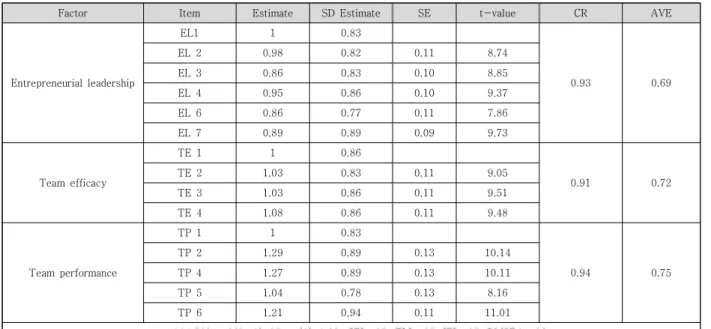
To assess the discriminant validity of the measures in our study, we conducted a confirmatory factor analysis(CFA) using AMOS 20.0 statistics package. The results are presented
in Table 2. The overall structural model showed a good fit to the data(x²=114.58, df=87, p=.03, x²/df=1.32 IFI=.97, TLI=.97, CFI=.97, RMSEA=.06).
4.2 Correlation Analysis
The results of correlations are provided in Table 3. As expected, entrepreneurial leadership is significantly correlated with team efficacy(r=0.42, p<0.01) and team performance(r=0.55, p<0.01).
Team efficacy is also positively correlated to team performance(r=0.50, p<0.01). Moreover, age is positively correlated to tenure(r=0.40, p<0.01) and team efficacy(r=0.09, p<0.05). It means that the older the members, the longer he or she may stays at the team, and the higher team efficacy may be.
4.3 Hypotheses Test
We use SEM procedures to examine the relationship of entrepreneurial leadership, team efficacy and team performance. As Table 4 shows, entrepreneurial leadership positively influence team efficacy and team performance, with standardized regression weights of 0.48(p<0.01) and 0.65(p<0.01), lending support for
Factor Item Estimate SD Estimate SE t-value CR AVE
Entrepreneurial leadership
EL1 1 0.83
0.93 0.69
EL 2 0.98 0.82 0.11 8.74
EL 3 0.86 0.83 0.10 8.85
EL 4 0.95 0.86 0.10 9.37
EL 6 0.86 0.77 0.11 7.86
EL 7 0.89 0.89 0.09 9.73
Team efficacy
TE 1 1 0.86
0.91 0.72
TE 2 1.03 0.83 0.11 9.05
TE 3 1.03 0.86 0.11 9.51
TE 4 1.08 0.86 0.11 9.48
Team performance
TP 1 1 0.83
0.94 0.75
TP 2 1.29 0.89 0.13 10.14
TP 4 1.27 0.89 0.13 10.11
TP 5 1.04 0.78 0.13 8.16
TP 6 1.21 0.94 0.11 11.01
x²=114.58(p=.03), df=87, x²/df=1.32, CFI=.97, TLI=.97, IFI=.97, RMSEA=.06
Table 2. Results of the CFA
H1 and H2. Our findings also show that team efficacy partially mediates the relationship between entrepreneurial leadership and team performance (see Table 5). When entrepreneurial leadership influenced team performance with a mediating role of team efficacy, the path coefficient was 0.30(0.65*0.45), and when the influence directly affected team performance without team efficacy as a mediator, the path coefficient was 0.48 , lending support for H3.
In addition, Bootstrapped confident intervals corroborate the significant indirect effect of entrepreneurial leadership on team performance (95%CI=[0.17, 0.47]). While the relationship between entrepreneurial leadership and team performance is showed to be positively significant (t=9.46, p<.01 95%CI=[0.72, 1.11]). It means that the mediation effect of team efficacy exists, while it is not a complete mediator. Thus, we confirmed that team efficacy partially
mediated the relationship between entrepreneurial leadership and team performance, again supporting H3.
5. Conclusions
The present study was motivated by three goals/ First, to investigate the effect of entrepreneurial leadership on team performance.
Second, to prove the importance of team efficacy to team performance. Third, to advance the understanding of the role of team efficacy between entrepreneurial leadership and team performance.
As expected, the research results supported all of our hypotheses, which showed that entrepreneurial leadership positively effect team performance(H1), and team efficacy (H2). In addition, bootstrap CIs corroborate the
Path Estimate SE SD estimate t-value p-value
Entrepreneurial leadership→Team performance 0.49 0.12 0.48 4.23 0.00
Entrepreneurial leadership→Team efficacy 0.63 0.12 0.65 5.46 0.00
Team efficacy →Team performance 0,48 0.12 0.45 4.01 0.00
Table 4. Path analysis
Mean SD 1 2 3 4 5 6 7
1. Age 3.18 1.62 1
2. Gender 1.48 0.50 -0.01 1
3. Education 2.53 1.03 0.02 0.03 1
4. Tenure 2.03 0.95 0.40** 0.03 0.06 1
5. Job type 2.41 1.18 0.02 0.03 -0.06 0.02 1
6. Entrepreneurial leadership 3.59 0.94 0.03 0.04 0.02 0.00 -0.05 1
7. Team performance 3.59 0.93 0.02 0.06 0.00 0.01 -0.00 0.55** 1
8. Team efficacy 3.62 0.89 0.09* -0.02 -0.02 0.05 -0.05 0.42** 0.50**
*p<0.05, **p<0.01.
Table 3. Means, standard deviations and correlations
Independent variables Dependent variables Direct effect Indirect effect Total effect
Entrepreneurial leadership Team performance 0.48 0.30 0.78
Team efficacy 0.65 0.00 0.65
Team efficacy Team performance 0.45 0.00 0.45
Table 5. Direct effects, indirect effects and total effects of variables.
significant indirect effects of entrepreneurial leadership on team performance through team efficacy, which means that team efficacy partially mediated the relationship between entrepreneurial leadership and team performance(H3).
Scholars suggested that it is necessary to conduct further research on the desirable workplace outcomes as a distinctive leadership style [15, 19, 26]. Entrepreneurial leadership can play a critical role in situations where a innovative workforce is required[22]. This means that employees should have a strong desire to identify and explore opportunities, which associated with new venture performance[12].
While we still have limited understanding of how entrepreneurial leadership may stimulate innovative behavior and organization performance[23]. Following Renko et al.'s(2015) conceptualization of entrepreneurial leadership[19], we argue that the entrepreneurial leadership style enables a firm to make its members more confident in their own team by influencing and directing the performance of group members as a passionate role model. Our study empirically extends the understanding of the role of entrepreneurial leadership style in organizational behavior in team level. Our findings indicate that entrepreneurial leadership positively related to team members' team efficacy. This provides evidence to support that entrepreneurial leadership may inspire employees' feeling of being compatible with their leader and organizational goals[25]. We confirmed team efficacy's mediing role between entrepreneurial leadership-team performance relationship. It stressed the importance of entrepreneurial leaders in terms of motivating workplace employees to develop their efficacy beliefs toward their teams(e.g. Renko et al., 2015). We respond to scholars' calls for investigating intervention mechanisms by showing that entrepreneurial leadership influences team performance through a
motivational mechanism.
Our findings have certain practical implications. First, in order to help firms to produce more outcomes, organizations should recognize the important value of entrepreneurial leadership by selecting leaders with this characteristics. At the same time, organizations can develop general managers' entrepreneurial skills by training(e.g., designing dynamic and acceptable goals). Our results also point the role of team efficacy on team performance. Thus, leaders and organizations should desirably coordinate well to help team members share strong beliefs concerning their teams' performance. Organizations should develop practices to build high-efficacy teams and develop team members understanding of the common goals. Considering the importance of team efficacy to team performance, organizations should develop practices to cultivate team members' understanding of common goals as well as confidence in achieving them. This may boost employees' contributions as part of a strong unit.
Our study may generate ambiguity regarding
causality. Future studies may use a longitudinal
empirical research design to confirm the causal
effects between entrepreneurial leadership and
team performance. In addition, considering the
limited ability to collect questionnaires, we
collected individual-level data for team-level
analysis. There may be some deviations between
the results of member's recognition and the
results of leader's evaluation. Thus, further
research could examine team performance from
multi sources. Moreover, although this study
contributes empirical evidence to the widely
established relation between entrepreneurial
leadership and team performance via team
efficacy, further research is encouraged to
explore the results while connecting with
self-efficacy in teams. For example,
entrepreneurial leadership may also stimulate
individual's self-efficacy by role modeling regard to team common goals. Assuming self-efficacy can also mediate the relationship between entrepreneurial leadership and team performance, it seems necessary to study the magnitude of the two mediating effects.
Furthermore, since entrepreneurial leadership emphasizes identifying and exploring opportunities, future research could study the relationship between entrepreneurial leadership and employees' entrepreneurial intent within and without the firm following prior studies[40, 41], and the influence of entrepreneurial intent on entrepreneurial success[18]. Cross-level research of integrating self-efficacy, team-efficacy, and other relevant mechanisms would enrich current knowledge on how entrepreneurial leadership influence organizational outcomes.
REFERENCES
[1] P. M. Swiercz & S. R. Lydon. (2002). Entrepreneurial leadership in high-tech firm: A fied study. Leadership and Organization Development Journal, 23(7), 380-386.
[2] D. F. Kuratko. (2007). Entrepreneurial leadership in the 21st century. Journal of Leadership and Organizational Studies, 13(4), 1-11.
[3] S. M. Jensen & F. Luthans. (2006). Entrepreneurs as authentic leaders: impact on employees’ attitudes.
Leadership & Organization Development Journal, 27(8), 646-666.
[4] V. Gupta, I. C. MacMillan & G. Surie. (2004).
Entrepreneurial leadership: Developing and measuring a cross-cultural construct. Journal of Business Venturing, 19, 241–260.
[5] C. L. Wang & H. Chugh. (2014). Entrepreneurial learning:
Past research and future challenges. International Journal of management Reviews, 16, 24-61
[6] G. Surie & A. Ashley. (2008). Integrating pragmatism and ethics in entrepreneurial leadership for sustainable value creation. Journal of Business Ethics, 81, 235-46.
[7] C. C. Cogliser & K. H. Brigham. (2004). The intersection of leadership and entrepreneurship:
Mutual lessons to be learned. The Leadership Quarterly, 15, 771-799.
[8] R. P. Vecchio. (2003). Entrepreneurship and leadership: Common trends and common threads.
Human Resource Management Review, 13(2). 303-327.
[9] R. Simth. (2019). The evolution entrepreneurial policing: a review of the literature. Journal of Entrepreneurship and Public Policy. 9(1). 1-20.
[10] J. Y. Park, L. D. Hu, D. C. Wu & A. Hooke. (2014).
Entrepreneurial leadership and innovativenss: The mediating role of team psychological safety. The Korean Leadership quarterly, 5(3), 25-61.
[11] O. Jones & H. Crompton. (2009). Enterprise logic and small firms: A model of authentic entrepreneurial leadership. Journal of Strategy and Management, 2(4), 329-351.
[12] S. L. Huang, D. H. Ding & Z. Chen. (2014).
Entrepreneurial leadership and performance in Chinese new ventures: A moderated mediation model of exploratory innovation, exploitative innovation and environmental dynamism. Creativity and Innovation Management, 23(4), 453-471.
[13] A. Wibowo, A. Saptono & Suparno. (2018). Does teachers’ creativity impact on vocational students’
entrepreneurial intention? Journal of Entrepreneurship Education, 21(3). 1-12.
[14] C. O'Reilly, R. C. Snyder & J. N. Boothe. (1993).
Effects of executive team demography on organizational change. In G. P. Huber & W. H. Glick (Eds), Organizational change and redesign: ideas and insights for improving performance, New York, NY:
Oxford University Press.
[15] C. M. Leitch & T. Volery. (2017). Entrepreneurial leadership: Insights and directions. International Small Business Journal, 35(2), 147-156.
[16] N. Nicholson. (1998). Personality and entrepreneurial leadership: A study of the heads of the UK’s most successful independent companies. European Management Journal, 6(5), 529-539.
[17] R. D. Ireland, M. A. Hitt & D. G. Sirmon. (2003). A model of strategic entrepreneurship-the construct and its dimensions. Journal of Management, 29(6), 963-989.
[18] M. J. Lee & J. G. Kim. (2020). The effects of entrepreneurial intention and entrepreneurship on entrepreneurial success. The Journal of Digital Policy
& Management, 11(9), 55-65.
[19] M. Renko, A. E. Tarabishy, A. L., Carsrud & M.
Brännback. (2015). Understanding and measuring entrepreneurial leadership style. Journal of Small Business Management, 53(1), 54-74.
[20] R. C. Becherer, M. E. Mendenhall & K. F. Eickhoff.
(2008). Separated at birth: An inquiry on the
conceptual independence of the entrepreneurship
and the leadership constructs. New England Journal of
Entrepreneurship. 11, 13–27.
[21] R. M. Stogdill. (1948). Personal factors associated with leadership: A survey of the literature. The Journal of Psychology: Interdisciplinary and Applied, 25, 35–71.
[22] M. H. Chen. (2017). Entrepreneurial leadership and new ventures: Creativity in entrepreneurial teams. Entrepreneurial Leadership and New Ventures, 16(3), 239-249.
[23] A. Newman, H. H. M. Tse, G. Schwarz & I. Nielsen.
(2018). The effects of employees' creative self-efficacy on innovative behavior: The role of entrepreneurial leadership. Journal of Business Research, 89, 1-9.
[24] A. M. Hardin, M. A. Fuller & R. M. Davison. (2007). I know I can, but can we? culture and efficacy beliefs in global virtual teams. Small Group Research, 38(1), 1-26.
[25] W. J. Cai, E. Lysova, S. N. Khapova & B. A. G. Bossink.
(2018). Does entrepreneurial leadership foster creativity among employees and teams? The mediating role of creative efficacy beliefs. Journal of Business and Psychology, 34(2), 203-217.
[26] R. G. McGrath & I. MacMillan. (2000). The Entrepreneurial Mindset. Harvard Business School Press.
[27] S. R. Lord, C. Sherrington & H. B. Menz. (2001). Falls in older people : Risk factors and strategies for prevention. Cambridge University Press.
[28] C. B. Gibson. (2003). The efficacy advantage: Factors related to the formation of group efficacy. Journal of Applied Social Psychology, 33(10), 2153-2186.
[29] C. Aube & V. Rousseau. (2011). Interpersonal aggression and team effectiveness: The mediating role of team goal commitment. Journal of Occupational and Organizational Psychology, 84(3), 565-580.
[30] T. Tseng. (2001). Collective efficacy, anxiety, creativity/innovation, and work performance at the team level. Doctoral dissertation, University of Southern California, Los Angeles.
[31] A. Srivastava, K. M. Bartol & E. A. Locke. (2006).
Empowering leadership in management teams: Effects on knowledge sharing, efficacy, and performance. The Academy of Management Journal 49(6). 1239-1251.
[32] A. Edmondson. (1999). Psychological safety and learning behavior in work teams. Administrative Science Quarterly. 44(2). 350-383.
[33] H. Zhao, S. Seibert & G. Hills. (2005). The mediating role of self-efficacy in the development of entrepreneurial intentions. Journal of Applied Psychology, 90(6). 1265-1272.
[34] G. L. Stewart & M. R. Barrick. (2000). Team structure and performance: Assessing the mediating role of intrateam process and the moderating role of task type. Academy of Management Journal, 43(2), 135–148.
[35] J. J. P. Jansen, F. A. J. Van den Bosh & H. W.
Volberda. (2006). Exploratory innovation, exploitative innovation, and performance: Effects of organizational antecedents and environmental
moderators. Management Science, 52(11), 1-32.
[36] K. J. Klein & S. W. J. Kozlowski. (2000). Multilevel theory, research, and methods in organizations:
Foundations, extensions, and new directions. San Francisco, CA, US: Jossey-Bass.
[37] L. R. James, R. G. Demaree & G. Wolf. (1984).
Estimating within-group interrater reliability with and without response bias. Journal of Applied Psychology, 69(1), 85-98.
[38] S. M. Gully, K. A. Incalcaterra, A. Joshi, & J. M.
Beaubien. (2002). A meta-analysis of team-efficacy, potency, and performance: Interdependence and level of analysis as moderators of observed relationships.
Journal of Applied Psychology, 87(5), 819-832.
[39] S. Paudel. (2019). Entrepreneurial leadership and business performance. South Asian Journal of Business Studies, 8(3), 348-369.
[40] Y. J. Jo. (2014). A study on the influence of entrepreneurship of entrepreneurial intentions:
Focused on the mediating effects of university entrepreneurship education satisfaction. The Journal of Digital Policy & Management, 12(11), 197-208.
[41] M. K. Kwon & H. S. Yang. (2016). The influence of entrepreneurial supporting policy and entrepreneurship on entrepreneurial intention in the fusion of industries-considering the moderating effect of the business failure burden and self-efficacy. The Journal of Digital Policy & Management, 14(15), 21-37.
왕 환 환(Huan-Huan Wang) [정회원]
․ 2014년 8월 : 요성대학교(중국) 한국 어학과(학사)
․ 2016년 8월 : 부산대학교 경영학과 석 사(경영학석사)
․ 2016년 9월 ~ 현재 : 부산대학교 경영 학과 박사과정
․ 관심분야 : 기업가정신, 리더십
․ E-Mail : [email protected]
이 염 남(Yan-Nan, li) [정회원]
․ 2011년 8월 : 부산대학교 경영학과 경 영학 석사
․ 2015년 2월 : 부산대학교 경영학과 박 사
․ 2015년 3월 ~ 2016년 9월 : 동명대 학교 경영학과 조교수
․ 2016년 9월 ~ 현재 : 경희대학교 테크 노경영대학원 객원교수
․ 관심분야 : 인사조직, 리더십, HRD
․ E-Mail : [email protected]
김 종 관(Jong-Kwan, Kim) [정회원]